Bringing Pronunciation Into Every Class(Revised 2010) Brock BradyWITH THANKS AND APPRECIATION TO KAREN TAYLOR AND SHIRLEY THOMPSON.
Please, Activate Your Background Knowledge1. When you've learned/used additional language as an adult, how    important has pronunciation been to you and your confidence in    using the language?    2. What kind of pronunciation instruction did you have?    3. Generally, when someone is teaching pronunciation what   activities do they carry out?    4. In your classes, when you address pronunciation, what do you   address and how?    5. How confident do you feel about teaching pronunciation?  Why?    6. If a Peruvian student says "River Amazon" is the cause grammar    or pronunciation?  Then--if you address the error "River   Amazon," does it make more sense to address it as a grammar or a        pronunciation problem?
What pronunciation features would you address with this student?
Basic Understandings about Pronunciation for StudentsIntelligibility:  I can understand okay, but it takes effortComprehensibility:  I can understand you easily, you are fluent and it is not hard to understand you.Please note though, that comprehensibility is a construct that depends on both the speaker and the listener.NB:  I’M TORN ON THIS.
Everyone Has An AccentYou don’t need to fix your accent.  Your accent is fine, but you may need to work on being understood.Accent is often as much a factor of grammar, world choice, and cultural assumptions as it is pronunciation.Many find accents charming!I don’t have a  French accent, but the French rarely make a fuss about not understanding me.
We need to understand a variety of accents, but only to produce oneSo look for opportunities to introduce a variety of different accents for in class listening.Remember, in some ways, listening is part of pronunciation.  As with “missing” phonemes, if you can’t hear it, you probably can’t produce it      (at least without some instructional assistance).
Accommodation TheoryIf I want to be accepted by you, if I want to be seen as a member of the group/community, I will try to make my communication CONVERGE to your norm.If I find aspect of your community (or language) unpleasant, I will make little effort to converge, in fact I may intentionally DIVERGE from your norm.
So what if you don’t like the way that “other” language users sound?First, you might not be consciously aware of it.However you may resist sounding like “them” generallyAmericans may find French sounds “effeminate,”  German (or Arabic) sounds “harsh and guttural,” or that “Korean women sound whiny,”  but Korean women may feel American women seem “loud and vulgar.”We are  obliged to alert students to such biases.
THE MOST BANG FOR THE BUCKFocusing First on Suprasegmentals
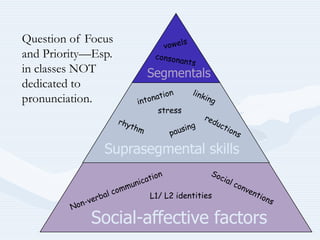
Question of Focus and Priority—Esp. in classes NOT dedicated to pronunciation.vowelsconsonantsSegmentalsintonationlinkingstressreductionsrhythmpausingSuprasegmental skills Social conventionsNon-verbal communicationL1/ L2 identitiesSocial-affective factors
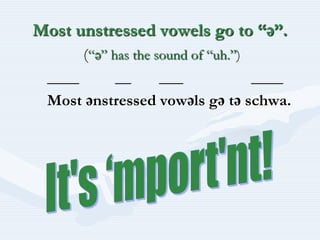
Most unstressed vowels go to “ә”. (“ә” has the sound of “uh.”)____         __       ___                 ____       Most әnstressed vowәls gә tә schwa. It's ‘mport'nt!
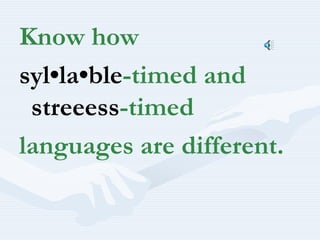
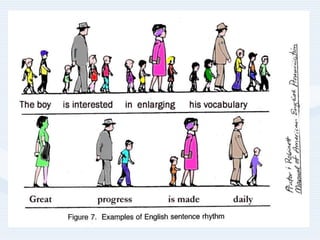
Know how syl•la•ble-timed and streeess-timed languages are different.
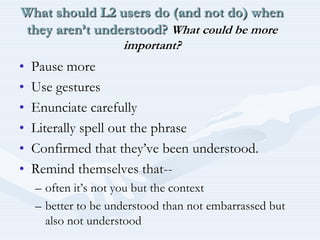
What should L2 users do (and not do) when they aren’t understood? What could be more important?Pause moreUse gesturesEnunciate carefullyLiterally spell out the phraseConfirmed that they’ve been understood.Remind themselves that-- often it’s not you but the contextbetter to be understood than not embarrassed but also not understood
SuprasegmentalsOn the Fly
Paying Attention to Word and Sentence Stress
One of the easiest ways to get students to feel the lengthening of stress syllables is to use (thick) rubber bandsYou stretch the rubber band on the stressed syllables and relax it on unstressed syllables.
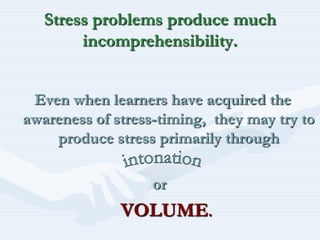
Stress problems produce much incomprehensibility.Even when learners have acquired the awareness of stress-timing,  they may try to produce stress primarily through                                    orVOLUME.intonation
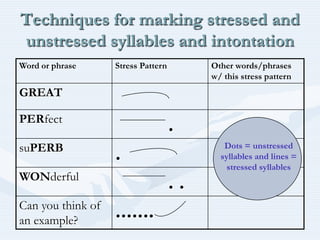
Techniques for marking stressed and unstressed syllables and intontationDots = unstressed syllables and lines = stressed syllables
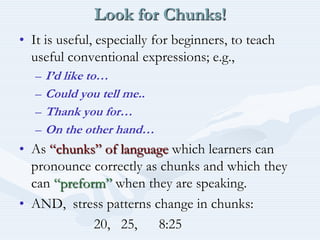
Look for Chunks!It is useful, especially for beginners, to teach useful conventional expressions; e.g.,I’d like to…Could you tell me..Thank you for…On the other hand…As “chunks” of language which learners can pronounce correctly as chunks and which they can “preform” when they are speaking.AND,  stress patterns change in chunks:                     20,   25,      8:25
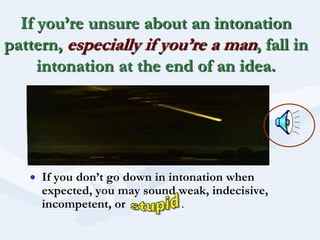
If you’re unsure about an intonation pattern, especially if you’re a man, fall in intonation at the end of an idea.If you don’t go down in intonation when expected, you may sound weak, indecisive, incompetent, or                  .stupid
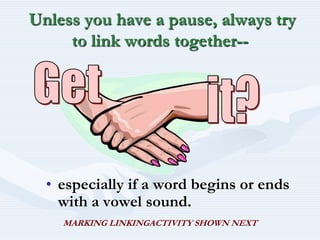
 Unless you have a pause, always try to link words together--especially if a word begins or ends with a vowel sound.Getit?MARKING LINKINGACTIVITY SHOWN NEXT
Failure to link or blend results in…If students fail to blend speech they will sound choppy.  In fact, if they do not blend they put a little glottal stop(a little burp of air made in the very back of your throat) between each word.
Thinking ahead for pronunciationWhat pronunciation elements could you highlight in the following lesson?
SomeSample Pronunciation Elements to Highlight (from “English: No Problem, Level 3 (2004) New Reader’s Press, p. 82)
General Classroom Techniques for Dealing with Pronunciation“On the Fly.”
For all learners, try to  have them listen first before seeing the text.Need to deTEXTualize learnersX
Convince students that written language isn’t oral language. Just because oral language sounds different from written language doesn’t make it “sloppy”
Pausing well makes anyone more comprehensible
Correcting Pronunciation Errors “On the Fly.”
 A WARNING ABOUT “LISTEN AND REPEAT”If a learner is having trouble pronouncing a word or phrase, you can kindly model it and have the learner try to repeat up to three times. If they haven’t got it in three tries, they won’t get it at that time.  So stop, tell the learner that it’s okay, s/he’ll get it later, and move on
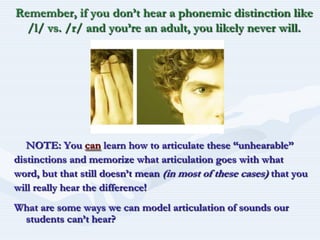
Remember, if you don’t hear a phonemic distinction like /l/ vs. /r/ and you’re an adult, you likely never will.NOTE: You canlearn how to articulate these “unhearable”distinctions and memorize what articulation goes with whatword, but that still doesn’t mean (in most of these cases) that youwill really hear the difference!What are some ways we can model articulation of sounds our students can’t hear?
Exaggeration is GoodWhen we need to change how we pronounce something, because it is hard to change pronunciation habits,  we many times have to exaggerate the change we are trying to make. Exaggeration helps us “make sure” we are doing it right. Then typically with time, once we control the feature better, we are able to “dial back” little by little until we can produce the feature without exaggeration

“BACKBUILDING”If someone is having trouble pronouncing a multisyllabic word or a phrase, they can sometimes manage to produce it by starting with the final syllable and “backbuilding” to the front, roughly syllable by syllable, until they have the entire utterance.For example, listen to me backbuild, “I’d like to order a bottle of wine.”
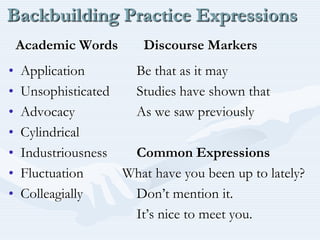
BackbuildingPracticeExpressionsAcademic Words	  Discourse MarkersApplication		Be that as it mayUnsophisticated	Studies have shown that Advocacy		As we saw previously CylindricalIndustriousness	Common ExpressionsFluctuation	     What have you been up to lately? Colleagially		Don’t mention it.					It’s nice to meet you.
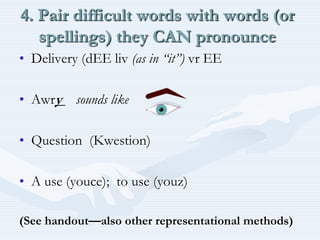
4. Pair difficult words with words (or spellings) they CAN pronounce Delivery (dEE liv (as in “it”) vr EEAwry sounds likeQuestion  (Kwestion)A use (youce);  to use (youz)(See handout—also other representational methods)
Make sure students have solid pronunciation skills for the basicsAlphabet	 	NumbersCommon first and last names
Thaaannks!

Bringing Pronunciation Into Every Class

  • 1.
    Bringing Pronunciation IntoEvery Class(Revised 2010) Brock BradyWITH THANKS AND APPRECIATION TO KAREN TAYLOR AND SHIRLEY THOMPSON.
  • 2.
    Please, Activate YourBackground Knowledge1. When you've learned/used additional language as an adult, how important has pronunciation been to you and your confidence in using the language? 2. What kind of pronunciation instruction did you have? 3. Generally, when someone is teaching pronunciation what activities do they carry out? 4. In your classes, when you address pronunciation, what do you address and how? 5. How confident do you feel about teaching pronunciation? Why? 6. If a Peruvian student says "River Amazon" is the cause grammar or pronunciation? Then--if you address the error "River Amazon," does it make more sense to address it as a grammar or a pronunciation problem?
  • 3.
    What pronunciation featureswould you address with this student?
  • 5.
    Basic Understandings aboutPronunciation for StudentsIntelligibility: I can understand okay, but it takes effortComprehensibility: I can understand you easily, you are fluent and it is not hard to understand you.Please note though, that comprehensibility is a construct that depends on both the speaker and the listener.NB: I’M TORN ON THIS.
  • 6.
    Everyone Has AnAccentYou don’t need to fix your accent. Your accent is fine, but you may need to work on being understood.Accent is often as much a factor of grammar, world choice, and cultural assumptions as it is pronunciation.Many find accents charming!I don’t have a French accent, but the French rarely make a fuss about not understanding me.
  • 7.
    We need tounderstand a variety of accents, but only to produce oneSo look for opportunities to introduce a variety of different accents for in class listening.Remember, in some ways, listening is part of pronunciation. As with “missing” phonemes, if you can’t hear it, you probably can’t produce it (at least without some instructional assistance).
  • 8.
    Accommodation TheoryIf Iwant to be accepted by you, if I want to be seen as a member of the group/community, I will try to make my communication CONVERGE to your norm.If I find aspect of your community (or language) unpleasant, I will make little effort to converge, in fact I may intentionally DIVERGE from your norm.
  • 9.
    So what ifyou don’t like the way that “other” language users sound?First, you might not be consciously aware of it.However you may resist sounding like “them” generallyAmericans may find French sounds “effeminate,” German (or Arabic) sounds “harsh and guttural,” or that “Korean women sound whiny,” but Korean women may feel American women seem “loud and vulgar.”We are obliged to alert students to such biases.
  • 10.
    THE MOST BANGFOR THE BUCKFocusing First on Suprasegmentals
  • 11.
    Question of Focusand Priority—Esp. in classes NOT dedicated to pronunciation.vowelsconsonantsSegmentalsintonationlinkingstressreductionsrhythmpausingSuprasegmental skills Social conventionsNon-verbal communicationL1/ L2 identitiesSocial-affective factors
  • 12.
    Most unstressed vowelsgo to “ә”. (“ә” has the sound of “uh.”)____ __ ___ ____ Most әnstressed vowәls gә tә schwa. It's ‘mport'nt!
  • 13.
    Know how syl•la•ble-timedand streeess-timed languages are different.
  • 16.
    What should L2users do (and not do) when they aren’t understood? What could be more important?Pause moreUse gesturesEnunciate carefullyLiterally spell out the phraseConfirmed that they’ve been understood.Remind themselves that-- often it’s not you but the contextbetter to be understood than not embarrassed but also not understood
  • 17.
  • 18.
    Paying Attention toWord and Sentence Stress
  • 19.
    One of theeasiest ways to get students to feel the lengthening of stress syllables is to use (thick) rubber bandsYou stretch the rubber band on the stressed syllables and relax it on unstressed syllables.
  • 20.
    Stress problems producemuch incomprehensibility.Even when learners have acquired the awareness of stress-timing, they may try to produce stress primarily through orVOLUME.intonation
  • 21.
    Techniques for markingstressed and unstressed syllables and intontationDots = unstressed syllables and lines = stressed syllables
  • 22.
    Look for Chunks!Itis useful, especially for beginners, to teach useful conventional expressions; e.g.,I’d like to…Could you tell me..Thank you for…On the other hand…As “chunks” of language which learners can pronounce correctly as chunks and which they can “preform” when they are speaking.AND, stress patterns change in chunks: 20, 25, 8:25
  • 23.
    If you’re unsureabout an intonation pattern, especially if you’re a man, fall in intonation at the end of an idea.If you don’t go down in intonation when expected, you may sound weak, indecisive, incompetent, or .stupid
  • 24.
    Unless youhave a pause, always try to link words together--especially if a word begins or ends with a vowel sound.Getit?MARKING LINKINGACTIVITY SHOWN NEXT
  • 25.
    Failure to linkor blend results in…If students fail to blend speech they will sound choppy. In fact, if they do not blend they put a little glottal stop(a little burp of air made in the very back of your throat) between each word.
  • 27.
    Thinking ahead forpronunciationWhat pronunciation elements could you highlight in the following lesson?
  • 28.
    SomeSample Pronunciation Elementsto Highlight (from “English: No Problem, Level 3 (2004) New Reader’s Press, p. 82)
  • 29.
    General Classroom Techniquesfor Dealing with Pronunciation“On the Fly.”
  • 30.
    For all learners,try to have them listen first before seeing the text.Need to deTEXTualize learnersX
  • 31.
    Convince students thatwritten language isn’t oral language. Just because oral language sounds different from written language doesn’t make it “sloppy”
  • 32.
    Pausing well makesanyone more comprehensible
  • 34.
  • 35.
    A WARNINGABOUT “LISTEN AND REPEAT”If a learner is having trouble pronouncing a word or phrase, you can kindly model it and have the learner try to repeat up to three times. If they haven’t got it in three tries, they won’t get it at that time. So stop, tell the learner that it’s okay, s/he’ll get it later, and move on
  • 36.
    Remember, if youdon’t hear a phonemic distinction like /l/ vs. /r/ and you’re an adult, you likely never will.NOTE: You canlearn how to articulate these “unhearable”distinctions and memorize what articulation goes with whatword, but that still doesn’t mean (in most of these cases) that youwill really hear the difference!What are some ways we can model articulation of sounds our students can’t hear?
  • 37.
    Exaggeration is GoodWhenwe need to change how we pronounce something, because it is hard to change pronunciation habits, we many times have to exaggerate the change we are trying to make. Exaggeration helps us “make sure” we are doing it right. Then typically with time, once we control the feature better, we are able to “dial back” little by little until we can produce the feature without exaggeration
  • 38.
    “BACKBUILDING”If someone ishaving trouble pronouncing a multisyllabic word or a phrase, they can sometimes manage to produce it by starting with the final syllable and “backbuilding” to the front, roughly syllable by syllable, until they have the entire utterance.For example, listen to me backbuild, “I’d like to order a bottle of wine.”
  • 39.
    BackbuildingPracticeExpressionsAcademic Words Discourse MarkersApplication Be that as it mayUnsophisticated Studies have shown that Advocacy As we saw previously CylindricalIndustriousness Common ExpressionsFluctuation What have you been up to lately? Colleagially Don’t mention it. It’s nice to meet you.
  • 40.
    4. Pair difficultwords with words (or spellings) they CAN pronounce Delivery (dEE liv (as in “it”) vr EEAwry sounds likeQuestion (Kwestion)A use (youce); to use (youz)(See handout—also other representational methods)
  • 41.
    Make sure studentshave solid pronunciation skills for the basicsAlphabet NumbersCommon first and last names
  • 42.