i
MONTGOMERY COLLEGE
DUBBING IN AMERICA AND JAPAN
BY:
SAMANTHA PISNER
A RESEARCH PAPER SUBMITTED TO DR. KAMALA EDARDS IN PARTIAL
FULFILLMENT OF THE REQUIREMENTS FOR EN102
APRIL 23, 2013
ROCKVILLE, MD 20805
ii
© COPYRIGHT SAMANTHA PISNER
iii
CONTENTS
Outline………………………………. iv
Title Page………………………………1
Works Cited……………………………..12
iv
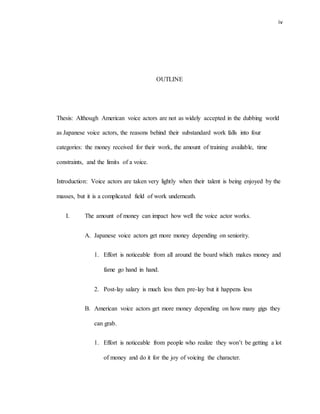
OUTLINE
Thesis: Although American voice actors are not as widely accepted in the dubbing world
as Japanese voice actors, the reasons behind their substandard work falls into four
categories: the money received for their work, the amount of training available, time
constraints, and the limits of a voice.
Introduction: Voice actors are taken very lightly when their talent is being enjoyed by the
masses, but it is a complicated field of work underneath.
I. The amount of money can impact how well the voice actor works.
A. Japanese voice actors get more money depending on seniority.
1. Effort is noticeable from all around the board which makes money and
fame go hand in hand.
2. Post-lay salary is much less then pre-lay but it happens less
B. American voice actors get more money depending on how many gigs they
can grab.
1. Effort is noticeable from people who realize they won’t be getting a lot
of money and do it for the joy of voicing the character.
v
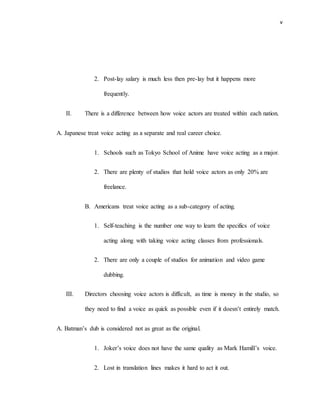
2. Post-lay salary is much less then pre-lay but it happens more
frequently.
II. There is a difference between how voice actors are treated within each nation.
A. Japanese treat voice acting as a separate and real career choice.
1. Schools such as Tokyo School of Anime have voice acting as a major.
2. There are plenty of studios that hold voice actors as only 20% are
freelance.
B. Americans treat voice acting as a sub-category of acting.
1. Self-teaching is the number one way to learn the specifics of voice
acting along with taking voice acting classes from professionals.
2. There are only a couple of studios for animation and video game
dubbing.
III. Directors choosing voice actors is difficult, as time is money in the studio, so
they need to find a voice as quick as possible even if it doesn’t entirely match.
A. Batman’s dub is considered not as great as the original.
1. Joker’s voice does not have the same quality as Mark Hamill’s voice.
2. Lost in translation lines makes it hard to act it out.
vi
B. Gundam Unicorn’s dub is considered not as great as the original.
1. Their voices seem over played and not authentic. - technique
2. Lost in translation lines makes it hard to act it out.
IV. Between Japan and America, there are different opportunities for dubbing.
A. Japanese voice actors get more work related to dubbing
1. There are live shows that are done to showcase voice actors.
2. Character CDs are a big deal in Japan which involves more
development between the actor and the character.
B. American voice actors are limited to what they can use their dub voice for.
1. The voice can only be used for that media and nothing else.
2. They are given the script and are expected to act it out perfectly within
three takes with barely knowing anything of the show or the character.
Conclusion: With a little bit of luck and a lot of hard work, these voice acting stumbling
blocks will become the stepping stones to future excellence in all forms of animation.
vii
Dubbing in America and Japan
Voice acting has impacted various mediums around the world from the typical
deeply voiced “in a world…” movie announcer trailers to the sing-song voices of Disney
Princesses. In the 80’s, Japanese animation or “anime” became popular in its original
language beginning with Astro Boy (Scott-Frazier). As the popularity of anime
blossomed, movie studios decided to pursue Western audiences by “dubbing” the
Japanese into English using American voice actors. Although American voice actors are
not as widely accepted in the dubbing world as Japanese voice actors, the reasons behind
their substandard work falls into four categories: the money received for their work, the
amount of training available, time constraints, and the limits of a voice.
Before getting into the voice categories, here is a little more background of dubbing.
Dubbing gave birth to anime being more main stream as shown through the abundance of
Pokémon and Yu-Gi-Oh! merchandise that can be seen in stores. What started as a limited
subculture has expanded into mainstream culture where most people have heard of these
franchises even if they are not avid consumers of the show or the genre. However, the
change in language from Japanese to English has caused enthusiasts of anime, called
anime fans, to harshly criticize the lack of talent in the Americanized dubs claiming that
the original is the only true way to enjoy the medium (Sinterniklaas). They have ridiculed
voice actors by creating a ruckus over how Japanese voice actors care more about their
viii
work and that voice actors do not have enough acting talent to create believable
performances (Sinterniklaas). This caters into some of the reasons why Hollywood actors
are being hired for Japanese dubbing roles such as casting Christian Bale as Howl in
Howl’s Moving Castle. Editing jobs are criticized, too, for when the lip flaps - a
character’s mouth movements - does not synchronize to a voice, it creates a bad kung-fu
style dub. However, this exacting nature of anime fans and the expectation of perfection
is not necessarily a terrible thing, they just want what they care about to be well done and
well received.
Voice acting is a uniquely demanding career. American voice actors selected for
dubbing Japanese animation are being given the chance to partake in something that they
care about hence they perform the best they can with what they are given including
working in conditions that are sometimes not up to the exacting standards of the anime
fan. This is overlooked by many of them, who directly blame the voice actors for what
they perceive as shoddy work. They often insinuate that the voice actors can just “fix” it
by acting better (Freeman). Instead, they should focus on some of the other factors that
contribute to voice acting; foremost, being the concept of wealth.
The first point that is mentioned is the impact of money that influences an actor to
work. In general, there is not a set amount of salary that voice actors receive for a job. It
always depends on the company they work for, their union status, and what type of
medium they are voicing (Crumpton). The most popular union in America is the Screen
ix
Actor’s Guild, SAG, where voice actors pay a yearly membership fee to have further
credit to their name and to have a greater chance of being hired for a part (Blum). Japan’s
unions are jointed with the studio they work for (Chaung). Japan and America both have
different standards for setting a minimum amount, but both still have the same variety of
payments to different voice actors.
Voice studios in Japan have the same union and non-union payment difference,
but the main distinction is that there is more animation work in Japan. Japan’s culture
relies heavily on animation. This is seen through such things as the giant Gundam in
Odaiba, Tokyo and the franchise of Hello Kitty being seen everywhere. Also, Japan’s
market is thriving due to animation in terms of business, economy, and people’s
psychology. It has given them more popularity by creating business and spreading their
culture around the world. In both Japan and America, there are two types of typed of
animation recording. Pre-lay work, voices recorded before the animation, is in abundance
for Japan along with post-lay or dubbing work, voices recorded after animation, as a
result of their culture. With so much work available, it is easier to make a living as a
voice actor in Japan, having multiple flows of income from various gigs which puts less
stress on the actor and gives them more outlets to be noticed (Chuang). If a voice talent is
also a singer, they become an idol to the masses earning them more work and money to
continue doing their job. Money is not as great a concern for Japanese voice actors as
they can still survive using voice acting only.
x
American voice talents run into a different problem. Dubbing is a harder medium
to get into because the studios that produce the dubs have little money but still strive to
produce a quality dub (Sinterniklaas). Studios that have little money can barely pay the
voice talents, so the actors who do this either need to get many gigs for that one medium
or find other mediums to work in (Adventures). Most voice actors need to have a second
job already to survive the first couple of years, especially if they work only in anime
(Adventures). Regardless of the voice actors’ category – commercial, animation,
audiobook, or other mediums that require a voice- the Internal Revenue Service groups
them together with stage actors and film actors. This makes it impossible to tell what the
actual salaries are for voice actors. However, voice actors unanimously say that dubbing
“pays a fraction of what original animation pays” (Adventures). The pay is so low that
Joshua Seth who voiced in popular Japanese animations dubs such as Digimon had to
move to doing hypnosis and other stage acts to make a living (Who Gets Paid). With this
harsh economic reality, a question comes to mind, “Why people would do this if they are
not going to be given enough money to live on?” The reason is that the only way to
succeed is that they have to love what they are doing. As spoken by voice actor Bob
Papenbrook, “If you can be doing anything else, DO IT…If this is the only thing that can
make you happy, then go for it” (Adventures). This translates to voice actors having
enough passion and humility to go behind a microphone and do the best they can solely
on the fact that they enjoy it.
xi
There are of course the few voice actors who do make quite a significant amount
of money; however, this is in the pre-lay work aspect. This includes The Simpsons voice
actors who garner $400,000 per episode (Crumpton) and Seth McFarlane’s acting in
Family Guy gains him around $125,000 per episode (Crumpton). They did not make this
much when they started out, but over the years their fame and pay increased, especially
since both these franchises are considered pop culture now. In the western animation
world, Jim Cummings and Mel Blanc who voiced almost all the characters in Disney and
Looney Tunes respectively gained recognition with money. Actors in Japan who do
voices for title characters in Bleach and Naruto, two main stream animations, also receive
a great deal of fame and money. Yet, the common factor with this is that they all record
in their original animation states. All of this is pre-lay work, which is much easier to
record as there is more focus on acting instead of trying to match lip flaps, leads to
having better performances (Blum).
There is also a difference between how voice actors are educated within each
nation. Japan treats voice acting as a real career choice and separate from acting. Schools
such as the Tokyo School of Anime have voice acting as a major, one of over 50
specialist schools stated to have it (Jikei). This combines with other schools holding
readily available classes that do not require graduating; classes that can be taken by
themselves without having to take core curriculum education. Some voice actors also
hold their own classes and private sessions as a way to give back to the community in
which they learned their work. This plus other methods can help obtain the skills required
xii
(Scott-Frazier). The degree in voice acting helps in gaining a job as the actor has more
credibility versus someone who has only had class training. There is also the fact that
there are simply more studios in Japan that house animation talents. There are three
categories of studios including management companies such as 81Produce, Osawa,
Baobab, Aoni, Haikyo; specific voice actor studios including Avex Entertainment; and
smaller companies that have been created from fall out of the larger industries (Chuang).
80% of voice talents work for one of these studios and unions, while the rest work
freelance (Chuang).
On the other hand, voice acting in America is treated as a sub-category of acting.
So much so that people have asked to Michael Sinterniklaas and other voice actors, “Why
don’t you [the voice actor] want to do real acting instead of voice acting” (Sinterniklaas).
This is derogatory because the key word in voice acting is the acting part thus saying that
it is not “real” offends the actor. With the limits they are given for learning how to act
behind the microphone, they work with what they are given. There are no specialist
schools in America therefore voice talents cannot train there. Instead they need to find
other outlets such as taking film acting classes, Shakespearean classes, and classes that
are put on by other voice talents (How Do I). Self study is also accomplished by using
voice talent’s websites that may contain useful information, voice acting podcasts such as
Voice Acting Mastery hosted by Crispin Freeman, and books dedicated to voice acting
(Freeman). Another problem for Japanese animation voice actors is that there are barely
any studios left that do dubbing (Sinterniklaas). The biggest one of them is FUNimation,
xiii
which dubs for Dragon Ball, Fruits Basket, Tiger and Bunny, and a variety of other
shows. Smaller ones exist such as NYAVPost, which dub for Gundam Unicorn
(Sinterniklaas). With the limited amount of anime studios it is harder to grab as many
gigs and this creates stress on the voice actor.
The third category that comes into play is the director’s decision making.
Directors choose voice actors to accommodate their time versus money needs. They need
to hire a voice actor fast even if their voice does not entirely match the original voice
(Freeman). Both Japan and America go through this restriction causing some of the
perceived faulty dubbing.
A great example for an alleged horrific Japanese dub of an American show is
Batman: The Animated Series. A common complaint is that the voice actor who plays
Joker does not do as good of a job as Mark Hamill. It does not have the “Joker” feel to it
(Bad Japanese Dubs). There is also the Japanese dub of Transformers Prime where the
vocal mannerism of Shockwave is changed completely to where he repeats a shortened
version of his name, “Shock-u”, while talking. Another character, Arachnia, also had her
voice changed along with her characterization making her sound like she is obsessed with
a character that she is not supposed to. These changes are based on director decisions and
translations that may not be accurate. These “lost in translation” lines can create
confusion in audience members especially if the story is complicated to begin with.
However, the perceived good dubs are based on longer voice actor schedules. They have
xiv
sessions from 10 AM to 9 PM every weekday for weeks and have time to rehearse their
lines before being recorded, which creates a more polished performance; almost up to the
standards as film or stage actors (Makino).
American voice actors on the other hand have a more difficult time recording as
they are under different pressures. Timing wise, after the director or producer finds a
person that can voice a character, the voice actor only has one session to record on
episode between the times of 9 AM to 5 PM and that they have to do a “cold read”
(Makino). A cold read is where there is no rehearsal for the script they are given which
plays into a voice actor’s talent to bring words alive that may have no meaning to him or
her. They only have direction from the director and the lines they say to put any meaning
and background to their acting (Adventures). Another problem with doing cold reads is
that it is also used for auditions. Voice actors are meant to come up with a voice that
embodies the character they would be playing, but barely knowing a thing about them. If
they get hired and they cannot use that voice for long periods of time or if it ends up not
being exactly what the director wanted, it causes terrible voices and having to be stuck
with that voice anyways. Pressure and stress of a voice and acting skill creates a difficult
setting to work with.
Translation lines also can confuse audience members which end up being the
translator’s fault and not the actor’s. Cultural norms also can create confusion. Some
things are meant to represent a cultural element in Japan, but have no meaning in
xv
America. A commonly overlooked aspect is when an anime character gets down on their
knees and bows in front of someone else in an act of begging. In America, it is just seen
as begging, but in Japan that position conveys a sense of greater vulnerability to be taken
more seriously. It is more a matter of trust, but also shame, which may cause the
character to cry. This act of crying may seem over the top for people in America (Scott-
Frazier). For example, in Gaoranger vs Super Sentai, there is a point where one of the
main characters, Kai Samezu, asks a trainer to teach him better ways to fight. At first the
trainer refuses, so Samezu ends up begging him. The trainer immediately changes his
attitude and treats him with kindness. An American audience would find this immediate
change out of character because of their lack of knowledge of Japan’s culture. Not only
are cultural changes a problem, the difference in grammar between the two languages can
cause inaccurate translations. In the same series that was previously mentioned, the
character’s frequently use the phrase “Ikuzou” which correctly translated means “Let’s
go”. However, a lot of the time it is translated to “We need to go now” which has a
different connotation. Thus, both culture and the action of translating can affect
animation.
There is also another factor of time crunching in same time synchronization
dubbing. Same time synchronization is when studios from both Japan and America work
together to air live an anime episode at the same time in each nation’s native language.
Normally, a studio in America needs to buy a license for a show or movie to dub from a
Japanese studio. Studios can buy licensing from any other Japanese studio; they never
xvi
need to stay with one (Sinterniklaas). NYAVPost is the first to try doing same time
synchronization with their dub of Gundam Unicorn (Sinterniklaas). It is now perceived as
one of the weaker series for Gundam because of this time crunch (Sinterniklaas).
Concerned fans voice that “A lot of the series seems haphazardly thrown together” most
likely because there just was not enough time to perfect it (Sinterniklaas).
With all of these factors going on, there is one more factor to talk about and that is
different opportunities for a voice that are presented in each nation. Japanese voice actors
do get more work related to dubbing that is not strictly an episode of the series. Their
work branches off into live shows and character CDs mainly. With live shows they are
able to participate with their acting partners and represent their characters (Makino). Skits
are created specifically for these showings and for the actors. In a way this gives them
more respect as an actor as they do both behind the camera and in front of the camera
work.
Character CDs encompass audio dramas and music that is sung by the characters
of an anime which are hugely popular in Japan. Shows such as Kyo Kara Maoh
incorporate both of these things to sell to their audience. This illustrates how multifaceted
voice actors have to be in Japan because they have to work with other mediums for their
shows. This wide spread work gives the voice actors even more time to connect with the
character they are portraying and convince the audience to an extent that they cannot
even tell who the voice actor is. These options and various ways to interact with the
xvii
character’s persona gives more reason to perceive that Japanese voice actors are better,
but it is highly based on how much time they have been able to create their character;
especially compared to the American voice actors who have less of a chance to let a
character develop.
American voice actors are limited to what they can use their dub voice for. Their
voices are strictly used for the dubbing of a series or movie only, without any outside
work relating to the character they portray. The closest thing to character CDs America
has gotten is the Pokémon Christmas Bash album and Yu-Gi-Oh: Music to Duel By. The
former album has all of the songs sung by at least one of the characters. In the latter, only
one song is sung mainly because the voice actor, Darren Dunstan, is an off-Broadway
actor and singer when he is not in the studio. It seems as though voice actors have the
ability to create a musical voice for their characters as shown by Crispin Freeman and his
passion for on stage acting while he is not recording. There were also two albums
produced by Jan Scott-Frazier that gathered a variety of voice actors including big names
such as Vig Mignogna and Chris Ayres entitled “Voices for Peace” and “Voices for
Tolerance” (Scott-Frazier). This more than proves that voice actors have the capability to
do Japan’s character CDs, if only they were given the opportunity.
Conventions are another place where American voice actors can use their voices.
Anime conventions and comic conventions are events that occur across the globe and
celebrate the culture of Japanese and Western/American animation. At these conventions,
xviii
to get more attendees, voice actors appear as guests and run panels to appeal to their fans.
This sometimes helps in getting more in-tune with their character, but a lot of the time
they are under restrictions on how and how much they can use it (Knotz). There are non-
disclosure agreements that are made to protect actors from using their voice
inappropriately. This shuts off another outlet for voice actors to use. However, sometimes
voice actors are not under this agreement and are allowed to have freedom with their
voices. Steve Blum, the voice of Starscream in Transformers Prime, takes pride in
changing into his voice randomly at conventions as seen by his love of ending his
character voice by saying “Call me Lord” (Blum).
With Japanese and American voice actors having fluctuating salaries, different
levels of training, time constraints, and the usage limits of a voice; there are plenty of
reasons why American voice actors may be perceived as bad. However, it should be
learned that all Japanese dubs are not that great. Anime enthusiasts need to learn that their
perception may not be one hundred percent sound and should acknowledge external
factors. But, with a little bit of luck and a lot of hard work, these voice acting stumbling
blocks will become the stepping stones to future excellence in all forms of animation.
xix
Works Cited
Adventures in Voice Acting. Dir. Eric P. Sherman. Perf. Tom Kenny, Steve Blum, and
Crispin Freeman. Bang Zoom!, 2008. DVD.
"Bad Japanese Dubs." Toonzone. Toonzone, 08 June 2009. Web. 28 Mar. 2013.
Blum, Steve, Voice Actor. Group Q&A at Katsucon, National Harbor, MD, 16 Feb.
2013.
--- "How Do I Become a Voice Actor?" STEVE BLUM VOICES How Do I
Become Voice Actor Comments. Steve Blum Voices, 2012. Web. 28 Mar. 2013.
Chuang, Jeff. "More than You Want to Know about Japanese Voice Acting Agencies."
Japanator. N.p., 16 Jan. 2009. Web. 24 Mar. 2013.
Crumpton, Craig. "How Much Do Voice Actors Earn?" Web log post. Voice Actors In
The News. N.p., 10 Feb. 2010. Web. 26 Mar. 2013.
Freeman, Crispin, Voice Actor and Director. Group Q&A at Katsucon, National Harbor,
MD, 16 Feb. 2013.
Jikei Gakuen COM Group. "Animation/Voice Actor Study in Japan!" Animation/Voice
Actor Study in Japan! N.p., n.d. Web. 24 Mar. 2013.
xx
Knotz, Michelle, Voice Actor. Group Q&A at AnimeNEXT, Somerset, New Jersey, 6
June 2011.
Makino, Yui, Veronica Taylor, Tom Wayland, and Rachael Lillis, Voice Actor. Group
Q&A at New York Anime Festival, New York, NY, 28 Sept. 2009.
Scott-Frazier, Jan, Voice Actor, Producer, Director, Animator, and Editor. Personal
Interview. 1 Nov. 2012.
Sinterniklaas, Michael, Voice Actor, Producer, and Director. Group Q&A at Otakon,
Baltimore, MD, 29 July 2012.
"Who Gets Paid More, American or Japanese Voice Actors?" Anime New Network. N.p.,
23 Aug. 2009. Web. 20 Mar. 2013.

Final Dubbing America vs Japan

  • 1.
    i MONTGOMERY COLLEGE DUBBING INAMERICA AND JAPAN BY: SAMANTHA PISNER A RESEARCH PAPER SUBMITTED TO DR. KAMALA EDARDS IN PARTIAL FULFILLMENT OF THE REQUIREMENTS FOR EN102 APRIL 23, 2013 ROCKVILLE, MD 20805
  • 2.
  • 3.
  • 4.
    iv OUTLINE Thesis: Although Americanvoice actors are not as widely accepted in the dubbing world as Japanese voice actors, the reasons behind their substandard work falls into four categories: the money received for their work, the amount of training available, time constraints, and the limits of a voice. Introduction: Voice actors are taken very lightly when their talent is being enjoyed by the masses, but it is a complicated field of work underneath. I. The amount of money can impact how well the voice actor works. A. Japanese voice actors get more money depending on seniority. 1. Effort is noticeable from all around the board which makes money and fame go hand in hand. 2. Post-lay salary is much less then pre-lay but it happens less B. American voice actors get more money depending on how many gigs they can grab. 1. Effort is noticeable from people who realize they won’t be getting a lot of money and do it for the joy of voicing the character.
  • 5.
    v 2. Post-lay salaryis much less then pre-lay but it happens more frequently. II. There is a difference between how voice actors are treated within each nation. A. Japanese treat voice acting as a separate and real career choice. 1. Schools such as Tokyo School of Anime have voice acting as a major. 2. There are plenty of studios that hold voice actors as only 20% are freelance. B. Americans treat voice acting as a sub-category of acting. 1. Self-teaching is the number one way to learn the specifics of voice acting along with taking voice acting classes from professionals. 2. There are only a couple of studios for animation and video game dubbing. III. Directors choosing voice actors is difficult, as time is money in the studio, so they need to find a voice as quick as possible even if it doesn’t entirely match. A. Batman’s dub is considered not as great as the original. 1. Joker’s voice does not have the same quality as Mark Hamill’s voice. 2. Lost in translation lines makes it hard to act it out.
  • 6.
    vi B. Gundam Unicorn’sdub is considered not as great as the original. 1. Their voices seem over played and not authentic. - technique 2. Lost in translation lines makes it hard to act it out. IV. Between Japan and America, there are different opportunities for dubbing. A. Japanese voice actors get more work related to dubbing 1. There are live shows that are done to showcase voice actors. 2. Character CDs are a big deal in Japan which involves more development between the actor and the character. B. American voice actors are limited to what they can use their dub voice for. 1. The voice can only be used for that media and nothing else. 2. They are given the script and are expected to act it out perfectly within three takes with barely knowing anything of the show or the character. Conclusion: With a little bit of luck and a lot of hard work, these voice acting stumbling blocks will become the stepping stones to future excellence in all forms of animation.
  • 7.
    vii Dubbing in Americaand Japan Voice acting has impacted various mediums around the world from the typical deeply voiced “in a world…” movie announcer trailers to the sing-song voices of Disney Princesses. In the 80’s, Japanese animation or “anime” became popular in its original language beginning with Astro Boy (Scott-Frazier). As the popularity of anime blossomed, movie studios decided to pursue Western audiences by “dubbing” the Japanese into English using American voice actors. Although American voice actors are not as widely accepted in the dubbing world as Japanese voice actors, the reasons behind their substandard work falls into four categories: the money received for their work, the amount of training available, time constraints, and the limits of a voice. Before getting into the voice categories, here is a little more background of dubbing. Dubbing gave birth to anime being more main stream as shown through the abundance of Pokémon and Yu-Gi-Oh! merchandise that can be seen in stores. What started as a limited subculture has expanded into mainstream culture where most people have heard of these franchises even if they are not avid consumers of the show or the genre. However, the change in language from Japanese to English has caused enthusiasts of anime, called anime fans, to harshly criticize the lack of talent in the Americanized dubs claiming that the original is the only true way to enjoy the medium (Sinterniklaas). They have ridiculed voice actors by creating a ruckus over how Japanese voice actors care more about their
  • 8.
    viii work and thatvoice actors do not have enough acting talent to create believable performances (Sinterniklaas). This caters into some of the reasons why Hollywood actors are being hired for Japanese dubbing roles such as casting Christian Bale as Howl in Howl’s Moving Castle. Editing jobs are criticized, too, for when the lip flaps - a character’s mouth movements - does not synchronize to a voice, it creates a bad kung-fu style dub. However, this exacting nature of anime fans and the expectation of perfection is not necessarily a terrible thing, they just want what they care about to be well done and well received. Voice acting is a uniquely demanding career. American voice actors selected for dubbing Japanese animation are being given the chance to partake in something that they care about hence they perform the best they can with what they are given including working in conditions that are sometimes not up to the exacting standards of the anime fan. This is overlooked by many of them, who directly blame the voice actors for what they perceive as shoddy work. They often insinuate that the voice actors can just “fix” it by acting better (Freeman). Instead, they should focus on some of the other factors that contribute to voice acting; foremost, being the concept of wealth. The first point that is mentioned is the impact of money that influences an actor to work. In general, there is not a set amount of salary that voice actors receive for a job. It always depends on the company they work for, their union status, and what type of medium they are voicing (Crumpton). The most popular union in America is the Screen
  • 9.
    ix Actor’s Guild, SAG,where voice actors pay a yearly membership fee to have further credit to their name and to have a greater chance of being hired for a part (Blum). Japan’s unions are jointed with the studio they work for (Chaung). Japan and America both have different standards for setting a minimum amount, but both still have the same variety of payments to different voice actors. Voice studios in Japan have the same union and non-union payment difference, but the main distinction is that there is more animation work in Japan. Japan’s culture relies heavily on animation. This is seen through such things as the giant Gundam in Odaiba, Tokyo and the franchise of Hello Kitty being seen everywhere. Also, Japan’s market is thriving due to animation in terms of business, economy, and people’s psychology. It has given them more popularity by creating business and spreading their culture around the world. In both Japan and America, there are two types of typed of animation recording. Pre-lay work, voices recorded before the animation, is in abundance for Japan along with post-lay or dubbing work, voices recorded after animation, as a result of their culture. With so much work available, it is easier to make a living as a voice actor in Japan, having multiple flows of income from various gigs which puts less stress on the actor and gives them more outlets to be noticed (Chuang). If a voice talent is also a singer, they become an idol to the masses earning them more work and money to continue doing their job. Money is not as great a concern for Japanese voice actors as they can still survive using voice acting only.
  • 10.
    x American voice talentsrun into a different problem. Dubbing is a harder medium to get into because the studios that produce the dubs have little money but still strive to produce a quality dub (Sinterniklaas). Studios that have little money can barely pay the voice talents, so the actors who do this either need to get many gigs for that one medium or find other mediums to work in (Adventures). Most voice actors need to have a second job already to survive the first couple of years, especially if they work only in anime (Adventures). Regardless of the voice actors’ category – commercial, animation, audiobook, or other mediums that require a voice- the Internal Revenue Service groups them together with stage actors and film actors. This makes it impossible to tell what the actual salaries are for voice actors. However, voice actors unanimously say that dubbing “pays a fraction of what original animation pays” (Adventures). The pay is so low that Joshua Seth who voiced in popular Japanese animations dubs such as Digimon had to move to doing hypnosis and other stage acts to make a living (Who Gets Paid). With this harsh economic reality, a question comes to mind, “Why people would do this if they are not going to be given enough money to live on?” The reason is that the only way to succeed is that they have to love what they are doing. As spoken by voice actor Bob Papenbrook, “If you can be doing anything else, DO IT…If this is the only thing that can make you happy, then go for it” (Adventures). This translates to voice actors having enough passion and humility to go behind a microphone and do the best they can solely on the fact that they enjoy it.
  • 11.
    xi There are ofcourse the few voice actors who do make quite a significant amount of money; however, this is in the pre-lay work aspect. This includes The Simpsons voice actors who garner $400,000 per episode (Crumpton) and Seth McFarlane’s acting in Family Guy gains him around $125,000 per episode (Crumpton). They did not make this much when they started out, but over the years their fame and pay increased, especially since both these franchises are considered pop culture now. In the western animation world, Jim Cummings and Mel Blanc who voiced almost all the characters in Disney and Looney Tunes respectively gained recognition with money. Actors in Japan who do voices for title characters in Bleach and Naruto, two main stream animations, also receive a great deal of fame and money. Yet, the common factor with this is that they all record in their original animation states. All of this is pre-lay work, which is much easier to record as there is more focus on acting instead of trying to match lip flaps, leads to having better performances (Blum). There is also a difference between how voice actors are educated within each nation. Japan treats voice acting as a real career choice and separate from acting. Schools such as the Tokyo School of Anime have voice acting as a major, one of over 50 specialist schools stated to have it (Jikei). This combines with other schools holding readily available classes that do not require graduating; classes that can be taken by themselves without having to take core curriculum education. Some voice actors also hold their own classes and private sessions as a way to give back to the community in which they learned their work. This plus other methods can help obtain the skills required
  • 12.
    xii (Scott-Frazier). The degreein voice acting helps in gaining a job as the actor has more credibility versus someone who has only had class training. There is also the fact that there are simply more studios in Japan that house animation talents. There are three categories of studios including management companies such as 81Produce, Osawa, Baobab, Aoni, Haikyo; specific voice actor studios including Avex Entertainment; and smaller companies that have been created from fall out of the larger industries (Chuang). 80% of voice talents work for one of these studios and unions, while the rest work freelance (Chuang). On the other hand, voice acting in America is treated as a sub-category of acting. So much so that people have asked to Michael Sinterniklaas and other voice actors, “Why don’t you [the voice actor] want to do real acting instead of voice acting” (Sinterniklaas). This is derogatory because the key word in voice acting is the acting part thus saying that it is not “real” offends the actor. With the limits they are given for learning how to act behind the microphone, they work with what they are given. There are no specialist schools in America therefore voice talents cannot train there. Instead they need to find other outlets such as taking film acting classes, Shakespearean classes, and classes that are put on by other voice talents (How Do I). Self study is also accomplished by using voice talent’s websites that may contain useful information, voice acting podcasts such as Voice Acting Mastery hosted by Crispin Freeman, and books dedicated to voice acting (Freeman). Another problem for Japanese animation voice actors is that there are barely any studios left that do dubbing (Sinterniklaas). The biggest one of them is FUNimation,
  • 13.
    xiii which dubs forDragon Ball, Fruits Basket, Tiger and Bunny, and a variety of other shows. Smaller ones exist such as NYAVPost, which dub for Gundam Unicorn (Sinterniklaas). With the limited amount of anime studios it is harder to grab as many gigs and this creates stress on the voice actor. The third category that comes into play is the director’s decision making. Directors choose voice actors to accommodate their time versus money needs. They need to hire a voice actor fast even if their voice does not entirely match the original voice (Freeman). Both Japan and America go through this restriction causing some of the perceived faulty dubbing. A great example for an alleged horrific Japanese dub of an American show is Batman: The Animated Series. A common complaint is that the voice actor who plays Joker does not do as good of a job as Mark Hamill. It does not have the “Joker” feel to it (Bad Japanese Dubs). There is also the Japanese dub of Transformers Prime where the vocal mannerism of Shockwave is changed completely to where he repeats a shortened version of his name, “Shock-u”, while talking. Another character, Arachnia, also had her voice changed along with her characterization making her sound like she is obsessed with a character that she is not supposed to. These changes are based on director decisions and translations that may not be accurate. These “lost in translation” lines can create confusion in audience members especially if the story is complicated to begin with. However, the perceived good dubs are based on longer voice actor schedules. They have
  • 14.
    xiv sessions from 10AM to 9 PM every weekday for weeks and have time to rehearse their lines before being recorded, which creates a more polished performance; almost up to the standards as film or stage actors (Makino). American voice actors on the other hand have a more difficult time recording as they are under different pressures. Timing wise, after the director or producer finds a person that can voice a character, the voice actor only has one session to record on episode between the times of 9 AM to 5 PM and that they have to do a “cold read” (Makino). A cold read is where there is no rehearsal for the script they are given which plays into a voice actor’s talent to bring words alive that may have no meaning to him or her. They only have direction from the director and the lines they say to put any meaning and background to their acting (Adventures). Another problem with doing cold reads is that it is also used for auditions. Voice actors are meant to come up with a voice that embodies the character they would be playing, but barely knowing a thing about them. If they get hired and they cannot use that voice for long periods of time or if it ends up not being exactly what the director wanted, it causes terrible voices and having to be stuck with that voice anyways. Pressure and stress of a voice and acting skill creates a difficult setting to work with. Translation lines also can confuse audience members which end up being the translator’s fault and not the actor’s. Cultural norms also can create confusion. Some things are meant to represent a cultural element in Japan, but have no meaning in
  • 15.
    xv America. A commonlyoverlooked aspect is when an anime character gets down on their knees and bows in front of someone else in an act of begging. In America, it is just seen as begging, but in Japan that position conveys a sense of greater vulnerability to be taken more seriously. It is more a matter of trust, but also shame, which may cause the character to cry. This act of crying may seem over the top for people in America (Scott- Frazier). For example, in Gaoranger vs Super Sentai, there is a point where one of the main characters, Kai Samezu, asks a trainer to teach him better ways to fight. At first the trainer refuses, so Samezu ends up begging him. The trainer immediately changes his attitude and treats him with kindness. An American audience would find this immediate change out of character because of their lack of knowledge of Japan’s culture. Not only are cultural changes a problem, the difference in grammar between the two languages can cause inaccurate translations. In the same series that was previously mentioned, the character’s frequently use the phrase “Ikuzou” which correctly translated means “Let’s go”. However, a lot of the time it is translated to “We need to go now” which has a different connotation. Thus, both culture and the action of translating can affect animation. There is also another factor of time crunching in same time synchronization dubbing. Same time synchronization is when studios from both Japan and America work together to air live an anime episode at the same time in each nation’s native language. Normally, a studio in America needs to buy a license for a show or movie to dub from a Japanese studio. Studios can buy licensing from any other Japanese studio; they never
  • 16.
    xvi need to staywith one (Sinterniklaas). NYAVPost is the first to try doing same time synchronization with their dub of Gundam Unicorn (Sinterniklaas). It is now perceived as one of the weaker series for Gundam because of this time crunch (Sinterniklaas). Concerned fans voice that “A lot of the series seems haphazardly thrown together” most likely because there just was not enough time to perfect it (Sinterniklaas). With all of these factors going on, there is one more factor to talk about and that is different opportunities for a voice that are presented in each nation. Japanese voice actors do get more work related to dubbing that is not strictly an episode of the series. Their work branches off into live shows and character CDs mainly. With live shows they are able to participate with their acting partners and represent their characters (Makino). Skits are created specifically for these showings and for the actors. In a way this gives them more respect as an actor as they do both behind the camera and in front of the camera work. Character CDs encompass audio dramas and music that is sung by the characters of an anime which are hugely popular in Japan. Shows such as Kyo Kara Maoh incorporate both of these things to sell to their audience. This illustrates how multifaceted voice actors have to be in Japan because they have to work with other mediums for their shows. This wide spread work gives the voice actors even more time to connect with the character they are portraying and convince the audience to an extent that they cannot even tell who the voice actor is. These options and various ways to interact with the
  • 17.
    xvii character’s persona givesmore reason to perceive that Japanese voice actors are better, but it is highly based on how much time they have been able to create their character; especially compared to the American voice actors who have less of a chance to let a character develop. American voice actors are limited to what they can use their dub voice for. Their voices are strictly used for the dubbing of a series or movie only, without any outside work relating to the character they portray. The closest thing to character CDs America has gotten is the Pokémon Christmas Bash album and Yu-Gi-Oh: Music to Duel By. The former album has all of the songs sung by at least one of the characters. In the latter, only one song is sung mainly because the voice actor, Darren Dunstan, is an off-Broadway actor and singer when he is not in the studio. It seems as though voice actors have the ability to create a musical voice for their characters as shown by Crispin Freeman and his passion for on stage acting while he is not recording. There were also two albums produced by Jan Scott-Frazier that gathered a variety of voice actors including big names such as Vig Mignogna and Chris Ayres entitled “Voices for Peace” and “Voices for Tolerance” (Scott-Frazier). This more than proves that voice actors have the capability to do Japan’s character CDs, if only they were given the opportunity. Conventions are another place where American voice actors can use their voices. Anime conventions and comic conventions are events that occur across the globe and celebrate the culture of Japanese and Western/American animation. At these conventions,
  • 18.
    xviii to get moreattendees, voice actors appear as guests and run panels to appeal to their fans. This sometimes helps in getting more in-tune with their character, but a lot of the time they are under restrictions on how and how much they can use it (Knotz). There are non- disclosure agreements that are made to protect actors from using their voice inappropriately. This shuts off another outlet for voice actors to use. However, sometimes voice actors are not under this agreement and are allowed to have freedom with their voices. Steve Blum, the voice of Starscream in Transformers Prime, takes pride in changing into his voice randomly at conventions as seen by his love of ending his character voice by saying “Call me Lord” (Blum). With Japanese and American voice actors having fluctuating salaries, different levels of training, time constraints, and the usage limits of a voice; there are plenty of reasons why American voice actors may be perceived as bad. However, it should be learned that all Japanese dubs are not that great. Anime enthusiasts need to learn that their perception may not be one hundred percent sound and should acknowledge external factors. But, with a little bit of luck and a lot of hard work, these voice acting stumbling blocks will become the stepping stones to future excellence in all forms of animation.
  • 19.
    xix Works Cited Adventures inVoice Acting. Dir. Eric P. Sherman. Perf. Tom Kenny, Steve Blum, and Crispin Freeman. Bang Zoom!, 2008. DVD. "Bad Japanese Dubs." Toonzone. Toonzone, 08 June 2009. Web. 28 Mar. 2013. Blum, Steve, Voice Actor. Group Q&A at Katsucon, National Harbor, MD, 16 Feb. 2013. --- "How Do I Become a Voice Actor?" STEVE BLUM VOICES How Do I Become Voice Actor Comments. Steve Blum Voices, 2012. Web. 28 Mar. 2013. Chuang, Jeff. "More than You Want to Know about Japanese Voice Acting Agencies." Japanator. N.p., 16 Jan. 2009. Web. 24 Mar. 2013. Crumpton, Craig. "How Much Do Voice Actors Earn?" Web log post. Voice Actors In The News. N.p., 10 Feb. 2010. Web. 26 Mar. 2013. Freeman, Crispin, Voice Actor and Director. Group Q&A at Katsucon, National Harbor, MD, 16 Feb. 2013. Jikei Gakuen COM Group. "Animation/Voice Actor Study in Japan!" Animation/Voice Actor Study in Japan! N.p., n.d. Web. 24 Mar. 2013.
  • 20.
    xx Knotz, Michelle, VoiceActor. Group Q&A at AnimeNEXT, Somerset, New Jersey, 6 June 2011. Makino, Yui, Veronica Taylor, Tom Wayland, and Rachael Lillis, Voice Actor. Group Q&A at New York Anime Festival, New York, NY, 28 Sept. 2009. Scott-Frazier, Jan, Voice Actor, Producer, Director, Animator, and Editor. Personal Interview. 1 Nov. 2012. Sinterniklaas, Michael, Voice Actor, Producer, and Director. Group Q&A at Otakon, Baltimore, MD, 29 July 2012. "Who Gets Paid More, American or Japanese Voice Actors?" Anime New Network. N.p., 23 Aug. 2009. Web. 20 Mar. 2013.