HOW TO TEACH
LISTENING BY:
FREY CARDENAS    and
ROSIBEL FERNANDEZ
LISTENING
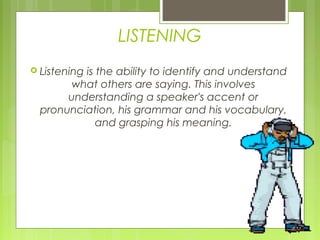
 Listening
         is the ability to identify and understand
      what others are saying. This involves
      understanding a speaker's accent or
 pronunciation, his grammar and his vocabulary,
            and grasping his meaning.
LISTENING AUDIO SEGMENTS
 You   can also teach listening skills through audio
  segments of radio programs, online podcasts,
  instructional lectures and other audio
  messages.
 First, instruct students to prepare for listening by
  considering anything that they will want to learn
  from the content of the audio segment.
 Repeat this activity but instruct students to not
  take notes until the completion of the audio
  segment.
 Use shorter or longer audio segments.
LISTENING VIDEO SEGMENTS
 Anotherhelpful resource for teaching listening skills
 are video segments, including short sketches, news
 programs, documentary films, interview segments,
 and dramatic and comedic material.

 Aswith audio segments, select the portion and
 length of the video segment based on the skill
 level of your students.

 Withyour students, first watch the segment without
 any sound and discuss it together.
WHY TEACH LISTENING?
    Students  hear different accents
     and varieties.
    Listening helps students to
     acquire language
     subconsciously.
    Listening is a receptive skill.
    Education.
    Mass communication.
‘Pre- listening…’
 During   the pre- listening phase, teachers
  need to recognize that all students bring
  different backgrounds to the listening
  experience.
 Beliefs, attitudes, and biases of the
  listeners will affect the understanding of
  the message.
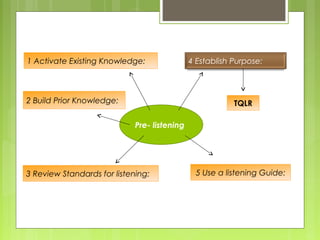
 There  are some strategies that students
 and teachers can use to prepare for a
 listening experience. They can:
1 Activate Existing Knowledge:                4 Establish Purpose:


2 Build Prior Knowledge:                                  TQLR

                             Pre- listening


3 Review Standards for listening:               5 Use a listening Guide:
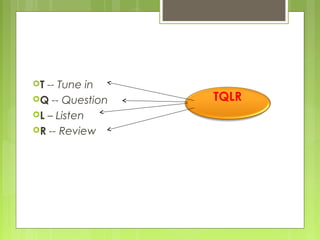
T -- Tune in
Q -- Question   TQLR
L – Listen
R -- Review
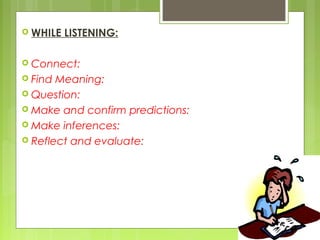
 WHILE   LISTENING:

 Connect:
 Find Meaning:
 Question:
 Make and confirm predictions:
 Make inferences:
 Reflect and evaluate:
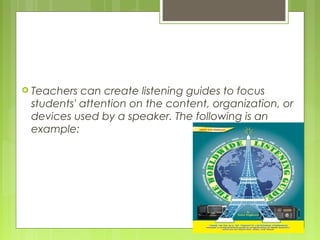
 Teachers can create listening guides to focus
 students' attention on the content, organization, or
 devices used by a speaker. The following is an
 example:
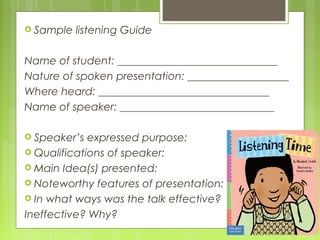
 Sample   listening Guide

Name of student: ______________________________
Nature of spoken presentation: ___________________
Where heard: ________________________________
Name of speaker: _____________________________

 Speaker’s  expressed purpose:
 Qualifications of speaker:
 Main Idea(s) presented:
 Noteworthy features of presentation:
 In what ways was the talk effective?

Ineffective? Why?
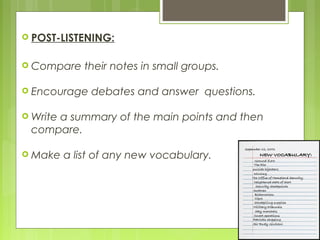
 POST-LISTENING:


 Compare     their notes in small groups.

 Encourage    debates and answer questions.

 Write
     a summary of the main points and then
 compare.

 Make    a list of any new vocabulary.
Students need to act upon what they have heard
to clarify meaning and extend their thinking. Some
examples follow.

   To begin with, students can ask questions of themselves and
    the speaker to clarify their understanding and confirm their
    assumptions.

    Students can review their notes and add information that
    they did not have an opportunity to record during the
    speech.

   Students can analyse and evaluate critically what they have
    heard. Students can review their notes and add information
    that they did not have an opportunity to record during the
    speech.
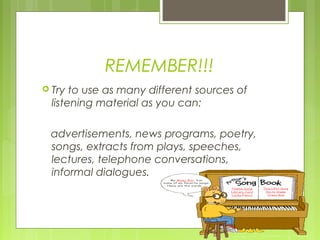
REMEMBER!!!
 Try  to use as many different sources of
  listening material as you can:

 advertisements, news programs, poetry,
 songs, extracts from plays, speeches,
 lectures, telephone conversations,
 informal dialogues.
A SUCCESSFUL LISTENING
           ACTIVITY
5 Ideas to make the best listening
activities ever!
1
 Reduce distractions and
 noise during the
listening segment.
2
 makesure the equipment produces
 acceptable sound quality.
3
 Read   or play the text a total of 2-3 times.
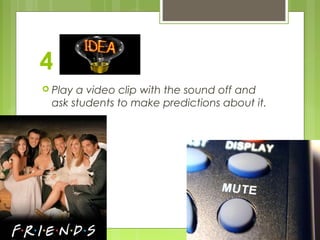
4
 Playa video clip with the sound off and
 ask students to make predictions about it.
5
 Give  students a listening task to do
    between classes.

How to teach listening

  • 1.
    HOW TO TEACH LISTENINGBY: FREY CARDENAS and ROSIBEL FERNANDEZ
  • 2.
    LISTENING  Listening is the ability to identify and understand what others are saying. This involves understanding a speaker's accent or pronunciation, his grammar and his vocabulary, and grasping his meaning.
  • 3.
    LISTENING AUDIO SEGMENTS You can also teach listening skills through audio segments of radio programs, online podcasts, instructional lectures and other audio messages.  First, instruct students to prepare for listening by considering anything that they will want to learn from the content of the audio segment.  Repeat this activity but instruct students to not take notes until the completion of the audio segment.  Use shorter or longer audio segments.
  • 4.
    LISTENING VIDEO SEGMENTS Anotherhelpful resource for teaching listening skills are video segments, including short sketches, news programs, documentary films, interview segments, and dramatic and comedic material.  Aswith audio segments, select the portion and length of the video segment based on the skill level of your students.  Withyour students, first watch the segment without any sound and discuss it together.
  • 5.
    WHY TEACH LISTENING?  Students hear different accents and varieties.  Listening helps students to acquire language subconsciously.  Listening is a receptive skill.  Education.  Mass communication.
  • 6.
    ‘Pre- listening…’  During the pre- listening phase, teachers need to recognize that all students bring different backgrounds to the listening experience.  Beliefs, attitudes, and biases of the listeners will affect the understanding of the message.
  • 7.
     There are some strategies that students and teachers can use to prepare for a listening experience. They can:
  • 8.
    1 Activate ExistingKnowledge: 4 Establish Purpose: 2 Build Prior Knowledge: TQLR Pre- listening 3 Review Standards for listening: 5 Use a listening Guide:
  • 9.
    T -- Tunein Q -- Question TQLR L – Listen R -- Review
  • 10.
     WHILE LISTENING:  Connect:  Find Meaning:  Question:  Make and confirm predictions:  Make inferences:  Reflect and evaluate:
  • 11.
     Teachers cancreate listening guides to focus students' attention on the content, organization, or devices used by a speaker. The following is an example:
  • 12.
     Sample listening Guide Name of student: ______________________________ Nature of spoken presentation: ___________________ Where heard: ________________________________ Name of speaker: _____________________________  Speaker’s expressed purpose:  Qualifications of speaker:  Main Idea(s) presented:  Noteworthy features of presentation:  In what ways was the talk effective? Ineffective? Why?
  • 13.
     POST-LISTENING:  Compare their notes in small groups.  Encourage debates and answer questions.  Write a summary of the main points and then compare.  Make a list of any new vocabulary.
  • 14.
    Students need toact upon what they have heard to clarify meaning and extend their thinking. Some examples follow.  To begin with, students can ask questions of themselves and the speaker to clarify their understanding and confirm their assumptions.  Students can review their notes and add information that they did not have an opportunity to record during the speech.  Students can analyse and evaluate critically what they have heard. Students can review their notes and add information that they did not have an opportunity to record during the speech.
  • 15.
    REMEMBER!!!  Try to use as many different sources of listening material as you can: advertisements, news programs, poetry, songs, extracts from plays, speeches, lectures, telephone conversations, informal dialogues.
  • 16.
    A SUCCESSFUL LISTENING ACTIVITY 5 Ideas to make the best listening activities ever!
  • 17.
    1 Reduce distractionsand noise during the listening segment.
  • 18.
    2  makesure theequipment produces acceptable sound quality.
  • 19.
    3  Read or play the text a total of 2-3 times.
  • 20.
    4  Playa videoclip with the sound off and ask students to make predictions about it.
  • 21.
    5  Give students a listening task to do between classes.