Increasing Comprehensible Input in Vocabulary Instruction Keith Pruitt, Ed.S. Doctoral Candidate Words of Wisdom Educational Consulting www.woweducationalconsulting.com www.myspace.com/wowedu
Agenda 9-10:30- Comprehensible Input and what it means to understand, Transfer theory, Schema 10:30-10:45 Break 10:45-12:00 Vocabulary Instruction Method 12:00-1:00 Lunch 1:00-2:30 Method, Exploding Vocabulary 2:30-2:45 Break 2:45-4:30 How to Create New Schema
 
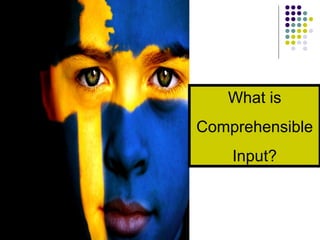
What is Comprehensible Input?
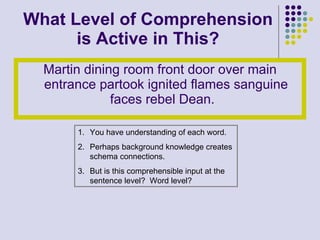
What Level of Comprehension is Active in This? Martin dining room front door over main entrance partook ignited flames sanguine faces rebel Dean.  You have understanding of each word. Perhaps background knowledge creates schema connections. But is this comprehensible input at the sentence level?  Word level?
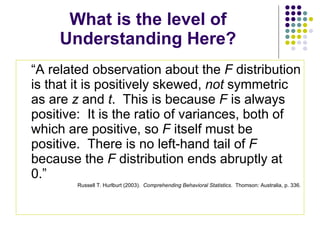
What is the level of Understanding Here? “A related observation about the  F  distribution is that it is positively skewed,  not  symmetric as are  z  and  t .  This is because  F  is always positive:  It is the ratio of variances, both of which are positive, so  F  itself must be positive.  There is no left-hand tail of  F  because the  F  distribution ends abruptly at 0.” Russell T. Hurlburt (2003).  Comprehending Behavioral Statistics .  Thomson: Australia, p. 336.
Observations In the first example, there was  no syntax . So there was no comprehensible input at the sentence level even though there was  understanding of every word . In the second example,  syntax was present  but a void developed of  word level meaning  not allowing contextual understanding of the paragraph.  “It had something to do with…”
Could We Conclude… Teaching grammar is not the same as acquiring or learning language? ( Krashen, 2003) Just learning words does not equal comprehension.  (Word callers) Knowing words is a pre-requisite to comprehension.  There are multiple factors for comprehension.
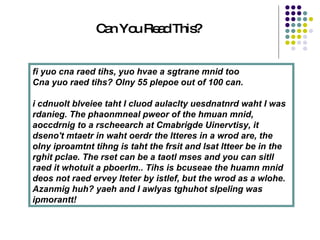
fi yuo cna raed tihs, yuo hvae a sgtrane mnid too  Cna yuo raed tihs? Olny 55 plepoe out of 100 can.  i cdnuolt blveiee taht I cluod aulaclty uesdnatnrd waht I was rdanieg. The phaonmneal pweor of the hmuan mnid, aoccdrnig to a rscheearch at Cmabrigde Uinervtisy, it dseno't mtaetr in waht oerdr the ltteres in a wrod are, the olny iproamtnt tihng is taht the frsit and lsat ltteer be in the rghit pclae. The rset can be a taotl mses and you can sitll raed it whotuit a pboerlm.. Tihs is bcuseae the huamn mnid deos not raed ervey lteter by istlef, but the wrod as a wlohe. Azanmig huh? yaeh and I awlyas tghuhot slpeling was ipmorantt!   Can You Read This?
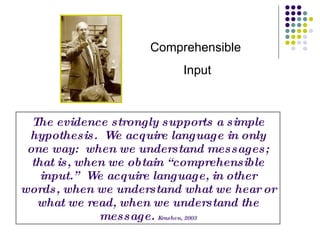
The evidence strongly supports a simple hypothesis.  We acquire language in only one way:  when we understand messages; that is, when we obtain “comprehensible input.”  We acquire language, in other words, when we understand what we hear or what we read, when we understand the message.  Krashen, 2003 Comprehensible  Input
Is Comprehensible Input something done by the teacher to the student or by the student based on the teacher?
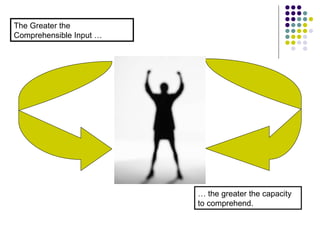
The Greater the Comprehensible Input … … the greater the capacity to comprehend.
So which is more desirable? The student who reads every word? Or The student who understands the meaning?
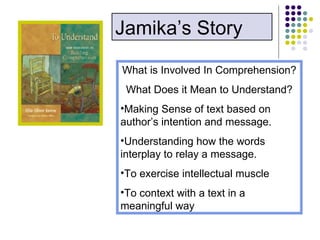
What is Involved In Comprehension? What Does it Mean to Understand? Making Sense of text based on author’s intention and message. Understanding how the words interplay to relay a message. To exercise intellectual muscle To context with a text in a meaningful way Jamika’s Story
And in the midst of normal conversation regarding comprehension, English Language Learners enter the picture and try to comprehend the input they receive. What must it be like?  Perhaps this  video  will shed some light.
Cummins’ Interdependence Theory :  Increasing CI through Transference  To the extent that instruction in Lx is effective in promoting proficiency in Lx, transfer of this proficiency to Ly will occur provided there is adequate exposure to Ly (either in school or environment) and adequate motivation to learn Ly. --J. Cummins, 1981.  “The Role of Primary Language Development in Promoting Educational Success for Language Minority Students.”  In  Schooling and Language Minority Students: A Theoretical Framework .  P. 29
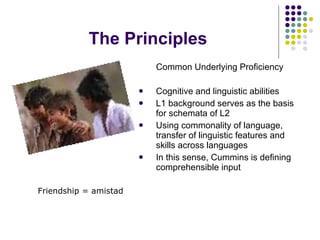
The Principles Common Underlying Proficiency Cognitive and linguistic abilities L1 background serves as the basis for schemata of L2 Using commonality of language, transfer of linguistic features and skills across languages In this sense, Cummins is defining comprehensible input Friendship = amistad
What Do ELL Students Need? The keys to effective reading instruction for ELLs include activating or building background knowledge, helping students use psychological strategies and linguistic cueing systems to construct meaning from English texts, choosing appropriate materials, and organizing curriculum around themes.   --David and Yvonne Freeman
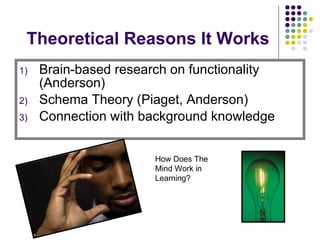
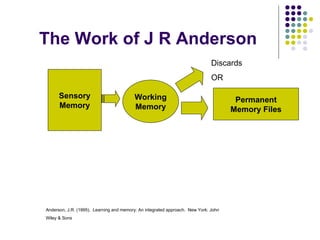
Theoretical Reasons It Works Brain-based research on functionality (Anderson) Schema Theory (Piaget, Anderson) Connection with background knowledge How Does The Mind Work in Learning?
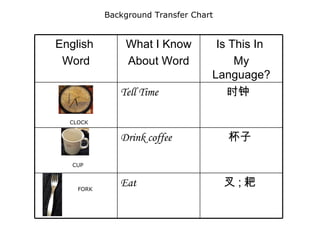
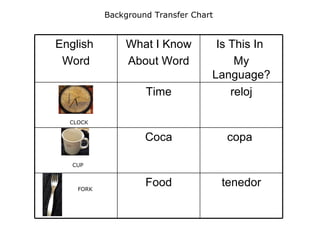
Questions to Make Connections What do I already know about…rocks? What is this called in my language? Can I transfer that language?
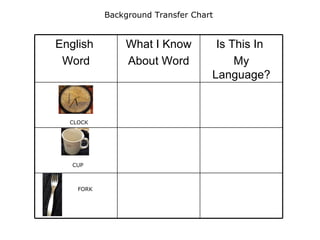
Background Transfer Chart CLOCK CUP FORK Is This In  My Language? What I Know About Word English  Word
Background Transfer Chart CLOCK CUP FORK 叉 ; 耙  Eat 杯子  Drink coffee 时钟   Tell Time Is This In  My Language? What I Know About Word English  Word
Background Transfer Chart CLOCK CUP FORK tenedor Food copa  Coca reloj Time Is This In  My Language? What I Know About Word English  Word
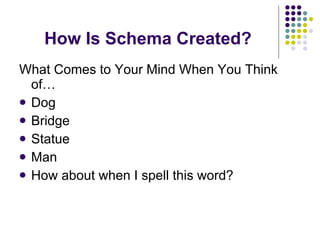
How Is Schema Created? What Comes to Your Mind When You Think of… Dog Bridge Statue Man How about when I spell this word?
The Work of J R Anderson Sensory Memory Working Memory Discards OR Permanent Memory Files Anderson, J.R. (1995).  Learning and memory: An integrated approach.  New York: John Wiley & Sons
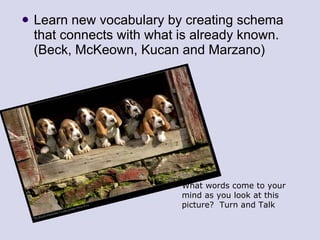
Learn new vocabulary by creating schema that connects with what is already known. (Beck, McKeown, Kucan and Marzano) What words come to your mind as you look at this picture?  Turn and Talk
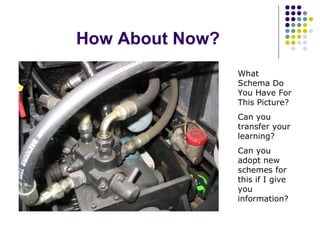
How About Now? What Schema Do You Have For This Picture? Can you transfer your learning? Can you adopt new schemes for this if I give you information?
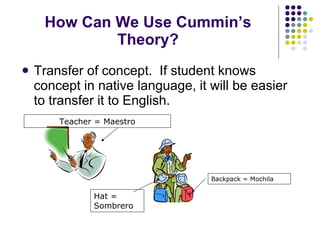
How Can We Use Cummin’s Theory? Transfer of concept.  If student knows concept in native language, it will be easier to transfer it to English. Teacher = Maestro Backpack = Mochila Hat = Sombrero
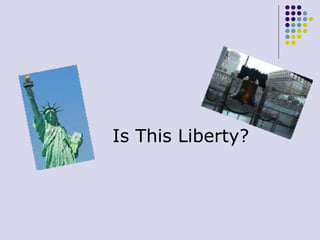
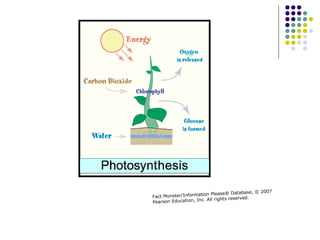
Now Let’s Look At Harder Concepts Find a partner: Discuss how you would go about explaining to students the following concepts: LIBERTY Photosynthesis Cell
Is This Liberty?
Fact Monster/Information Please® Database, © 2007 Pearson Education, Inc. All rights reserved.
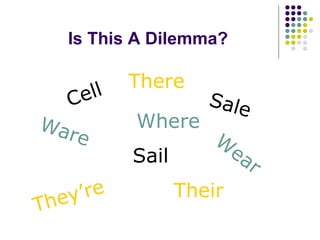
Is This A Dilemma? Cell Sale Sail Ware Where Wear They’re There Their
Let’s Review: Strategies Used Alternative Texts Visuals Engagement Illustration/ stories Graphic Organizers Collaboration Humor- Keep it interesting and fun
Beck, McKeown, Kucan Vocabulary must first be orally introduced. Vocabulary is not grade specific. Words must be explained, not defined. Must be contextualized. Multiple usages in a meaningful context (8-10). Create Schema (visual representation) Students reflect with each other Three Tiers of Vocabulary
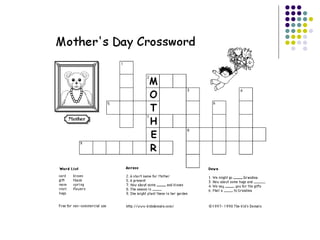
Working With Vocabulary Explain Restate Show Discuss Refine and Reflect Apply and Learning Games Robert Marzano,  Building Background Knowledge
Explain Putting words in terms students already know. How would you  explain  to students the word comforting?
Comforting - Something or someone that is comforting makes you feel good when you are sad or hurt.   Beck & McKeown, Elements of Reading Vocabulary, Steck Vaughn, 2004 Further explain by putting the word in a context. A warm cup of tea is comforting when my throat hurts. My dog feels comforting when I am hurt.
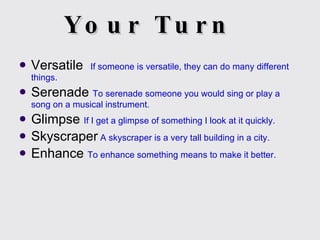
Your Turn With a partner, come up with an explanation and a context for each of the following words. Versatile Serenade Glimpse Skyscraper Enhance
Your Turn Versatile  If someone is versatile, they can do many different things. Serenade  To serenade someone you would sing or play a song on a musical instrument. Glimpse  If I get a glimpse of something I look at it quickly. Skyscraper  A skyscraper is a very tall building in a city. Enhance  To enhance something means to make it better.
Working With Vocabulary Explain Restate Show Discuss Refine and Reflect Apply and Learning Games Robert Marzano,  Building Background Knowledge
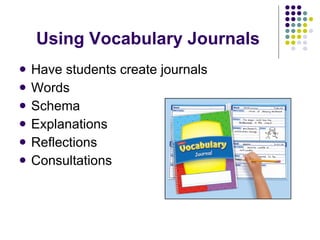
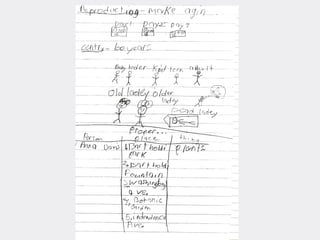
Using Vocabulary Journals Have students create journals Words Schema Explanations Reflections Consultations
 
Working With Vocabulary Explain Restate Show Discuss Refine and Reflect Apply and Learning Games Robert Marzano,  Building Background Knowledge
By creating the visual representation, they are making the learning concrete by making permanent memory files. Why is this important?
Hooking The Learning Have you ever met someone and then five minutes later…you couldn’t remember their name? Have you ever met someone for the first time that you had talked with on the phone for a long time only to think,… they don’t look like what I thought? Do you think in images? Think about your husband or wife. Do you just dream in words, or do you create images?
Do Not Under-estimate the power of a picture. The Heart of the Tulip By Keith Pruitt
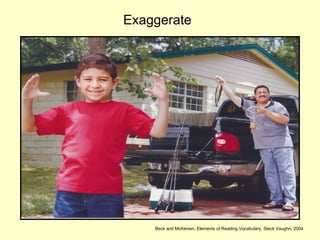
Exaggerate Beck and McKeown, Elements of Reading Vocabulary, Steck Vaughn, 2004
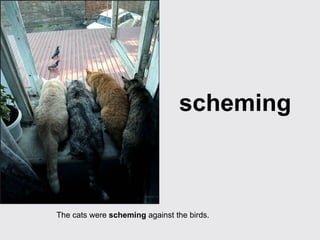
scheming The cats were  scheming  against the birds.
Invisible
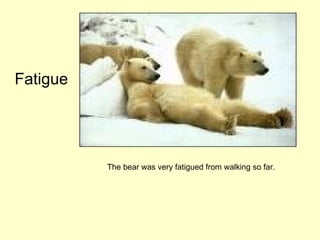
Fatigue The bear was very fatigued from walking so far.
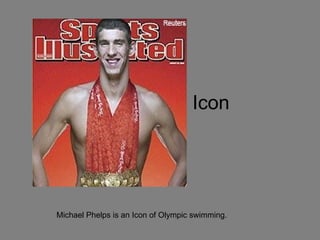
Icon Michael Phelps is an Icon of Olympic swimming.
Spider Would this be helpful in a Science lesson? ©Keith Pruitt, Art by Keith
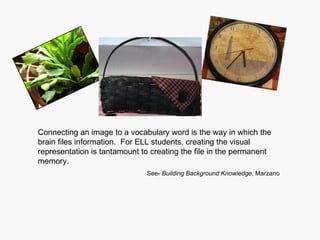
Connecting an image to a vocabulary word is the way in which the brain files information.  For ELL students, creating the visual representation is tantamount to creating the file in the permanent memory. See-  Building Background Knowledge , Marzano
Working With Vocabulary Explain Restate Show Discuss Refine and Reflect Apply and Learning Games Robert Marzano,  Building Background Knowledge
Open For Discussion What are the possible advantages of students discussing with each other their concepts of a word (context, visual representation, etc.)? Ability to transfer from L1 to L2 using peer tutoring. Sharing personal understanding broadens each understanding. Creates multiple contexts for usage.
Working With Vocabulary Explain Restate Show Discuss Refine and Reflect Apply and Learning Games Robert Marzano,  Building Background Knowledge
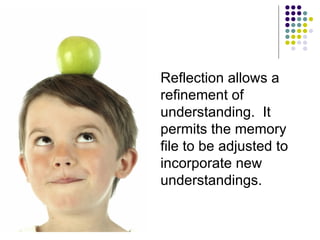
Reflection allows a refinement of understanding.  It permits the memory file to be adjusted to incorporate new understandings.
Working With Vocabulary Explain Restate Show Discuss Refine and Reflect Apply and Learning Games Robert Marzano,  Building Background Knowledge
http://www.gamequarium.com/evocabulary.html http://eslbears.homestead.com/Contact_Info.html http://www.manythings.org/lulu/
Games on Facebook
 
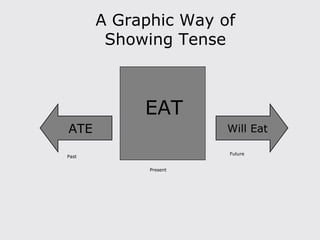
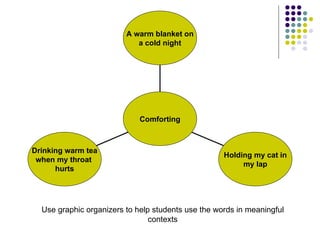
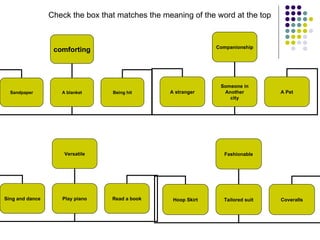
Using Graphic Organizers Graphic organizers take concepts and organize them visually enabling students recall of their comprehensible input. May be used as part of the games/ practice. Valuable as a tool for assessment.
EAT ATE Will Eat A Graphic Way of Showing Tense Past Present Future
Use graphic organizers to help students use the words in meaningful contexts Drinking warm tea when my throat  hurts Holding my cat in my lap A warm blanket on a cold night Comforting
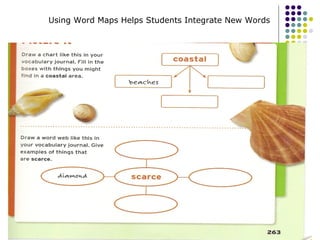
Using Word Maps Helps Students Integrate New Words
Check the box that matches the meaning of the word at the top comforting Sandpaper A blanket Being hit Versatile Sing and dance Play piano Read a book Companionship A stranger Someone in Another city A Pet Fashionable Hoop Skirt Tailored suit Coveralls
The Flow Chart
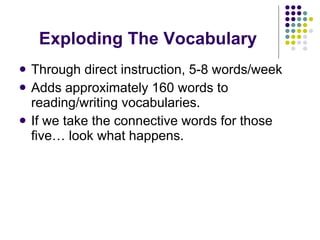
Exploding The Vocabulary Through direct instruction, 5-8 words/week Adds approximately 160 words to reading/writing vocabularies. If we take the connective words for those five… look what happens.
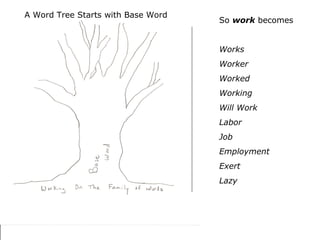
So  work  becomes Works Worker Worked Working Will Work Labor Job Employment Exert Lazy A Word Tree Starts with Base Word
Using Word Tree Those five words have become @50 words. Now in 32 weeks we have instructed 1600 words. Students may gain another 320-600 words via reading. Now we have exploded the vocabulary by a maximum of 2200 words in 32 weeks. In the traditional program 640 words are instructed, but only 64-120 of them are learned. And emphasis is on spelling.
You Try It Here are some common words taught.  What other words may we teach in conjunction with these: Glimmer Vast Artistic Disturb
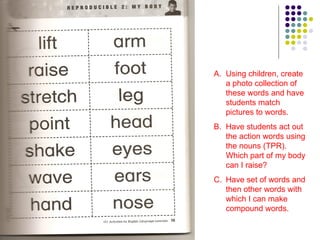
Using Word Sorts Morris suggests that using the tactile experience of word sorts provides mental stimulus for students and creates schema files. How might word sorts look in your classroom? Here are a couple of examples.
Using children, create a photo collection of these words and have students match pictures to words. Have students act out the action words using the nouns (TPR).  Which part of my body can I raise? Have set of words and then other words with which I can make compound words.
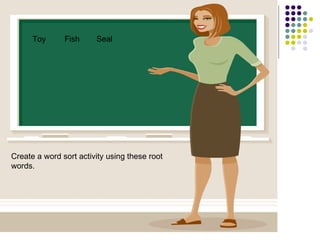
Create a word sort activity using these root words. Toy Fish Seal
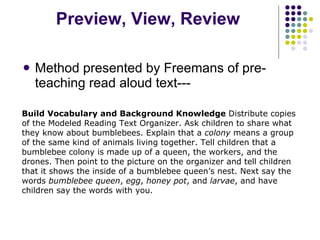
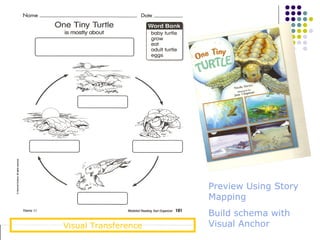
Preview, View, Review Method presented by Freemans of pre-teaching read aloud text--- Build Vocabulary and Background Knowledge  Distribute copies of the Modeled Reading Text Organizer. Ask children to share what they know about bumblebees. Explain that a  colony  means a group of the same kind of animals living together. Tell children that a bumblebee colony is made up of a queen, the workers, and the drones. Then point to the picture on the organizer and tell children that it shows the inside of a bumblebee queen’s nest. Next say the words  bumblebee queen ,  egg ,  honey pot , and  larvae , and have children say the words with you.
Preview Using Story Mapping Build schema with Visual Anchor Visual Transference
Word Substitution Sometimes Known as Trading Penny Words for $ Words Make= Create, Build, Construct, Craft Went= traveled, drove, walked Like- admire, enjoy, ?, ?, ? Fast- ?, ?, ?, ?
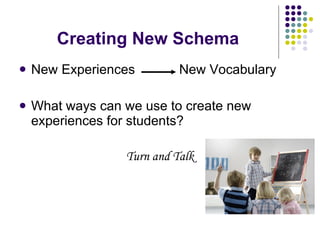
Creating New Schema New Experiences  New Vocabulary What ways can we use to create new experiences for students? Turn and Talk
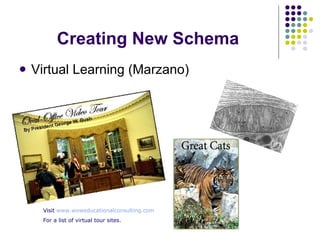
Creating New Schema Virtual Learning (Marzano) Visit  www.woweducationalconsulting.com For a list of virtual tour sites.
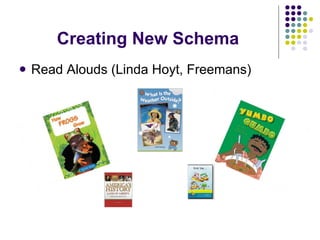
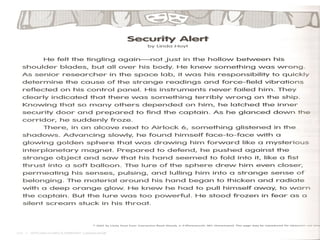
Creating New Schema Read Alouds (Linda Hoyt, Freemans)
 
 
Steps to Using What words need explaining? What substitute words could I use that students might understand? How can I explain the word so as to create a context for the students? What schema can I build- can I hook the learning?
Your Turn Get in groups of three-four Examine a big book and select three words that need pre-teaching before reading the story. Create a lesson of how you would teach those words using our steps from Beck.
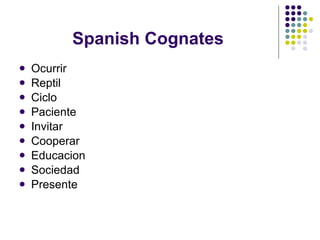
Creating New Schema Using Spanish Cognates Hundreds of words in Spanish and English have common roots in Latin.  Many of the these words are the same except for one letter.  These serve as good basis of conversation. Turn and Talk:  Tell me what the English word is for these Spanish cognates.
Spanish Cognates Ocurrir Reptil Ciclo Paciente Invitar Cooperar Educacion Sociedad Presente
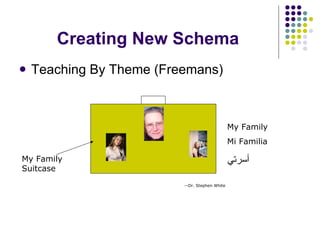
Creating New Schema Teaching By Theme (Freemans) My Family Suitcase My Family Mi Familia أسرتي   --Dr. Stephen White
Building The Family Each student receives a cardboard luggage cut out. They may use pictures or text to tell the story of their family. They may work together to work with language, but each person in the luggage should be labeled (L1 and L2). Teacher then helps to fill in the story.
Summary ELL students (and all others) are engaging learning based on the accumulation of words. Having multiple strategies in the classroom can help boost reading achievement and the acquisition of a new language. Research shows that using  Beck  methodology brings success for every disaggregated group, ethnicity, socio-economic class.
Your Turn Turn and Talk:  What strategy have you learned today that you want to incorporate into your classroom? What impact would learning 2000+ words/year have on your students? What are your first steps?
Thank You Words of Wisdom Educational Consulting Keith Pruitt [email_address] 615-448-7304 www.woweducationalconsulting.com www.myspace.com/wowedu

Increasing Comprehensible Input In Vocabulary Instruction

  • 1.
    Increasing Comprehensible Inputin Vocabulary Instruction Keith Pruitt, Ed.S. Doctoral Candidate Words of Wisdom Educational Consulting www.woweducationalconsulting.com www.myspace.com/wowedu
  • 2.
    Agenda 9-10:30- ComprehensibleInput and what it means to understand, Transfer theory, Schema 10:30-10:45 Break 10:45-12:00 Vocabulary Instruction Method 12:00-1:00 Lunch 1:00-2:30 Method, Exploding Vocabulary 2:30-2:45 Break 2:45-4:30 How to Create New Schema
  • 3.
  • 4.
  • 5.
    What Level ofComprehension is Active in This? Martin dining room front door over main entrance partook ignited flames sanguine faces rebel Dean. You have understanding of each word. Perhaps background knowledge creates schema connections. But is this comprehensible input at the sentence level? Word level?
  • 6.
    What is thelevel of Understanding Here? “A related observation about the F distribution is that it is positively skewed, not symmetric as are z and t . This is because F is always positive: It is the ratio of variances, both of which are positive, so F itself must be positive. There is no left-hand tail of F because the F distribution ends abruptly at 0.” Russell T. Hurlburt (2003). Comprehending Behavioral Statistics . Thomson: Australia, p. 336.
  • 7.
    Observations In thefirst example, there was no syntax . So there was no comprehensible input at the sentence level even though there was understanding of every word . In the second example, syntax was present but a void developed of word level meaning not allowing contextual understanding of the paragraph. “It had something to do with…”
  • 8.
    Could We Conclude…Teaching grammar is not the same as acquiring or learning language? ( Krashen, 2003) Just learning words does not equal comprehension. (Word callers) Knowing words is a pre-requisite to comprehension. There are multiple factors for comprehension.
  • 9.
    fi yuo cnaraed tihs, yuo hvae a sgtrane mnid too Cna yuo raed tihs? Olny 55 plepoe out of 100 can. i cdnuolt blveiee taht I cluod aulaclty uesdnatnrd waht I was rdanieg. The phaonmneal pweor of the hmuan mnid, aoccdrnig to a rscheearch at Cmabrigde Uinervtisy, it dseno't mtaetr in waht oerdr the ltteres in a wrod are, the olny iproamtnt tihng is taht the frsit and lsat ltteer be in the rghit pclae. The rset can be a taotl mses and you can sitll raed it whotuit a pboerlm.. Tihs is bcuseae the huamn mnid deos not raed ervey lteter by istlef, but the wrod as a wlohe. Azanmig huh? yaeh and I awlyas tghuhot slpeling was ipmorantt! Can You Read This?
  • 10.
    The evidence stronglysupports a simple hypothesis. We acquire language in only one way: when we understand messages; that is, when we obtain “comprehensible input.” We acquire language, in other words, when we understand what we hear or what we read, when we understand the message. Krashen, 2003 Comprehensible Input
  • 11.
    Is Comprehensible Inputsomething done by the teacher to the student or by the student based on the teacher?
  • 12.
    The Greater theComprehensible Input … … the greater the capacity to comprehend.
  • 13.
    So which ismore desirable? The student who reads every word? Or The student who understands the meaning?
  • 14.
    What is InvolvedIn Comprehension? What Does it Mean to Understand? Making Sense of text based on author’s intention and message. Understanding how the words interplay to relay a message. To exercise intellectual muscle To context with a text in a meaningful way Jamika’s Story
  • 15.
    And in themidst of normal conversation regarding comprehension, English Language Learners enter the picture and try to comprehend the input they receive. What must it be like? Perhaps this video will shed some light.
  • 16.
    Cummins’ Interdependence Theory: Increasing CI through Transference To the extent that instruction in Lx is effective in promoting proficiency in Lx, transfer of this proficiency to Ly will occur provided there is adequate exposure to Ly (either in school or environment) and adequate motivation to learn Ly. --J. Cummins, 1981. “The Role of Primary Language Development in Promoting Educational Success for Language Minority Students.” In Schooling and Language Minority Students: A Theoretical Framework . P. 29
  • 17.
    The Principles CommonUnderlying Proficiency Cognitive and linguistic abilities L1 background serves as the basis for schemata of L2 Using commonality of language, transfer of linguistic features and skills across languages In this sense, Cummins is defining comprehensible input Friendship = amistad
  • 18.
    What Do ELLStudents Need? The keys to effective reading instruction for ELLs include activating or building background knowledge, helping students use psychological strategies and linguistic cueing systems to construct meaning from English texts, choosing appropriate materials, and organizing curriculum around themes. --David and Yvonne Freeman
  • 19.
    Theoretical Reasons ItWorks Brain-based research on functionality (Anderson) Schema Theory (Piaget, Anderson) Connection with background knowledge How Does The Mind Work in Learning?
  • 20.
    Questions to MakeConnections What do I already know about…rocks? What is this called in my language? Can I transfer that language?
  • 21.
    Background Transfer ChartCLOCK CUP FORK Is This In My Language? What I Know About Word English Word
  • 22.
    Background Transfer ChartCLOCK CUP FORK 叉 ; 耙 Eat 杯子 Drink coffee 时钟  Tell Time Is This In My Language? What I Know About Word English Word
  • 23.
    Background Transfer ChartCLOCK CUP FORK tenedor Food copa Coca reloj Time Is This In My Language? What I Know About Word English Word
  • 24.
    How Is SchemaCreated? What Comes to Your Mind When You Think of… Dog Bridge Statue Man How about when I spell this word?
  • 25.
    The Work ofJ R Anderson Sensory Memory Working Memory Discards OR Permanent Memory Files Anderson, J.R. (1995). Learning and memory: An integrated approach. New York: John Wiley & Sons
  • 26.
    Learn new vocabularyby creating schema that connects with what is already known. (Beck, McKeown, Kucan and Marzano) What words come to your mind as you look at this picture? Turn and Talk
  • 27.
    How About Now?What Schema Do You Have For This Picture? Can you transfer your learning? Can you adopt new schemes for this if I give you information?
  • 28.
    How Can WeUse Cummin’s Theory? Transfer of concept. If student knows concept in native language, it will be easier to transfer it to English. Teacher = Maestro Backpack = Mochila Hat = Sombrero
  • 29.
    Now Let’s LookAt Harder Concepts Find a partner: Discuss how you would go about explaining to students the following concepts: LIBERTY Photosynthesis Cell
  • 30.
  • 31.
    Fact Monster/Information Please®Database, © 2007 Pearson Education, Inc. All rights reserved.
  • 32.
    Is This ADilemma? Cell Sale Sail Ware Where Wear They’re There Their
  • 33.
    Let’s Review: StrategiesUsed Alternative Texts Visuals Engagement Illustration/ stories Graphic Organizers Collaboration Humor- Keep it interesting and fun
  • 34.
    Beck, McKeown, KucanVocabulary must first be orally introduced. Vocabulary is not grade specific. Words must be explained, not defined. Must be contextualized. Multiple usages in a meaningful context (8-10). Create Schema (visual representation) Students reflect with each other Three Tiers of Vocabulary
  • 35.
    Working With VocabularyExplain Restate Show Discuss Refine and Reflect Apply and Learning Games Robert Marzano, Building Background Knowledge
  • 36.
    Explain Putting wordsin terms students already know. How would you explain to students the word comforting?
  • 37.
    Comforting - Somethingor someone that is comforting makes you feel good when you are sad or hurt. Beck & McKeown, Elements of Reading Vocabulary, Steck Vaughn, 2004 Further explain by putting the word in a context. A warm cup of tea is comforting when my throat hurts. My dog feels comforting when I am hurt.
  • 38.
    Your Turn Witha partner, come up with an explanation and a context for each of the following words. Versatile Serenade Glimpse Skyscraper Enhance
  • 39.
    Your Turn Versatile If someone is versatile, they can do many different things. Serenade To serenade someone you would sing or play a song on a musical instrument. Glimpse If I get a glimpse of something I look at it quickly. Skyscraper A skyscraper is a very tall building in a city. Enhance To enhance something means to make it better.
  • 40.
    Working With VocabularyExplain Restate Show Discuss Refine and Reflect Apply and Learning Games Robert Marzano, Building Background Knowledge
  • 41.
    Using Vocabulary JournalsHave students create journals Words Schema Explanations Reflections Consultations
  • 42.
  • 43.
    Working With VocabularyExplain Restate Show Discuss Refine and Reflect Apply and Learning Games Robert Marzano, Building Background Knowledge
  • 44.
    By creating thevisual representation, they are making the learning concrete by making permanent memory files. Why is this important?
  • 45.
    Hooking The LearningHave you ever met someone and then five minutes later…you couldn’t remember their name? Have you ever met someone for the first time that you had talked with on the phone for a long time only to think,… they don’t look like what I thought? Do you think in images? Think about your husband or wife. Do you just dream in words, or do you create images?
  • 46.
    Do Not Under-estimatethe power of a picture. The Heart of the Tulip By Keith Pruitt
  • 47.
    Exaggerate Beck andMcKeown, Elements of Reading Vocabulary, Steck Vaughn, 2004
  • 48.
    scheming The catswere scheming against the birds.
  • 49.
  • 50.
    Fatigue The bearwas very fatigued from walking so far.
  • 51.
    Icon Michael Phelpsis an Icon of Olympic swimming.
  • 52.
    Spider Would thisbe helpful in a Science lesson? ©Keith Pruitt, Art by Keith
  • 53.
    Connecting an imageto a vocabulary word is the way in which the brain files information. For ELL students, creating the visual representation is tantamount to creating the file in the permanent memory. See- Building Background Knowledge , Marzano
  • 54.
    Working With VocabularyExplain Restate Show Discuss Refine and Reflect Apply and Learning Games Robert Marzano, Building Background Knowledge
  • 55.
    Open For DiscussionWhat are the possible advantages of students discussing with each other their concepts of a word (context, visual representation, etc.)? Ability to transfer from L1 to L2 using peer tutoring. Sharing personal understanding broadens each understanding. Creates multiple contexts for usage.
  • 56.
    Working With VocabularyExplain Restate Show Discuss Refine and Reflect Apply and Learning Games Robert Marzano, Building Background Knowledge
  • 57.
    Reflection allows arefinement of understanding. It permits the memory file to be adjusted to incorporate new understandings.
  • 58.
    Working With VocabularyExplain Restate Show Discuss Refine and Reflect Apply and Learning Games Robert Marzano, Building Background Knowledge
  • 59.
  • 60.
  • 61.
  • 62.
    Using Graphic OrganizersGraphic organizers take concepts and organize them visually enabling students recall of their comprehensible input. May be used as part of the games/ practice. Valuable as a tool for assessment.
  • 63.
    EAT ATE WillEat A Graphic Way of Showing Tense Past Present Future
  • 64.
    Use graphic organizersto help students use the words in meaningful contexts Drinking warm tea when my throat hurts Holding my cat in my lap A warm blanket on a cold night Comforting
  • 65.
    Using Word MapsHelps Students Integrate New Words
  • 66.
    Check the boxthat matches the meaning of the word at the top comforting Sandpaper A blanket Being hit Versatile Sing and dance Play piano Read a book Companionship A stranger Someone in Another city A Pet Fashionable Hoop Skirt Tailored suit Coveralls
  • 67.
  • 68.
    Exploding The VocabularyThrough direct instruction, 5-8 words/week Adds approximately 160 words to reading/writing vocabularies. If we take the connective words for those five… look what happens.
  • 69.
    So work becomes Works Worker Worked Working Will Work Labor Job Employment Exert Lazy A Word Tree Starts with Base Word
  • 70.
    Using Word TreeThose five words have become @50 words. Now in 32 weeks we have instructed 1600 words. Students may gain another 320-600 words via reading. Now we have exploded the vocabulary by a maximum of 2200 words in 32 weeks. In the traditional program 640 words are instructed, but only 64-120 of them are learned. And emphasis is on spelling.
  • 71.
    You Try ItHere are some common words taught. What other words may we teach in conjunction with these: Glimmer Vast Artistic Disturb
  • 72.
    Using Word SortsMorris suggests that using the tactile experience of word sorts provides mental stimulus for students and creates schema files. How might word sorts look in your classroom? Here are a couple of examples.
  • 73.
    Using children, createa photo collection of these words and have students match pictures to words. Have students act out the action words using the nouns (TPR). Which part of my body can I raise? Have set of words and then other words with which I can make compound words.
  • 74.
    Create a wordsort activity using these root words. Toy Fish Seal
  • 75.
    Preview, View, ReviewMethod presented by Freemans of pre-teaching read aloud text--- Build Vocabulary and Background Knowledge Distribute copies of the Modeled Reading Text Organizer. Ask children to share what they know about bumblebees. Explain that a colony means a group of the same kind of animals living together. Tell children that a bumblebee colony is made up of a queen, the workers, and the drones. Then point to the picture on the organizer and tell children that it shows the inside of a bumblebee queen’s nest. Next say the words bumblebee queen , egg , honey pot , and larvae , and have children say the words with you.
  • 76.
    Preview Using StoryMapping Build schema with Visual Anchor Visual Transference
  • 77.
    Word Substitution SometimesKnown as Trading Penny Words for $ Words Make= Create, Build, Construct, Craft Went= traveled, drove, walked Like- admire, enjoy, ?, ?, ? Fast- ?, ?, ?, ?
  • 78.
    Creating New SchemaNew Experiences New Vocabulary What ways can we use to create new experiences for students? Turn and Talk
  • 79.
    Creating New SchemaVirtual Learning (Marzano) Visit www.woweducationalconsulting.com For a list of virtual tour sites.
  • 80.
    Creating New SchemaRead Alouds (Linda Hoyt, Freemans)
  • 81.
  • 82.
  • 83.
    Steps to UsingWhat words need explaining? What substitute words could I use that students might understand? How can I explain the word so as to create a context for the students? What schema can I build- can I hook the learning?
  • 84.
    Your Turn Getin groups of three-four Examine a big book and select three words that need pre-teaching before reading the story. Create a lesson of how you would teach those words using our steps from Beck.
  • 85.
    Creating New SchemaUsing Spanish Cognates Hundreds of words in Spanish and English have common roots in Latin. Many of the these words are the same except for one letter. These serve as good basis of conversation. Turn and Talk: Tell me what the English word is for these Spanish cognates.
  • 86.
    Spanish Cognates OcurrirReptil Ciclo Paciente Invitar Cooperar Educacion Sociedad Presente
  • 87.
    Creating New SchemaTeaching By Theme (Freemans) My Family Suitcase My Family Mi Familia أسرتي --Dr. Stephen White
  • 88.
    Building The FamilyEach student receives a cardboard luggage cut out. They may use pictures or text to tell the story of their family. They may work together to work with language, but each person in the luggage should be labeled (L1 and L2). Teacher then helps to fill in the story.
  • 89.
    Summary ELL students(and all others) are engaging learning based on the accumulation of words. Having multiple strategies in the classroom can help boost reading achievement and the acquisition of a new language. Research shows that using Beck methodology brings success for every disaggregated group, ethnicity, socio-economic class.
  • 90.
    Your Turn Turnand Talk: What strategy have you learned today that you want to incorporate into your classroom? What impact would learning 2000+ words/year have on your students? What are your first steps?
  • 91.
    Thank You Wordsof Wisdom Educational Consulting Keith Pruitt [email_address] 615-448-7304 www.woweducationalconsulting.com www.myspace.com/wowedu