Meet me at:   www.letras.ufmg.br/profs/reinildes Professor  Reinildes Dias , Ph.D . FALE - UFMG [email_address] Reading in ENGLISH
L2 Reading is a basic life skill.  Without the ability to read in  English well, opportunities for  personal fulfillment and job  success inevitably will be lost.
These environments can also encourage students to read and  write  in  English  for different social purposes.  Literacy rich environments display texts everywhere and provide opportunities that can engage students in L2 reading and writing activities.
Reading throughout the years:  from the 70s to now. The  interactive  model Three  cognitive models The  bottom-up  model The  top-down  model
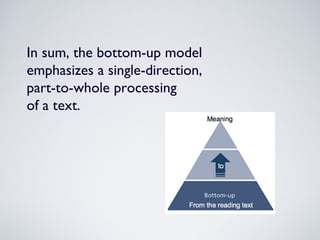
The   bottom-up model   acknowledges  that … Readers proceed from the written  text to meaning. Readers are passive recipients of  meaning. Meaning resides in texts. Meaning is driven by the text. Reading proceeds from part to whole.
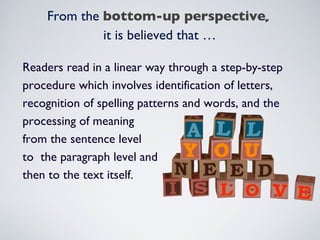
From the   bottom-up perspective ,  it is believed that … Readers read in a linear way through a step-by-step  procedure which involves identification of letters,  recognition of spelling patterns and words, and the  processing of meaning  from the sentence level  to  the paragraph level and  then to the text itself.
In sum, the bottom-up model  emphasizes a single-direction, part-to-whole processing  of a text.
Main proponents of the bottom-up  model of reading Gough, P.B. (1972). One second of reading. In: J.F. Kavanagh and I.G. Mattingly (eds.),  Language by ear and by the eye  (pp. 331-58). Cambridge, MA: MIT Press. LaBerge, D. and Samuels, S.J. (1974). Toward a theory of automatic information processing in reading.  Cognitive Psychology , 6, 293-323.
According  to  Gough  (1972), reading  is a sequential or serial mental process.  In his words , “ Readers begin by translating the parts  of written language (letters) into speech sounds, then piece the sounds together  to form individual words, then piece the words  together  to arrive  at  an understanding of the author’s written message.”
Important element: readers’ prior knowledge. Focuses on what readers bring to the process Readers activate prior knowledge to understand  texts. Readers  are active processors of meaning. Top-down process
Reading is a “psycholinguistic guessing game”,  Goodman, 1970.  Reading proceeds from whole to part.  Meaning is brought to the written text, not  derived from it.  Reading is driven by meaning. Top-down process:
Kenneth Goodman (1967). Reading: A psycholinguistic guessing game.  Journal of Reading Specialist , 6, 126-35. Frank Smith (1971).  Understanding reading.  New York: Holt, Rinehart and Winston. Main advocates of the top-down  model of reading
Traditional view of reading (bottom-up model) Cognitive view of reading (top-down model)
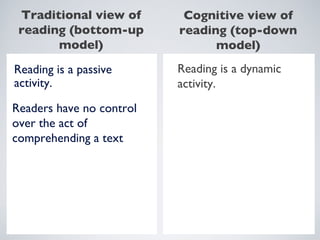
Traditional view of reading (bottom-up model) Reading is a passive activity.  Cognitive view of reading (top-down model)
Traditional view of reading (bottom-up model) Reading is a passive activity.  Cognitive view of reading (top-down model) Reading is a dynamic activity.
Traditional view of reading (bottom-up model) Reading is a passive activity.  Readers have no control  over the act of  comprehending a text Cognitive view of reading (top-down model) Reading is a dynamic activity.
Traditional view of reading (bottom-up model) Reading is a passive activity.  Readers have no control  over the act of  comprehending a text Cognitive view of reading (top-down model) Readers make use of their previous knowledge to comprehend a text.  Reading is a dynamic activity.
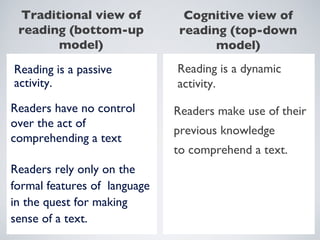
Traditional view of reading (bottom-up model) Reading is a passive activity.  Readers have no control  over the act of  comprehending a text Readers rely only on the formal features of  language in the quest for making  sense of a text. Cognitive view of reading (top-down model) Readers make use of their previous knowledge to comprehend a text.  Reading is a dynamic activity.
Traditional view of reading (bottom-up model) Reading is a passive activity.  Readers have no control  over the act of  comprehending a text Readers rely only on the formal features of  language  in the quest for making  Sense of a text. Cognitive view of reading (top-down model) Readers make use of their previous knowledge to comprehend a text.  Reading is a dynamic activity.  Readers (as well as texts) are at the heart of the reading process.
The interactive model of reading   Acknowledges that reading involves  both a bottom-up and a top-down process.
The interactive model of reading   Recognizes the simultaneous interaction  of bottom-up and top-down processes during reading comprehension.
The interactive model of reading   Readers rely on their prior knowledge and also on the formal features of language in  the quest for making sense of a text.
The interactive model of reading   Stresses the dynamic interaction of the active mind of the reader and  the written text.
The interactive model of reading   Examines reading comprehension from the point of view of connected discourse.
The interactive model of reading   Starts considering readers’ cultural  background and value systems in the process of reading comprehension.
The interactive model of reading   Acknowledges the importance of schema, that is,  units of organized knowledge about events, situations,  or objects that readers have stored in their mind’s cognitive  structures during the process of reading comprehension.
The interactive model of reading   Schema knowledge is subdivided into  formal   and  content schema  with the acknowledgment  of the  importance of  the social, cultural and  text rhetorical features in reading comprehension Carrell & Einsterhold  (1988)
David Rumelhart (1980). Schemata: the building blocks of cognition. In: Spiro, R.J.; Bruce, B. C.; Brewer, W. F. (ed).  Theoretical issues in reading comprehension . p. 33-58. Keith Stanovich (1980). Toward an interactive- compensatory model of individual differences in the development of reading fluency.  Reading Research Quarterly , 16, 32-71. Main advocates of the interactive  model of reading
Cognitive views of reading (top-down and  interactive models) A spoken or written text does not in itself  carry meaning; rather, it provides directions  for readers on how to use their own stored knowledge  to retrieve and construct meaning.  Encompass this fundamental principle  from schema theory: (Adams & Collins  apud  Leahey & Harris, 1989. p. 201).
A social view  of reading Posits that reading performs a socializing function. Assumes that texts are social and cultural artifacts reflecting group values and norms. Acknowledges the fact that texts are materialized or structured into different genres. Recognizes that we communicate through genres that fulfill different social purposes in particular contexts of use.
The two perspectives are integrated into a  holistic view of the reading process. Meaning is reader-generated and it depends on the activation of different types of knowledge (prior knowledge, textual, lexical-systemic and strategic knowledge). Toward a synthesis:  A sociocognitive view of reading  (Bernhardt, 1991).
Toward a synthesis:  A sociocognitive view of reading  (Bernhardt, 1991). Acknowledges the dynamic relationships between text producers, text receivers and the text itself.   Recognizes the ongoing interaction between reader and writer, mediated by the text and context. This interaction is socially constructed.
Toward a synthesis:  A sociocognitive view of reading  (Bernhardt, 1991). Schema knowledge (from schema theory) is  both a social and a mentalistic construct.  Understands the concept of text as a social construct.
The reading  text Conceptualized as a social construct.  Viewed as a communicative event that is socially and culturally recognizable, both  in spoken and written modes. Materialized in different genres for a variety of social communicative purposes.
The reading  text A reading text can be paper, electronic, or live. It may comprise one or more semiotic systems (linguistic, sound, visual, spatial, gestural). Texts are consciously constructed. Meanings are actively constructed. A text may be constructed using intertextuality. Texts may be multimodal, interactive, linear, and nonlinear. (Anstey; Bull, 2004)
A genre-based approach to teach L2 reading Encourages habits of meaning-making  by students. Centered on the explicit identification  and analysis of genre features to show  how patterns of language work to shape meaning.
A genre-based approach to teach L2 reading Counts on students’ recognition of genre similarities between Portuguese and English to enhance L2 reading comprehension. Counts on students’ repeated experiences  with texts in their mother language to enhance L2 reading comprehension.
A genre-based approach to teach L2 reading Encourages students to contextualize the particular texts they have to read by an understanding of the specific situations for which they have been written, their communicative purposes, intended audience, the social role played by the author, and when and where they were published.
A genre-based approach to teach L2 reading In other words, this approach to teaching encourages students to answer this set of questions: “ who writes what, for what purposes, how, where, and when ” in order to understand the overall context for which texts have been written as well as who they want to influence.
A genre-based approach to teach L2 reading Teaches the discursive, the lexical and  the linguistic features of different genres explicitly to  enhance  L2  reading  comprehension.
Fase 1:  Pré-leitura Ativação de conhecimento  anterior Fases de uma aula de leitura Para mais informaç ões,  http: //tinyurl . com/fases-aula-leitura Proposta Curricular de Língua Estrangeira do Estado de Minas Gerais. 2003 .
Fase 2 Compreensão de pontos gerais Compreensão das condições de produção do texto Exploração da informação não-verbal   Fases de uma aula de leitura Para mais informaç ões,  http: //tinyurl . com/fases-aula-leitura Proposta Curricular de Língua Estrangeira do Estado de Minas Gerais. 2003 .
Fase 3 Compreensão de pontos principais Exploração da informação verbal: construção dos elos coesivos - lexicais e gramaticais -  inferências. Fases de uma aula de leitura Para mais informaç ões,  http: //tinyurl . com/fases-aula-leitura Proposta Curricular de Língua Estrangeira do Estado de Minas Gerais. 2003 .
Fase 4 Compreensão detalhada Exploração da informação verbal: inferências, sínteses, integração. Resumo do texto lido na forma de diagramas, esquemas e mapas  conceituais Fases de uma aula de leitura Para mais informaç ões,  http: //tinyurl . com/fases-aula-leitura Proposta Curricular de Língua Estrangeira do Estado de Minas Gerais. 2003 .
Fase 5: Pós-Leitura Reflexões sobre as características  retórico-discursivas e linguístico- textuais do texto lido. Fases de uma aula de leitura Para mais informaç ões,  http: //tinyurl . com/fases-aula-leitura Proposta Curricular de Língua Estrangeira do Estado de Minas Gerais. 2003 .
Fase 5: Pós-Leitura (cont.) Atividades de desenvolvimento de vocabul ário . Atividades de aprendizagem de gramática Fases de uma aula de leitura Para mais informaç ões,  http: //tinyurl . com/fases-aula-leitura Proposta Curricular de Língua Estrangeira do Estado de Minas Gerais. 2003 .
Feel free to get in touch with me:   [email_address] Thanks for your  attention!
References http://www.nadasisland.com/reading/#interact http://www.nclrc.org/essentials/reading/reindex.htm http://www.sil.org/lingualinks/literacy/ReferenceMaterials/glossaryofliteracyterms/WhatIsAnInteractiveReadingMode.htm http://tsl591.blogspot.com/2008/07/models-of-readinginteractive.html http://www.landmark.edu/institute/assistive_technology/reading_overview.html http://www.llas.ac.uk/resources/gpg/1420

Reading

  • 1.
    Meet me at: www.letras.ufmg.br/profs/reinildes Professor Reinildes Dias , Ph.D . FALE - UFMG [email_address] Reading in ENGLISH
  • 2.
    L2 Reading isa basic life skill. Without the ability to read in English well, opportunities for personal fulfillment and job success inevitably will be lost.
  • 3.
    These environments canalso encourage students to read and write in English for different social purposes. Literacy rich environments display texts everywhere and provide opportunities that can engage students in L2 reading and writing activities.
  • 4.
    Reading throughout theyears: from the 70s to now. The interactive model Three cognitive models The bottom-up model The top-down model
  • 5.
    The bottom-up model acknowledges that … Readers proceed from the written text to meaning. Readers are passive recipients of meaning. Meaning resides in texts. Meaning is driven by the text. Reading proceeds from part to whole.
  • 6.
    From the bottom-up perspective , it is believed that … Readers read in a linear way through a step-by-step procedure which involves identification of letters, recognition of spelling patterns and words, and the processing of meaning from the sentence level to the paragraph level and then to the text itself.
  • 7.
    In sum, thebottom-up model emphasizes a single-direction, part-to-whole processing of a text.
  • 8.
    Main proponents ofthe bottom-up model of reading Gough, P.B. (1972). One second of reading. In: J.F. Kavanagh and I.G. Mattingly (eds.), Language by ear and by the eye (pp. 331-58). Cambridge, MA: MIT Press. LaBerge, D. and Samuels, S.J. (1974). Toward a theory of automatic information processing in reading. Cognitive Psychology , 6, 293-323.
  • 9.
    According to Gough (1972), reading is a sequential or serial mental process. In his words , “ Readers begin by translating the parts of written language (letters) into speech sounds, then piece the sounds together to form individual words, then piece the words together to arrive at an understanding of the author’s written message.”
  • 10.
    Important element: readers’prior knowledge. Focuses on what readers bring to the process Readers activate prior knowledge to understand texts. Readers are active processors of meaning. Top-down process
  • 11.
    Reading is a“psycholinguistic guessing game”, Goodman, 1970. Reading proceeds from whole to part. Meaning is brought to the written text, not derived from it. Reading is driven by meaning. Top-down process:
  • 12.
    Kenneth Goodman (1967).Reading: A psycholinguistic guessing game. Journal of Reading Specialist , 6, 126-35. Frank Smith (1971). Understanding reading. New York: Holt, Rinehart and Winston. Main advocates of the top-down model of reading
  • 13.
    Traditional view ofreading (bottom-up model) Cognitive view of reading (top-down model)
  • 14.
    Traditional view ofreading (bottom-up model) Reading is a passive activity. Cognitive view of reading (top-down model)
  • 15.
    Traditional view ofreading (bottom-up model) Reading is a passive activity. Cognitive view of reading (top-down model) Reading is a dynamic activity.
  • 16.
    Traditional view ofreading (bottom-up model) Reading is a passive activity. Readers have no control over the act of comprehending a text Cognitive view of reading (top-down model) Reading is a dynamic activity.
  • 17.
    Traditional view ofreading (bottom-up model) Reading is a passive activity. Readers have no control over the act of comprehending a text Cognitive view of reading (top-down model) Readers make use of their previous knowledge to comprehend a text. Reading is a dynamic activity.
  • 18.
    Traditional view ofreading (bottom-up model) Reading is a passive activity. Readers have no control over the act of comprehending a text Readers rely only on the formal features of language in the quest for making sense of a text. Cognitive view of reading (top-down model) Readers make use of their previous knowledge to comprehend a text. Reading is a dynamic activity.
  • 19.
    Traditional view ofreading (bottom-up model) Reading is a passive activity. Readers have no control over the act of comprehending a text Readers rely only on the formal features of language in the quest for making Sense of a text. Cognitive view of reading (top-down model) Readers make use of their previous knowledge to comprehend a text. Reading is a dynamic activity. Readers (as well as texts) are at the heart of the reading process.
  • 20.
    The interactive modelof reading Acknowledges that reading involves both a bottom-up and a top-down process.
  • 21.
    The interactive modelof reading Recognizes the simultaneous interaction of bottom-up and top-down processes during reading comprehension.
  • 22.
    The interactive modelof reading Readers rely on their prior knowledge and also on the formal features of language in the quest for making sense of a text.
  • 23.
    The interactive modelof reading Stresses the dynamic interaction of the active mind of the reader and the written text.
  • 24.
    The interactive modelof reading Examines reading comprehension from the point of view of connected discourse.
  • 25.
    The interactive modelof reading Starts considering readers’ cultural background and value systems in the process of reading comprehension.
  • 26.
    The interactive modelof reading Acknowledges the importance of schema, that is, units of organized knowledge about events, situations, or objects that readers have stored in their mind’s cognitive structures during the process of reading comprehension.
  • 27.
    The interactive modelof reading Schema knowledge is subdivided into formal and content schema with the acknowledgment of the importance of the social, cultural and text rhetorical features in reading comprehension Carrell & Einsterhold (1988)
  • 28.
    David Rumelhart (1980).Schemata: the building blocks of cognition. In: Spiro, R.J.; Bruce, B. C.; Brewer, W. F. (ed). Theoretical issues in reading comprehension . p. 33-58. Keith Stanovich (1980). Toward an interactive- compensatory model of individual differences in the development of reading fluency. Reading Research Quarterly , 16, 32-71. Main advocates of the interactive model of reading
  • 29.
    Cognitive views ofreading (top-down and interactive models) A spoken or written text does not in itself carry meaning; rather, it provides directions for readers on how to use their own stored knowledge to retrieve and construct meaning. Encompass this fundamental principle from schema theory: (Adams & Collins apud Leahey & Harris, 1989. p. 201).
  • 30.
    A social view of reading Posits that reading performs a socializing function. Assumes that texts are social and cultural artifacts reflecting group values and norms. Acknowledges the fact that texts are materialized or structured into different genres. Recognizes that we communicate through genres that fulfill different social purposes in particular contexts of use.
  • 31.
    The two perspectivesare integrated into a holistic view of the reading process. Meaning is reader-generated and it depends on the activation of different types of knowledge (prior knowledge, textual, lexical-systemic and strategic knowledge). Toward a synthesis: A sociocognitive view of reading (Bernhardt, 1991).
  • 32.
    Toward a synthesis: A sociocognitive view of reading (Bernhardt, 1991). Acknowledges the dynamic relationships between text producers, text receivers and the text itself. Recognizes the ongoing interaction between reader and writer, mediated by the text and context. This interaction is socially constructed.
  • 33.
    Toward a synthesis: A sociocognitive view of reading (Bernhardt, 1991). Schema knowledge (from schema theory) is both a social and a mentalistic construct. Understands the concept of text as a social construct.
  • 34.
    The reading text Conceptualized as a social construct. Viewed as a communicative event that is socially and culturally recognizable, both in spoken and written modes. Materialized in different genres for a variety of social communicative purposes.
  • 35.
    The reading text A reading text can be paper, electronic, or live. It may comprise one or more semiotic systems (linguistic, sound, visual, spatial, gestural). Texts are consciously constructed. Meanings are actively constructed. A text may be constructed using intertextuality. Texts may be multimodal, interactive, linear, and nonlinear. (Anstey; Bull, 2004)
  • 36.
    A genre-based approachto teach L2 reading Encourages habits of meaning-making by students. Centered on the explicit identification and analysis of genre features to show how patterns of language work to shape meaning.
  • 37.
    A genre-based approachto teach L2 reading Counts on students’ recognition of genre similarities between Portuguese and English to enhance L2 reading comprehension. Counts on students’ repeated experiences with texts in their mother language to enhance L2 reading comprehension.
  • 38.
    A genre-based approachto teach L2 reading Encourages students to contextualize the particular texts they have to read by an understanding of the specific situations for which they have been written, their communicative purposes, intended audience, the social role played by the author, and when and where they were published.
  • 39.
    A genre-based approachto teach L2 reading In other words, this approach to teaching encourages students to answer this set of questions: “ who writes what, for what purposes, how, where, and when ” in order to understand the overall context for which texts have been written as well as who they want to influence.
  • 40.
    A genre-based approachto teach L2 reading Teaches the discursive, the lexical and the linguistic features of different genres explicitly to enhance L2 reading comprehension.
  • 41.
    Fase 1: Pré-leitura Ativação de conhecimento anterior Fases de uma aula de leitura Para mais informaç ões, http: //tinyurl . com/fases-aula-leitura Proposta Curricular de Língua Estrangeira do Estado de Minas Gerais. 2003 .
  • 42.
    Fase 2 Compreensãode pontos gerais Compreensão das condições de produção do texto Exploração da informação não-verbal Fases de uma aula de leitura Para mais informaç ões, http: //tinyurl . com/fases-aula-leitura Proposta Curricular de Língua Estrangeira do Estado de Minas Gerais. 2003 .
  • 43.
    Fase 3 Compreensãode pontos principais Exploração da informação verbal: construção dos elos coesivos - lexicais e gramaticais - inferências. Fases de uma aula de leitura Para mais informaç ões, http: //tinyurl . com/fases-aula-leitura Proposta Curricular de Língua Estrangeira do Estado de Minas Gerais. 2003 .
  • 44.
    Fase 4 Compreensãodetalhada Exploração da informação verbal: inferências, sínteses, integração. Resumo do texto lido na forma de diagramas, esquemas e mapas conceituais Fases de uma aula de leitura Para mais informaç ões, http: //tinyurl . com/fases-aula-leitura Proposta Curricular de Língua Estrangeira do Estado de Minas Gerais. 2003 .
  • 45.
    Fase 5: Pós-LeituraReflexões sobre as características retórico-discursivas e linguístico- textuais do texto lido. Fases de uma aula de leitura Para mais informaç ões, http: //tinyurl . com/fases-aula-leitura Proposta Curricular de Língua Estrangeira do Estado de Minas Gerais. 2003 .
  • 46.
    Fase 5: Pós-Leitura(cont.) Atividades de desenvolvimento de vocabul ário . Atividades de aprendizagem de gramática Fases de uma aula de leitura Para mais informaç ões, http: //tinyurl . com/fases-aula-leitura Proposta Curricular de Língua Estrangeira do Estado de Minas Gerais. 2003 .
  • 47.
    Feel free toget in touch with me: [email_address] Thanks for your attention!
  • 48.
    References http://www.nadasisland.com/reading/#interact http://www.nclrc.org/essentials/reading/reindex.htmhttp://www.sil.org/lingualinks/literacy/ReferenceMaterials/glossaryofliteracyterms/WhatIsAnInteractiveReadingMode.htm http://tsl591.blogspot.com/2008/07/models-of-readinginteractive.html http://www.landmark.edu/institute/assistive_technology/reading_overview.html http://www.llas.ac.uk/resources/gpg/1420