ADOPTING AND ADAPTING
MATERIALS
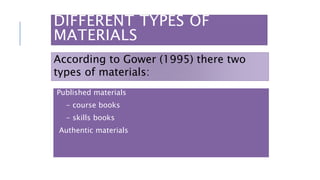
DIFFERENT TYPES OF
MATERIALS
Published materials
- course books
- skills books
Authentic materials
According to Gower (1995) there two
types of materials:
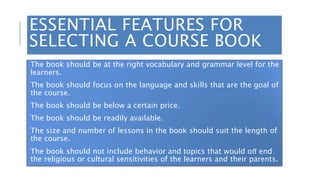
ESSENTIAL FEATURES FOR
SELECTING A COURSE BOOK
The book should be at the right vocabulary and grammar level for the
learners.
The book should focus on the language and skills that are the goal of
the course.
The book should be below a certain price.
The book should be readily available.
The size and number of lessons in the book should suit the length of
the course.
The book should not include behavior and topics that would off end
the religious or cultural sensitivities of the learners and their parents.
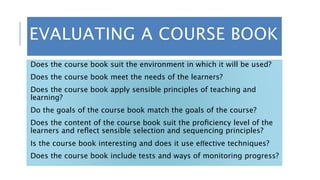
EVALUATING A COURSE BOOK
Does the course book suit the environment in which it will be used?
Does the course book meet the needs of the learners?
Does the course book apply sensible principles of teaching and
learning?
Do the goals of the course book match the goals of the course?
Does the content of the course book suit the proficiency level of the
learners and reflect sensible selection and sequencing principles?
Is the course book interesting and does it use effective techniques?
Does the course book include tests and ways of monitoring progress?
FOR “CHECKLIST FOR ADOPTING
TEXTBOOKS” SEE BROWN (1995) P. 161
“Steps for adapting materials” see
Brown (1995) p. 166
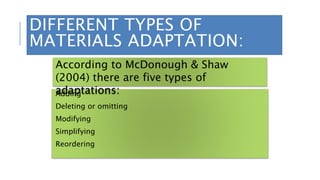
DIFFERENT TYPES OF
MATERIALS ADAPTATION:
Adding
Deleting or omitting
Modifying
Simplifying
Reordering
According to McDonough & Shaw
(2004) there are five types of
adaptations:
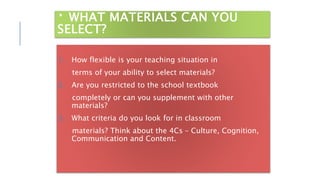
WHAT MATERIALS CAN YOU
SELECT?
1. How flexible is your teaching situation in
terms of your ability to select materials?
2. Are you restricted to the school textbook
completely or can you supplement with other
materials?
3. What criteria do you look for in classroom
materials? Think about the 4Cs – Culture, Cognition,
Communication and Content.
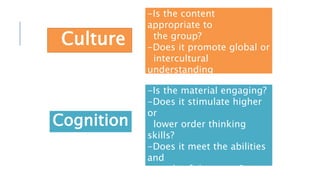
Culture
-Is the content
appropriate to
the group?
-Does it promote global or
intercultural
understanding
and awareness?
Cognition
-Is the material engaging?
-Does it stimulate higher
or
lower order thinking
skills?
-Does it meet the abilities
and
needs of the group?
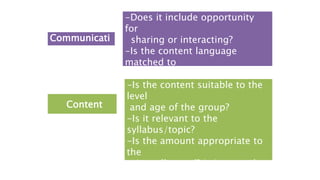
Communicati
on
-Does it include opportunity
for
sharing or interacting?
-Is the content language
matched to
the level of the group?
Content
-Is the content suitable to the
level
and age of the group?
-Is it relevant to the
syllabus/topic?
-Is the amount appropriate to
the
time allocated? Is it up to date
and
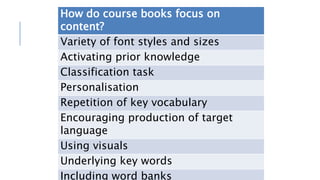
How do course books focus on
content?
Variety of font styles and sizes
Activating prior knowledge
Classification task
Personalisation
Repetition of key vocabulary
Encouraging production of target
language
Using visuals
Underlying key words
Including word banks
HOW DO YOU SELECT
AND ADAPT
AUTHENTIC
MATERIALS?
ADVANTAGES & DISADVANTAGES OF
AUTHENTIC MATERIALS
Advantages Disadvantages
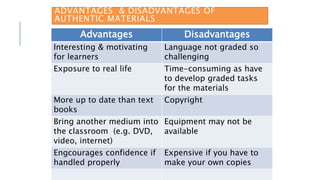
ADVANTAGES & DISADVANTAGES OF
AUTHENTIC MATERIALS
Advantages Disadvantages
Interesting & motivating
for learners
Language not graded so
challenging
Exposure to real life Time-consuming as have
to develop graded tasks
for the materials
More up to date than text
books
Copyright
Bring another medium into
the classroom (e.g. DVD,
video, internet)
Equipment may not be
available
Engcourages confidence if
handled properly
Expensive if you have to
make your own copies
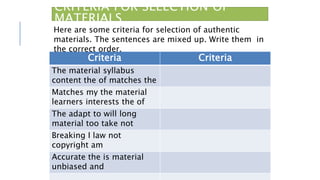
CRITERIA FOR SELECTION OF
MATERIALS
Criteria Criteria
The material syllabus
content the of matches the
Matches my the material
learners interests the of
The adapt to will long
material too take not
Breaking I law not
copyright am
Accurate the is material
unbiased and
Here are some criteria for selection of authentic
materials. The sentences are mixed up. Write them in
the correct order.
ADAPTATION METHOD
REFERENCES
Brown, JD.1996. The Elements of Language Curriculum; A Systematic
Approach to Program Development. Boston, Mass.: Heinle & Heinle
Publishers
Nation, I.S.P. & Macalister, J. 2010. Language Curriculum Design.
Oxon: Routledge.

Adopting and Adapting Materials

  • 1.
  • 2.
    DIFFERENT TYPES OF MATERIALS Publishedmaterials - course books - skills books Authentic materials According to Gower (1995) there two types of materials:
  • 3.
    ESSENTIAL FEATURES FOR SELECTINGA COURSE BOOK The book should be at the right vocabulary and grammar level for the learners. The book should focus on the language and skills that are the goal of the course. The book should be below a certain price. The book should be readily available. The size and number of lessons in the book should suit the length of the course. The book should not include behavior and topics that would off end the religious or cultural sensitivities of the learners and their parents.
  • 4.
    EVALUATING A COURSEBOOK Does the course book suit the environment in which it will be used? Does the course book meet the needs of the learners? Does the course book apply sensible principles of teaching and learning? Do the goals of the course book match the goals of the course? Does the content of the course book suit the proficiency level of the learners and reflect sensible selection and sequencing principles? Is the course book interesting and does it use effective techniques? Does the course book include tests and ways of monitoring progress?
  • 5.
    FOR “CHECKLIST FORADOPTING TEXTBOOKS” SEE BROWN (1995) P. 161 “Steps for adapting materials” see Brown (1995) p. 166
  • 6.
    DIFFERENT TYPES OF MATERIALSADAPTATION: Adding Deleting or omitting Modifying Simplifying Reordering According to McDonough & Shaw (2004) there are five types of adaptations:
  • 7.
    WHAT MATERIALS CANYOU SELECT? 1. How flexible is your teaching situation in terms of your ability to select materials? 2. Are you restricted to the school textbook completely or can you supplement with other materials? 3. What criteria do you look for in classroom materials? Think about the 4Cs – Culture, Cognition, Communication and Content.
  • 8.
    Culture -Is the content appropriateto the group? -Does it promote global or intercultural understanding and awareness? Cognition -Is the material engaging? -Does it stimulate higher or lower order thinking skills? -Does it meet the abilities and needs of the group?
  • 9.
    Communicati on -Does it includeopportunity for sharing or interacting? -Is the content language matched to the level of the group? Content -Is the content suitable to the level and age of the group? -Is it relevant to the syllabus/topic? -Is the amount appropriate to the time allocated? Is it up to date and
  • 10.
    How do coursebooks focus on content? Variety of font styles and sizes Activating prior knowledge Classification task Personalisation Repetition of key vocabulary Encouraging production of target language Using visuals Underlying key words Including word banks
  • 11.
    HOW DO YOUSELECT AND ADAPT AUTHENTIC MATERIALS?
  • 12.
    ADVANTAGES & DISADVANTAGESOF AUTHENTIC MATERIALS Advantages Disadvantages
  • 13.
    ADVANTAGES & DISADVANTAGESOF AUTHENTIC MATERIALS Advantages Disadvantages Interesting & motivating for learners Language not graded so challenging Exposure to real life Time-consuming as have to develop graded tasks for the materials More up to date than text books Copyright Bring another medium into the classroom (e.g. DVD, video, internet) Equipment may not be available Engcourages confidence if handled properly Expensive if you have to make your own copies
  • 14.
    CRITERIA FOR SELECTIONOF MATERIALS Criteria Criteria The material syllabus content the of matches the Matches my the material learners interests the of The adapt to will long material too take not Breaking I law not copyright am Accurate the is material unbiased and Here are some criteria for selection of authentic materials. The sentences are mixed up. Write them in the correct order.
  • 18.
  • 19.
    REFERENCES Brown, JD.1996. TheElements of Language Curriculum; A Systematic Approach to Program Development. Boston, Mass.: Heinle & Heinle Publishers Nation, I.S.P. & Macalister, J. 2010. Language Curriculum Design. Oxon: Routledge.