Vikas Kumar Saini
Roll No.-13284 ,EEE
NIT-Hamirpur( H.P. )
Contents :-
 Introduction
 Power triangle
 Reactive power
 Why do we need reactive power
 Need for reactive power compensation
 Compensation techniques
 Conclusion
Introduction : -
The demand of the reactive power is mainly
originated from inductive load connected to the
system .
These inductive loads generally electromagnetic
circuit of electric motors, electrical transformers,
distribution networks and induction furnaces etc.
Reactive power compensation is the defined as the
management of reactive power to improve the
performance of AC system . There are two aspects : -
1. Load compensation
2. Voltage support
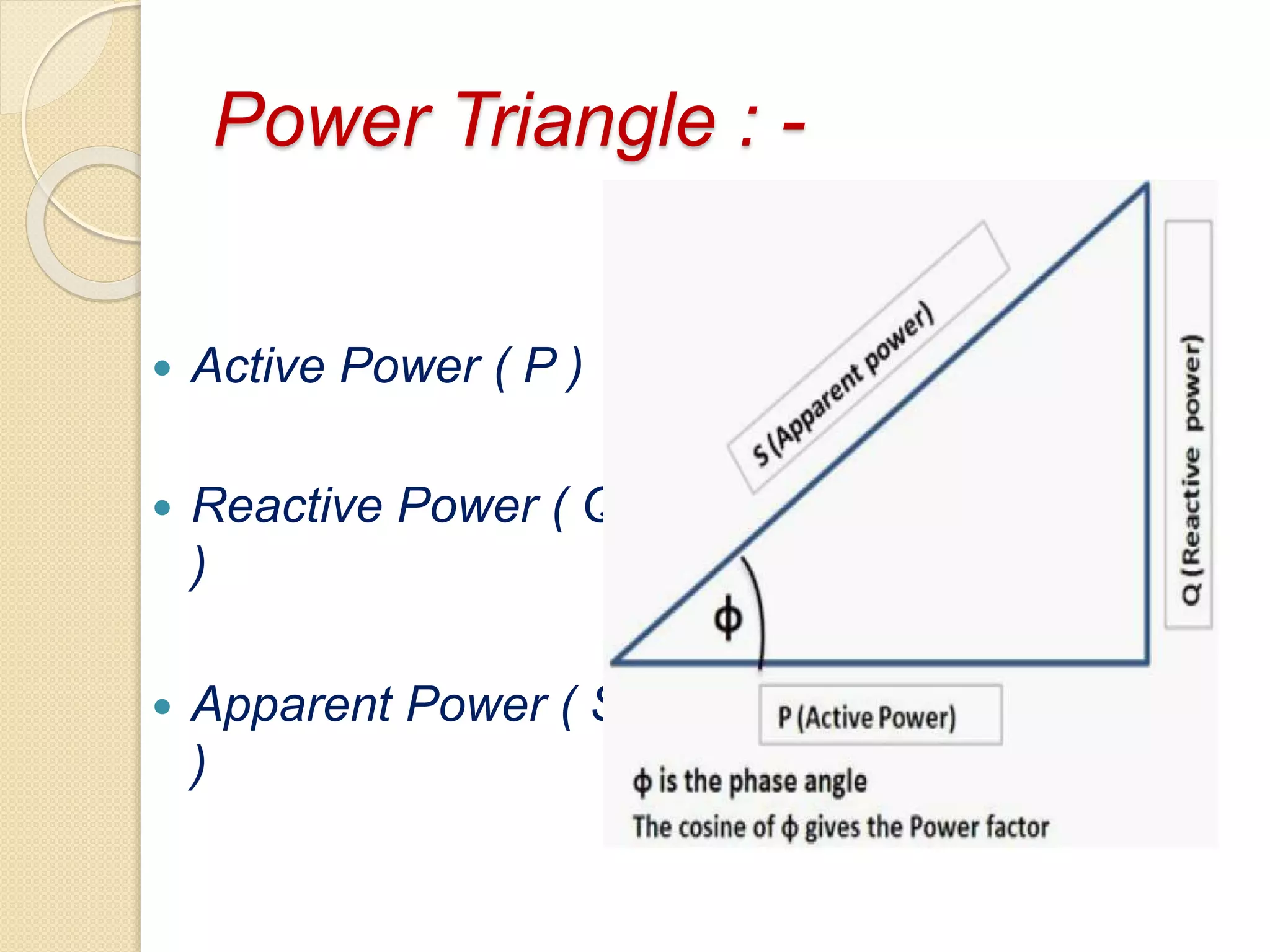
Power Triangle : -
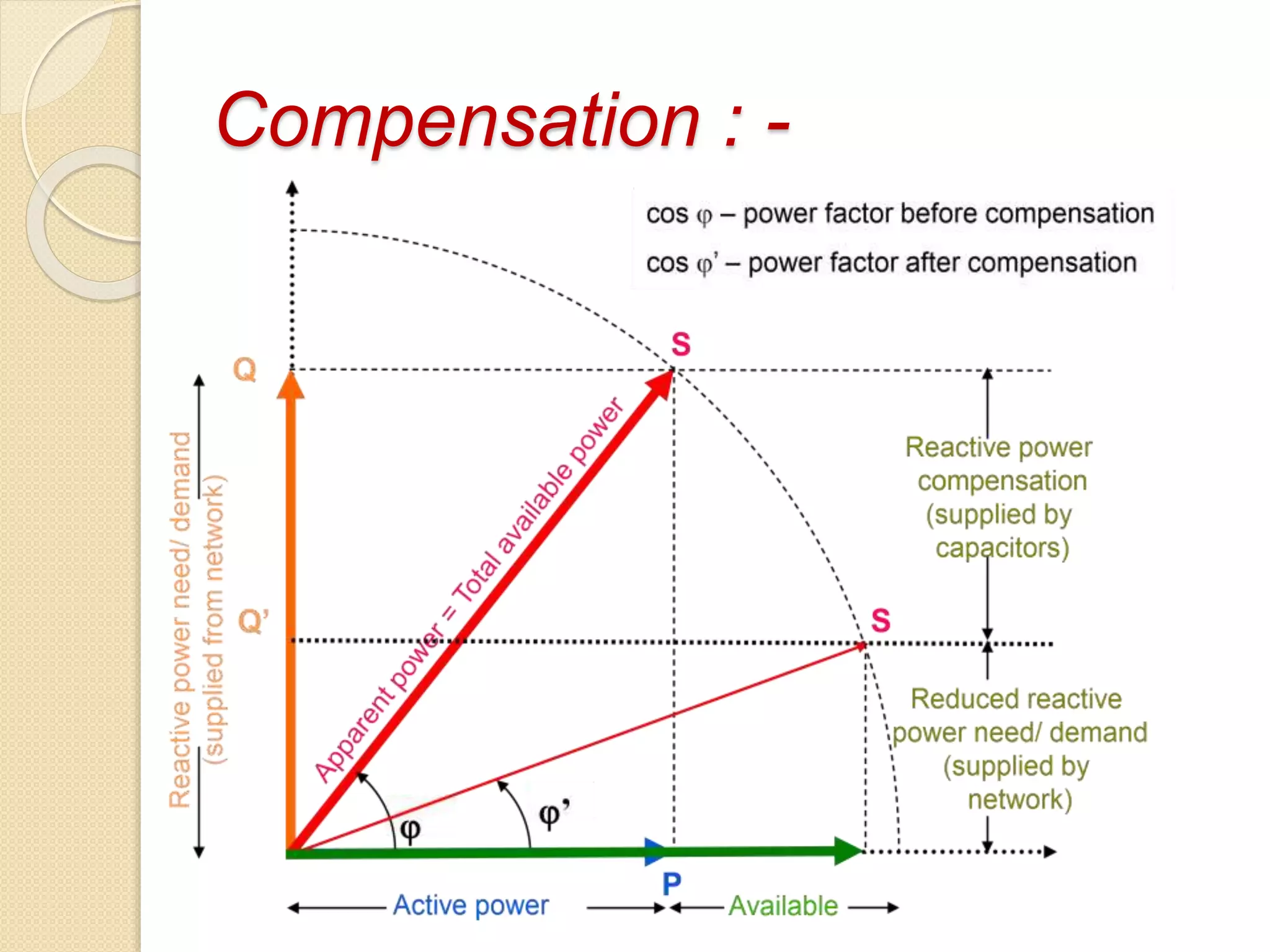
 Active Power ( P )
 Reactive Power ( Q
)
 Apparent Power ( S
)
Active Power ( P ) : - It is the power that actually
powers the equipment and performs useful work . Unit
of it W .
Reactive Power ( Q ) : - It is the power that magnetic
equipment
{ transformer , motor etc. } needs to produce the
magnetizing
flux . Unit of it VAr .
Apparent Power ( S ) : - It is the “ vectorial summation ” of
active power ( P ) and reactive power ( Q ) . Unit of it VA .
Reactive Power : -
The portion of power flow that is temporarily stored in
the form of magnetic or electric fields , due to
inductive or capacitive network element and then
returned to source is known as reactive power .
Reactive power can best be described as the
quantity of “unused” power that is stored in reactive
components , such as inductors or capacitors . In
other words , the reactive circuit returns as much
power to the supply as it consumes .
Why do we need reactive
power : -
In resistive loads the current produces the heat
energy which produces the desired output but incase
of inductive loads the current creates the magnetic
field which further produces the desired work.
Therefore reactive power is the non working power
caused by the magnetic current to operate and
sustain magnetism in the device .
Reactive power (vars) is required to maintain the
voltage to deliver active power (watts) through
transmission lines. When there is not enough
reactive power the voltage sags down and it is not
possible to deliver the required power to load through
the lines.
Need for reactive power
compensation : -
Reactive power generated by the ac power source is
stored in a reactor during a quarter of a cycle and in
the next quarter of the cycle it is sent back to the
power source. Therefore the reactive power
oscillates between the ac source and the reactor at a
frequency equals to two times the rated value (50 or
60 Hz). So to avoid the circulation between the load
and source it needs to be compensated .
To improve system power factor .
Reduce losses associated with the system .
Improves the voltage regulation in the network .
Increased system stability .
Reactive power levels have an effect on voltage
collapse .
Compensation : -
Compensation Techniques : -
Synchronous Condenser
Shunt Compensation
Series Compensation
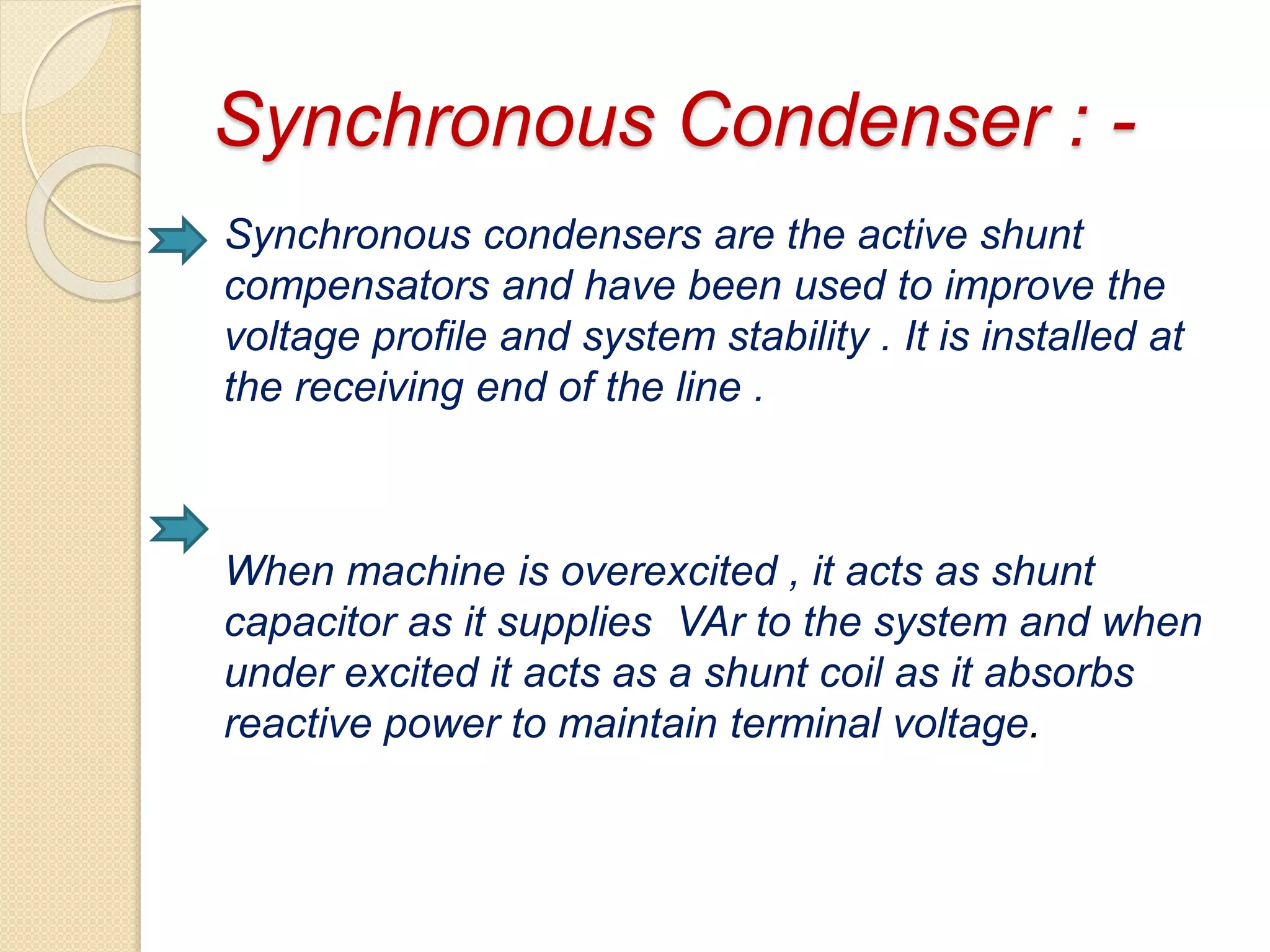
Synchronous Condenser : -
Synchronous condensers are the active shunt
compensators and have been used to improve the
voltage profile and system stability . It is installed at
the receiving end of the line .
When machine is overexcited , it acts as shunt
capacitor as it supplies VAr to the system and when
under excited it acts as a shunt coil as it absorbs
reactive power to maintain terminal voltage.
Shunt Compensation : -
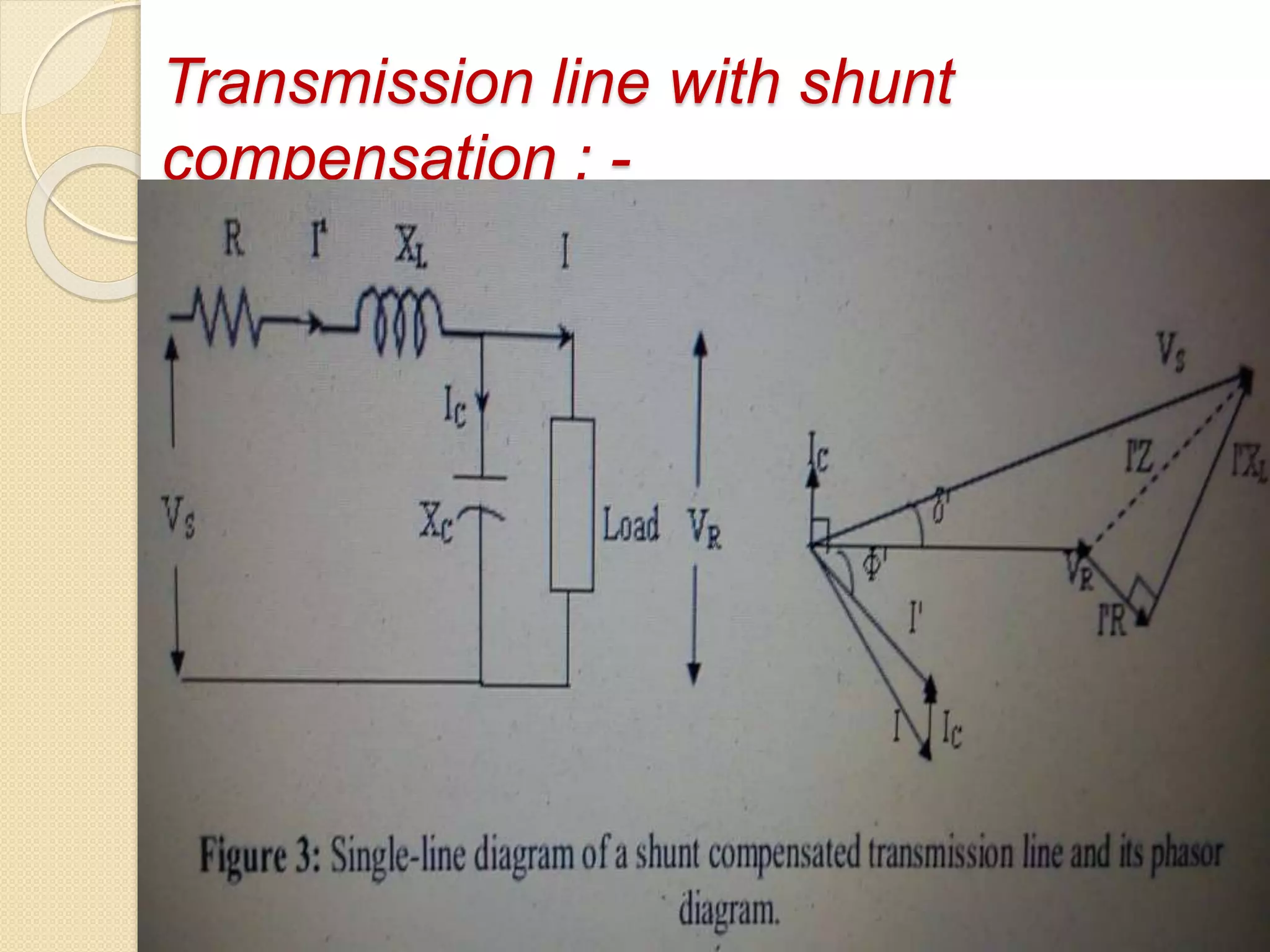
The device that is connected in parallel with the
transmission line for reactive power compensation is
called the shunt compensator
It can be provided by either a current source, voltage
source or a capacitor.
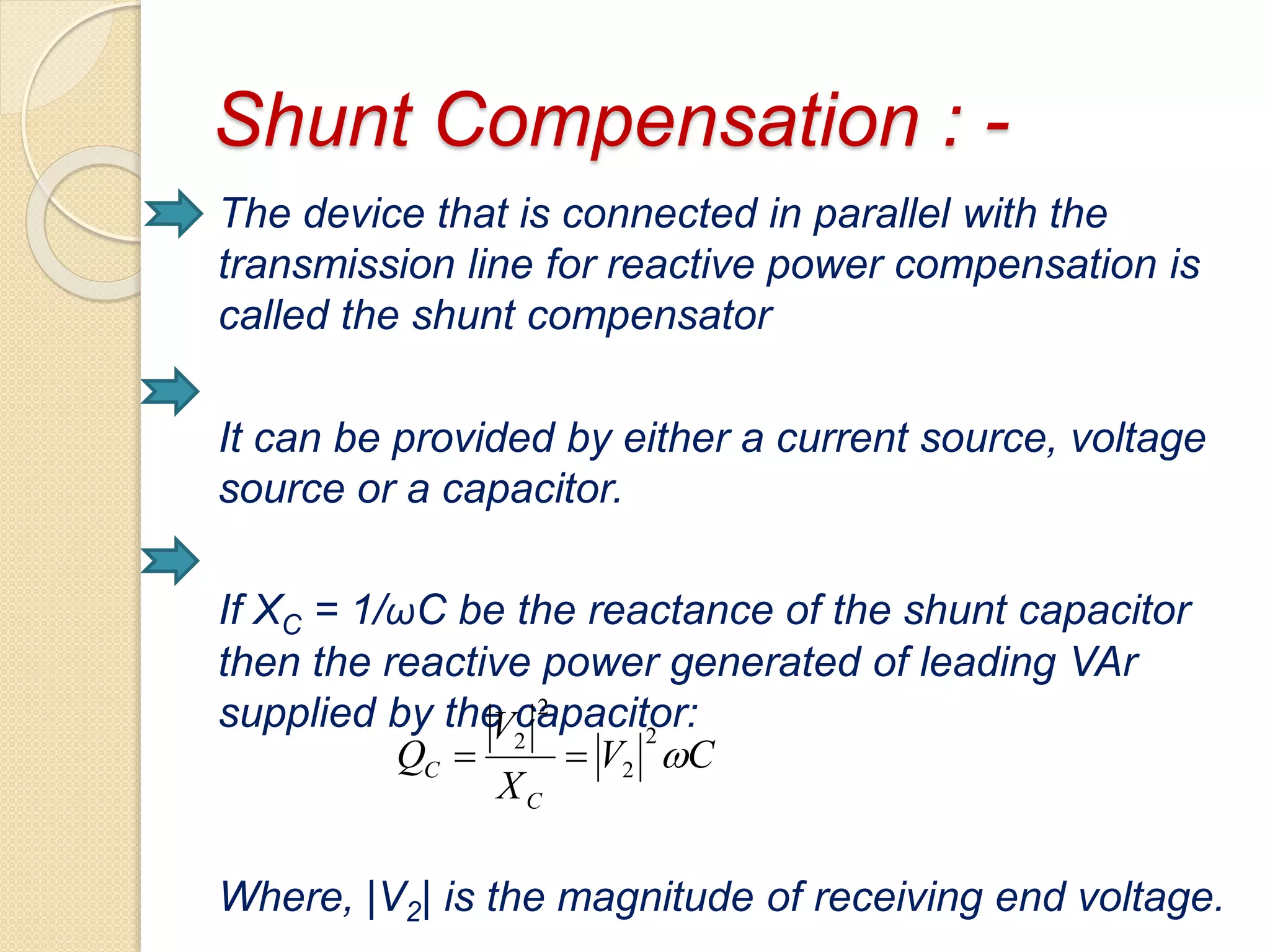
If XC = 1/ωC be the reactance of the shunt capacitor
then the reactive power generated of leading VAr
supplied by the capacitor:
Where, |V2| is the magnitude of receiving end voltage.
CV
X
V
Q
C
C 
2
2
2
2

Transmission line with shunt
compensation : -
Series Compensation : -
Capacitor are connected in series in the lines and are
used mainly for boosting the receiving end voltage,
increase in transmission capacity and reduction in
losses in the lines .
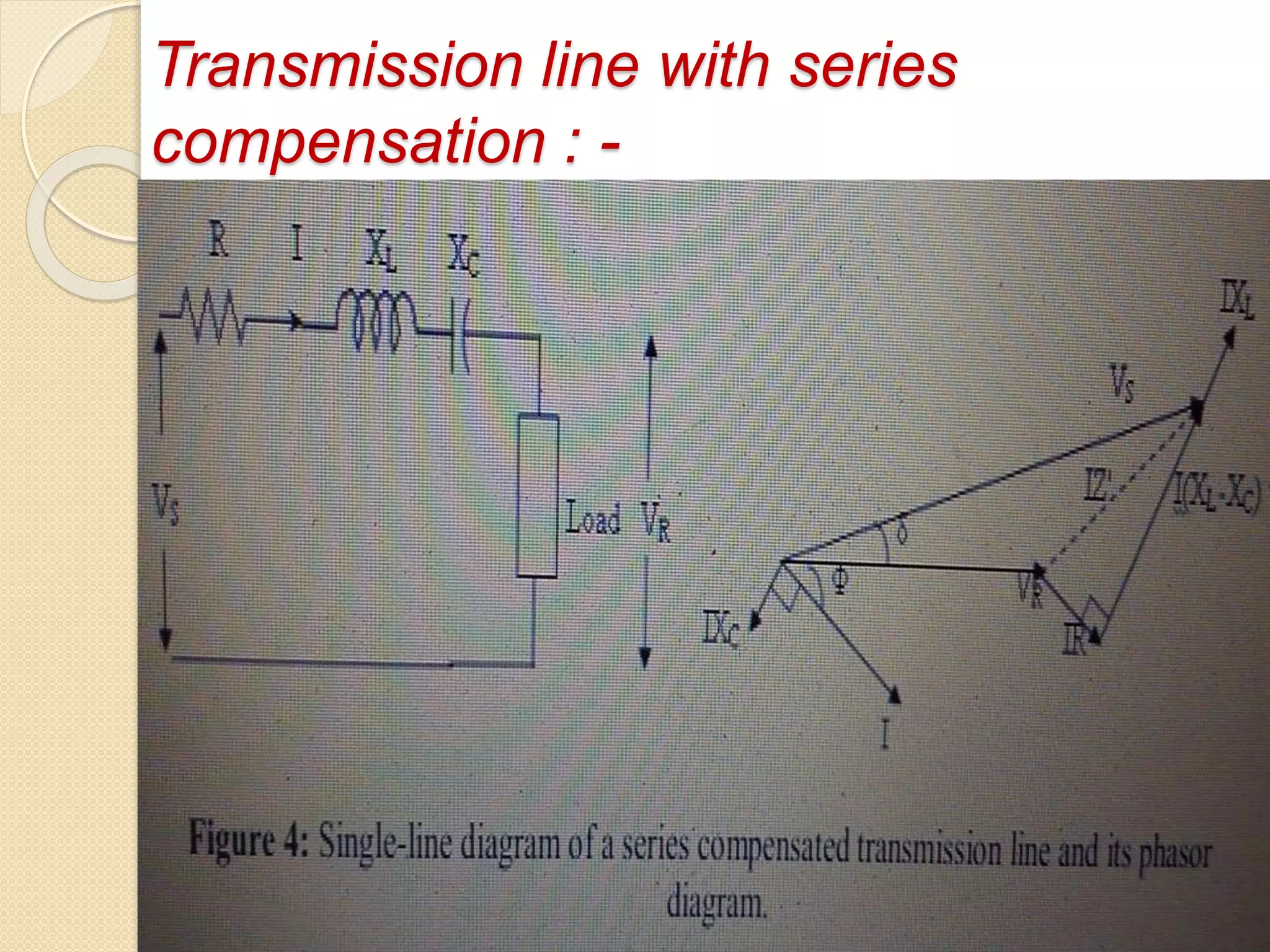
The capacitive reactance of series capacitor
neutralizes the inductive reactance of the line hence ,
reduces effective reactance of the line. Thereby ,
voltage regulation of the system is improved .
Transmission line with series
compensation : -
Conclusion : -
From all the previous discussion we can
conclude that reactive power
compensation is a must for improving
the performance of the ac system. By
reactive power compensation we can
control the power factor and reduce the
consumption of electricity .
References : -
Need for reactive power compensation by ABB
www.electrical-engineering portal.com
www.electrical4u.com
www.slideshare.net
ethesis.nitrkl.ac.in/2243/1/Project_Thesis_Final.pdf
Reactive power compensation

Reactive power compensation

  • 1.
    Vikas Kumar Saini RollNo.-13284 ,EEE NIT-Hamirpur( H.P. )
  • 2.
    Contents :-  Introduction Power triangle  Reactive power  Why do we need reactive power  Need for reactive power compensation  Compensation techniques  Conclusion
  • 3.
    Introduction : - Thedemand of the reactive power is mainly originated from inductive load connected to the system . These inductive loads generally electromagnetic circuit of electric motors, electrical transformers, distribution networks and induction furnaces etc. Reactive power compensation is the defined as the management of reactive power to improve the performance of AC system . There are two aspects : - 1. Load compensation 2. Voltage support
  • 4.
    Power Triangle :-  Active Power ( P )  Reactive Power ( Q )  Apparent Power ( S )
  • 5.
    Active Power (P ) : - It is the power that actually powers the equipment and performs useful work . Unit of it W . Reactive Power ( Q ) : - It is the power that magnetic equipment { transformer , motor etc. } needs to produce the magnetizing flux . Unit of it VAr . Apparent Power ( S ) : - It is the “ vectorial summation ” of active power ( P ) and reactive power ( Q ) . Unit of it VA .
  • 6.
    Reactive Power :- The portion of power flow that is temporarily stored in the form of magnetic or electric fields , due to inductive or capacitive network element and then returned to source is known as reactive power . Reactive power can best be described as the quantity of “unused” power that is stored in reactive components , such as inductors or capacitors . In other words , the reactive circuit returns as much power to the supply as it consumes .
  • 7.
    Why do weneed reactive power : - In resistive loads the current produces the heat energy which produces the desired output but incase of inductive loads the current creates the magnetic field which further produces the desired work. Therefore reactive power is the non working power caused by the magnetic current to operate and sustain magnetism in the device . Reactive power (vars) is required to maintain the voltage to deliver active power (watts) through transmission lines. When there is not enough reactive power the voltage sags down and it is not possible to deliver the required power to load through the lines.
  • 8.
    Need for reactivepower compensation : - Reactive power generated by the ac power source is stored in a reactor during a quarter of a cycle and in the next quarter of the cycle it is sent back to the power source. Therefore the reactive power oscillates between the ac source and the reactor at a frequency equals to two times the rated value (50 or 60 Hz). So to avoid the circulation between the load and source it needs to be compensated . To improve system power factor .
  • 9.
    Reduce losses associatedwith the system . Improves the voltage regulation in the network . Increased system stability . Reactive power levels have an effect on voltage collapse .
  • 10.
  • 11.
    Compensation Techniques :- Synchronous Condenser Shunt Compensation Series Compensation
  • 12.
    Synchronous Condenser :- Synchronous condensers are the active shunt compensators and have been used to improve the voltage profile and system stability . It is installed at the receiving end of the line . When machine is overexcited , it acts as shunt capacitor as it supplies VAr to the system and when under excited it acts as a shunt coil as it absorbs reactive power to maintain terminal voltage.
  • 13.
    Shunt Compensation :- The device that is connected in parallel with the transmission line for reactive power compensation is called the shunt compensator It can be provided by either a current source, voltage source or a capacitor. If XC = 1/ωC be the reactance of the shunt capacitor then the reactive power generated of leading VAr supplied by the capacitor: Where, |V2| is the magnitude of receiving end voltage. CV X V Q C C  2 2 2 2 
  • 14.
    Transmission line withshunt compensation : -
  • 15.
    Series Compensation :- Capacitor are connected in series in the lines and are used mainly for boosting the receiving end voltage, increase in transmission capacity and reduction in losses in the lines . The capacitive reactance of series capacitor neutralizes the inductive reactance of the line hence , reduces effective reactance of the line. Thereby , voltage regulation of the system is improved .
  • 16.
    Transmission line withseries compensation : -
  • 17.
    Conclusion : - Fromall the previous discussion we can conclude that reactive power compensation is a must for improving the performance of the ac system. By reactive power compensation we can control the power factor and reduce the consumption of electricity .
  • 18.
    References : - Needfor reactive power compensation by ABB www.electrical-engineering portal.com www.electrical4u.com www.slideshare.net ethesis.nitrkl.ac.in/2243/1/Project_Thesis_Final.pdf