ELECTRIC TRACTION
S.RAGUL,
AP/EEE
DEPARTMENT OF EEE
KONGUNADU COLLEGE OF
ENGINEERING & TECHNOLGY
electric traction KONGUNADU COLLEGE OF ENGINEERING & TECHNOLOGY
1
Content:
 Introduction to electric traction
 Major classification, requirements, merits, demerits, supply
system, speed variation.
 Factors affecting energy considerations, traction features, recent
trends
 References
INTRODUCTION:
 The locomotion in which the driving force is
obtained from electric motor is called the electric
traction system.
 There are various system of electric traction
existing such as electric train, trolley buses,
diesel-electric vehicles and gas turbine electric
vehicles
2
electric traction KONGUNADU COLLEGE OF ENGINEERING & TECHNOLOGY
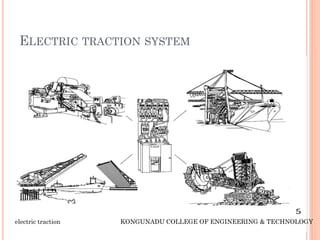
ELECTRIC TRACTION SYSTEM
3
electric traction KONGUNADU COLLEGE OF ENGINEERING & TECHNOLOGY
MAJOR CLASSIFICATIONS OF
TRACTION
 Non-electric traction:
examples
steam engine drive
ic engine drive
 Electric traction:
examples
diesel electric drive
gas turbine electric drive
4
electric traction KONGUNADU COLLEGE OF ENGINEERING & TECHNOLOGY
REQUIREMENTS OF AN IDEAL TRACTION
SYSTEM
 The starting tractive effort should be high so as
to have rapid acceleration.
 The wear on the track should be minimum.
 The equipments should be capable of
withstanding large temporary loads.
 Speed control should be easy.
 Pollution free.
 Low initial and maintenance cost.
 The locomotive should be self contain and able to
run on any route.
5
electric traction KONGUNADU COLLEGE OF ENGINEERING & TECHNOLOGY
MERITS OF ELECTRIC TRACTION
 High starting torque.
 Less maintenance cost
 Cheapest method of traction
 Rapid acceleration and braking
 Less vibration
 Free from smoke and flue gases hence used for
underground and tubular railway.
6
electric traction KONGUNADU COLLEGE OF ENGINEERING & TECHNOLOGY
DEMERITS OF ELECTRIC TRACTION
 High capital cost.
 Problem of supply failure.
 The electrically operated vehicles have to move
on guided track only.
 Additional equipment is required for achieving
electric braking and control.
7
electric traction ONGUNADU COLLEGE OF ENGINEERING & TECHNOLOGY
DIFFERENT SYSTEMS OF TRACTION:
 Direct steam engine drive
 Direct IC engine drive
 Steam electric drive
 IC engine electric drive
 Petrol electric traction
 Battery electric drive
 Electric drive
8
OUTDOOR LIGHTING KONGUNADU COLLEGE OF ENGINEERING & TECHNOLOGY
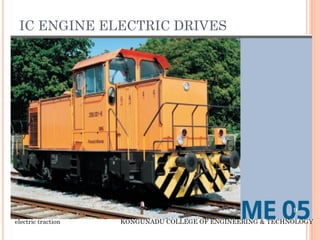
IC ENGINE ELECTRIC DRIVES
9
electric traction KONGUNADU COLLEGE OF ENGINEERING & TECHNOLOGY
SUPPLY SYSTEMS FOR ELECTRIC
TRACTION:
 D.C system
 A.C system
 Single phase
 Three phase
 Composite system
 Single phase AC to DC
 Single phase to three phase
10
electric traction KONGUNADU COLLEGE OF ENGINEERING & TECHNOLOGY
SPEED TIME CURVE FOR TRAIN MOVEMENT
 Acceleration
 Constant acceleration
 Speed curve running
 Free run or constant speed period
 Coasting period
 Retardation or braking period
11
electric traction KONGUNADU COLLEGE OF ENGINEERING & TECHNOLOGY
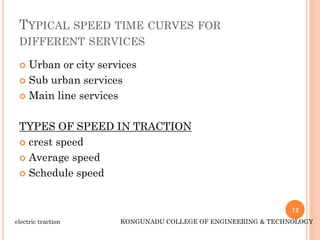
TYPICAL SPEED TIME CURVES FOR
DIFFERENT SERVICES
 Urban or city services
 Sub urban services
 Main line services
TYPES OF SPEED IN TRACTION
 crest speed
 Average speed
 Schedule speed
12
electric traction KONGUNADU COLLEGE OF ENGINEERING & TECHNOLOGY
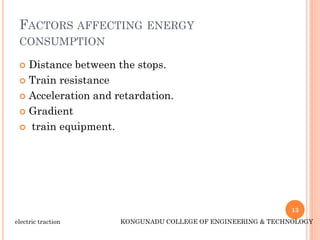
FACTORS AFFECTING ENERGY
CONSUMPTION
 Distance between the stops.
 Train resistance
 Acceleration and retardation.
 Gradient
 train equipment.
13
electric traction KONGUNADU COLLEGE OF ENGINEERING & TECHNOLOGY
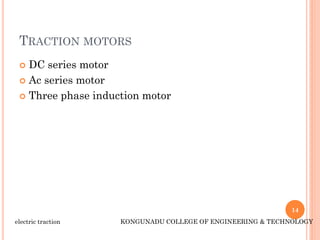
TRACTION MOTORS
 DC series motor
 Ac series motor
 Three phase induction motor
14
electric traction KONGUNADU COLLEGE OF ENGINEERING & TECHNOLOGY
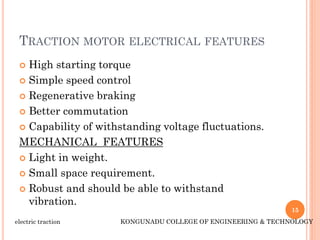
TRACTION MOTOR ELECTRICAL FEATURES
 High starting torque
 Simple speed control
 Regenerative braking
 Better commutation
 Capability of withstanding voltage fluctuations.
MECHANICAL FEATURES
 Light in weight.
 Small space requirement.
 Robust and should be able to withstand
vibration.
15
electric traction KONGUNADU COLLEGE OF ENGINEERING & TECHNOLOGY
RECENT TRENDS IN ELECTRIC TRACTION
 Tap changer control
 Thyristor control
 Chopper control
 Micro processor control
16
electric traction KONGUNADU COLLEGE OF ENGINEERING & TECHNOLOGY
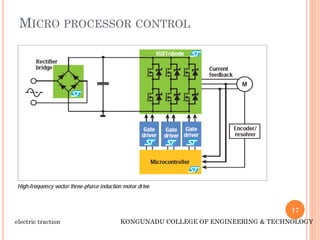
MICRO PROCESSOR CONTROL
17
electric traction KONGUNADU COLLEGE OF ENGINEERING & TECHNOLOGY
Conclusion:
 The Major classification of electric traction, requirements, merits,
demerits, supply system, speed variation, factors affecting energy
considerations, traction features, recent trends is explained in detail
with suitable diagrams.
References:
 N.V. Suryanarayana, “Utilisation of Electric Power”, Wiley
Eastern Limited, New Age International Limited,1993.
 J.B.Gupta, “Utilisation Electric power and Electric
Traction”, S.K.Kataria and Sons, 2000.
 G.D.Rai, “Non-Conventional Energy Sources”, Khanna
Publications Ltd., New Delhi, 1997
 C.L.Wadhwa,“Generation, Distribution and Utilisation of
Electrical Energy”, New AgeInternationalPvt.Ltd., 2003.
 B.H.Khan, “Non Conventional Energy Resource”, Tata
Mcgraw hill eductation pvt ltd.., 2009
 VThiyagaran, “Electric Energy Generation, Utilization and
Conservation”, Lakshmi publications.,2016
 Other Web Sources
18
electric traction KONGUNADU COLLEGE OF ENGINEERING & TECHNOLOGY

Electric traction ppt

  • 1.
    ELECTRIC TRACTION S.RAGUL, AP/EEE DEPARTMENT OFEEE KONGUNADU COLLEGE OF ENGINEERING & TECHNOLGY electric traction KONGUNADU COLLEGE OF ENGINEERING & TECHNOLOGY 1 Content:  Introduction to electric traction  Major classification, requirements, merits, demerits, supply system, speed variation.  Factors affecting energy considerations, traction features, recent trends  References
  • 2.
    INTRODUCTION:  The locomotionin which the driving force is obtained from electric motor is called the electric traction system.  There are various system of electric traction existing such as electric train, trolley buses, diesel-electric vehicles and gas turbine electric vehicles 2 electric traction KONGUNADU COLLEGE OF ENGINEERING & TECHNOLOGY
  • 3.
    ELECTRIC TRACTION SYSTEM 3 electrictraction KONGUNADU COLLEGE OF ENGINEERING & TECHNOLOGY
  • 4.
    MAJOR CLASSIFICATIONS OF TRACTION Non-electric traction: examples steam engine drive ic engine drive  Electric traction: examples diesel electric drive gas turbine electric drive 4 electric traction KONGUNADU COLLEGE OF ENGINEERING & TECHNOLOGY
  • 5.
    REQUIREMENTS OF ANIDEAL TRACTION SYSTEM  The starting tractive effort should be high so as to have rapid acceleration.  The wear on the track should be minimum.  The equipments should be capable of withstanding large temporary loads.  Speed control should be easy.  Pollution free.  Low initial and maintenance cost.  The locomotive should be self contain and able to run on any route. 5 electric traction KONGUNADU COLLEGE OF ENGINEERING & TECHNOLOGY
  • 6.
    MERITS OF ELECTRICTRACTION  High starting torque.  Less maintenance cost  Cheapest method of traction  Rapid acceleration and braking  Less vibration  Free from smoke and flue gases hence used for underground and tubular railway. 6 electric traction KONGUNADU COLLEGE OF ENGINEERING & TECHNOLOGY
  • 7.
    DEMERITS OF ELECTRICTRACTION  High capital cost.  Problem of supply failure.  The electrically operated vehicles have to move on guided track only.  Additional equipment is required for achieving electric braking and control. 7 electric traction ONGUNADU COLLEGE OF ENGINEERING & TECHNOLOGY
  • 8.
    DIFFERENT SYSTEMS OFTRACTION:  Direct steam engine drive  Direct IC engine drive  Steam electric drive  IC engine electric drive  Petrol electric traction  Battery electric drive  Electric drive 8 OUTDOOR LIGHTING KONGUNADU COLLEGE OF ENGINEERING & TECHNOLOGY
  • 9.
    IC ENGINE ELECTRICDRIVES 9 electric traction KONGUNADU COLLEGE OF ENGINEERING & TECHNOLOGY
  • 10.
    SUPPLY SYSTEMS FORELECTRIC TRACTION:  D.C system  A.C system  Single phase  Three phase  Composite system  Single phase AC to DC  Single phase to three phase 10 electric traction KONGUNADU COLLEGE OF ENGINEERING & TECHNOLOGY
  • 11.
    SPEED TIME CURVEFOR TRAIN MOVEMENT  Acceleration  Constant acceleration  Speed curve running  Free run or constant speed period  Coasting period  Retardation or braking period 11 electric traction KONGUNADU COLLEGE OF ENGINEERING & TECHNOLOGY
  • 12.
    TYPICAL SPEED TIMECURVES FOR DIFFERENT SERVICES  Urban or city services  Sub urban services  Main line services TYPES OF SPEED IN TRACTION  crest speed  Average speed  Schedule speed 12 electric traction KONGUNADU COLLEGE OF ENGINEERING & TECHNOLOGY
  • 13.
    FACTORS AFFECTING ENERGY CONSUMPTION Distance between the stops.  Train resistance  Acceleration and retardation.  Gradient  train equipment. 13 electric traction KONGUNADU COLLEGE OF ENGINEERING & TECHNOLOGY
  • 14.
    TRACTION MOTORS  DCseries motor  Ac series motor  Three phase induction motor 14 electric traction KONGUNADU COLLEGE OF ENGINEERING & TECHNOLOGY
  • 15.
    TRACTION MOTOR ELECTRICALFEATURES  High starting torque  Simple speed control  Regenerative braking  Better commutation  Capability of withstanding voltage fluctuations. MECHANICAL FEATURES  Light in weight.  Small space requirement.  Robust and should be able to withstand vibration. 15 electric traction KONGUNADU COLLEGE OF ENGINEERING & TECHNOLOGY
  • 16.
    RECENT TRENDS INELECTRIC TRACTION  Tap changer control  Thyristor control  Chopper control  Micro processor control 16 electric traction KONGUNADU COLLEGE OF ENGINEERING & TECHNOLOGY
  • 17.
    MICRO PROCESSOR CONTROL 17 electrictraction KONGUNADU COLLEGE OF ENGINEERING & TECHNOLOGY
  • 18.
    Conclusion:  The Majorclassification of electric traction, requirements, merits, demerits, supply system, speed variation, factors affecting energy considerations, traction features, recent trends is explained in detail with suitable diagrams. References:  N.V. Suryanarayana, “Utilisation of Electric Power”, Wiley Eastern Limited, New Age International Limited,1993.  J.B.Gupta, “Utilisation Electric power and Electric Traction”, S.K.Kataria and Sons, 2000.  G.D.Rai, “Non-Conventional Energy Sources”, Khanna Publications Ltd., New Delhi, 1997  C.L.Wadhwa,“Generation, Distribution and Utilisation of Electrical Energy”, New AgeInternationalPvt.Ltd., 2003.  B.H.Khan, “Non Conventional Energy Resource”, Tata Mcgraw hill eductation pvt ltd.., 2009  VThiyagaran, “Electric Energy Generation, Utilization and Conservation”, Lakshmi publications.,2016  Other Web Sources 18 electric traction KONGUNADU COLLEGE OF ENGINEERING & TECHNOLOGY