
Reactive PoweR-
PRoblems
and
solutions
POWER
Apparent
Power
Real Power
Reactive
Power
Reactive PoweR
Power is referred as the product of voltage and current i.e.
POWER = V x I
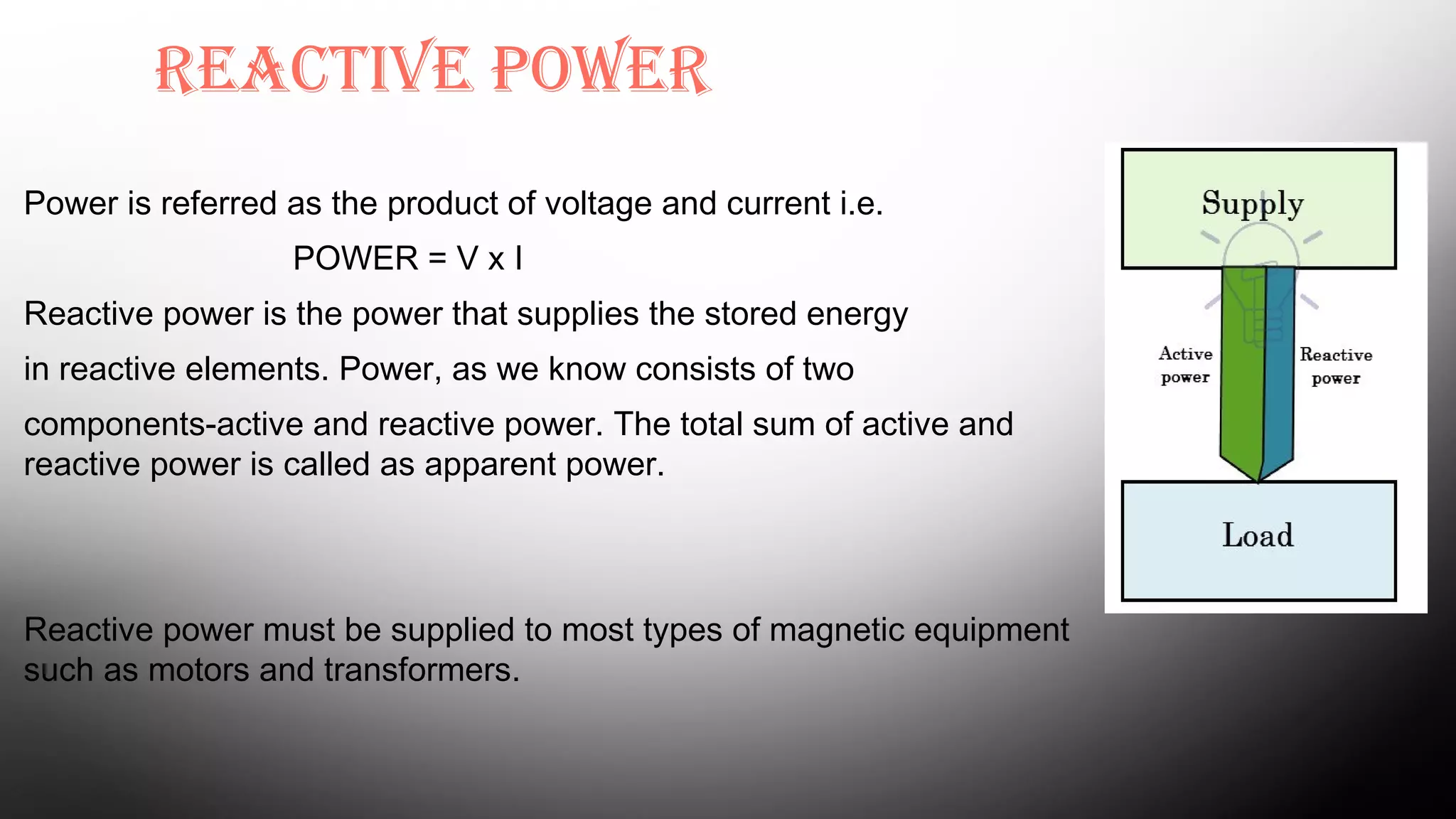
Reactive power is the power that supplies the stored energy
in reactive elements. Power, as we know consists of two
components-active and reactive power. The total sum of active and
reactive power is called as apparent power.
Reactive power must be supplied to most types of magnetic equipment
such as motors and transformers.
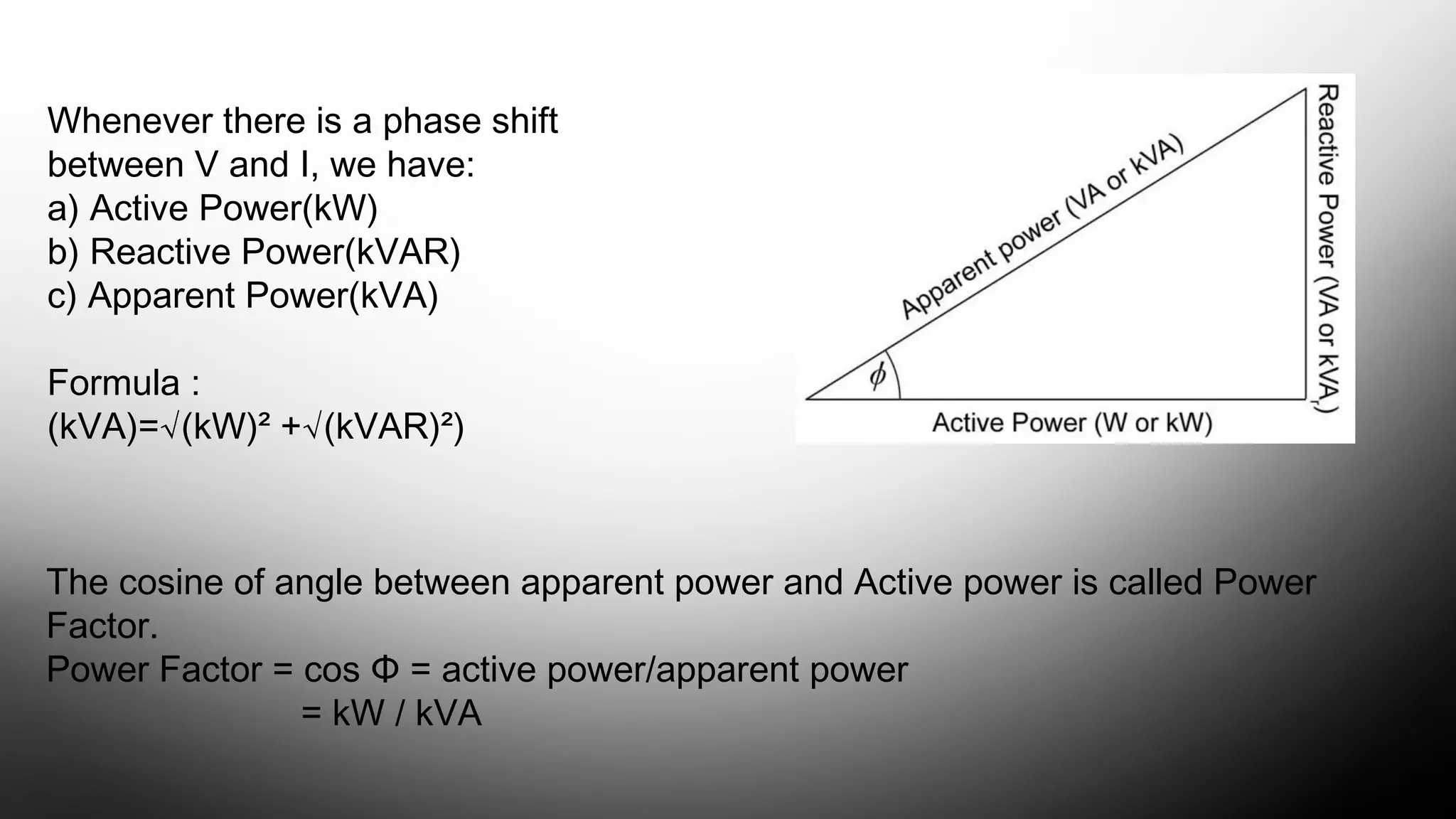
Whenever there is a phase shift
between V and I, we have:
a) Active Power(kW)
b) Reactive Power(kVAR)
c) Apparent Power(kVA)
Formula :
(kVA)=√(kW)² +√(kVAR)²)
The cosine of angle between apparent power and Active power is called Power
Factor.
Power Factor = cos Φ = active power/apparent power
= kW / kVA
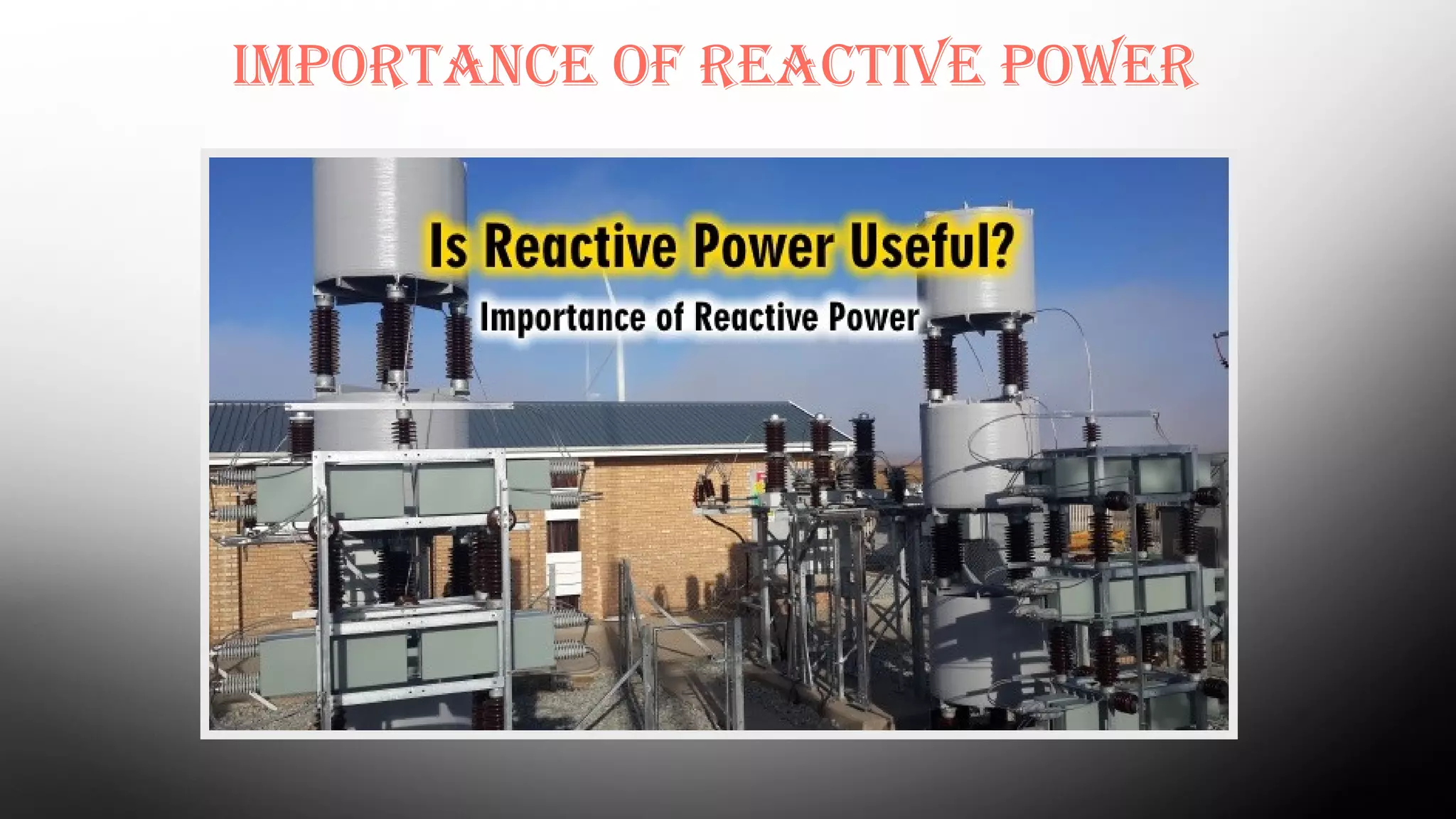
Importance of reactIve power
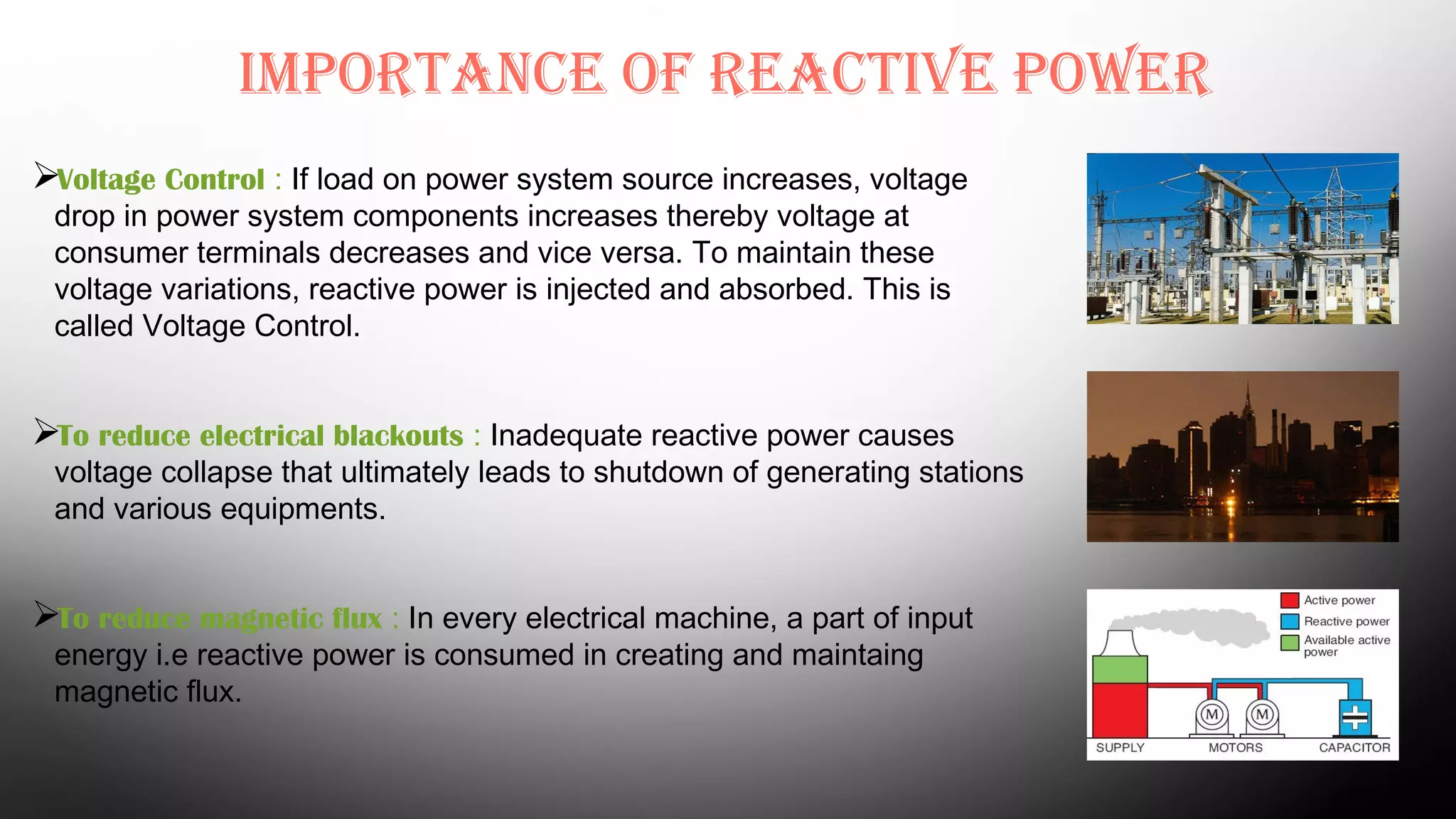
Voltage Control : If load on power system source increases, voltage
drop in power system components increases thereby voltage at
consumer terminals decreases and vice versa. To maintain these
voltage variations, reactive power is injected and absorbed. This is
called Voltage Control.
To reduce electrical blackouts : Inadequate reactive power causes
voltage collapse that ultimately leads to shutdown of generating stations
and various equipments.
To reduce magnetic flux : In every electrical machine, a part of input
energy i.e reactive power is consumed in creating and maintaing
magnetic flux.
Problems of reactive Power
Since electrical current flowing through electrical system is higher than that
necessary to do the required work, excess power dissipates in form of heat as
reactive current flows through resistive components like wires, switches etc.
Typical residential meters only read real power i.e. what you would have with power
factor of 1. While electrical companies don’t charge residencies directly for reactive
power, it is common misconception to say that reactive power correction has no
economic benefit. To begin with, companies correct for power factor around industrial
complexes or they charge more for reactive power.
Power factor correction can have adverse effect on sensitive industrialized
equipments if not handled by knowledgeable, experienced professionals.
By increasing the efficiency of electrical systems, energy demand and its
environmental impact is lessened.
solutions of reactive Powaer
Simple Compensation Strategies
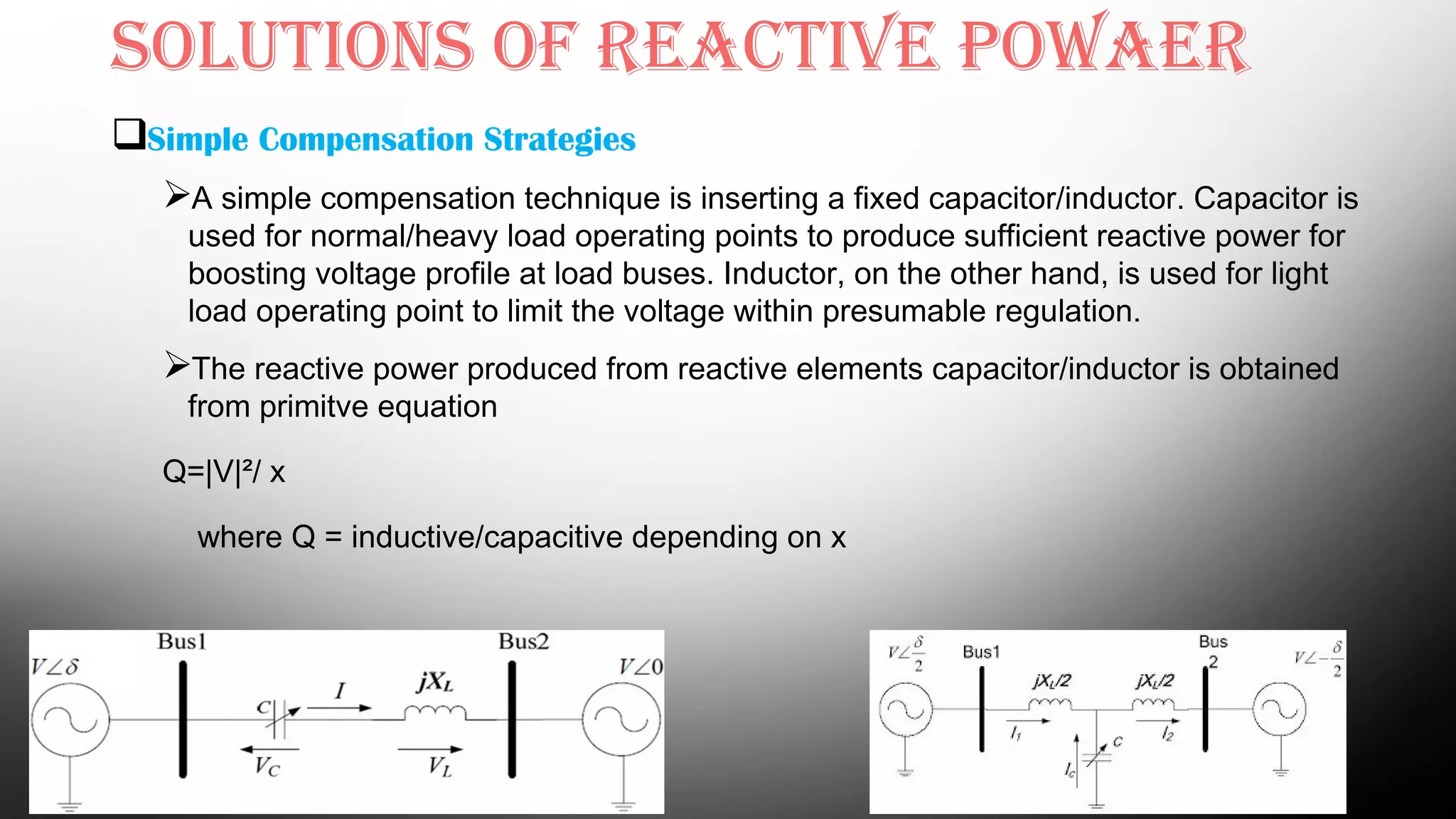
A simple compensation technique is inserting a fixed capacitor/inductor. Capacitor is
used for normal/heavy load operating points to produce sufficient reactive power for
boosting voltage profile at load buses. Inductor, on the other hand, is used for light
load operating point to limit the voltage within presumable regulation.
The reactive power produced from reactive elements capacitor/inductor is obtained
from primitve equation
Q=|V|²/ x
where Q = inductive/capacitive depending on x
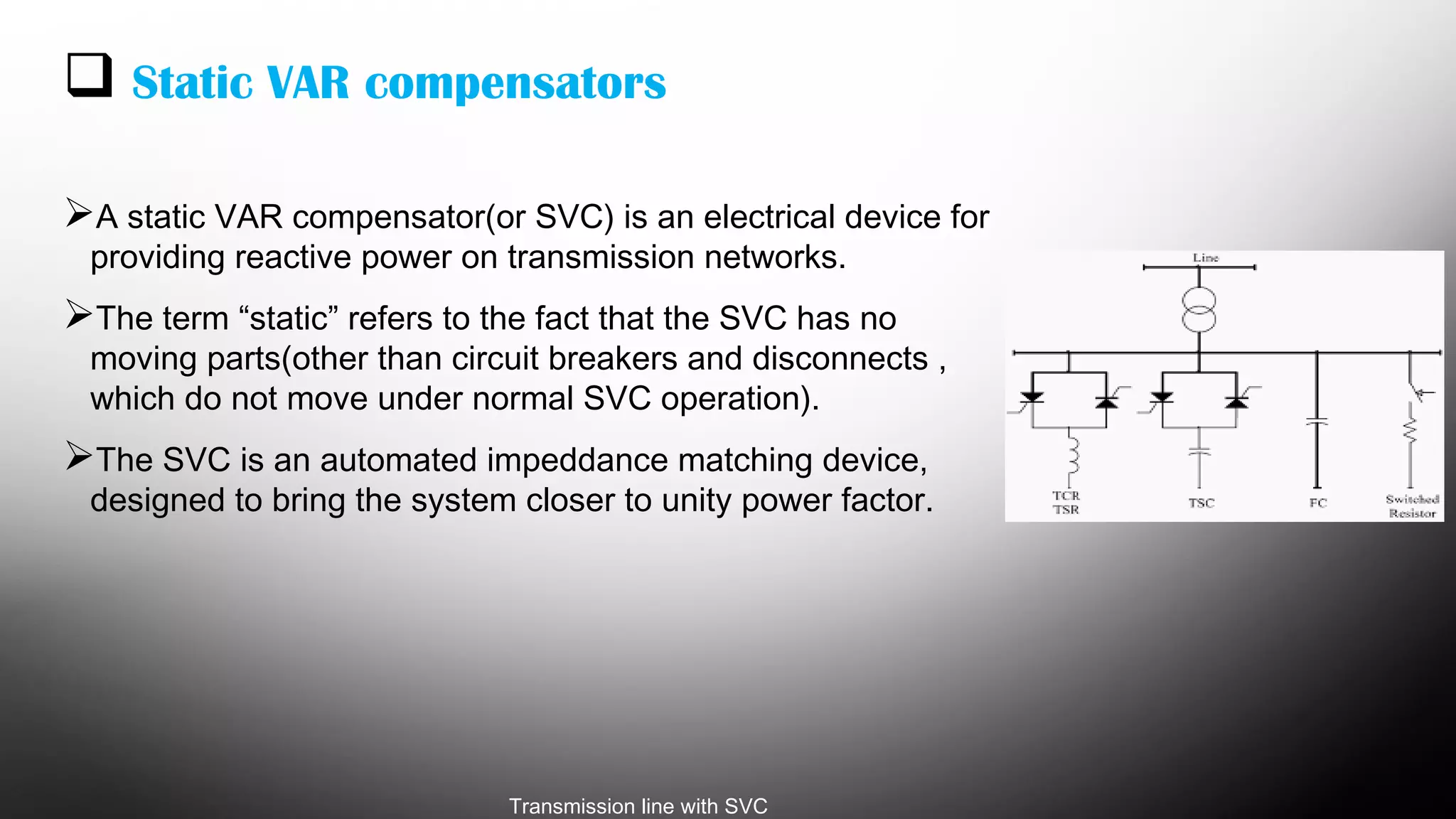
 Static VAR compensators
A static VAR compensator(or SVC) is an electrical device for
providing reactive power on transmission networks.
The term “static” refers to the fact that the SVC has no
moving parts(other than circuit breakers and disconnects ,
which do not move under normal SVC operation).
The SVC is an automated impeddance matching device,
designed to bring the system closer to unity power factor.
Transmission line with SVC
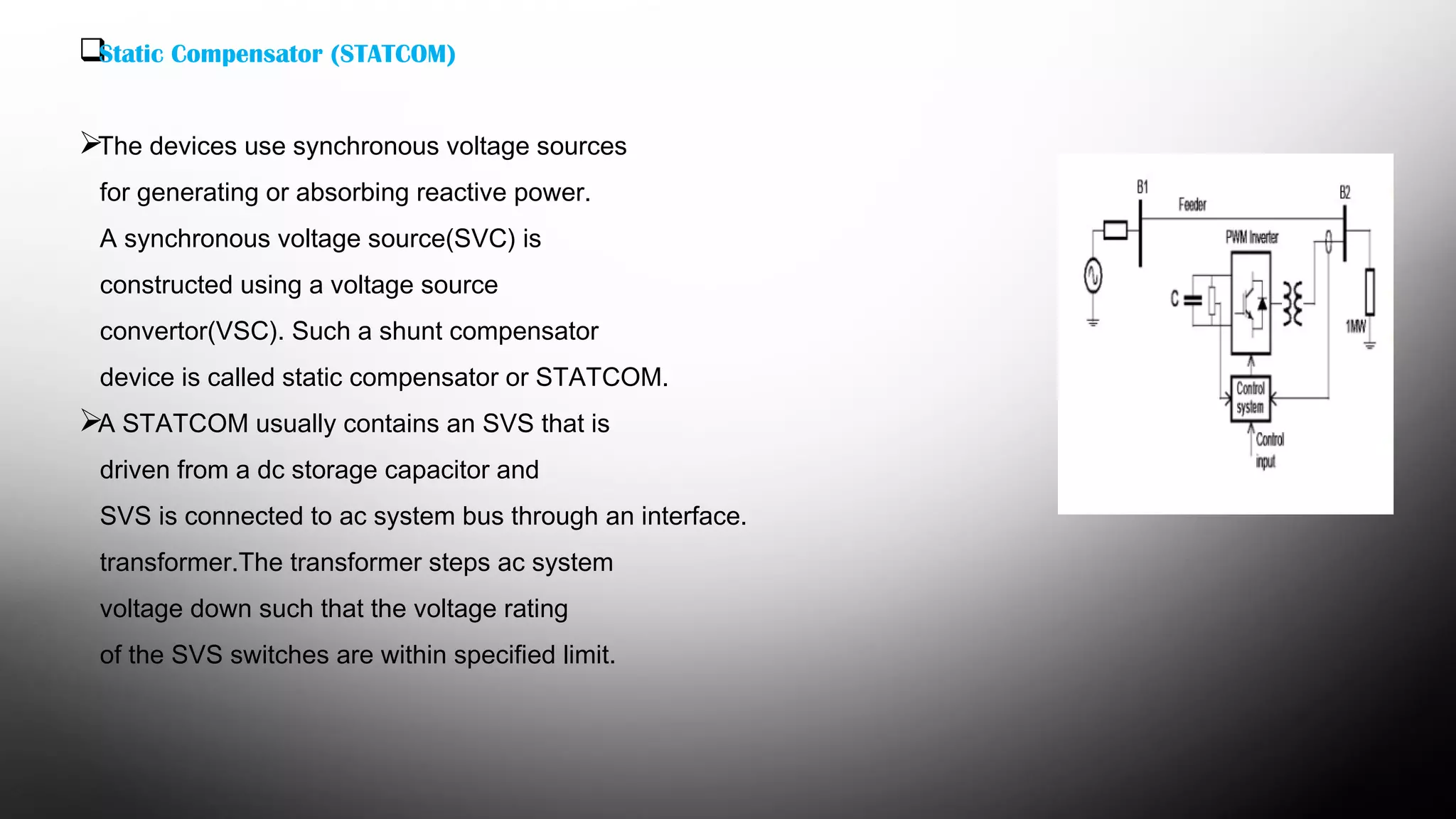
Static Compensator (STATCOM)
The devices use synchronous voltage sources
for generating or absorbing reactive power.
A synchronous voltage source(SVC) is
constructed using a voltage source
convertor(VSC). Such a shunt compensator
device is called static compensator or STATCOM.
A STATCOM usually contains an SVS that is
driven from a dc storage capacitor and
SVS is connected to ac system bus through an interface.
transformer.The transformer steps ac system
voltage down such that the voltage rating
of the SVS switches are within specified limit.
CONCLUSION
• The project report is a comprehensive overview for problems of reactive
power and different compensation strategies as solutions of reactive
power.Reactive power is mandatory for operating a power system as
different types of load require reactive power to function.We can
conclude that reactive power compensation is must for improving the
performance of AC system as with help of reactive power, we can
control the power factor and reduce the consumption of electricity.
Presented By:
Abhinav Dubey
Reg No. : 11803384
Section : K18QW
Guided By:
Mr. Gurpreet Singh
Asst. Professor, LPU

Reactive Power : Problems and Solutions

  • 1.
  • 2.
  • 3.
    Reactive PoweR Power isreferred as the product of voltage and current i.e. POWER = V x I Reactive power is the power that supplies the stored energy in reactive elements. Power, as we know consists of two components-active and reactive power. The total sum of active and reactive power is called as apparent power. Reactive power must be supplied to most types of magnetic equipment such as motors and transformers.
  • 4.
    Whenever there isa phase shift between V and I, we have: a) Active Power(kW) b) Reactive Power(kVAR) c) Apparent Power(kVA) Formula : (kVA)=√(kW)² +√(kVAR)²) The cosine of angle between apparent power and Active power is called Power Factor. Power Factor = cos Φ = active power/apparent power = kW / kVA
  • 5.
  • 6.
    Importance of reactIvepower Voltage Control : If load on power system source increases, voltage drop in power system components increases thereby voltage at consumer terminals decreases and vice versa. To maintain these voltage variations, reactive power is injected and absorbed. This is called Voltage Control. To reduce electrical blackouts : Inadequate reactive power causes voltage collapse that ultimately leads to shutdown of generating stations and various equipments. To reduce magnetic flux : In every electrical machine, a part of input energy i.e reactive power is consumed in creating and maintaing magnetic flux.
  • 7.
    Problems of reactivePower Since electrical current flowing through electrical system is higher than that necessary to do the required work, excess power dissipates in form of heat as reactive current flows through resistive components like wires, switches etc. Typical residential meters only read real power i.e. what you would have with power factor of 1. While electrical companies don’t charge residencies directly for reactive power, it is common misconception to say that reactive power correction has no economic benefit. To begin with, companies correct for power factor around industrial complexes or they charge more for reactive power. Power factor correction can have adverse effect on sensitive industrialized equipments if not handled by knowledgeable, experienced professionals. By increasing the efficiency of electrical systems, energy demand and its environmental impact is lessened.
  • 8.
    solutions of reactivePowaer Simple Compensation Strategies A simple compensation technique is inserting a fixed capacitor/inductor. Capacitor is used for normal/heavy load operating points to produce sufficient reactive power for boosting voltage profile at load buses. Inductor, on the other hand, is used for light load operating point to limit the voltage within presumable regulation. The reactive power produced from reactive elements capacitor/inductor is obtained from primitve equation Q=|V|²/ x where Q = inductive/capacitive depending on x
  • 9.
     Static VARcompensators A static VAR compensator(or SVC) is an electrical device for providing reactive power on transmission networks. The term “static” refers to the fact that the SVC has no moving parts(other than circuit breakers and disconnects , which do not move under normal SVC operation). The SVC is an automated impeddance matching device, designed to bring the system closer to unity power factor. Transmission line with SVC
  • 10.
    Static Compensator (STATCOM) Thedevices use synchronous voltage sources for generating or absorbing reactive power. A synchronous voltage source(SVC) is constructed using a voltage source convertor(VSC). Such a shunt compensator device is called static compensator or STATCOM. A STATCOM usually contains an SVS that is driven from a dc storage capacitor and SVS is connected to ac system bus through an interface. transformer.The transformer steps ac system voltage down such that the voltage rating of the SVS switches are within specified limit.
  • 11.
    CONCLUSION • The projectreport is a comprehensive overview for problems of reactive power and different compensation strategies as solutions of reactive power.Reactive power is mandatory for operating a power system as different types of load require reactive power to function.We can conclude that reactive power compensation is must for improving the performance of AC system as with help of reactive power, we can control the power factor and reduce the consumption of electricity.
  • 12.
    Presented By: Abhinav Dubey RegNo. : 11803384 Section : K18QW Guided By: Mr. Gurpreet Singh Asst. Professor, LPU

Editor's Notes

  • #9 <number>