

Video Lecture and E-Content Created by
R.D.SIVAKUMAR,M.Sc.,M.Phil.,M.Tech.,
Assistant Professor of Computer Science &
Assistant Professor and Head, Department of M.Com.(CA),
Ayya Nadar Janaki Ammal College,
Sivakasi – 626 124.
Mobile: 099440-42243
e-mail : sivamsccsit@gmail.com website: www.rdsivakumar.blogspot.in
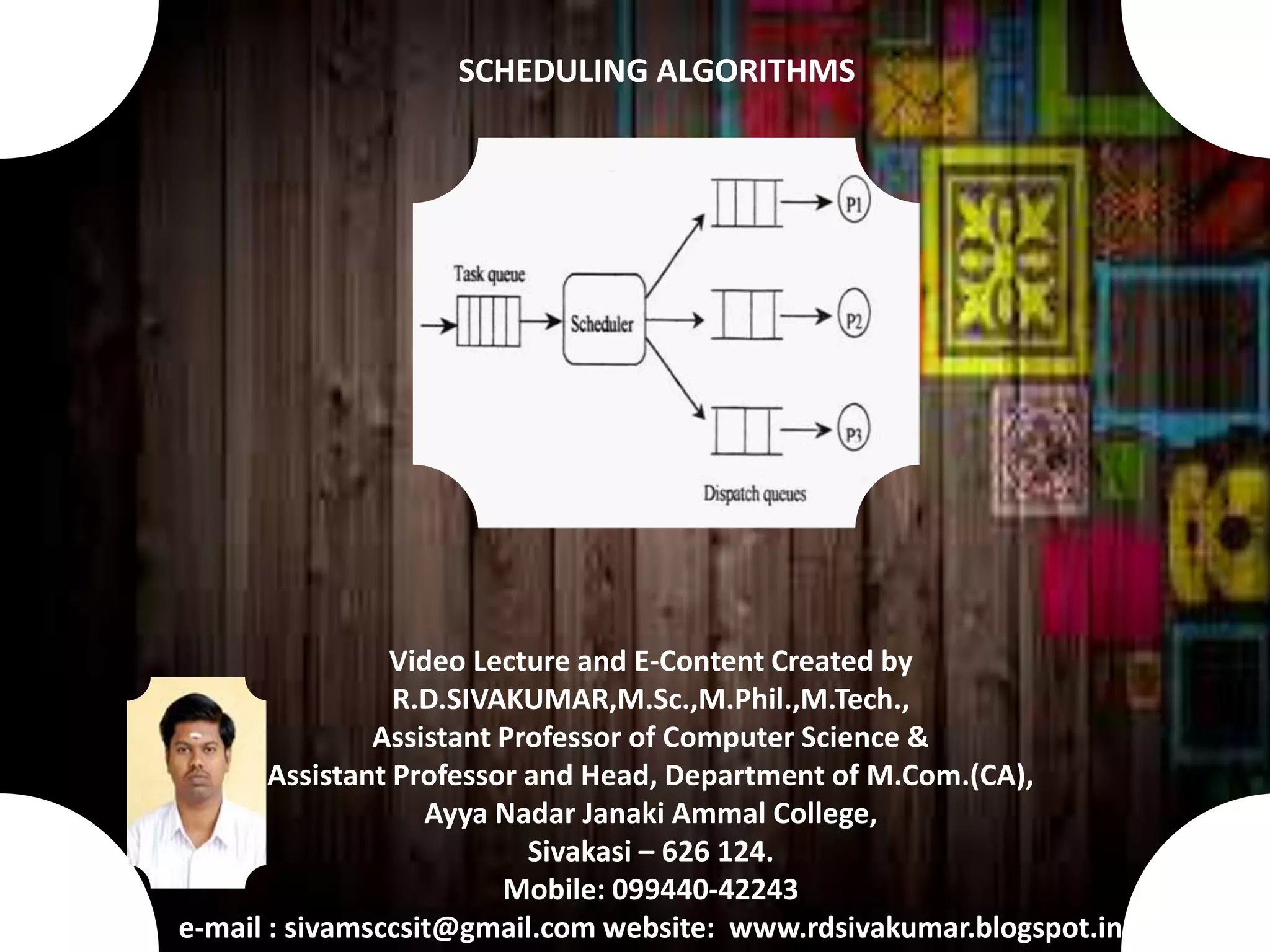
SCHEDULING ALGORITHMS
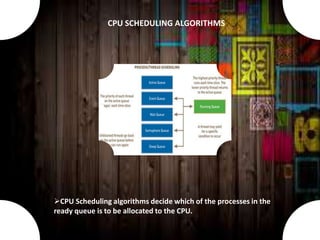
CPU Scheduling algorithms decide which of the processes in the
ready queue is to be allocated to the CPU.
CPU SCHEDULING ALGORITHMS
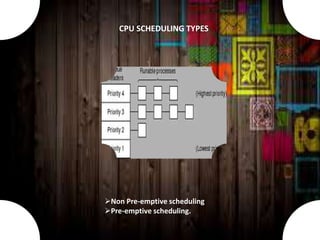
Non Pre-emptive scheduling
Pre-emptive scheduling.
CPU SCHEDULING TYPES
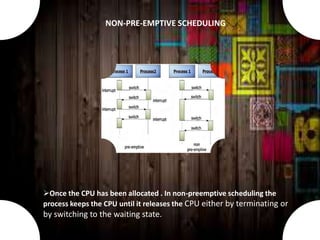
Once the CPU has been allocated . In non-preemptive scheduling the
process keeps the CPU until it releases the CPU either by terminating or
by switching to the waiting state.
NON-PRE-EMPTIVE SCHEDULING
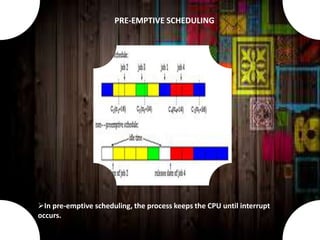
In pre-emptive scheduling, the process keeps the CPU until interrupt
occurs.
PRE-EMPTIVE SCHEDULING
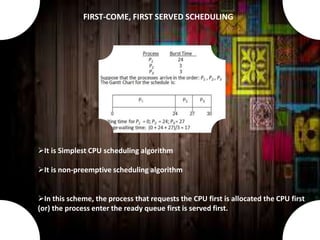
It is Simplest CPU scheduling algorithm
It is non-preemptive scheduling algorithm
In this scheme, the process that requests the CPU first is allocated the CPU first
(or) the process enter the ready queue first is served first.
FIRST-COME, FIRST SERVED SCHEDULING
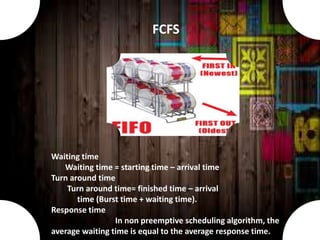
Waiting time
Waiting time = starting time – arrival time
Turn around time
Turn around time= finished time – arrival
time (Burst time + waiting time).
Response time
In non preemptive scheduling algorithm, the
average waiting time is equal to the average response time.
FCFS
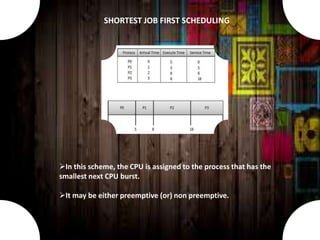
In this scheme, the CPU is assigned to the process that has the
smallest next CPU burst.
It may be either preemptive (or) non preemptive.
SHORTEST JOB FIRST SCHEDULING
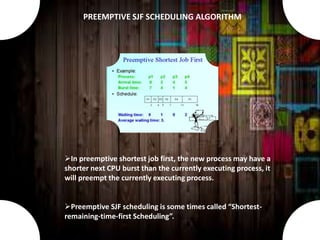
In preemptive shortest job first, the new process may have a
shorter next CPU burst than the currently executing process, it
will preempt the currently executing process.
Preemptive SJF scheduling is some times called “Shortest-
remaining-time-first Scheduling”.
PREEMPTIVE SJF SCHEDULING ALGORITHM
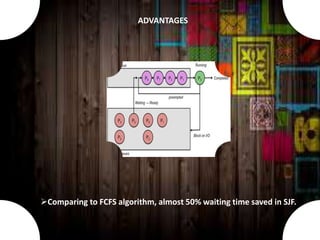
Comparing to FCFS algorithm, almost 50% waiting time saved in SJF.
ADVANTAGES
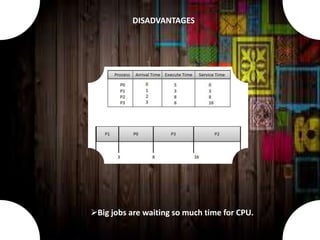
Big jobs are waiting so much time for CPU.
DISADVANTAGES
In this scheme, a priority is associated with each process and
the CPU is allocated to the process with the highest priority.
Equal priority processes are scheduled in FCFS order.
Priorities are indicated by range of numbers.
Low numbers represent the high priority
It may be either preemptive or non preemptive
PRIORITY SCHEDULING ALGORITHM
In preemptive priority scheduling algorithm, the new process may have
higher priority than the currently executing process, it will preempt the
currently executing process.
PREEMPTIVE
PRIORITY SCHEDULING ALGORITHM
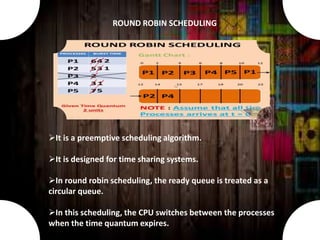
It is a preemptive scheduling algorithm.
It is designed for time sharing systems.
In round robin scheduling, the ready queue is treated as a
circular queue.
In this scheduling, the CPU switches between the processes
when the time quantum expires.
ROUND ROBIN SCHEDULING
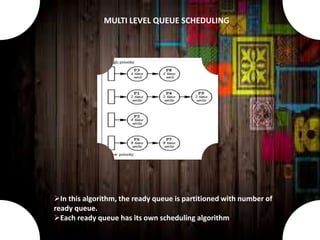
In this algorithm, the ready queue is partitioned with number of
ready queue.
Each ready queue has its own scheduling algorithm.
MULTI LEVEL QUEUE SCHEDULING
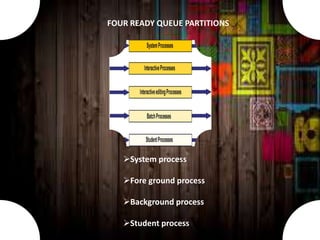
System process
Fore ground process
Background process
Student process
FOUR READY QUEUE PARTITIONS
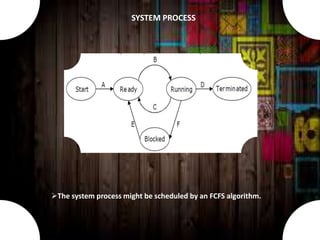
The system process might be scheduled by an FCFS algorithm.
SYSTEM PROCESS
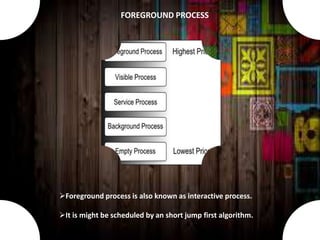
Foreground process is also known as interactive process.
It is might be scheduled by an short jump first algorithm.
FOREGROUND PROCESS
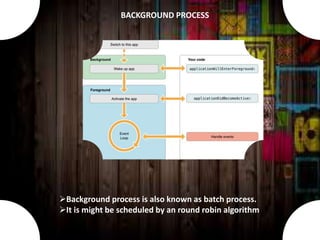
Background process is also known as batch process.
It is might be scheduled by an round robin algorithm.
BACKGROUND PROCESS
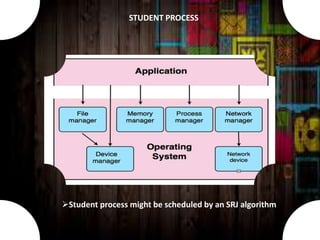
Student process might be scheduled by an SRJ algorithm.
STUDENT PROCESS
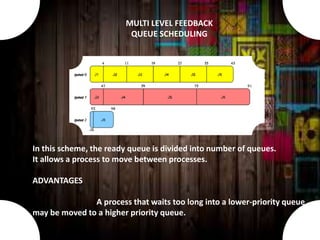
In this scheme, the ready queue is divided into number of queues.
It allows a process to move between processes.
ADVANTAGES
A process that waits too long into a lower-priority queue
may be moved to a higher priority queue.
MULTI LEVEL FEEDBACK
QUEUE SCHEDULING
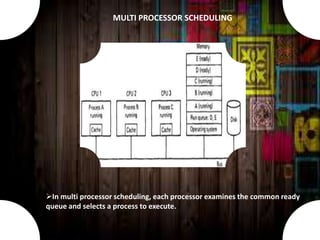
In multi processor scheduling, each processor examines the common ready
queue and selects a process to execute.
MULTI PROCESSOR SCHEDULING
Scheduling Algorithms-R.D.Sivakumar

Scheduling Algorithms-R.D.Sivakumar

  • 1.
    Video Lecture andE-Content Created by R.D.SIVAKUMAR,M.Sc.,M.Phil.,M.Tech., Assistant Professor of Computer Science & Assistant Professor and Head, Department of M.Com.(CA), Ayya Nadar Janaki Ammal College, Sivakasi – 626 124. Mobile: 099440-42243 e-mail : sivamsccsit@gmail.com website: www.rdsivakumar.blogspot.in SCHEDULING ALGORITHMS
  • 2.
    CPU Scheduling algorithmsdecide which of the processes in the ready queue is to be allocated to the CPU. CPU SCHEDULING ALGORITHMS
  • 3.
    Non Pre-emptive scheduling Pre-emptivescheduling. CPU SCHEDULING TYPES
  • 4.
    Once the CPUhas been allocated . In non-preemptive scheduling the process keeps the CPU until it releases the CPU either by terminating or by switching to the waiting state. NON-PRE-EMPTIVE SCHEDULING
  • 5.
    In pre-emptive scheduling,the process keeps the CPU until interrupt occurs. PRE-EMPTIVE SCHEDULING
  • 6.
    It is SimplestCPU scheduling algorithm It is non-preemptive scheduling algorithm In this scheme, the process that requests the CPU first is allocated the CPU first (or) the process enter the ready queue first is served first. FIRST-COME, FIRST SERVED SCHEDULING
  • 7.
    Waiting time Waiting time= starting time – arrival time Turn around time Turn around time= finished time – arrival time (Burst time + waiting time). Response time In non preemptive scheduling algorithm, the average waiting time is equal to the average response time. FCFS
  • 8.
    In this scheme,the CPU is assigned to the process that has the smallest next CPU burst. It may be either preemptive (or) non preemptive. SHORTEST JOB FIRST SCHEDULING
  • 9.
    In preemptive shortestjob first, the new process may have a shorter next CPU burst than the currently executing process, it will preempt the currently executing process. Preemptive SJF scheduling is some times called “Shortest- remaining-time-first Scheduling”. PREEMPTIVE SJF SCHEDULING ALGORITHM
  • 10.
    Comparing to FCFSalgorithm, almost 50% waiting time saved in SJF. ADVANTAGES
  • 11.
    Big jobs arewaiting so much time for CPU. DISADVANTAGES
  • 12.
    In this scheme,a priority is associated with each process and the CPU is allocated to the process with the highest priority. Equal priority processes are scheduled in FCFS order. Priorities are indicated by range of numbers. Low numbers represent the high priority It may be either preemptive or non preemptive PRIORITY SCHEDULING ALGORITHM
  • 13.
    In preemptive priorityscheduling algorithm, the new process may have higher priority than the currently executing process, it will preempt the currently executing process. PREEMPTIVE PRIORITY SCHEDULING ALGORITHM
  • 14.
    It is apreemptive scheduling algorithm. It is designed for time sharing systems. In round robin scheduling, the ready queue is treated as a circular queue. In this scheduling, the CPU switches between the processes when the time quantum expires. ROUND ROBIN SCHEDULING
  • 15.
    In this algorithm,the ready queue is partitioned with number of ready queue. Each ready queue has its own scheduling algorithm. MULTI LEVEL QUEUE SCHEDULING
  • 16.
    System process Fore groundprocess Background process Student process FOUR READY QUEUE PARTITIONS
  • 17.
    The system processmight be scheduled by an FCFS algorithm. SYSTEM PROCESS
  • 18.
    Foreground process isalso known as interactive process. It is might be scheduled by an short jump first algorithm. FOREGROUND PROCESS
  • 19.
    Background process isalso known as batch process. It is might be scheduled by an round robin algorithm. BACKGROUND PROCESS
  • 20.
    Student process mightbe scheduled by an SRJ algorithm. STUDENT PROCESS
  • 21.
    In this scheme,the ready queue is divided into number of queues. It allows a process to move between processes. ADVANTAGES A process that waits too long into a lower-priority queue may be moved to a higher priority queue. MULTI LEVEL FEEDBACK QUEUE SCHEDULING
  • 22.
    In multi processorscheduling, each processor examines the common ready queue and selects a process to execute. MULTI PROCESSOR SCHEDULING