This document discusses various concepts and algorithms related to process scheduling. It covers basic concepts like CPU bursts and scheduling criteria. It then describes several common scheduling algorithms like FCFS, SJF, priority scheduling, and round robin. It also discusses more advanced topics like multiple processor scheduling, thread scheduling, and load balancing.
1. Basic Concepts
•Maximum CPU utilization obtained with multiprogramming
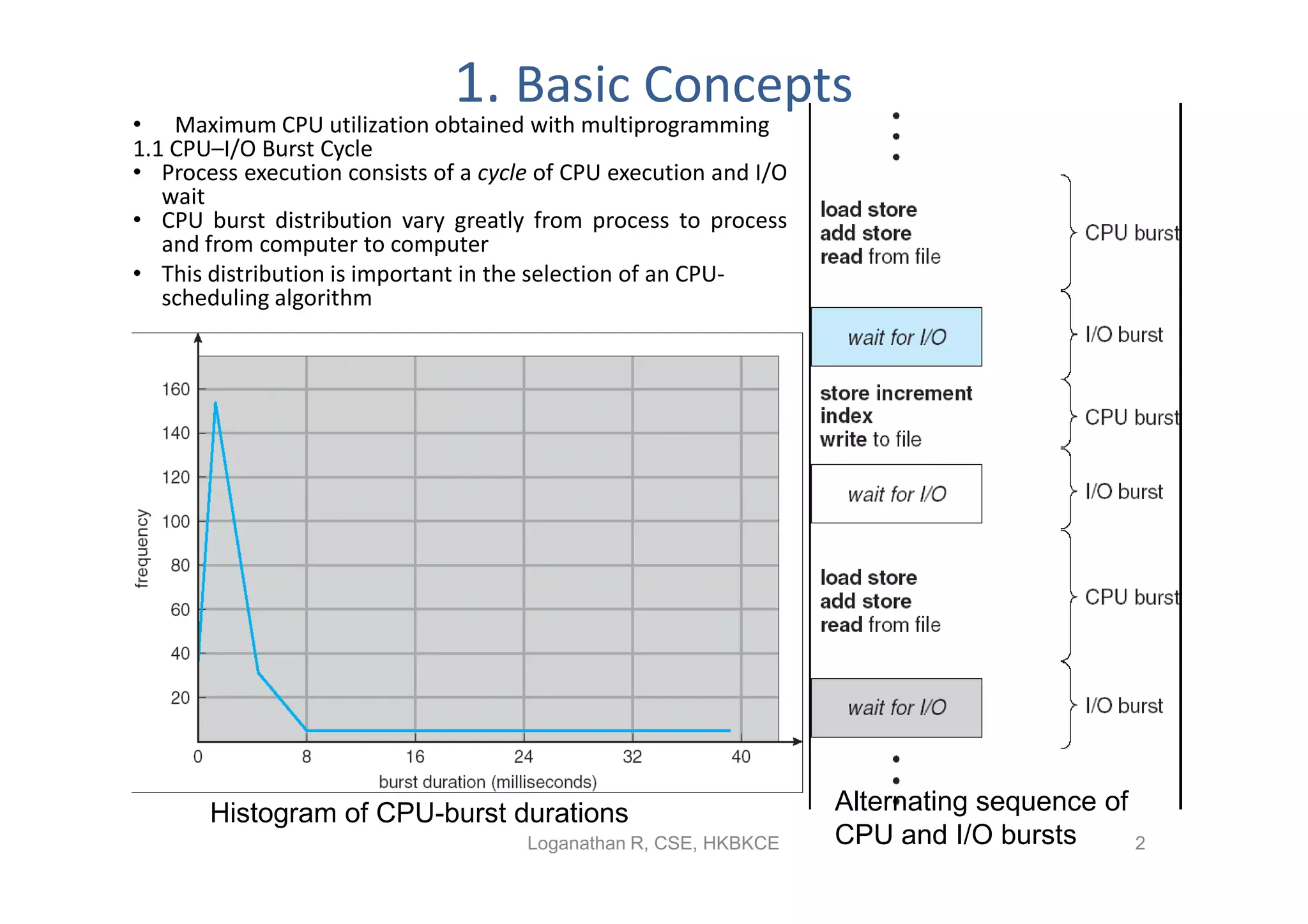
1.1 CPU–I/O Burst Cycle
• Process execution consists of a cycle of CPU execution and I/O
wait
• CPU burst distribution vary greatly from process to process
and from computer to computer
• This distribution is important in the selection of an CPU-
scheduling algorithm
Histogram of CPU-burst durations Alternating sequence of
Loganathan R, CSE, HKBKCE CPU and I/O bursts 2
3.
1. Basic ConceptsContd..
1.2 CPU Scheduler (Short-term scheduler)
• Selects from among the processes in memory that are ready to execute, and allocates
the CPU to one of them
• Ready queue is not necessarily a first-in, first-out (FIFO) queue and it can be
implemented as a FIFO queue, a priority queue, a tree, or an unordered linked list
1.3 Preemptive Scheduling
• CPU scheduling decisions may take place when a process:
1. Switches from running to waiting state 2. Switches from running to ready state
3. Switches from waiting to ready state 4. Terminates
• Scheduling under 1 and 4 is non-preemptive or cooperative
– Once the CPU has been allocated to a process, the process keeps the CPU until it releases the
CPU either by terminating or by switching to the waiting state. Example : Windows 3.x/95
• Scheduling under 2 and 3 is preemptive
-- Incurs cost in shared data access s and affects OS kernel design
1.4 Dispatcher
• Dispatcher module gives control of the CPU to the process selected by the short-term
scheduler which involves:
- switching context -switching to user mode
- jumping to the proper location in the user program to restart that program
• Dispatch latency – time it takes for the dispatcher to stop one process and start another
running
Loganathan R, CSE, HKBKCE 3
4.
2. Scheduling Criteria
•Choosing a scheduling algorithms will be based on the properties of the
algorithms
• Many Criteria have been suggested for comparing CPU scheduling
algorithms
1. CPU utilization – keep the CPU as busy as possible
2. Throughput – number of processes completed per time unit
3. Turnaround time – amount of time to execute a particular process
4. Waiting time – amount of time a process waiting in the ready queue
5. Response time - time from the submission of a request until the first
response is produced, not output (for time-sharing environment)
• Optimization Criteria
– Maximize CPU utilization
– Maximize throughput
– Minimize turnaround time
– Minimize waiting time
– Minimize response time
Loganathan R, CSE, HKBKCE 4
5.
3. Scheduling Algorithms
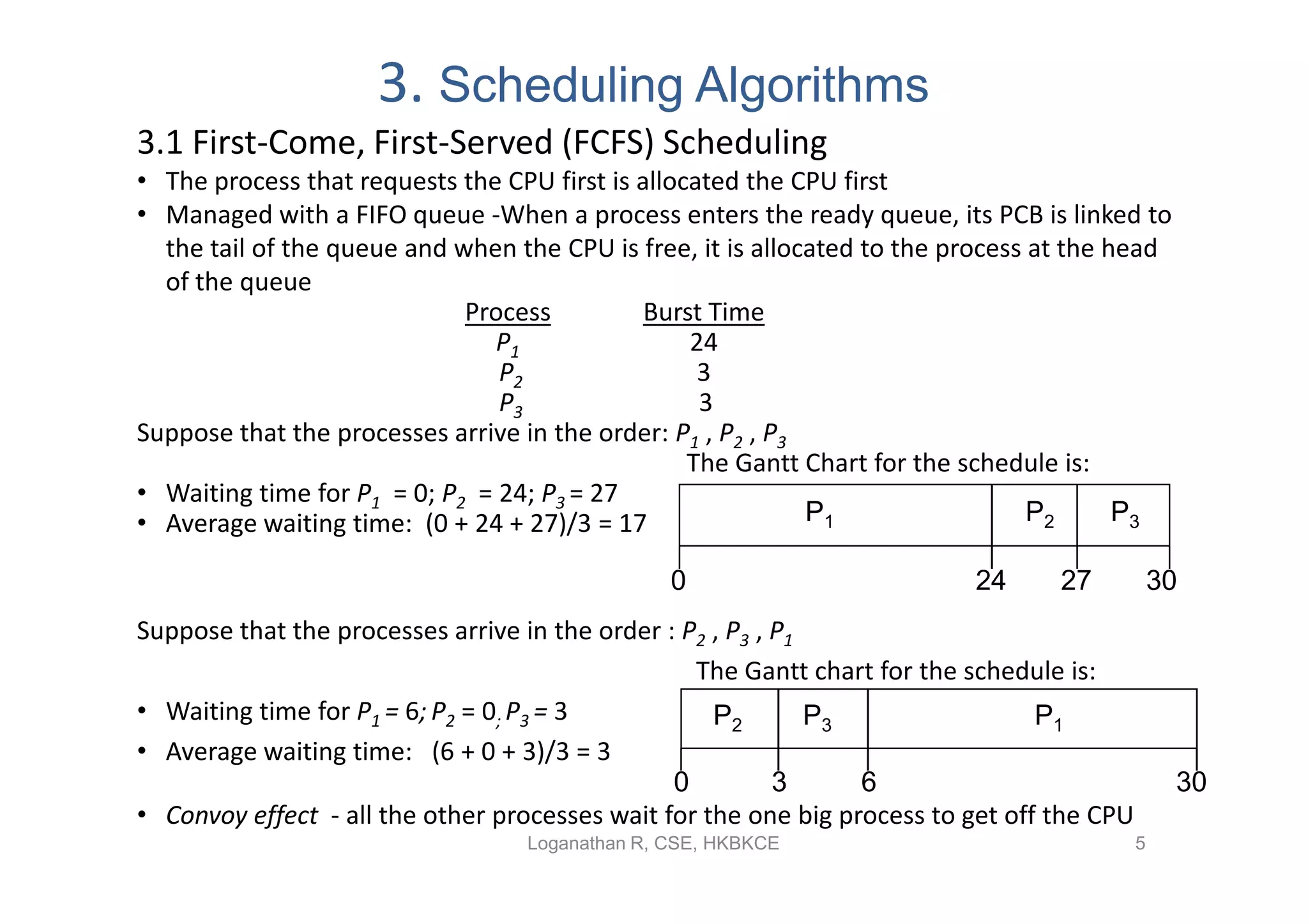
3.1First-Come, First-Served (FCFS) Scheduling
• The process that requests the CPU first is allocated the CPU first
• Managed with a FIFO queue -When a process enters the ready queue, its PCB is linked to
the tail of the queue and when the CPU is free, it is allocated to the process at the head
of the queue
Process Burst Time
P1 24
P2 3
P3 3
Suppose that the processes arrive in the order: P1 , P2 , P3
The Gantt Chart for the schedule is:
• Waiting time for P1 = 0; P2 = 24; P3 = 27
• Average waiting time: (0 + 24 + 27)/3 = 17 P1 P2 P3
0 24 27 30
Suppose that the processes arrive in the order : P2 , P3 , P1
The Gantt chart for the schedule is:
• Waiting time for P1 = 6; P2 = 0; P3 = 3 P2 P3 P1
• Average waiting time: (6 + 0 + 3)/3 = 3
0 3 6 30
• Convoy effect - all the other processes wait for the one big process to get off the CPU
Loganathan R, CSE, HKBKCE 5
6.
3. Scheduling Algorithms Contd..
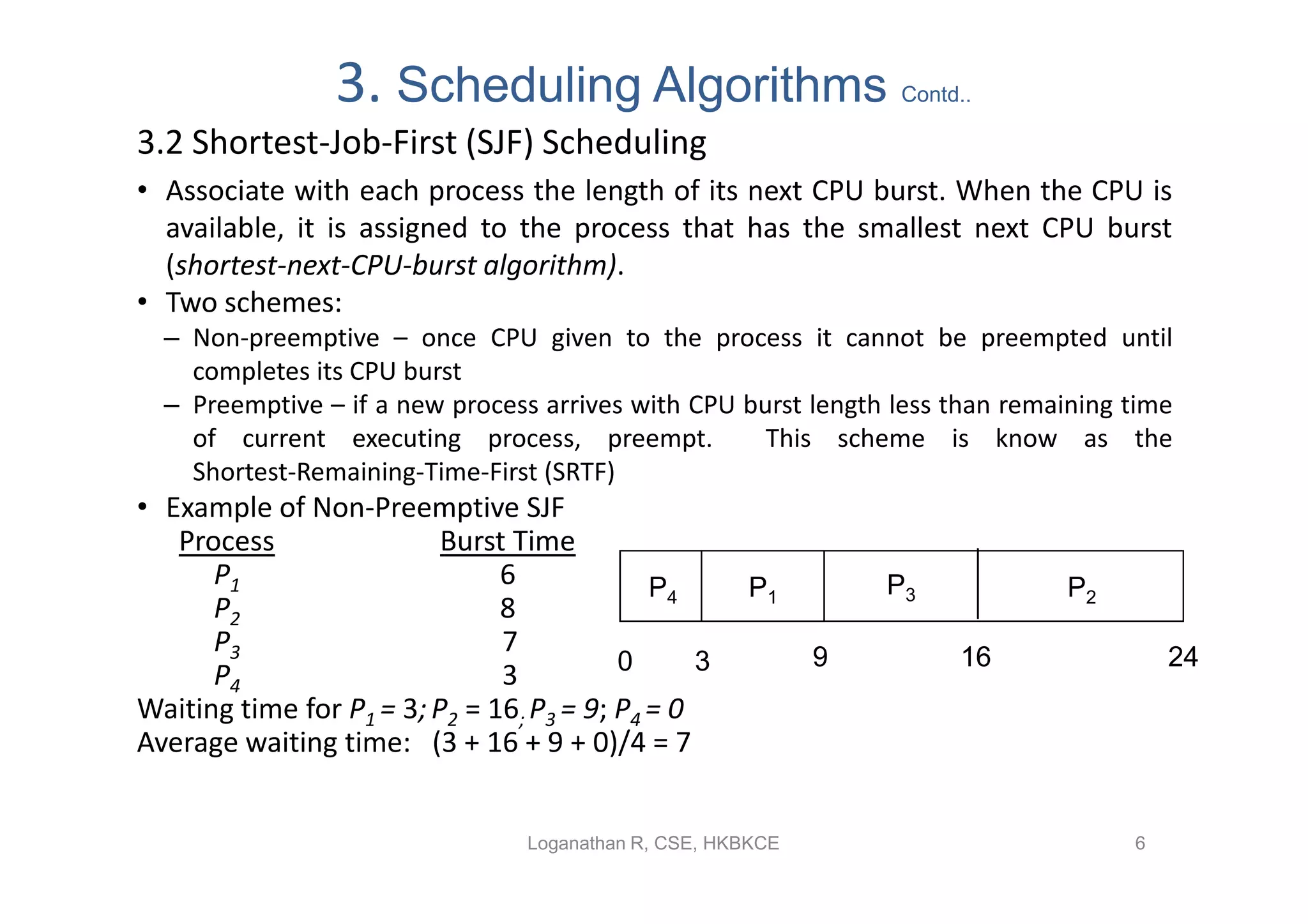
3.2 Shortest-Job-First (SJF) Scheduling
• Associate with each process the length of its next CPU burst. When the CPU is
available, it is assigned to the process that has the smallest next CPU burst
(shortest-next-CPU-burst algorithm).
• Two schemes:
– Non-preemptive – once CPU given to the process it cannot be preempted until
completes its CPU burst
– Preemptive – if a new process arrives with CPU burst length less than remaining time
of current executing process, preempt. This scheme is know as the
Shortest-Remaining-Time-First (SRTF)
• Example of Non-Preemptive SJF
Process Burst Time
P1 6 P4 P1 P3 P2
P2 8
P3 7 9 16 24
0 3
P4 3
Waiting time for P1 = 3; P2 = 16; P3 = 9; P4 = 0
Average waiting time: (3 + 16 + 9 + 0)/4 = 7
Loganathan R, CSE, HKBKCE 6
7.
3. Scheduling Algorithms Contd..
3.2 Shortest-Job-First (SJF) Scheduling
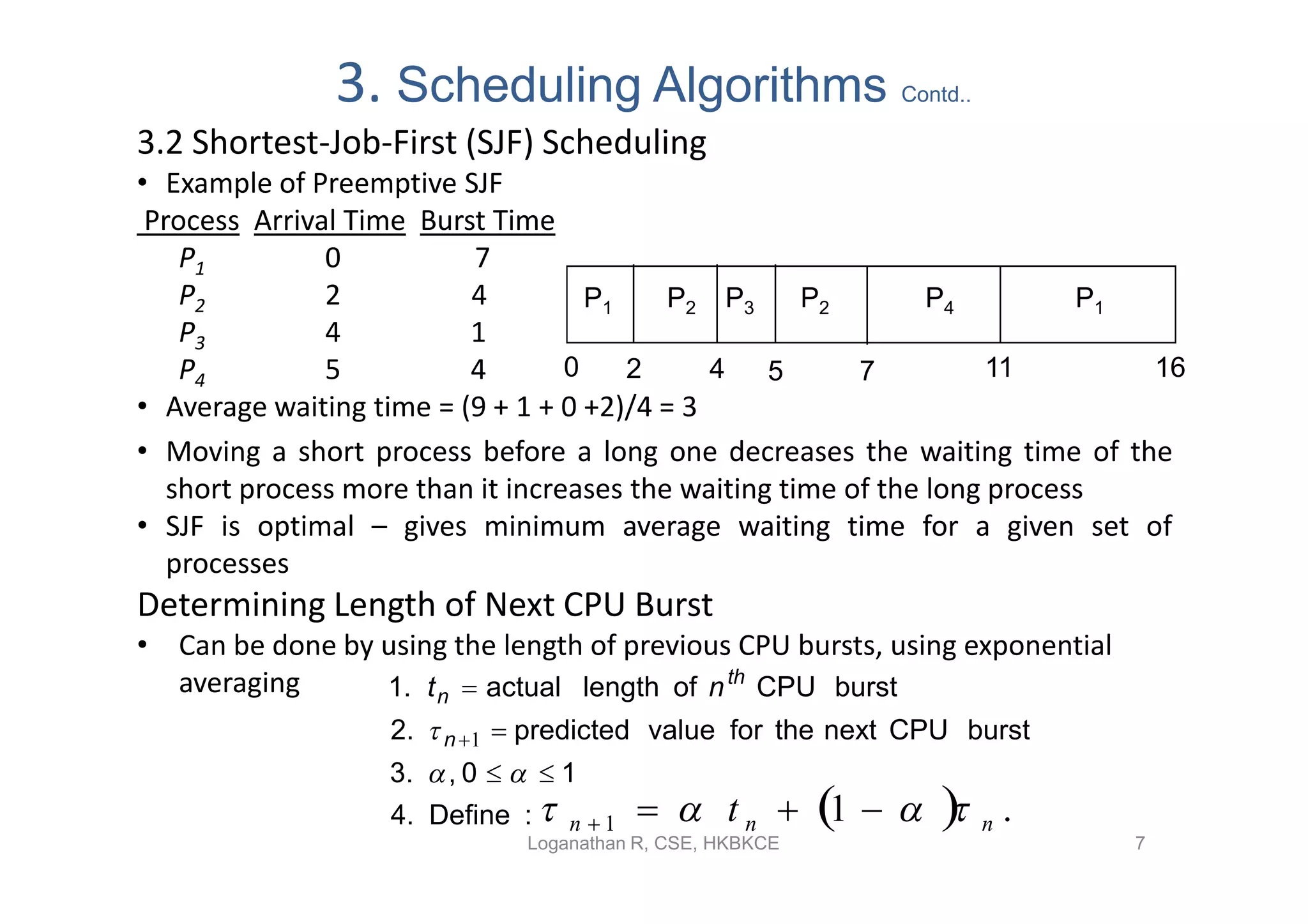
• Example of Preemptive SJF
Process Arrival Time Burst Time
P1 0 7
P2 2 4 P1 P2 P3 P2 P4 P1
P3 4 1
P4 5 4 0 2 4 5 7 11 16
• Average waiting time = (9 + 1 + 0 +2)/4 = 3
• Moving a short process before a long one decreases the waiting time of the
short process more than it increases the waiting time of the long process
• SJF is optimal – gives minimum average waiting time for a given set of
processes
Determining Length of Next CPU Burst
• Can be done by using the length of previous CPU bursts, using exponential
averaging 1. t n actual length of n th CPU burst
2. n 1 predicted value for the next CPU burst
3. , 0 1
4. Define : n 1 t n 1 n .
Loganathan R, CSE, HKBKCE 7
8.
3. Scheduling Algorithms Contd..
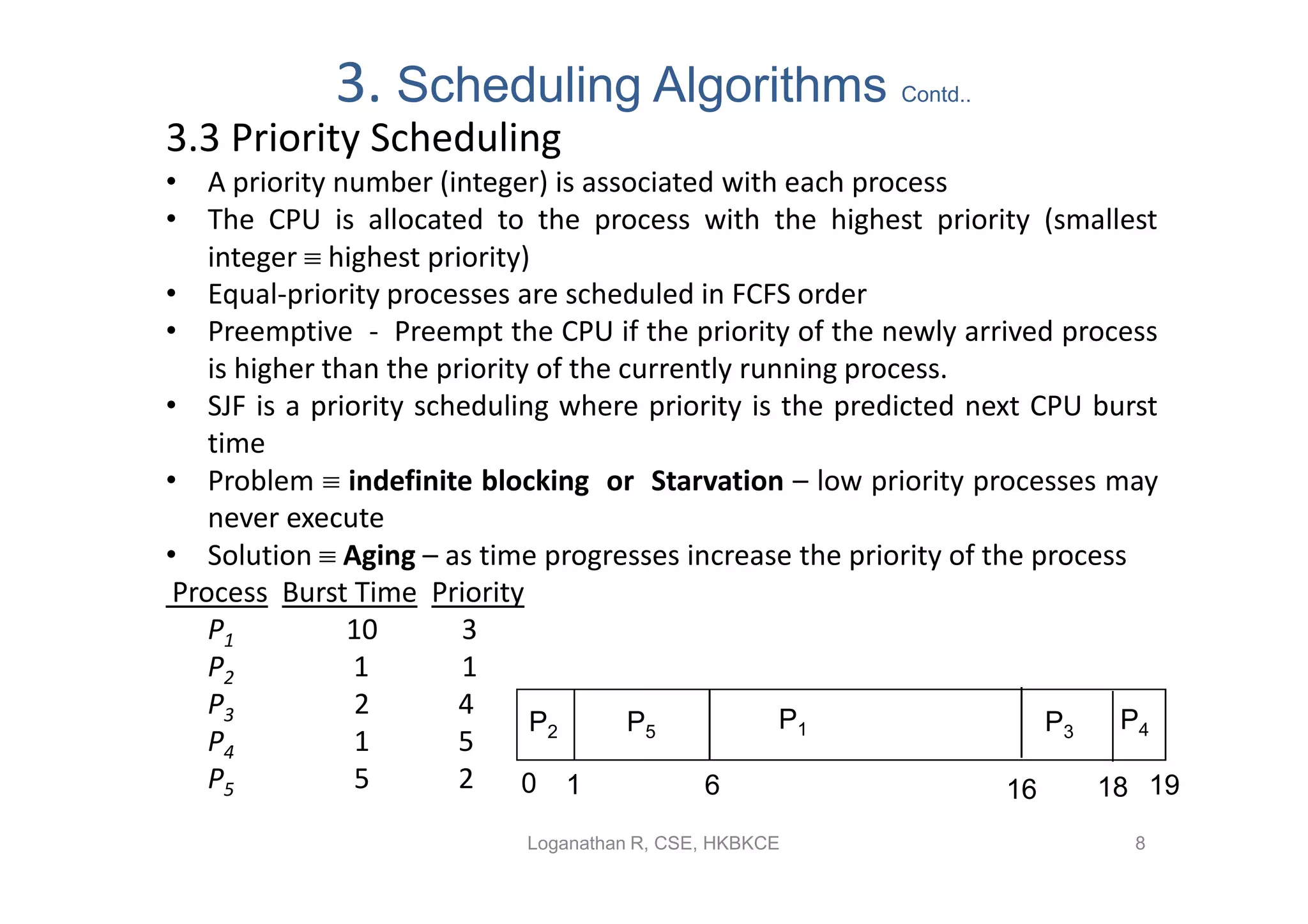
3.3 Priority Scheduling
• A priority number (integer) is associated with each process
• The CPU is allocated to the process with the highest priority (smallest
integer highest priority)
• Equal-priority processes are scheduled in FCFS order
• Preemptive - Preempt the CPU if the priority of the newly arrived process
is higher than the priority of the currently running process.
• SJF is a priority scheduling where priority is the predicted next CPU burst
time
• Problem indefinite blocking or Starvation – low priority processes may
never execute
• Solution Aging – as time progresses increase the priority of the process
Process Burst Time Priority
P1 10 3
P2 1 1
P3 2 4 P1 P4
P2 P5 P3
P4 1 5
P5 5 2 0 1 6 16 18 19
Loganathan R, CSE, HKBKCE 8
9.
3. Scheduling Algorithms Contd..
3.4 Round Robin (RR) Scheduling
• Each process gets a small unit of CPU time (time quantum), usually 10-100
milliseconds. After this time has elapsed, the process is preempted and
added to the end of the ready queue.
• If there are n processes in the ready queue and the time quantum is q, then
each process gets 1/n of the CPU time in chunks of at most q time units at
once. No process waits more than (n-1)q time units.
• Performance
– q is too large FCFS
– q is too small context switch overhead is too high
• Typically, higher average turnaround than SJF, but better response
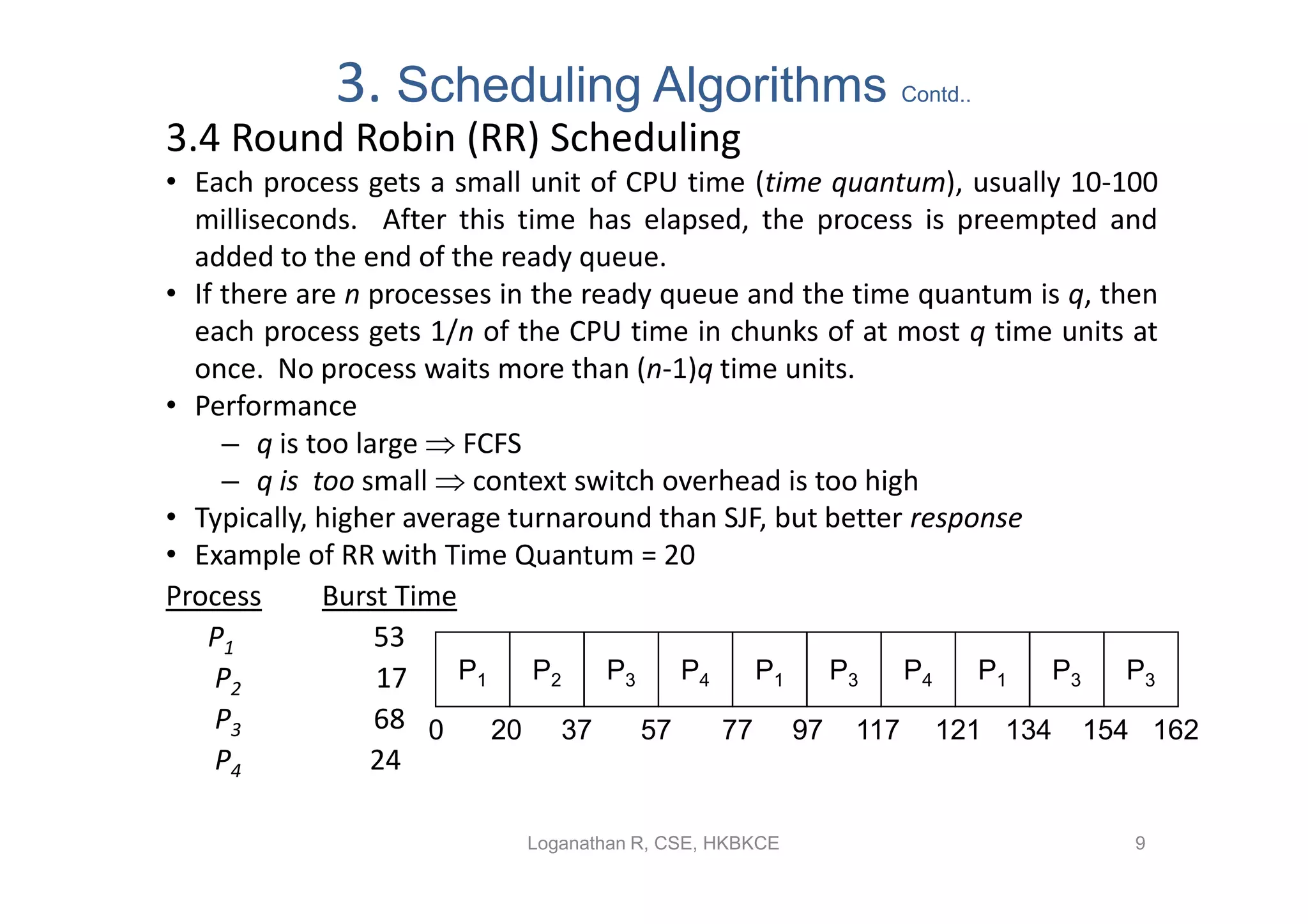
• Example of RR with Time Quantum = 20
Process Burst Time
P1 53
P2 17 P1 P2 P3 P4 P1 P3 P4 P1 P3 P3
P3 68 0 20 37 57 77 97 117 121 134 154 162
P4 24
Loganathan R, CSE, HKBKCE 9
10.
3. Scheduling Algorithms Contd..
3.4 Round Robin (RR) Scheduling
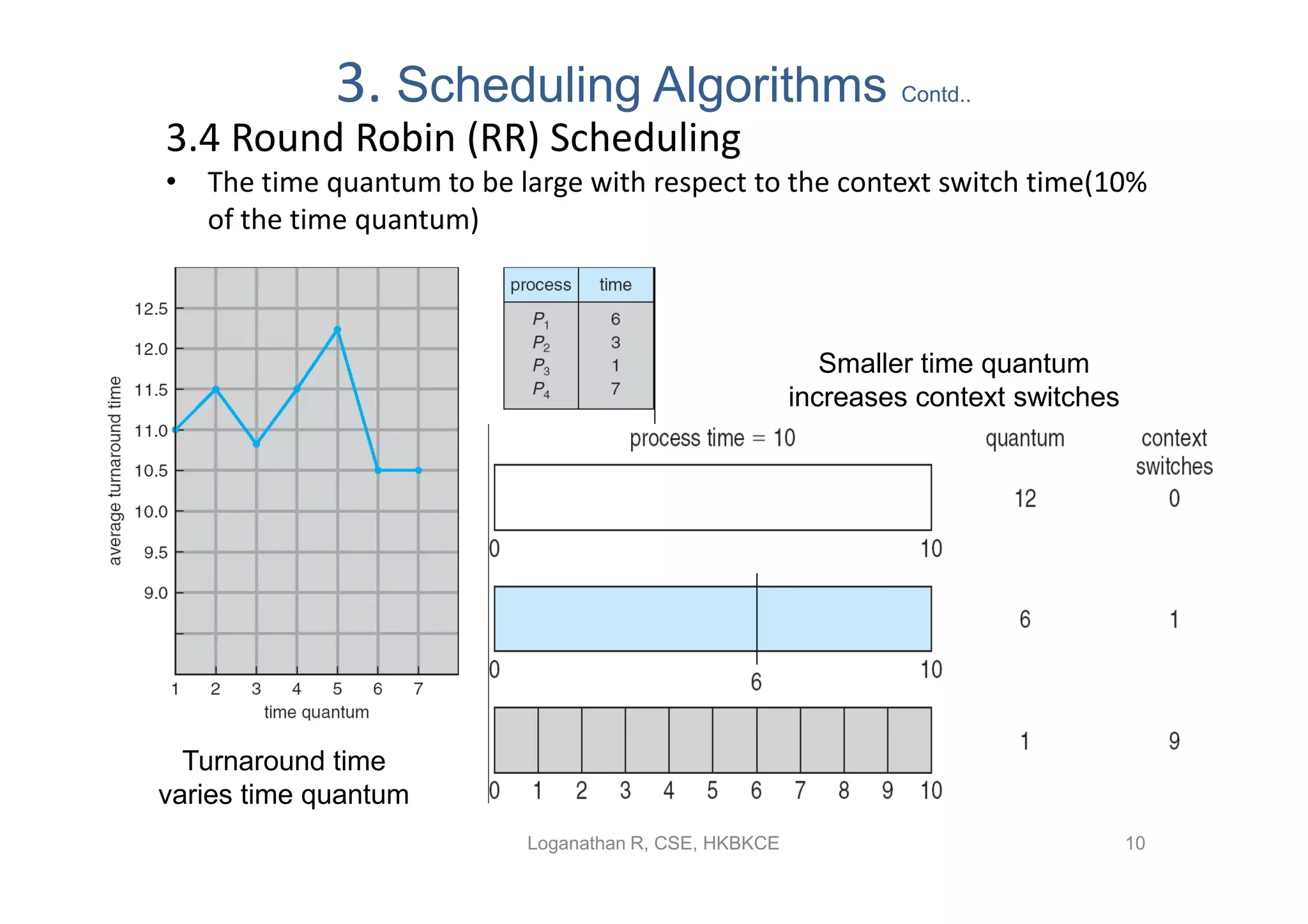
• The time quantum to be large with respect to the context switch time(10%
of the time quantum)
Smaller time quantum
increases context switches
Turnaround time
varies time quantum
Loganathan R, CSE, HKBKCE 10
11.
3. Scheduling Algorithms Contd..
3.5 Multilevel Queue Scheduling
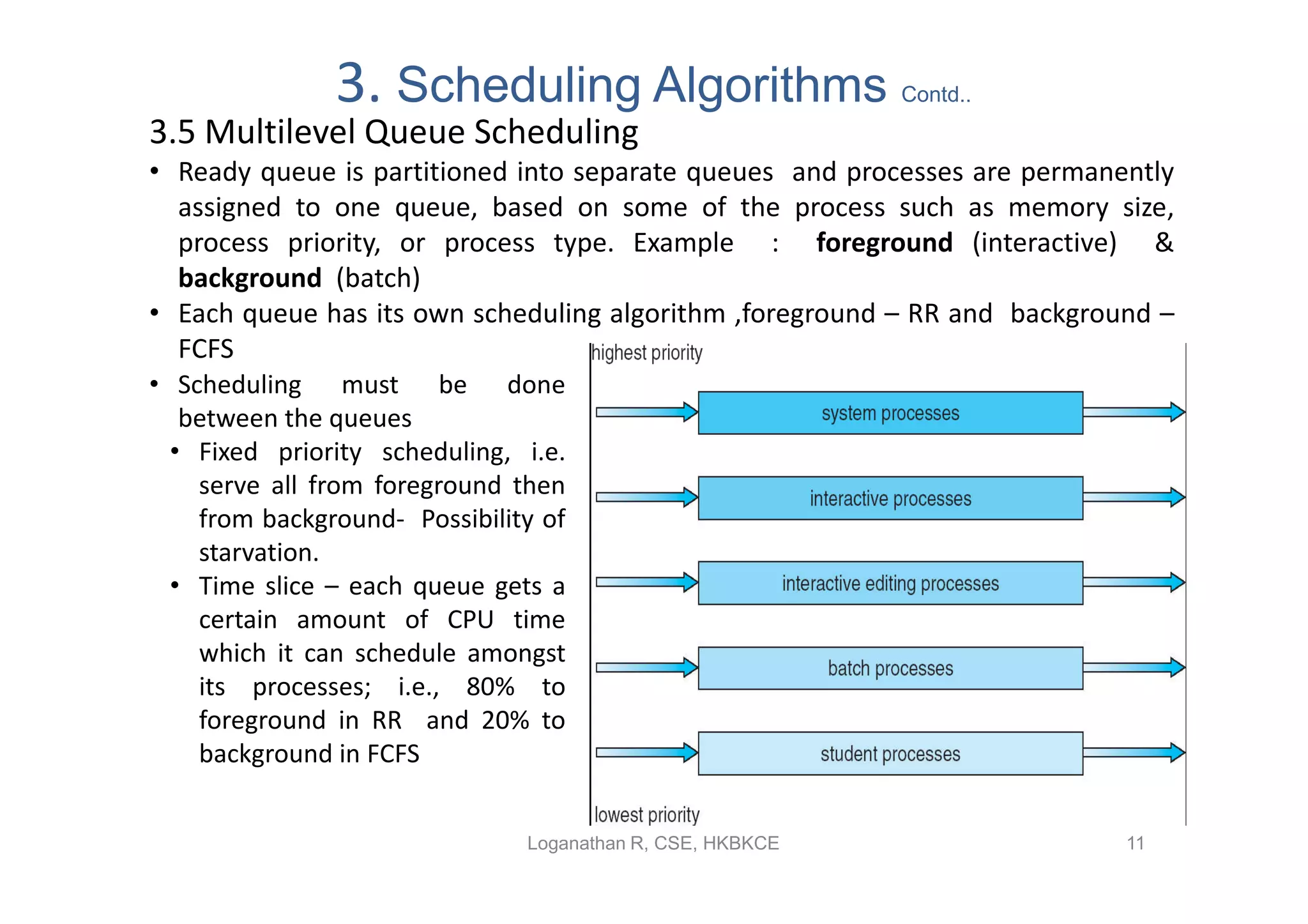
• Ready queue is partitioned into separate queues and processes are permanently
assigned to one queue, based on some of the process such as memory size,
process priority, or process type. Example : foreground (interactive) &
background (batch)
• Each queue has its own scheduling algorithm ,foreground – RR and background –
FCFS
• Scheduling must be done
between the queues
• Fixed priority scheduling, i.e.
serve all from foreground then
from background- Possibility of
starvation.
• Time slice – each queue gets a
certain amount of CPU time
which it can schedule amongst
its processes; i.e., 80% to
foreground in RR and 20% to
background in FCFS
Loganathan R, CSE, HKBKCE 11
12.
3. Scheduling Algorithms Contd..
3.6 Multilevel Feedback-Queue Scheduling
• A process can move between the various queues; aging can be implemented this way
• Multilevel-feedback-queue scheduler defined by the following parameters:
– number of queues - scheduling algorithms for each queue
– method used to determine when to upgrade a process
– method used to determine when to demote a process
– method used to determine which queue a process will enter when it needs service
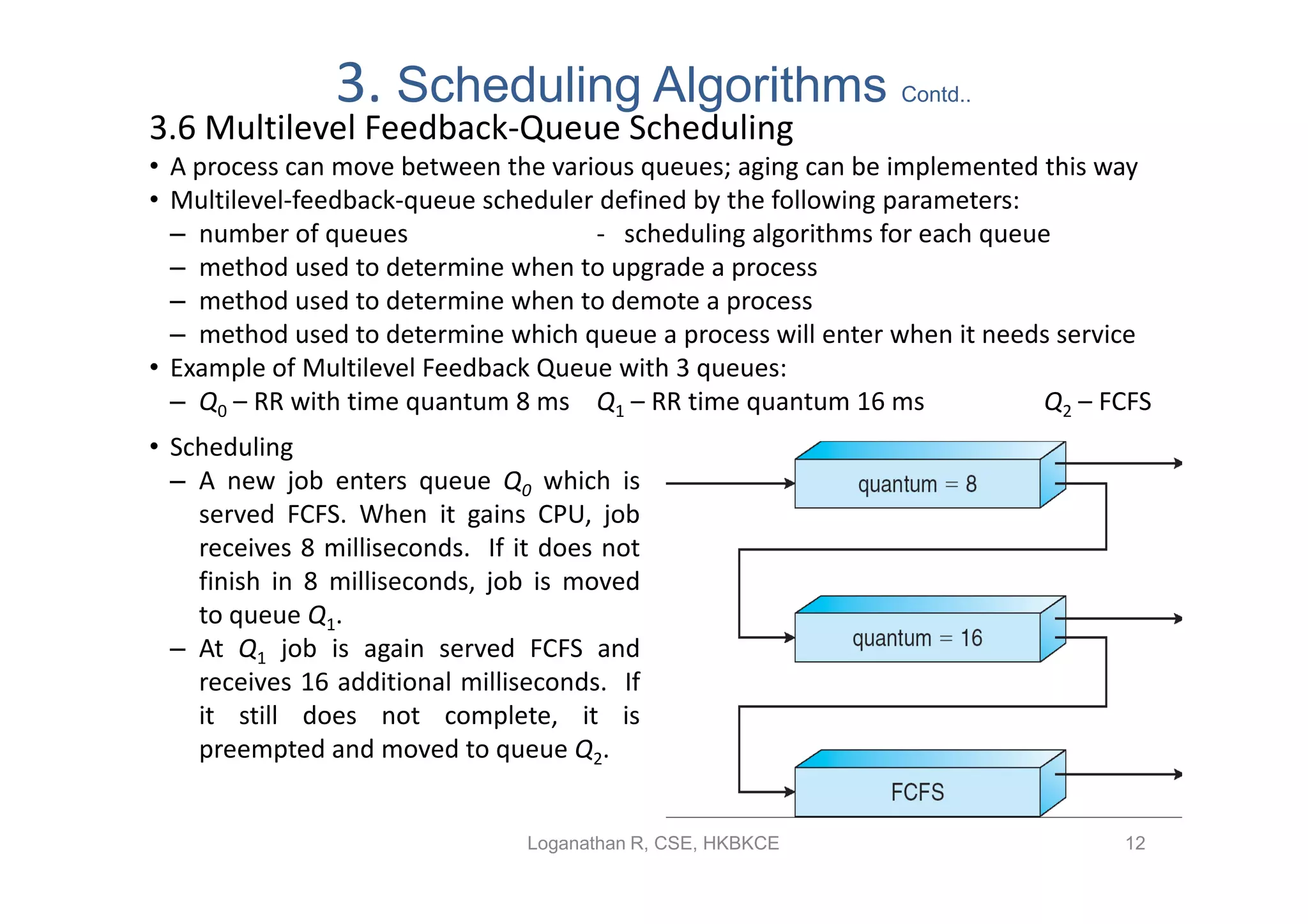
• Example of Multilevel Feedback Queue with 3 queues:
– Q0 – RR with time quantum 8 ms Q1 – RR time quantum 16 ms Q2 – FCFS
• Scheduling
– A new job enters queue Q0 which is
served FCFS. When it gains CPU, job
receives 8 milliseconds. If it does not
finish in 8 milliseconds, job is moved
to queue Q1.
– At Q1 job is again served FCFS and
receives 16 additional milliseconds. If
it still does not complete, it is
preempted and moved to queue Q2.
Loganathan R, CSE, HKBKCE 12
13.
4. Multiple-Processor Scheduling
•Load sharing is possible but CPU scheduling is more complex when multiple CPUs
are available
4.1 Approaches (for Homogeneous processors in multiprocessor)
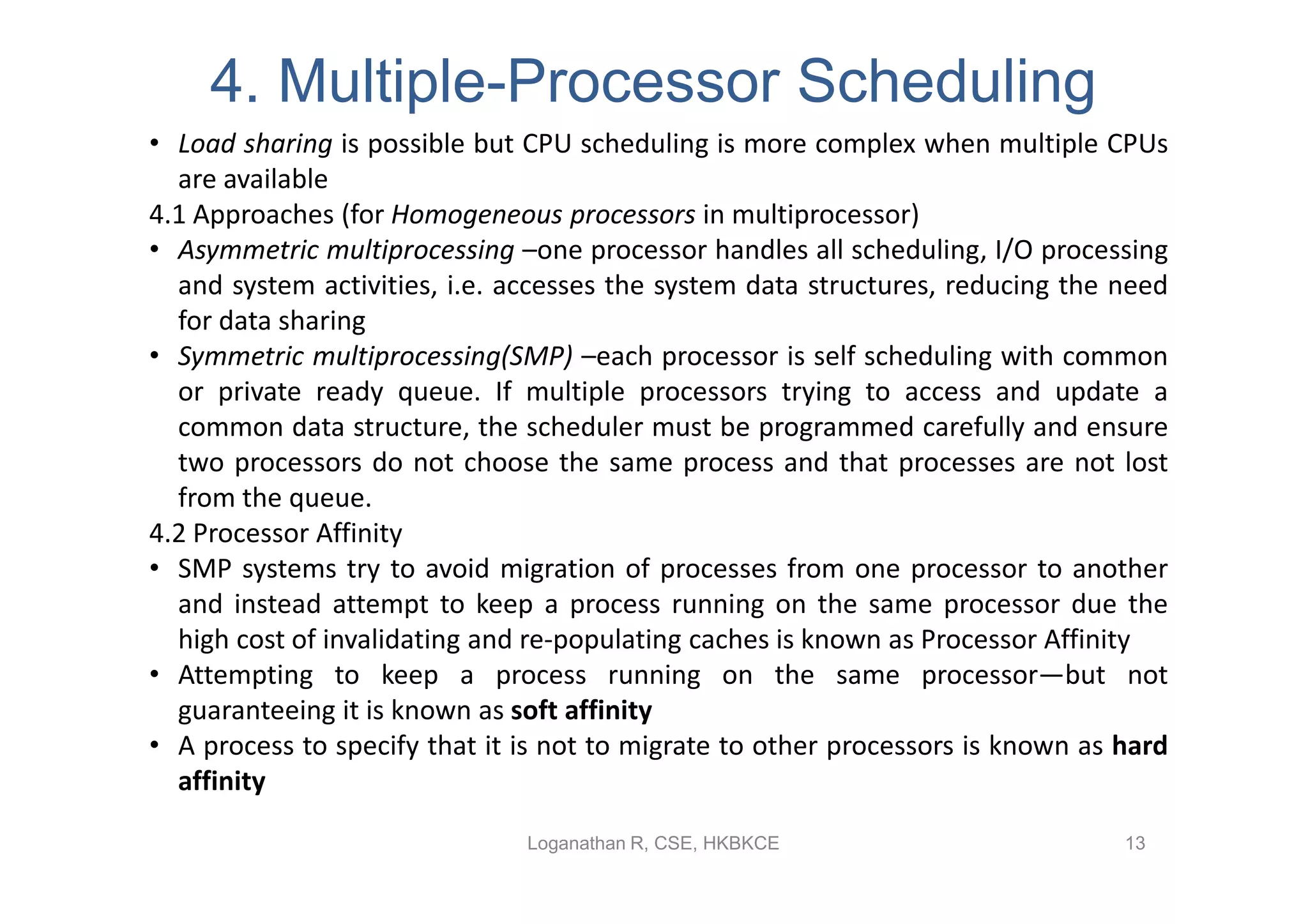
• Asymmetric multiprocessing –one processor handles all scheduling, I/O processing
and system activities, i.e. accesses the system data structures, reducing the need
for data sharing
• Symmetric multiprocessing(SMP) –each processor is self scheduling with common
or private ready queue. If multiple processors trying to access and update a
common data structure, the scheduler must be programmed carefully and ensure
two processors do not choose the same process and that processes are not lost
from the queue.
4.2 Processor Affinity
• SMP systems try to avoid migration of processes from one processor to another
and instead attempt to keep a process running on the same processor due the
high cost of invalidating and re-populating caches is known as Processor Affinity
• Attempting to keep a process running on the same processor—but not
guaranteeing it is known as soft affinity
• A process to specify that it is not to migrate to other processors is known as hard
affinity
Loganathan R, CSE, HKBKCE 13
14.
4. Multiple-Processor SchedulingContd…
4.3 Load Balancing
• Load balancing is to keep the workload evenly distributed across all processors
• Load balancing is necessary where each processor has its own private queue
• Approaches
– Push migration, a specific task periodically checks the load on each processor and—
if it finds an imbalance— evenly distributes the load by moving (or pushing)
processes from overloaded to idle or less-busy
– Pull migration, an idle processor pulls a waiting process from a busy processor
• Load balancing often counteracts the benefits of processor affinity
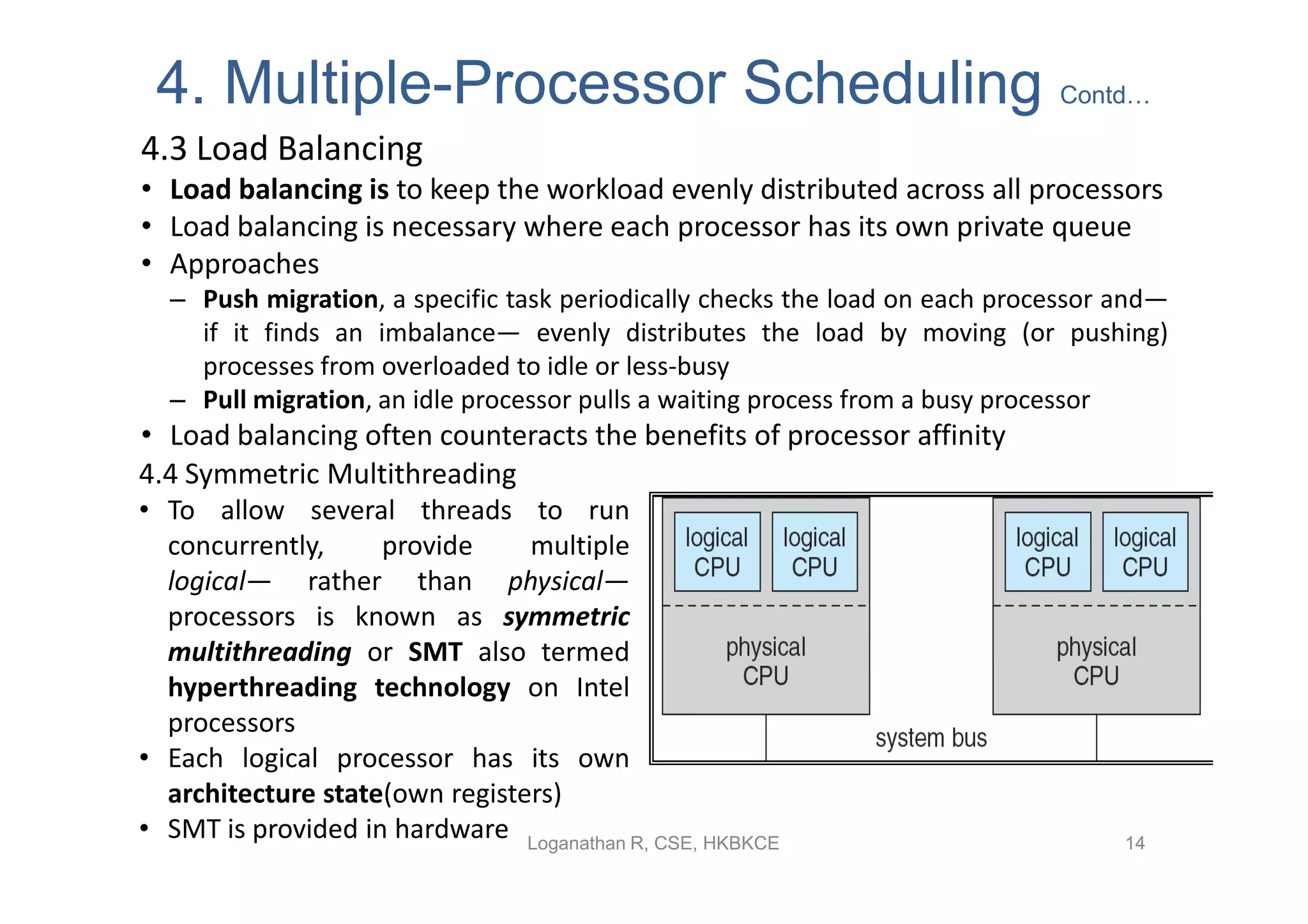
4.4 Symmetric Multithreading
• To allow several threads to run
concurrently, provide multiple
logical— rather than physical—
processors is known as symmetric
multithreading or SMT also termed
hyperthreading technology on Intel
processors
• Each logical processor has its own
architecture state(own registers)
• SMT is provided in hardware Loganathan R, CSE, HKBKCE 14
15.
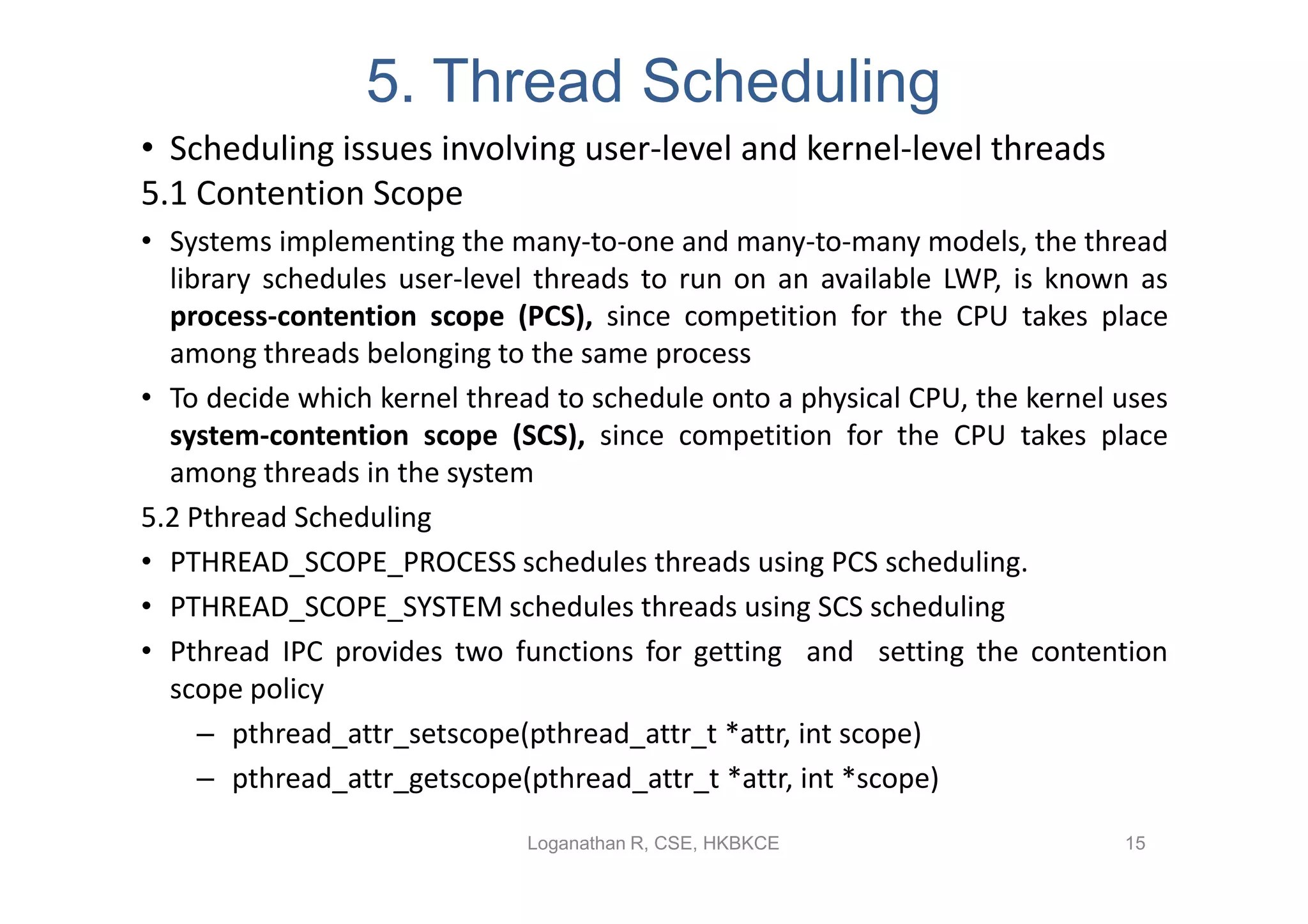
5. Thread Scheduling
•Scheduling issues involving user-level and kernel-level threads
5.1 Contention Scope
• Systems implementing the many-to-one and many-to-many models, the thread
library schedules user-level threads to run on an available LWP, is known as
process-contention scope (PCS), since competition for the CPU takes place
among threads belonging to the same process
• To decide which kernel thread to schedule onto a physical CPU, the kernel uses
system-contention scope (SCS), since competition for the CPU takes place
among threads in the system
5.2 Pthread Scheduling
• PTHREAD_SCOPE_PROCESS schedules threads using PCS scheduling.
• PTHREAD_SCOPE_SYSTEM schedules threads using SCS scheduling
• Pthread IPC provides two functions for getting and setting the contention
scope policy
– pthread_attr_setscope(pthread_attr_t *attr, int scope)
– pthread_attr_getscope(pthread_attr_t *attr, int *scope)
Loganathan R, CSE, HKBKCE 15