CPU
SCHEDULING
By- Nitish Kumar Sandhawar
Roll-52
Id- 17049
Subject-Operating System
PRIORITY AND ROUND ROBIN
CPU SHEDULING
– CPU scheduling is a process which allows one
process to use the CPU while the execution of
another process is on hold (in waiting state) due to
due to unavailability of any resources like I/O etc,
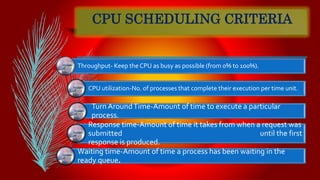
CPU SCHEDULING CRITERIA
Throughput- Keep the CPU as busy as possible (from 0% to 100%).
CPU utilization-No. of processes that complete their execution per time unit.
Turn AroundTime-Amount of time to execute a particular
process.
Response time-Amount of time it takes from when a request was
submitted until the first
response is produced.
Waiting time-Amount of time a process has been waiting in the
ready queue.
Different Types of Scheduling Algorithm
There are two types of scheduling algorithm :-
1.Preemptive
a) Preempted SJF (In some Cases)-also called pre-emptive SJF
b) Preempted Priority (In some Cases)-also called pre-emptive
Priority
c) Round Robin
d) Multilevel Queue Scheduling
e) Multilevel Feedback Queue
–
1.Non-Preemptive
a) First Come First Serve
b) Non-Preempted SJF
PRIORITY
 The Priority scheduling algorithm is a general case of the SJF
algorithm. It is a non-Preemptive, pre-emptive algorithm and
one of the most common scheduling algorithms in batch
systems.
 Each process is assigned a priority. Process with highest priority
is to be executed first and so on. Process with same priority are
executed on FCFS basis.
 In Priority algorithm priority (p) is the inverse of the given
priority value. The larger the numeric value of priority, the lower
the priority, and vice versa.
 Priority can be decided based on memory requirements, time
Wait time of each process is as follows −
Average Wait Time: (9+5+12+0) / 4 = 6.5
Proce
ss
Wait Time : Service Time - Arrival
Time
P0 9 - 0 = 9
P1 6 - 1 = 5
P2 14 - 2 = 12
P3 0 - 0 = 0
– Advantage-
 Simplicity
 Reasonable support for priority
 Suitable for applications with varying
and resource requirement.
– Disadvantage-
 Indefinite blocking or starvation.
 A priority scheduling can leave some
priority waiting processes indefinitely
CPU.
ROUND ROBIN
 Round Robin is the preemptive process
scheduling algorithm.
 Each process is provided a fix time to execute,
it is called a quantum.
 Once a process is executed for a given time
period, it is preempted and other process
executes for a given time period.
 Context switching is used to save states of
preempted processes.
 The Round Robin scheduling is especially
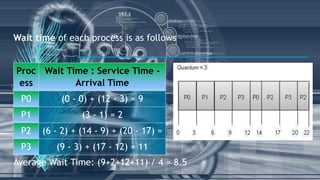
Wait time of each process is as follows –
Proc
ess
Wait Time : Service Time -
Arrival Time
P0 (0 - 0) + (12 - 3) = 9
P1 (3 - 1) = 2
P2 (6 - 2) + (14 - 9) + (20 - 17) =
P3 (9 - 3) + (17 - 12) = 11
Average Wait Time: (9+2+12+11) / 4 = 8.5
Advantage-
• There is fairness since every process gets equal
CPU.
• The newly created process is added to end of ready
queue.
• A round-robin scheduler generally employs time-
sharing, giving each job a time slot or quantum.
Disadvantage-
• Very important jobs wait in line.
• Largest job take enough time for completion.
• Setting the quantum too short causes too many context
switches and lower the CPU efficiency.
• Setting the quantum too long may cause poor response
THANK
YOU FOR
YOUR PATIENCE

scheduling algorithm

  • 1.
    CPU SCHEDULING By- Nitish KumarSandhawar Roll-52 Id- 17049 Subject-Operating System PRIORITY AND ROUND ROBIN
  • 2.
    CPU SHEDULING – CPUscheduling is a process which allows one process to use the CPU while the execution of another process is on hold (in waiting state) due to due to unavailability of any resources like I/O etc,
  • 3.
    CPU SCHEDULING CRITERIA Throughput-Keep the CPU as busy as possible (from 0% to 100%). CPU utilization-No. of processes that complete their execution per time unit. Turn AroundTime-Amount of time to execute a particular process. Response time-Amount of time it takes from when a request was submitted until the first response is produced. Waiting time-Amount of time a process has been waiting in the ready queue.
  • 4.
    Different Types ofScheduling Algorithm There are two types of scheduling algorithm :- 1.Preemptive a) Preempted SJF (In some Cases)-also called pre-emptive SJF b) Preempted Priority (In some Cases)-also called pre-emptive Priority c) Round Robin d) Multilevel Queue Scheduling e) Multilevel Feedback Queue – 1.Non-Preemptive a) First Come First Serve b) Non-Preempted SJF
  • 5.
    PRIORITY  The Priorityscheduling algorithm is a general case of the SJF algorithm. It is a non-Preemptive, pre-emptive algorithm and one of the most common scheduling algorithms in batch systems.  Each process is assigned a priority. Process with highest priority is to be executed first and so on. Process with same priority are executed on FCFS basis.  In Priority algorithm priority (p) is the inverse of the given priority value. The larger the numeric value of priority, the lower the priority, and vice versa.  Priority can be decided based on memory requirements, time
  • 6.
    Wait time ofeach process is as follows − Average Wait Time: (9+5+12+0) / 4 = 6.5 Proce ss Wait Time : Service Time - Arrival Time P0 9 - 0 = 9 P1 6 - 1 = 5 P2 14 - 2 = 12 P3 0 - 0 = 0
  • 7.
    – Advantage-  Simplicity Reasonable support for priority  Suitable for applications with varying and resource requirement. – Disadvantage-  Indefinite blocking or starvation.  A priority scheduling can leave some priority waiting processes indefinitely CPU.
  • 8.
    ROUND ROBIN  RoundRobin is the preemptive process scheduling algorithm.  Each process is provided a fix time to execute, it is called a quantum.  Once a process is executed for a given time period, it is preempted and other process executes for a given time period.  Context switching is used to save states of preempted processes.  The Round Robin scheduling is especially
  • 9.
    Wait time ofeach process is as follows – Proc ess Wait Time : Service Time - Arrival Time P0 (0 - 0) + (12 - 3) = 9 P1 (3 - 1) = 2 P2 (6 - 2) + (14 - 9) + (20 - 17) = P3 (9 - 3) + (17 - 12) = 11 Average Wait Time: (9+2+12+11) / 4 = 8.5
  • 10.
    Advantage- • There isfairness since every process gets equal CPU. • The newly created process is added to end of ready queue. • A round-robin scheduler generally employs time- sharing, giving each job a time slot or quantum. Disadvantage- • Very important jobs wait in line. • Largest job take enough time for completion. • Setting the quantum too short causes too many context switches and lower the CPU efficiency. • Setting the quantum too long may cause poor response
  • 11.