OPERATING SYSTEMS

   SCHEDULING


    Jerry Breecher


      5: CPU-Scheduling   1
CPU Scheduling
                 What Is In This Chapter?
•   This chapter is about how to get a process attached to a processor.

•   It centers around efficient algorithms that perform well.

•   The design of a scheduler is concerned with making sure all users get
    their fair share of the resources.


                                5: CPU-Scheduling                         2
CPU Scheduling
                What Is In This Chapter?

•   Basic Concepts
•   Scheduling Criteria
•   Scheduling Algorithms
•   Multiple-Processor Scheduling
•   Real-Time Scheduling
•   Thread Scheduling
•   Operating Systems Examples
•   Java Thread Scheduling
•   Algorithm Evaluation

                         5: CPU-Scheduling   3
CPU SCHEDULING                                               Scheduling
                                                                  Concepts
Multiprogramming        A number of programs can be in
                        memory at the same time. Allows
                        overlap of CPU and I/O.
Jobs                    (batch) are programs        that   run
                        without user interaction.
User                    (time shared) are programs that
                        may have user interaction.
Process                 is the common name for both.
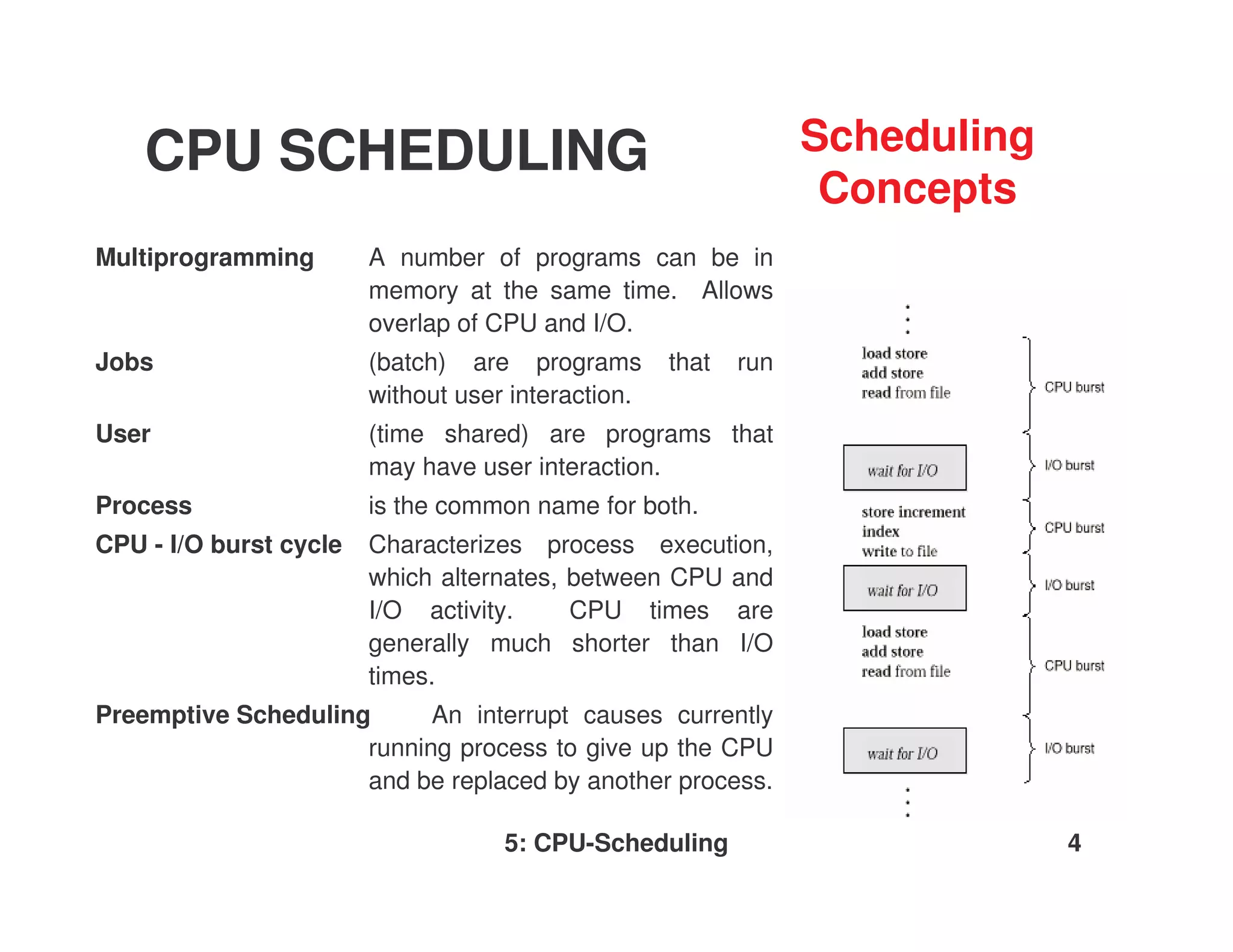
CPU - I/O burst cycle   Characterizes process execution,
                        which alternates, between CPU and
                        I/O activity.     CPU times are
                        generally much shorter than I/O
                        times.
Preemptive Scheduling      An interrupt causes currently
                     running process to give up the CPU
                     and be replaced by another process.

                                    5: CPU-Scheduling                         4
CPU SCHEDULING                                   The Scheduler


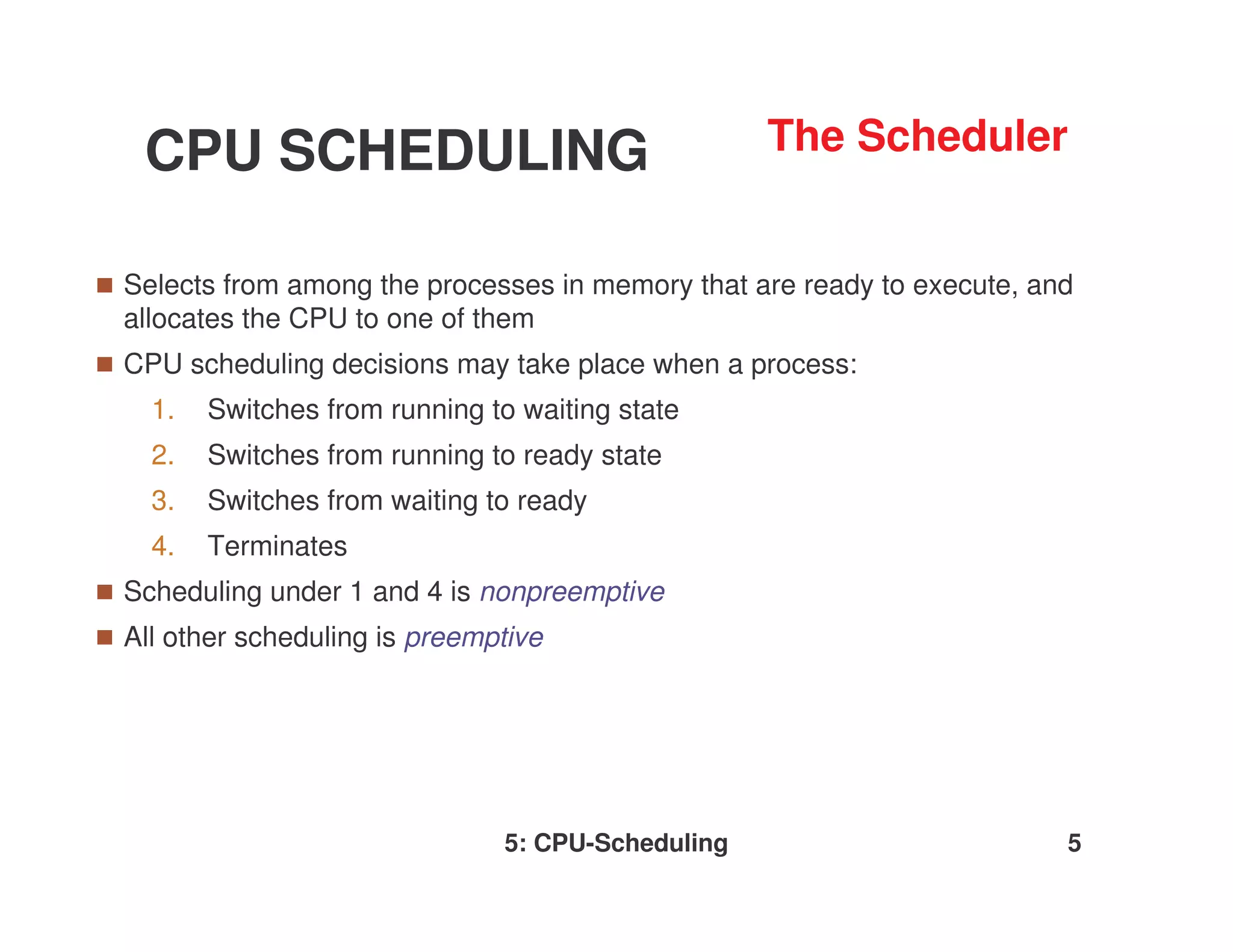
Selects from among the processes in memory that are ready to execute, and
allocates the CPU to one of them
CPU scheduling decisions may take place when a process:
  1.   Switches from running to waiting state
  2.   Switches from running to ready state
  3.   Switches from waiting to ready
  4.   Terminates
Scheduling under 1 and 4 is nonpreemptive
All other scheduling is preemptive


                              5: CPU-Scheduling                         5
CPU SCHEDULING                                     The Dispatcher


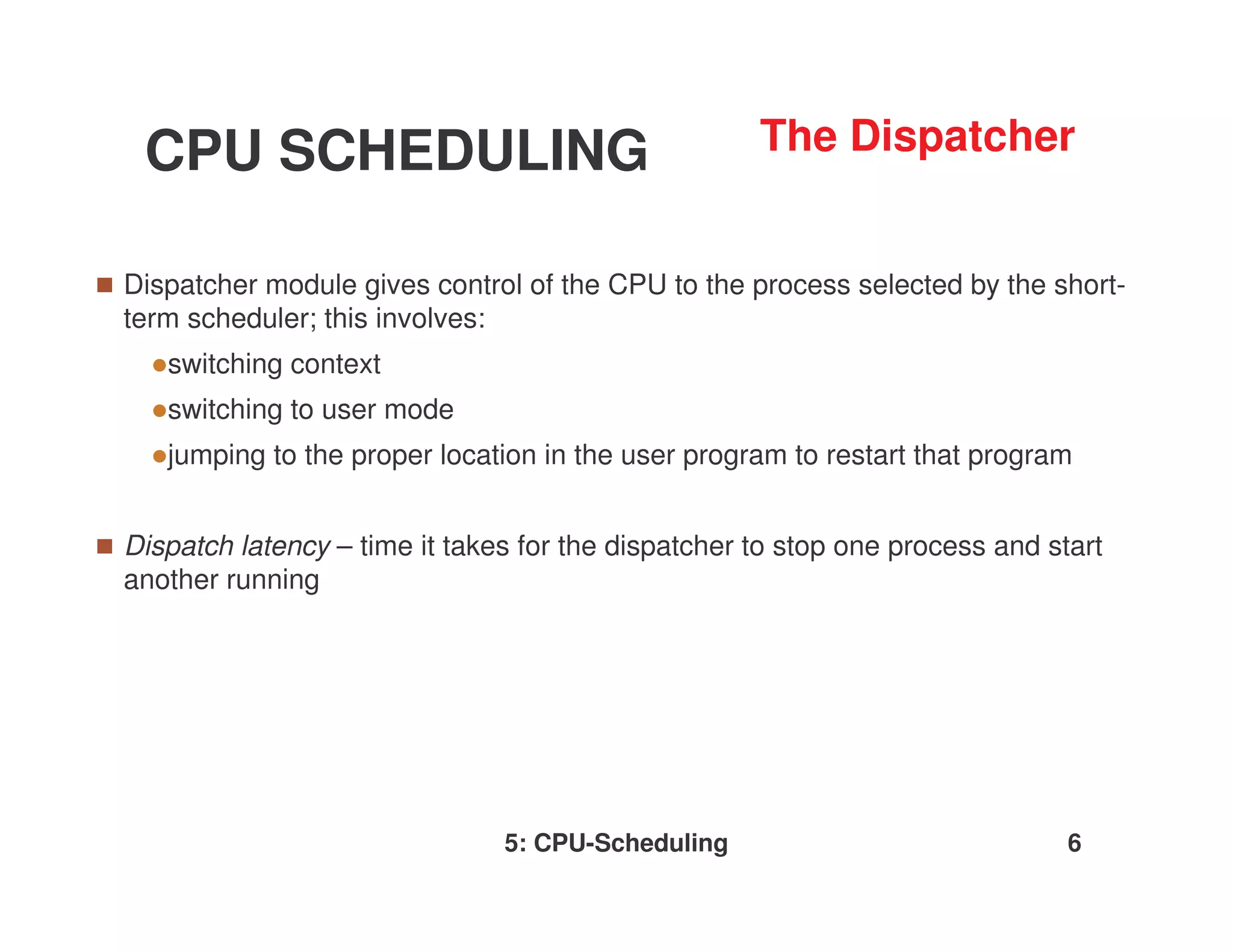
Dispatcher module gives control of the CPU to the process selected by the short-
term scheduler; this involves:
   switching context
   switching to user mode
   jumping to the proper location in the user program to restart that program


Dispatch latency – time it takes for the dispatcher to stop one process and start
another running


                               5: CPU-Scheduling                              6
Criteria For
    CPU SCHEDULING                                           Performance
                                                              Evaluation
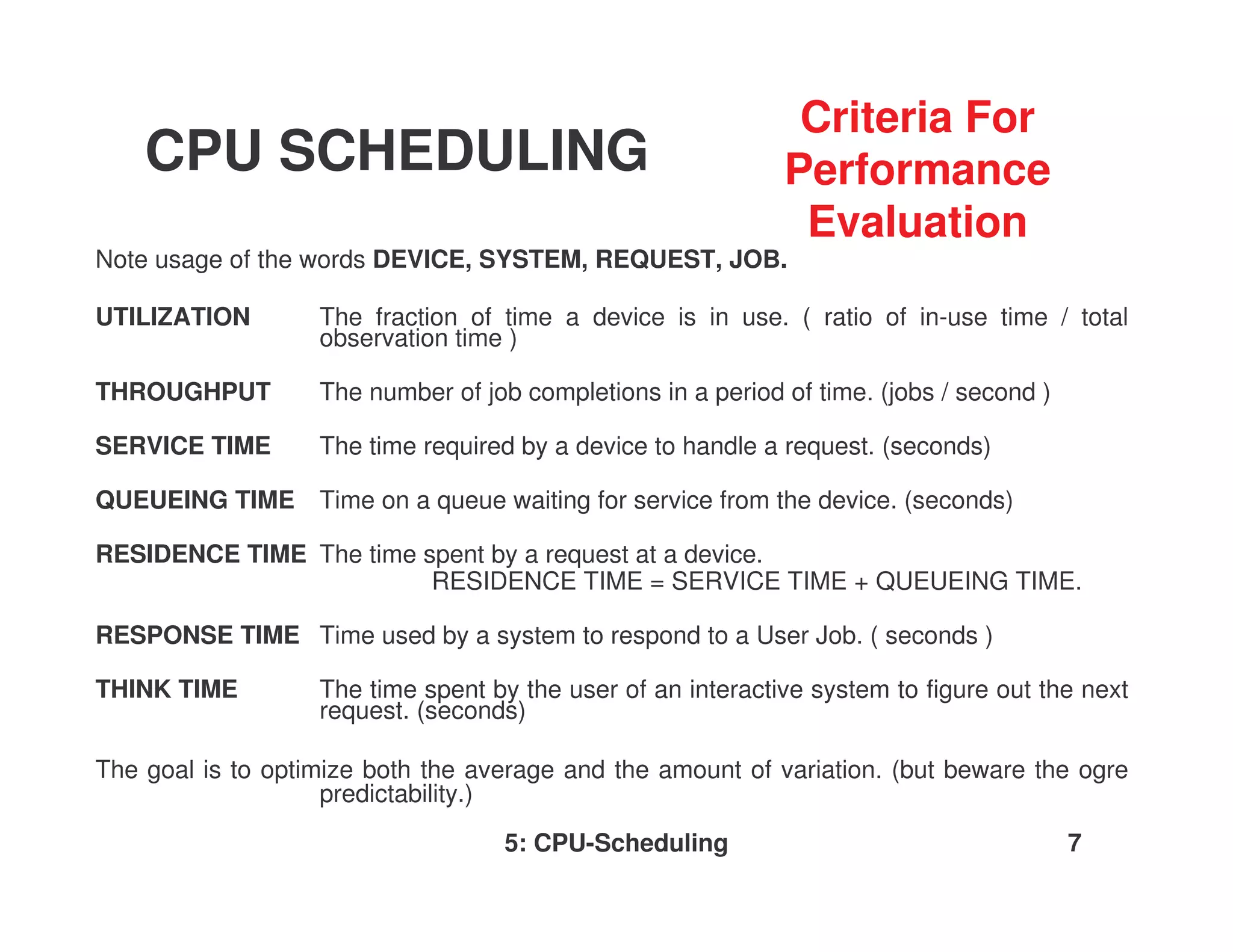
Note usage of the words DEVICE, SYSTEM, REQUEST, JOB.

UTILIZATION        The fraction of time a device is in use. ( ratio of in-use time / total
                   observation time )

THROUGHPUT         The number of job completions in a period of time. (jobs / second )

SERVICE TIME       The time required by a device to handle a request. (seconds)

QUEUEING TIME Time on a queue waiting for service from the device. (seconds)

RESIDENCE TIME The time spent by a request at a device.
                         RESIDENCE TIME = SERVICE TIME + QUEUEING TIME.

RESPONSE TIME Time used by a system to respond to a User Job. ( seconds )

THINK TIME         The time spent by the user of an interactive system to figure out the next
                   request. (seconds)

The goal is to optimize both the average and the amount of variation. (but beware the ogre
                    predictability.)
                                   5: CPU-Scheduling                                     7
Scheduling
   CPU SCHEDULING                             Behavior
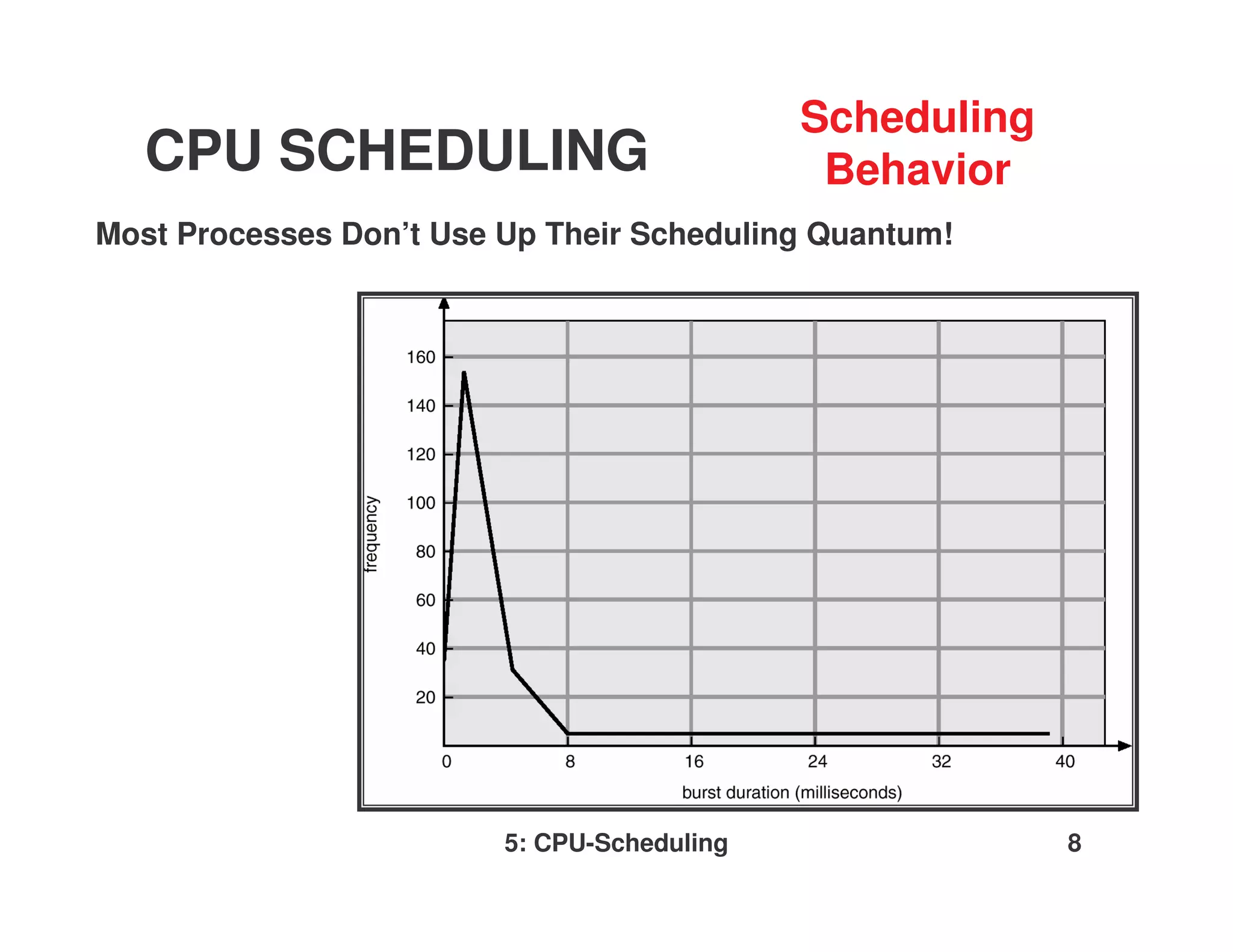
Most Processes Don’t Use Up Their Scheduling Quantum!


                         5: CPU-Scheduling                8
CPU SCHEDULING                                      Scheduling
                                                       Algorithms

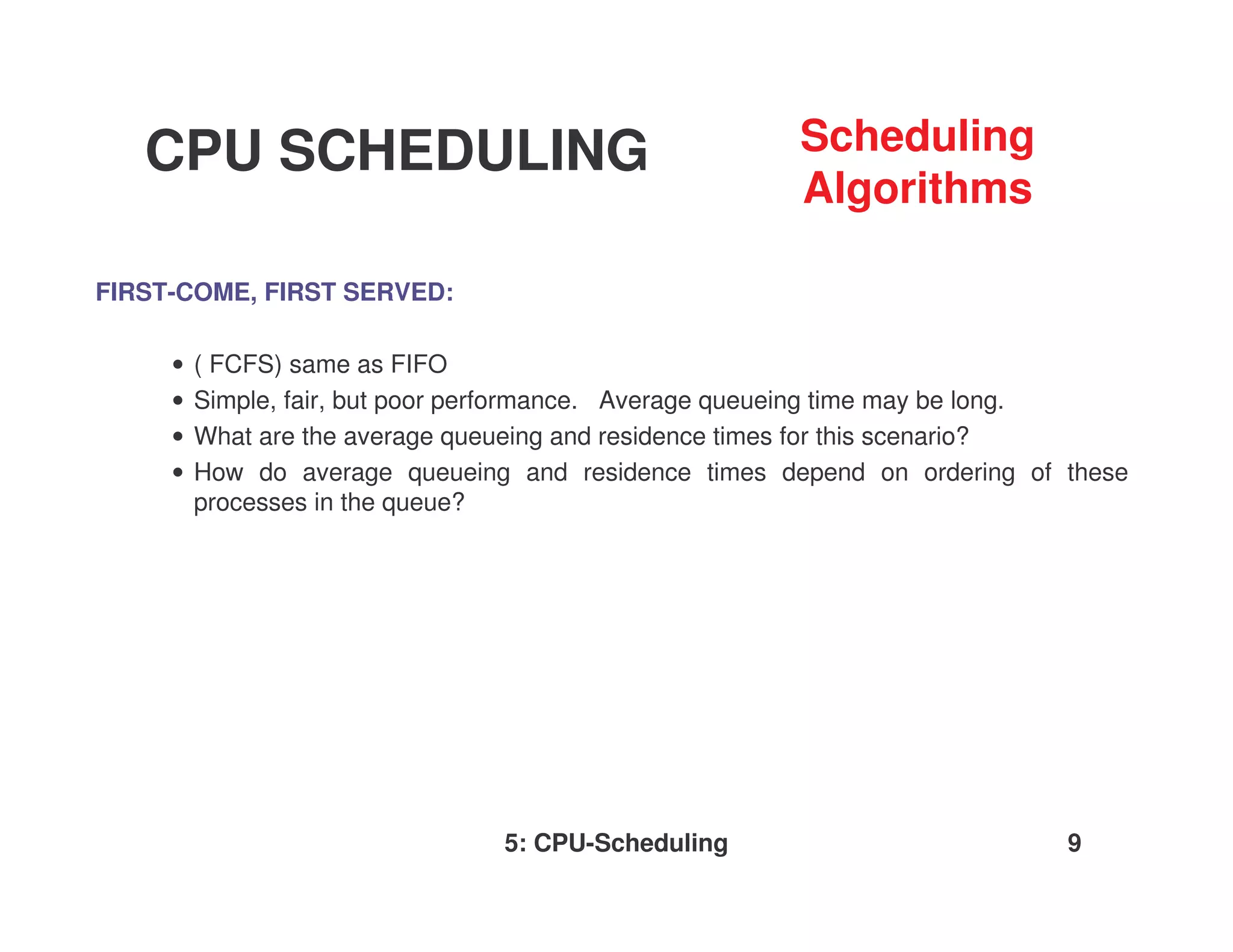
FIRST-COME, FIRST SERVED:

     •   ( FCFS) same as FIFO
     •   Simple, fair, but poor performance. Average queueing time may be long.
     •   What are the average queueing and residence times for this scenario?
     •   How do average queueing and residence times depend on ordering of these
         processes in the queue?


                                5: CPU-Scheduling                          9
CPU SCHEDULING                                         Scheduling
                                                            Algorithms
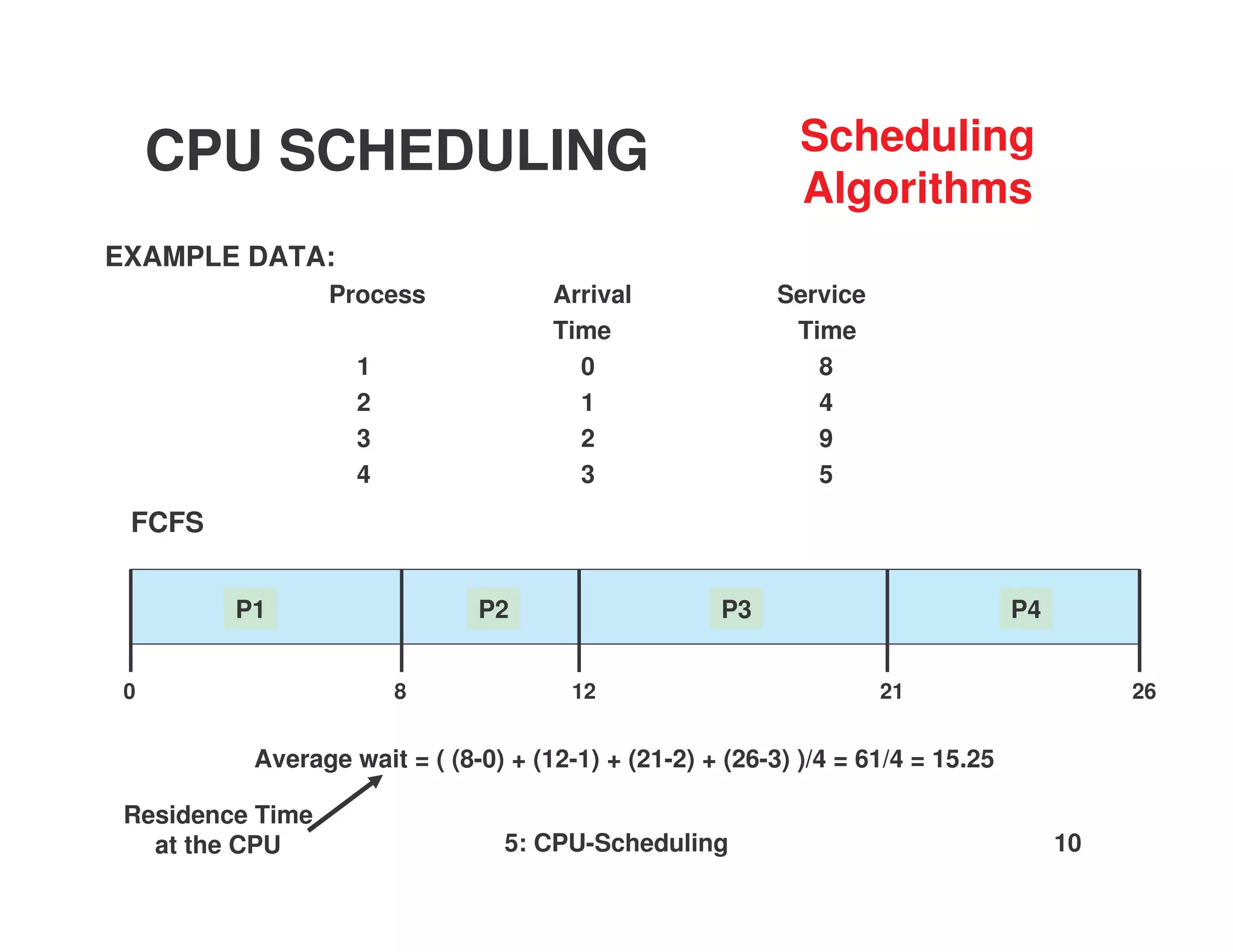
EXAMPLE DATA:
                  Process            Arrival              Service
                                     Time                  Time
                    1                  0                     8
                    2                  1                     4
                    3                  2                     9
                    4                  3                     5
 FCFS


         P1                   P2                    P3                           P4


 0                      8              12                           21                     26


          Average wait = ( (8-0) + (12-1) + (21-2) + (26-3) )/4 = 61/4 = 15.25

 Residence Time
   at the CPU                   5: CPU-Scheduling                                     10
CPU SCHEDULING                                                     Scheduling
                                                                   Algorithms

SHORTEST JOB FIRST:

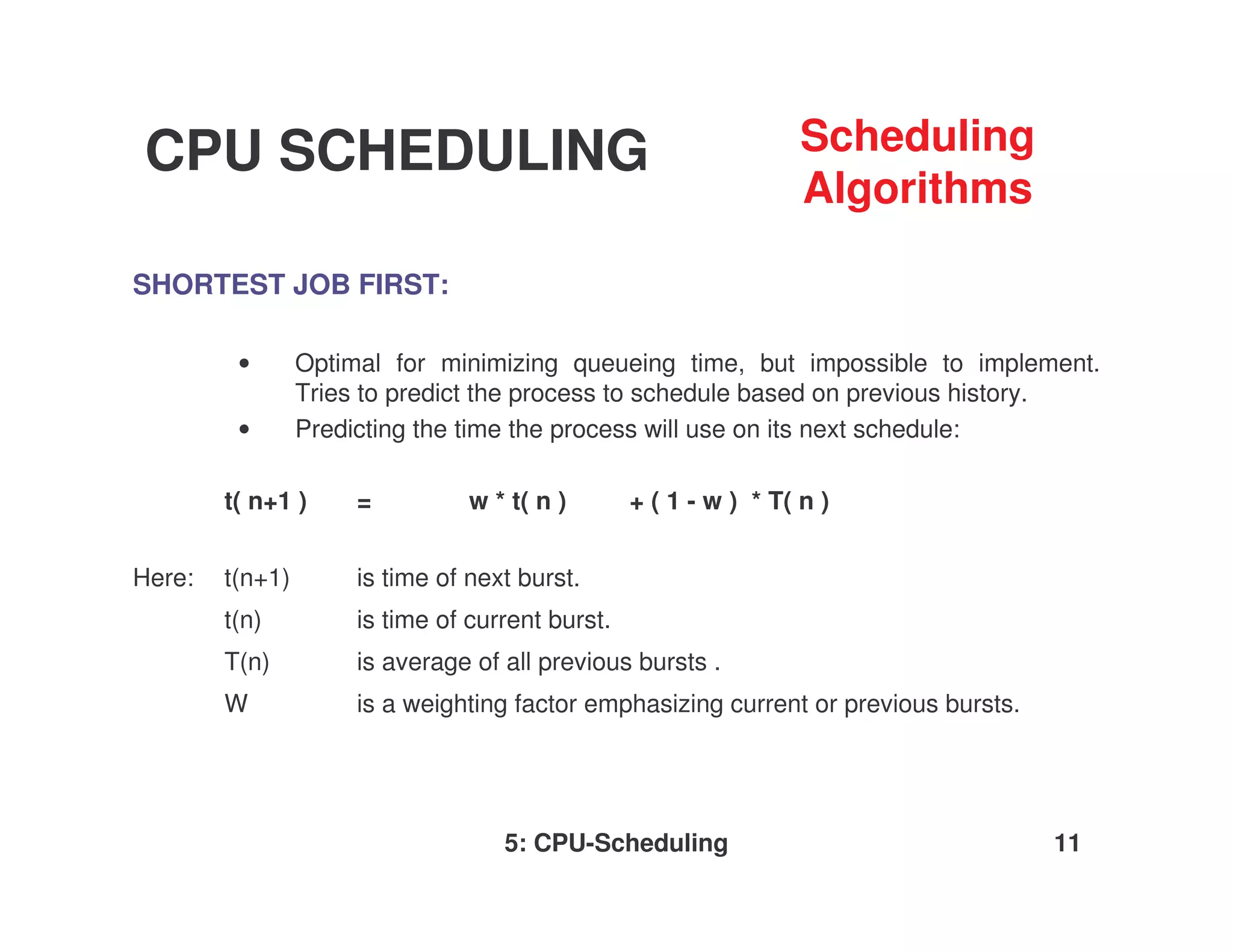
         •       Optimal for minimizing queueing time, but impossible to implement.
                 Tries to predict the process to schedule based on previous history.
         •       Predicting the time the process will use on its next schedule:

        t( n+1 )      =          w * t( n )       + ( 1 - w ) * T( n )


Here:   t(n+1)        is time of next burst.
        t(n)          is time of current burst.
        T(n)          is average of all previous bursts .
        W             is a weighting factor emphasizing current or previous bursts.


                                    5: CPU-Scheduling                                 11
CPU SCHEDULING                                          Scheduling
                                                         Algorithms
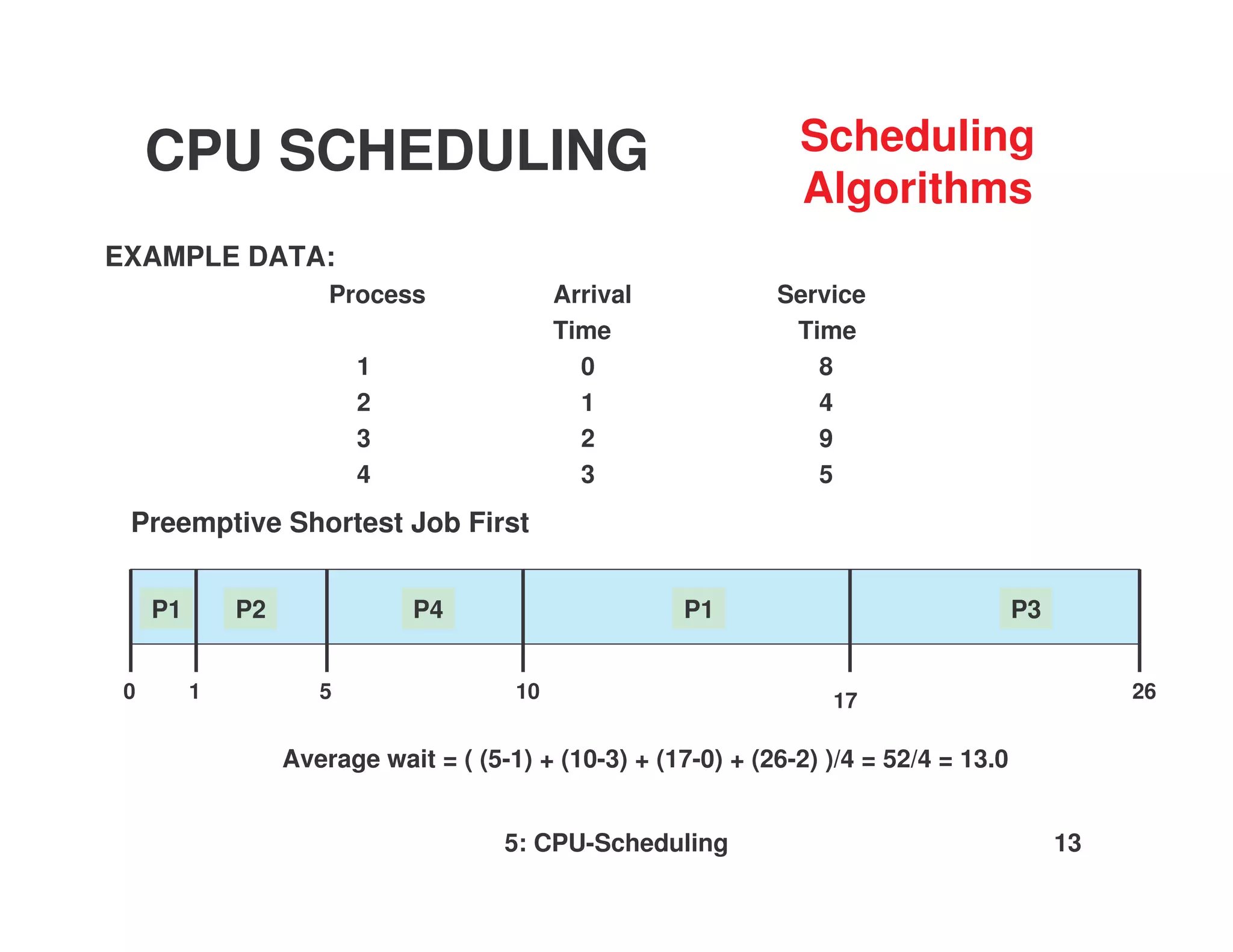
PREEMPTIVE ALGORITHMS:

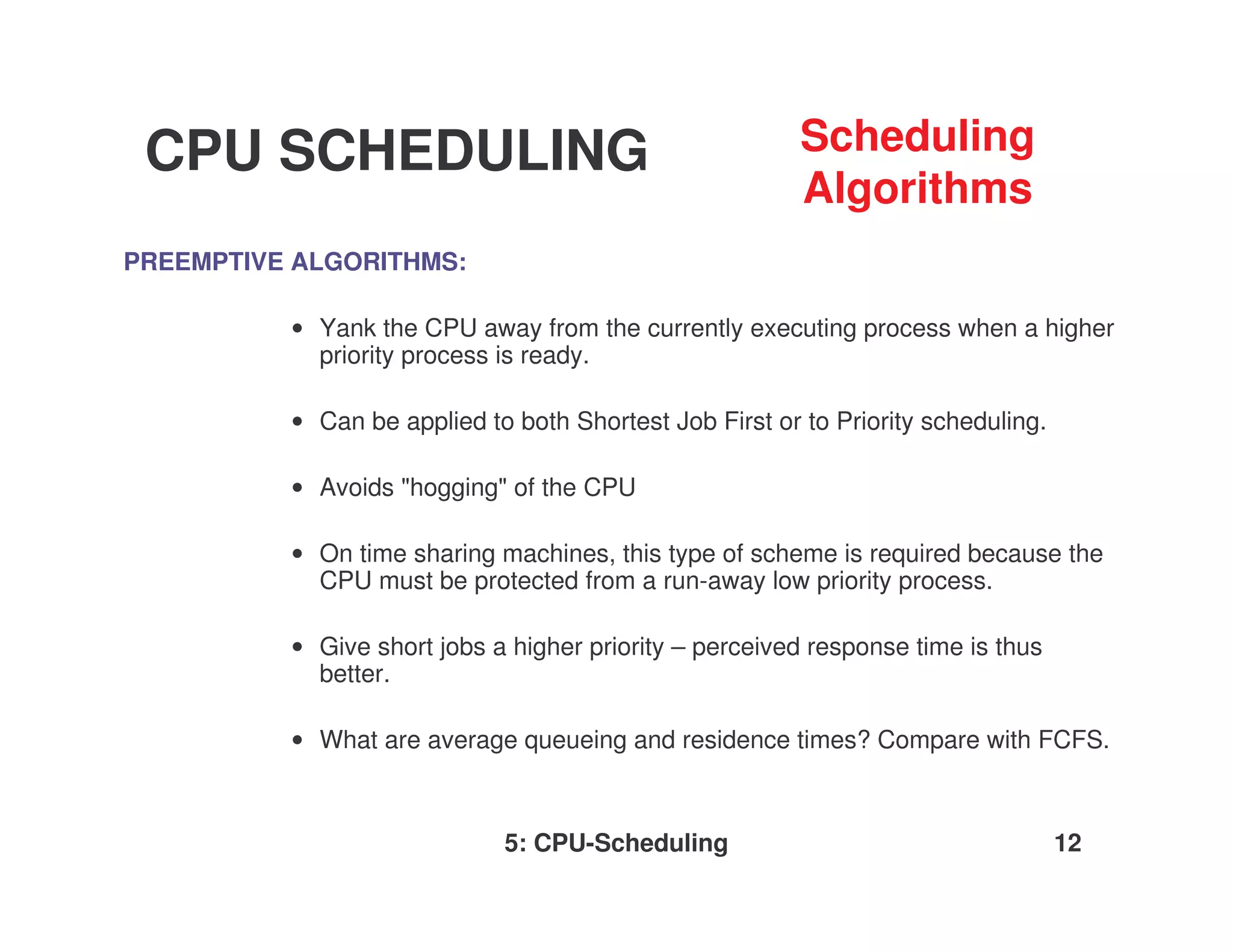
          • Yank the CPU away from the currently executing process when a higher
            priority process is ready.

          • Can be applied to both Shortest Job First or to Priority scheduling.

          • Avoids "hogging" of the CPU

          • On time sharing machines, this type of scheme is required because the
            CPU must be protected from a run-away low priority process.

          • Give short jobs a higher priority – perceived response time is thus
            better.

          • What are average queueing and residence times? Compare with FCFS.


                             5: CPU-Scheduling                                     12
CPU SCHEDULING                                               Scheduling
                                                                  Algorithms
EXAMPLE DATA:
                       Process               Arrival            Service
                                             Time                Time
                          1                    0                   8
                          2                    1                   4
                          3                    2                   9
                          4                    3                   5
 Preemptive Shortest Job First


     P1       P2               P4                       P1                               P3


 0        1           5                 10                           17                            26


                   Average wait = ( (5-1) + (10-3) + (17-0) + (26-2) )/4 = 52/4 = 13.0


                                       5: CPU-Scheduling                                      13
CPU SCHEDULING                                              Scheduling
                                                               Algorithms

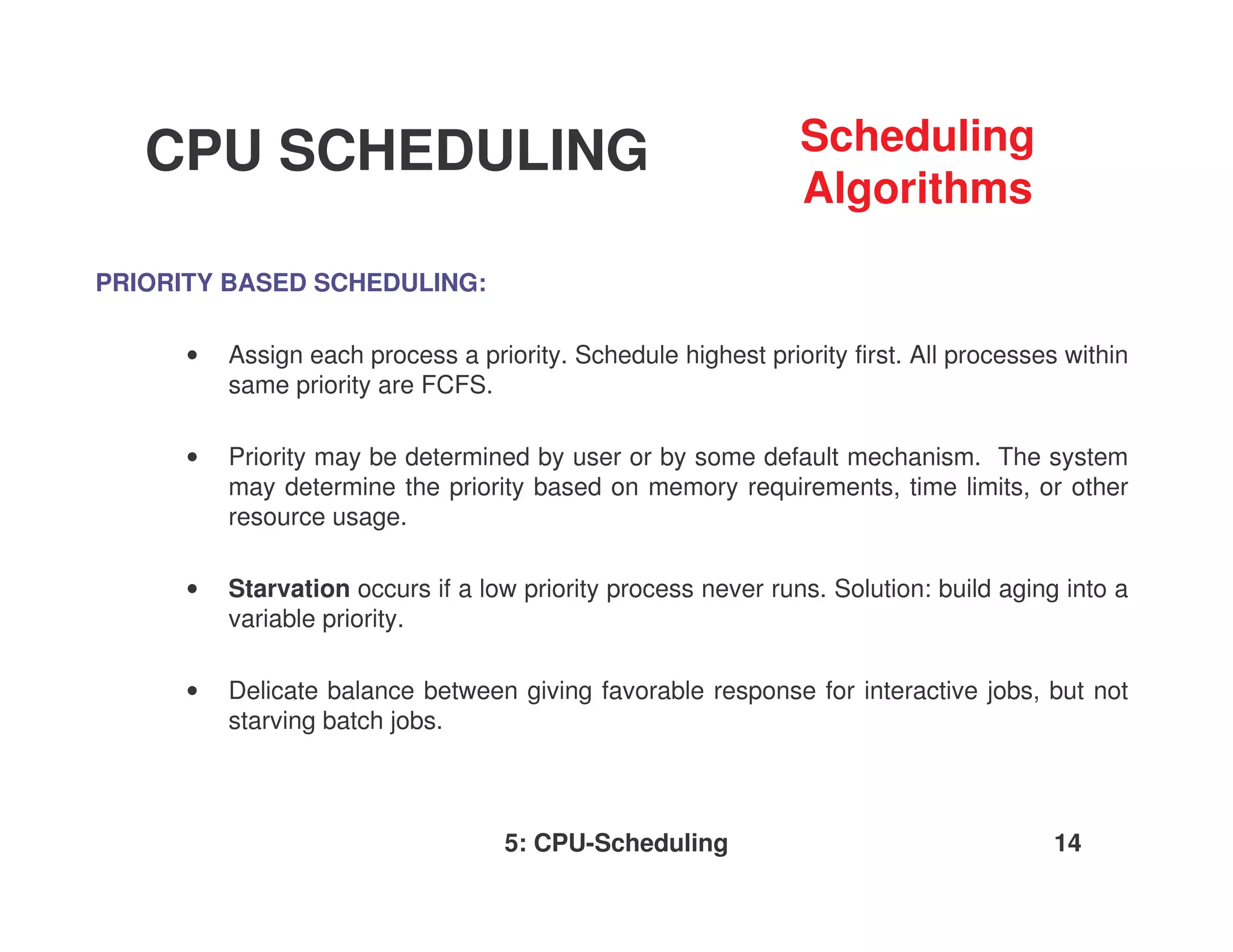
PRIORITY BASED SCHEDULING:

      •   Assign each process a priority. Schedule highest priority first. All processes within
          same priority are FCFS.

      •   Priority may be determined by user or by some default mechanism. The system
          may determine the priority based on memory requirements, time limits, or other
          resource usage.

      •   Starvation occurs if a low priority process never runs. Solution: build aging into a
          variable priority.

      •   Delicate balance between giving favorable response for interactive jobs, but not
          starving batch jobs.


                                    5: CPU-Scheduling                                  14
CPU SCHEDULING                                            Scheduling
                                                           Algorithms
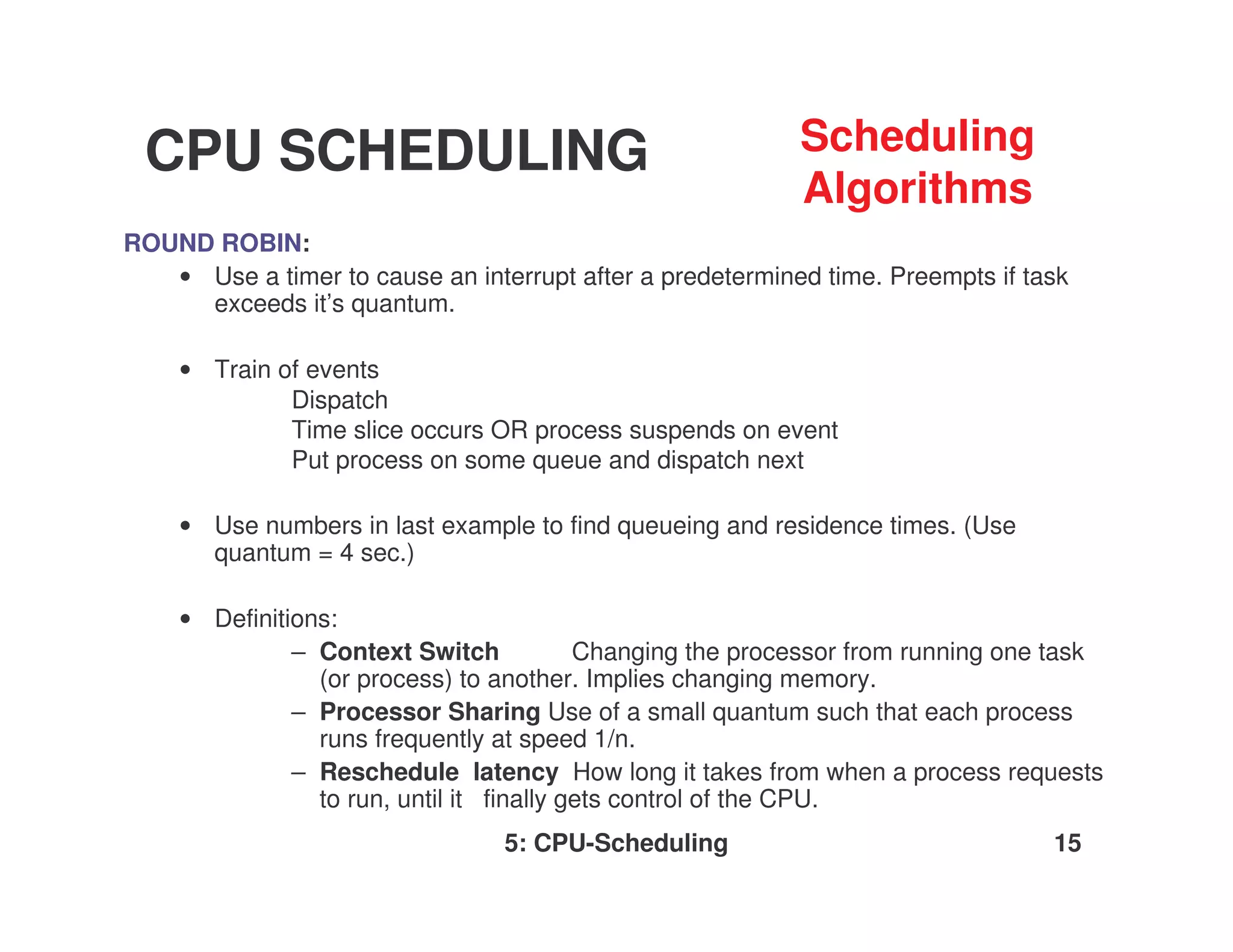
ROUND ROBIN:
   • Use a timer to cause an interrupt after a predetermined time. Preempts if task
     exceeds it’s quantum.

    • Train of events
             Dispatch
             Time slice occurs OR process suspends on event
             Put process on some queue and dispatch next

    • Use numbers in last example to find queueing and residence times. (Use
      quantum = 4 sec.)

    • Definitions:
              – Context Switch            Changing the processor from running one task
                (or process) to another. Implies changing memory.
              – Processor Sharing Use of a small quantum such that each process
                runs frequently at speed 1/n.
              – Reschedule latency How long it takes from when a process requests
                to run, until it finally gets control of the CPU.
                                 5: CPU-Scheduling                               15
CPU SCHEDULING                                            Scheduling
                                                           Algorithms
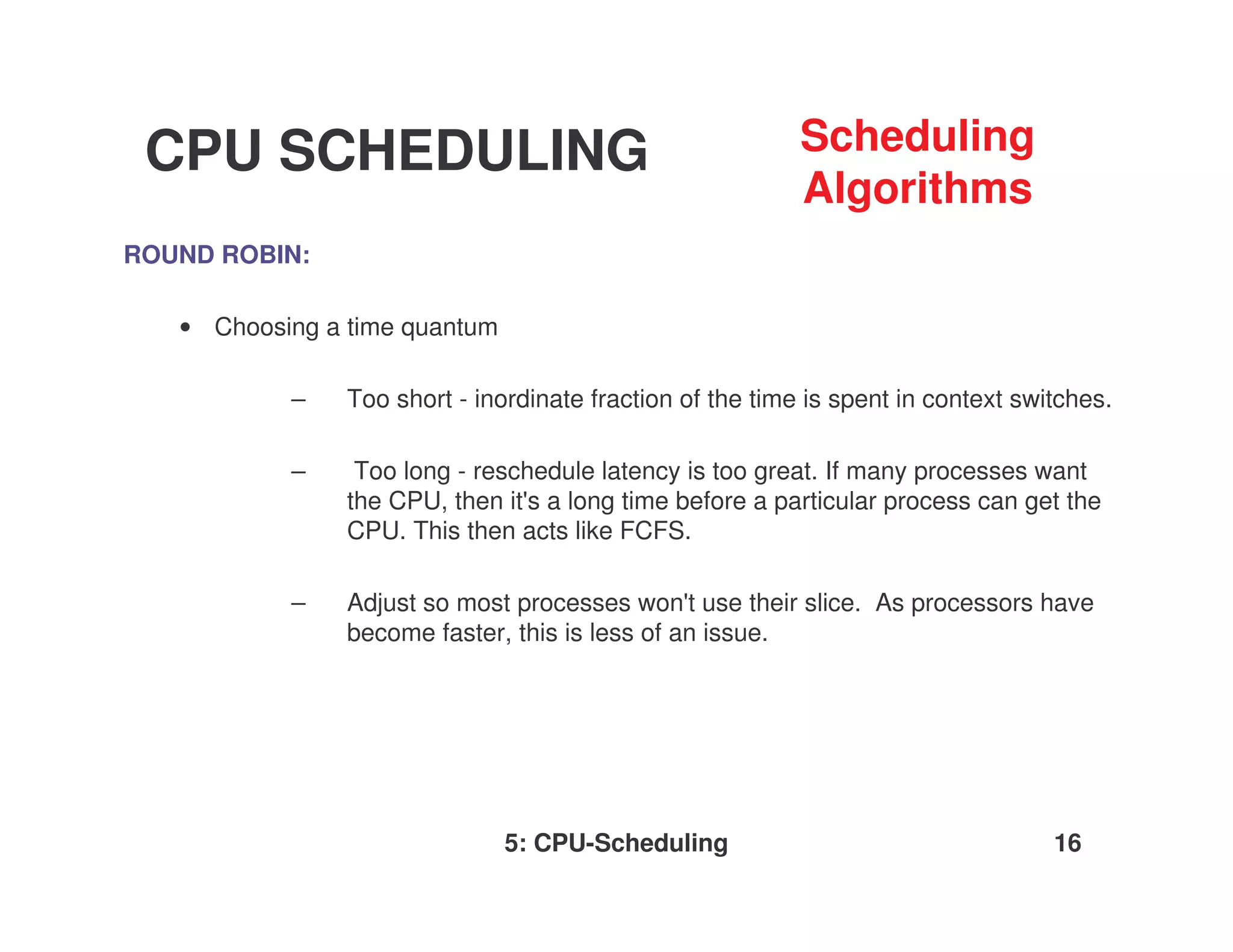
ROUND ROBIN:

   • Choosing a time quantum

           –    Too short - inordinate fraction of the time is spent in context switches.

           –     Too long - reschedule latency is too great. If many processes want
                the CPU, then it' a long time before a particular process can get the
                                 s
                CPU. This then acts like FCFS.

           –    Adjust so most processes won'use their slice. As processors have
                                                t
                become faster, this is less of an issue.


                               5: CPU-Scheduling                                   16
CPU SCHEDULING                                               Scheduling
                                                                  Algorithms
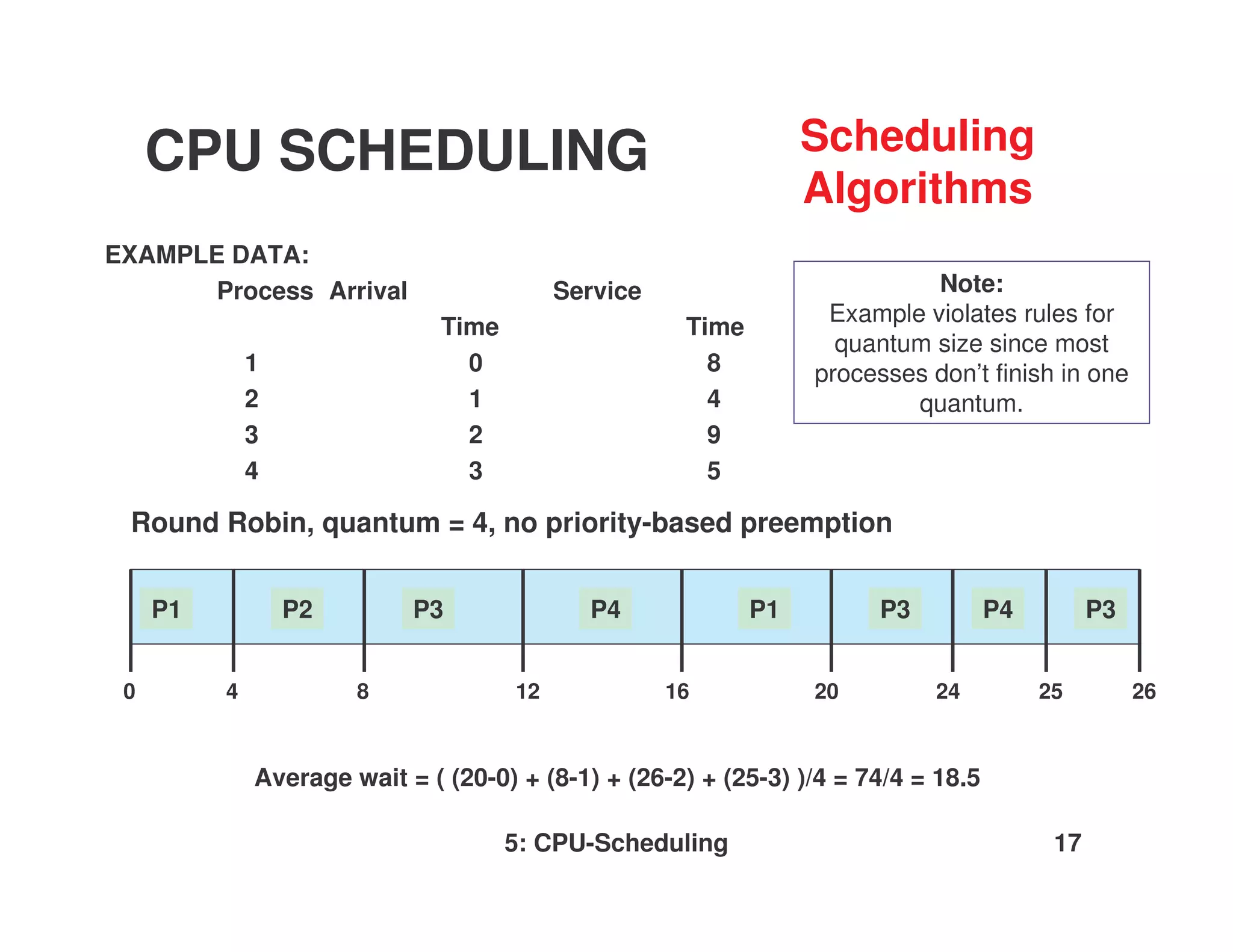
EXAMPLE DATA:
       Process Arrival                     Service                          Note:
                                                                   Example violates rules for
                               Time                   Time
                                                                    quantum size since most
              1                  0                      8         processes don’t finish in one
              2                  1                      4                 quantum.
              3                  2                      9
              4                  3                      5

 Round Robin, quantum = 4, no priority-based preemption


     P1           P2        P3               P4              P1         P3          P4         P3


 0        4            8              12             16           20         24          25         26


              Average wait = ( (20-0) + (8-1) + (26-2) + (25-3) )/4 = 74/4 = 18.5

                                      5: CPU-Scheduling                                   17
CPU SCHEDULING                                           Scheduling
                                                             Algorithms
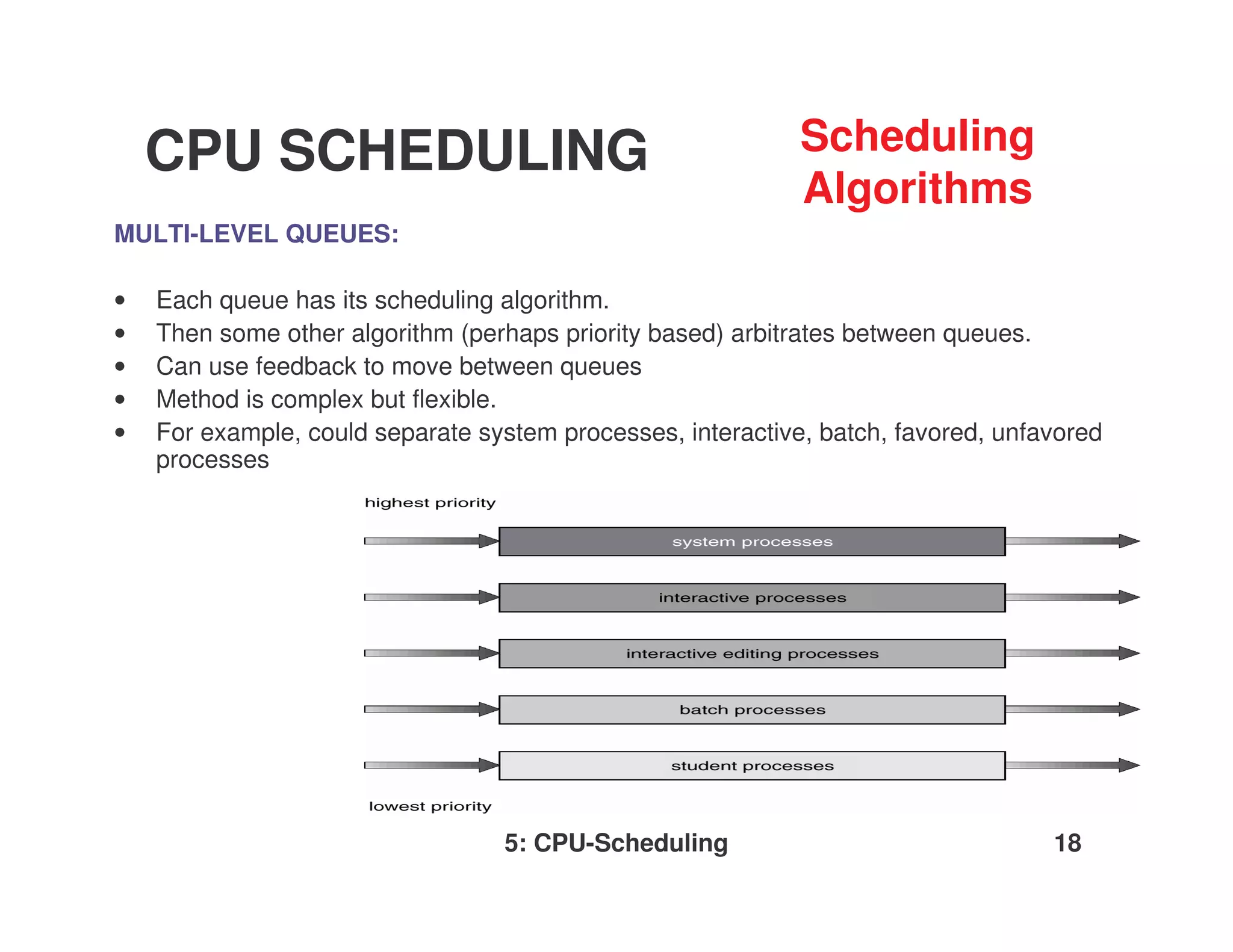
MULTI-LEVEL QUEUES:

•   Each queue has its scheduling algorithm.
•   Then some other algorithm (perhaps priority based) arbitrates between queues.
•   Can use feedback to move between queues
•   Method is complex but flexible.
•   For example, could separate system processes, interactive, batch, favored, unfavored
    processes


                                  5: CPU-Scheduling                                18
CPU SCHEDULING                             Using Priorities

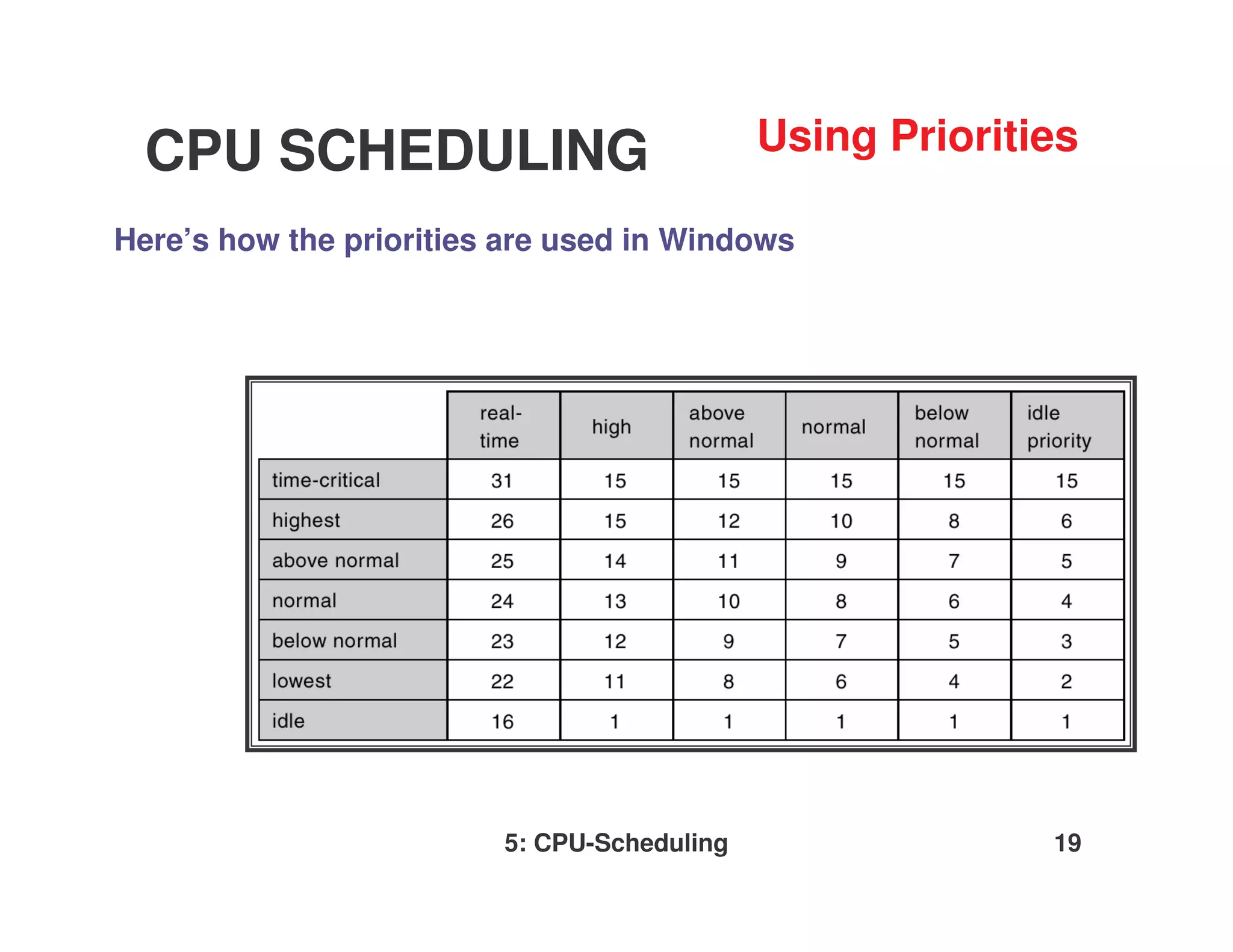
Here’s how the priorities are used in Windows


                         5: CPU-Scheduling                 19
CPU SCHEDULING                                       Scheduling
                                                         Algorithms
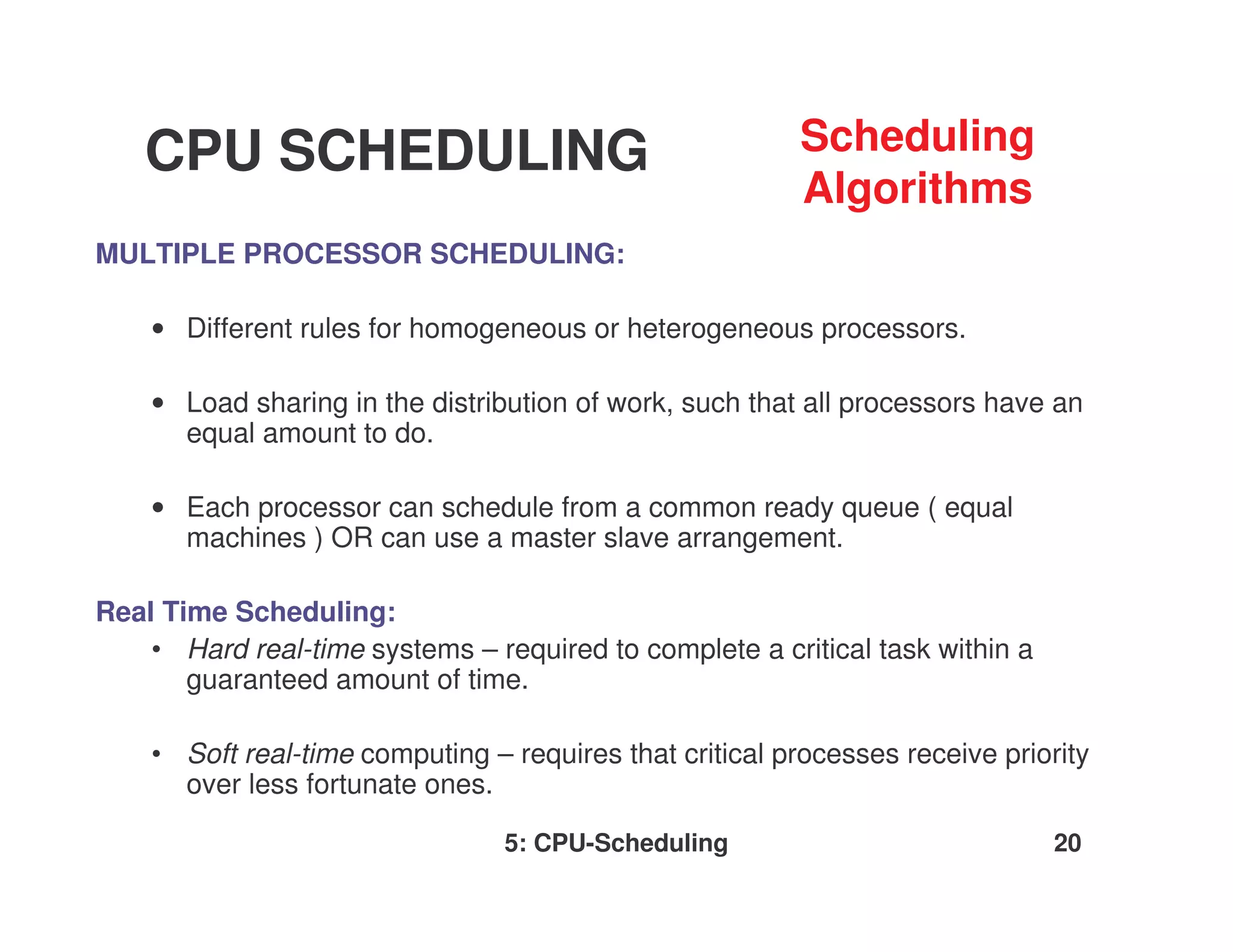
MULTIPLE PROCESSOR SCHEDULING:

    • Different rules for homogeneous or heterogeneous processors.

    • Load sharing in the distribution of work, such that all processors have an
      equal amount to do.

    • Each processor can schedule from a common ready queue ( equal
      machines ) OR can use a master slave arrangement.

Real Time Scheduling:
    • Hard real-time systems – required to complete a critical task within a
       guaranteed amount of time.

    • Soft real-time computing – requires that critical processes receive priority
      over less fortunate ones.

                                 5: CPU-Scheduling                             20
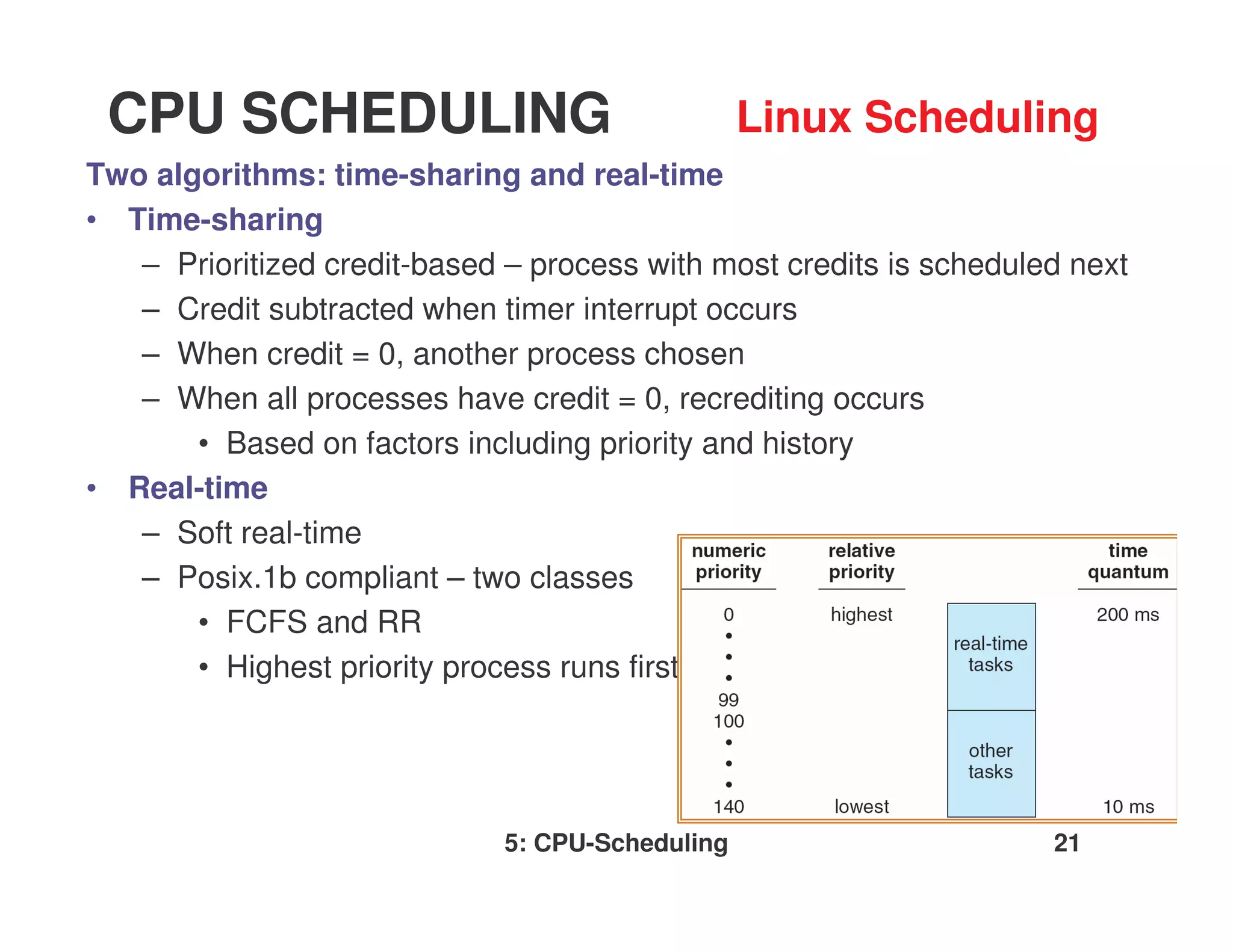
CPU SCHEDULING                                   Linux Scheduling
Two algorithms: time-sharing and real-time
• Time-sharing
   – Prioritized credit-based – process with most credits is scheduled next
   – Credit subtracted when timer interrupt occurs
   – When credit = 0, another process chosen
   – When all processes have credit = 0, recrediting occurs
       • Based on factors including priority and history
• Real-time
   – Soft real-time
   – Posix.1b compliant – two classes
       • FCFS and RR
       • Highest priority process runs first


                              5: CPU-Scheduling                      21
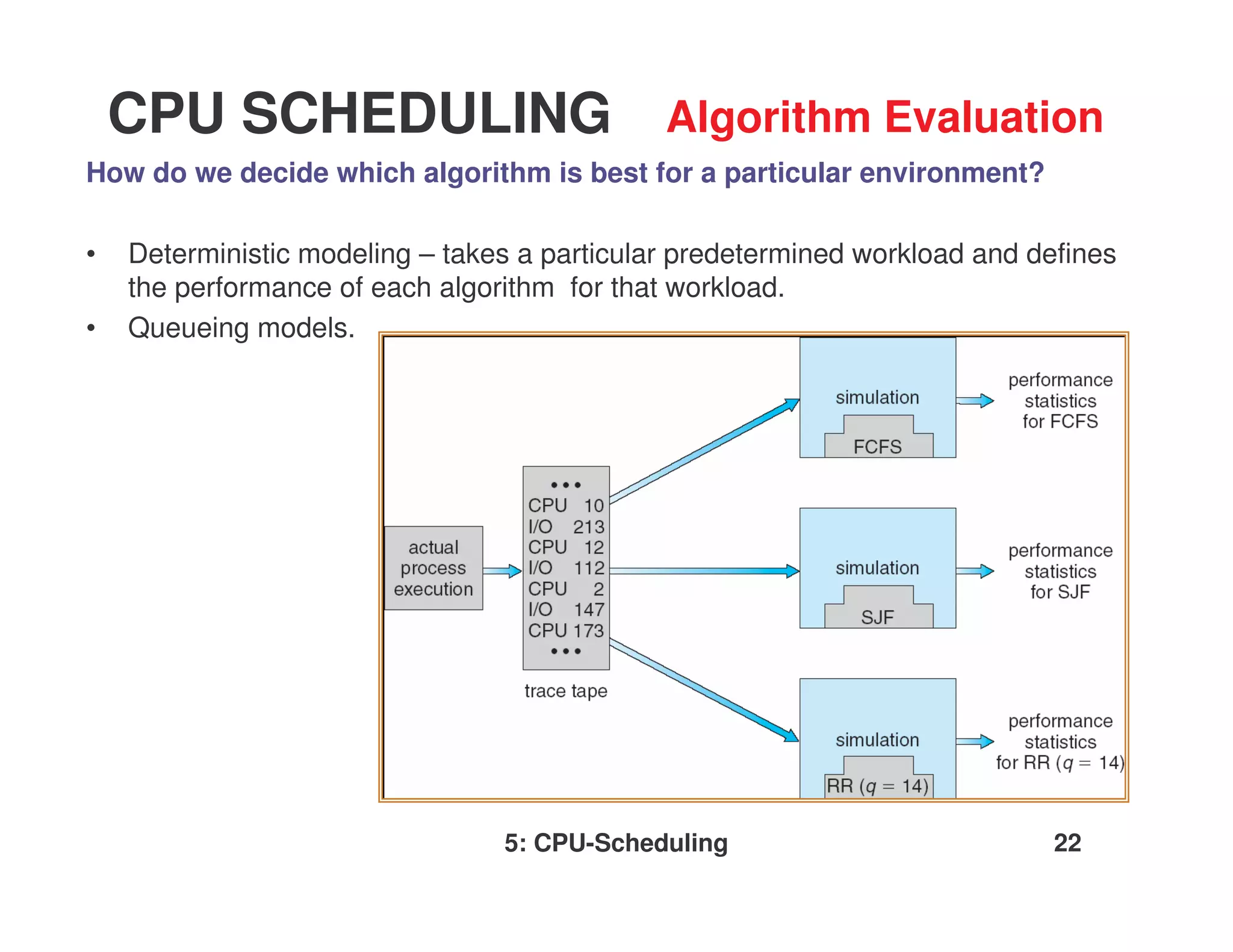
CPU SCHEDULING                            Algorithm Evaluation
How do we decide which algorithm is best for a particular environment?

•   Deterministic modeling – takes a particular predetermined workload and defines
    the performance of each algorithm for that workload.
•   Queueing models.


                                 5: CPU-Scheduling                           22
CPU SCHEDULING
                                WRAPUP
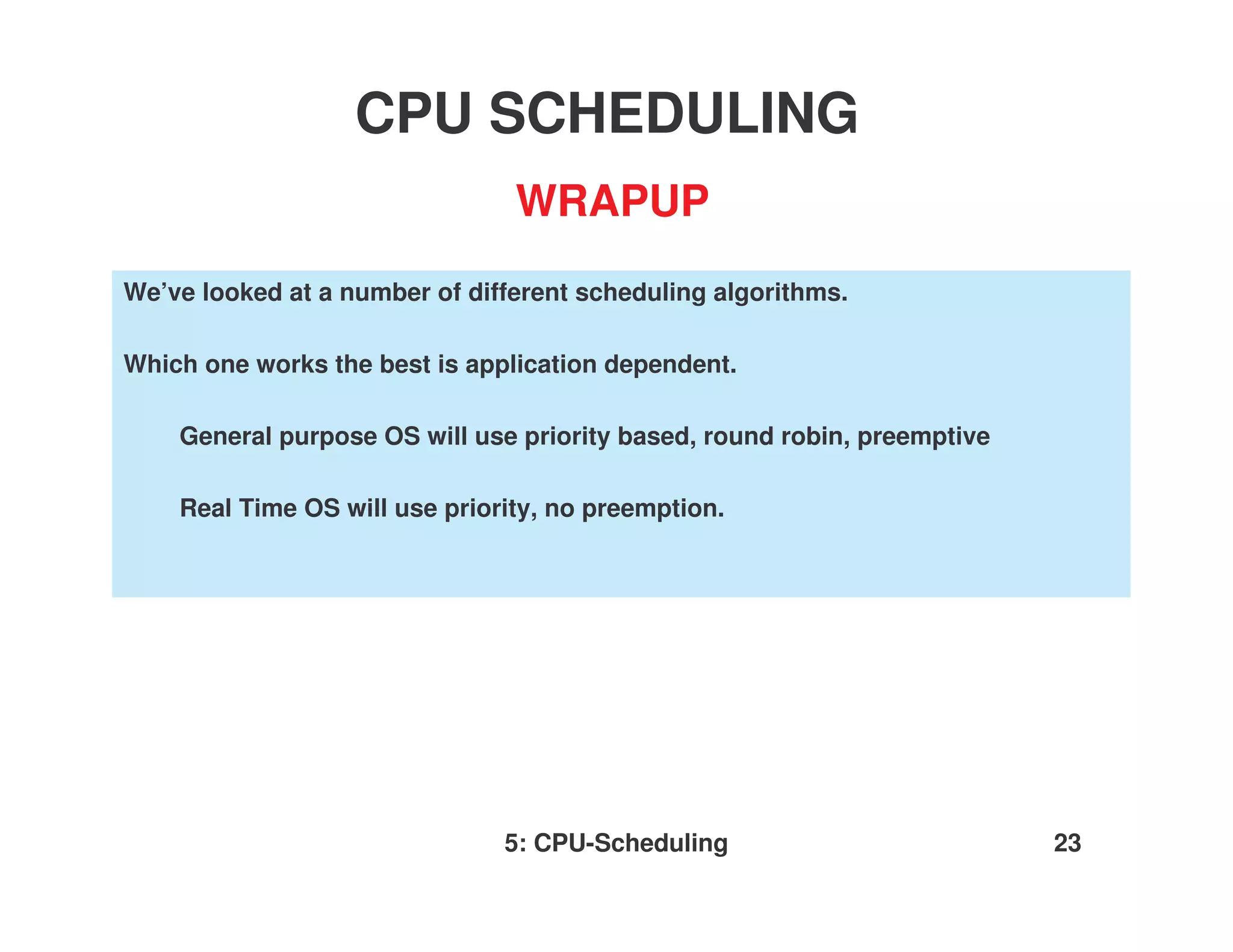
We’ve looked at a number of different scheduling algorithms.

Which one works the best is application dependent.

    General purpose OS will use priority based, round robin, preemptive

    Real Time OS will use priority, no preemption.


                               5: CPU-Scheduling                          23

cpu scheduling by shivam singh

  • 1.
    OPERATING SYSTEMS SCHEDULING Jerry Breecher 5: CPU-Scheduling 1
  • 2.
    CPU Scheduling What Is In This Chapter? • This chapter is about how to get a process attached to a processor. • It centers around efficient algorithms that perform well. • The design of a scheduler is concerned with making sure all users get their fair share of the resources. 5: CPU-Scheduling 2
  • 3.
    CPU Scheduling What Is In This Chapter? • Basic Concepts • Scheduling Criteria • Scheduling Algorithms • Multiple-Processor Scheduling • Real-Time Scheduling • Thread Scheduling • Operating Systems Examples • Java Thread Scheduling • Algorithm Evaluation 5: CPU-Scheduling 3
  • 4.
    CPU SCHEDULING Scheduling Concepts Multiprogramming A number of programs can be in memory at the same time. Allows overlap of CPU and I/O. Jobs (batch) are programs that run without user interaction. User (time shared) are programs that may have user interaction. Process is the common name for both. CPU - I/O burst cycle Characterizes process execution, which alternates, between CPU and I/O activity. CPU times are generally much shorter than I/O times. Preemptive Scheduling An interrupt causes currently running process to give up the CPU and be replaced by another process. 5: CPU-Scheduling 4
  • 5.
    CPU SCHEDULING The Scheduler Selects from among the processes in memory that are ready to execute, and allocates the CPU to one of them CPU scheduling decisions may take place when a process: 1. Switches from running to waiting state 2. Switches from running to ready state 3. Switches from waiting to ready 4. Terminates Scheduling under 1 and 4 is nonpreemptive All other scheduling is preemptive 5: CPU-Scheduling 5
  • 6.
    CPU SCHEDULING The Dispatcher Dispatcher module gives control of the CPU to the process selected by the short- term scheduler; this involves: switching context switching to user mode jumping to the proper location in the user program to restart that program Dispatch latency – time it takes for the dispatcher to stop one process and start another running 5: CPU-Scheduling 6
  • 7.
    Criteria For CPU SCHEDULING Performance Evaluation Note usage of the words DEVICE, SYSTEM, REQUEST, JOB. UTILIZATION The fraction of time a device is in use. ( ratio of in-use time / total observation time ) THROUGHPUT The number of job completions in a period of time. (jobs / second ) SERVICE TIME The time required by a device to handle a request. (seconds) QUEUEING TIME Time on a queue waiting for service from the device. (seconds) RESIDENCE TIME The time spent by a request at a device. RESIDENCE TIME = SERVICE TIME + QUEUEING TIME. RESPONSE TIME Time used by a system to respond to a User Job. ( seconds ) THINK TIME The time spent by the user of an interactive system to figure out the next request. (seconds) The goal is to optimize both the average and the amount of variation. (but beware the ogre predictability.) 5: CPU-Scheduling 7
  • 8.
    Scheduling CPU SCHEDULING Behavior Most Processes Don’t Use Up Their Scheduling Quantum! 5: CPU-Scheduling 8
  • 9.
    CPU SCHEDULING Scheduling Algorithms FIRST-COME, FIRST SERVED: • ( FCFS) same as FIFO • Simple, fair, but poor performance. Average queueing time may be long. • What are the average queueing and residence times for this scenario? • How do average queueing and residence times depend on ordering of these processes in the queue? 5: CPU-Scheduling 9
  • 10.
    CPU SCHEDULING Scheduling Algorithms EXAMPLE DATA: Process Arrival Service Time Time 1 0 8 2 1 4 3 2 9 4 3 5 FCFS P1 P2 P3 P4 0 8 12 21 26 Average wait = ( (8-0) + (12-1) + (21-2) + (26-3) )/4 = 61/4 = 15.25 Residence Time at the CPU 5: CPU-Scheduling 10
  • 11.
    CPU SCHEDULING Scheduling Algorithms SHORTEST JOB FIRST: • Optimal for minimizing queueing time, but impossible to implement. Tries to predict the process to schedule based on previous history. • Predicting the time the process will use on its next schedule: t( n+1 ) = w * t( n ) + ( 1 - w ) * T( n ) Here: t(n+1) is time of next burst. t(n) is time of current burst. T(n) is average of all previous bursts . W is a weighting factor emphasizing current or previous bursts. 5: CPU-Scheduling 11
  • 12.
    CPU SCHEDULING Scheduling Algorithms PREEMPTIVE ALGORITHMS: • Yank the CPU away from the currently executing process when a higher priority process is ready. • Can be applied to both Shortest Job First or to Priority scheduling. • Avoids "hogging" of the CPU • On time sharing machines, this type of scheme is required because the CPU must be protected from a run-away low priority process. • Give short jobs a higher priority – perceived response time is thus better. • What are average queueing and residence times? Compare with FCFS. 5: CPU-Scheduling 12
  • 13.
    CPU SCHEDULING Scheduling Algorithms EXAMPLE DATA: Process Arrival Service Time Time 1 0 8 2 1 4 3 2 9 4 3 5 Preemptive Shortest Job First P1 P2 P4 P1 P3 0 1 5 10 17 26 Average wait = ( (5-1) + (10-3) + (17-0) + (26-2) )/4 = 52/4 = 13.0 5: CPU-Scheduling 13
  • 14.
    CPU SCHEDULING Scheduling Algorithms PRIORITY BASED SCHEDULING: • Assign each process a priority. Schedule highest priority first. All processes within same priority are FCFS. • Priority may be determined by user or by some default mechanism. The system may determine the priority based on memory requirements, time limits, or other resource usage. • Starvation occurs if a low priority process never runs. Solution: build aging into a variable priority. • Delicate balance between giving favorable response for interactive jobs, but not starving batch jobs. 5: CPU-Scheduling 14
  • 15.
    CPU SCHEDULING Scheduling Algorithms ROUND ROBIN: • Use a timer to cause an interrupt after a predetermined time. Preempts if task exceeds it’s quantum. • Train of events Dispatch Time slice occurs OR process suspends on event Put process on some queue and dispatch next • Use numbers in last example to find queueing and residence times. (Use quantum = 4 sec.) • Definitions: – Context Switch Changing the processor from running one task (or process) to another. Implies changing memory. – Processor Sharing Use of a small quantum such that each process runs frequently at speed 1/n. – Reschedule latency How long it takes from when a process requests to run, until it finally gets control of the CPU. 5: CPU-Scheduling 15
  • 16.
    CPU SCHEDULING Scheduling Algorithms ROUND ROBIN: • Choosing a time quantum – Too short - inordinate fraction of the time is spent in context switches. – Too long - reschedule latency is too great. If many processes want the CPU, then it' a long time before a particular process can get the s CPU. This then acts like FCFS. – Adjust so most processes won'use their slice. As processors have t become faster, this is less of an issue. 5: CPU-Scheduling 16
  • 17.
    CPU SCHEDULING Scheduling Algorithms EXAMPLE DATA: Process Arrival Service Note: Example violates rules for Time Time quantum size since most 1 0 8 processes don’t finish in one 2 1 4 quantum. 3 2 9 4 3 5 Round Robin, quantum = 4, no priority-based preemption P1 P2 P3 P4 P1 P3 P4 P3 0 4 8 12 16 20 24 25 26 Average wait = ( (20-0) + (8-1) + (26-2) + (25-3) )/4 = 74/4 = 18.5 5: CPU-Scheduling 17
  • 18.
    CPU SCHEDULING Scheduling Algorithms MULTI-LEVEL QUEUES: • Each queue has its scheduling algorithm. • Then some other algorithm (perhaps priority based) arbitrates between queues. • Can use feedback to move between queues • Method is complex but flexible. • For example, could separate system processes, interactive, batch, favored, unfavored processes 5: CPU-Scheduling 18
  • 19.
    CPU SCHEDULING Using Priorities Here’s how the priorities are used in Windows 5: CPU-Scheduling 19
  • 20.
    CPU SCHEDULING Scheduling Algorithms MULTIPLE PROCESSOR SCHEDULING: • Different rules for homogeneous or heterogeneous processors. • Load sharing in the distribution of work, such that all processors have an equal amount to do. • Each processor can schedule from a common ready queue ( equal machines ) OR can use a master slave arrangement. Real Time Scheduling: • Hard real-time systems – required to complete a critical task within a guaranteed amount of time. • Soft real-time computing – requires that critical processes receive priority over less fortunate ones. 5: CPU-Scheduling 20
  • 21.
    CPU SCHEDULING Linux Scheduling Two algorithms: time-sharing and real-time • Time-sharing – Prioritized credit-based – process with most credits is scheduled next – Credit subtracted when timer interrupt occurs – When credit = 0, another process chosen – When all processes have credit = 0, recrediting occurs • Based on factors including priority and history • Real-time – Soft real-time – Posix.1b compliant – two classes • FCFS and RR • Highest priority process runs first 5: CPU-Scheduling 21
  • 22.
    CPU SCHEDULING Algorithm Evaluation How do we decide which algorithm is best for a particular environment? • Deterministic modeling – takes a particular predetermined workload and defines the performance of each algorithm for that workload. • Queueing models. 5: CPU-Scheduling 22
  • 23.
    CPU SCHEDULING WRAPUP We’ve looked at a number of different scheduling algorithms. Which one works the best is application dependent. General purpose OS will use priority based, round robin, preemptive Real Time OS will use priority, no preemption. 5: CPU-Scheduling 23