โ€ข DR SHIV RK DUBEY
โ€ข MBBS (Hons), MD (Pediatrics)
โ€ข KGMU, Lucknow
โ€ข SR โ€“ AIIMS BHOPAL
โ€ข RDA stands for Recommended Dietary Allowance, also
commonly known as Recommended Daily Allowances. It
is the recommended daily vitamins and mineral
intake considered adequate for healthy people.
The RDA was last revised in 1989, and is rather
outdated. Parts of it are replaced by the Dietary
Reference Intakes (DRI), the most recent dietary
guidelines by the Food and Nutrition Board of the
Institute of Medicine, National Academy of Sciences,
1997-2001, in a collaboration between the US and
Canada.
There are two different types of
nutrients:
โ€ข macronutrients;
โ€ข micronutrients.
There are three macronutrients
that are essential for health.
These are:
โ€ข carbohydrate;
โ€ข protein;
โ€ข fat.
MICRONUTRIENTS โ€“ vitamins and
minerals.
โ€ข TRACE ELEMENTS CONSTITUTE ___ % OF BODY
WEIGHT ?
(DNB-2014)
โ€ข 1%
โ€ข 0.1%
โ€ข 0.01%
โ€ข 0.001%
โ€ข MOST ABUNDANT SUBSTANCE IN THE BODY? AIPG
88
โ€ข WATER (60%)
โ€ข 2nd MOST ABUNDANT SUBSTANCE IN THE BODY ?
AIPG 89
โ€ข PROTEIN
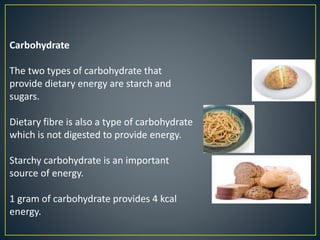
Carbohydrate
The two types of carbohydrate that
provide dietary energy are starch and
sugars.
Dietary fibre is also a type of carbohydrate
which is not digested to provide energy.
Starchy carbohydrate is an important
source of energy.
1 gram of carbohydrate provides 4 kcal
energy.
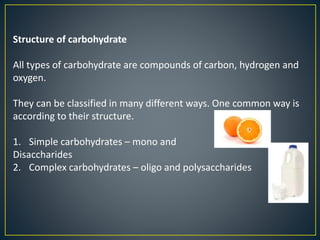
Structure of carbohydrate
All types of carbohydrate are compounds of carbon, hydrogen and
oxygen.
They can be classified in many different ways. One common way is
according to their structure.
1. Simple carbohydrates โ€“ mono and
Disaccharides
2. Complex carbohydrates โ€“ oligo and polysaccharides
โ€ข Which of the following is not an essential AA ? PGI 97
โ€ข TYROSINE
โ€ข TRYPTOPHAN
โ€ข THREONINE
โ€ข METHIONINE
โ€ข WHICH OF THE FOLLOWING IS NOT AN INDICATOR
OF PROTEIN QUALITY? DNB 05
โ€ข AA score
โ€ข Biological value
โ€ข Protein energy ratio
โ€ข True digestibility
โ€ข WHAT IS NPU ( net protein utilisation ) ?
Protein
Protein is essential for growth and repair and
keeping cells healthy.
Protein also provides energy:
1 gram of protein provides 4kcal.
Essential amino acids = AH ! MeTTh VIL PhLy
Arginine, histidine (semi essential)
methionine, tryptophan, threonine, valine,
isoleucine, leucine, phenyl alanine, lysine.
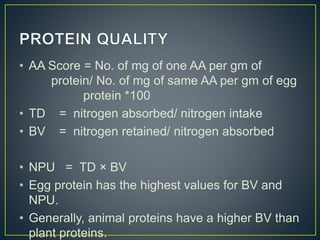
โ€ข AA Score = No. of mg of one AA per gm of
protein/ No. of mg of same AA per gm of egg
protein *100
โ€ข TD = nitrogen absorbed/ nitrogen intake
โ€ข BV = nitrogen retained/ nitrogen absorbed
โ€ข NPU = TD ร— BV
โ€ข Egg protein has the highest values for BV and
NPU.
โ€ข Generally, animal proteins have a higher BV than
plant proteins.
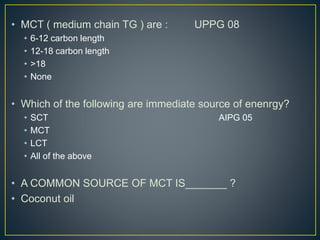
โ€ข MCT ( medium chain TG ) are : UPPG 08
โ€ข 6-12 carbon length
โ€ข 12-18 carbon length
โ€ข >18
โ€ข None
โ€ข Which of the following are immediate source of enenrgy?
โ€ข SCT AIPG 05
โ€ข MCT
โ€ข LCT
โ€ข All of the above
โ€ข A COMMON SOURCE OF MCT IS_______ ?
โ€ข Coconut oil
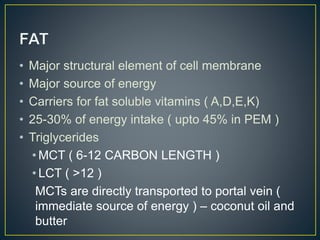
โ€ข Major structural element of cell membrane
โ€ข Major source of energy
โ€ข Carriers for fat soluble vitamins ( A,D,E,K)
โ€ข 25-30% of energy intake ( upto 45% in PEM )
โ€ข Triglycerides
โ€ข MCT ( 6-12 CARBON LENGTH )
โ€ข LCT ( >12 )
MCTs are directly transported to portal vein (
immediate source of energy ) โ€“ coconut oil and
butter
โ€ข Cannot be synthesised in the body and have to
be supplemented.
โ€ข Linoleic, linolenic, EPA (eicosapentanoic acid)
and DHA (docosahexanoic acid )
โ€ข Important component of grey matter and
enhance intellectual performance.
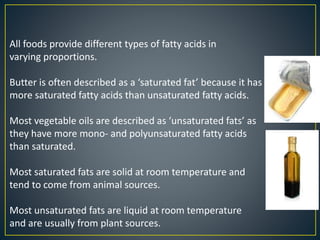
All foods provide different types of fatty acids in
varying proportions.
Butter is often described as a โ€˜saturated fatโ€™ because it has
more saturated fatty acids than unsaturated fatty acids.
Most vegetable oils are described as โ€˜unsaturated fatsโ€™ as
they have more mono- and polyunsaturated fatty acids
than saturated.
Most saturated fats are solid at room temperature and
tend to come from animal sources.
Most unsaturated fats are liquid at room temperature
and are usually from plant sources.
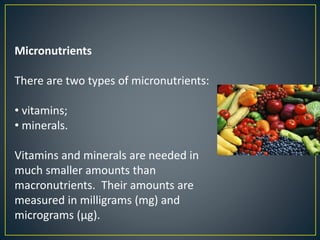
Micronutrients
There are two types of micronutrients:
โ€ข vitamins;
โ€ข minerals.
Vitamins and minerals are needed in
much smaller amounts than
macronutrients. Their amounts are
measured in milligrams (mg) and
micrograms (ฮผg).
โ€ข Which of the following is a water soluble vitamin ? MPPG
99
โ€ข Vit A
โ€ข C
โ€ข D
โ€ข E
โ€ข DRI of VIT A IN INFANTS IS ? MPPG 02
โ€ข 100-200 MCG
โ€ข 300-400 MCG
โ€ข 750 MCG
โ€ข 1000 MCG
โ€ข RDA of a 2 year old child is-----1100/1400/1500/1700 kcal
(AI)
Vitamins
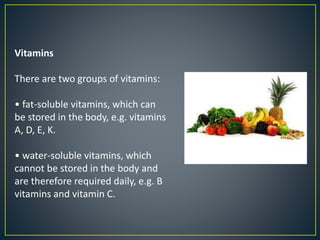
There are two groups of vitamins:
โ€ข fat-soluble vitamins, which can
be stored in the body, e.g. vitamins
A, D, E, K.
โ€ข water-soluble vitamins, which
cannot be stored in the body and
are therefore required daily, e.g. B
vitamins and vitamin C.
Fat soluble vitamins
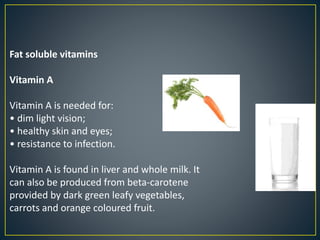
Vitamin A
Vitamin A is needed for:
โ€ข dim light vision;
โ€ข healthy skin and eyes;
โ€ข resistance to infection.
Vitamin A is found in liver and whole milk. It
can also be produced from beta-carotene
provided by dark green leafy vegetables,
carrots and orange coloured fruit.
โ€ข Infants = 300-400 mcg
โ€ข Children = 400-600 mcg
โ€ข Adolescents = 750 mcg
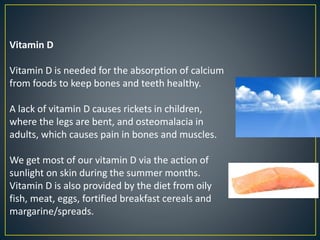
Vitamin D
Vitamin D is needed for the absorption of calcium
from foods to keep bones and teeth healthy.
A lack of vitamin D causes rickets in children,
where the legs are bent, and osteomalacia in
adults, which causes pain in bones and muscles.
We get most of our vitamin D via the action of
sunlight on skin during the summer months.
Vitamin D is also provided by the diet from oily
fish, meat, eggs, fortified breakfast cereals and
margarine/spreads.
โ€ข Infants and Children = 400 IU/day (10 mcg)
โ€ข DEFICIENCY OF WHICH MICRONUTRIENT
CAUSES HEMOLYTIC ANEMIA IN PRE TERM
INFANTS ? AI 08
โ€ข A/D/E/K
โ€ข ALL INSTITUTIONAL DELIVERIES ARE GIVEN
A IM dose of which micronutrient ?
โ€ข A/D/E/K
โ€ข TOCOPHEROL is : vit A/D/E/K AI 00
โ€ข Anti oxidant
โ€ข Manifestation of def are โ€“ hemolytic anemia,
spinocerebellar disease.
โ€ข RDA = normal infants โ€“ 0.4 mcg/kg/day
premature infant โ€“ 15-20 mg/day may be
required
Sources โ€“ vegetable oils, green leafy
vegetables and nuts.
โ€ข Main role is as a cofactor in โ€˜post translational
carboxylationโ€™ of glutamic acid to form glutamate
(Gla), which takes place in the liver.
โ€ข Sources โ€“ green leafy vegetables, normal gut
flora.
โ€ข RDA โ€“ 1 mg im at birth to all newborns.
โ€ข Older children 10-30 mcg/day
โ€ข PANTOTHENIC ACID is : PGI
98
โ€ขB3/B5/B7/B9
โ€ข CAN ANYBODY NAME ALL B COMPLEX
VITAMINS ???
โ€ข B1 โ€“ THIAMINE
โ€ข B2 โ€“ RIBOFLAVIN
โ€ข B3 โ€“ NIACIN
โ€ข B5 โ€“ PANTOTHENIC ACID
โ€ข B6 โ€“ PYRIDOXINE
โ€ข B12 โ€“ COBALAMINE
โ€ข folate
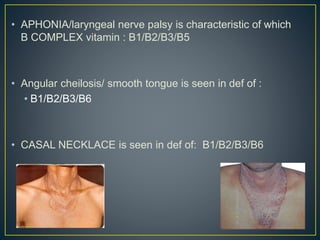
โ€ข APHONIA/laryngeal nerve palsy is characteristic of which
B COMPLEX vitamin : B1/B2/B3/B5
โ€ข Angular cheilosis/ smooth tongue is seen in def of :
โ€ข B1/B2/B3/B6
โ€ข CASAL NECKLACE is seen in def of: B1/B2/B3/B6
Thiamin (vitamin B1)
Thiamin is required to release energy from
carbohydrate.
It is also involved in the normal function of
the nervous system.
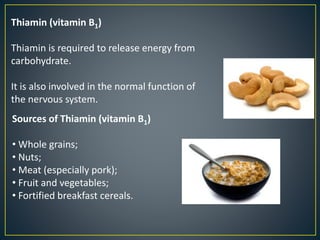
Sources of Thiamin (vitamin B1)
โ€ข Whole grains;
โ€ข Nuts;
โ€ข Meat (especially pork);
โ€ข Fruit and vegetables;
โ€ข Fortified breakfast cereals.
โ€ข RDA โ€“ 0.4 mg/1000 kcal
โ€ข Def.- aphonia/laryngeal N palsy, wernickeโ€™s
โ€ข Thiamine diphosphate โ€“ cofactor for
โ€ข Carb metabolism โ€“ pyruvate DH,AKG ( Alpha
ketoG ), transketolase
โ€ข HMP shunt โ€“ NADP
โ€ข Nerve conduction โ€“ Ach, GABA
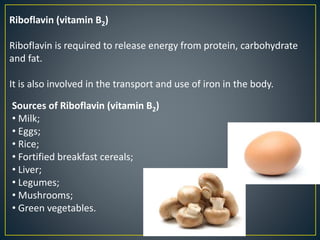
Riboflavin (vitamin B2)
Riboflavin is required to release energy from protein, carbohydrate
and fat.
It is also involved in the transport and use of iron in the body.
Sources of Riboflavin (vitamin B2)
โ€ข Milk;
โ€ข Eggs;
โ€ข Rice;
โ€ข Fortified breakfast cereals;
โ€ข Liver;
โ€ข Legumes;
โ€ข Mushrooms;
โ€ข Green vegetables.
โ€ข Oxidation reduction reaction โ€“ FMN and
FAD
โ€ข Milk, egg, legumes, mushrooms
โ€ข Angular cheilosis, glossitis ( smooth
tongue )
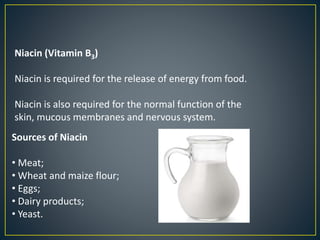
Niacin (Vitamin B3)
Niacin is required for the release of energy from food.
Niacin is also required for the normal function of the
skin, mucous membranes and nervous system.
Sources of Niacin
โ€ข Meat;
โ€ข Wheat and maize flour;
โ€ข Eggs;
โ€ข Dairy products;
โ€ข Yeast.
โ€ข Niacin/nicotinic acid/nicotinamide
โ€ข Def โ€“ pellagra, hartnup disease
โ€ข 3 D โ€“ dermatitis, dementia and diarrhoea
โ€ข Casal necklace
โ€ข All common food sources โ€“ resistant to heating.
โ€ข 1 NE = 1 mg niacin = 60 mg tryptophan
โ€ข RDA = 6.4-8 NE/1000 kcal.
โ€ข Deficiency caused by
โ€ข Drugs โ€“ INH, Penicillamine, steroids, AED,
OCP
โ€ข HEMODIALYSIS
FEATURES INCLUDE โ€“ irritability, seizures,
vomiting
Oxaluria, oxalic acid bladder stones
VIT B6 DEPENDENT SYNDROMES โ€“
pyridoxine
dependent seizures
โ€ข PERNICIOUS ANEMIA IS CAUSED DUE TO
DEF OF :
โ€ข B12
โ€ข INTRINSIC FACTOR
โ€ข BOTH
โ€ข NONE
โ€ข A WOMEN DELIVERED A BABY WITH lumbo
sacral meningomyelocele. Which nutrient def is
mostly attributed?
โ€ข What is the treatment?
โ€ข Only non veg diet
โ€ข IF (STOMACH) + B12 --------->
RECEPTOR IN ILEUM-๏ƒ enterohepatic
circulation
โ€ข So deficiency in โ€“ strict veg, IF def
(pernicious anemia, IBD, ileal resection.
โ€ข Hyperpigmentation of knuckles, involuntary
movements, developmental regression.
โ€ข Deficiency in pregnancy causes NTDs.
โ€ข 400 mcg/day before conception and in first
trimester of pregnancy.
โ€ข KESHAN DISEASE is caused by def of
โ€ข SELENIUM ( CARDIOMYOPATHY )
โ€ข GLUCOSE INTOLERANCE/DIABETES has
been attributed due to def of which trace
element:
โ€ข CHROMIUM
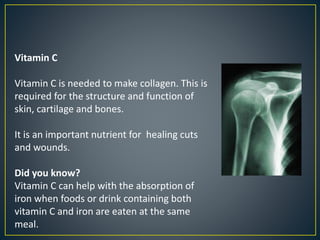
Vitamin C
Vitamin C is needed to make collagen. This is
required for the structure and function of
skin, cartilage and bones.
It is an important nutrient for healing cuts
and wounds.
Did you know?
Vitamin C can help with the absorption of
iron when foods or drink containing both
vitamin C and iron are eaten at the same
meal.
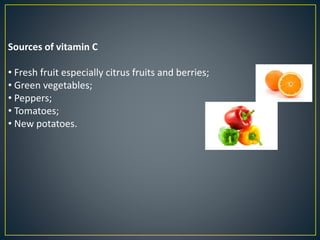
Sources of vitamin C
โ€ข Fresh fruit especially citrus fruits and berries;
โ€ข Green vegetables;
โ€ข Peppers;
โ€ข Tomatoes;
โ€ข New potatoes.
Minerals
Minerals are inorganic substances required
by the body in small amounts for a variety of
different functions.
The body requires different amounts of each
mineral.
People have different requirements,
according to their:
โ€ข age;
โ€ข gender;
โ€ข physiological state (e.g. pregnancy).
Calcium
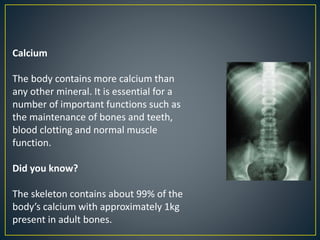
The body contains more calcium than
any other mineral. It is essential for a
number of important functions such as
the maintenance of bones and teeth,
blood clotting and normal muscle
function.
Did you know?
The skeleton contains about 99% of the
bodyโ€™s calcium with approximately 1kg
present in adult bones.
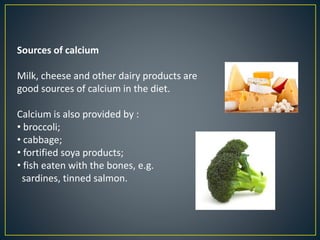
Sources of calcium
Milk, cheese and other dairy products are
good sources of calcium in the diet.
Calcium is also provided by :
โ€ข broccoli;
โ€ข cabbage;
โ€ข fortified soya products;
โ€ข fish eaten with the bones, e.g.
sardines, tinned salmon.
Iron
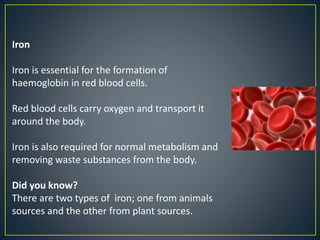
Iron is essential for the formation of
haemoglobin in red blood cells.
Red blood cells carry oxygen and transport it
around the body.
Iron is also required for normal metabolism and
removing waste substances from the body.
Did you know?
There are two types of iron; one from animals
sources and the other from plant sources.
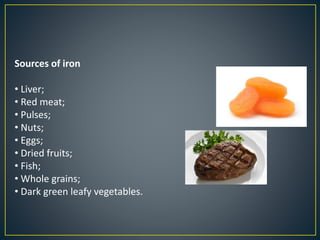
Sources of iron
โ€ข Liver;
โ€ข Red meat;
โ€ข Pulses;
โ€ข Nuts;
โ€ข Eggs;
โ€ข Dried fruits;
โ€ข Fish;
โ€ข Whole grains;
โ€ข Dark green leafy vegetables.
Iron in the diet
A lack of iron in the diet means that the stores in the
body will run out.
This can lead to anaemia.
Women and teenage girls need to ensure they have
enough because their requirements are higher than
those of men of the same age due to menstruation.
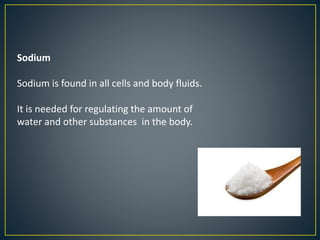
Sodium
Sodium is found in all cells and body fluids.
It is needed for regulating the amount of
water and other substances in the body.
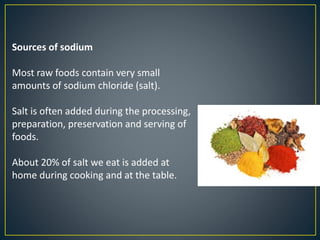
Sources of sodium
Most raw foods contain very small
amounts of sodium chloride (salt).
Salt is often added during the processing,
preparation, preservation and serving of
foods.
About 20% of salt we eat is added at
home during cooking and at the table.
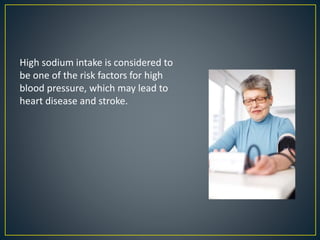
High sodium intake is considered to
be one of the risk factors for high
blood pressure, which may lead to
heart disease and stroke.
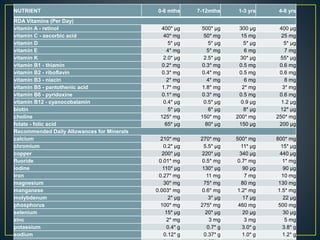
Recommended Daily Allowances (RDA) Chart for Infants & Children
NUTRIENT 0-6 mths 7-12mths 1-3 yrs 4-8 yrs
RDA Vitamins (Per Day)
vitamin A - retinol 400* ยตg 500* ยตg 300 ยตg 400 ยตg
vitamin C - ascorbic acid 40* mg 50* mg 15 mg 25 mg
vitamin D 5* ยตg 5* ยตg 5* ยตg 5* ยตg
vitamin E 4* mg 5* mg 6 mg 7 mg
vitamin K 2.0* ยตg 2.5* ยตg 30* ยตg 55* ยตg
vitamin B1 - thiamin 0.2* mg 0.3* mg 0.5 mg 0.6 mg
vitamin B2 - riboflavin 0.3* mg 0.4* mg 0.5 mg 0.6 mg
vitamin B3 - niacin 2* mg 4* mg 6 mg 8 mg
vitamin B5 - pantothenic acid 1.7* mg 1.8* mg 2* mg 3* mg
vitamin B6 - pyridoxine 0.1* mg 0.3* mg 0.5 mg 0.6 mg
vitamin B12 - cyanocobalamin 0.4* ยตg 0.5* ยตg 0.9 ยตg 1.2 ยตg
biotin 5* ยตg 6* ยตg 8* ยตg 12* ยตg
choline 125* mg 150* mg 200* mg 250* mg
folate - folic acid 65* ยตg 80* ยตg 150 ยตg 200 ยตg
Recommended Daily Allowances for Minerals
calcium 210* mg 270* mg 500* mg 800* mg
chromium 0.2* ยตg 5.5* ยตg 11* ยตg 15* ยตg
copper 200* ยตg 220* ยตg 340 ยตg 440 ยตg
fluoride 0.01* mg 0.5* mg 0.7* mg 1* mg
iodine 110* ยตg 130* ยตg 90 ยตg 90 ยตg
iron 0.27* mg 11 mg 7 mg 10 mg
magnesium 30* mg 75* mg 80 mg 130 mg
manganese 0.003* mg 0.6* mg 1.2* mg 1.5* mg
molybdenum 2* ยตg 3* ยตg 17 ยตg 22 ยตg
phosphorus 100* mg 275* mg 460 mg 500 mg
selenium 15* ยตg 20* ยตg 20 ยตg 30 ยตg
zinc 2* mg 3 mg 3 mg 5 mg
potassium 0.4* g 0.7* g 3.0* g 3.8* g
sodium 0.12* g 0.37* g 1.0* g 1.2* g
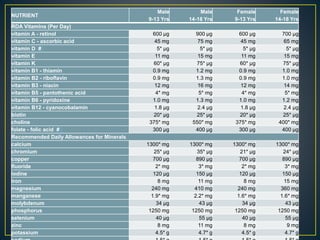
Recommended Daily Allowances for Older Children (9 to 18 Years)
NUTRIENT
Male
9-13 Yrs
Male
14-18 Yrs
Female
9-13 Yrs
Female
14-18 Yrs
RDA Vitamins (Per Day)
vitamin A - retinol 600 ยตg 900 ยตg 600 ยตg 700 ยตg
vitamin C - ascorbic acid 45 mg 75 mg 45 mg 65 mg
vitamin D #1 5* ยตg 5* ยตg 5* ยตg 5* ยตg
vitamin E 11 mg 15 mg 11 mg 15 mg
vitamin K 60* ยตg 75* ยตg 60* ยตg 75* ยตg
vitamin B1 - thiamin 0.9 mg 1.2 mg 0.9 mg 1.0 mg
vitamin B2 - riboflavin 0.9 mg 1.3 mg 0.9 mg 1.0 mg
vitamin B3 - niacin 12 mg 16 mg 12 mg 14 mg
vitamin B5 - pantothenic acid 4* mg 5* mg 4* mg 5* mg
vitamin B6 - pyridoxine 1.0 mg 1.3 mg 1.0 mg 1.2 mg
vitamin B12 - cyanocobalamin 1.8 ยตg 2.4 ยตg 1.8 ยตg 2.4 ยตg
biotin 20* ยตg 25* ยตg 20* ยตg 25* ยตg
choline 375* mg 550* mg 375* mg 400* mg
folate - folic acid #3 300 ยตg 400 ยตg 300 ยตg 400 ยตg
Recommended Daily Allowances for Minerals
calcium 1300* mg 1300* mg 1300* mg 1300* mg
chromium 25* ยตg 35* ยตg 21* ยตg 24* ยตg
copper 700 ยตg 890 ยตg 700 ยตg 890 ยตg
fluoride 2* mg 3* mg 2* mg 3* mg
iodine 120 ยตg 150 ยตg 120 ยตg 150 ยตg
iron 8 mg 11 mg 8 mg 15 mg
magnesium 240 mg 410 mg 240 mg 360 mg
manganese 1.9* mg 2.2* mg 1.6* mg 1.6* mg
molybdenum 34 ยตg 43 ยตg 34 ยตg 43 ยตg
phosphorus 1250 mg 1250 mg 1250 mg 1250 mg
selenium 40 ยตg 55 ยตg 40 ยตg 55 ยตg
zinc 8 mg 11 mg 8 mg 9 mg
potassium 4.5* g 4.7* g 4.5* g 4.7* g
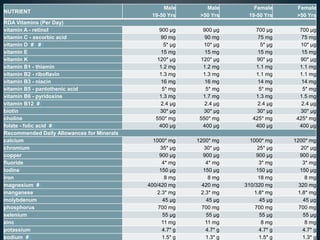
Recommended Daily Allowances for Adults (19 Years and Up)
NUTRIENT
Male
19-50 Yrs
Male
>50 Yrs
Female
19-50 Yrs
Female
>50 Yrs
RDA Vitamins (Per Day)
vitamin A - retinol 900 ยตg 900 ยตg 700 ยตg 700 ยตg
vitamin C - ascorbic acid 90 mg 90 mg 75 mg 75 mg
vitamin D #1 #5 5* ยตg 10* ยตg 5* ยตg 10* ยตg
vitamin E 15 mg 15 mg 15 mg 15 mg
vitamin K 120* ยตg 120* ยตg 90* ยตg 90* ยตg
vitamin B1 - thiamin 1.2 mg 1.2 mg 1.1 mg 1.1 mg
vitamin B2 - riboflavin 1.3 mg 1.3 mg 1.1 mg 1.1 mg
vitamin B3 - niacin 16 mg 16 mg 14 mg 14 mg
vitamin B5 - pantothenic acid 5* mg 5* mg 5* mg 5* mg
vitamin B6 - pyridoxine 1.3 mg 1.7 mg 1.3 mg 1.5 mg
vitamin B12 #2 2.4 ยตg 2.4 ยตg 2.4 ยตg 2.4 ยตg
biotin 30* ยตg 30* ยตg 30* ยตg 30* ยตg
choline 550* mg 550* mg 425* mg 425* mg
folate - folic acid #3 400 ยตg 400 ยตg 400 ยตg 400 ยตg
Recommended Daily Allowances for Minerals
calcium 1000* mg 1200* mg 1000* mg 1200* mg
chromium 35* ยตg 30* ยตg 25* ยตg 20* ยตg
copper 900 ยตg 900 ยตg 900 ยตg 900 ยตg
fluoride 4* mg 4* mg 3* mg 3* mg
iodine 150 ยตg 150 ยตg 150 ยตg 150 ยตg
iron 8 mg 8 mg 18 mg 8 mg
magnesium #4 400/420 mg 420 mg 310/320 mg 320 mg
manganese 2.3* mg 2.3* mg 1.8* mg 1.8* mg
molybdenum 45 ยตg 45 ยตg 45 ยตg 45 ยตg
phosphorus 700 mg 700 mg 700 mg 700 mg
selenium 55 ยตg 55 ยตg 55 ยตg 55 ยตg
zinc 11 mg 11 mg 8 mg 8 mg
potassium 4.7* g 4.7* g 4.7* g 4.7* g
sodium #5 1.5* g 1.3* g 1.5* g 1.3* g
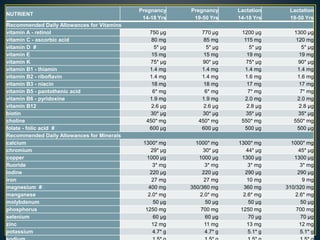
Recommended Daily Allowances for Pregnancy / Lactating Mothers
NUTRIENT
Pregnancy
14-18 Yrs
Pregnancy
19-50 Yrs
Lactation
14-18 Yrs
Lactation
19-50 Yrs
Recommended Daily Allowances for Vitamins
vitamin A - retinol 750 ยตg 770 ยตg 1200 ยตg 1300 ยตg
vitamin C - ascorbic acid 80 mg 85 mg 115 mg 120 mg
vitamin D #1 5* ยตg 5* ยตg 5* ยตg 5* ยตg
vitamin E 15 mg 15 mg 19 mg 19 mg
vitamin K 75* ยตg 90* ยตg 75* ยตg 90* ยตg
vitamin B1 - thiamin 1.4 mg 1.4 mg 1.4 mg 1.4 mg
vitamin B2 - riboflavin 1.4 mg 1.4 mg 1.6 mg 1.6 mg
vitamin B3 - niacin 18 mg 18 mg 17 mg 17 mg
vitamin B5 - pantothenic acid 6* mg 6* mg 7* mg 7* mg
vitamin B6 - pyridoxine 1.9 mg 1.9 mg 2.0 mg 2.0 mg
vitamin B12 2.6 ยตg 2.6 ยตg 2.8 ยตg 2.8 ยตg
biotin 30* ยตg 30* ยตg 35* ยตg 35* ยตg
choline 450* mg 450* mg 550* mg 550* mg
folate - folic acid #3 600 ยตg 600 ยตg 500 ยตg 500 ยตg
Recommended Daily Allowances for Minerals
calcium 1300* mg 1000* mg 1300* mg 1000* mg
chromium 29* ยตg 30* ยตg 44* ยตg 45* ยตg
copper 1000 ยตg 1000 ยตg 1300 ยตg 1300 ยตg
fluoride 3* mg 3* mg 3* mg 3* mg
iodine 220 ยตg 220 ยตg 290 ยตg 290 ยตg
iron 27 mg 27 mg 10 mg 9 mg
magnesium #6 400 mg 350/360 mg 360 mg 310/320 mg
manganese 2.0* mg 2.0* mg 2.6* mg 2.6* mg
molybdenum 50 ยตg 50 ยตg 50 ยตg 50 ยตg
phosphorus 1250 mg 700 mg 1250 mg 700 mg
selenium 60 ยตg 60 ยตg 70 ยตg 70 ยตg
zinc 12 mg 11 mg 13 mg 12 mg
potassium 4.7* g 4.7* g 5.1* g 5.1* g
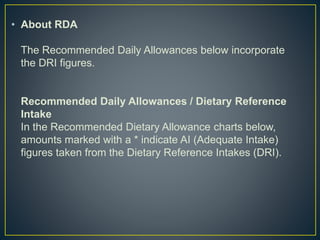
โ€ข About RDA
The Recommended Daily Allowances below incorporate
the DRI figures.
Recommended Daily Allowances / Dietary Reference
Intake
In the Recommended Dietary Allowance charts below,
amounts marked with a * indicate AI (Adequate Intake)
figures taken from the Dietary Reference Intakes (DRI).
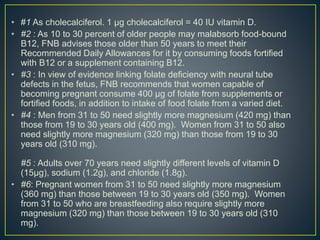
โ€ข #1 As cholecalciferol. 1 ยตg cholecalciferol = 40 IU vitamin D.
โ€ข #2 : As 10 to 30 percent of older people may malabsorb food-bound
B12, FNB advises those older than 50 years to meet their
Recommended Daily Allowances for it by consuming foods fortified
with B12 or a supplement containing B12.
โ€ข #3 : In view of evidence linking folate deficiency with neural tube
defects in the fetus, FNB recommends that women capable of
becoming pregnant consume 400 ยตg of folate from supplements or
fortified foods, in addition to intake of food folate from a varied diet.
โ€ข #4 : Men from 31 to 50 need slightly more magnesium (420 mg) than
those from 19 to 30 years old (400 mg). Women from 31 to 50 also
need slightly more magnesium (320 mg) than those from 19 to 30
years old (310 mg).
#5 : Adults over 70 years need slightly different levels of vitamin D
(15ยตg), sodium (1.2g), and chloride (1.8g).
โ€ข #6: Pregnant women from 31 to 50 need slightly more magnesium
(360 mg) than those between 19 to 30 years old (350 mg). Women
from 31 to 50 who are breastfeeding also require slightly more
magnesium (320 mg) than those between 19 to 30 years old (310
mg).
Rda macro and micronutrients

Rda macro and micronutrients

  • 1.
    โ€ข DR SHIVRK DUBEY โ€ข MBBS (Hons), MD (Pediatrics) โ€ข KGMU, Lucknow โ€ข SR โ€“ AIIMS BHOPAL
  • 2.
    โ€ข RDA standsfor Recommended Dietary Allowance, also commonly known as Recommended Daily Allowances. It is the recommended daily vitamins and mineral intake considered adequate for healthy people. The RDA was last revised in 1989, and is rather outdated. Parts of it are replaced by the Dietary Reference Intakes (DRI), the most recent dietary guidelines by the Food and Nutrition Board of the Institute of Medicine, National Academy of Sciences, 1997-2001, in a collaboration between the US and Canada.
  • 3.
    There are twodifferent types of nutrients: โ€ข macronutrients; โ€ข micronutrients. There are three macronutrients that are essential for health. These are: โ€ข carbohydrate; โ€ข protein; โ€ข fat. MICRONUTRIENTS โ€“ vitamins and minerals.
  • 4.
    โ€ข TRACE ELEMENTSCONSTITUTE ___ % OF BODY WEIGHT ? (DNB-2014) โ€ข 1% โ€ข 0.1% โ€ข 0.01% โ€ข 0.001% โ€ข MOST ABUNDANT SUBSTANCE IN THE BODY? AIPG 88 โ€ข WATER (60%) โ€ข 2nd MOST ABUNDANT SUBSTANCE IN THE BODY ? AIPG 89 โ€ข PROTEIN
  • 5.
    Carbohydrate The two typesof carbohydrate that provide dietary energy are starch and sugars. Dietary fibre is also a type of carbohydrate which is not digested to provide energy. Starchy carbohydrate is an important source of energy. 1 gram of carbohydrate provides 4 kcal energy.
  • 6.
    Structure of carbohydrate Alltypes of carbohydrate are compounds of carbon, hydrogen and oxygen. They can be classified in many different ways. One common way is according to their structure. 1. Simple carbohydrates โ€“ mono and Disaccharides 2. Complex carbohydrates โ€“ oligo and polysaccharides
  • 7.
    โ€ข Which ofthe following is not an essential AA ? PGI 97 โ€ข TYROSINE โ€ข TRYPTOPHAN โ€ข THREONINE โ€ข METHIONINE โ€ข WHICH OF THE FOLLOWING IS NOT AN INDICATOR OF PROTEIN QUALITY? DNB 05 โ€ข AA score โ€ข Biological value โ€ข Protein energy ratio โ€ข True digestibility โ€ข WHAT IS NPU ( net protein utilisation ) ?
  • 8.
    Protein Protein is essentialfor growth and repair and keeping cells healthy. Protein also provides energy: 1 gram of protein provides 4kcal. Essential amino acids = AH ! MeTTh VIL PhLy Arginine, histidine (semi essential) methionine, tryptophan, threonine, valine, isoleucine, leucine, phenyl alanine, lysine.
  • 9.
    โ€ข AA Score= No. of mg of one AA per gm of protein/ No. of mg of same AA per gm of egg protein *100 โ€ข TD = nitrogen absorbed/ nitrogen intake โ€ข BV = nitrogen retained/ nitrogen absorbed โ€ข NPU = TD ร— BV โ€ข Egg protein has the highest values for BV and NPU. โ€ข Generally, animal proteins have a higher BV than plant proteins.
  • 10.
    โ€ข MCT (medium chain TG ) are : UPPG 08 โ€ข 6-12 carbon length โ€ข 12-18 carbon length โ€ข >18 โ€ข None โ€ข Which of the following are immediate source of enenrgy? โ€ข SCT AIPG 05 โ€ข MCT โ€ข LCT โ€ข All of the above โ€ข A COMMON SOURCE OF MCT IS_______ ? โ€ข Coconut oil
  • 11.
    โ€ข Major structuralelement of cell membrane โ€ข Major source of energy โ€ข Carriers for fat soluble vitamins ( A,D,E,K) โ€ข 25-30% of energy intake ( upto 45% in PEM ) โ€ข Triglycerides โ€ข MCT ( 6-12 CARBON LENGTH ) โ€ข LCT ( >12 ) MCTs are directly transported to portal vein ( immediate source of energy ) โ€“ coconut oil and butter
  • 12.
    โ€ข Cannot besynthesised in the body and have to be supplemented. โ€ข Linoleic, linolenic, EPA (eicosapentanoic acid) and DHA (docosahexanoic acid ) โ€ข Important component of grey matter and enhance intellectual performance.
  • 13.
    All foods providedifferent types of fatty acids in varying proportions. Butter is often described as a โ€˜saturated fatโ€™ because it has more saturated fatty acids than unsaturated fatty acids. Most vegetable oils are described as โ€˜unsaturated fatsโ€™ as they have more mono- and polyunsaturated fatty acids than saturated. Most saturated fats are solid at room temperature and tend to come from animal sources. Most unsaturated fats are liquid at room temperature and are usually from plant sources.
  • 14.
    Micronutrients There are twotypes of micronutrients: โ€ข vitamins; โ€ข minerals. Vitamins and minerals are needed in much smaller amounts than macronutrients. Their amounts are measured in milligrams (mg) and micrograms (ฮผg).
  • 15.
    โ€ข Which ofthe following is a water soluble vitamin ? MPPG 99 โ€ข Vit A โ€ข C โ€ข D โ€ข E โ€ข DRI of VIT A IN INFANTS IS ? MPPG 02 โ€ข 100-200 MCG โ€ข 300-400 MCG โ€ข 750 MCG โ€ข 1000 MCG โ€ข RDA of a 2 year old child is-----1100/1400/1500/1700 kcal (AI)
  • 16.
    Vitamins There are twogroups of vitamins: โ€ข fat-soluble vitamins, which can be stored in the body, e.g. vitamins A, D, E, K. โ€ข water-soluble vitamins, which cannot be stored in the body and are therefore required daily, e.g. B vitamins and vitamin C.
  • 17.
    Fat soluble vitamins VitaminA Vitamin A is needed for: โ€ข dim light vision; โ€ข healthy skin and eyes; โ€ข resistance to infection. Vitamin A is found in liver and whole milk. It can also be produced from beta-carotene provided by dark green leafy vegetables, carrots and orange coloured fruit.
  • 18.
    โ€ข Infants =300-400 mcg โ€ข Children = 400-600 mcg โ€ข Adolescents = 750 mcg
  • 19.
    Vitamin D Vitamin Dis needed for the absorption of calcium from foods to keep bones and teeth healthy. A lack of vitamin D causes rickets in children, where the legs are bent, and osteomalacia in adults, which causes pain in bones and muscles. We get most of our vitamin D via the action of sunlight on skin during the summer months. Vitamin D is also provided by the diet from oily fish, meat, eggs, fortified breakfast cereals and margarine/spreads.
  • 20.
    โ€ข Infants andChildren = 400 IU/day (10 mcg)
  • 21.
    โ€ข DEFICIENCY OFWHICH MICRONUTRIENT CAUSES HEMOLYTIC ANEMIA IN PRE TERM INFANTS ? AI 08 โ€ข A/D/E/K โ€ข ALL INSTITUTIONAL DELIVERIES ARE GIVEN A IM dose of which micronutrient ? โ€ข A/D/E/K โ€ข TOCOPHEROL is : vit A/D/E/K AI 00
  • 22.
    โ€ข Anti oxidant โ€ขManifestation of def are โ€“ hemolytic anemia, spinocerebellar disease. โ€ข RDA = normal infants โ€“ 0.4 mcg/kg/day premature infant โ€“ 15-20 mg/day may be required Sources โ€“ vegetable oils, green leafy vegetables and nuts.
  • 23.
    โ€ข Main roleis as a cofactor in โ€˜post translational carboxylationโ€™ of glutamic acid to form glutamate (Gla), which takes place in the liver. โ€ข Sources โ€“ green leafy vegetables, normal gut flora. โ€ข RDA โ€“ 1 mg im at birth to all newborns. โ€ข Older children 10-30 mcg/day
  • 24.
    โ€ข PANTOTHENIC ACIDis : PGI 98 โ€ขB3/B5/B7/B9 โ€ข CAN ANYBODY NAME ALL B COMPLEX VITAMINS ???
  • 25.
    โ€ข B1 โ€“THIAMINE โ€ข B2 โ€“ RIBOFLAVIN โ€ข B3 โ€“ NIACIN โ€ข B5 โ€“ PANTOTHENIC ACID โ€ข B6 โ€“ PYRIDOXINE โ€ข B12 โ€“ COBALAMINE โ€ข folate
  • 26.
    โ€ข APHONIA/laryngeal nervepalsy is characteristic of which B COMPLEX vitamin : B1/B2/B3/B5 โ€ข Angular cheilosis/ smooth tongue is seen in def of : โ€ข B1/B2/B3/B6 โ€ข CASAL NECKLACE is seen in def of: B1/B2/B3/B6
  • 27.
    Thiamin (vitamin B1) Thiaminis required to release energy from carbohydrate. It is also involved in the normal function of the nervous system. Sources of Thiamin (vitamin B1) โ€ข Whole grains; โ€ข Nuts; โ€ข Meat (especially pork); โ€ข Fruit and vegetables; โ€ข Fortified breakfast cereals.
  • 28.
    โ€ข RDA โ€“0.4 mg/1000 kcal โ€ข Def.- aphonia/laryngeal N palsy, wernickeโ€™s โ€ข Thiamine diphosphate โ€“ cofactor for โ€ข Carb metabolism โ€“ pyruvate DH,AKG ( Alpha ketoG ), transketolase โ€ข HMP shunt โ€“ NADP โ€ข Nerve conduction โ€“ Ach, GABA
  • 29.
    Riboflavin (vitamin B2) Riboflavinis required to release energy from protein, carbohydrate and fat. It is also involved in the transport and use of iron in the body. Sources of Riboflavin (vitamin B2) โ€ข Milk; โ€ข Eggs; โ€ข Rice; โ€ข Fortified breakfast cereals; โ€ข Liver; โ€ข Legumes; โ€ข Mushrooms; โ€ข Green vegetables.
  • 30.
    โ€ข Oxidation reductionreaction โ€“ FMN and FAD โ€ข Milk, egg, legumes, mushrooms โ€ข Angular cheilosis, glossitis ( smooth tongue )
  • 31.
    Niacin (Vitamin B3) Niacinis required for the release of energy from food. Niacin is also required for the normal function of the skin, mucous membranes and nervous system. Sources of Niacin โ€ข Meat; โ€ข Wheat and maize flour; โ€ข Eggs; โ€ข Dairy products; โ€ข Yeast.
  • 32.
    โ€ข Niacin/nicotinic acid/nicotinamide โ€ขDef โ€“ pellagra, hartnup disease โ€ข 3 D โ€“ dermatitis, dementia and diarrhoea โ€ข Casal necklace โ€ข All common food sources โ€“ resistant to heating. โ€ข 1 NE = 1 mg niacin = 60 mg tryptophan โ€ข RDA = 6.4-8 NE/1000 kcal.
  • 33.
    โ€ข Deficiency causedby โ€ข Drugs โ€“ INH, Penicillamine, steroids, AED, OCP โ€ข HEMODIALYSIS FEATURES INCLUDE โ€“ irritability, seizures, vomiting Oxaluria, oxalic acid bladder stones VIT B6 DEPENDENT SYNDROMES โ€“ pyridoxine dependent seizures
  • 34.
    โ€ข PERNICIOUS ANEMIAIS CAUSED DUE TO DEF OF : โ€ข B12 โ€ข INTRINSIC FACTOR โ€ข BOTH โ€ข NONE โ€ข A WOMEN DELIVERED A BABY WITH lumbo sacral meningomyelocele. Which nutrient def is mostly attributed? โ€ข What is the treatment?
  • 35.
    โ€ข Only nonveg diet โ€ข IF (STOMACH) + B12 ---------> RECEPTOR IN ILEUM-๏ƒ enterohepatic circulation โ€ข So deficiency in โ€“ strict veg, IF def (pernicious anemia, IBD, ileal resection. โ€ข Hyperpigmentation of knuckles, involuntary movements, developmental regression.
  • 36.
    โ€ข Deficiency inpregnancy causes NTDs. โ€ข 400 mcg/day before conception and in first trimester of pregnancy.
  • 37.
    โ€ข KESHAN DISEASEis caused by def of โ€ข SELENIUM ( CARDIOMYOPATHY ) โ€ข GLUCOSE INTOLERANCE/DIABETES has been attributed due to def of which trace element: โ€ข CHROMIUM
  • 38.
    Vitamin C Vitamin Cis needed to make collagen. This is required for the structure and function of skin, cartilage and bones. It is an important nutrient for healing cuts and wounds. Did you know? Vitamin C can help with the absorption of iron when foods or drink containing both vitamin C and iron are eaten at the same meal.
  • 39.
    Sources of vitaminC โ€ข Fresh fruit especially citrus fruits and berries; โ€ข Green vegetables; โ€ข Peppers; โ€ข Tomatoes; โ€ข New potatoes.
  • 40.
    Minerals Minerals are inorganicsubstances required by the body in small amounts for a variety of different functions. The body requires different amounts of each mineral. People have different requirements, according to their: โ€ข age; โ€ข gender; โ€ข physiological state (e.g. pregnancy).
  • 41.
    Calcium The body containsmore calcium than any other mineral. It is essential for a number of important functions such as the maintenance of bones and teeth, blood clotting and normal muscle function. Did you know? The skeleton contains about 99% of the bodyโ€™s calcium with approximately 1kg present in adult bones.
  • 42.
    Sources of calcium Milk,cheese and other dairy products are good sources of calcium in the diet. Calcium is also provided by : โ€ข broccoli; โ€ข cabbage; โ€ข fortified soya products; โ€ข fish eaten with the bones, e.g. sardines, tinned salmon.
  • 43.
    Iron Iron is essentialfor the formation of haemoglobin in red blood cells. Red blood cells carry oxygen and transport it around the body. Iron is also required for normal metabolism and removing waste substances from the body. Did you know? There are two types of iron; one from animals sources and the other from plant sources.
  • 44.
    Sources of iron โ€ขLiver; โ€ข Red meat; โ€ข Pulses; โ€ข Nuts; โ€ข Eggs; โ€ข Dried fruits; โ€ข Fish; โ€ข Whole grains; โ€ข Dark green leafy vegetables.
  • 45.
    Iron in thediet A lack of iron in the diet means that the stores in the body will run out. This can lead to anaemia. Women and teenage girls need to ensure they have enough because their requirements are higher than those of men of the same age due to menstruation.
  • 46.
    Sodium Sodium is foundin all cells and body fluids. It is needed for regulating the amount of water and other substances in the body.
  • 47.
    Sources of sodium Mostraw foods contain very small amounts of sodium chloride (salt). Salt is often added during the processing, preparation, preservation and serving of foods. About 20% of salt we eat is added at home during cooking and at the table.
  • 48.
    High sodium intakeis considered to be one of the risk factors for high blood pressure, which may lead to heart disease and stroke.
  • 50.
    Recommended Daily Allowances(RDA) Chart for Infants & Children NUTRIENT 0-6 mths 7-12mths 1-3 yrs 4-8 yrs RDA Vitamins (Per Day) vitamin A - retinol 400* ยตg 500* ยตg 300 ยตg 400 ยตg vitamin C - ascorbic acid 40* mg 50* mg 15 mg 25 mg vitamin D 5* ยตg 5* ยตg 5* ยตg 5* ยตg vitamin E 4* mg 5* mg 6 mg 7 mg vitamin K 2.0* ยตg 2.5* ยตg 30* ยตg 55* ยตg vitamin B1 - thiamin 0.2* mg 0.3* mg 0.5 mg 0.6 mg vitamin B2 - riboflavin 0.3* mg 0.4* mg 0.5 mg 0.6 mg vitamin B3 - niacin 2* mg 4* mg 6 mg 8 mg vitamin B5 - pantothenic acid 1.7* mg 1.8* mg 2* mg 3* mg vitamin B6 - pyridoxine 0.1* mg 0.3* mg 0.5 mg 0.6 mg vitamin B12 - cyanocobalamin 0.4* ยตg 0.5* ยตg 0.9 ยตg 1.2 ยตg biotin 5* ยตg 6* ยตg 8* ยตg 12* ยตg choline 125* mg 150* mg 200* mg 250* mg folate - folic acid 65* ยตg 80* ยตg 150 ยตg 200 ยตg Recommended Daily Allowances for Minerals calcium 210* mg 270* mg 500* mg 800* mg chromium 0.2* ยตg 5.5* ยตg 11* ยตg 15* ยตg copper 200* ยตg 220* ยตg 340 ยตg 440 ยตg fluoride 0.01* mg 0.5* mg 0.7* mg 1* mg iodine 110* ยตg 130* ยตg 90 ยตg 90 ยตg iron 0.27* mg 11 mg 7 mg 10 mg magnesium 30* mg 75* mg 80 mg 130 mg manganese 0.003* mg 0.6* mg 1.2* mg 1.5* mg molybdenum 2* ยตg 3* ยตg 17 ยตg 22 ยตg phosphorus 100* mg 275* mg 460 mg 500 mg selenium 15* ยตg 20* ยตg 20 ยตg 30 ยตg zinc 2* mg 3 mg 3 mg 5 mg potassium 0.4* g 0.7* g 3.0* g 3.8* g sodium 0.12* g 0.37* g 1.0* g 1.2* g
  • 51.
    Recommended Daily Allowancesfor Older Children (9 to 18 Years) NUTRIENT Male 9-13 Yrs Male 14-18 Yrs Female 9-13 Yrs Female 14-18 Yrs RDA Vitamins (Per Day) vitamin A - retinol 600 ยตg 900 ยตg 600 ยตg 700 ยตg vitamin C - ascorbic acid 45 mg 75 mg 45 mg 65 mg vitamin D #1 5* ยตg 5* ยตg 5* ยตg 5* ยตg vitamin E 11 mg 15 mg 11 mg 15 mg vitamin K 60* ยตg 75* ยตg 60* ยตg 75* ยตg vitamin B1 - thiamin 0.9 mg 1.2 mg 0.9 mg 1.0 mg vitamin B2 - riboflavin 0.9 mg 1.3 mg 0.9 mg 1.0 mg vitamin B3 - niacin 12 mg 16 mg 12 mg 14 mg vitamin B5 - pantothenic acid 4* mg 5* mg 4* mg 5* mg vitamin B6 - pyridoxine 1.0 mg 1.3 mg 1.0 mg 1.2 mg vitamin B12 - cyanocobalamin 1.8 ยตg 2.4 ยตg 1.8 ยตg 2.4 ยตg biotin 20* ยตg 25* ยตg 20* ยตg 25* ยตg choline 375* mg 550* mg 375* mg 400* mg folate - folic acid #3 300 ยตg 400 ยตg 300 ยตg 400 ยตg Recommended Daily Allowances for Minerals calcium 1300* mg 1300* mg 1300* mg 1300* mg chromium 25* ยตg 35* ยตg 21* ยตg 24* ยตg copper 700 ยตg 890 ยตg 700 ยตg 890 ยตg fluoride 2* mg 3* mg 2* mg 3* mg iodine 120 ยตg 150 ยตg 120 ยตg 150 ยตg iron 8 mg 11 mg 8 mg 15 mg magnesium 240 mg 410 mg 240 mg 360 mg manganese 1.9* mg 2.2* mg 1.6* mg 1.6* mg molybdenum 34 ยตg 43 ยตg 34 ยตg 43 ยตg phosphorus 1250 mg 1250 mg 1250 mg 1250 mg selenium 40 ยตg 55 ยตg 40 ยตg 55 ยตg zinc 8 mg 11 mg 8 mg 9 mg potassium 4.5* g 4.7* g 4.5* g 4.7* g
  • 52.
    Recommended Daily Allowancesfor Adults (19 Years and Up) NUTRIENT Male 19-50 Yrs Male >50 Yrs Female 19-50 Yrs Female >50 Yrs RDA Vitamins (Per Day) vitamin A - retinol 900 ยตg 900 ยตg 700 ยตg 700 ยตg vitamin C - ascorbic acid 90 mg 90 mg 75 mg 75 mg vitamin D #1 #5 5* ยตg 10* ยตg 5* ยตg 10* ยตg vitamin E 15 mg 15 mg 15 mg 15 mg vitamin K 120* ยตg 120* ยตg 90* ยตg 90* ยตg vitamin B1 - thiamin 1.2 mg 1.2 mg 1.1 mg 1.1 mg vitamin B2 - riboflavin 1.3 mg 1.3 mg 1.1 mg 1.1 mg vitamin B3 - niacin 16 mg 16 mg 14 mg 14 mg vitamin B5 - pantothenic acid 5* mg 5* mg 5* mg 5* mg vitamin B6 - pyridoxine 1.3 mg 1.7 mg 1.3 mg 1.5 mg vitamin B12 #2 2.4 ยตg 2.4 ยตg 2.4 ยตg 2.4 ยตg biotin 30* ยตg 30* ยตg 30* ยตg 30* ยตg choline 550* mg 550* mg 425* mg 425* mg folate - folic acid #3 400 ยตg 400 ยตg 400 ยตg 400 ยตg Recommended Daily Allowances for Minerals calcium 1000* mg 1200* mg 1000* mg 1200* mg chromium 35* ยตg 30* ยตg 25* ยตg 20* ยตg copper 900 ยตg 900 ยตg 900 ยตg 900 ยตg fluoride 4* mg 4* mg 3* mg 3* mg iodine 150 ยตg 150 ยตg 150 ยตg 150 ยตg iron 8 mg 8 mg 18 mg 8 mg magnesium #4 400/420 mg 420 mg 310/320 mg 320 mg manganese 2.3* mg 2.3* mg 1.8* mg 1.8* mg molybdenum 45 ยตg 45 ยตg 45 ยตg 45 ยตg phosphorus 700 mg 700 mg 700 mg 700 mg selenium 55 ยตg 55 ยตg 55 ยตg 55 ยตg zinc 11 mg 11 mg 8 mg 8 mg potassium 4.7* g 4.7* g 4.7* g 4.7* g sodium #5 1.5* g 1.3* g 1.5* g 1.3* g
  • 53.
    Recommended Daily Allowancesfor Pregnancy / Lactating Mothers NUTRIENT Pregnancy 14-18 Yrs Pregnancy 19-50 Yrs Lactation 14-18 Yrs Lactation 19-50 Yrs Recommended Daily Allowances for Vitamins vitamin A - retinol 750 ยตg 770 ยตg 1200 ยตg 1300 ยตg vitamin C - ascorbic acid 80 mg 85 mg 115 mg 120 mg vitamin D #1 5* ยตg 5* ยตg 5* ยตg 5* ยตg vitamin E 15 mg 15 mg 19 mg 19 mg vitamin K 75* ยตg 90* ยตg 75* ยตg 90* ยตg vitamin B1 - thiamin 1.4 mg 1.4 mg 1.4 mg 1.4 mg vitamin B2 - riboflavin 1.4 mg 1.4 mg 1.6 mg 1.6 mg vitamin B3 - niacin 18 mg 18 mg 17 mg 17 mg vitamin B5 - pantothenic acid 6* mg 6* mg 7* mg 7* mg vitamin B6 - pyridoxine 1.9 mg 1.9 mg 2.0 mg 2.0 mg vitamin B12 2.6 ยตg 2.6 ยตg 2.8 ยตg 2.8 ยตg biotin 30* ยตg 30* ยตg 35* ยตg 35* ยตg choline 450* mg 450* mg 550* mg 550* mg folate - folic acid #3 600 ยตg 600 ยตg 500 ยตg 500 ยตg Recommended Daily Allowances for Minerals calcium 1300* mg 1000* mg 1300* mg 1000* mg chromium 29* ยตg 30* ยตg 44* ยตg 45* ยตg copper 1000 ยตg 1000 ยตg 1300 ยตg 1300 ยตg fluoride 3* mg 3* mg 3* mg 3* mg iodine 220 ยตg 220 ยตg 290 ยตg 290 ยตg iron 27 mg 27 mg 10 mg 9 mg magnesium #6 400 mg 350/360 mg 360 mg 310/320 mg manganese 2.0* mg 2.0* mg 2.6* mg 2.6* mg molybdenum 50 ยตg 50 ยตg 50 ยตg 50 ยตg phosphorus 1250 mg 700 mg 1250 mg 700 mg selenium 60 ยตg 60 ยตg 70 ยตg 70 ยตg zinc 12 mg 11 mg 13 mg 12 mg potassium 4.7* g 4.7* g 5.1* g 5.1* g
  • 54.
    โ€ข About RDA TheRecommended Daily Allowances below incorporate the DRI figures. Recommended Daily Allowances / Dietary Reference Intake In the Recommended Dietary Allowance charts below, amounts marked with a * indicate AI (Adequate Intake) figures taken from the Dietary Reference Intakes (DRI).
  • 55.
    โ€ข #1 Ascholecalciferol. 1 ยตg cholecalciferol = 40 IU vitamin D. โ€ข #2 : As 10 to 30 percent of older people may malabsorb food-bound B12, FNB advises those older than 50 years to meet their Recommended Daily Allowances for it by consuming foods fortified with B12 or a supplement containing B12. โ€ข #3 : In view of evidence linking folate deficiency with neural tube defects in the fetus, FNB recommends that women capable of becoming pregnant consume 400 ยตg of folate from supplements or fortified foods, in addition to intake of food folate from a varied diet. โ€ข #4 : Men from 31 to 50 need slightly more magnesium (420 mg) than those from 19 to 30 years old (400 mg). Women from 31 to 50 also need slightly more magnesium (320 mg) than those from 19 to 30 years old (310 mg). #5 : Adults over 70 years need slightly different levels of vitamin D (15ยตg), sodium (1.2g), and chloride (1.8g). โ€ข #6: Pregnant women from 31 to 50 need slightly more magnesium (360 mg) than those between 19 to 30 years old (350 mg). Women from 31 to 50 who are breastfeeding also require slightly more magnesium (320 mg) than those between 19 to 30 years old (310 mg).