Lecture 3:Dietary
Requirements And Guidelines
DR. SHARIFAH WAJIHAH WAFA
sharifahwajihah@unisza.edu.my
Topic Learning Outcomes
Define the Dietary Reference Intakes (DRIs)
Present four (4) levels that represent five (5) food group in
Malaysian Food Guide Pyramid
Read and understand a nutrition facts label.
Present the 14 key Messages of Malaysian Dietary Guidelines and 15
Key Messages Malaysian Dietary Guidelines for Children and
Adolescents
1
2
3
4
Course Outline
Dietary reference intakes: Defining Nutrient Needs
The Food Guide Pyramid: A tool for Diet Planning
Food Labels: Knowing What you Choose
The Dietary Guidelines for Malaysians
I. Dietary reference intakes:
Defining Nutrient Needs
What are DRIs?
• Standards to guide safe & adequate intakes of
essential nutrients for healthy humans.
– Sick individuals have different needs.
• Designed to promote optimal function & health for
healthy people.
• Are specific for groups of people based on: life stage,
gender, conditions of pregnancy & lactation.
• Are adequate for moderately active people.
• developed by the Institute of Medicine of The
National Academies.
Malaysia RNI
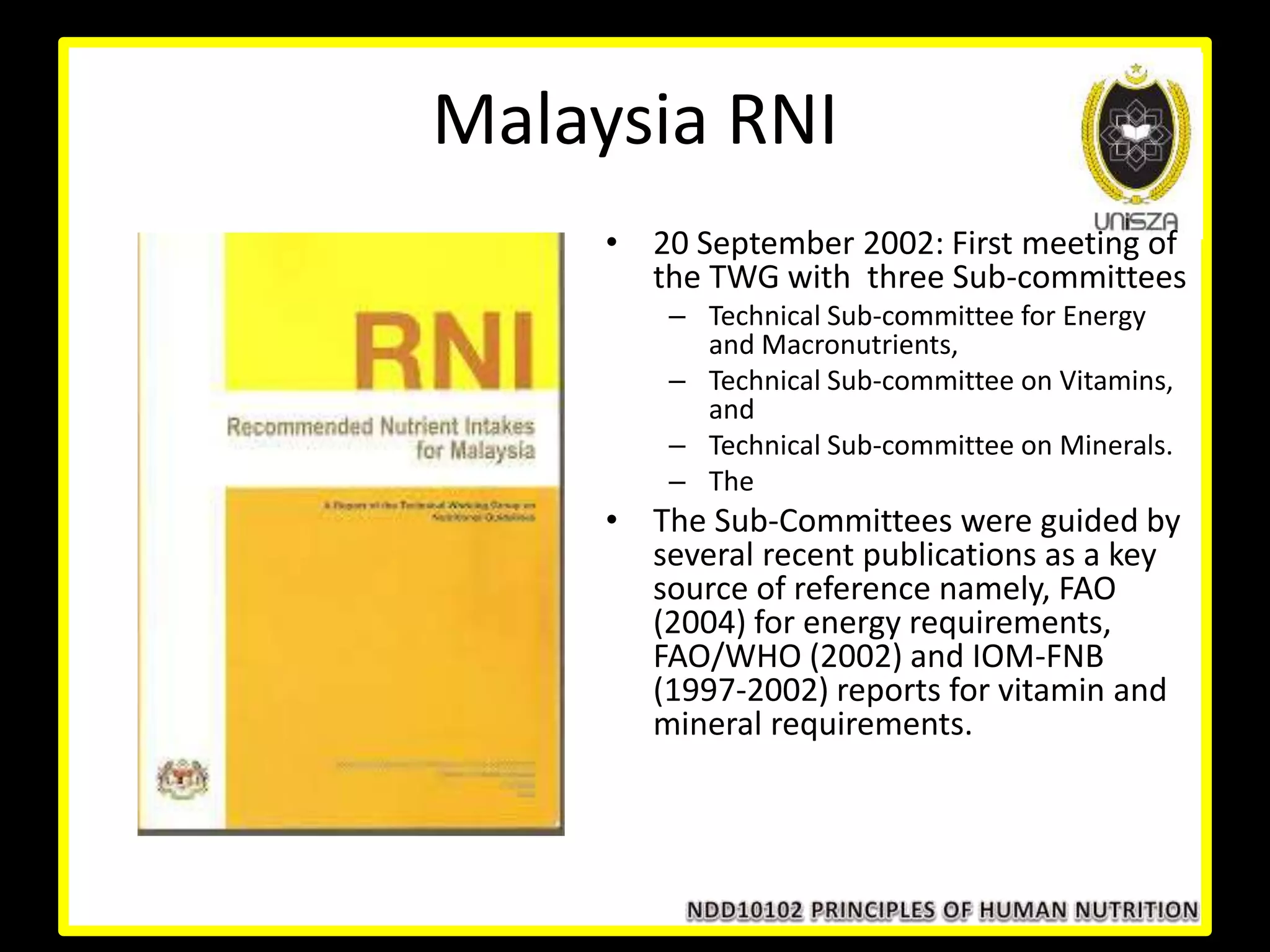
• 20 September 2002: First meeting of
the TWG with three Sub-committees
– Technical Sub-committee for Energy
and Macronutrients,
– Technical Sub-committee on Vitamins,
and
– Technical Sub-committee on Minerals.
– The
• The Sub-Committees were guided by
several recent publications as a key
source of reference namely, FAO
(2004) for energy requirements,
FAO/WHO (2002) and IOM-FNB
(1997-2002) reports for vitamin and
mineral requirements.
Components of the DRIs
• Four values instead of one
• These are:
– EAR: Estimated Average Requirement
– RDA: Recommended Dietary Allowance
– AI: Adequate Intake
– UL: Tolerable Upper Intake Level
• How derived? How Interpreted?
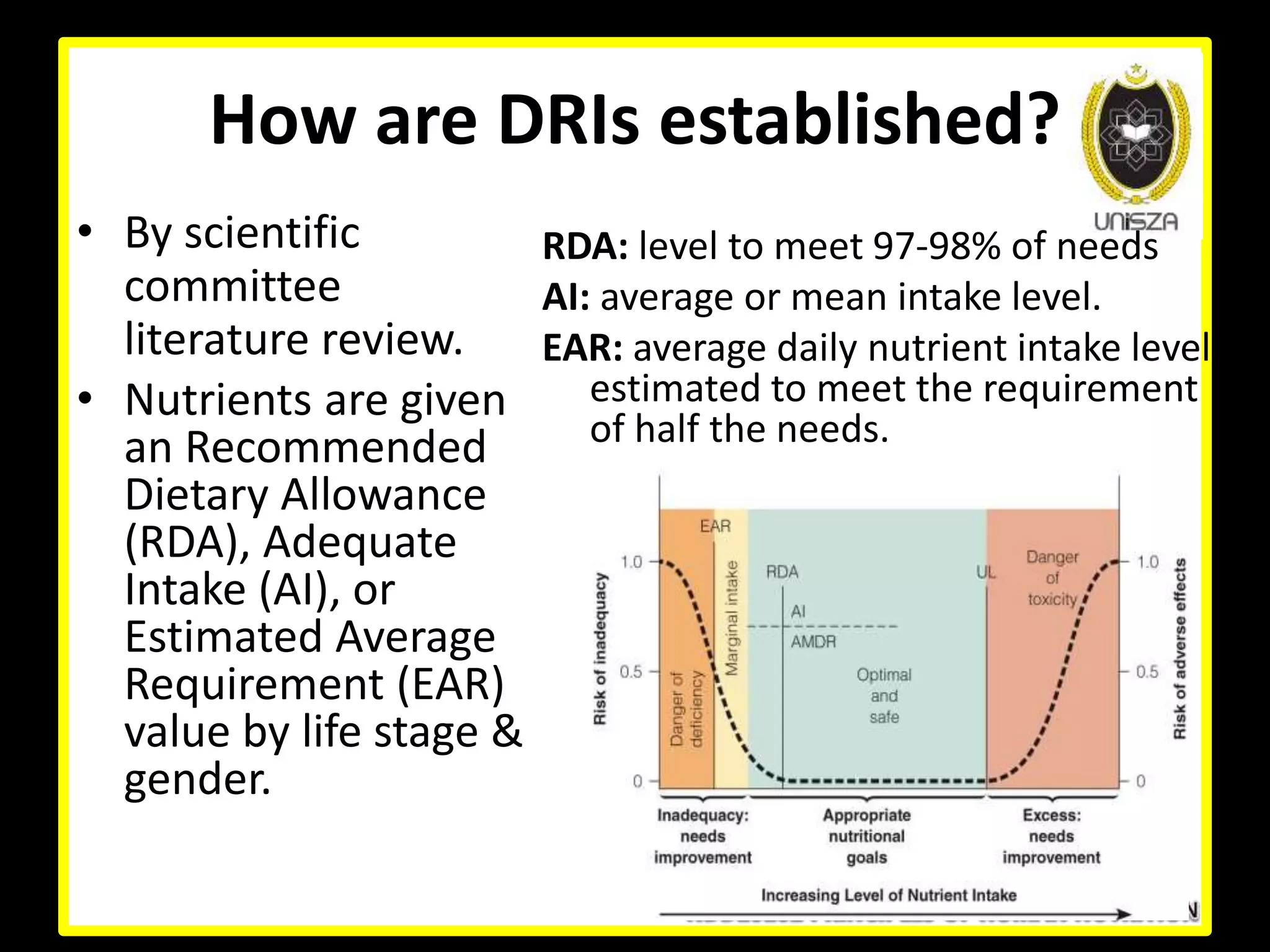
How are DRIs established?
• By scientific
committee
literature review.
• Nutrients are given
an Recommended
Dietary Allowance
(RDA), Adequate
Intake (AI), or
Estimated Average
Requirement (EAR)
value by life stage &
gender.
RDA: level to meet 97-98% of needs
AI: average or mean intake level.
EAR: average daily nutrient intake level
estimated to meet the requirement
of half the needs.
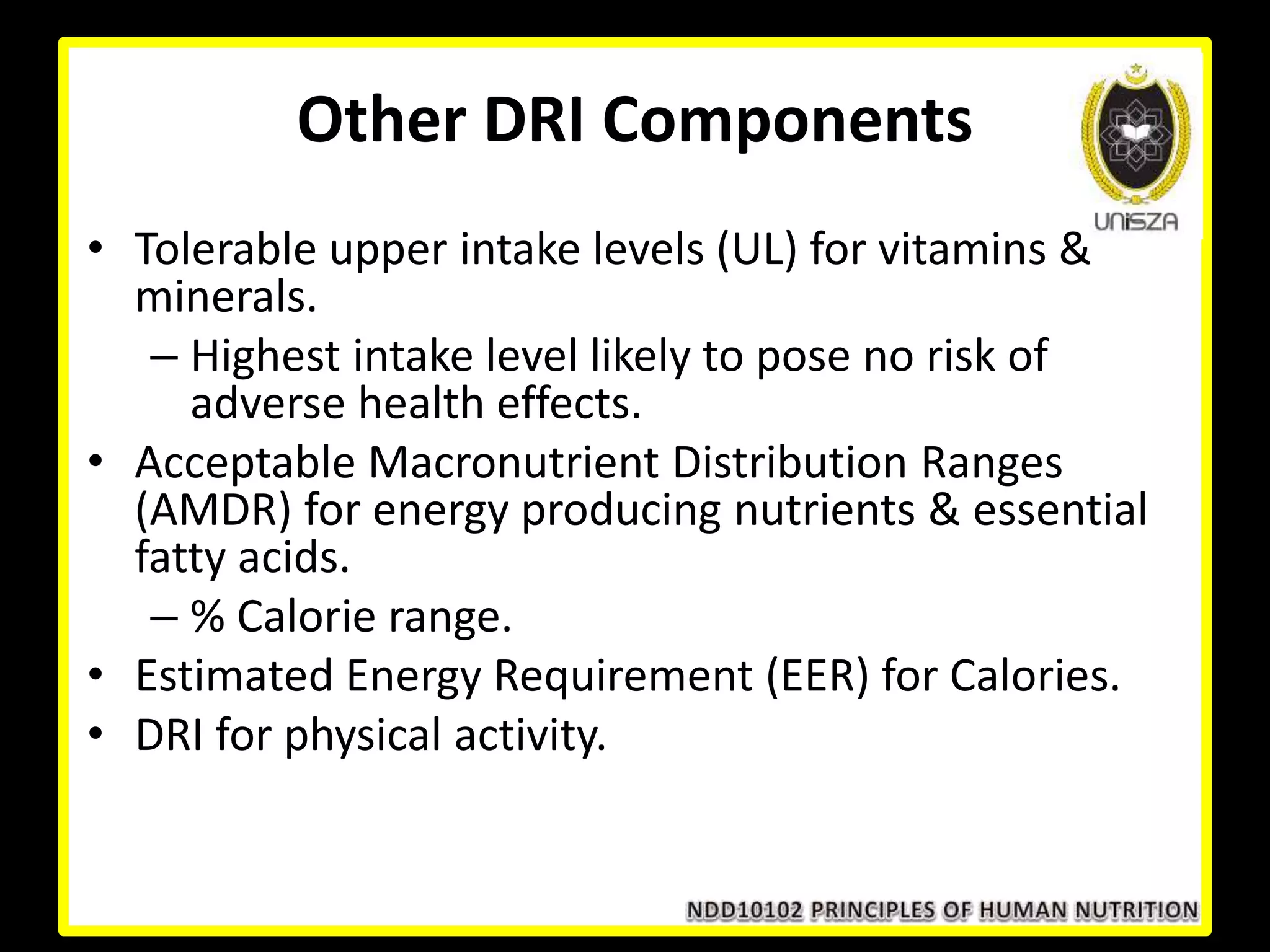
Other DRI Components
• Tolerable upper intake levels (UL) for vitamins &
minerals.
– Highest intake level likely to pose no risk of
adverse health effects.
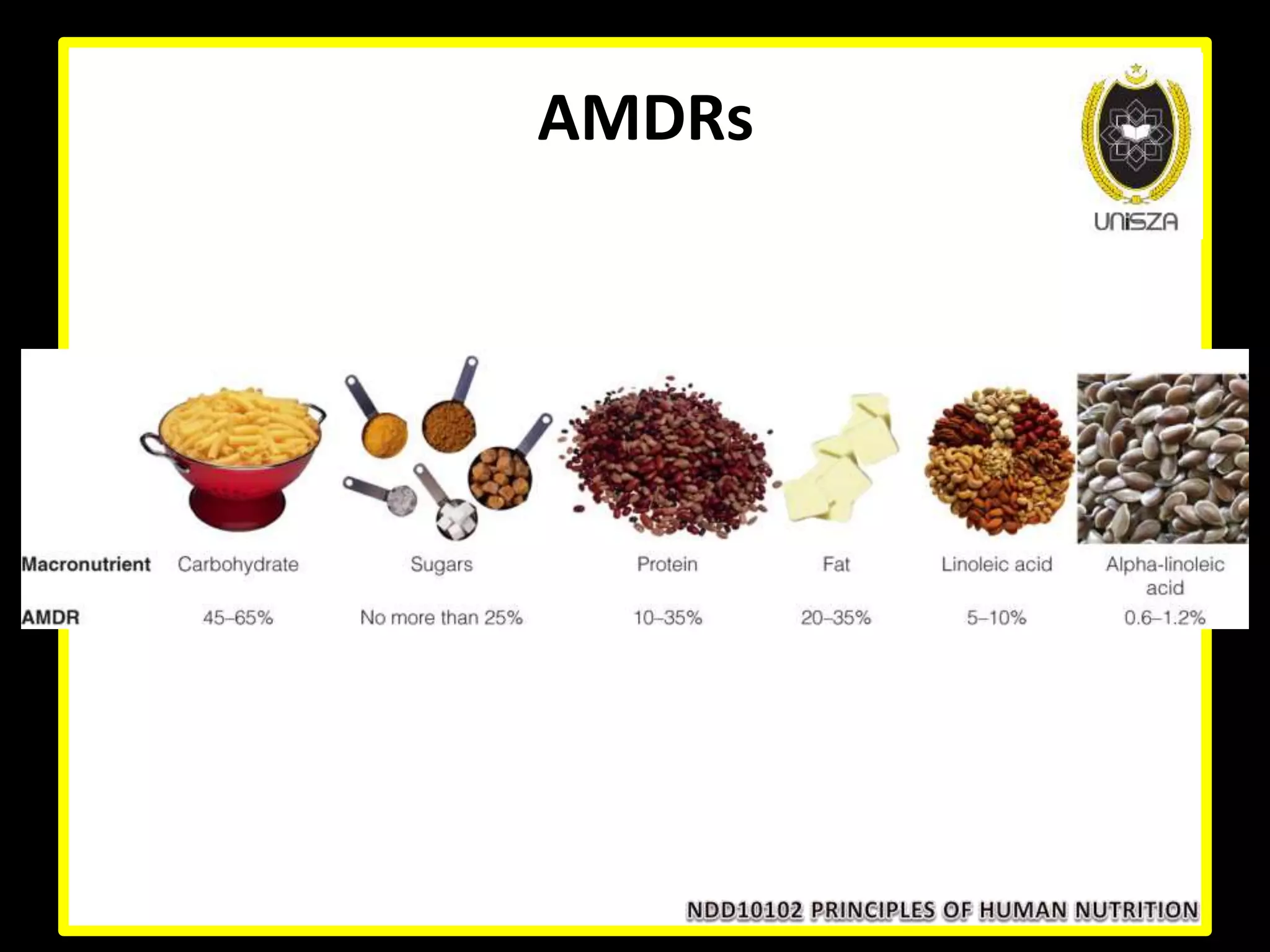
• Acceptable Macronutrient Distribution Ranges
(AMDR) for energy producing nutrients & essential
fatty acids.
– % Calorie range.
• Estimated Energy Requirement (EER) for Calories.
• DRI for physical activity.
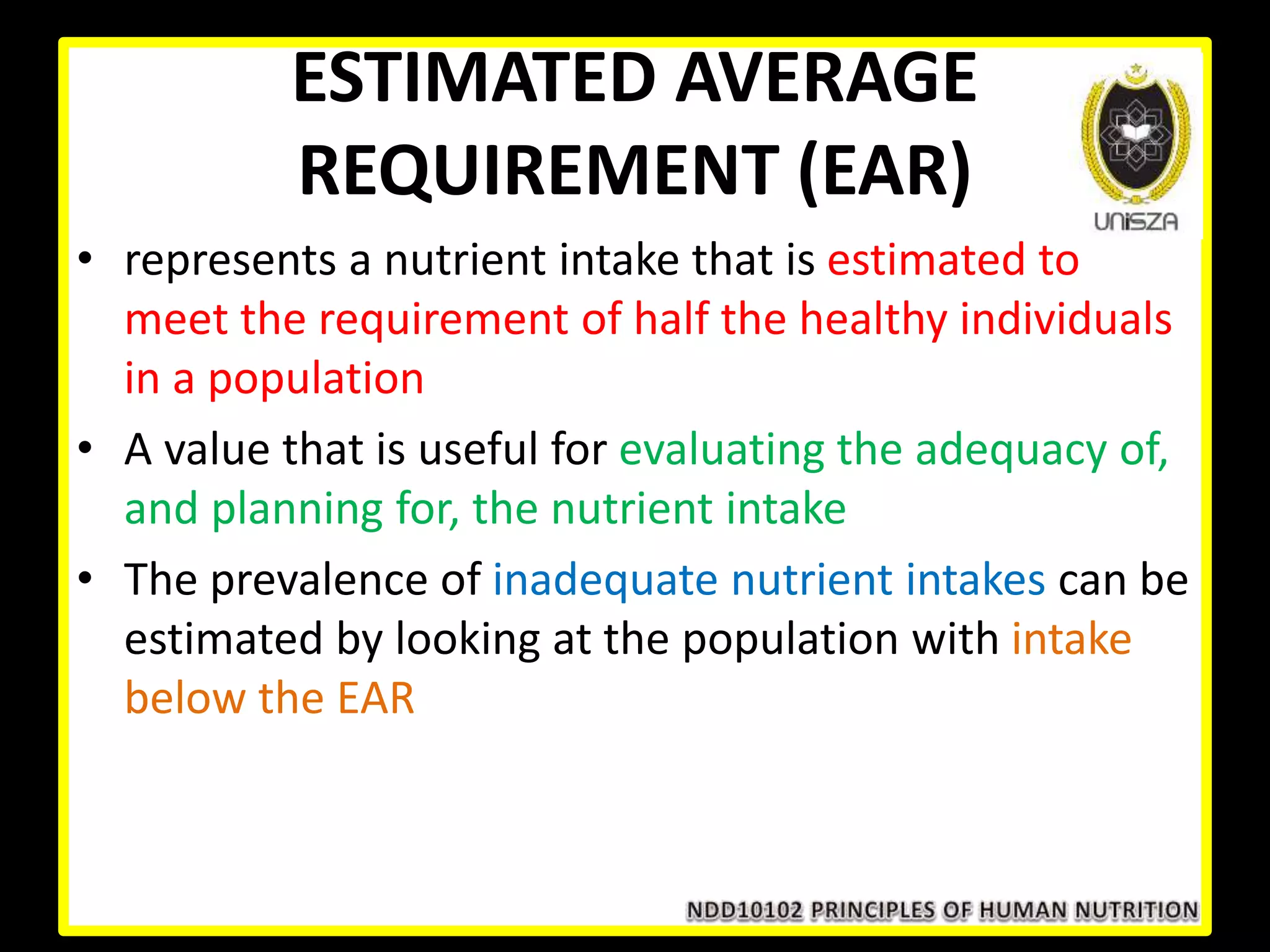
ESTIMATED AVERAGE
REQUIREMENT (EAR)
• represents a nutrient intake that is estimated to
meet the requirement of half the healthy individuals
in a population
• A value that is useful for evaluating the adequacy of,
and planning for, the nutrient intake
• The prevalence of inadequate nutrient intakes can be
estimated by looking at the population with intake
below the EAR
RECOMMENDED DIETARY
ALLOWANCE (RDA)
• The RDA represents the average daily dietary intake that
is sufficient to meet the nutrient requirement of nearly
all (97%-98%) healthy individuals in a population.
• The RDA is to be used as a guide for the individual
• RDA is ONLY a target
• Intake less than the RDA does not necessarily indicate
that the need of that particular individual have not been
met.
• However, the risk of deficiency is low if intake meets the
RDA.
ADEQUATE INTAKES (AIs)
• AIs are estimates used when there is insufficient
scientific evidence to set an EAR and calculate an
RDA
• It is based on observed or experimentally
determined approximation of the average
nutrient intake by a healthy population
• When an AI value rather than an RDA is set, it
targets the need for more research on the
requirement of that nutrient
• Can be used as a goal for individual intake
TOLERABLE UPPER INTAKE
LEVEL (UL)
• The UL is the highest level of daily nutrient intake
that is likely to pose no risks of adverse health effects
to most individuals in the general population.
• Consider it a maximum for daily intake of a specific
nutrient on a long-term basis.
• Used as a guide for limiting intake when planning
diets and evaluating the possibility of over-
consumption
Tolerable Upper
Intake Levels: ULs
• For vitamins with DRIs
• For minerals with DRIs
• For arsenic, boron, nickel, silicon, vanadium
Interpreting the DRI
• Used to assess adequacy of dietary intake
• Designed to ensure adequate nutrition for most
people in a population
• Does not inform us of what specific foods to eat
• Note: Another term, the Daily Value (DV) is used on
food labels, discussed later.
Applications of the DRI
• Provide a set of standards that can be used to
– plan diets
– Assess the adequacy of diets
– Make judgments about excessive intakes for individuals
and populations
• Example: they can be used as a standard for meals
prepared for
– Schools
– Hospitals
– health-care facilities
– gov feeding program for the elderly
– space-shuttle astronauts
Cont’d..
• Can be used to
– determine standards for food labeling
– develop practical tools for diet planning such as
Food Guide Pyramid
– Interpret information gathered about the food
consumed by a population to help identify
potential nutritional inadequacies that may be of
public health concern
DRIs Exist
For:
• Vitamins:
– A, D, E, K, B1 (thiamin), B2
(riboflavin), B3 (niacin), B6, B12,
folate, vitamin C
– biotin, pantothenic acid, choline
• Minerals:
– Ca, P, Mg, Fe, Zn, I, Se
– Cu, Mn, Cr, Mo, F
– Na, K, Cl
• Water:
– Men ≥19 years: 3.7 L/day (approx.
15 cups)
– Women ≥ 19 years : 2.7 L/day
(approx. 11 cups)
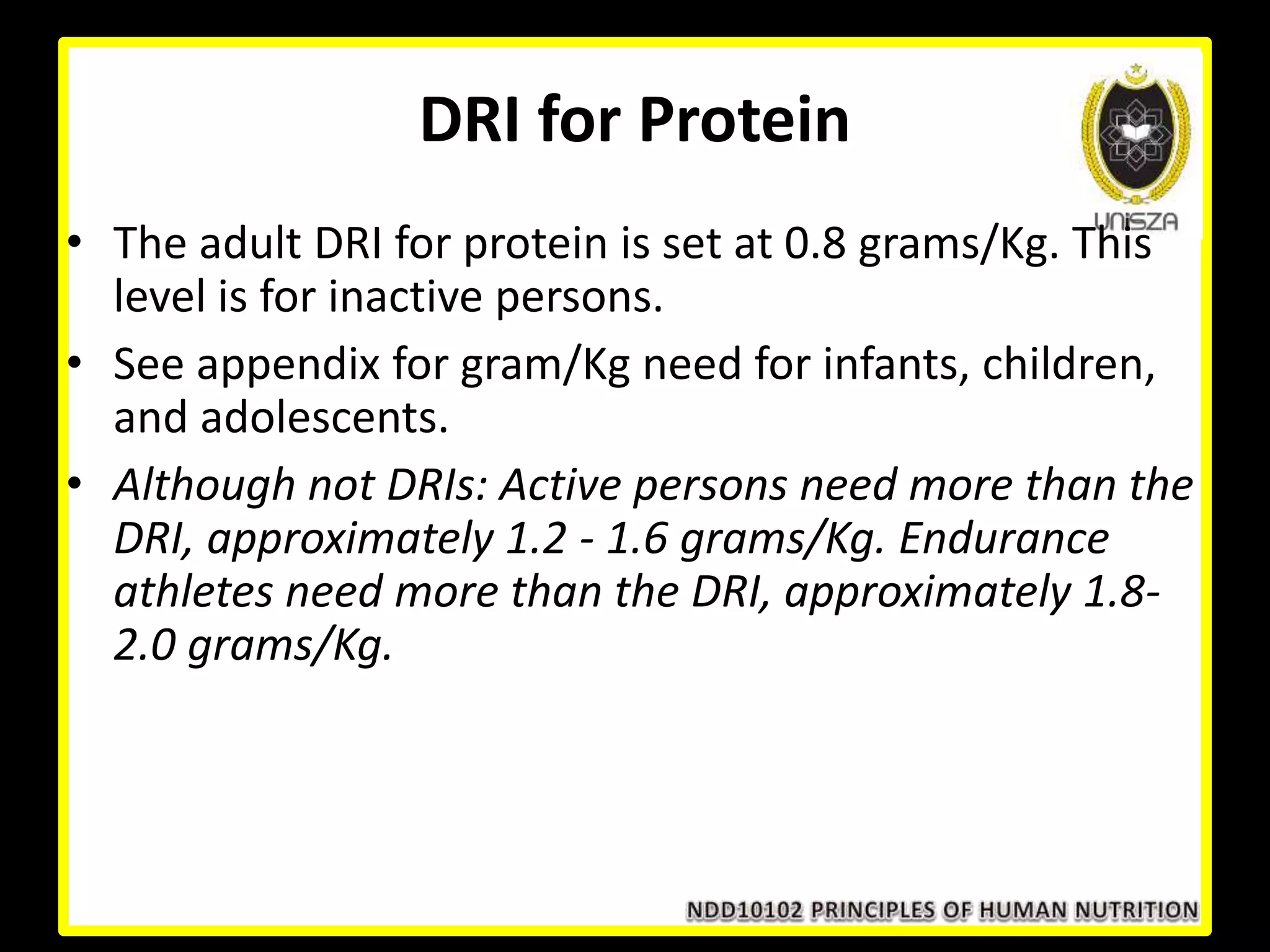
DRI for Protein
• The adult DRI for protein is set at 0.8 grams/Kg. This
level is for inactive persons.
• See appendix for gram/Kg need for infants, children,
and adolescents.
• Although not DRIs: Active persons need more than the
DRI, approximately 1.2 - 1.6 grams/Kg. Endurance
athletes need more than the DRI, approximately 1.8-
2.0 grams/Kg.
DRI for Carbohydrate,
Fiber & Fat
• Carbohydrate: At least 130 gm/day for adults
• Fiber:  38 gm/d  25 gm/d, [adults]
• 1.4 gm/100 Calories consumed
• FAT: not determined for adults
• Essential Fatty Acids:
• Linoleic Acid:
17 12 [adults, gm/d ]
• Alpha-Linolenic Acid:
1.6 1.1 [adults, gm/d ]
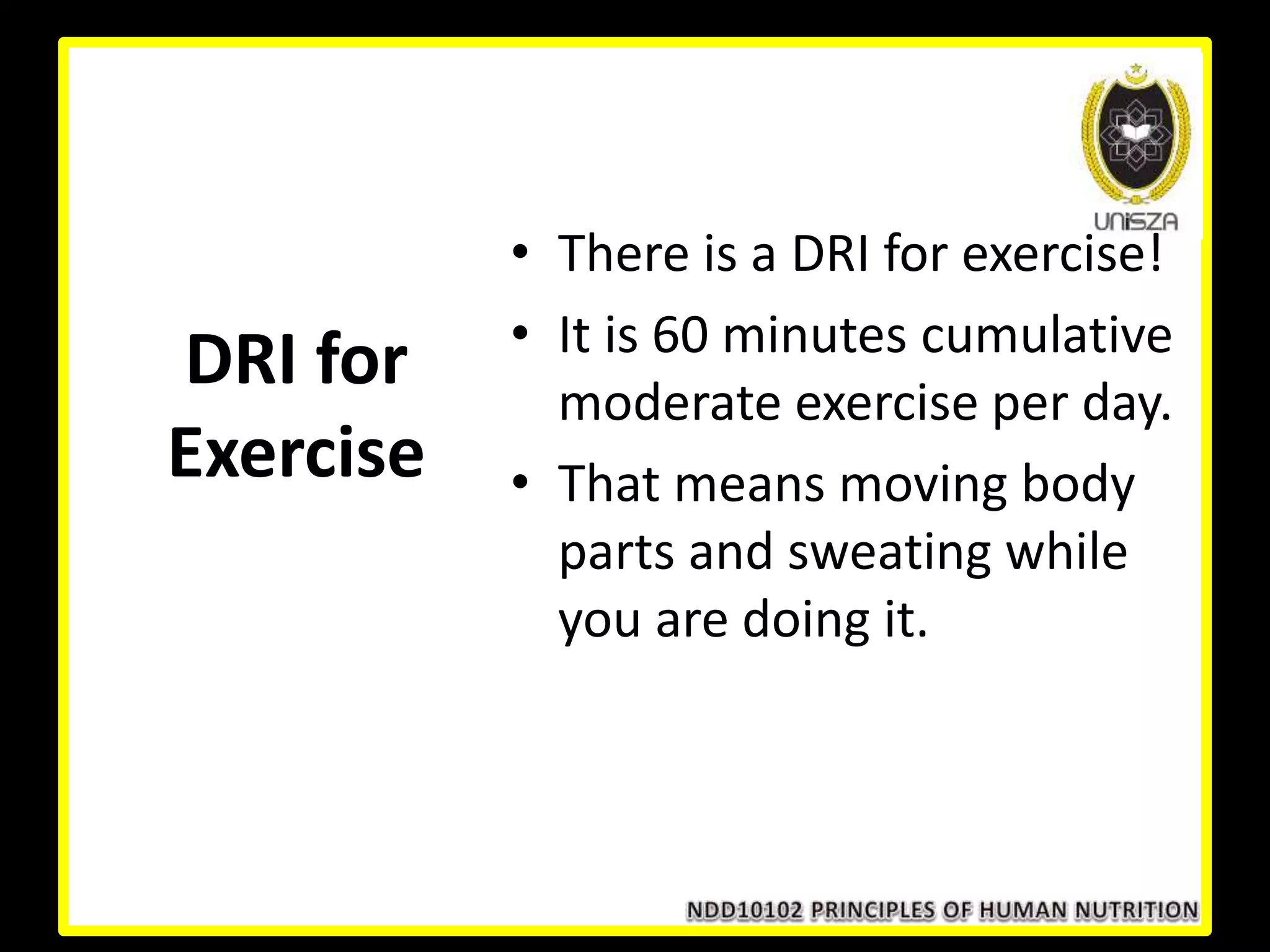
DRI for
Exercise
• There is a DRI for exercise!
• It is 60 minutes cumulative
moderate exercise per day.
• That means moving body
parts and sweating while
you are doing it.
AMDRs
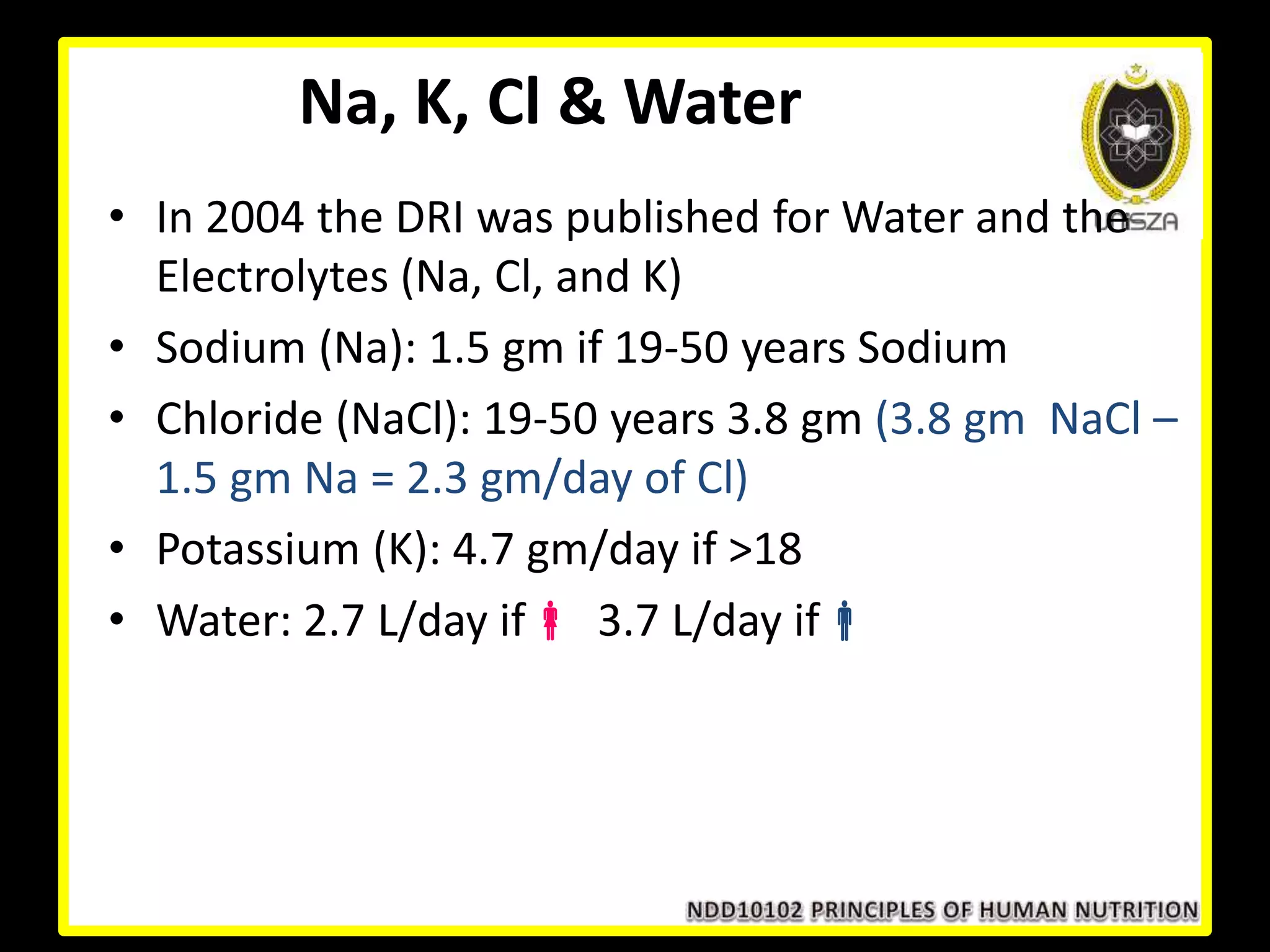
Na, K, Cl & Water
• In 2004 the DRI was published for Water and the
Electrolytes (Na, Cl, and K)
• Sodium (Na): 1.5 gm if 19-50 years Sodium
• Chloride (NaCl): 19-50 years 3.8 gm (3.8 gm NaCl –
1.5 gm Na = 2.3 gm/day of Cl)
• Potassium (K): 4.7 gm/day if >18
• Water: 2.7 L/day if 3.7 L/day if
DRIs Do Not Exist For:
• Cholesterol
• Sulfur (sulfate)
• Cobalt
• Non-essential, nutritional supplements
Recap..
• DRIs are a collection of values to express a persons
nutrient need based on their life stage & gender.
• The exact DRI value may be as an RDA, AI, EAR depending
on scientific information available for each nutrient.
• DRIs are expressed as ULs and AMDRs.
• For Calories the DRI is called the EER.
• There is DRI recommendation for Physical activity.
• The DRIs are standards that have many important
purposes and uses.
References for this presentation are the same as those for this topic found in module 2 of the textbook
II. The Food Guide Pyramid: A
tool for Diet Planning
2. THE FOOD GUIDE PYRAMID:
A TOOL FOR DIET PLANNING
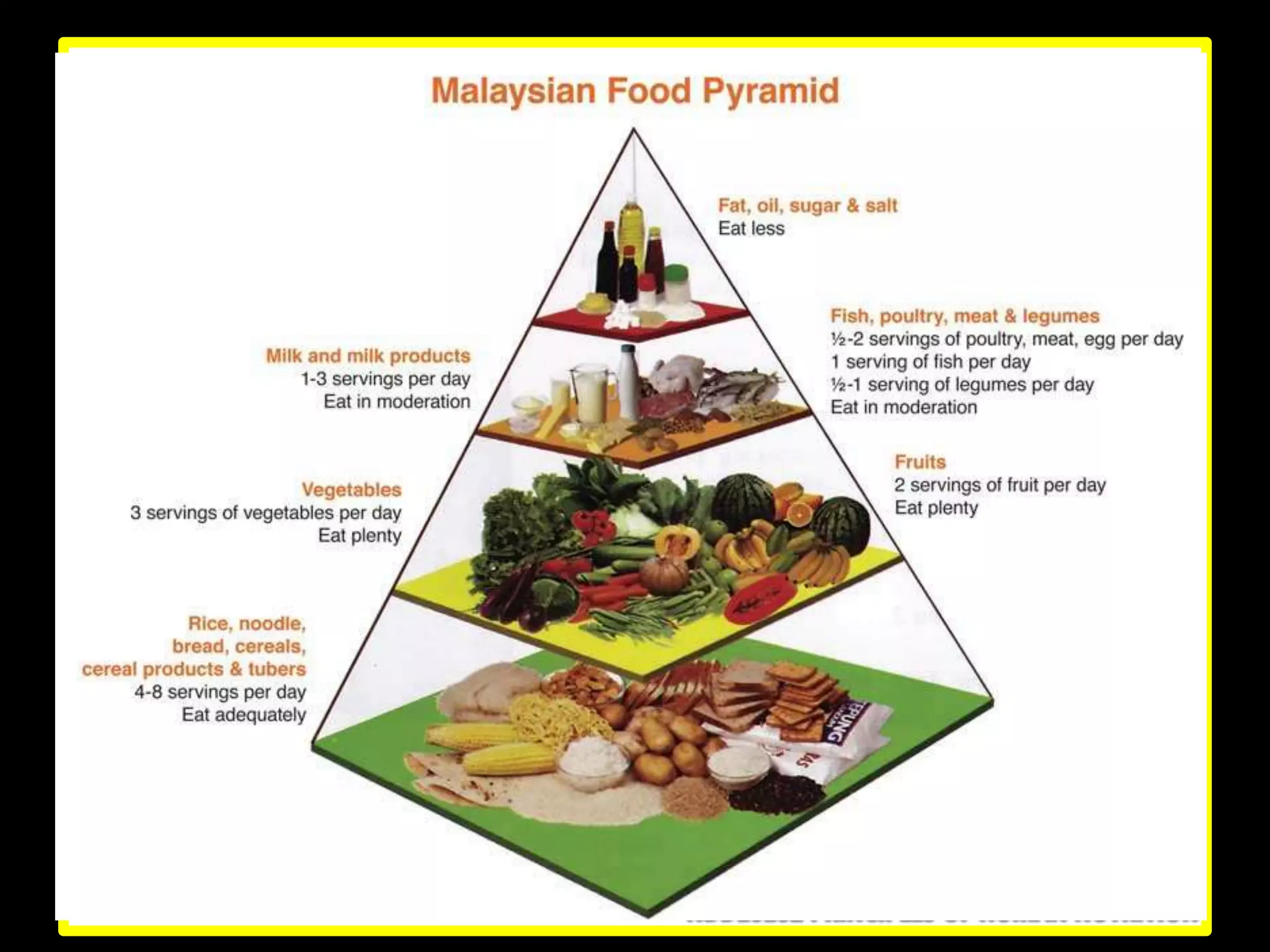
• Malaysian Food Pyramid is a simple guide for individuals to vary
their foods intake according to the total daily food serving
recommended.
• A balanced diet contains the combination of foods that will provide
all the nutrients needed by our body.
• The body needs many types of food in varying amounts to maintain
health.
• A food pyramid consists of four (4) levels that represent five (5)
food group. Indicated beside each food group is the recommended
number of servings per day from each group.
• From the bottom to the top of the food pyramid, the size of each
food group becomes smaller indicating that an individual should eat
more of the foods at the base of the pyramid and less of the foods
at the top of the pyramid.
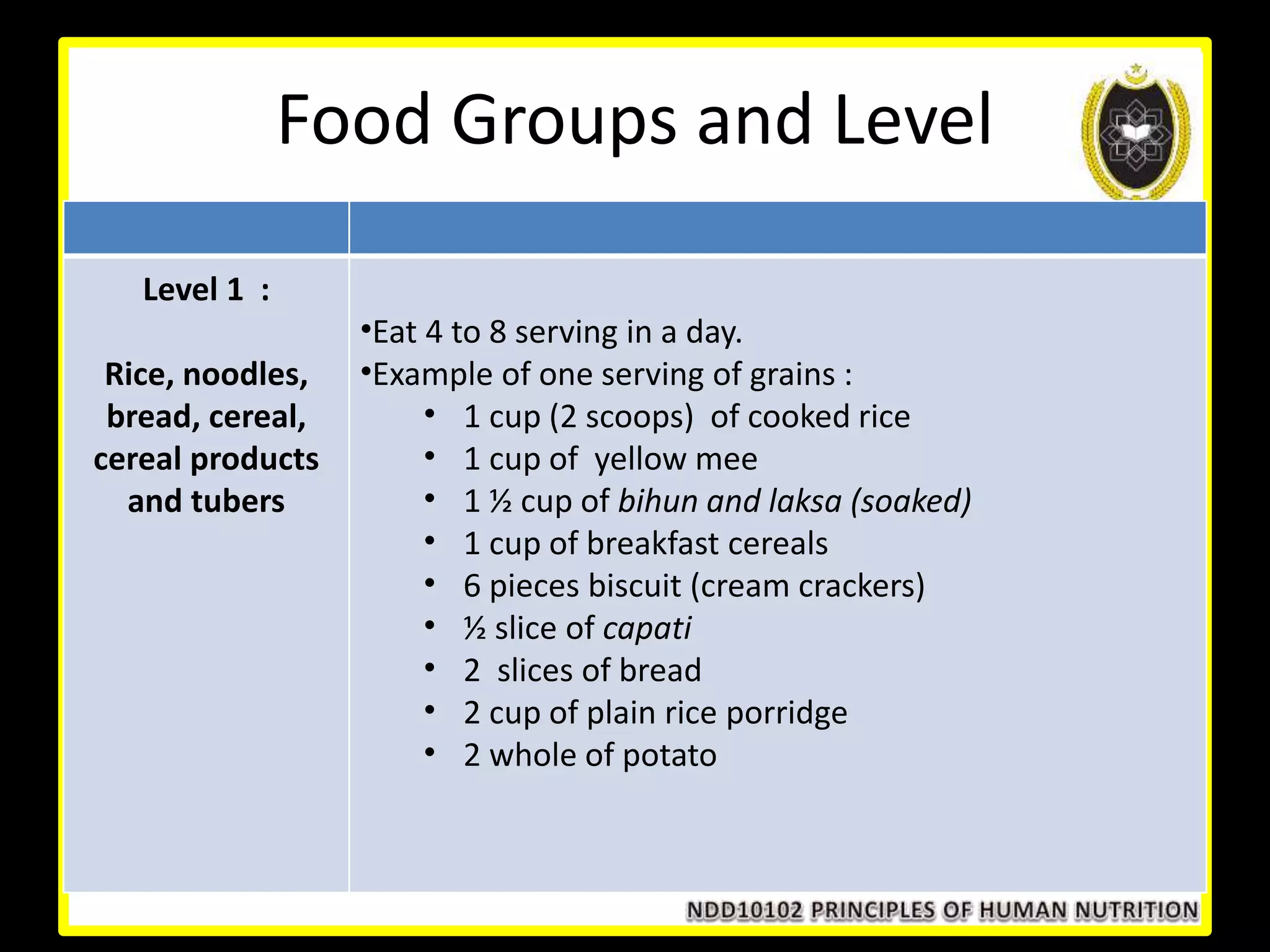
Food Groups and Level
Level 1 :
Rice, noodles,
bread, cereal,
cereal products
and tubers
•Eat 4 to 8 serving in a day.
•Example of one serving of grains :
• 1 cup (2 scoops) of cooked rice
• 1 cup of yellow mee
• 1 ½ cup of bihun and laksa (soaked)
• 1 cup of breakfast cereals
• 6 pieces biscuit (cream crackers)
• ½ slice of capati
• 2 slices of bread
• 2 cup of plain rice porridge
• 2 whole of potato
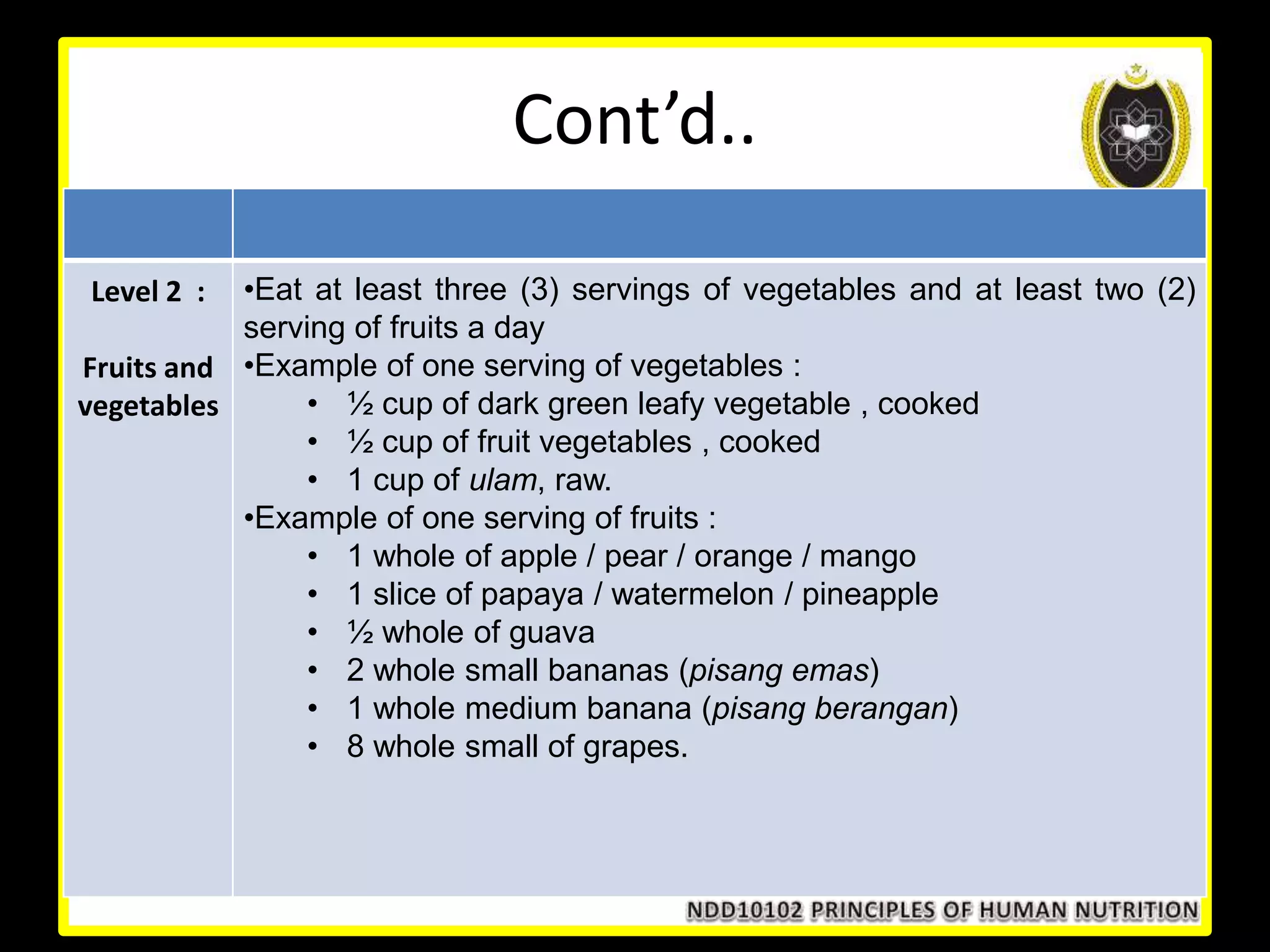
Cont’d..
Level 2 :
Fruits and
vegetables
•Eat at least three (3) servings of vegetables and at least two (2)
serving of fruits a day
•Example of one serving of vegetables :
• ½ cup of dark green leafy vegetable , cooked
• ½ cup of fruit vegetables , cooked
• 1 cup of ulam, raw.
•Example of one serving of fruits :
• 1 whole of apple / pear / orange / mango
• 1 slice of papaya / watermelon / pineapple
• ½ whole of guava
• 2 whole small bananas (pisang emas)
• 1 whole medium banana (pisang berangan)
• 8 whole small of grapes.
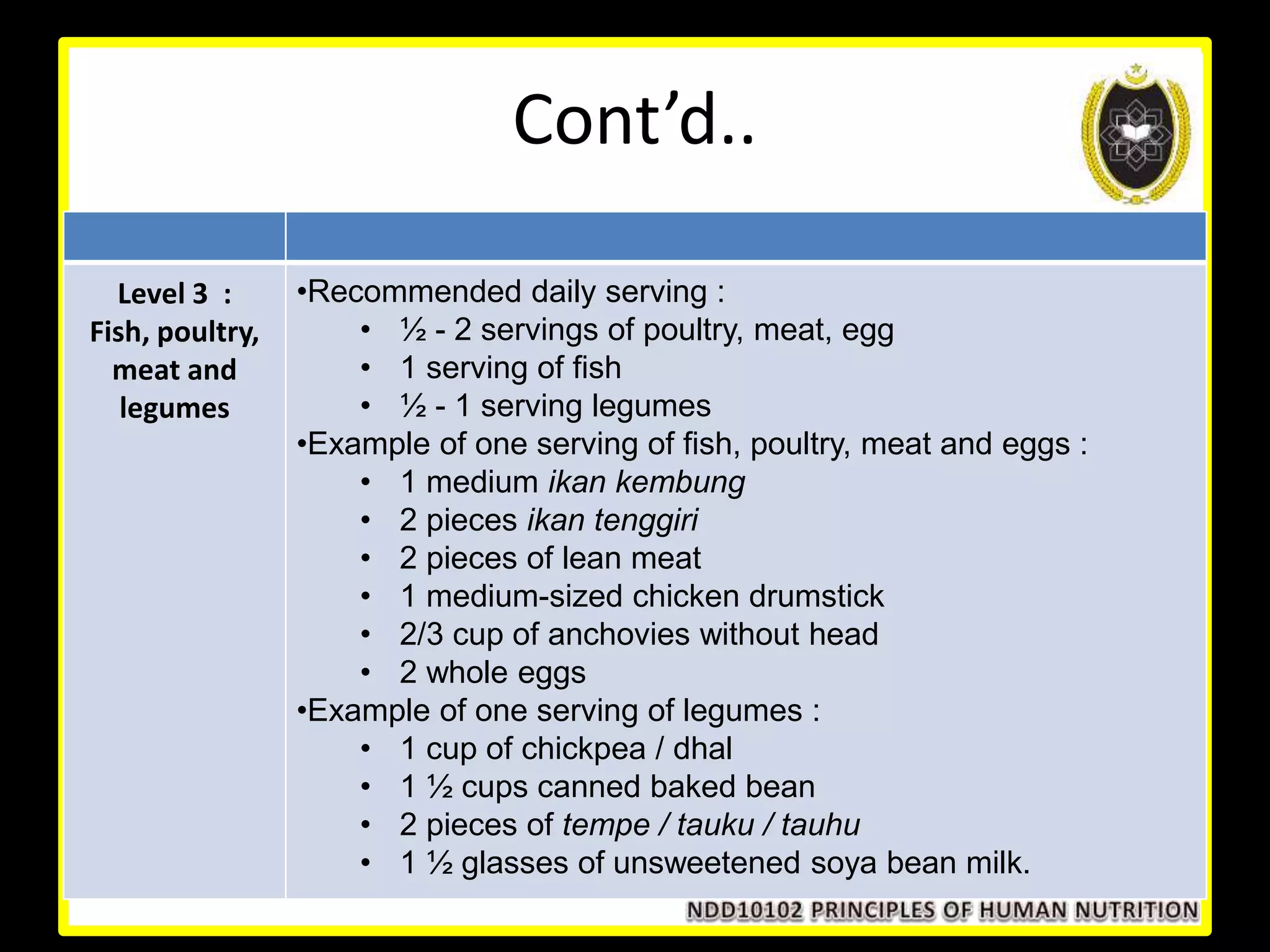
Level 3 :
Fish, poultry,
meat and
legumes
•Recommended daily serving :
• ½ - 2 servings of poultry, meat, egg
• 1 serving of fish
• ½ - 1 serving legumes
•Example of one serving of fish, poultry, meat and eggs :
• 1 medium ikan kembung
• 2 pieces ikan tenggiri
• 2 pieces of lean meat
• 1 medium-sized chicken drumstick
• 2/3 cup of anchovies without head
• 2 whole eggs
•Example of one serving of legumes :
• 1 cup of chickpea / dhal
• 1 ½ cups canned baked bean
• 2 pieces of tempe / tauku / tauhu
• 1 ½ glasses of unsweetened soya bean milk.
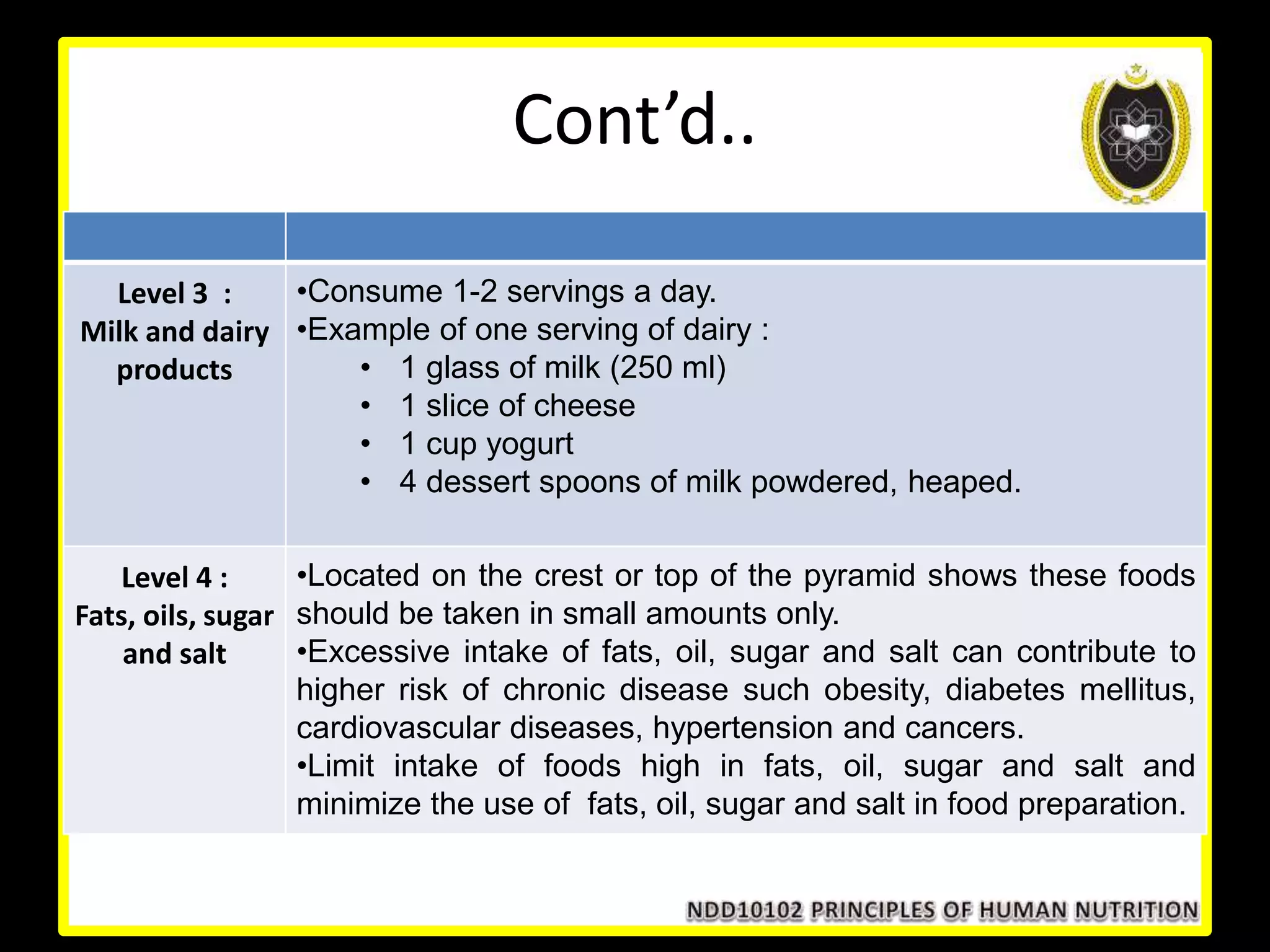
Cont’d..
Level 3 :
Milk and dairy
products
•Consume 1-2 servings a day.
•Example of one serving of dairy :
• 1 glass of milk (250 ml)
• 1 slice of cheese
• 1 cup yogurt
• 4 dessert spoons of milk powdered, heaped.
Level 4 :
Fats, oils, sugar
and salt
•Located on the crest or top of the pyramid shows these foods
should be taken in small amounts only.
•Excessive intake of fats, oil, sugar and salt can contribute to
higher risk of chronic disease such obesity, diabetes mellitus,
cardiovascular diseases, hypertension and cancers.
•Limit intake of foods high in fats, oil, sugar and salt and
minimize the use of fats, oil, sugar and salt in food preparation.
Cont’d..
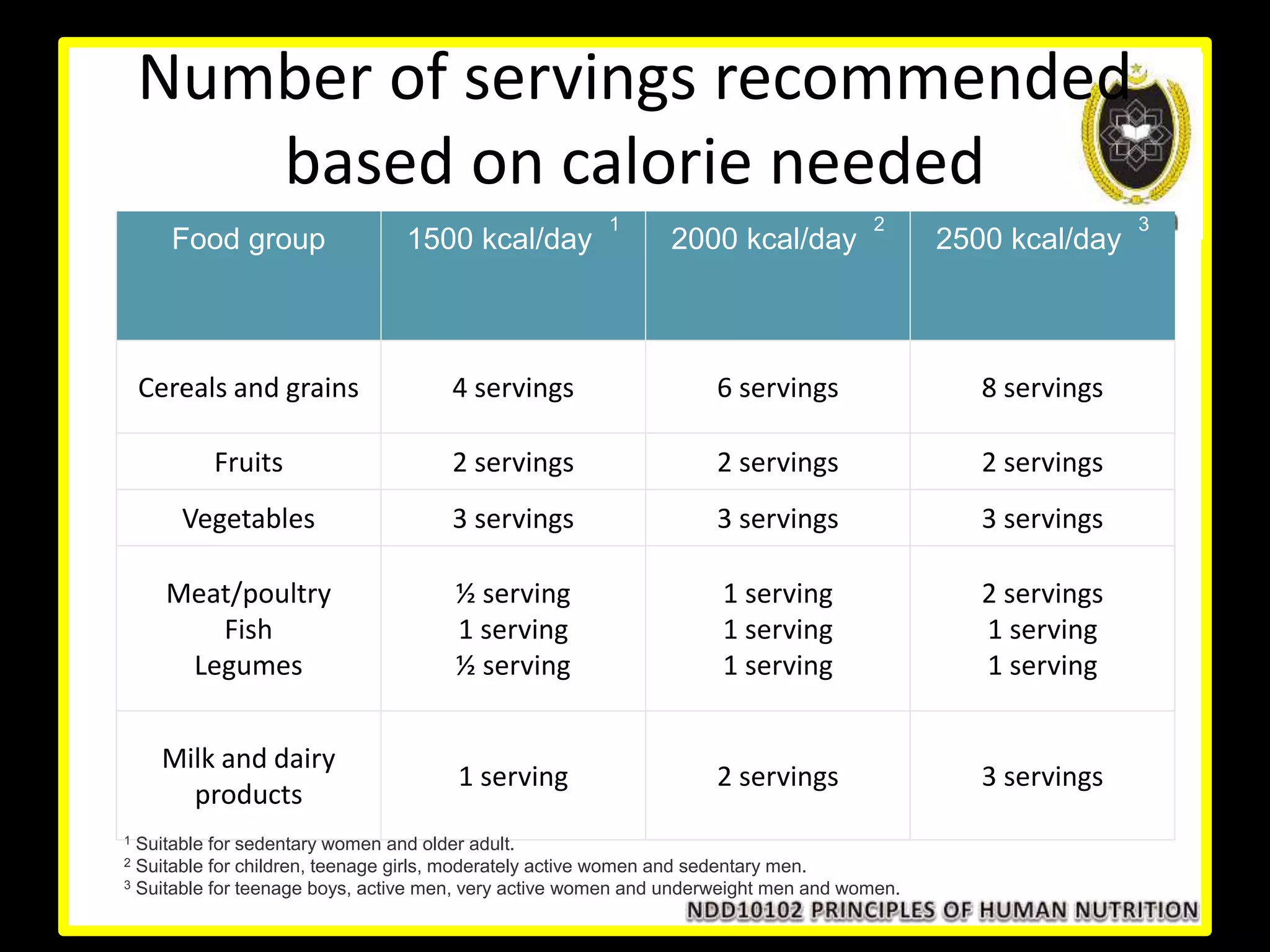
Number of servings recommended
based on calorie needed
Food group 1500 kcal/day
1
2000 kcal/day
2
2500 kcal/day
3
Cereals and grains 4 servings 6 servings 8 servings
Fruits 2 servings 2 servings 2 servings
Vegetables 3 servings 3 servings 3 servings
Meat/poultry
Fish
Legumes
½ serving
1 serving
½ serving
1 serving
1 serving
1 serving
2 servings
1 serving
1 serving
Milk and dairy
products
1 serving 2 servings 3 servings
1 Suitable for sedentary women and older adult.
2 Suitable for children, teenage girls, moderately active women and sedentary men.
3 Suitable for teenage boys, active men, very active women and underweight men and women.
Cont’d..
• Choosing for balance and variety
– When planning a diet, it must
• Meet nutrient needs
• Consider the nutrient density
• Be variety
• Be balance
What is the concept of nutrient density?
• Foods that contain a significant amount of a specific
nutrient compared to its caloric content have a high
nutrient density.
• Opposite of “empty calorie”
• i.e : both skim milk and ice cream in a same group.
However, a 1 cup serving of skim milk provides
300mg of calcium in 90 kcal whereas a cup of ice-
cream provides 168 mg of calcium in 265 kcal. Thus,
skim milk have higher nutrient density because it
provides more nutrients per kcal than the ice-cream
III. Food Labels: Knowing
What you Choose
FOOD LABELS: KNOWING WHAT YOU
CHOOSE
• Another tool that can be used in diet planning
• Designed to help consumers make healthy
food choices by providing information about :
– the nutrient composition of foods
– How a food fits into the overall diet
Consumer Nutrition: Food Labels and Health Claims
What nutrition information do food labels provide?
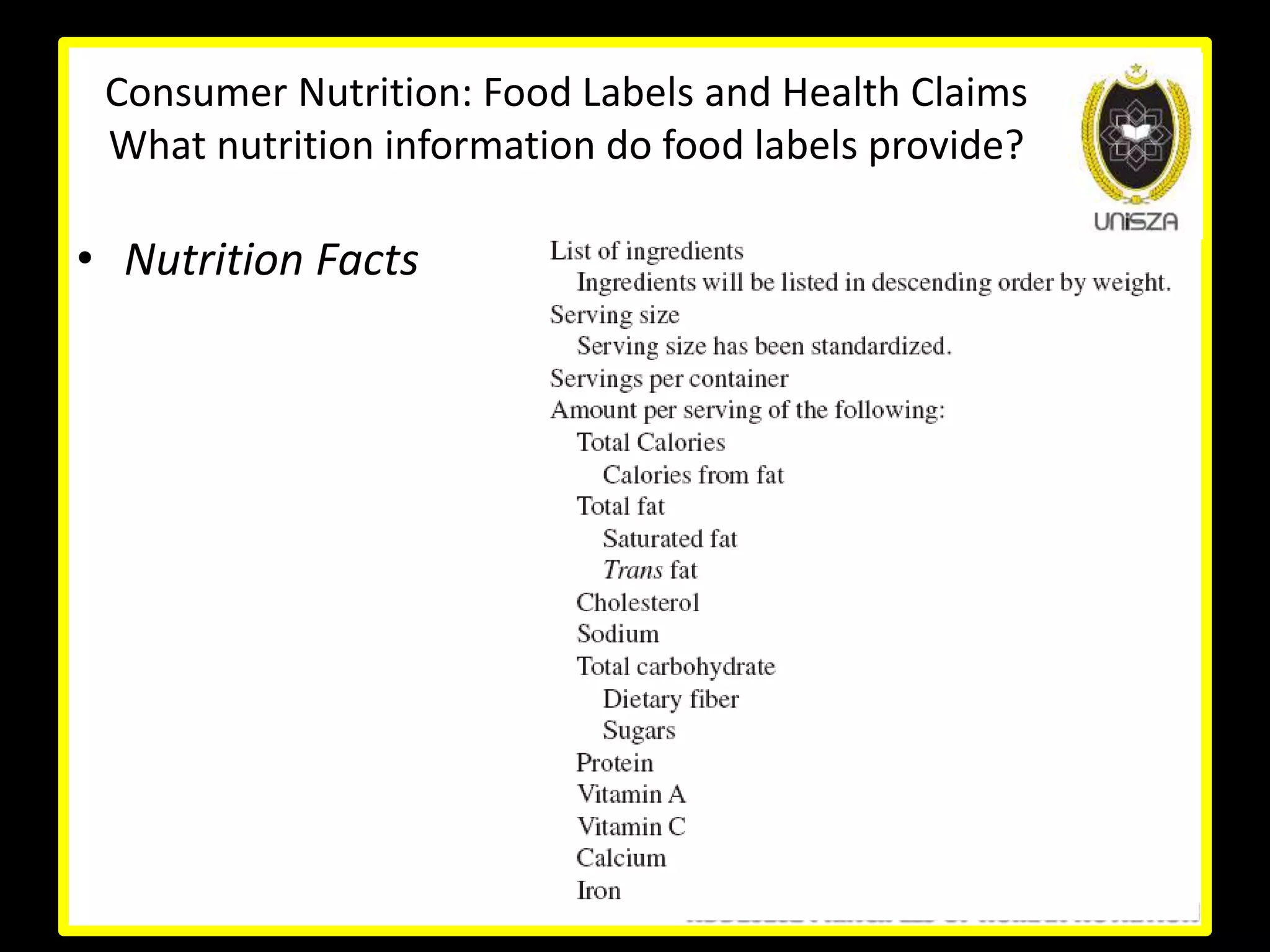
• Nutrition Facts
How can I use this information to select a
healthier diet?
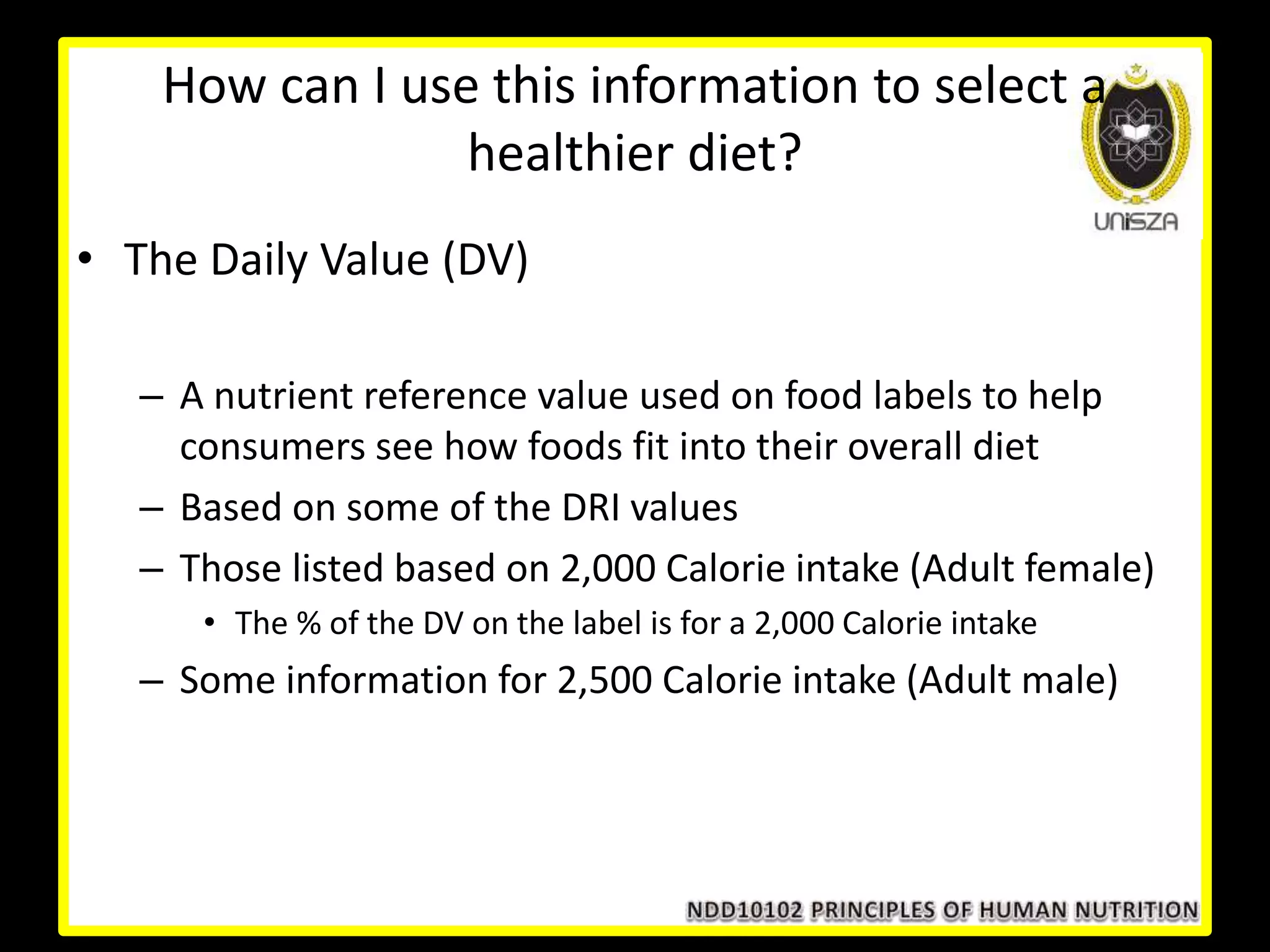
• The Daily Value (DV)
– A nutrient reference value used on food labels to help
consumers see how foods fit into their overall diet
– Based on some of the DRI values
– Those listed based on 2,000 Calorie intake (Adult female)
• The % of the DV on the label is for a 2,000 Calorie intake
– Some information for 2,500 Calorie intake (Adult male)
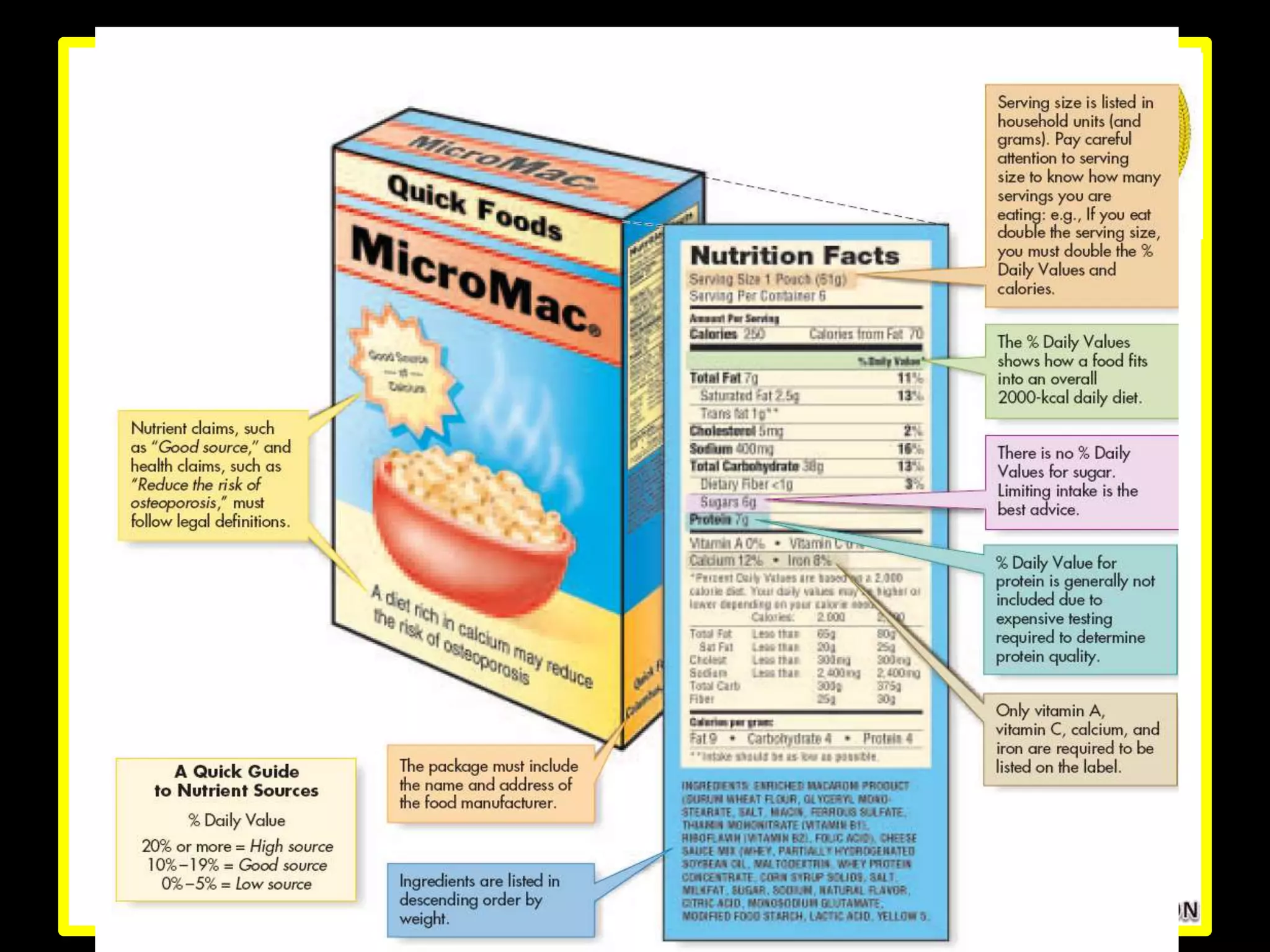
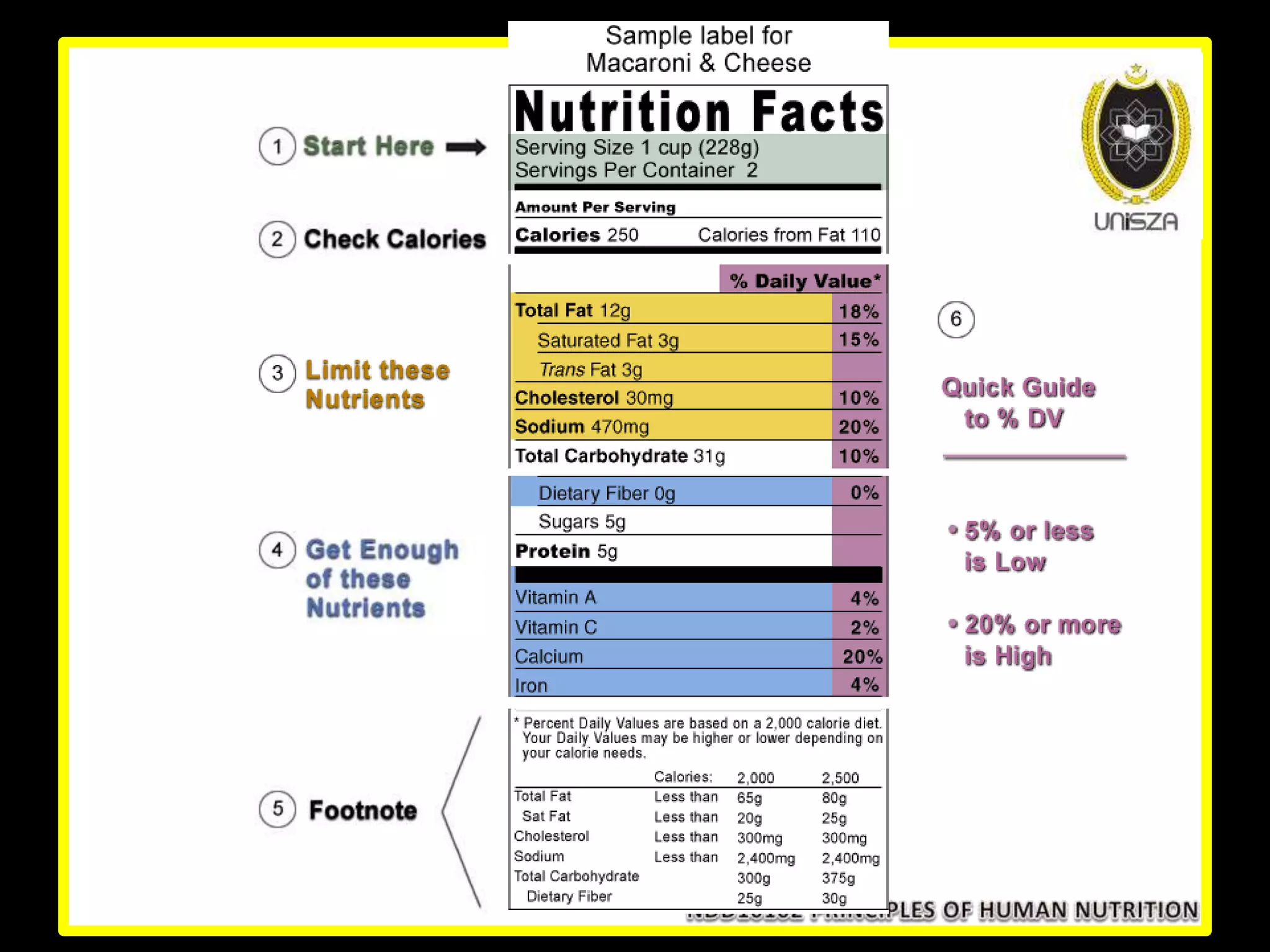
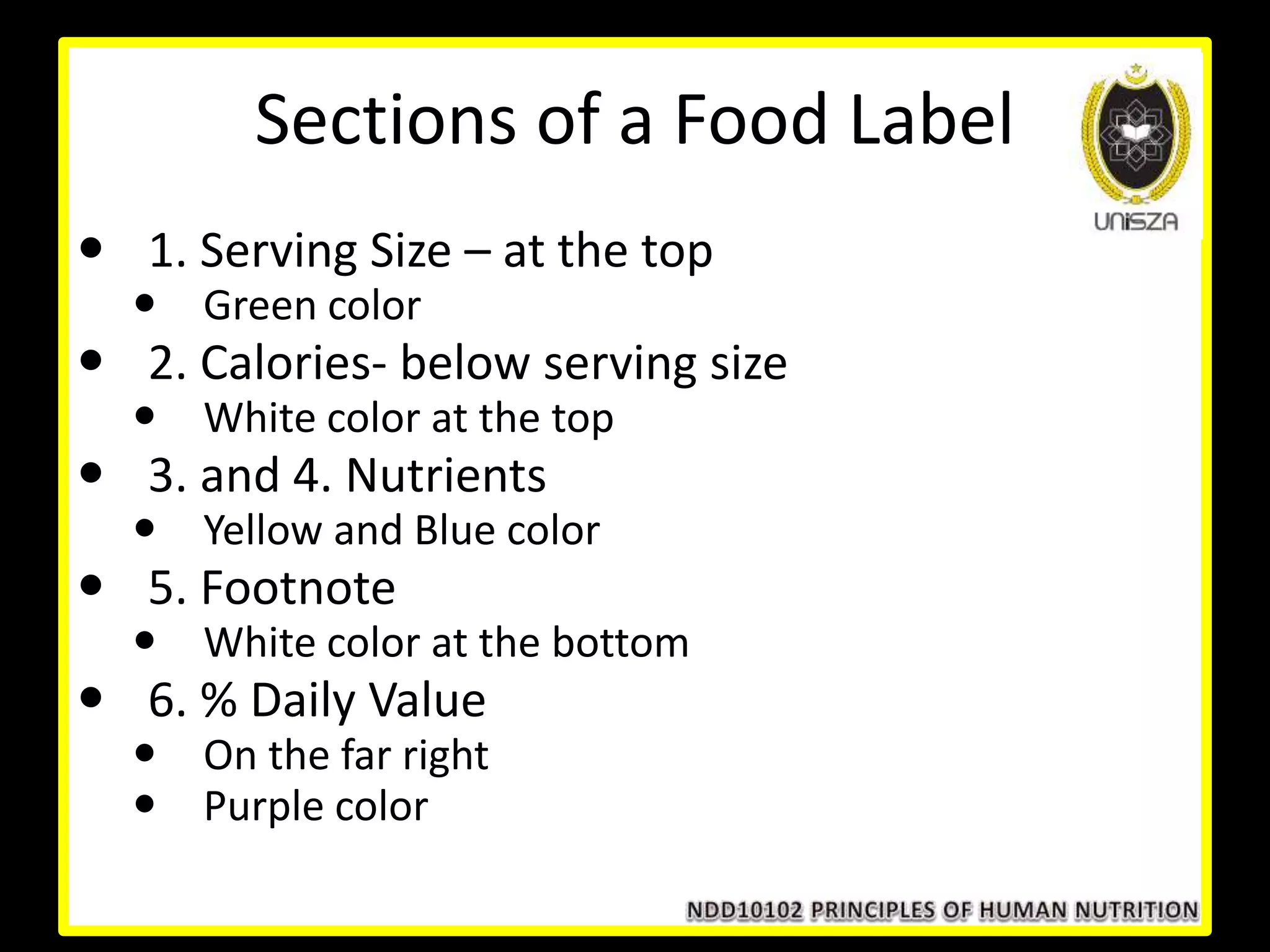
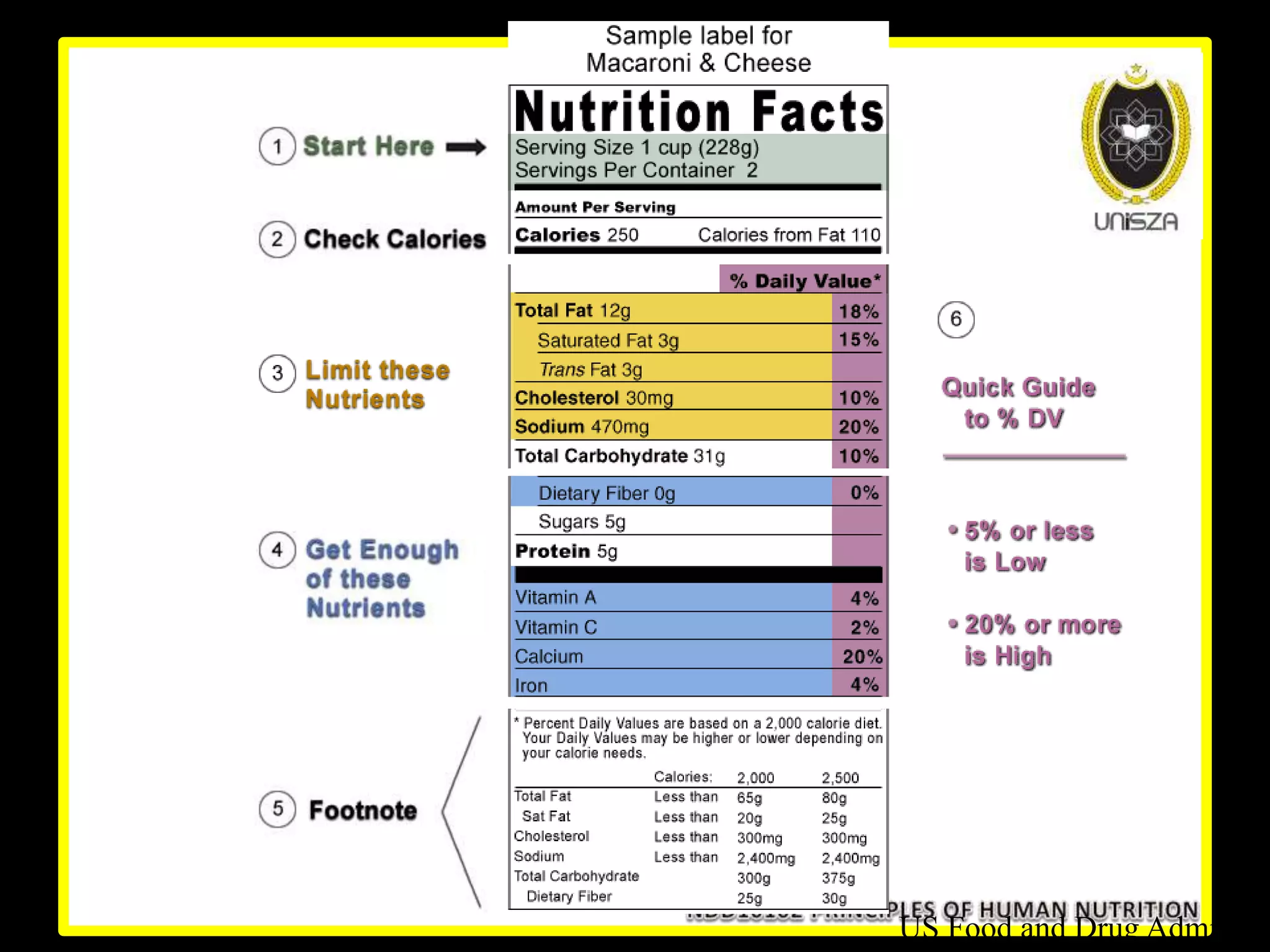
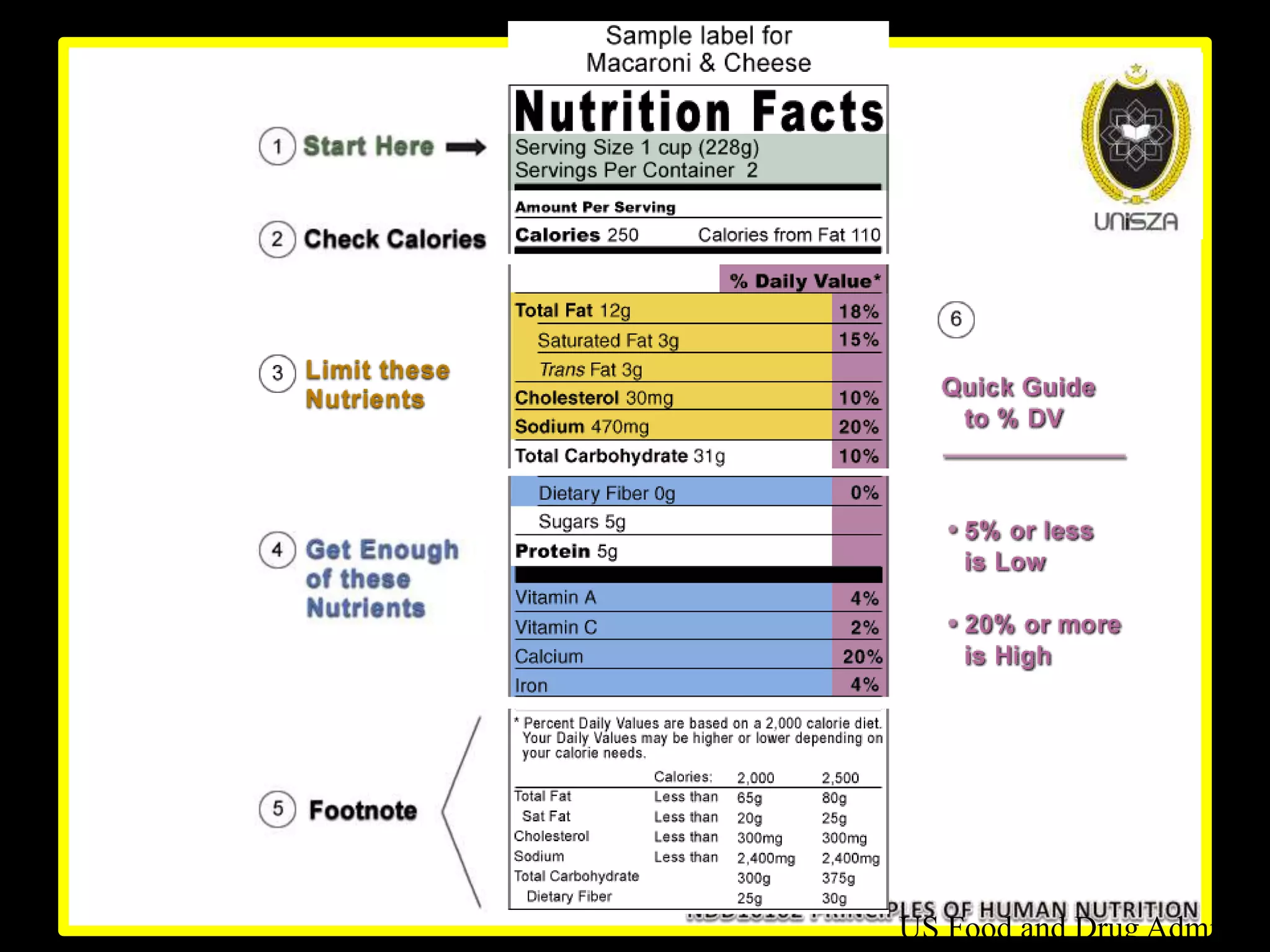
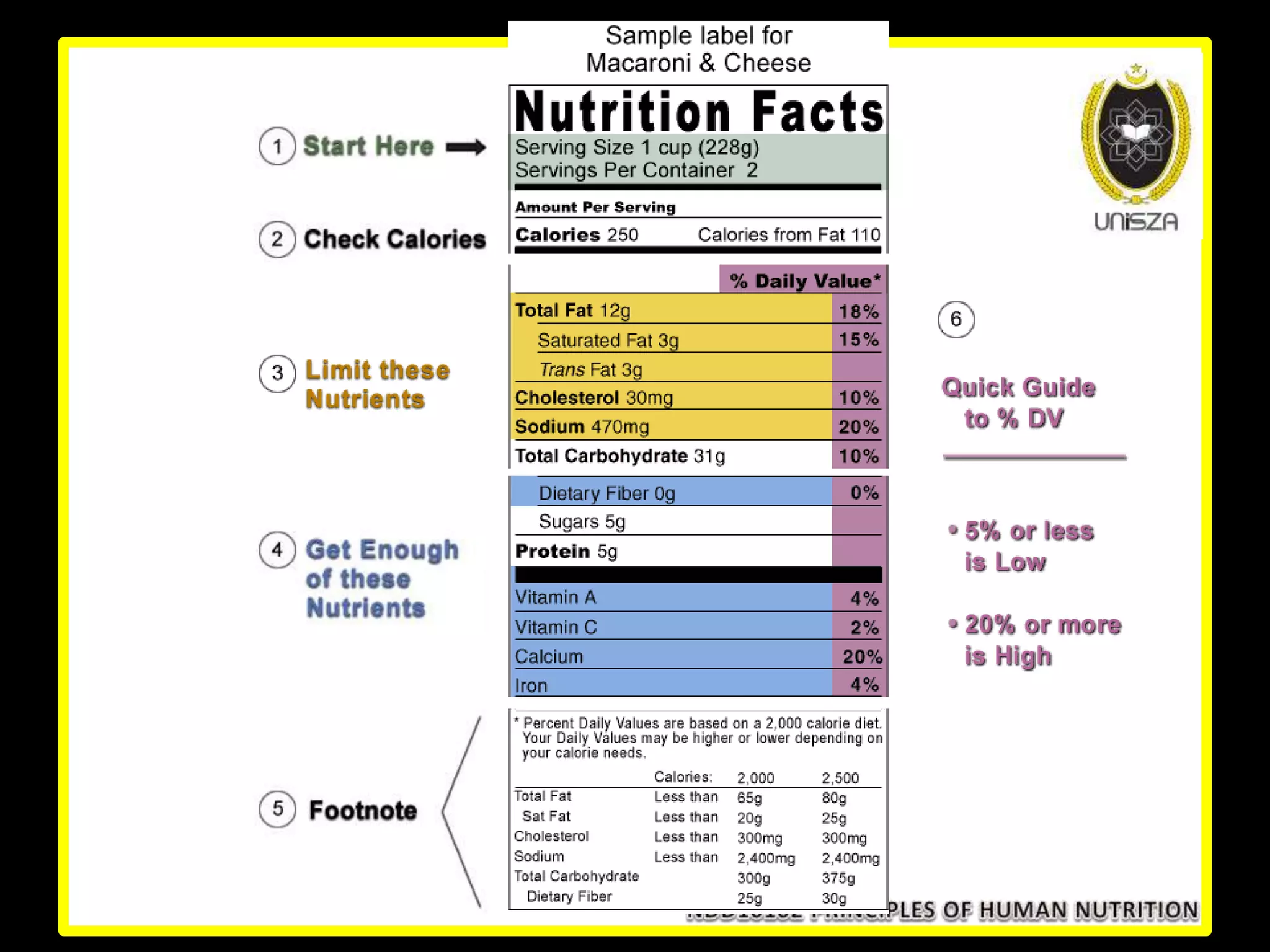
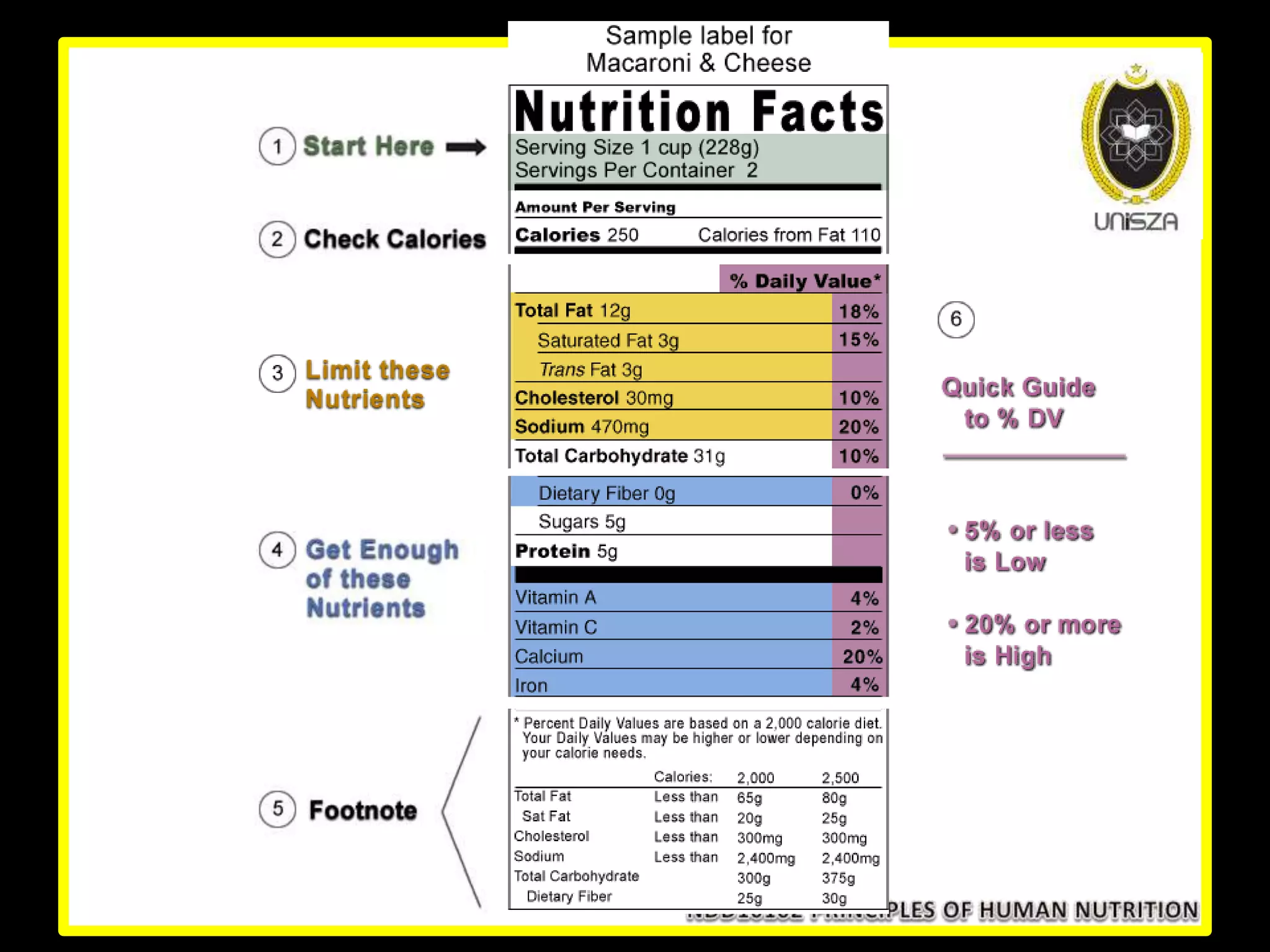
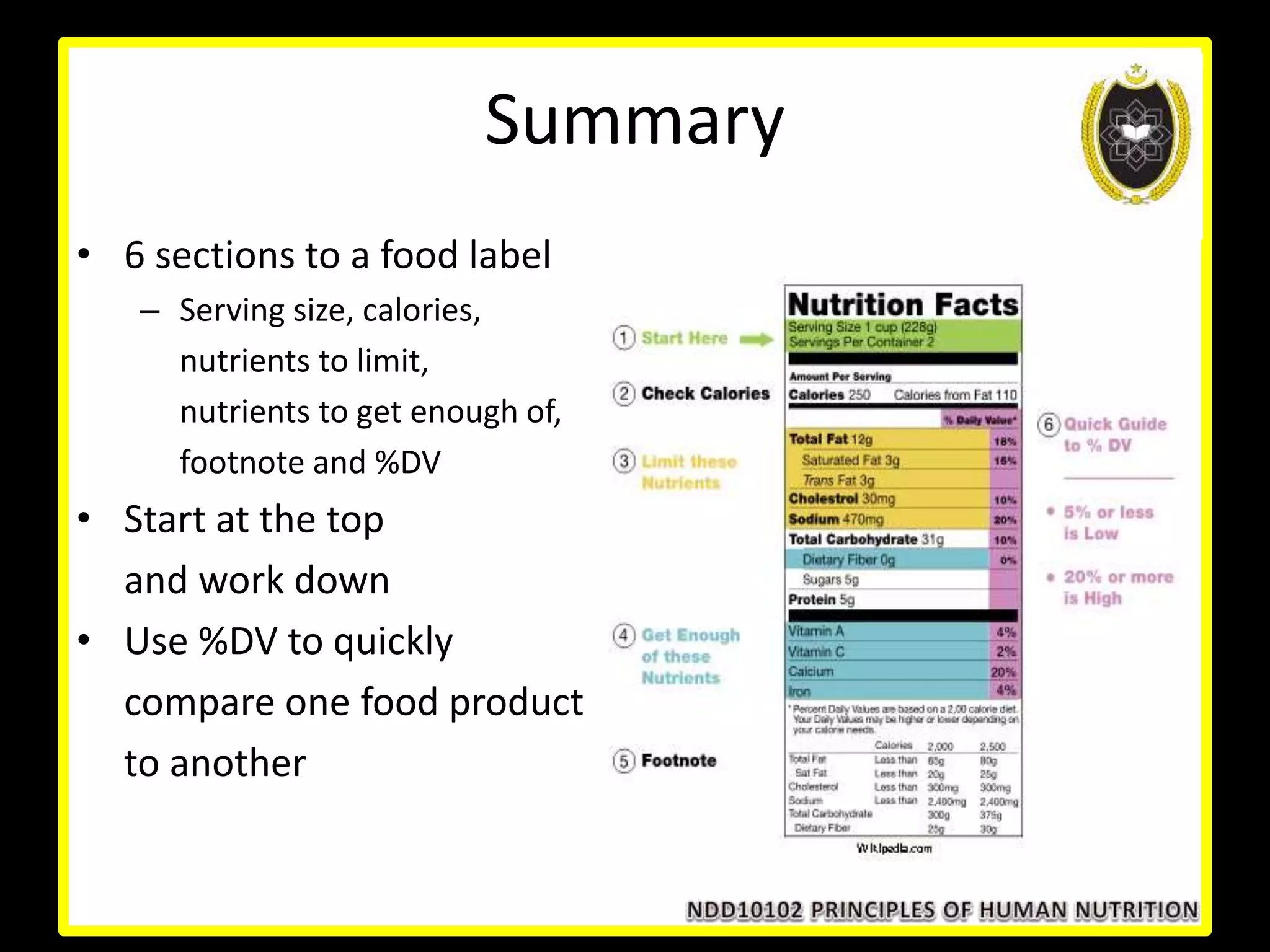
Sections of a Food Label
 1. Serving Size – at the top
 Green color
 2. Calories- below serving size
 White color at the top
 3. and 4. Nutrients
 Yellow and Blue color
 5. Footnote
 White color at the bottom
 6. % Daily Value
 On the far right
 Purple color
US Food and Drug Admin
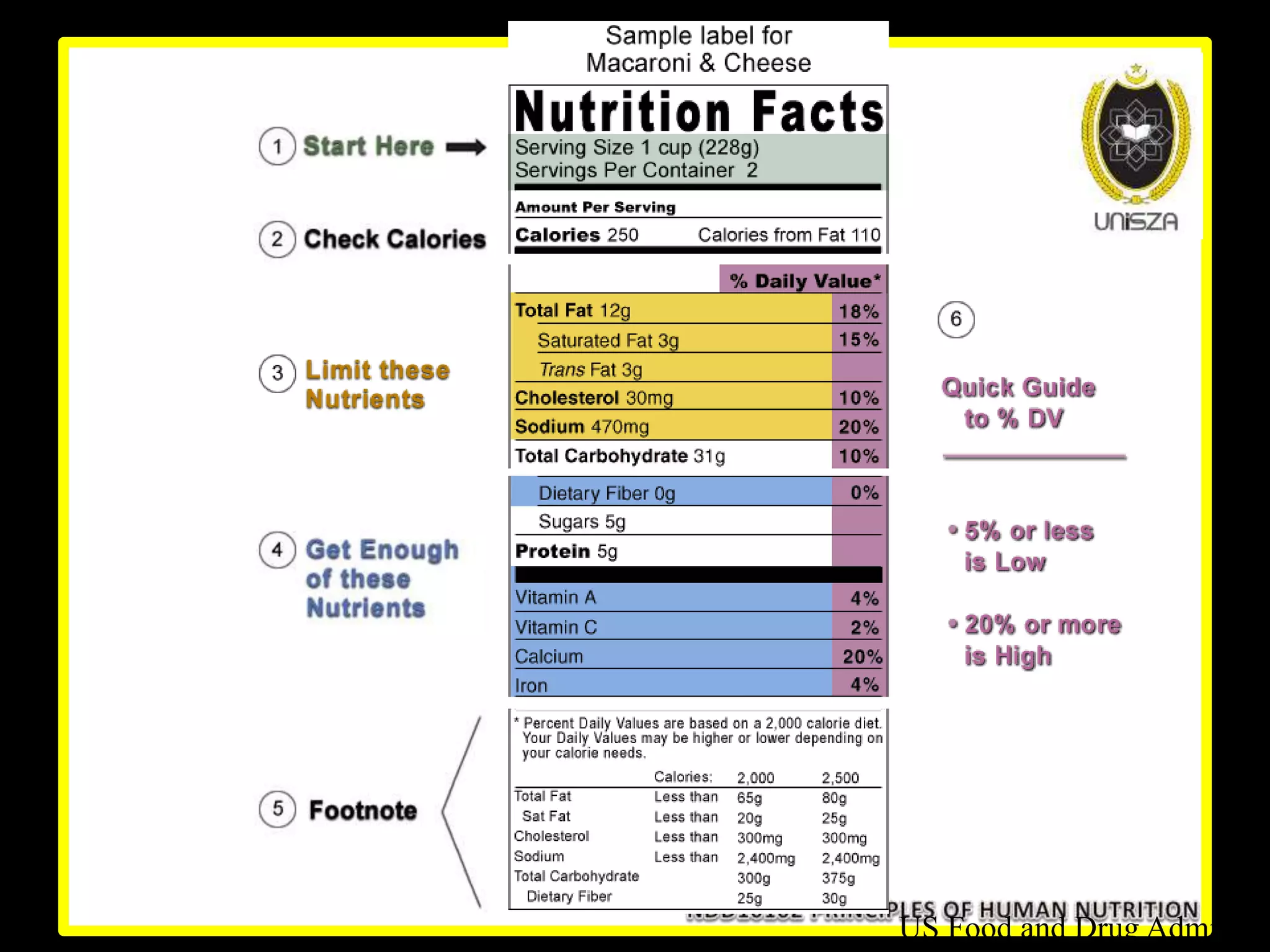
Serving Size
• How much is the serving size?
– Standard
– Compare similar foods
– Familiar units
• Cups, pieces, tablespoons
– How much actually consumed
• Servings per container
– Multiply if consuming more than one serving
– Total amount of calories and nutrients
US Food and Drug Admin
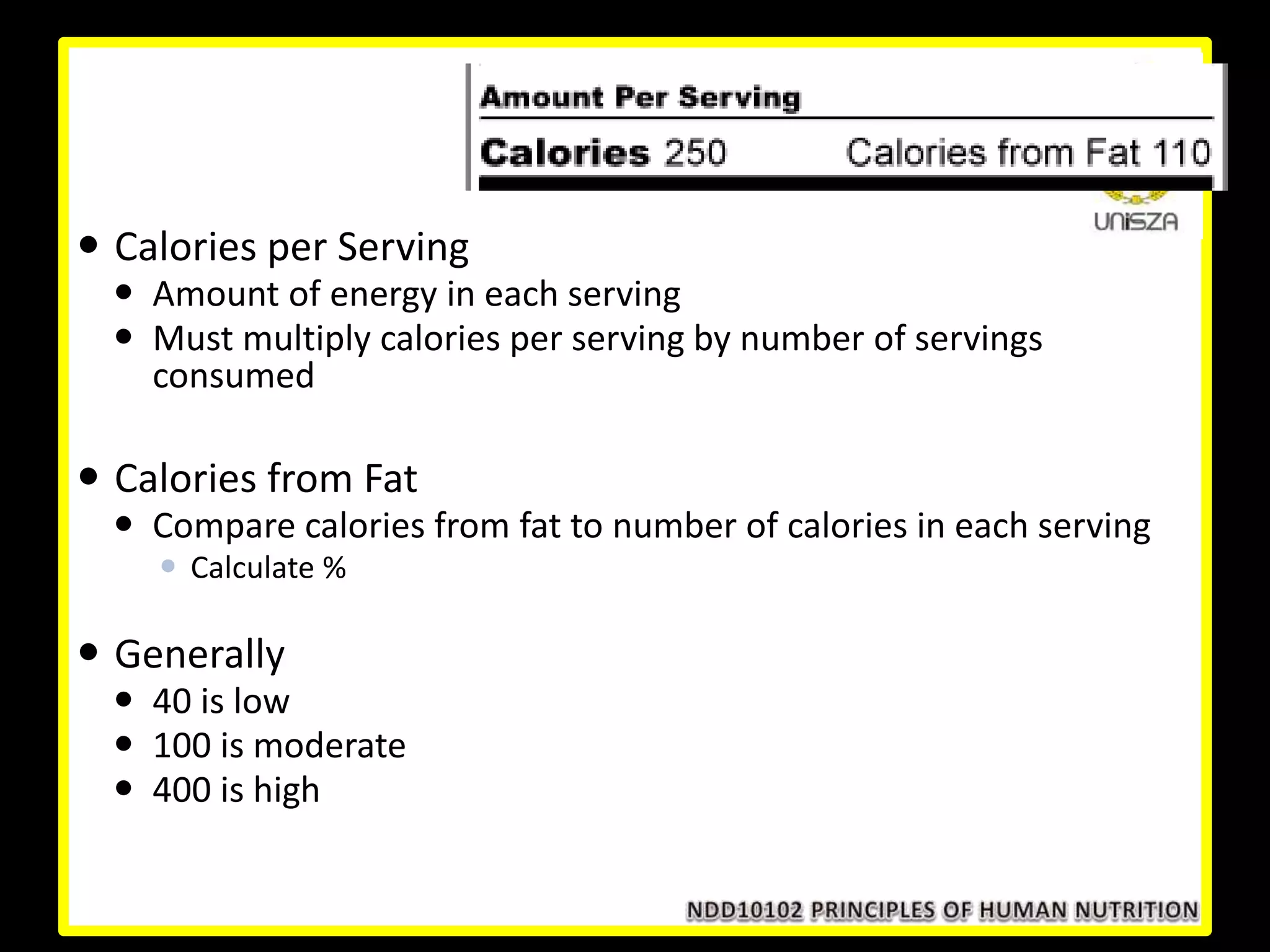
Calories
 Calories per Serving
 Amount of energy in each serving
 Must multiply calories per serving by number of servings
consumed
 Calories from Fat
 Compare calories from fat to number of calories in each serving
 Calculate %
 Generally
 40 is low
 100 is moderate
 400 is high
US Food and Drug Admin
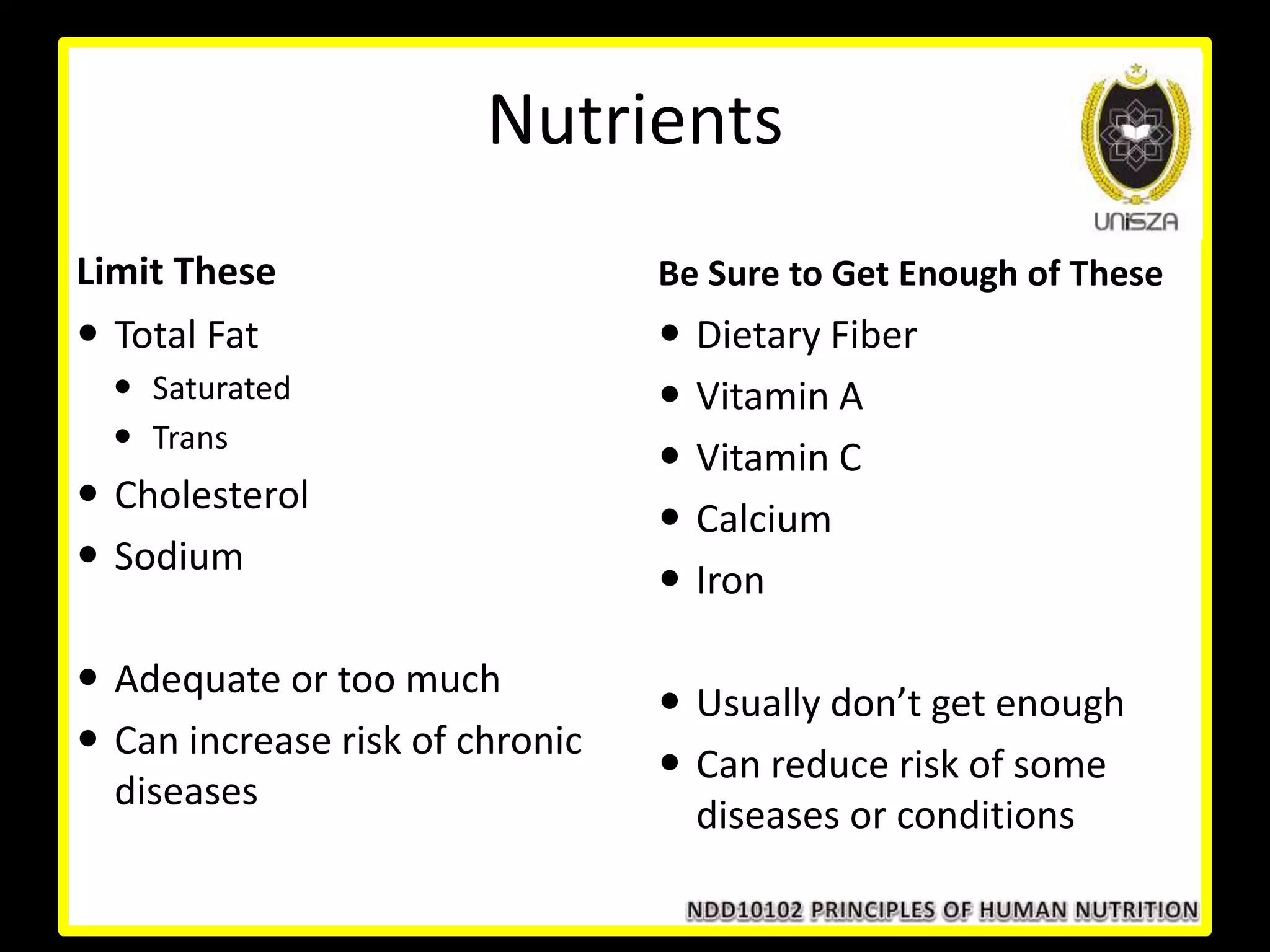
Nutrients
Limit These Be Sure to Get Enough of These
 Total Fat
 Saturated
 Trans
 Cholesterol
 Sodium
 Adequate or too much
 Can increase risk of chronic
diseases
 Dietary Fiber
 Vitamin A
 Vitamin C
 Calcium
 Iron
 Usually don’t get enough
 Can reduce risk of some
diseases or conditions
Footnote
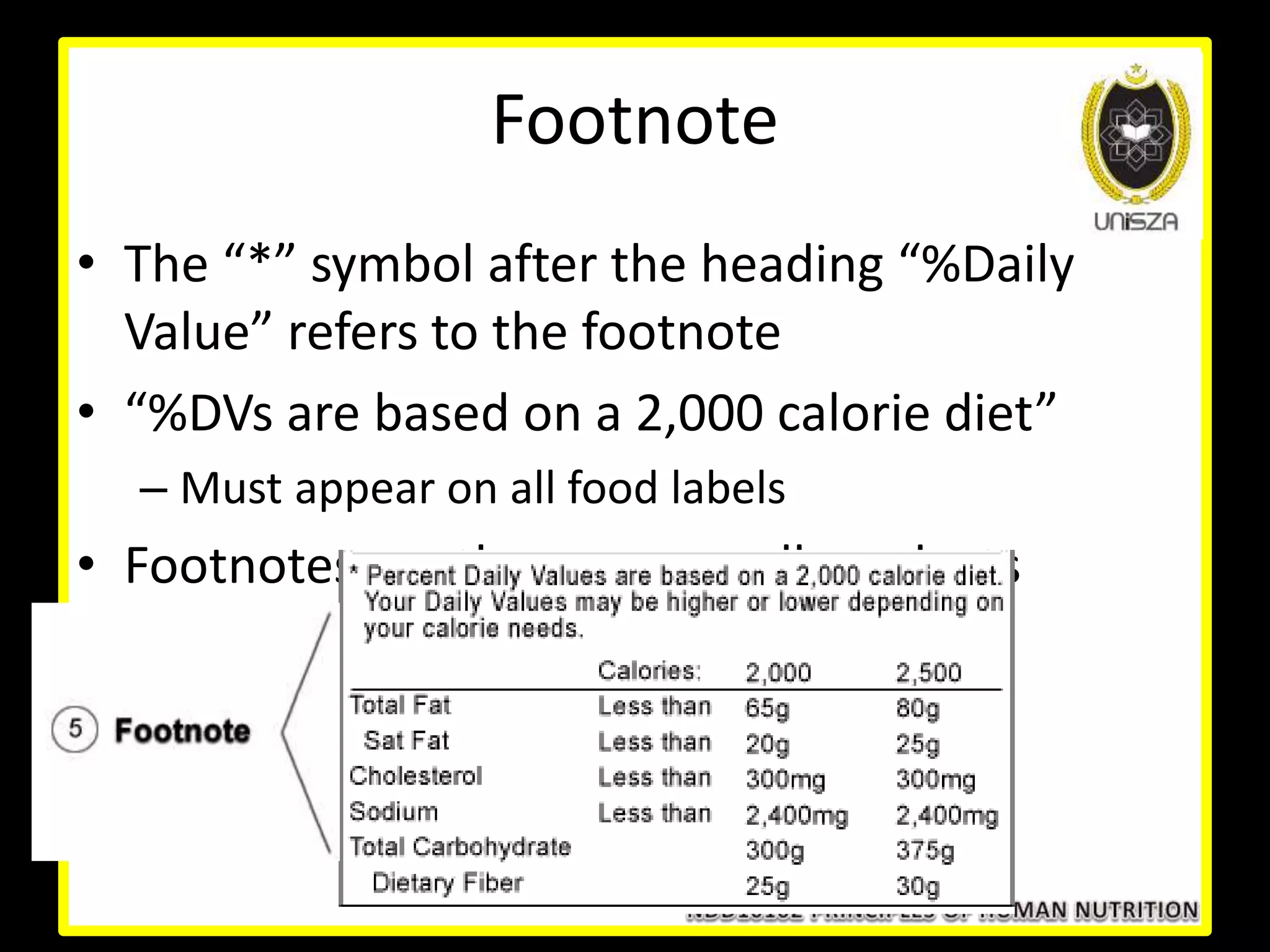
• The “*” symbol after the heading “%Daily
Value” refers to the footnote
• “%DVs are based on a 2,000 calorie diet”
– Must appear on all food labels
• Footnotes are the same on all products
Percent Daily Value
• %DV
– On right hand side of every food label
– Based on 2,000 calorie diet
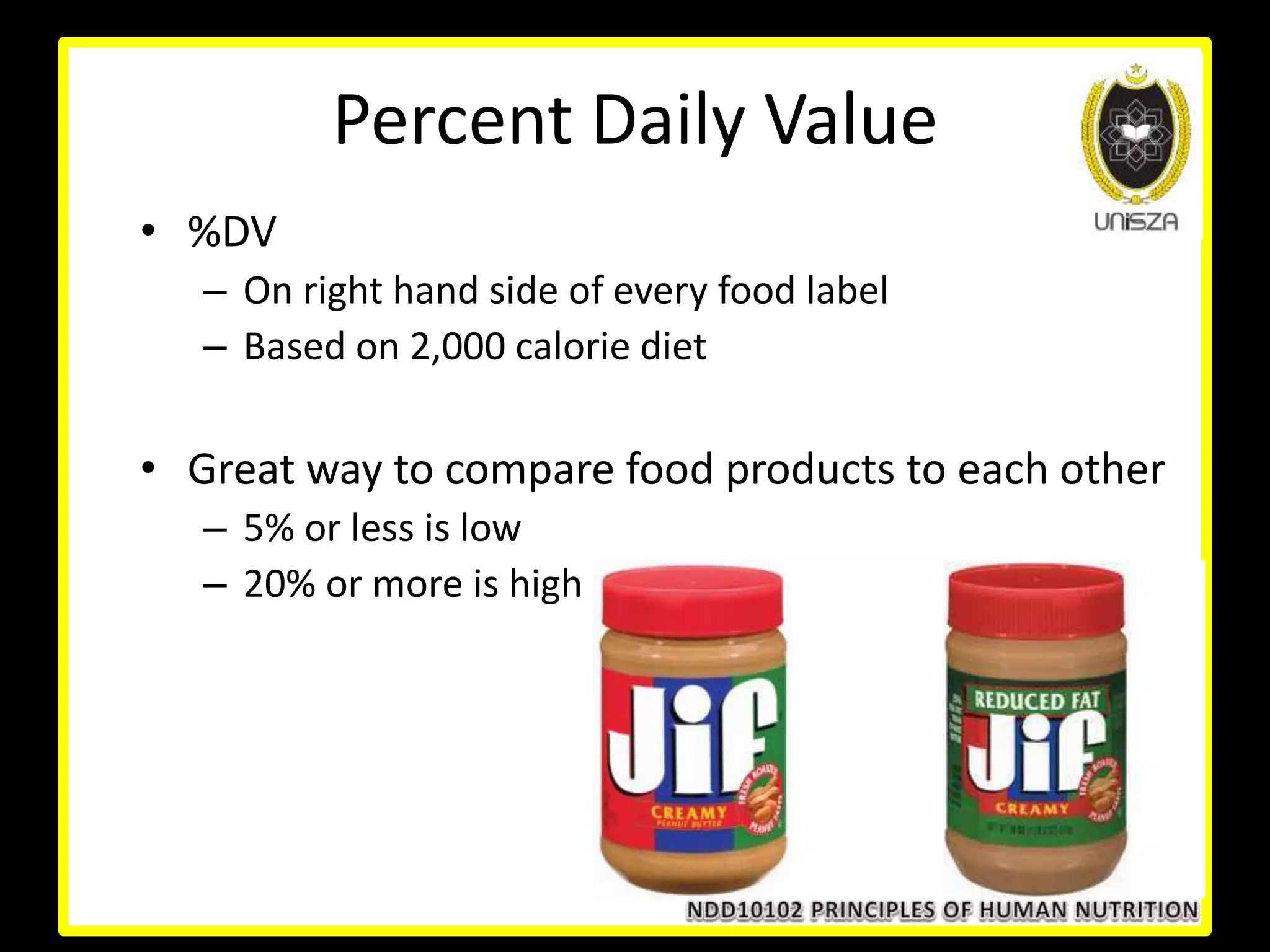
• Great way to compare food products to each other
– 5% or less is low
– 20% or more is high
Summary
• 6 sections to a food label
– Serving size, calories,
nutrients to limit,
nutrients to get enough of,
footnote and %DV
• Start at the top
and work down
• Use %DV to quickly
compare one food product
to another
IV. The Dietary Guidelines for
Malaysians
4. MALAYSIAN DIETARY
GUIDELINES
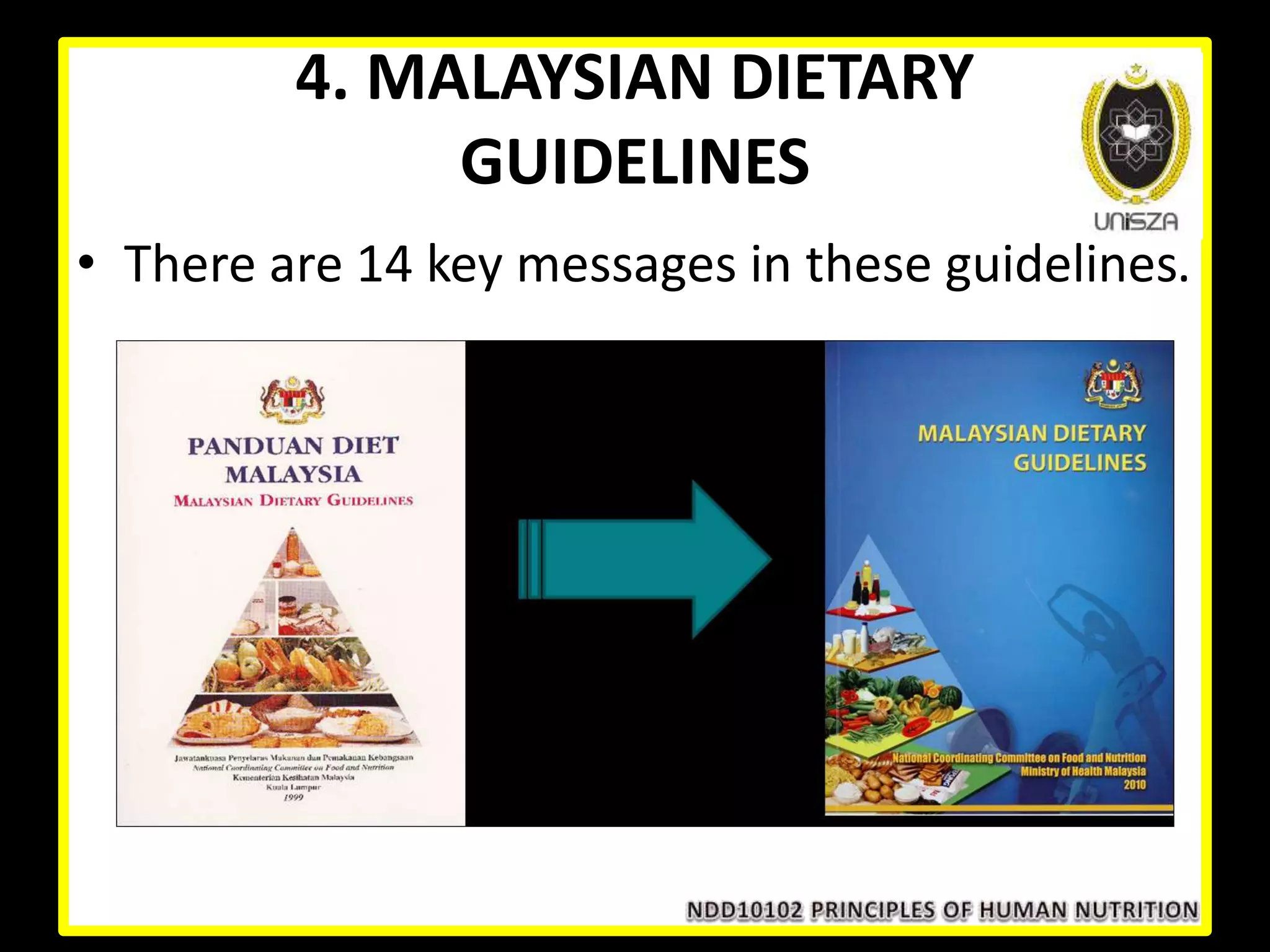
• There are 14 key messages in these guidelines.
MDG 2010
• Key Message 1: Eat a variety of foods within
your recommended intake.
– Key Recommendations
1. Choose your daily food intake from a combination of foods
based on the Malaysian Food Pyramid
2. Choose your daily food intake according to the serving size
recommended
– Additional recommendations: nutrient supplements
• Supplements are not necessary for most individuals.
Supplements of vitamins, minerals or fiber do not supply
the nutrients and other essential components present in
foods that are important to health
• Key Message 2: Maintain body weight in a
healthy range.
– Key Recommendations
1. Maintain body weight in the healthy range by
balancing calorie intake with physical activity
2. Weigh yourself regularly, at least once a week
3. If you are an adult, prevent gradual weight gain over
time
4. If overweight, aim for a slow and steady weight loss
5. If underweight, increase energy intake as
recommended
MDG 2010
• Key Message 3: Be active physically every
day.
– Key Recommendations
1. Be active everyday in as many ways you can
2. Accumulate at least 30 minutes of moderate intensity
physical activity on at least 5 to 6 days a week,
preferably daily
3. Participate in activities that increase flexibility,
strength and endurance of the muscles, ad frequent
as 2-3 times a week
4. Limit physical inactivity and sedentary habits
MDG 2010
• Key Message 4: Eat adequate amount of rice,
other cereal products (preferably whole
grain) and tubers.
– Key Recommendations
1. Consume at least 4 servings of cereals foods daily
2. Choose at least half of your grain products from
whole grains
3. Choose cereal products that are high in fiber, low in
fat, sugar and salt
MDG 2010
• Key Message 5: Eat plenty of fruits and
vegetables every day.
– Key Recommendations
1. Eat a variety fruits everyday
2. Eat a variety vegetables everyday
3. Eat at least 5 servings of fruits and vegetables
everyday
MDG 2010
• Key Message 6: Consume moderate amounts of
fish, meat, poultry, eggs, legumes and nuts.
– Key Recommendations
1. Consume fish more frequently , if possible daily
2. Consume meat, poultry and egg moderately
3. Practice healthier cooking methods for fish, meat, poultry
and egg dishes
4. Choose meat and poultry that are low in fat and
cholesterol
5. Consume legumes daily
6. Include nuts and seeds in weekly diet
MDG 2010
• Key Message 7: Consume adequate amounts
of milk and milk products.
– Key Recommendations
1. Consume milk and milk products everyday
2. Replace sweetened condensed milk and sweetened
condensed filled milk with unsweetened liquid or
powdered milk
MDG 2010
• Key Message 8: Limit intake of foods high in fats
and minimize fats and oils in food preparation.
– Key Recommendations:
1. Limit the intake of UFA to less than 10%of total daily
calorie intake
2. Increase the intake of MUFA and PUFA
3. Limit the intake of foods high in cholesterol
4. Limit foods containing TFA
5. Minimize the use of fat in food preparation in order to
keep total daily fat intake between 20% to 30% energy
6. When eating out, choose low-fat foods
MDG 2010
• Key Message 9: Choose and prepare foods
with less salt and sauces
– Key Recommendations
1. Limit salt intake to 1 tsp a day
2. Reduce consumption of highly salted foods and
condiments
MDG 2010
• Key Message 10: Consume foods and
beverages low in sugar
– Key Recommendations
1. Eat foods low in sugar
2. Drink beverages low in sugar
MDG 2010
• Key Message 11: Drink plenty of water daily.
– Key Recommendations:
1. Drink 6-8 glasses of plain water daily
2. Maintain fluid intake from other food sources
3. Avoid alcoholic beverages
MDG 2010
• Key Message 12: Practice exclusive breastfeeding
from birth until 6 months and continue to breastfeed
until two years of age
– Key recommendations
1. Prepare for breastfeeding during pregnancy
2. Initiate breastfeeding within one hour of birth
3. Breastfeed frequently and on demand
4. Give only breast milk to baby below six months with no
additional food or food
5. Continue to give babies breast milk even if the baby is not with
the mother
6. Introduce complementary foods to baby beginning at 6 months
of age
7. Lactating mothers should get plenty of rest, adequate food and
drink to maintain health
8. Husband and family members should provide full support to
lactating mothers.
MDG 2010
• Key Message 13: Consume safe and clean
foods and beverages
– Key Recommendations
1. Choose safe and clean foods and beverages
2. Store foods appropriately
3. Prepare foods hygienically
4. Cook foods thoroughly
5. Hold foods appropriately
6. When eating out, choose safe and clean premises
MDG 2010
• Key Message 14: Make effective use of
nutrition information on food labels.
– Key Recommendations
1. Use Nutrition Information Panel (NIP) as a guide in
making food choices
2. Make use of nutrition claims wisely
3. Educate children on the use of NIP
MDG 2010
MDG for children and
adolescents
• Key Message 1: Practice exclusive breastfeeding from
birth until 6 months and continue to breastfeed until 2
years of age
– Key Recommendations
1. Be mentally prepared during pregnancy for exclusive breastfeeding
2. Start breastfeeding within one hour of birth
3. Breastfeed frequently and on demand.
4. Breastfeed with correct techniques.
5. Avoid giving liquids or food other than breast milk to breastfed
babies below 6 months.
6. Continue to give breast milk even when mother returns to work.
7. Get enough rest, nutritious food and drinks to maintain health while
breastfeeding.
8. Obtain full support to breastfeed from husband, family members
and community.
9. Use cup feeding as an alternative to breastfeeding.
• Key Message 2: Give appropriate complementary
foods to children between the age of 6 months to 2
years
– Key Recommendations
1. Start baby on complementary food from 6 months of age.
2. Feed children with enough food to meet their energy needs.
3. Increase the feeding frequency of complementary foods
according to age.
4. Change food texture and preparation methods gradually as the
baby gets older.
5. Give a variety of food and gradually increase the quantity to
ensure that all nutrient needs are met.
6. Consider your child’s stage of development and ability when
feeding.
7. Give sick children extra fluids and offer small but frequent
meals.
• Key Message 3: Eat a variety of foods within
your recommended intake
– Key Recommendations
1. Choose and ensure that the daily diet consists of
foods based on the Malaysian Food Pyramid.
2. Choose and ensure the number of servings consumed
are based on caloric needs.
• Key Message 4: Attain healthy weight for optimum
growth
– Key recommendations
1. Monitor the growth of children and adolescents using
appropriate growth standards or charts to ensure healthy
growth.
2. Children and adolescents should consume adequate amount of
calories and nutrients needed for healthy growth.
3. For children and adolescents who are overweight or obese,
reduce weight gradually by adopting a healthy diet and increase
physical activity.
4. If the child is underweight or having growth failure, increase
calorie intake as recommended.
5. Instill a healthy body image in children and adolescents.
• Key Message 5: Be physically active everyday
– Key Recommendations
1. Be physically active everyday in as many ways as you
can.
2. Accumulate at least 60 minutes of moderate-intensity
physical activity daily.
3. Participate at least 3 times a week, in activities that
increase muscle and bone strength.
4. Limit physical inactivity and sedentary habits.
• Key Message 6: Eat adequate amount of rice,
cereals or tubers
– Key recommendations
1. Ensure an adequate intake of cereals and cereal
based foods according to age.
2. Ensure that at least half of daily cereal intake includes
whole grain.
3. Prepare and choose healthier tubers and cereal
products.
• Key Message 7: Eat fruit and vegetables
everyday
– Key recommendations
1. Eat a variety of fruits and vegetables everyday.
2. Eat adequate amount of fruits and vegetables
everyday.
• Key Message 8: Consume moderate amounts
of fish, meat, poultry, egg, legumes and nuts
– Key recommendations
1. Eat fish daily.
2. Consume meat, poultry and egg moderately.
3. Practice healthier cooking methods for fish, meat,
poultry and egg dishes.
4. Choose meat and poultry that are low in fat and
cholesterol.
5. Consume legumes daily.
6. Include nuts and seeds in weekly diet.
• Key Message 9: Consume milk and milk
products everyday
– Key recommendations
1. Consume 2 to 3 servings of milk and milk products
everyday.
2. Use milk and milk products creatively.
3. Choose milk and milk products appropriate to
physiological needs.
4. Encourage milk consumption through education and
promotion.
• Key Message 10: Include appropriate
amounts and types of fats in the diets
– Key recommendations
1. Limit total daily fat intake to 25 and 30% of energy.
2. Limit the intake of saturated fats (SFA).
3. Increase the intake of polyunsaturated fatty acids
(PUFA).
4. Limit foods containing trans fatty acids (TFAs).
5. Choose low-fat foods when eating out.
• Key Message 11: Limit intake of salt and
sauce
– Key recommendations
1. Choose and prepare foods with less salt and sauces
2. Instil preference for low-salt foods.
• Key Message 12: Consume foods and
beverages low in sugar
– Key recommendations:
1. Eat foods low in sugars.
2. Drink beverages low in sugars.
3. Instil a preference for less sweet taste.
4. Choose sugar-free or less sugary products.
• Key Message 13: Drink plenty of water daily
– Key recommendations
1. Drink an adequate amount of plain water daily.
2. Avoid alcoholic beverages.
• Key Message 14:Consume safe and clean foods
and beverages
– Key recommendations
1. Keep clean.
2. Prepare food hygienically.
3. Cook food thoroughly.
4. Keep food appropriately.
5. Use safe water and safe raw materials.
6. Read the product label.
7. Choose clean and safe foods.
8. Use safe foods containers.
9. Choose clean and safe premises to eat.
• Key Message 15: Educate children on the use of
nutrition information on food labels
– Key recommendations
1. Educate children on the nutrition information found on
food labels.
2. Create various opportunities to educate children about the
nutrition information on food labels.
3. Explain the components in the Nutrition Information Panel
(NIP) for older children.
4. Explain the meaning of ‘Nutrient Content Claim’ and
‘Nutrient Comparative Claim’.
5. Make nutrition labeling education as part of school
activities.
Thank you for listening…

Lecture 3 Dietary requirements and guidelines

  • 1.
    Lecture 3:Dietary Requirements AndGuidelines DR. SHARIFAH WAJIHAH WAFA sharifahwajihah@unisza.edu.my
  • 2.
    Topic Learning Outcomes Definethe Dietary Reference Intakes (DRIs) Present four (4) levels that represent five (5) food group in Malaysian Food Guide Pyramid Read and understand a nutrition facts label. Present the 14 key Messages of Malaysian Dietary Guidelines and 15 Key Messages Malaysian Dietary Guidelines for Children and Adolescents 1 2 3 4
  • 3.
    Course Outline Dietary referenceintakes: Defining Nutrient Needs The Food Guide Pyramid: A tool for Diet Planning Food Labels: Knowing What you Choose The Dietary Guidelines for Malaysians
  • 4.
    I. Dietary referenceintakes: Defining Nutrient Needs
  • 5.
    What are DRIs? •Standards to guide safe & adequate intakes of essential nutrients for healthy humans. – Sick individuals have different needs. • Designed to promote optimal function & health for healthy people. • Are specific for groups of people based on: life stage, gender, conditions of pregnancy & lactation. • Are adequate for moderately active people. • developed by the Institute of Medicine of The National Academies.
  • 6.
    Malaysia RNI • 20September 2002: First meeting of the TWG with three Sub-committees – Technical Sub-committee for Energy and Macronutrients, – Technical Sub-committee on Vitamins, and – Technical Sub-committee on Minerals. – The • The Sub-Committees were guided by several recent publications as a key source of reference namely, FAO (2004) for energy requirements, FAO/WHO (2002) and IOM-FNB (1997-2002) reports for vitamin and mineral requirements.
  • 7.
    Components of theDRIs • Four values instead of one • These are: – EAR: Estimated Average Requirement – RDA: Recommended Dietary Allowance – AI: Adequate Intake – UL: Tolerable Upper Intake Level • How derived? How Interpreted?
  • 8.
    How are DRIsestablished? • By scientific committee literature review. • Nutrients are given an Recommended Dietary Allowance (RDA), Adequate Intake (AI), or Estimated Average Requirement (EAR) value by life stage & gender. RDA: level to meet 97-98% of needs AI: average or mean intake level. EAR: average daily nutrient intake level estimated to meet the requirement of half the needs.
  • 9.
    Other DRI Components •Tolerable upper intake levels (UL) for vitamins & minerals. – Highest intake level likely to pose no risk of adverse health effects. • Acceptable Macronutrient Distribution Ranges (AMDR) for energy producing nutrients & essential fatty acids. – % Calorie range. • Estimated Energy Requirement (EER) for Calories. • DRI for physical activity.
  • 10.
    ESTIMATED AVERAGE REQUIREMENT (EAR) •represents a nutrient intake that is estimated to meet the requirement of half the healthy individuals in a population • A value that is useful for evaluating the adequacy of, and planning for, the nutrient intake • The prevalence of inadequate nutrient intakes can be estimated by looking at the population with intake below the EAR
  • 11.
    RECOMMENDED DIETARY ALLOWANCE (RDA) •The RDA represents the average daily dietary intake that is sufficient to meet the nutrient requirement of nearly all (97%-98%) healthy individuals in a population. • The RDA is to be used as a guide for the individual • RDA is ONLY a target • Intake less than the RDA does not necessarily indicate that the need of that particular individual have not been met. • However, the risk of deficiency is low if intake meets the RDA.
  • 12.
    ADEQUATE INTAKES (AIs) •AIs are estimates used when there is insufficient scientific evidence to set an EAR and calculate an RDA • It is based on observed or experimentally determined approximation of the average nutrient intake by a healthy population • When an AI value rather than an RDA is set, it targets the need for more research on the requirement of that nutrient • Can be used as a goal for individual intake
  • 13.
    TOLERABLE UPPER INTAKE LEVEL(UL) • The UL is the highest level of daily nutrient intake that is likely to pose no risks of adverse health effects to most individuals in the general population. • Consider it a maximum for daily intake of a specific nutrient on a long-term basis. • Used as a guide for limiting intake when planning diets and evaluating the possibility of over- consumption
  • 14.
    Tolerable Upper Intake Levels:ULs • For vitamins with DRIs • For minerals with DRIs • For arsenic, boron, nickel, silicon, vanadium
  • 15.
    Interpreting the DRI •Used to assess adequacy of dietary intake • Designed to ensure adequate nutrition for most people in a population • Does not inform us of what specific foods to eat • Note: Another term, the Daily Value (DV) is used on food labels, discussed later.
  • 16.
    Applications of theDRI • Provide a set of standards that can be used to – plan diets – Assess the adequacy of diets – Make judgments about excessive intakes for individuals and populations • Example: they can be used as a standard for meals prepared for – Schools – Hospitals – health-care facilities – gov feeding program for the elderly – space-shuttle astronauts
  • 17.
    Cont’d.. • Can beused to – determine standards for food labeling – develop practical tools for diet planning such as Food Guide Pyramid – Interpret information gathered about the food consumed by a population to help identify potential nutritional inadequacies that may be of public health concern
  • 18.
    DRIs Exist For: • Vitamins: –A, D, E, K, B1 (thiamin), B2 (riboflavin), B3 (niacin), B6, B12, folate, vitamin C – biotin, pantothenic acid, choline • Minerals: – Ca, P, Mg, Fe, Zn, I, Se – Cu, Mn, Cr, Mo, F – Na, K, Cl • Water: – Men ≥19 years: 3.7 L/day (approx. 15 cups) – Women ≥ 19 years : 2.7 L/day (approx. 11 cups)
  • 19.
    DRI for Protein •The adult DRI for protein is set at 0.8 grams/Kg. This level is for inactive persons. • See appendix for gram/Kg need for infants, children, and adolescents. • Although not DRIs: Active persons need more than the DRI, approximately 1.2 - 1.6 grams/Kg. Endurance athletes need more than the DRI, approximately 1.8- 2.0 grams/Kg.
  • 20.
    DRI for Carbohydrate, Fiber& Fat • Carbohydrate: At least 130 gm/day for adults • Fiber:  38 gm/d  25 gm/d, [adults] • 1.4 gm/100 Calories consumed • FAT: not determined for adults • Essential Fatty Acids: • Linoleic Acid: 17 12 [adults, gm/d ] • Alpha-Linolenic Acid: 1.6 1.1 [adults, gm/d ]
  • 21.
    DRI for Exercise • Thereis a DRI for exercise! • It is 60 minutes cumulative moderate exercise per day. • That means moving body parts and sweating while you are doing it.
  • 22.
  • 23.
    Na, K, Cl& Water • In 2004 the DRI was published for Water and the Electrolytes (Na, Cl, and K) • Sodium (Na): 1.5 gm if 19-50 years Sodium • Chloride (NaCl): 19-50 years 3.8 gm (3.8 gm NaCl – 1.5 gm Na = 2.3 gm/day of Cl) • Potassium (K): 4.7 gm/day if >18 • Water: 2.7 L/day if 3.7 L/day if
  • 24.
    DRIs Do NotExist For: • Cholesterol • Sulfur (sulfate) • Cobalt • Non-essential, nutritional supplements
  • 25.
    Recap.. • DRIs area collection of values to express a persons nutrient need based on their life stage & gender. • The exact DRI value may be as an RDA, AI, EAR depending on scientific information available for each nutrient. • DRIs are expressed as ULs and AMDRs. • For Calories the DRI is called the EER. • There is DRI recommendation for Physical activity. • The DRIs are standards that have many important purposes and uses. References for this presentation are the same as those for this topic found in module 2 of the textbook
  • 26.
    II. The FoodGuide Pyramid: A tool for Diet Planning
  • 27.
    2. THE FOODGUIDE PYRAMID: A TOOL FOR DIET PLANNING • Malaysian Food Pyramid is a simple guide for individuals to vary their foods intake according to the total daily food serving recommended. • A balanced diet contains the combination of foods that will provide all the nutrients needed by our body. • The body needs many types of food in varying amounts to maintain health. • A food pyramid consists of four (4) levels that represent five (5) food group. Indicated beside each food group is the recommended number of servings per day from each group. • From the bottom to the top of the food pyramid, the size of each food group becomes smaller indicating that an individual should eat more of the foods at the base of the pyramid and less of the foods at the top of the pyramid.
  • 29.
    Food Groups andLevel Level 1 : Rice, noodles, bread, cereal, cereal products and tubers •Eat 4 to 8 serving in a day. •Example of one serving of grains : • 1 cup (2 scoops) of cooked rice • 1 cup of yellow mee • 1 ½ cup of bihun and laksa (soaked) • 1 cup of breakfast cereals • 6 pieces biscuit (cream crackers) • ½ slice of capati • 2 slices of bread • 2 cup of plain rice porridge • 2 whole of potato
  • 30.
    Cont’d.. Level 2 : Fruitsand vegetables •Eat at least three (3) servings of vegetables and at least two (2) serving of fruits a day •Example of one serving of vegetables : • ½ cup of dark green leafy vegetable , cooked • ½ cup of fruit vegetables , cooked • 1 cup of ulam, raw. •Example of one serving of fruits : • 1 whole of apple / pear / orange / mango • 1 slice of papaya / watermelon / pineapple • ½ whole of guava • 2 whole small bananas (pisang emas) • 1 whole medium banana (pisang berangan) • 8 whole small of grapes.
  • 31.
    Level 3 : Fish,poultry, meat and legumes •Recommended daily serving : • ½ - 2 servings of poultry, meat, egg • 1 serving of fish • ½ - 1 serving legumes •Example of one serving of fish, poultry, meat and eggs : • 1 medium ikan kembung • 2 pieces ikan tenggiri • 2 pieces of lean meat • 1 medium-sized chicken drumstick • 2/3 cup of anchovies without head • 2 whole eggs •Example of one serving of legumes : • 1 cup of chickpea / dhal • 1 ½ cups canned baked bean • 2 pieces of tempe / tauku / tauhu • 1 ½ glasses of unsweetened soya bean milk. Cont’d..
  • 32.
    Level 3 : Milkand dairy products •Consume 1-2 servings a day. •Example of one serving of dairy : • 1 glass of milk (250 ml) • 1 slice of cheese • 1 cup yogurt • 4 dessert spoons of milk powdered, heaped. Level 4 : Fats, oils, sugar and salt •Located on the crest or top of the pyramid shows these foods should be taken in small amounts only. •Excessive intake of fats, oil, sugar and salt can contribute to higher risk of chronic disease such obesity, diabetes mellitus, cardiovascular diseases, hypertension and cancers. •Limit intake of foods high in fats, oil, sugar and salt and minimize the use of fats, oil, sugar and salt in food preparation. Cont’d..
  • 33.
    Number of servingsrecommended based on calorie needed Food group 1500 kcal/day 1 2000 kcal/day 2 2500 kcal/day 3 Cereals and grains 4 servings 6 servings 8 servings Fruits 2 servings 2 servings 2 servings Vegetables 3 servings 3 servings 3 servings Meat/poultry Fish Legumes ½ serving 1 serving ½ serving 1 serving 1 serving 1 serving 2 servings 1 serving 1 serving Milk and dairy products 1 serving 2 servings 3 servings 1 Suitable for sedentary women and older adult. 2 Suitable for children, teenage girls, moderately active women and sedentary men. 3 Suitable for teenage boys, active men, very active women and underweight men and women.
  • 34.
    Cont’d.. • Choosing forbalance and variety – When planning a diet, it must • Meet nutrient needs • Consider the nutrient density • Be variety • Be balance
  • 35.
    What is theconcept of nutrient density? • Foods that contain a significant amount of a specific nutrient compared to its caloric content have a high nutrient density. • Opposite of “empty calorie” • i.e : both skim milk and ice cream in a same group. However, a 1 cup serving of skim milk provides 300mg of calcium in 90 kcal whereas a cup of ice- cream provides 168 mg of calcium in 265 kcal. Thus, skim milk have higher nutrient density because it provides more nutrients per kcal than the ice-cream
  • 36.
    III. Food Labels:Knowing What you Choose
  • 37.
    FOOD LABELS: KNOWINGWHAT YOU CHOOSE • Another tool that can be used in diet planning • Designed to help consumers make healthy food choices by providing information about : – the nutrient composition of foods – How a food fits into the overall diet
  • 38.
    Consumer Nutrition: FoodLabels and Health Claims What nutrition information do food labels provide? • Nutrition Facts
  • 39.
    How can Iuse this information to select a healthier diet? • The Daily Value (DV) – A nutrient reference value used on food labels to help consumers see how foods fit into their overall diet – Based on some of the DRI values – Those listed based on 2,000 Calorie intake (Adult female) • The % of the DV on the label is for a 2,000 Calorie intake – Some information for 2,500 Calorie intake (Adult male)
  • 42.
    Sections of aFood Label  1. Serving Size – at the top  Green color  2. Calories- below serving size  White color at the top  3. and 4. Nutrients  Yellow and Blue color  5. Footnote  White color at the bottom  6. % Daily Value  On the far right  Purple color
  • 43.
    US Food andDrug Admin
  • 44.
    Serving Size • Howmuch is the serving size? – Standard – Compare similar foods – Familiar units • Cups, pieces, tablespoons – How much actually consumed • Servings per container – Multiply if consuming more than one serving – Total amount of calories and nutrients
  • 45.
    US Food andDrug Admin
  • 46.
    Calories  Calories perServing  Amount of energy in each serving  Must multiply calories per serving by number of servings consumed  Calories from Fat  Compare calories from fat to number of calories in each serving  Calculate %  Generally  40 is low  100 is moderate  400 is high
  • 47.
    US Food andDrug Admin
  • 48.
    Nutrients Limit These BeSure to Get Enough of These  Total Fat  Saturated  Trans  Cholesterol  Sodium  Adequate or too much  Can increase risk of chronic diseases  Dietary Fiber  Vitamin A  Vitamin C  Calcium  Iron  Usually don’t get enough  Can reduce risk of some diseases or conditions
  • 50.
    Footnote • The “*”symbol after the heading “%Daily Value” refers to the footnote • “%DVs are based on a 2,000 calorie diet” – Must appear on all food labels • Footnotes are the same on all products
  • 52.
    Percent Daily Value •%DV – On right hand side of every food label – Based on 2,000 calorie diet • Great way to compare food products to each other – 5% or less is low – 20% or more is high
  • 54.
    Summary • 6 sectionsto a food label – Serving size, calories, nutrients to limit, nutrients to get enough of, footnote and %DV • Start at the top and work down • Use %DV to quickly compare one food product to another
  • 55.
    IV. The DietaryGuidelines for Malaysians
  • 56.
    4. MALAYSIAN DIETARY GUIDELINES •There are 14 key messages in these guidelines.
  • 57.
    MDG 2010 • KeyMessage 1: Eat a variety of foods within your recommended intake. – Key Recommendations 1. Choose your daily food intake from a combination of foods based on the Malaysian Food Pyramid 2. Choose your daily food intake according to the serving size recommended – Additional recommendations: nutrient supplements • Supplements are not necessary for most individuals. Supplements of vitamins, minerals or fiber do not supply the nutrients and other essential components present in foods that are important to health
  • 58.
    • Key Message2: Maintain body weight in a healthy range. – Key Recommendations 1. Maintain body weight in the healthy range by balancing calorie intake with physical activity 2. Weigh yourself regularly, at least once a week 3. If you are an adult, prevent gradual weight gain over time 4. If overweight, aim for a slow and steady weight loss 5. If underweight, increase energy intake as recommended MDG 2010
  • 59.
    • Key Message3: Be active physically every day. – Key Recommendations 1. Be active everyday in as many ways you can 2. Accumulate at least 30 minutes of moderate intensity physical activity on at least 5 to 6 days a week, preferably daily 3. Participate in activities that increase flexibility, strength and endurance of the muscles, ad frequent as 2-3 times a week 4. Limit physical inactivity and sedentary habits MDG 2010
  • 60.
    • Key Message4: Eat adequate amount of rice, other cereal products (preferably whole grain) and tubers. – Key Recommendations 1. Consume at least 4 servings of cereals foods daily 2. Choose at least half of your grain products from whole grains 3. Choose cereal products that are high in fiber, low in fat, sugar and salt MDG 2010
  • 61.
    • Key Message5: Eat plenty of fruits and vegetables every day. – Key Recommendations 1. Eat a variety fruits everyday 2. Eat a variety vegetables everyday 3. Eat at least 5 servings of fruits and vegetables everyday MDG 2010
  • 62.
    • Key Message6: Consume moderate amounts of fish, meat, poultry, eggs, legumes and nuts. – Key Recommendations 1. Consume fish more frequently , if possible daily 2. Consume meat, poultry and egg moderately 3. Practice healthier cooking methods for fish, meat, poultry and egg dishes 4. Choose meat and poultry that are low in fat and cholesterol 5. Consume legumes daily 6. Include nuts and seeds in weekly diet MDG 2010
  • 63.
    • Key Message7: Consume adequate amounts of milk and milk products. – Key Recommendations 1. Consume milk and milk products everyday 2. Replace sweetened condensed milk and sweetened condensed filled milk with unsweetened liquid or powdered milk MDG 2010
  • 64.
    • Key Message8: Limit intake of foods high in fats and minimize fats and oils in food preparation. – Key Recommendations: 1. Limit the intake of UFA to less than 10%of total daily calorie intake 2. Increase the intake of MUFA and PUFA 3. Limit the intake of foods high in cholesterol 4. Limit foods containing TFA 5. Minimize the use of fat in food preparation in order to keep total daily fat intake between 20% to 30% energy 6. When eating out, choose low-fat foods MDG 2010
  • 65.
    • Key Message9: Choose and prepare foods with less salt and sauces – Key Recommendations 1. Limit salt intake to 1 tsp a day 2. Reduce consumption of highly salted foods and condiments MDG 2010
  • 66.
    • Key Message10: Consume foods and beverages low in sugar – Key Recommendations 1. Eat foods low in sugar 2. Drink beverages low in sugar MDG 2010
  • 67.
    • Key Message11: Drink plenty of water daily. – Key Recommendations: 1. Drink 6-8 glasses of plain water daily 2. Maintain fluid intake from other food sources 3. Avoid alcoholic beverages MDG 2010
  • 68.
    • Key Message12: Practice exclusive breastfeeding from birth until 6 months and continue to breastfeed until two years of age – Key recommendations 1. Prepare for breastfeeding during pregnancy 2. Initiate breastfeeding within one hour of birth 3. Breastfeed frequently and on demand 4. Give only breast milk to baby below six months with no additional food or food 5. Continue to give babies breast milk even if the baby is not with the mother 6. Introduce complementary foods to baby beginning at 6 months of age 7. Lactating mothers should get plenty of rest, adequate food and drink to maintain health 8. Husband and family members should provide full support to lactating mothers. MDG 2010
  • 69.
    • Key Message13: Consume safe and clean foods and beverages – Key Recommendations 1. Choose safe and clean foods and beverages 2. Store foods appropriately 3. Prepare foods hygienically 4. Cook foods thoroughly 5. Hold foods appropriately 6. When eating out, choose safe and clean premises MDG 2010
  • 70.
    • Key Message14: Make effective use of nutrition information on food labels. – Key Recommendations 1. Use Nutrition Information Panel (NIP) as a guide in making food choices 2. Make use of nutrition claims wisely 3. Educate children on the use of NIP MDG 2010
  • 71.
    MDG for childrenand adolescents • Key Message 1: Practice exclusive breastfeeding from birth until 6 months and continue to breastfeed until 2 years of age – Key Recommendations 1. Be mentally prepared during pregnancy for exclusive breastfeeding 2. Start breastfeeding within one hour of birth 3. Breastfeed frequently and on demand. 4. Breastfeed with correct techniques. 5. Avoid giving liquids or food other than breast milk to breastfed babies below 6 months. 6. Continue to give breast milk even when mother returns to work. 7. Get enough rest, nutritious food and drinks to maintain health while breastfeeding. 8. Obtain full support to breastfeed from husband, family members and community. 9. Use cup feeding as an alternative to breastfeeding.
  • 72.
    • Key Message2: Give appropriate complementary foods to children between the age of 6 months to 2 years – Key Recommendations 1. Start baby on complementary food from 6 months of age. 2. Feed children with enough food to meet their energy needs. 3. Increase the feeding frequency of complementary foods according to age. 4. Change food texture and preparation methods gradually as the baby gets older. 5. Give a variety of food and gradually increase the quantity to ensure that all nutrient needs are met. 6. Consider your child’s stage of development and ability when feeding. 7. Give sick children extra fluids and offer small but frequent meals.
  • 73.
    • Key Message3: Eat a variety of foods within your recommended intake – Key Recommendations 1. Choose and ensure that the daily diet consists of foods based on the Malaysian Food Pyramid. 2. Choose and ensure the number of servings consumed are based on caloric needs.
  • 74.
    • Key Message4: Attain healthy weight for optimum growth – Key recommendations 1. Monitor the growth of children and adolescents using appropriate growth standards or charts to ensure healthy growth. 2. Children and adolescents should consume adequate amount of calories and nutrients needed for healthy growth. 3. For children and adolescents who are overweight or obese, reduce weight gradually by adopting a healthy diet and increase physical activity. 4. If the child is underweight or having growth failure, increase calorie intake as recommended. 5. Instill a healthy body image in children and adolescents.
  • 75.
    • Key Message5: Be physically active everyday – Key Recommendations 1. Be physically active everyday in as many ways as you can. 2. Accumulate at least 60 minutes of moderate-intensity physical activity daily. 3. Participate at least 3 times a week, in activities that increase muscle and bone strength. 4. Limit physical inactivity and sedentary habits.
  • 76.
    • Key Message6: Eat adequate amount of rice, cereals or tubers – Key recommendations 1. Ensure an adequate intake of cereals and cereal based foods according to age. 2. Ensure that at least half of daily cereal intake includes whole grain. 3. Prepare and choose healthier tubers and cereal products.
  • 77.
    • Key Message7: Eat fruit and vegetables everyday – Key recommendations 1. Eat a variety of fruits and vegetables everyday. 2. Eat adequate amount of fruits and vegetables everyday.
  • 78.
    • Key Message8: Consume moderate amounts of fish, meat, poultry, egg, legumes and nuts – Key recommendations 1. Eat fish daily. 2. Consume meat, poultry and egg moderately. 3. Practice healthier cooking methods for fish, meat, poultry and egg dishes. 4. Choose meat and poultry that are low in fat and cholesterol. 5. Consume legumes daily. 6. Include nuts and seeds in weekly diet.
  • 79.
    • Key Message9: Consume milk and milk products everyday – Key recommendations 1. Consume 2 to 3 servings of milk and milk products everyday. 2. Use milk and milk products creatively. 3. Choose milk and milk products appropriate to physiological needs. 4. Encourage milk consumption through education and promotion.
  • 80.
    • Key Message10: Include appropriate amounts and types of fats in the diets – Key recommendations 1. Limit total daily fat intake to 25 and 30% of energy. 2. Limit the intake of saturated fats (SFA). 3. Increase the intake of polyunsaturated fatty acids (PUFA). 4. Limit foods containing trans fatty acids (TFAs). 5. Choose low-fat foods when eating out.
  • 81.
    • Key Message11: Limit intake of salt and sauce – Key recommendations 1. Choose and prepare foods with less salt and sauces 2. Instil preference for low-salt foods.
  • 82.
    • Key Message12: Consume foods and beverages low in sugar – Key recommendations: 1. Eat foods low in sugars. 2. Drink beverages low in sugars. 3. Instil a preference for less sweet taste. 4. Choose sugar-free or less sugary products.
  • 83.
    • Key Message13: Drink plenty of water daily – Key recommendations 1. Drink an adequate amount of plain water daily. 2. Avoid alcoholic beverages.
  • 84.
    • Key Message14:Consume safe and clean foods and beverages – Key recommendations 1. Keep clean. 2. Prepare food hygienically. 3. Cook food thoroughly. 4. Keep food appropriately. 5. Use safe water and safe raw materials. 6. Read the product label. 7. Choose clean and safe foods. 8. Use safe foods containers. 9. Choose clean and safe premises to eat.
  • 85.
    • Key Message15: Educate children on the use of nutrition information on food labels – Key recommendations 1. Educate children on the nutrition information found on food labels. 2. Create various opportunities to educate children about the nutrition information on food labels. 3. Explain the components in the Nutrition Information Panel (NIP) for older children. 4. Explain the meaning of ‘Nutrient Content Claim’ and ‘Nutrient Comparative Claim’. 5. Make nutrition labeling education as part of school activities.
  • 86.
    Thank you forlistening…