Nutrition
Dr. Pramila Kudva
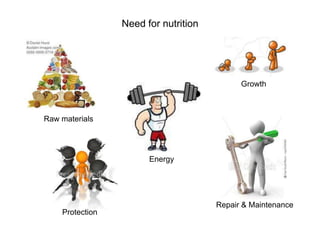
Need for nutrition
Growth
Repair & Maintenance
Raw materials
Protection
Energy
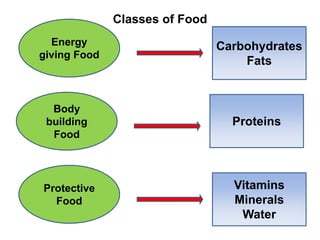
Energy
giving Food
Carbohydrates
Fats
Body
building
Food
Proteins
Protective
Food
Vitamins
Minerals
Water
Classes of Food
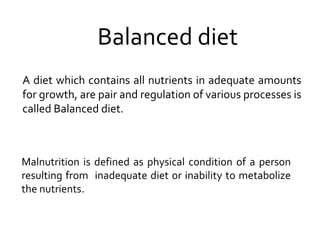
Balanced diet
A diet which contains all nutrients in adequate amounts
for growth, are pair and regulation of various processes is
called Balanced diet.
Malnutrition is defined as physical condition of a person
resulting from inadequate diet or inability to metabolize
the nutrients.
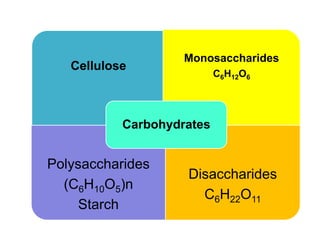
Cellulose
Monosaccharides
C6H12O6
Polysaccharides
(C6H10O5)n
Starch
Disaccharides
C6H22O11
Carbohydrates
Cellulose
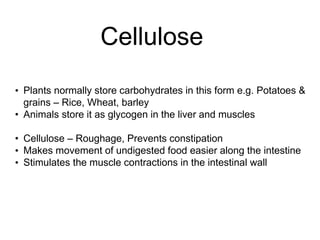
• Plants normally store carbohydrates in this form e.g. Potatoes &
grains – Rice, Wheat, barley
• Animals store it as glycogen in the liver and muscles
• Cellulose – Roughage, Prevents constipation
• Makes movement of undigested food easier along the intestine
• Stimulates the muscle contractions in the intestinal wall
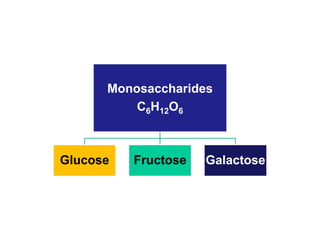
Monosaccharides
C6H12O6
Glucose Fructose Galactose
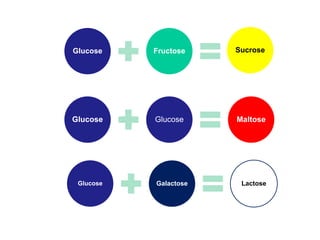
Glucose Fructose Sucrose
Glucose Glucose Maltose
Glucose Galactose Lactose
Disaccharides C6H22O11
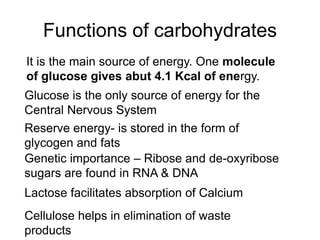
Functions of carbohydrates
It is the main source of energy. One molecule
of glucose gives abut 4.1 Kcal of energy.
Reserve energy- is stored in the form of
glycogen and fats
Genetic importance – Ribose and de-oxyribose
sugars are found in RNA & DNA
Lactose facilitates absorption of Calcium
Cellulose helps in elimination of waste
products
Glucose is the only source of energy for the
Central Nervous System
Fats [Lipids]
Carry more carbon & Hydrogen and less oxygen
Saturated fats Un-Saturated fats
They are solids at room
temp
They are liquids at room
temp
Found in animal products
Contains bad cholesterol -
LDL
They have melting points
higher than room
temperature
Found in plant products
These reduce LDL
cholesterol (bad) and
maintain HDL (good)
cholesterol
They have melting points
higher than room
temperature
Functions of
fats
Functions of Fats
• Richest source of energy
• Important form of storage of food.
• Acts as a solvent for the absorption of
fat-soluble vitamins A, D, E and K.
• Subcutaneous Fat works as an
insulator.
• Stored fat works as reserve energy.
• Fats also help in the synthesis of
Vitamin D.
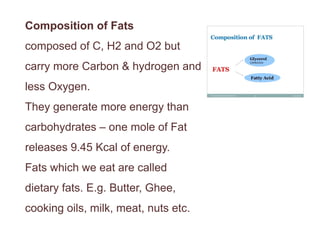
Composition of Fats
composed of C, H2 and O2 but
carry more Carbon & hydrogen and
less Oxygen.
They generate more energy than
carbohydrates – one mole of Fat
releases 9.45 Kcal of energy.
Fats which we eat are called
dietary fats. E.g. Butter, Ghee,
cooking oils, milk, meat, nuts etc.
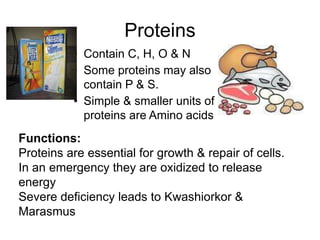
Proteins
• Contain C, H, O & N
• Some proteins may also
contain P & S.
• Simple & smaller units of
proteins are Amino acids
Functions:
Proteins are essential for growth & repair of cells.
In an emergency they are oxidized to release
energy
Severe deficiency leads to Kwashiorkor &
Marasmus
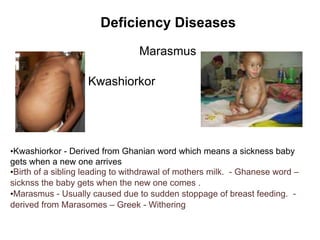
Kwashiorkor
Marasmus
Deficiency Diseases
•Kwashiorkor - Derived from Ghanian word which means a sickness baby
gets when a new one arrives
•Birth of a sibling leading to withdrawal of mothers milk. - Ghanese word –
sicknss the baby gets when the new one comes .
•Marasmus - Usually caused due to sudden stoppage of breast feeding. -
derived from Marasomes – Greek - Withering
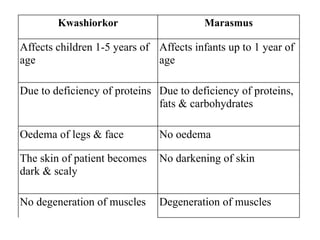
Kwashiorkor Marasmus
Affects children 1-5 years of
age
Affects infants up to 1 year of
age
Due to deficiency of proteins Due to deficiency of proteins,
fats & carbohydrates
Oedema of legs & face No oedema
The skin of patient becomes
dark & scaly
No darkening of skin
No degeneration of muscles Degeneration of muscles
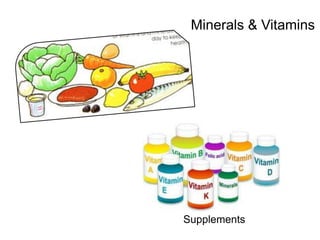
Supplements
Minerals & Vitamins
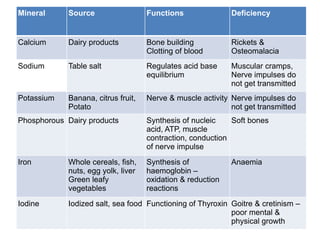
Mineral Source Functions Deficiency
Calcium Dairy products Bone building
Clotting of blood
Rickets &
Osteomalacia
Sodium Table salt Regulates acid base
equilibrium
Muscular cramps,
Nerve impulses do
not get transmitted
Potassium Banana, citrus fruit,
Potato
Nerve & muscle activity Nerve impulses do
not get transmitted
Phosphorous Dairy products Synthesis of nucleic
acid, ATP, muscle
contraction, conduction
of nerve impulse
Soft bones
Iron Whole cereals, fish,
nuts, egg yolk, liver
Green leafy
vegetables
Synthesis of
haemoglobin –
oxidation & reduction
reactions
Anaemia
Iodine Iodized salt, sea food Functioning of Thyroxin Goitre & cretinism –
poor mental &
physical growth
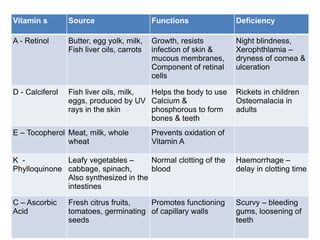
Vitamin s Source Functions Deficiency
A - Retinol Butter, egg yolk, milk,
Fish liver oils, carrots
Growth, resists
infection of skin &
mucous membranes,
Component of retinal
cells
Night blindness,
Xerophthlamia –
dryness of cornea &
ulceration
D - Calciferol Fish liver oils, milk,
eggs, produced by UV
rays in the skin
Helps the body to use
Calcium &
phosphorous to form
bones & teeth
Rickets in children
Osteomalacia in
adults
E – Tocopherol Meat, milk, whole
wheat
Prevents oxidation of
Vitamin A
K -
Phylloquinone
Leafy vegetables –
cabbage, spinach,
Also synthesized in the
intestines
Normal clotting of the
blood
Haemorrhage –
delay in clotting time
C – Ascorbic
Acid
Fresh citrus fruits,
tomatoes, germinating
seeds
Promotes functioning
of capillary walls
Scurvy – bleeding
gums, loosening of
teeth
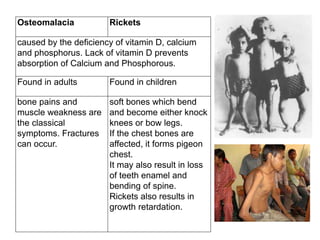
Osteomalacia Rickets
caused by the deficiency of vitamin D, calcium
and phosphorus. Lack of vitamin D prevents
absorption of Calcium and Phosphorous.
Found in adults Found in children
bone pains and
muscle weakness are
the classical
symptoms. Fractures
can occur.
soft bones which bend
and become either knock
knees or bow legs.
If the chest bones are
affected, it forms pigeon
chest.
It may also result in loss
of teeth enamel and
bending of spine.
Rickets also results in
growth retardation.
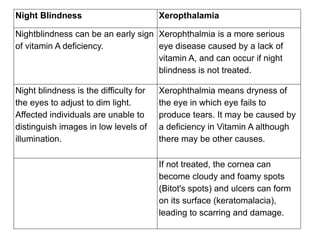
Night Blindness Xeropthalamia
Nightblindness can be an early sign
of vitamin A deficiency.
Xerophthalmia is a more serious
eye disease caused by a lack of
vitamin A, and can occur if night
blindness is not treated.
Night blindness is the difficulty for
the eyes to adjust to dim light.
Affected individuals are unable to
distinguish images in low levels of
illumination.
Xerophthalmia means dryness of
the eye in which eye fails to
produce tears. It may be caused by
a deficiency in Vitamin A although
there may be other causes.
If not treated, the cornea can
become cloudy and foamy spots
(Bitot's spots) and ulcers can form
on its surface (keratomalacia),
leading to scarring and damage.
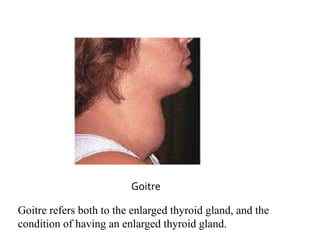
Goitre
Goitre refers both to the enlarged thyroid gland, and the
condition of having an enlarged thyroid gland.
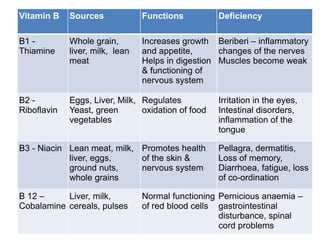
Vitamin B Sources Functions Deficiency
B1 -
Thiamine
Whole grain,
liver, milk, lean
meat
Increases growth
and appetite,
Helps in digestion
& functioning of
nervous system
Beriberi – inflammatory
changes of the nerves
Muscles become weak
B2 -
Riboflavin
Eggs, Liver, Milk,
Yeast, green
vegetables
Regulates
oxidation of food
Irritation in the eyes,
Intestinal disorders,
inflammation of the
tongue
B3 - Niacin Lean meat, milk,
liver, eggs,
ground nuts,
whole grains
Promotes health
of the skin &
nervous system
Pellagra, dermatitis,
Loss of memory,
Diarrhoea, fatigue, loss
of co-ordination
B 12 –
Cobalamine
Liver, milk,
cereals, pulses
Normal functioning
of red blood cells
Pernicious anaemia –
gastrointestinal
disturbance, spinal
cord problems
Beri-beri Pellagra
Deficiency of Vitamin B1 deficiency of vitamin B4 or
niacin
Symptoms: Swelling of legs,
extreme weakness, headache,
dizziness, palpitations and
loss of appetite.
Has 3 Ds – Dry skin, diarrhea,
Dementia [loss of memory]
Diet to be rich in groundnuts,
pulses, fruits and unpolished
rice
Diet with mostly Maize
interferes with the absorption
of Vitamin B 4.
Water
• Acts as a solvent
• Used to produce digestive juices
• Used in the transportation of food and
Oxygen through out the body
• Used in the excretion of soluble waste
• Involved in the maintenance of body
temperature
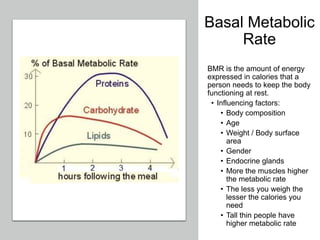
Basal Metabolic
Rate
BMR is the amount of energy
expressed in calories that a
person needs to keep the body
functioning at rest.
• Influencing factors:
• Body composition
• Age
• Weight / Body surface
area
• Gender
• Endocrine glands
• More the muscles higher
the metabolic rate
• The less you weigh the
lesser the calories you
need
• Tall thin people have
higher metabolic rate
Dr. Pramila Kudva is a PhD in
Education from Mumbai
University. She has over three
decades of experience as a
teacher, teacher educator.
Currently she is working as a
principal of an ICSE school in
Mumbai. She has several
academic publications to her
credit. This book covers several
theories, techniques and
classroom management aspects
with innumerable examples. A
must for the school library.
E-mail:
Pramilakudva2016@gmail.com

Nutrition

  • 1.
  • 2.
    Need for nutrition Growth Repair& Maintenance Raw materials Protection Energy
  • 3.
  • 4.
    Balanced diet A dietwhich contains all nutrients in adequate amounts for growth, are pair and regulation of various processes is called Balanced diet. Malnutrition is defined as physical condition of a person resulting from inadequate diet or inability to metabolize the nutrients.
  • 5.
  • 6.
    Cellulose • Plants normallystore carbohydrates in this form e.g. Potatoes & grains – Rice, Wheat, barley • Animals store it as glycogen in the liver and muscles • Cellulose – Roughage, Prevents constipation • Makes movement of undigested food easier along the intestine • Stimulates the muscle contractions in the intestinal wall
  • 7.
  • 8.
    Glucose Fructose Sucrose GlucoseGlucose Maltose Glucose Galactose Lactose Disaccharides C6H22O11
  • 9.
    Functions of carbohydrates Itis the main source of energy. One molecule of glucose gives abut 4.1 Kcal of energy. Reserve energy- is stored in the form of glycogen and fats Genetic importance – Ribose and de-oxyribose sugars are found in RNA & DNA Lactose facilitates absorption of Calcium Cellulose helps in elimination of waste products Glucose is the only source of energy for the Central Nervous System
  • 10.
    Fats [Lipids] Carry morecarbon & Hydrogen and less oxygen Saturated fats Un-Saturated fats They are solids at room temp They are liquids at room temp Found in animal products Contains bad cholesterol - LDL They have melting points higher than room temperature Found in plant products These reduce LDL cholesterol (bad) and maintain HDL (good) cholesterol They have melting points higher than room temperature
  • 11.
    Functions of fats Functions ofFats • Richest source of energy • Important form of storage of food. • Acts as a solvent for the absorption of fat-soluble vitamins A, D, E and K. • Subcutaneous Fat works as an insulator. • Stored fat works as reserve energy. • Fats also help in the synthesis of Vitamin D.
  • 12.
    Composition of Fats composedof C, H2 and O2 but carry more Carbon & hydrogen and less Oxygen. They generate more energy than carbohydrates – one mole of Fat releases 9.45 Kcal of energy. Fats which we eat are called dietary fats. E.g. Butter, Ghee, cooking oils, milk, meat, nuts etc.
  • 13.
    Proteins • Contain C,H, O & N • Some proteins may also contain P & S. • Simple & smaller units of proteins are Amino acids Functions: Proteins are essential for growth & repair of cells. In an emergency they are oxidized to release energy Severe deficiency leads to Kwashiorkor & Marasmus
  • 14.
    Kwashiorkor Marasmus Deficiency Diseases •Kwashiorkor -Derived from Ghanian word which means a sickness baby gets when a new one arrives •Birth of a sibling leading to withdrawal of mothers milk. - Ghanese word – sicknss the baby gets when the new one comes . •Marasmus - Usually caused due to sudden stoppage of breast feeding. - derived from Marasomes – Greek - Withering
  • 15.
    Kwashiorkor Marasmus Affects children1-5 years of age Affects infants up to 1 year of age Due to deficiency of proteins Due to deficiency of proteins, fats & carbohydrates Oedema of legs & face No oedema The skin of patient becomes dark & scaly No darkening of skin No degeneration of muscles Degeneration of muscles
  • 16.
  • 17.
    Mineral Source FunctionsDeficiency Calcium Dairy products Bone building Clotting of blood Rickets & Osteomalacia Sodium Table salt Regulates acid base equilibrium Muscular cramps, Nerve impulses do not get transmitted Potassium Banana, citrus fruit, Potato Nerve & muscle activity Nerve impulses do not get transmitted Phosphorous Dairy products Synthesis of nucleic acid, ATP, muscle contraction, conduction of nerve impulse Soft bones Iron Whole cereals, fish, nuts, egg yolk, liver Green leafy vegetables Synthesis of haemoglobin – oxidation & reduction reactions Anaemia Iodine Iodized salt, sea food Functioning of Thyroxin Goitre & cretinism – poor mental & physical growth
  • 18.
    Vitamin s SourceFunctions Deficiency A - Retinol Butter, egg yolk, milk, Fish liver oils, carrots Growth, resists infection of skin & mucous membranes, Component of retinal cells Night blindness, Xerophthlamia – dryness of cornea & ulceration D - Calciferol Fish liver oils, milk, eggs, produced by UV rays in the skin Helps the body to use Calcium & phosphorous to form bones & teeth Rickets in children Osteomalacia in adults E – Tocopherol Meat, milk, whole wheat Prevents oxidation of Vitamin A K - Phylloquinone Leafy vegetables – cabbage, spinach, Also synthesized in the intestines Normal clotting of the blood Haemorrhage – delay in clotting time C – Ascorbic Acid Fresh citrus fruits, tomatoes, germinating seeds Promotes functioning of capillary walls Scurvy – bleeding gums, loosening of teeth
  • 19.
    Osteomalacia Rickets caused bythe deficiency of vitamin D, calcium and phosphorus. Lack of vitamin D prevents absorption of Calcium and Phosphorous. Found in adults Found in children bone pains and muscle weakness are the classical symptoms. Fractures can occur. soft bones which bend and become either knock knees or bow legs. If the chest bones are affected, it forms pigeon chest. It may also result in loss of teeth enamel and bending of spine. Rickets also results in growth retardation.
  • 20.
    Night Blindness Xeropthalamia Nightblindnesscan be an early sign of vitamin A deficiency. Xerophthalmia is a more serious eye disease caused by a lack of vitamin A, and can occur if night blindness is not treated. Night blindness is the difficulty for the eyes to adjust to dim light. Affected individuals are unable to distinguish images in low levels of illumination. Xerophthalmia means dryness of the eye in which eye fails to produce tears. It may be caused by a deficiency in Vitamin A although there may be other causes. If not treated, the cornea can become cloudy and foamy spots (Bitot's spots) and ulcers can form on its surface (keratomalacia), leading to scarring and damage.
  • 21.
    Goitre Goitre refers bothto the enlarged thyroid gland, and the condition of having an enlarged thyroid gland.
  • 22.
    Vitamin B SourcesFunctions Deficiency B1 - Thiamine Whole grain, liver, milk, lean meat Increases growth and appetite, Helps in digestion & functioning of nervous system Beriberi – inflammatory changes of the nerves Muscles become weak B2 - Riboflavin Eggs, Liver, Milk, Yeast, green vegetables Regulates oxidation of food Irritation in the eyes, Intestinal disorders, inflammation of the tongue B3 - Niacin Lean meat, milk, liver, eggs, ground nuts, whole grains Promotes health of the skin & nervous system Pellagra, dermatitis, Loss of memory, Diarrhoea, fatigue, loss of co-ordination B 12 – Cobalamine Liver, milk, cereals, pulses Normal functioning of red blood cells Pernicious anaemia – gastrointestinal disturbance, spinal cord problems
  • 23.
    Beri-beri Pellagra Deficiency ofVitamin B1 deficiency of vitamin B4 or niacin Symptoms: Swelling of legs, extreme weakness, headache, dizziness, palpitations and loss of appetite. Has 3 Ds – Dry skin, diarrhea, Dementia [loss of memory] Diet to be rich in groundnuts, pulses, fruits and unpolished rice Diet with mostly Maize interferes with the absorption of Vitamin B 4.
  • 24.
    Water • Acts asa solvent • Used to produce digestive juices • Used in the transportation of food and Oxygen through out the body • Used in the excretion of soluble waste • Involved in the maintenance of body temperature
  • 25.
    Basal Metabolic Rate BMR isthe amount of energy expressed in calories that a person needs to keep the body functioning at rest. • Influencing factors: • Body composition • Age • Weight / Body surface area • Gender • Endocrine glands • More the muscles higher the metabolic rate • The less you weigh the lesser the calories you need • Tall thin people have higher metabolic rate
  • 26.
    Dr. Pramila Kudvais a PhD in Education from Mumbai University. She has over three decades of experience as a teacher, teacher educator. Currently she is working as a principal of an ICSE school in Mumbai. She has several academic publications to her credit. This book covers several theories, techniques and classroom management aspects with innumerable examples. A must for the school library. E-mail: Pramilakudva2016@gmail.com

Editor's Notes

  • #6 Plants normally store carbohydrates in this form e.g. Potatoes & grains – Rice, Wheat, barley Animals store it as glycogen in the liver and muscles Cellulose – Roughage Prevents constipation Makes movement of undigested food easier along the intestine Stimulates the muscle contractions in the intestinal wall
  • #18 Cell permeability gets affected without Na, & K
  • #19 Fat soluble vitamins are A, D, E and K – can be stored for a longer period of time Water soluble ones are B complex & C Excess of vitamins can be harmful. Rickets – bones lack Ca & turn soft
  • #25 Water needs to be regularly replaced.