POSTOPERATIVE FEVER
Dr. Alok Kumar Sinha
Definition:
• Temperature higher than 38C (100.4F) on two
consecutive post operated day or higher than 39 c
(>102.2F) on any post op day
Pathophysiology
• Fever 38 c is common after surgery
• usually inflammatory stimulus of surgery: resolve
spontaneously
• fever= Response to cytokine release: not necessarily
signal infection
*Cytokines produced by monocyte, macrophage, endothelial cells
*Associated cytokines = IL1, IL6, TNF alpha, INF gamma.
SIRS
• Four Criteria:
- temperature > 38 c or <36 c
- heart rate >90
-Respiratory rate > 20
- WBC - 12*10/L or < 4*10/L
• Sign of Organ dysfunction:
-systolic BP <90 mm Hg(MAP, 65 mm Hg
- drop in B.P > 40 mm Hg in hypertensive patient
- lactate >2 mmol/ L
-urine output <0.5 ml/kg/hr. for consecutive 2 hr.
Immediate Fever: 0 or 1Day
• Malignant Hyperthermia (40 C)- inhalational anesthetic
or muscle relaxant (Halothane or Succinylcholine)
• Bacteremia - >40 C occurring 30 - 40 min after procedure
for UTI
• Gas gangrene - >40 C after GI surgery due to
contamination (CL. Perfringes)
• Febrile non hemolytic transfusion reaction
Acute fever
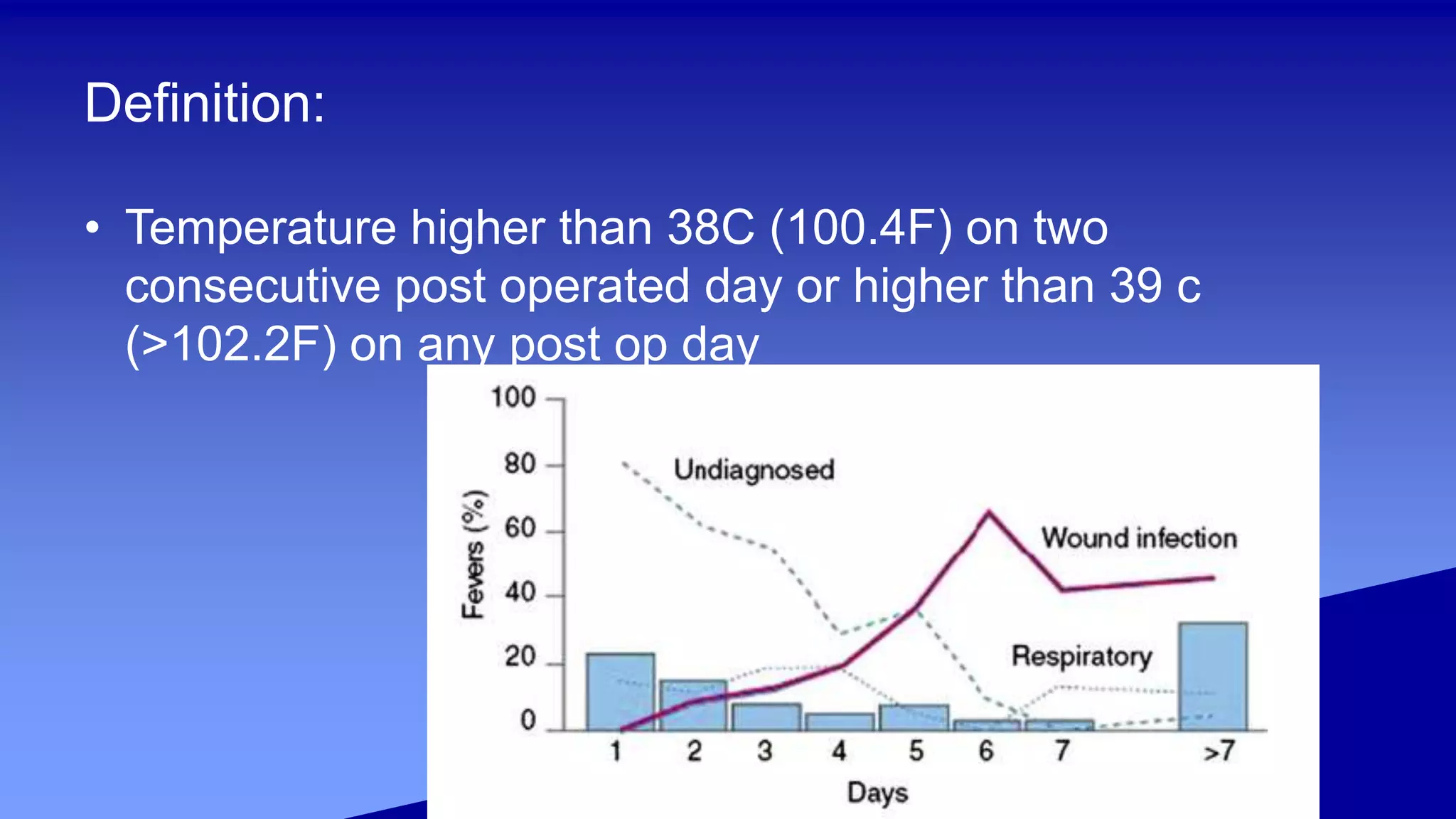
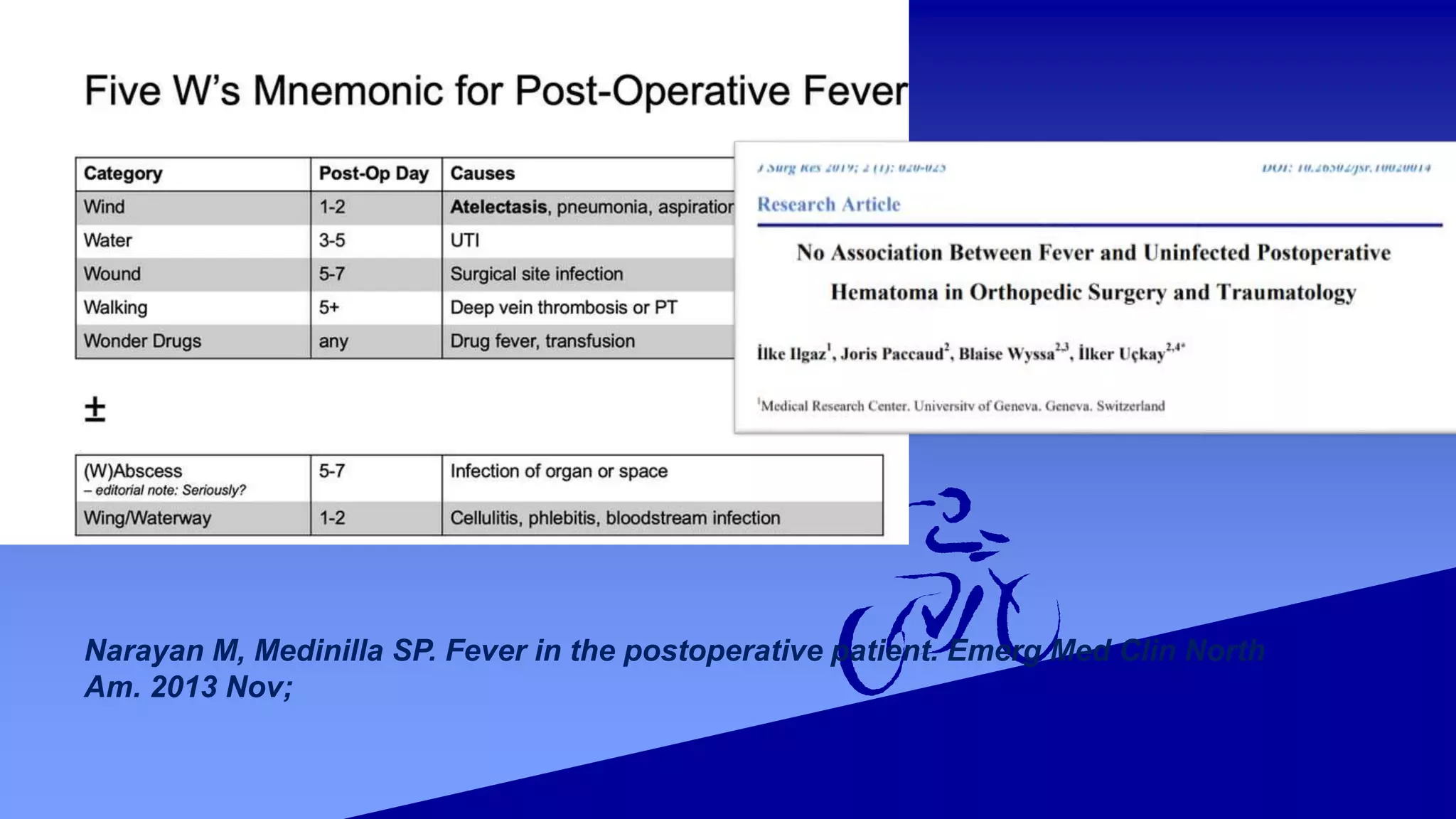
• POD 1 to 3 - pyretic response to surgery
• POD 3 - unresolved atelectasis resulting pneumonia
• POD 5 - Thrombophlebitis
• POD 7 - Pulmonary embolism
• POD 7 (5 - 10) Wound infection)
Narayan M, Medinilla SP. Fever in the postoperative patient. Emerg Med Clin North
Am. 2013 Nov;
Subacute fever - 1 to 4 weeks
• POD 10: Deep infection ( pelvic and abdominal abscess)
Delayed fever
• More than 4 weeks
• Skin and soft tissue infection
• Viral infection
Evaluation
• ABCs
• Resuscitate
• History of present illness: analgesia record, operative
note, nursing report, flowchart
• PE:
- complete exam
-look wounds- take off dressing
- look at drain output
- check peripheral IV line sites, central venous line,
foley, tubes
Lab Studies
• labs to order if concerned for infection:
- CBC, sputum Cx, UCx, Blood Cx
. imaging:
-CXR (for pneumonia)
-Venous Duplex USG (for DVT)
- CT scan for abscess, leak, pancreatitis, PE
Lab studies
• The risk of bacteraemia in patients with postoperative
fever but no other symptoms of infection is low. Routine
procurement of blood cultures in such patients is
ineffective and of limited utility.
Management
• intervention needed ?
• remove / replace source of infection- debride wound’
remove Foley
• Anticoagulant for DVT/PE
• CT guided drainage of abscess
Treatment
• O2
• fluid balance, IV fluid
• antibiotics
• Drugs - antibiotics, analgesics, antiemetics
• incentive spirometry
• venous thromboembolism
Differential Diagnosis
• pneumonia
• pulmonary embolism
• wound infection
• UTI
• transfusion reaction
• sinusitis
Take home: fever is no
proof of SSI/remote
infection
• Uçkay et al evaluated 1,071 patients for postorthopaedic fever,
infection, and antibiotic use in a heterogeneous population of
orthopaedic patients. Concluded that
• Fever as a general hallmark of inflammation despite
antipyretics: 19%,
• A quarter of all febrile were febrile exclusively during the first 2
postop days. The majority had occasional temperature peaks
for up to 1 week postop.
Take home
• Occurrence of postoperative fever does not seem to be
related to a worse outcome, (as reported in a prospective
trial 2,311 immune suppressed patients with colorectal
cancer).
Chen JS, Changchien CR, Tang R (2008)
Postoperative fever and survival in patients after
open resection for colorectal cancer

POSTOPERATIVE FEVER

  • 1.
  • 2.
    Definition: • Temperature higherthan 38C (100.4F) on two consecutive post operated day or higher than 39 c (>102.2F) on any post op day
  • 3.
    Pathophysiology • Fever 38c is common after surgery • usually inflammatory stimulus of surgery: resolve spontaneously • fever= Response to cytokine release: not necessarily signal infection *Cytokines produced by monocyte, macrophage, endothelial cells *Associated cytokines = IL1, IL6, TNF alpha, INF gamma.
  • 4.
    SIRS • Four Criteria: -temperature > 38 c or <36 c - heart rate >90 -Respiratory rate > 20 - WBC - 12*10/L or < 4*10/L • Sign of Organ dysfunction: -systolic BP <90 mm Hg(MAP, 65 mm Hg - drop in B.P > 40 mm Hg in hypertensive patient - lactate >2 mmol/ L -urine output <0.5 ml/kg/hr. for consecutive 2 hr.
  • 5.
    Immediate Fever: 0or 1Day • Malignant Hyperthermia (40 C)- inhalational anesthetic or muscle relaxant (Halothane or Succinylcholine) • Bacteremia - >40 C occurring 30 - 40 min after procedure for UTI • Gas gangrene - >40 C after GI surgery due to contamination (CL. Perfringes) • Febrile non hemolytic transfusion reaction
  • 6.
    Acute fever • POD1 to 3 - pyretic response to surgery • POD 3 - unresolved atelectasis resulting pneumonia • POD 5 - Thrombophlebitis • POD 7 - Pulmonary embolism • POD 7 (5 - 10) Wound infection)
  • 8.
    Narayan M, MedinillaSP. Fever in the postoperative patient. Emerg Med Clin North Am. 2013 Nov;
  • 9.
    Subacute fever -1 to 4 weeks • POD 10: Deep infection ( pelvic and abdominal abscess)
  • 10.
    Delayed fever • Morethan 4 weeks • Skin and soft tissue infection • Viral infection
  • 11.
    Evaluation • ABCs • Resuscitate •History of present illness: analgesia record, operative note, nursing report, flowchart • PE: - complete exam -look wounds- take off dressing - look at drain output - check peripheral IV line sites, central venous line, foley, tubes
  • 12.
    Lab Studies • labsto order if concerned for infection: - CBC, sputum Cx, UCx, Blood Cx . imaging: -CXR (for pneumonia) -Venous Duplex USG (for DVT) - CT scan for abscess, leak, pancreatitis, PE
  • 13.
    Lab studies • Therisk of bacteraemia in patients with postoperative fever but no other symptoms of infection is low. Routine procurement of blood cultures in such patients is ineffective and of limited utility.
  • 14.
    Management • intervention needed? • remove / replace source of infection- debride wound’ remove Foley • Anticoagulant for DVT/PE • CT guided drainage of abscess
  • 15.
    Treatment • O2 • fluidbalance, IV fluid • antibiotics • Drugs - antibiotics, analgesics, antiemetics • incentive spirometry • venous thromboembolism
  • 16.
    Differential Diagnosis • pneumonia •pulmonary embolism • wound infection • UTI • transfusion reaction • sinusitis
  • 17.
    Take home: feveris no proof of SSI/remote infection • Uçkay et al evaluated 1,071 patients for postorthopaedic fever, infection, and antibiotic use in a heterogeneous population of orthopaedic patients. Concluded that • Fever as a general hallmark of inflammation despite antipyretics: 19%, • A quarter of all febrile were febrile exclusively during the first 2 postop days. The majority had occasional temperature peaks for up to 1 week postop.
  • 18.
    Take home • Occurrenceof postoperative fever does not seem to be related to a worse outcome, (as reported in a prospective trial 2,311 immune suppressed patients with colorectal cancer). Chen JS, Changchien CR, Tang R (2008) Postoperative fever and survival in patients after open resection for colorectal cancer