Structure and Function of
RBC. (ERYTHROPOIESIS)
MS. SHAMA PRAVEEN
TUTOR PHYSIOLOGY
STRUCTURE OF RBCs
 62.5% water, 35% hemoglobin & 2.5% other substances (glucose, lipids).
 Circular, biconcave in shape.(explained)
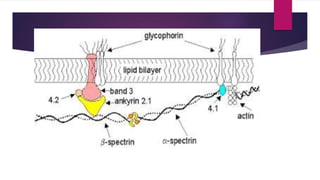
 Red cell membrane is made up of integral protein, lipid bilayer and membrane
skeleton.
 Lipid bilayer:- Provide impermeable barrier.
Maintain a slippery exterior, so that red cells do not stick to
the vascular endothelium.
 Integral protein:- important membrane proteins are band-3 protein, glycophorins,
Rh D protein and various ion channels.
Integral proteins
 Antigenic determination and cellular metabolism.
 Band-3 is the major anion exchanger (chloride-bicarbonate exchange) and also
regulates metabolic pathways.
 Glycophorins modulate interaction between red cells and interaction of red cells
to endothelium.
 Glycophorins-C provides stability and shape to red cell membrane and its
deficiency leads to elliptocytosis.
Membrane skeleton
 Present on internal side of red cell membrane.
 Ankyrin and Spectrin are important membrane skeleton proteins.
 Spectrin is composed of 2 subunits: α and β. these subunits align in antiparallel
fashion to form flexible rod like structure.
 Spectrin molecules maintain cellular shape, provide structural support to
membrane lipid bilayer and regulate lateral mobility of integral membrane
proteins.
 Ankyrin provides primary linkage between membrane skeleton and lipid bilayer.
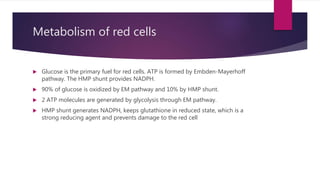
Metabolism of red cells
 Glucose is the primary fuel for red cells. ATP is formed by Embden-Mayerhoff
pathway. The HMP shunt provides NADPH.
 90% of glucose is oxidized by EM pathway and 10% by HMP shunt.
 2 ATP molecules are generated by glycolysis through EM pathway.
 HMP shunt generates NADPH, keeps glutathione in reduced state, which is a
strong reducing agent and prevents damage to the red cell
Functions of RBCs
 Transportation of gases.
 Blood group classification.
 Maintenance of acid base balance.
 Contribute to 50% of viscosity of blood.
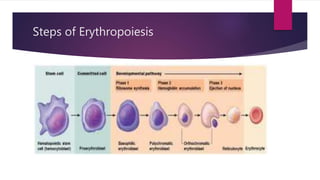
ERYTHROPOIESIS
 Process of formation of red cells.
 Three stages of erythropoiesis:- mesoblastic, hepatic and medullary.
 Mesoblastic Stage: during intrauterine life, erythropoiesis first takes place in
mesoderm of yolk sac.
 Hepatic stage: from the 5th week of gestation, erythropoiesis takes place in the
liver and spleen.
 Medullary stage: from the 5th month of intrauterine life, the bone marrow starts
forming red cells.
 After birth, bone marrow becomes the sole site of erythropoiesis.
Steps of Erythropoiesis
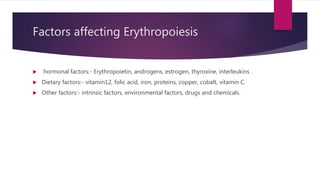
Factors affecting Erythropoiesis
 hormonal factors:- Erythropoietin, androgens, estrogen, thyroxine, interleukins .
 Dietary factors:- vitamin12, folic acid, iron, proteins, copper, cobalt, vitamin C.
 Other factors:- intrinsic factors, environmental factors, drugs and chemicals.
Thank you

Rbcs function

  • 1.
    Structure and Functionof RBC. (ERYTHROPOIESIS) MS. SHAMA PRAVEEN TUTOR PHYSIOLOGY
  • 2.
    STRUCTURE OF RBCs 62.5% water, 35% hemoglobin & 2.5% other substances (glucose, lipids).  Circular, biconcave in shape.(explained)  Red cell membrane is made up of integral protein, lipid bilayer and membrane skeleton.  Lipid bilayer:- Provide impermeable barrier. Maintain a slippery exterior, so that red cells do not stick to the vascular endothelium.  Integral protein:- important membrane proteins are band-3 protein, glycophorins, Rh D protein and various ion channels.
  • 3.
    Integral proteins  Antigenicdetermination and cellular metabolism.  Band-3 is the major anion exchanger (chloride-bicarbonate exchange) and also regulates metabolic pathways.  Glycophorins modulate interaction between red cells and interaction of red cells to endothelium.  Glycophorins-C provides stability and shape to red cell membrane and its deficiency leads to elliptocytosis.
  • 4.
    Membrane skeleton  Presenton internal side of red cell membrane.  Ankyrin and Spectrin are important membrane skeleton proteins.  Spectrin is composed of 2 subunits: α and β. these subunits align in antiparallel fashion to form flexible rod like structure.  Spectrin molecules maintain cellular shape, provide structural support to membrane lipid bilayer and regulate lateral mobility of integral membrane proteins.  Ankyrin provides primary linkage between membrane skeleton and lipid bilayer.
  • 6.
    Metabolism of redcells  Glucose is the primary fuel for red cells. ATP is formed by Embden-Mayerhoff pathway. The HMP shunt provides NADPH.  90% of glucose is oxidized by EM pathway and 10% by HMP shunt.  2 ATP molecules are generated by glycolysis through EM pathway.  HMP shunt generates NADPH, keeps glutathione in reduced state, which is a strong reducing agent and prevents damage to the red cell
  • 7.
    Functions of RBCs Transportation of gases.  Blood group classification.  Maintenance of acid base balance.  Contribute to 50% of viscosity of blood.
  • 8.
    ERYTHROPOIESIS  Process offormation of red cells.  Three stages of erythropoiesis:- mesoblastic, hepatic and medullary.  Mesoblastic Stage: during intrauterine life, erythropoiesis first takes place in mesoderm of yolk sac.  Hepatic stage: from the 5th week of gestation, erythropoiesis takes place in the liver and spleen.  Medullary stage: from the 5th month of intrauterine life, the bone marrow starts forming red cells.  After birth, bone marrow becomes the sole site of erythropoiesis.
  • 9.
  • 10.
    Factors affecting Erythropoiesis hormonal factors:- Erythropoietin, androgens, estrogen, thyroxine, interleukins .  Dietary factors:- vitamin12, folic acid, iron, proteins, copper, cobalt, vitamin C.  Other factors:- intrinsic factors, environmental factors, drugs and chemicals.
  • 11.