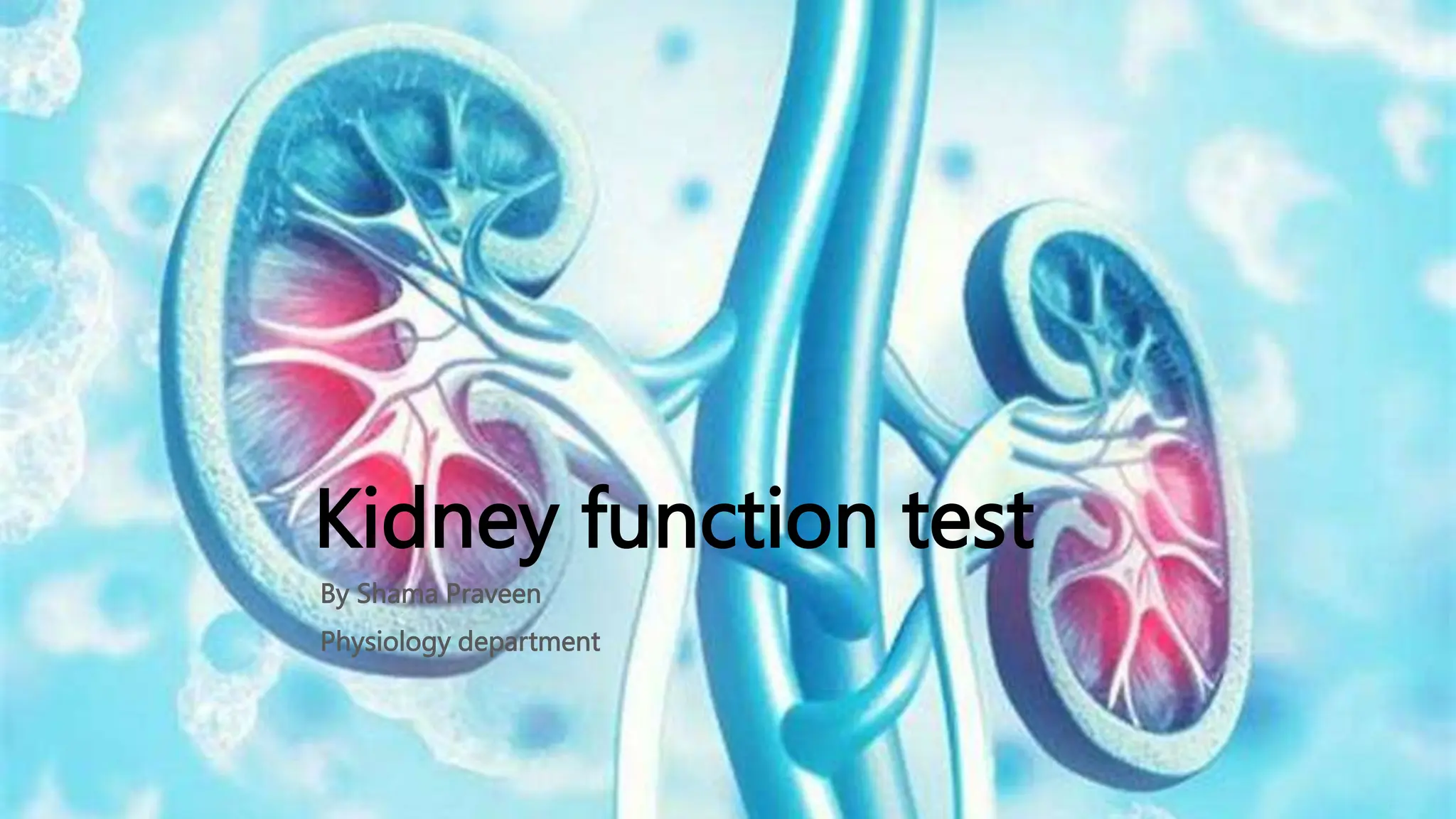
Kidney function test
By Shama Praveen
Physiology department
Objectives
 Primary function of kidney is achieved by two principle mechanisms:
Glomerular filtration (assess glomerular function)
Tubular reabsorption and secretion (assess tubular function)
Glomerular function tests
 Blood urea determination
 Blood creatinine estimation
 Inulin clearance test
 Creatinine clearance test
 Urea clearance test
 PAH clearance test
 Estimation of proteins in the urine
Tubular function tests
 Urine concentration test
 Urine dilution test
 Detection of uric acid excretion
 Test for acidification of urine
 Test for alkalinisation of urine
 Test for amino acids in urine.
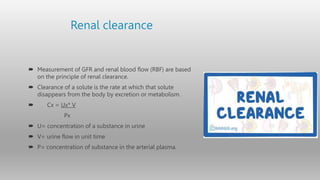
Renal clearance
 Measurement of GFR and renal blood flow (RBF) are based
on the principle of renal clearance.
 Clearance of a solute is the rate at which that solute
disappears from the body by excretion or metabolism.
 Cx = Ux* V
Px
 U= concentration of a substance in urine
 V= urine flow in unit time
 P= concentration of substance in the arterial plasma.
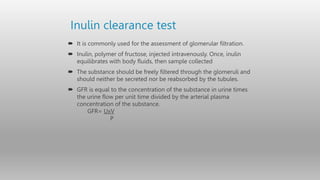
Inulin clearance test
 It is commonly used for the assessment of glomerular filtration.
 Inulin, polymer of fructose, injected intravenously. Once, inulin
equilibrates with body fluids, then sample collected
 The substance should be freely filtered through the glomeruli and
should neither be secreted nor be reabsorbed by the tubules.
 GFR is equal to the concentration of the substance in urine times
the urine flow per unit time divided by the arterial plasma
concentration of the substance.
GFR= UxV
P
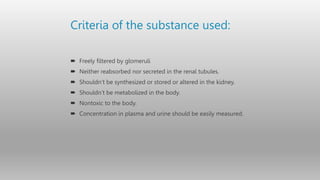
Criteria of the substance used:
 Freely filtered by glomeruli
 Neither reabsorbed nor secreted in the renal tubules.
 Shouldn’t be synthesized or stored or altered in the kidney.
 Shouldn’t be metabolized in the body.
 Nontoxic to the body.
 Concentration in plasma and urine should be easily measured.
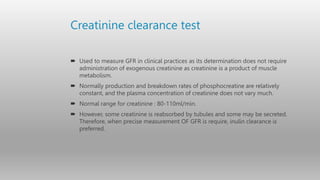
Creatinine clearance test
 Used to measure GFR in clinical practices as its determination does not require
administration of exogenous creatinine as creatinine is a product of muscle
metabolism.
 Normally production and breakdown rates of phosphocreatine are relatively
constant, and the plasma concentration of creatinine does not vary much.
 Normal range for creatinine : 80-110ml/min.
 However, some creatinine is reabsorbed by tubules and some may be secreted.
Therefore, when precise measurement OF GFR is require, inulin clearance is
preferred.
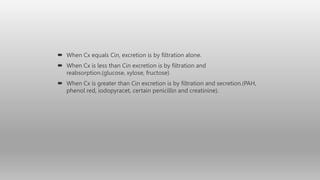
 When Cx equals Cin, excretion is by filtration alone.
 When Cx is less than Cin excretion is by filtration and
reabsorption.(glucose, xylose, fructose)
 When Cx is greater than Cin excretion is by filtration and secretion.(PAH,
phenol red, iodopyracet, certain penicillin and creatinine).
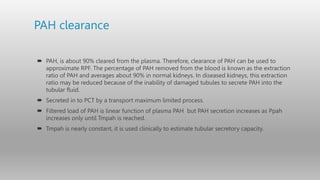
PAH clearance
 PAH, is about 90% cleared from the plasma. Therefore, clearance of PAH can be used to
approximate RPF. The percentage of PAH removed from the blood is known as the extraction
ratio of PAH and averages about 90% in normal kidneys. In diseased kidneys, this extraction
ratio may be reduced because of the inability of damaged tubules to secrete PAH into the
tubular fluid.
 Secreted in to PCT by a transport maximum limited process.
 Filtered load of PAH is linear function of plasma PAH but PAH secretion increases as Ppah
increases only until Tmpah is reached.
 Tmpah is nearly constant, it is used clinically to estimate tubular secretory capacity.
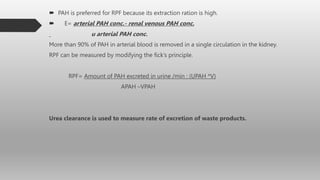
 PAH is preferred for RPF because its extraction ration is high.
 E= arterial PAH conc.- renal venous PAH conc.
u arterial PAH conc.
More than 90% of PAH in arterial blood is removed in a single circulation in the kidney.
RPF can be measured by modifying the fick’s principle.
RPF= Amount of PAH excreted in urine /min : (UPAH *V)
APAH –VPAH
Urea clearance is used to measure rate of excretion of waste products.
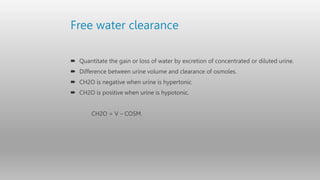
Free water clearance
 Quantitate the gain or loss of water by excretion of concentrated or diluted urine.
 Difference between urine volume and clearance of osmoles.
 CH2O is negative when urine is hypertonic
 CH2O is positive when urine is hypotonic.
CH2O = V – COSM.
Filtration fraction
 FILTRATION FRACTION IS CALCULATED FROM GFR DIVIDED BY RPF To calculate the
filtration fraction, which is the fraction of plasma that filters through the glomerular
membrane, one must first know the RPF (PAH clearance) and the GFR (inulin
clearance). If the RPF is 650 ml/min and the GFR is 125 ml/min, the filtration
fraction (FF) is calculated as follows:
 FF = GFR/RPF = 125/650 = 0.19
Thank you

Kidney function test.pptx. Renal clearance

  • 1.
    Kidney function test ByShama Praveen Physiology department
  • 2.
    Objectives  Primary functionof kidney is achieved by two principle mechanisms: Glomerular filtration (assess glomerular function) Tubular reabsorption and secretion (assess tubular function)
  • 3.
    Glomerular function tests Blood urea determination  Blood creatinine estimation  Inulin clearance test  Creatinine clearance test  Urea clearance test  PAH clearance test  Estimation of proteins in the urine
  • 4.
    Tubular function tests Urine concentration test  Urine dilution test  Detection of uric acid excretion  Test for acidification of urine  Test for alkalinisation of urine  Test for amino acids in urine.
  • 5.
    Renal clearance  Measurementof GFR and renal blood flow (RBF) are based on the principle of renal clearance.  Clearance of a solute is the rate at which that solute disappears from the body by excretion or metabolism.  Cx = Ux* V Px  U= concentration of a substance in urine  V= urine flow in unit time  P= concentration of substance in the arterial plasma.
  • 6.
    Inulin clearance test It is commonly used for the assessment of glomerular filtration.  Inulin, polymer of fructose, injected intravenously. Once, inulin equilibrates with body fluids, then sample collected  The substance should be freely filtered through the glomeruli and should neither be secreted nor be reabsorbed by the tubules.  GFR is equal to the concentration of the substance in urine times the urine flow per unit time divided by the arterial plasma concentration of the substance. GFR= UxV P
  • 7.
    Criteria of thesubstance used:  Freely filtered by glomeruli  Neither reabsorbed nor secreted in the renal tubules.  Shouldn’t be synthesized or stored or altered in the kidney.  Shouldn’t be metabolized in the body.  Nontoxic to the body.  Concentration in plasma and urine should be easily measured.
  • 8.
    Creatinine clearance test Used to measure GFR in clinical practices as its determination does not require administration of exogenous creatinine as creatinine is a product of muscle metabolism.  Normally production and breakdown rates of phosphocreatine are relatively constant, and the plasma concentration of creatinine does not vary much.  Normal range for creatinine : 80-110ml/min.  However, some creatinine is reabsorbed by tubules and some may be secreted. Therefore, when precise measurement OF GFR is require, inulin clearance is preferred.
  • 9.
     When Cxequals Cin, excretion is by filtration alone.  When Cx is less than Cin excretion is by filtration and reabsorption.(glucose, xylose, fructose)  When Cx is greater than Cin excretion is by filtration and secretion.(PAH, phenol red, iodopyracet, certain penicillin and creatinine).
  • 10.
    PAH clearance  PAH,is about 90% cleared from the plasma. Therefore, clearance of PAH can be used to approximate RPF. The percentage of PAH removed from the blood is known as the extraction ratio of PAH and averages about 90% in normal kidneys. In diseased kidneys, this extraction ratio may be reduced because of the inability of damaged tubules to secrete PAH into the tubular fluid.  Secreted in to PCT by a transport maximum limited process.  Filtered load of PAH is linear function of plasma PAH but PAH secretion increases as Ppah increases only until Tmpah is reached.  Tmpah is nearly constant, it is used clinically to estimate tubular secretory capacity.
  • 11.
     PAH ispreferred for RPF because its extraction ration is high.  E= arterial PAH conc.- renal venous PAH conc. u arterial PAH conc. More than 90% of PAH in arterial blood is removed in a single circulation in the kidney. RPF can be measured by modifying the fick’s principle. RPF= Amount of PAH excreted in urine /min : (UPAH *V) APAH –VPAH Urea clearance is used to measure rate of excretion of waste products.
  • 12.
    Free water clearance Quantitate the gain or loss of water by excretion of concentrated or diluted urine.  Difference between urine volume and clearance of osmoles.  CH2O is negative when urine is hypertonic  CH2O is positive when urine is hypotonic. CH2O = V – COSM.
  • 13.
    Filtration fraction  FILTRATIONFRACTION IS CALCULATED FROM GFR DIVIDED BY RPF To calculate the filtration fraction, which is the fraction of plasma that filters through the glomerular membrane, one must first know the RPF (PAH clearance) and the GFR (inulin clearance). If the RPF is 650 ml/min and the GFR is 125 ml/min, the filtration fraction (FF) is calculated as follows:  FF = GFR/RPF = 125/650 = 0.19
  • 14.