Rational Unified
Process (RUP)
1
RUP Introduction
Defining
The Rational Unified Process is a software engineering process. It
provides a disciplined approach to assigning tasks and
responsibilities within a development organization.
Its goal
is to ensure the production of high-quality software that meets
the needs of its end users within a predictable schedule and
budget.
2
More about RUP
The Rational Unified Process supports object-oriented techniques.
Several of the models are object-oriented models, based on the
concepts of objects, classes, and associations between them. These
models, like many other technical artifacts, use the Unified
Modeling Language (UML) as the common notation.
3
Six best practices of RUP
1. Develop software iteratively
2. Manage requirements
3. Use component-based architectures
4. Visually model software
5. Verify software quality
6. Control changes to software
Six best practices as described in the rational unified process is a
paradigm in software engineering that lists six ideas to follow when
designing any software project to minimize faults and increase
productivity.
4
Phases & Iterations of RUP
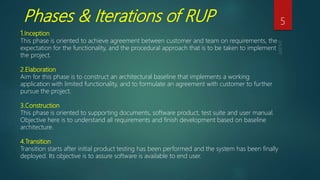
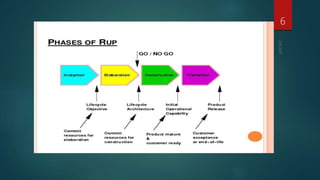
1.Inception
This phase is oriented to achieve agreement between customer and team on requirements, the
expectation for the functionality, and the procedural approach that is to be taken to implement
the project.
2.Elaboration
Aim for this phase is to construct an architectural baseline that implements a working
application with limited functionality, and to formulate an agreement with customer to further
pursue the project.
3.Construction
This phase is oriented to supporting documents, software product, test suite and user manual.
Objective here is to understand all requirements and finish development based on baseline
architecture.
4.Transition
Transition starts after initial product testing has been performed and the system has been finally
deployed. Its objective is to assure software is available to end user.
5
6
Benefits of RUP
7
1. Better Control over Software
2. Easily resolves risks
3. Control changes
4. Flexible pattern
5. Efficient delivery process
6. Supports iterative development
7. Teamwork Over Distances
References
• Searchsoftware.com: What is Rationale Unified
Process?? (IBM Development: Getting from Use
Cases to Codes
• Martin Fowler: The New Methodology
8

Rational unified process (rup)

  • 1.
  • 2.
    RUP Introduction Defining The RationalUnified Process is a software engineering process. It provides a disciplined approach to assigning tasks and responsibilities within a development organization. Its goal is to ensure the production of high-quality software that meets the needs of its end users within a predictable schedule and budget. 2
  • 3.
    More about RUP TheRational Unified Process supports object-oriented techniques. Several of the models are object-oriented models, based on the concepts of objects, classes, and associations between them. These models, like many other technical artifacts, use the Unified Modeling Language (UML) as the common notation. 3
  • 4.
    Six best practicesof RUP 1. Develop software iteratively 2. Manage requirements 3. Use component-based architectures 4. Visually model software 5. Verify software quality 6. Control changes to software Six best practices as described in the rational unified process is a paradigm in software engineering that lists six ideas to follow when designing any software project to minimize faults and increase productivity. 4
  • 5.
    Phases & Iterationsof RUP 1.Inception This phase is oriented to achieve agreement between customer and team on requirements, the expectation for the functionality, and the procedural approach that is to be taken to implement the project. 2.Elaboration Aim for this phase is to construct an architectural baseline that implements a working application with limited functionality, and to formulate an agreement with customer to further pursue the project. 3.Construction This phase is oriented to supporting documents, software product, test suite and user manual. Objective here is to understand all requirements and finish development based on baseline architecture. 4.Transition Transition starts after initial product testing has been performed and the system has been finally deployed. Its objective is to assure software is available to end user. 5
  • 6.
  • 7.
    Benefits of RUP 7 1.Better Control over Software 2. Easily resolves risks 3. Control changes 4. Flexible pattern 5. Efficient delivery process 6. Supports iterative development 7. Teamwork Over Distances
  • 8.
    References • Searchsoftware.com: Whatis Rationale Unified Process?? (IBM Development: Getting from Use Cases to Codes • Martin Fowler: The New Methodology 8