AN OVERVIEW OF THE RATIONAL UNIFIED PROCESS (RUP) Eric Villagomez TS5130 - System Development Theory and Practice
What is RUP? RUP was originally developed by Rational Software (now part of IBM). It is a Software engineering process It is a process product It enhances team productivity It creates and maintains models It is a guide to effectively use the Unified Modeling Language Its goal is to delivery a high quality product that the customer actually wants.
Why not use Waterfall instead? The Waterfall method follows a sequential approach to software development. This limits the ability to react to any change or correct problems in a timely matter. Assumptions: Requirements never change. All information is known upfront. The customer will be satisfied with the end results. Technology will not change when it comes time to integrate.
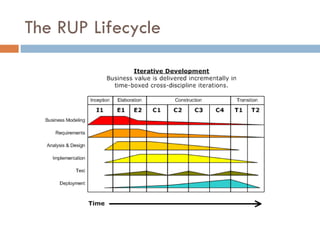
The RUP Lifecycle
The Four Phases of RUP The Inception Phase The goal is to obtain buy-in from key stakeholders. The Elaboration Phase Objective is to specify requirements in greater detail and define the architecture for the system. The Construction Phase The focus here is to develop the application to the point where it is ready for deployment. The Transition Phase We can now delivery the system into production.
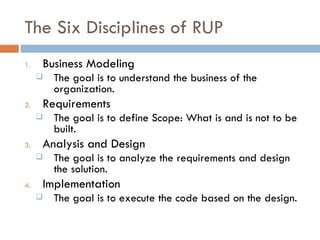
The Six Disciplines of RUP Business Modeling The goal is to understand the business of the organization. Requirements The goal is to define Scope: What is and is not to be built. Analysis and Design The goal is to analyze the requirements and design the solution. Implementation The goal is to execute the code based on the design.
The Six Disciplines of RUP (Cont.) Test The goal is to verify all aspects of the system to ensure quality. Deployment The goal is plan and deliver a working system to the customer.
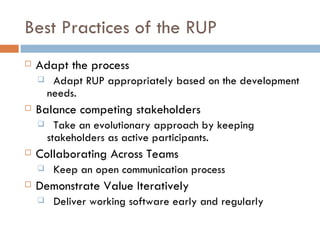
Best Practices of the RUP Adapt the process Adapt RUP appropriately based on the development needs. Balance competing stakeholders Take an evolutionary approach by keeping stakeholders as active participants. Collaborating Across Teams Keep an open communication process Demonstrate Value Iteratively Deliver working software early and regularly
Best Practices of the RUP (Cont.) Elevate the level of Abstraction Adapt modeling tools, reuse existing code, and focus on architecture Focus continuously on Quality This is done by testing at every major part of the project.
Disadvantages of RUP The process may be too complex to implement Development can get out of control It is a heavyweight process You need an expert to fully adopt this process
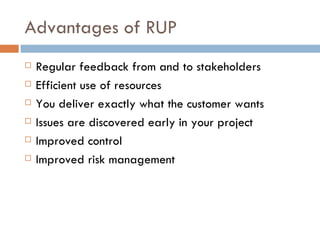
Advantages of RUP Regular feedback from and to stakeholders Efficient use of resources You deliver exactly what the customer wants Issues are discovered early in your project Improved control Improved risk management
References Rational Unified Process: Best Practices for Software Development Teams http://www.ibm.com/developerworks/rational/library/content/03July/1000/1251/1251_bestpractices_TP026B.pdf A Manager’s Introduction to the Rational Unified Process (RUP) http://www.ambysoft.com/downloads/managersIntroToRUP.pdf The Rational Unified Process http://www.menloinnovations.com/freestuff/whitepapers/Rational%20Unified%20Process.pdf

RUP

  • 1.
    AN OVERVIEW OFTHE RATIONAL UNIFIED PROCESS (RUP) Eric Villagomez TS5130 - System Development Theory and Practice
  • 2.
    What is RUP?RUP was originally developed by Rational Software (now part of IBM). It is a Software engineering process It is a process product It enhances team productivity It creates and maintains models It is a guide to effectively use the Unified Modeling Language Its goal is to delivery a high quality product that the customer actually wants.
  • 3.
    Why not useWaterfall instead? The Waterfall method follows a sequential approach to software development. This limits the ability to react to any change or correct problems in a timely matter. Assumptions: Requirements never change. All information is known upfront. The customer will be satisfied with the end results. Technology will not change when it comes time to integrate.
  • 4.
  • 5.
    The Four Phasesof RUP The Inception Phase The goal is to obtain buy-in from key stakeholders. The Elaboration Phase Objective is to specify requirements in greater detail and define the architecture for the system. The Construction Phase The focus here is to develop the application to the point where it is ready for deployment. The Transition Phase We can now delivery the system into production.
  • 6.
    The Six Disciplinesof RUP Business Modeling The goal is to understand the business of the organization. Requirements The goal is to define Scope: What is and is not to be built. Analysis and Design The goal is to analyze the requirements and design the solution. Implementation The goal is to execute the code based on the design.
  • 7.
    The Six Disciplinesof RUP (Cont.) Test The goal is to verify all aspects of the system to ensure quality. Deployment The goal is plan and deliver a working system to the customer.
  • 8.
    Best Practices ofthe RUP Adapt the process Adapt RUP appropriately based on the development needs. Balance competing stakeholders Take an evolutionary approach by keeping stakeholders as active participants. Collaborating Across Teams Keep an open communication process Demonstrate Value Iteratively Deliver working software early and regularly
  • 9.
    Best Practices ofthe RUP (Cont.) Elevate the level of Abstraction Adapt modeling tools, reuse existing code, and focus on architecture Focus continuously on Quality This is done by testing at every major part of the project.
  • 10.
    Disadvantages of RUPThe process may be too complex to implement Development can get out of control It is a heavyweight process You need an expert to fully adopt this process
  • 11.
    Advantages of RUPRegular feedback from and to stakeholders Efficient use of resources You deliver exactly what the customer wants Issues are discovered early in your project Improved control Improved risk management
  • 12.
    References Rational UnifiedProcess: Best Practices for Software Development Teams http://www.ibm.com/developerworks/rational/library/content/03July/1000/1251/1251_bestpractices_TP026B.pdf A Manager’s Introduction to the Rational Unified Process (RUP) http://www.ambysoft.com/downloads/managersIntroToRUP.pdf The Rational Unified Process http://www.menloinnovations.com/freestuff/whitepapers/Rational%20Unified%20Process.pdf