Topic: RAOULT’S LAW
ROLL #16 CH 42 HASNAIN NAWAZ
PHYSICAL & ANALYTICAL CHEMISTRY
CONTENTS OF RAOULT’S LAW
 Introduction
 Definition
 Explanation.
 Limitation of Raoult’s Law
 Colligative Properties.
 Lowering of Vapor Pressure.
 Elevation of Boiling Point.
 Depression of Freezing Point.
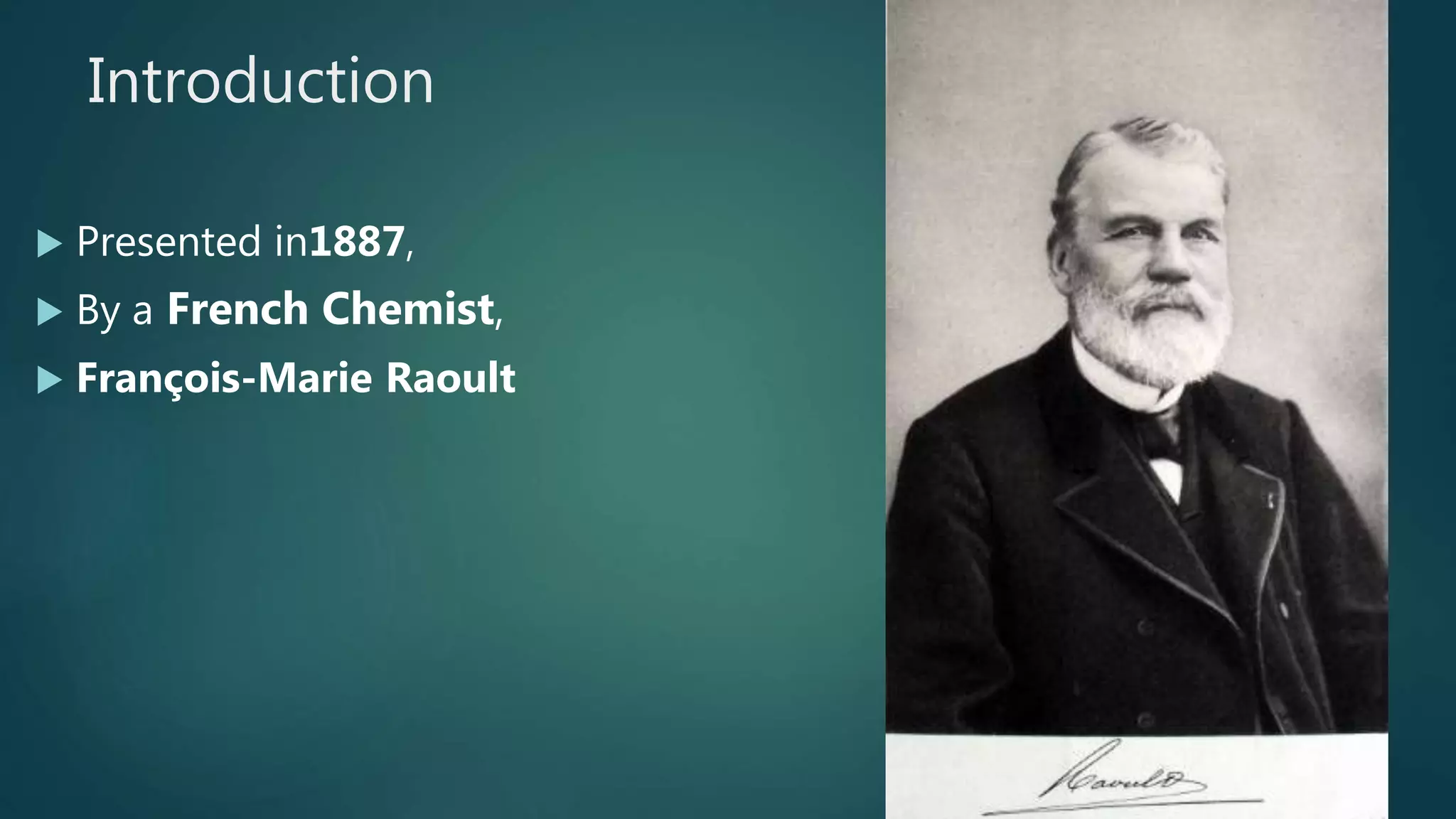
Introduction
 Presented in1887,
 By a French Chemist,
 François-Marie Raoult
Definition
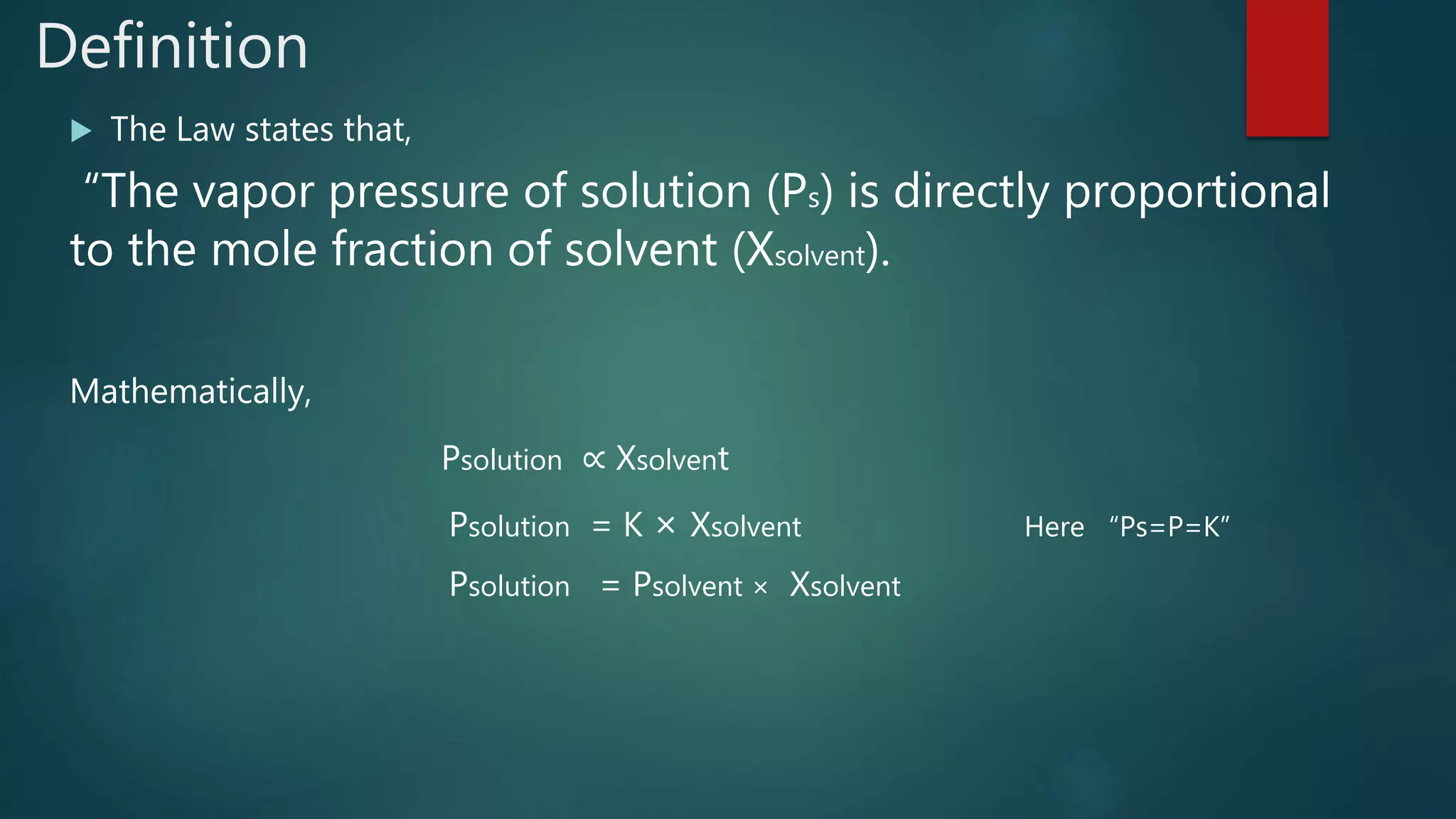
 The Law states that,
“The vapor pressure of solution (Ps) is directly proportional
to the mole fraction of solvent (Xsolvent).
Mathematically,
Psolution ∝ Xsolvent
Psolution = K × Xsolvent Here “Ps=P=K”
Psolution = Psolvent × Xsolvent
Graphical Representation
 Raoult’s Law is a linear equation (y=mx+b)
 A plot of Psolution vs mole fraction gives a
straight line with a slope equal to Psolvent.
 Psolution ∝ Xsolvent
Vapor and Vapor Pressure
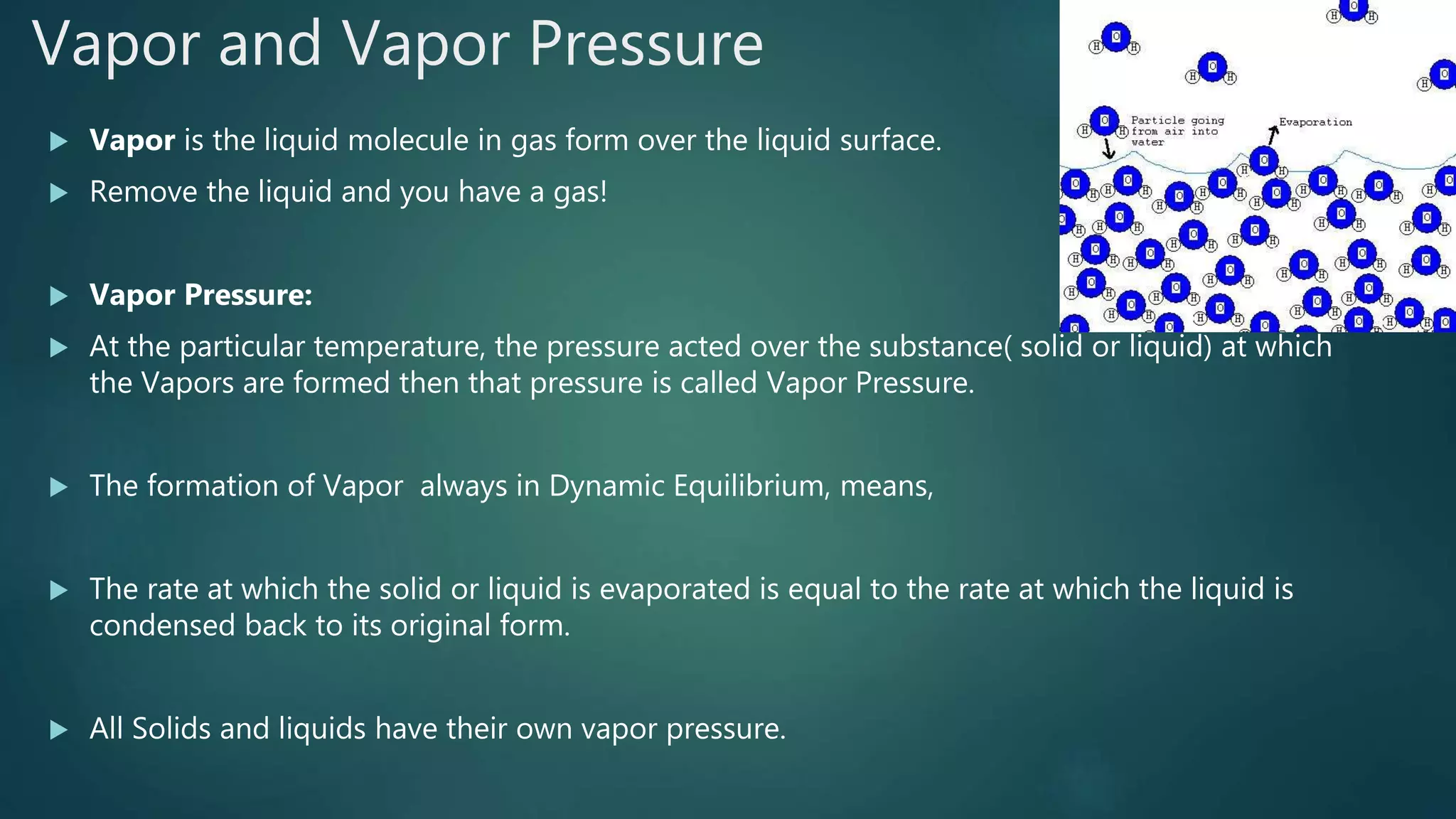
 Vapor is the liquid molecule in gas form over the liquid surface.
 Remove the liquid and you have a gas!
 Vapor Pressure:
 At the particular temperature, the pressure acted over the substance( solid or liquid) at which
the Vapors are formed then that pressure is called Vapor Pressure.
 The formation of Vapor always in Dynamic Equilibrium, means,
 The rate at which the solid or liquid is evaporated is equal to the rate at which the liquid is
condensed back to its original form.
 All Solids and liquids have their own vapor pressure.
Vapor Pressure of Solutions
 In a closed container at constant
temperature an equilibrium
vapor pressure is established.
 Here the Dynamic Equilibrium is
established. The picture on the
left indicates that vapor
molecules leave a solvent to
dilute a solution.
 The solute decreases the number
of solvent molecules per unit
volume lowering the tendency
for the molecules to escape into
vapor.
Initial Final
Vapor Pressure of Solutions
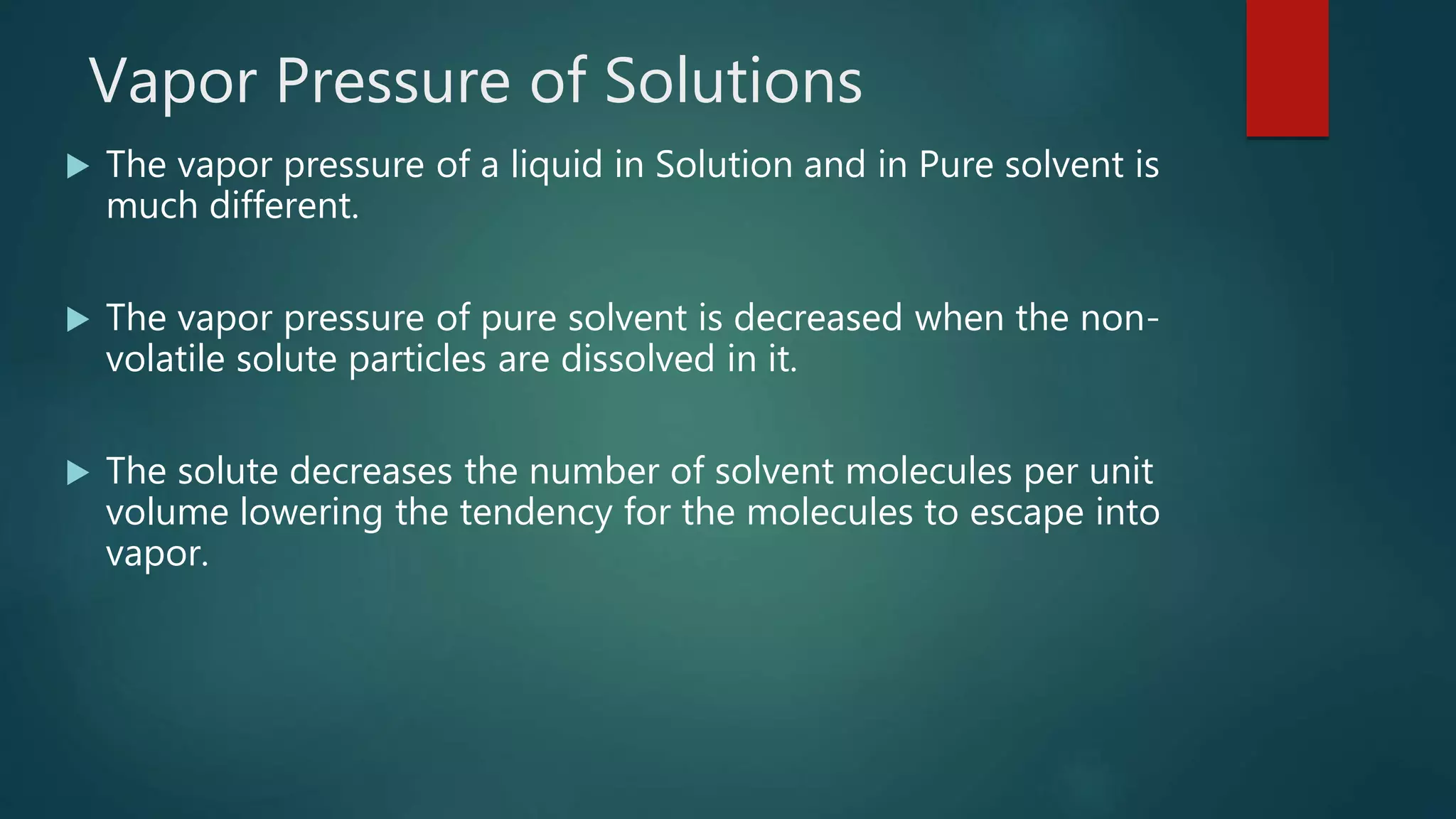
 The vapor pressure of a liquid in Solution and in Pure solvent is
much different.
 The vapor pressure of pure solvent is decreased when the non-
volatile solute particles are dissolved in it.
 The solute decreases the number of solvent molecules per unit
volume lowering the tendency for the molecules to escape into
vapor.
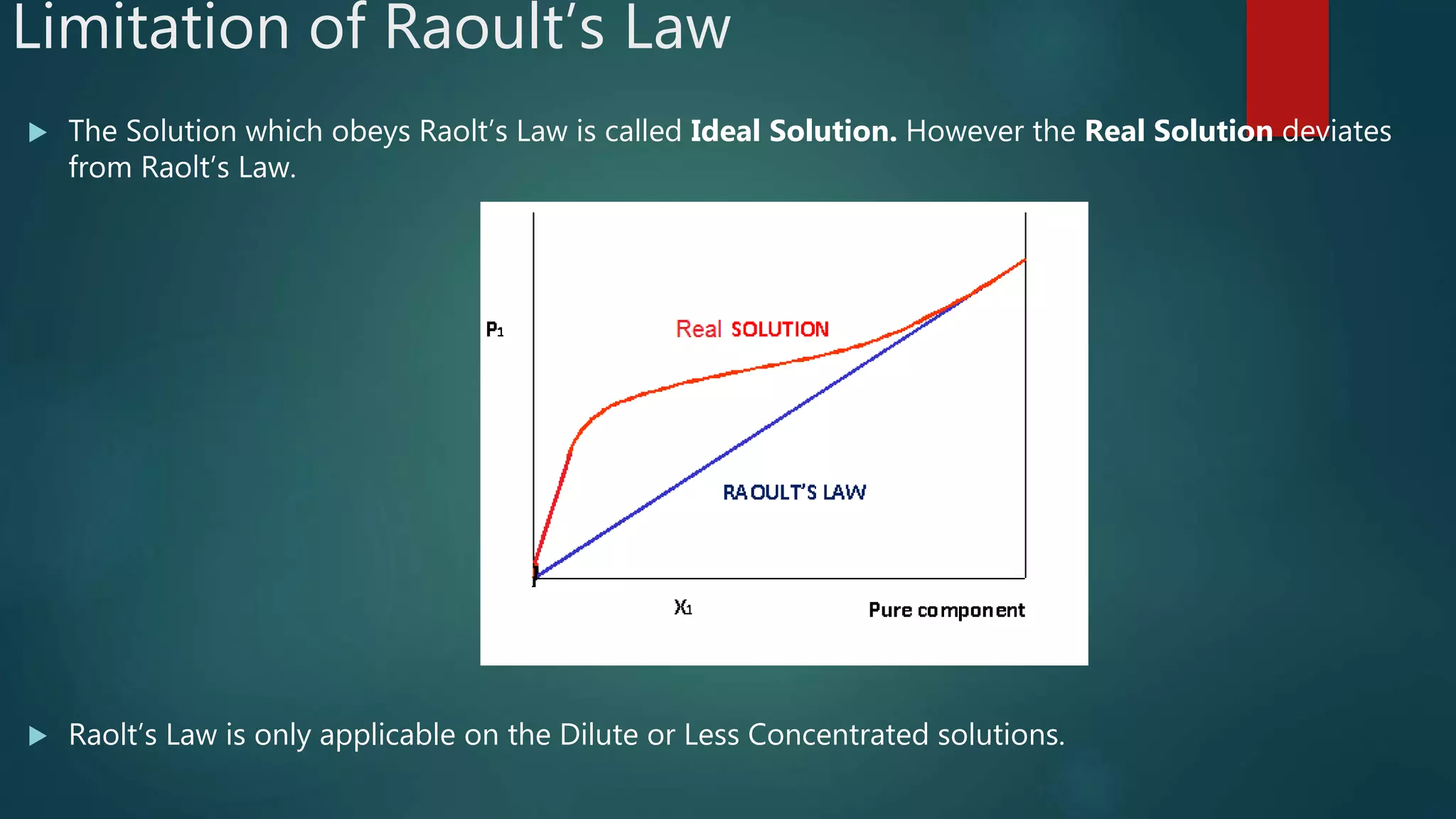
Limitation of Raoult’s Law
 The Solution which obeys Raolt’s Law is called Ideal Solution. However the Real Solution deviates
from Raolt’s Law.
 Raolt’s Law is only applicable on the Dilute or Less Concentrated solutions.
If AA Denotes Solvent-Solvent molecules, and AB denotes Solute & Solvent
molecules and γ is attractive force between molecules then,
For IDEAL SOLUTIONS,
γAA = γAB
While this is not true for,
REAL SOLUTIONS,
γAA < γAB or γAA > γAB
Negative and Positive Deviation
 Negative Deviation: Positive Deviation
If the vapor pressure of a Positive Deviation is when the
mixture is lower than cohesive forces become
expected from Raoult's law, dominant over adhesive ones.
there is said to be a
negative deviation.
In negative deviation
Adhesive forces between
Like molecules is dominant
Over the cohesive forces
Between like molecules.
Colligative Properties
Definition:
Colligative Properties are those properties, observed when the non-volatile solute particles are
dissolved in the dilute solution.
 Colligative Properties depend on No: of Particles (how many solute particles are present as
well as the solvent amount).
But these properties are independent of,
 Nature of Substance
 Chemical Reactivity of Substance.
 When the solute is dissolved into a dilute solution,
Following properties are exhibited.
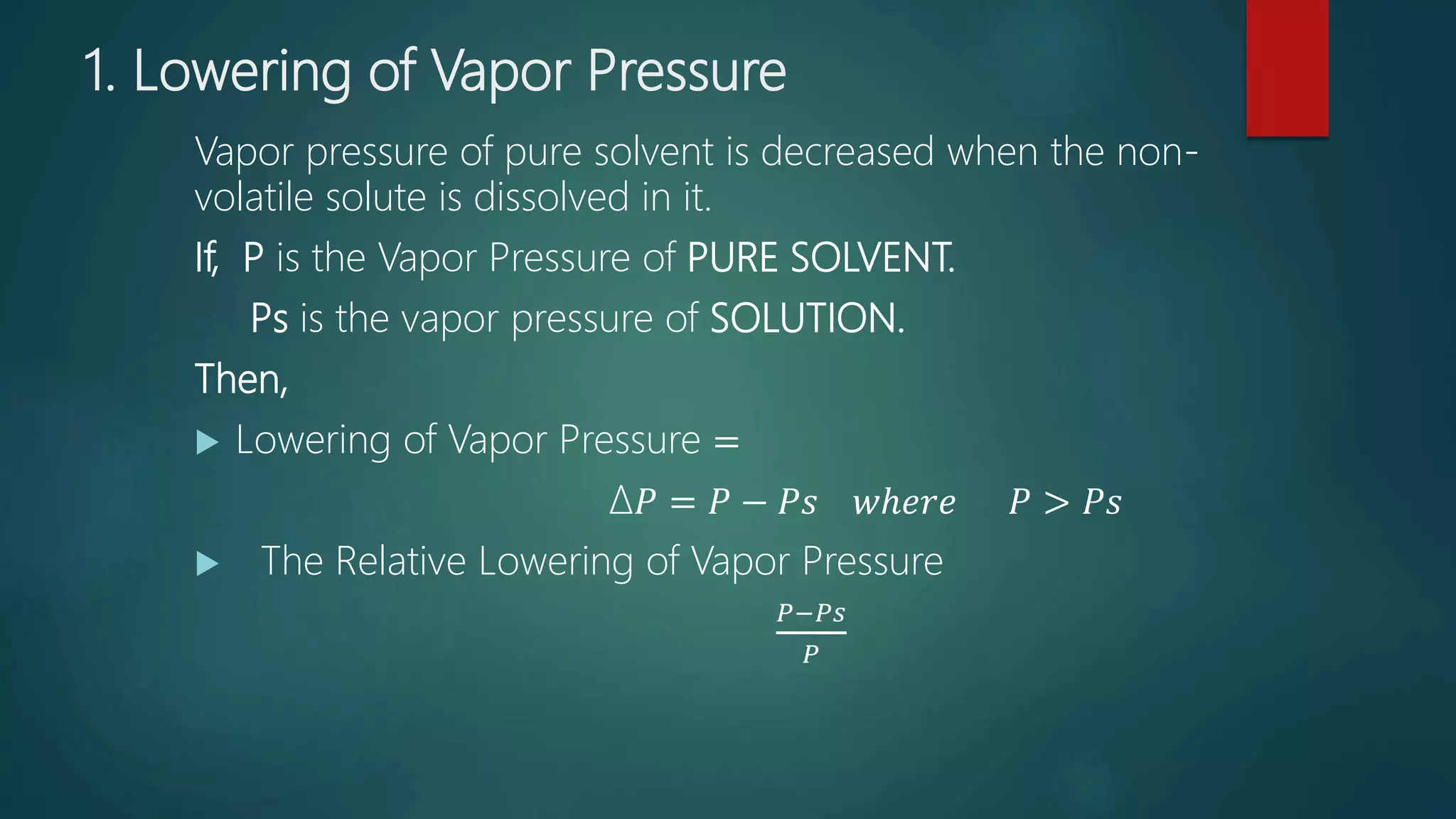
1. Lowering of Vapor Pressure
Vapor pressure of pure solvent is decreased when the non-
volatile solute is dissolved in it.
If, P is the Vapor Pressure of PURE SOLVENT.
Ps is the vapor pressure of SOLUTION.
Then,
 Lowering of Vapor Pressure =
Δ𝑃 = 𝑃 − 𝑃𝑠 𝑤ℎ𝑒𝑟𝑒 𝑃 > 𝑃𝑠
 The Relative Lowering of Vapor Pressure
𝑃−𝑃𝑠
𝑃
Relative Lowering of Vapor Pressure
The lowering of vapor pressure is relative to the vapor
pressure of pure solvent is referred as a Relative Lowering of
Vapor Pressure.
Then,
 The Relative Lowering of Vapor Pressure
𝑃−𝑃𝑠
𝑃
Relative Lowering of Vapor Pressure
“The relative lowering of vapor pressure of solution (
𝑃−𝑃𝑠
𝑃
)is
equal to the mole fraction of solute (Xsolute).
Mathematically,
𝑃−𝑃𝑠
𝑃
= Xsolute
𝑃−𝑃𝑠
𝑃
=
𝑛
𝑛+𝑁
Here “P>Ps”
NOTE:- The Relative Lowering Of Vapor Pressure
is referred to the all values relative to the
Vapor pressure of Pure Solvent.
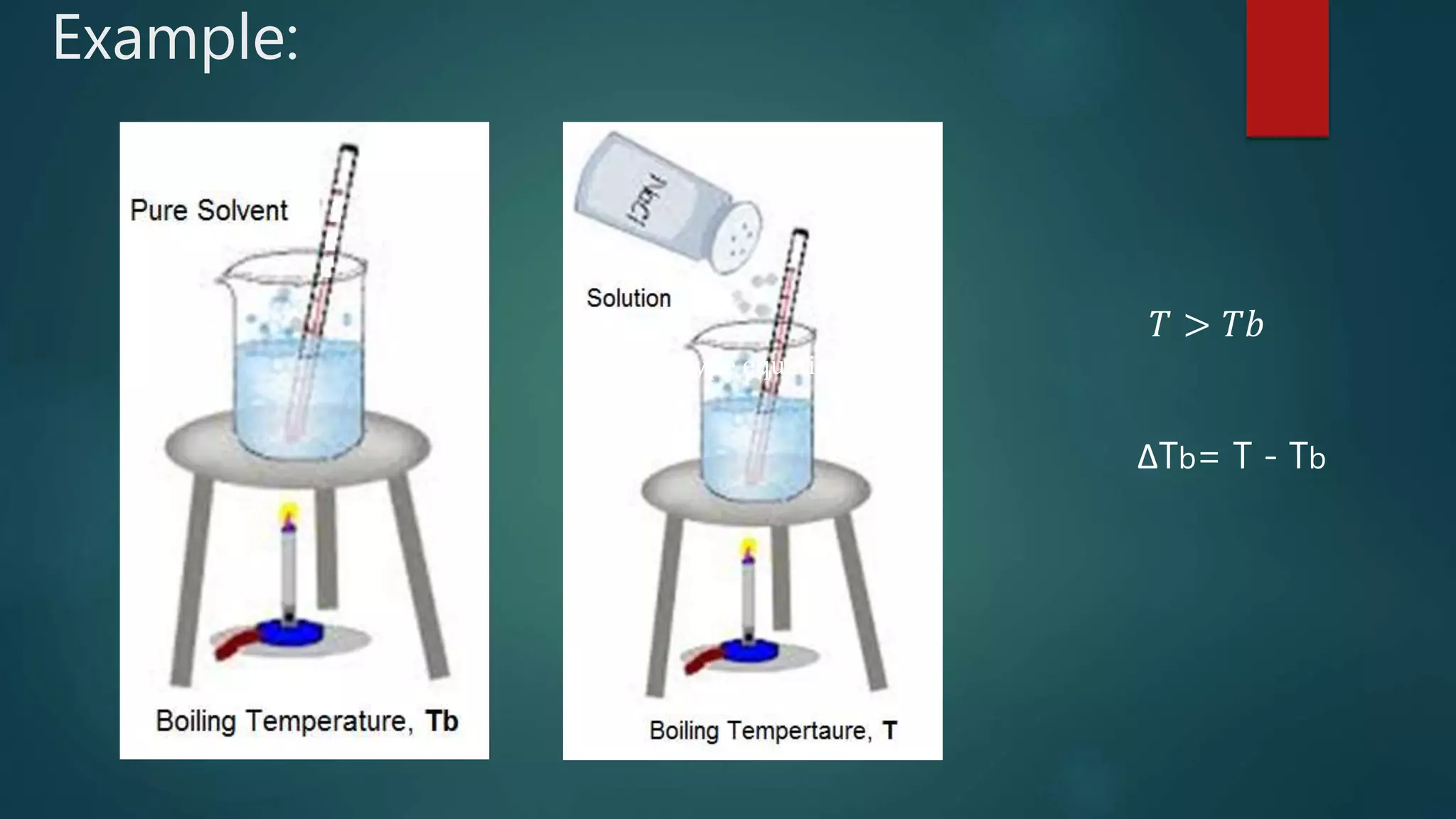
2. Boiling Point Elevation
 Boiling occurs when the vapor
pressure of a liquid equals
atmospheric pressure.
 But since the vapor pressure of a
solution is always lower than that of
the pure solvent, more Heat will be
needed to boil the liquid.
Example:
Type equation here.
𝑇 > 𝑇𝑏
ΔTb= T - Tb
Boiling Point Elevation
 The quantitative relationship which describes this behavior
looks like this:
∆ Tb = Kbm
 ∆ Tb is the change in the boiling point.
 Kb is the "molal boiling point constant" which is a property
of the solvent.
 m is the molality of the solute in the solution.
3. Freezing Point Depression
 Freezing point depression is a colligative property observed in
solutions that results from the introduction of solute molecules to a
solvent. The freezing points of solutions are all lower than that of
the pure solvent and is directly proportional to the molality of the
solute.
Example:
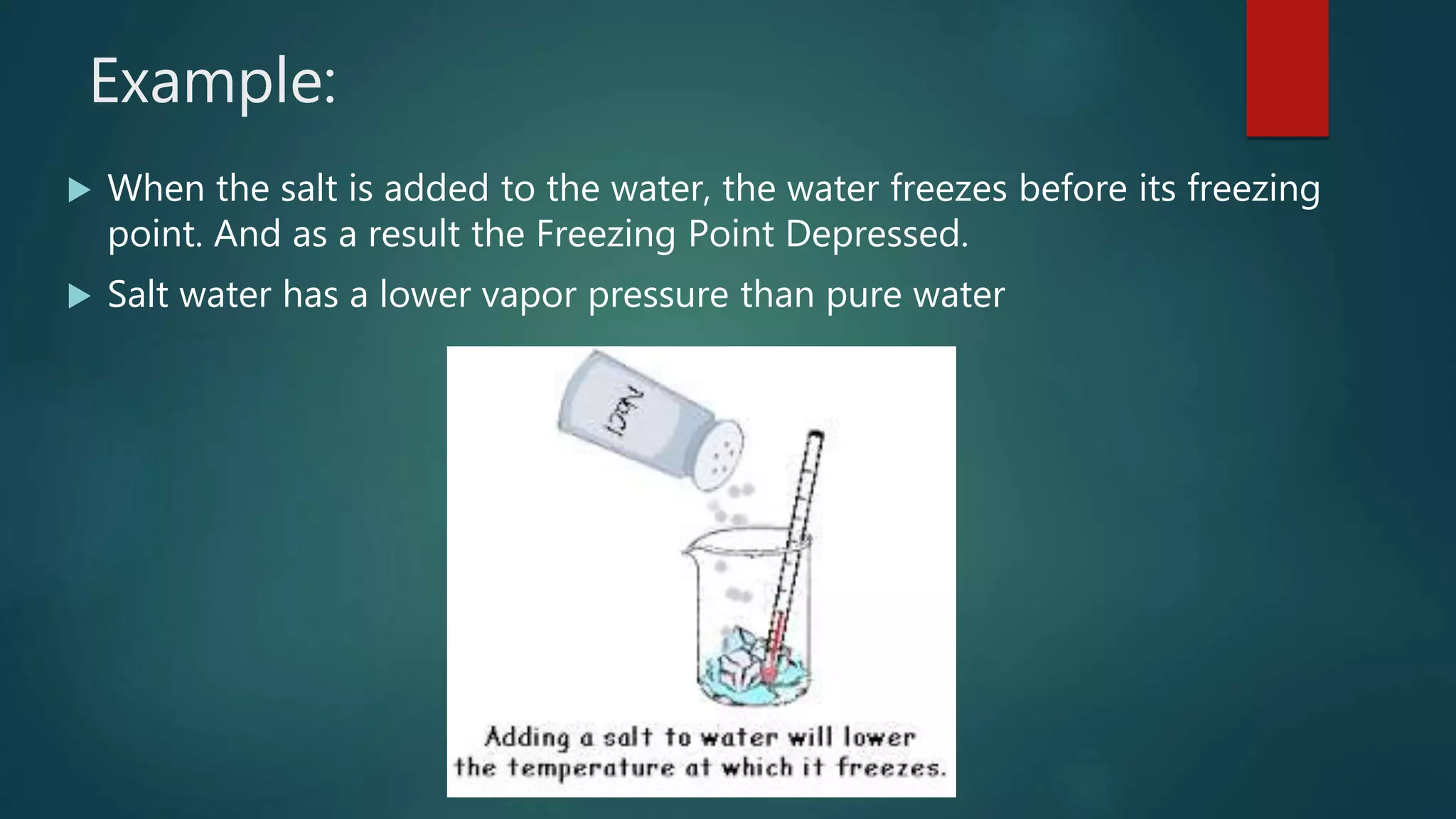
 When the salt is added to the water, the water freezes before its freezing
point. And as a result the Freezing Point Depressed.
 Salt water has a lower vapor pressure than pure water
𝑇𝑓 > 𝑇
ΔTf = Tf - T
Freezing Point Depression
 ∆ Tf=Kfm
 Where ∆ Tf is the freezing point depression, the change in
freezing point between the pure solvent and the solution.
 Kf is the molal freezing point constant. Values depend on
the solvent.
 m is the molality of the solute in the solution
THANKS FOR BEARING ME SO.!! :-P

RAOULT'S LAW ( Physical & Analytical Chemistry)

  • 1.
    Topic: RAOULT’S LAW ROLL#16 CH 42 HASNAIN NAWAZ PHYSICAL & ANALYTICAL CHEMISTRY
  • 2.
    CONTENTS OF RAOULT’SLAW  Introduction  Definition  Explanation.  Limitation of Raoult’s Law  Colligative Properties.  Lowering of Vapor Pressure.  Elevation of Boiling Point.  Depression of Freezing Point.
  • 3.
    Introduction  Presented in1887, By a French Chemist,  François-Marie Raoult
  • 4.
    Definition  The Lawstates that, “The vapor pressure of solution (Ps) is directly proportional to the mole fraction of solvent (Xsolvent). Mathematically, Psolution ∝ Xsolvent Psolution = K × Xsolvent Here “Ps=P=K” Psolution = Psolvent × Xsolvent
  • 5.
    Graphical Representation  Raoult’sLaw is a linear equation (y=mx+b)  A plot of Psolution vs mole fraction gives a straight line with a slope equal to Psolvent.  Psolution ∝ Xsolvent
  • 6.
    Vapor and VaporPressure  Vapor is the liquid molecule in gas form over the liquid surface.  Remove the liquid and you have a gas!  Vapor Pressure:  At the particular temperature, the pressure acted over the substance( solid or liquid) at which the Vapors are formed then that pressure is called Vapor Pressure.  The formation of Vapor always in Dynamic Equilibrium, means,  The rate at which the solid or liquid is evaporated is equal to the rate at which the liquid is condensed back to its original form.  All Solids and liquids have their own vapor pressure.
  • 7.
    Vapor Pressure ofSolutions  In a closed container at constant temperature an equilibrium vapor pressure is established.  Here the Dynamic Equilibrium is established. The picture on the left indicates that vapor molecules leave a solvent to dilute a solution.  The solute decreases the number of solvent molecules per unit volume lowering the tendency for the molecules to escape into vapor. Initial Final
  • 8.
    Vapor Pressure ofSolutions  The vapor pressure of a liquid in Solution and in Pure solvent is much different.  The vapor pressure of pure solvent is decreased when the non- volatile solute particles are dissolved in it.  The solute decreases the number of solvent molecules per unit volume lowering the tendency for the molecules to escape into vapor.
  • 9.
    Limitation of Raoult’sLaw  The Solution which obeys Raolt’s Law is called Ideal Solution. However the Real Solution deviates from Raolt’s Law.  Raolt’s Law is only applicable on the Dilute or Less Concentrated solutions.
  • 10.
    If AA DenotesSolvent-Solvent molecules, and AB denotes Solute & Solvent molecules and γ is attractive force between molecules then, For IDEAL SOLUTIONS, γAA = γAB While this is not true for, REAL SOLUTIONS, γAA < γAB or γAA > γAB
  • 11.
    Negative and PositiveDeviation  Negative Deviation: Positive Deviation If the vapor pressure of a Positive Deviation is when the mixture is lower than cohesive forces become expected from Raoult's law, dominant over adhesive ones. there is said to be a negative deviation. In negative deviation Adhesive forces between Like molecules is dominant Over the cohesive forces Between like molecules.
  • 12.
    Colligative Properties Definition: Colligative Propertiesare those properties, observed when the non-volatile solute particles are dissolved in the dilute solution.  Colligative Properties depend on No: of Particles (how many solute particles are present as well as the solvent amount). But these properties are independent of,  Nature of Substance  Chemical Reactivity of Substance.
  • 13.
     When thesolute is dissolved into a dilute solution, Following properties are exhibited.
  • 14.
    1. Lowering ofVapor Pressure Vapor pressure of pure solvent is decreased when the non- volatile solute is dissolved in it. If, P is the Vapor Pressure of PURE SOLVENT. Ps is the vapor pressure of SOLUTION. Then,  Lowering of Vapor Pressure = Δ𝑃 = 𝑃 − 𝑃𝑠 𝑤ℎ𝑒𝑟𝑒 𝑃 > 𝑃𝑠  The Relative Lowering of Vapor Pressure 𝑃−𝑃𝑠 𝑃
  • 15.
    Relative Lowering ofVapor Pressure The lowering of vapor pressure is relative to the vapor pressure of pure solvent is referred as a Relative Lowering of Vapor Pressure. Then,  The Relative Lowering of Vapor Pressure 𝑃−𝑃𝑠 𝑃
  • 16.
    Relative Lowering ofVapor Pressure “The relative lowering of vapor pressure of solution ( 𝑃−𝑃𝑠 𝑃 )is equal to the mole fraction of solute (Xsolute). Mathematically, 𝑃−𝑃𝑠 𝑃 = Xsolute 𝑃−𝑃𝑠 𝑃 = 𝑛 𝑛+𝑁 Here “P>Ps” NOTE:- The Relative Lowering Of Vapor Pressure is referred to the all values relative to the Vapor pressure of Pure Solvent.
  • 17.
    2. Boiling PointElevation  Boiling occurs when the vapor pressure of a liquid equals atmospheric pressure.  But since the vapor pressure of a solution is always lower than that of the pure solvent, more Heat will be needed to boil the liquid.
  • 18.
    Example: Type equation here. 𝑇> 𝑇𝑏 ΔTb= T - Tb
  • 19.
  • 20.
    Boiling Point Elevation The quantitative relationship which describes this behavior looks like this: ∆ Tb = Kbm  ∆ Tb is the change in the boiling point.  Kb is the "molal boiling point constant" which is a property of the solvent.  m is the molality of the solute in the solution.
  • 21.
    3. Freezing PointDepression  Freezing point depression is a colligative property observed in solutions that results from the introduction of solute molecules to a solvent. The freezing points of solutions are all lower than that of the pure solvent and is directly proportional to the molality of the solute.
  • 22.
    Example:  When thesalt is added to the water, the water freezes before its freezing point. And as a result the Freezing Point Depressed.  Salt water has a lower vapor pressure than pure water
  • 23.
    𝑇𝑓 > 𝑇 ΔTf= Tf - T Freezing Point Depression
  • 24.
    Freezing Point Depression ∆ Tf=Kfm  Where ∆ Tf is the freezing point depression, the change in freezing point between the pure solvent and the solution.  Kf is the molal freezing point constant. Values depend on the solvent.  m is the molality of the solute in the solution
  • 25.
    THANKS FOR BEARINGME SO.!! :-P