
Name : Muhammad Hamad Qureshi
Roll No. : D-19-CH-61
Department : Chemical Engineering DUET, Karachi.
Subject : Chemical engineering thermodynamics II
Topic : Raoult’s Law
Teacher : Sir Abdul Sattar Jatoi
Raoult’s law :
The vapour pressure of a solvent above a solution is equal to the product of the
vapour pressure of pure solvent and mole fraction of solvent in solution.
Mathematically
Psolution = ΧsolventP0
solvent ----------- (1)
Where, p is the vapour pressure of solvent in solution , p0
is the vapour pressure of
pure solvent and X is the mole fraction of solvent.
As we know that, x1 + x2 = 1
or x1 = 1- x2
Putting this value of x1 in equation (1)
p = p0
(1- x2)
p = p0
- p0
x2
p0
– p = p0
x2
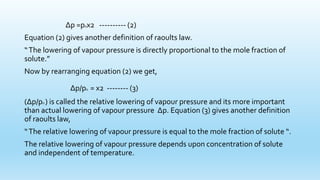
∆p =p0x2 ---------- (2)
Equation (2) gives another definition of raoults law.
“The lowering of vapour pressure is directly proportional to the mole fraction of
solute.”
Now by rearranging equation (2) we get,
∆p/p0 = x2 -------- (3)
(∆p/p0 ) is called the relative lowering of vapour pressure and its more important
than actual lowering of vapour pressure ∆p. Equation (3) gives another definition
of raoults law,
“The relative lowering of vapour pressure is equal to the mole fraction of solute “.
The relative lowering of vapour pressure depends upon concentration of solute
and independent of temperature.
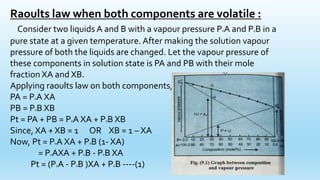
Raoults law when both components are volatile :
Consider two liquids A and B with a vapour pressure P0A and P0B in a
pure state at a given temperature. After making the solution vapour
pressure of both the liquids are changed. Let the vapour pressure of
these components in solution state is PA and PB with their mole
fraction XA and XB.
Applying raoults law on both components,
PA = P0A XA
PB = P0B XB
Pt = PA + PB = P0A XA + P0B XB
Since, XA + XB = 1 OR XB = 1 – XA
Now, Pt = P0A XA + P0B (1- XA)
= P0AXA + P0B - P0B XA
Pt = (P0A - P0B )XA + P0B ----(1)
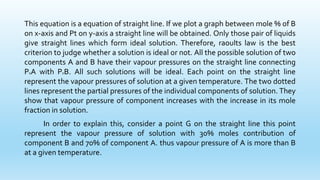
This equation is a equation of straight line. If we plot a graph between mole % of B
on x-axis and Pt on y-axis a straight line will be obtained. Only those pair of liquids
give straight lines which form ideal solution. Therefore, raoults law is the best
criterion to judge whether a solution is ideal or not. All the possible solution of two
components A and B have their vapour pressures on the straight line connecting
P0A with P0B. All such solutions will be ideal. Each point on the straight line
represent the vapour pressures of solution at a given temperature. The two dotted
lines represent the partial pressures of the individual components of solution. They
show that vapour pressure of component increases with the increase in its mole
fraction in solution.
In order to explain this, consider a point G on the straight line this point
represent the vapour pressure of solution with 30% moles contribution of
component B and 70% of component A. thus vapour pressure of A is more than B
at a given temperature.
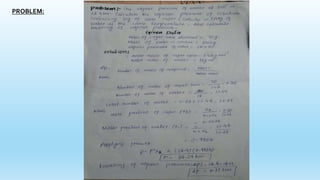
PROBLEM:
Thank you!

Roults law

  • 1.
    Name : MuhammadHamad Qureshi Roll No. : D-19-CH-61 Department : Chemical Engineering DUET, Karachi. Subject : Chemical engineering thermodynamics II Topic : Raoult’s Law Teacher : Sir Abdul Sattar Jatoi
  • 2.
    Raoult’s law : Thevapour pressure of a solvent above a solution is equal to the product of the vapour pressure of pure solvent and mole fraction of solvent in solution. Mathematically Psolution = ΧsolventP0 solvent ----------- (1) Where, p is the vapour pressure of solvent in solution , p0 is the vapour pressure of pure solvent and X is the mole fraction of solvent. As we know that, x1 + x2 = 1 or x1 = 1- x2 Putting this value of x1 in equation (1) p = p0 (1- x2) p = p0 - p0 x2 p0 – p = p0 x2
  • 3.
    ∆p =p0x2 ----------(2) Equation (2) gives another definition of raoults law. “The lowering of vapour pressure is directly proportional to the mole fraction of solute.” Now by rearranging equation (2) we get, ∆p/p0 = x2 -------- (3) (∆p/p0 ) is called the relative lowering of vapour pressure and its more important than actual lowering of vapour pressure ∆p. Equation (3) gives another definition of raoults law, “The relative lowering of vapour pressure is equal to the mole fraction of solute “. The relative lowering of vapour pressure depends upon concentration of solute and independent of temperature.
  • 4.
    Raoults law whenboth components are volatile : Consider two liquids A and B with a vapour pressure P0A and P0B in a pure state at a given temperature. After making the solution vapour pressure of both the liquids are changed. Let the vapour pressure of these components in solution state is PA and PB with their mole fraction XA and XB. Applying raoults law on both components, PA = P0A XA PB = P0B XB Pt = PA + PB = P0A XA + P0B XB Since, XA + XB = 1 OR XB = 1 – XA Now, Pt = P0A XA + P0B (1- XA) = P0AXA + P0B - P0B XA Pt = (P0A - P0B )XA + P0B ----(1)
  • 5.
    This equation isa equation of straight line. If we plot a graph between mole % of B on x-axis and Pt on y-axis a straight line will be obtained. Only those pair of liquids give straight lines which form ideal solution. Therefore, raoults law is the best criterion to judge whether a solution is ideal or not. All the possible solution of two components A and B have their vapour pressures on the straight line connecting P0A with P0B. All such solutions will be ideal. Each point on the straight line represent the vapour pressures of solution at a given temperature. The two dotted lines represent the partial pressures of the individual components of solution. They show that vapour pressure of component increases with the increase in its mole fraction in solution. In order to explain this, consider a point G on the straight line this point represent the vapour pressure of solution with 30% moles contribution of component B and 70% of component A. thus vapour pressure of A is more than B at a given temperature.
  • 6.
  • 7.