Ghani Khan Choudhury Institute of
Engineering & Technology
Title: Colligative properties
sub:- chemistry-ii
Name:-Khadija khatun
ROLL:- 35503424033
DEPT:- FOOD TECHNOLOGY
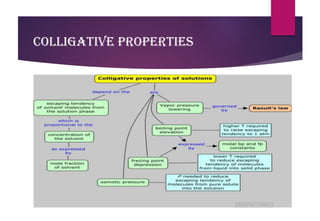
Colligative properties
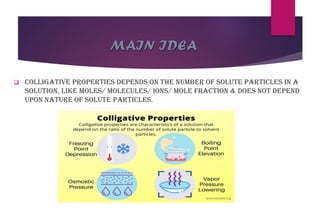
MAIN IDEA
❑ Colligative properties depends on the number of solute particles in a
solution, like moles/ molecules/ ions/ mole fraction & does not depend
upon nature of solute particles.
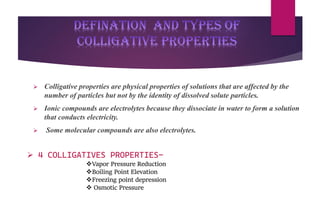
DEFINATION and types of
colligative properties
➢ Colligative properties are physical properties of solutions that are affected by the
number of particles but not by the identity of dissolved solute particles.
➢ Ionic compounds are electrolytes because they dissociate in water to form a solution
that conducts electricity.
➢ Some molecular compounds are also electrolytes.
➢ 4 COLLIGATIVES PROPERTIES-
❖Vapor Pressure Reduction
❖Boiling Point Elevation
❖Freezing point depression
❖ Osmotic Pressure
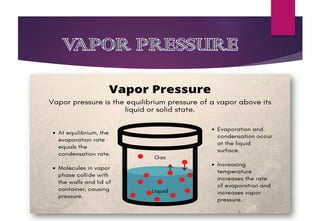
VAPOR PRESSURE
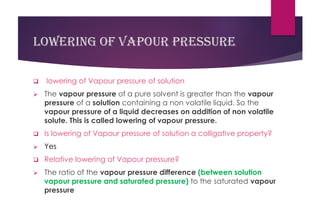
Lowering of vapour pressure
❑ lowering of Vapour pressure of solution
➢ The vapour pressure of a pure solvent is greater than the vapour
pressure of a solution containing a non volatile liquid. So the
vapour pressure of a liquid decreases on addition of non volatile
solute. This is called lowering of vapour pressure.
❑ Is lowering of Vapour pressure of solution a colligative property?
➢ Yes
❑ Relative lowering of Vapour pressure?
➢ The ratio of the vapour pressure difference (between solution
vapour pressure and saturated pressure) to the saturated vapour
pressure
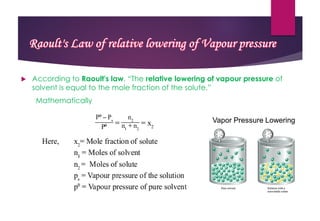
 According to Raoult's law, “The relative lowering of vapour pressure of
solvent is equal to the mole fraction of the solute.”
Mathematically
Raoult's Law of relative lowering of Vapour pressure
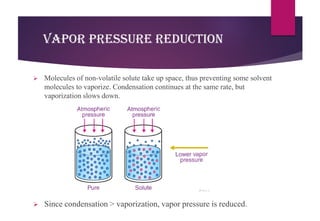
Vapor Pressure Reduction
➢ Molecules of non-volatile solute take up space, thus preventing some solvent
molecules to vaporize. Condensation continues at the same rate, but
vaporization slows down.
➢ Since condensation > vaporization, vapor pressure is reduced.
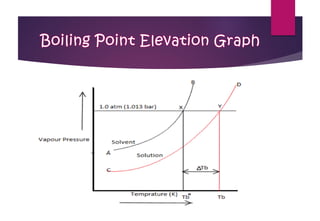
➢ Boiling-point elevation describes the phenomenon that the boiling point of a liquid
will be higher when another compound is added, meaning that a solution has a
higher boiling point than a pure solvent. This happens whenever a non-volatile
solute, such as a salt, is added to a pure solvent, such as water.
➢ Adding a non-volatile solute, reduces vapor pressure, more energy is
needed to make the solutions boil, raising the boiling point.
➢ Boiling point elevation = BP of the solution -BP of the solvent.
➢ Directly proportional to the number of solute molecules.
Boiling Point Elevation
Boiling Point Elevation Graph
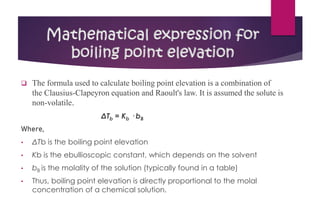
❑ The formula used to calculate boiling point elevation is a combination of
the Clausius-Clapeyron equation and Raoult's law. It is assumed the solute is
non-volatile.
ΔTb = Kb · bB
Where,
• ΔTb is the boiling point elevation
• Kb is the ebullioscopic constant, which depends on the solvent
• bB is the molality of the solution (typically found in a table)
• Thus, boiling point elevation is directly proportional to the molal
concentration of a chemical solution.
Mathematical expression for
boiling point elevation
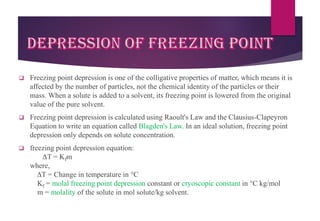
❑ Freezing point depression is one of the colligative properties of matter, which means it is
affected by the number of particles, not the chemical identity of the particles or their
mass. When a solute is added to a solvent, its freezing point is lowered from the original
value of the pure solvent.
❑ Freezing point depression is calculated using Raoult's Law and the Clausius-Clapeyron
Equation to write an equation called Blagden's Law. In an ideal solution, freezing point
depression only depends on solute concentration.
❑ freezing point depression equation:
ΔT = Kfm
where,
ΔT = Change in temperature in °C
Kf = molal freezing point depression constant or cryoscopic constant in °C kg/mol
m = molality of the solute in mol solute/kg solvent.
Depression of Freezing point
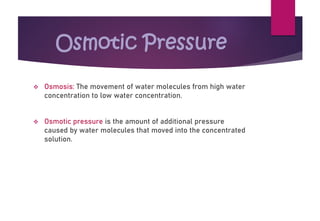
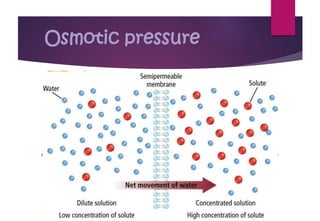
❖ Osmosis: The movement of water molecules from high water
concentration to low water concentration.
❖ Osmotic pressure is the amount of additional pressure
caused by water molecules that moved into the concentrated
solution.
Osmotic Pressure
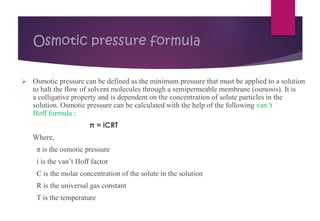
Osmotic pressure formula
➢ Osmotic pressure can be defined as the minimum pressure that must be applied to a solution
to halt the flow of solvent molecules through a semipermeable membrane (osmosis). It is
a colligative property and is dependent on the concentration of solute particles in the
solution. Osmotic pressure can be calculated with the help of the following van 't
Hoff formula :
π = iCRT
Where,
π is the osmotic pressure
i is the van’t Hoff factor
C is the molar concentration of the solute in the solution
R is the universal gas constant
T is the temperature
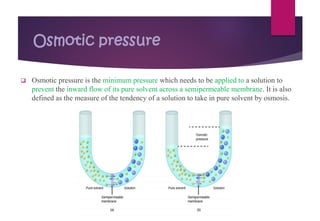
Osmotic pressure
❑ Osmotic pressure is the minimum pressure which needs to be applied to a solution to
prevent the inward flow of its pure solvent across a semipermeable membrane. It is also
defined as the measure of the tendency of a solution to take in pure solvent by osmosis.
Osmotic pressure
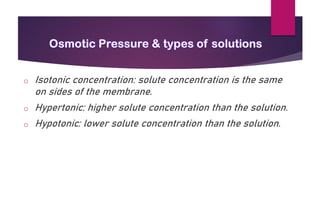
o Isotonic concentration: solute concentration is the same
on sides of the membrane.
o Hypertonic: higher solute concentration than the solution.
o Hypotonic: lower solute concentration than the solution.
Osmotic Pressure & types of solutions
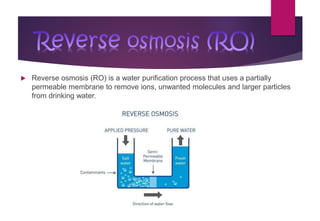
 Reverse osmosis (RO) is a water purification process that uses a partially
permeable membrane to remove ions, unwanted molecules and larger particles
from drinking water.
Reverse osmosis (RO)
CONCLUSION AND REFFERENCE
CONCLUSION
Colligative properties depend only on the number of solute particles in a solution, not their
type. These include vapor pressure lowering, boiling point elevation, freezing point depression,
and osmotic pressure. They are useful in real-life applications like antifreeze, food preservation,
and calculating molar mass.
REFERENCES
➢ Atkins & de Paula, Physical Chemistry, Oxford Univ. Press
➢ Chang & Goldsby, Chemistry, McGraw-Hill
➢ Petrucci et al., General Chemistry, Pearson
T H A N K
Y O U


Khadija khatun 1234567890000000000000000

  • 1.
    Ghani Khan ChoudhuryInstitute of Engineering & Technology Title: Colligative properties sub:- chemistry-ii Name:-Khadija khatun ROLL:- 35503424033 DEPT:- FOOD TECHNOLOGY
  • 2.
  • 3.
    MAIN IDEA ❑ Colligativeproperties depends on the number of solute particles in a solution, like moles/ molecules/ ions/ mole fraction & does not depend upon nature of solute particles.
  • 4.
    DEFINATION and typesof colligative properties ➢ Colligative properties are physical properties of solutions that are affected by the number of particles but not by the identity of dissolved solute particles. ➢ Ionic compounds are electrolytes because they dissociate in water to form a solution that conducts electricity. ➢ Some molecular compounds are also electrolytes. ➢ 4 COLLIGATIVES PROPERTIES- ❖Vapor Pressure Reduction ❖Boiling Point Elevation ❖Freezing point depression ❖ Osmotic Pressure
  • 5.
  • 6.
    Lowering of vapourpressure ❑ lowering of Vapour pressure of solution ➢ The vapour pressure of a pure solvent is greater than the vapour pressure of a solution containing a non volatile liquid. So the vapour pressure of a liquid decreases on addition of non volatile solute. This is called lowering of vapour pressure. ❑ Is lowering of Vapour pressure of solution a colligative property? ➢ Yes ❑ Relative lowering of Vapour pressure? ➢ The ratio of the vapour pressure difference (between solution vapour pressure and saturated pressure) to the saturated vapour pressure
  • 7.
     According toRaoult's law, “The relative lowering of vapour pressure of solvent is equal to the mole fraction of the solute.” Mathematically Raoult's Law of relative lowering of Vapour pressure
  • 8.
    Vapor Pressure Reduction ➢Molecules of non-volatile solute take up space, thus preventing some solvent molecules to vaporize. Condensation continues at the same rate, but vaporization slows down. ➢ Since condensation > vaporization, vapor pressure is reduced.
  • 9.
    ➢ Boiling-point elevationdescribes the phenomenon that the boiling point of a liquid will be higher when another compound is added, meaning that a solution has a higher boiling point than a pure solvent. This happens whenever a non-volatile solute, such as a salt, is added to a pure solvent, such as water. ➢ Adding a non-volatile solute, reduces vapor pressure, more energy is needed to make the solutions boil, raising the boiling point. ➢ Boiling point elevation = BP of the solution -BP of the solvent. ➢ Directly proportional to the number of solute molecules. Boiling Point Elevation
  • 10.
  • 11.
    ❑ The formulaused to calculate boiling point elevation is a combination of the Clausius-Clapeyron equation and Raoult's law. It is assumed the solute is non-volatile. ΔTb = Kb · bB Where, • ΔTb is the boiling point elevation • Kb is the ebullioscopic constant, which depends on the solvent • bB is the molality of the solution (typically found in a table) • Thus, boiling point elevation is directly proportional to the molal concentration of a chemical solution. Mathematical expression for boiling point elevation
  • 12.
    ❑ Freezing pointdepression is one of the colligative properties of matter, which means it is affected by the number of particles, not the chemical identity of the particles or their mass. When a solute is added to a solvent, its freezing point is lowered from the original value of the pure solvent. ❑ Freezing point depression is calculated using Raoult's Law and the Clausius-Clapeyron Equation to write an equation called Blagden's Law. In an ideal solution, freezing point depression only depends on solute concentration. ❑ freezing point depression equation: ΔT = Kfm where, ΔT = Change in temperature in °C Kf = molal freezing point depression constant or cryoscopic constant in °C kg/mol m = molality of the solute in mol solute/kg solvent. Depression of Freezing point
  • 13.
    ❖ Osmosis: Themovement of water molecules from high water concentration to low water concentration. ❖ Osmotic pressure is the amount of additional pressure caused by water molecules that moved into the concentrated solution. Osmotic Pressure
  • 14.
    Osmotic pressure formula ➢Osmotic pressure can be defined as the minimum pressure that must be applied to a solution to halt the flow of solvent molecules through a semipermeable membrane (osmosis). It is a colligative property and is dependent on the concentration of solute particles in the solution. Osmotic pressure can be calculated with the help of the following van 't Hoff formula : π = iCRT Where, π is the osmotic pressure i is the van’t Hoff factor C is the molar concentration of the solute in the solution R is the universal gas constant T is the temperature
  • 15.
    Osmotic pressure ❑ Osmoticpressure is the minimum pressure which needs to be applied to a solution to prevent the inward flow of its pure solvent across a semipermeable membrane. It is also defined as the measure of the tendency of a solution to take in pure solvent by osmosis.
  • 16.
  • 17.
    o Isotonic concentration:solute concentration is the same on sides of the membrane. o Hypertonic: higher solute concentration than the solution. o Hypotonic: lower solute concentration than the solution. Osmotic Pressure & types of solutions
  • 18.
     Reverse osmosis(RO) is a water purification process that uses a partially permeable membrane to remove ions, unwanted molecules and larger particles from drinking water. Reverse osmosis (RO)
  • 19.
    CONCLUSION AND REFFERENCE CONCLUSION Colligativeproperties depend only on the number of solute particles in a solution, not their type. These include vapor pressure lowering, boiling point elevation, freezing point depression, and osmotic pressure. They are useful in real-life applications like antifreeze, food preservation, and calculating molar mass. REFERENCES ➢ Atkins & de Paula, Physical Chemistry, Oxford Univ. Press ➢ Chang & Goldsby, Chemistry, McGraw-Hill ➢ Petrucci et al., General Chemistry, Pearson T H A N K Y O U