Randomized Controlled
Trials
LEARNING OUTCOMES
By the end of the presentation you should be able to:
1. Define randomized control trails, their types, advantages and
disadvantages
2. Describe the steps involved in randomization process, blinding,
quality control
3. Discuss methods used to reduce bias in RCT
4. Demonstrate how to register and report RCT
5. Critique a published RCT
RCT
RANDOMIZED CONTROLLED
TRIAL
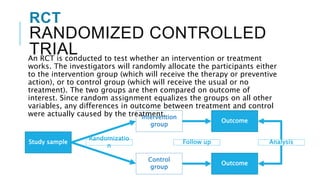
An RCT is conducted to test whether an intervention or treatment
works. The investigators will randomly allocate the participants either
to the intervention group (which will receive the therapy or preventive
action), or to control group (which will receive the usual or no
treatment). The two groups are then compared on outcome of
interest. Since random assignment equalizes the groups on all other
variables, any differences in outcome between treatment and control
were actually caused by the treatment.
Study sample
Intervention
group
Control
group
Outcome
Outcome
Randomizatio
n
Follow up Analysis
RANDOMISATION:
STEPS IN A TYPICAL
RANDOMISATION PROCESS
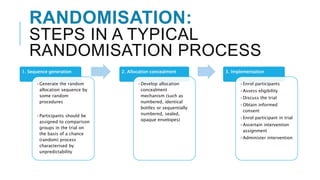
1. Sequence generation
•Generate the random
allocation sequence by
some random
procedures
•Participants should be
assigned to comparison
groups in the trial on
the basis of a chance
(random) process
characterised by
unpredictability
2. Allocation concealment
•Develop allocation
concealment
mechanism (such as
numbered, identical
bottles or sequentially
numbered, sealed,
opaque envelopes)
3. Implementation
•Enrol participants
•Assess eligibility
•Discuss the trial
•Obtain informed
consent
•Enrol participant in trial
•Ascertain intervention
assignment
•Administer intervention
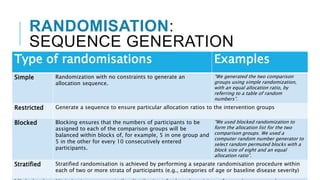
RANDOMISATION:
SEQUENCE GENERATION
Type of randomisations Examples
Simple Randomization with no constraints to generate an
allocation sequence.
“We generated the two comparison
groups using simple randomization,
with an equal allocation ratio, by
referring to a table of random
numbers”.
Restricted Generate a sequence to ensure particular allocation ratios to the intervention groups
Blocked Blocking ensures that the numbers of participants to be
assigned to each of the comparison groups will be
balanced within blocks of, for example, 5 in one group and
5 in the other for every 10 consecutively entered
participants.
“We used blocked randomization to
form the allocation list for the two
comparison groups. We used a
computer random number generator to
select random permuted blocks with a
block size of eight and an equal
allocation ratio”.
Stratified Stratified randomisation is achieved by performing a separate randomisation procedure within
each of two or more strata of participants (e.g., categories of age or baseline disease severity)
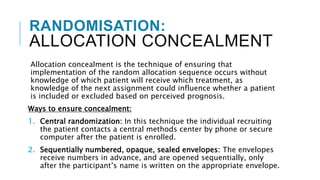
RANDOMISATION:
ALLOCATION CONCEALMENT
Allocation concealment is the technique of ensuring that
implementation of the random allocation sequence occurs without
knowledge of which patient will receive which treatment, as
knowledge of the next assignment could influence whether a patient
is included or excluded based on perceived prognosis.
Ways to ensure concealment:
1. Central randomization: In this technique the individual recruiting
the patient contacts a central methods center by phone or secure
computer after the patient is enrolled.
2. Sequentially numbered, opaque, sealed envelopes: The envelopes
receive numbers in advance, and are opened sequentially, only
after the participant’s name is written on the appropriate envelope.
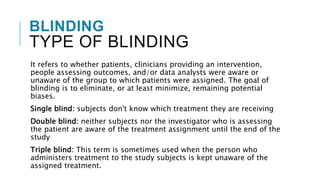
BLINDING
TYPE OF BLINDING
It refers to whether patients, clinicians providing an intervention,
people assessing outcomes, and/or data analysts were aware or
unaware of the group to which patients were assigned. The goal of
blinding is to eliminate, or at least minimize, remaining potential
biases.
Single blind: subjects don't know which treatment they are receiving
Double blind: neither subjects nor the investigator who is assessing
the patient are aware of the treatment assignment until the end of the
study
Triple blind: This term is sometimes used when the person who
administers treatment to the study subjects is kept unaware of the
assigned treatment.
Quality Control
PROTOCOL ADHERENCE & TREATMENT FIDELITY:
As the independent variable, the treatment plays the lead role in a trial
testing whether an intervention works. Procedures need to be in place to
ensure that the intervention is implemented as intended
QUALITY MONITORING:
Ongoing quality monitoring is necessary to detect errors and missing
data in a timely manner that allows them to be corrected.
ADVERSE EVENTS AND SERIOUS ADVERSE EVENTS
Methods need to be in place to identify and report adverse events (AE), or
A serious life-threatening adverse event (SAE) that occur during the
course of a study.
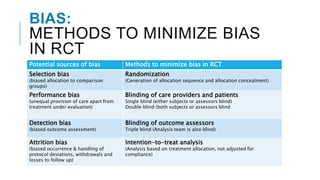
BIAS:
METHODS TO MINIMIZE BIAS
IN RCT
Potential sources of bias Methods to minimize bias in RCT
Selection bias
(biased allocation to comparison
groups)
Randomization
(Generation of allocation sequence and allocation concealment)
Performance bias
(unequal provision of care apart from
treatment under evaluation)
Blinding of care providers and patients
Single blind (either subjects or assessors blind)
Double blind (both subjects or assessors blind
Detection bias
(biased outcome assessment)
Blinding of outcome assessors
Triple blind (Analysis team is also blind)
Attrition bias
(biased occurrence & handling of
protocol deviations, withdrawals and
losses to follow up)
Intention-to-treat analysis
(Analysis based on treatment allocation, not adjusted for
compliance)
RCT
DIFFERENT TYPES OF RCT
DESIGN
There are several variations on the basic RCT design:
Cross-over Design
This describes a special case of a randomized controlled trial wherein each
subject serves as his/her own control. In this design, a study is divided
into two time periods: During the first time period, each participant
receives either the control treatment or the experimental treatment.
During the second time period, participants switch conditions. The initial
treatment each subject receives is determined by random assignment.
Cluster randomized design
Whole groups of participants (e.g., schools, clinics, worksites) are
randomized to intervention or control. The unit of randomization is a
group rather than an individual.
RCT:
ADVANTAGES &
DISADVANTAGES
Advantages
1. Eliminates selection bias, balancing
both known and unknown
prognostic factors by distributing
confounders equally between the
groups to be compared for the
outcome.
2. Random assignment permits the
use of probability theory to express
the likelihood that any difference in
outcome between intervention
groups merely reflects chance
3. Facilitates blinding the identity of
treatments to the investigators,
participants, and evaluators which
reduces bias after assignment of
treatments
Disadvantages
1. Expensive in terms of time,
personnel and resources
2. Ethical issues for certain
interventions or circumstances
3. May be unsuitable because of
problems of likely co-operation or
rarity of outcome
4. Tend to induce artificial situation
because of
 Volunteerism
 Strict eligibility criteria
 Highly standardised interventions
that may be different from occurs
in common practice (difference
between efficacy and effectiveness)
REPORTING RCT
CONSOLIDATED STANDARDS OF
REPORTING TRIALS
The CONSORT provides a set of standards for reporting the results of
randomised controlled trials (RCTs)
It encompasses various initiatives to alleviate the problems arising
from inadequate reporting of randomized controlled trials.
It is main product is the CONSORT Statement, which is an evidence-
based, minimum set of recommendations for reporting randomized
trials. It offers a standard way for authors to prepare reports of trial
findings, facilitating their complete and transparent reporting, and
aiding their critical appraisal and interpretation.
Assessed for eligibility (n= )
Excluded (n= )
¨ Not meeting inclusion criteria (n= )
¨ Declined to participate (n= )
¨ Other reasons (n= )
Analysed (n= )
¨ Excluded from analysis (give reasons) (n= )
Lost to follow-up (give reasons) (n= )
Discontinued intervention (give reasons) (n= )
Allocated to intervention (n= )
¨ Received allocated intervention (n= )
¨ Did not receive allocated intervention (give
reasons) (n= )
Lost to follow-up (give reasons) (n= )
Discontinued intervention (give reasons) (n= )
Allocated to intervention (n= )
¨ Received allocated intervention (n= )
¨ Did not receive allocated intervention (give
reasons) (n= )
Analysed (n= )
¨ Excluded from analysis (give reasons) (n= )
Allocation
Analysis
Follow-Up
Randomized (n= )
Enrollment
CONSORT 2010 Flow Diagram
CONSORT 2010 checklist of information to include when reporting a
randomised trial
Click here to download the checklist
Section/Topic
Item
No Checklist item
Reported on
page No
Methods
Trial design 3a Description of trial design (such as parallel, factorial) including allocation ratio
3b Important changes to methods after trial commencement (such as eligibility criteria), with reasons
Participants 4a Eligibility criteria for participants
4b Settings and locations where the data were collected
Interventions 5 The interventions for each group with sufficient details to allow replication, including how and when they were
actually administered
Outcomes 6a Completely defined pre-specified primary and secondary outcome measures, including how and when they
were assessed
6b Any changes to trial outcomes after the trial commenced, with reasons
Sample size 7a How sample size was determined
7b When applicable, explanation of any interim analyses and stopping guidelines
Randomisation:
Sequence
generation
8a Method used to generate the random allocation sequence
8b Type of randomisation; details of any restriction (such as blocking and block size)
Allocation
concealment
mechanism
9 Mechanism used to implement the random allocation sequence (such as sequentially numbered containers),
describing any steps taken to conceal the sequence until interventions were assigned
Implementation 10 Who generated the random allocation sequence, who enrolled participants, and who assigned participants to
interventions
Blinding 11a If done, who was blinded after assignment to interventions (for example, participants, care providers, those
assessing outcomes) and how
11b If relevant, description of the similarity of interventions
REGISTERING RCT
INTERNATIONAL CLINICAL TRIALS
REGISTRY PLATFORM
Trial registration: The registration of all interventional trials is a scientific, ethical and
moral responsibility.
The mission of the WHO ICTRP is to ensure that a complete view of research
is accessible to all those involved in health care decision making. This will
improve research transparency and will ultimately strengthen the validity and
value of the scientific evidence base.
WHO regards trial registration as the publication of an internationally-agreed
set of information about the design, conduct and administration of clinical
trials. These details are published on a publicly-accessible website managed
by a registry conforming to WHO standards.
Where to register a trial?
Details of RCTs should be submitted to any one of the Primary Registries in
the WHO Registry Network
EXAMPLE
Please click here to read this article
Click on the link to read the article. Read this article and use CONSORT checklist to verify its quality
Allocation
concealment
A technique used to prevent selection bias by concealing the allocation sequence from those assigning
participants to intervention groups, until the moment of assignment. Allocation concealment prevents
researchers from (unconsciously or otherwise) influencing which participants are assigned to a given intervention
group.
Allocation ratio The ratio of intended numbers of participants in each of the comparison groups. For two group trials, the
allocation ratio is usually 1:1, but unequal allocation (such as 1:2) is sometimes used.
Allocation sequence A list of intervention groups, randomly ordered, used to assign sequentially enrolled participants to intervention
groups. Also termed the "assignment schedule", "randomization schedule", or "randomization list".
Blinding (masking) - The practice of keeping the trial participants, care providers, those collecting data, and sometimes even those
analyzing data unaware of which intervention is being administered to which participant. Blinding is intended to
prevent bias on the part of study personnel. The most common application is "double-blinding", in which
participants, caregivers and those assessing outcome are blinded to intervention assignment. The term "masking"
may be used instead of blinding.
Enrollment The act of admitting a participant into a trial. Participants should be enrolled only after study personnel have
confirmed that all the eligibility criteria have been met. Formal enrollment must occur before randomized
assignment
Follow-up A process of periodic contact with participants enrolled in the randomized trial for the purpose of administering
the assigned intervention(s), modifying the course of intervention(s), observing the effects of the intervention(s),
or for data collection.
Generation of
allocation
sequence -
The procedure used to obtain the (random) sequence for making intervention assignments, such as use of a table
of random numbers or a computerized random-number generator. Options such as simple randomization,
blocked randomization, and stratified randomization are part of the generation of the allocation sequence.
GLOSSARY
GLOSSARY
Outcome (primary and
secondary)
An outcome variable of interest in the trial (also called an end point). Differences between groups in the
outcome variable(s) are believed to be the result of the differing interventions. The primary outcome is the
outcome of greatest importance. Data on secondary outcomes are used to evaluate additional effects of the
intervention.
Performance bias Systematic differences in the care provided to the participants in the comparison groups other than the
intervention under investigation.
Permuted block
design
An approach to generating an allocation sequence in which the number of assignments to intervention groups
satisfies a specified allocation ratio (such as 1:1 or 2:1) after every "block" of specified size. For example, a
block of size 12 would contain 6 A and 6 B with a ratio of 1:1 or 8 A and 4 B with a ratio of 2:1. Generating the
allocation sequence involves randomly selecting from all the permutations of assignments that meet the
specified ratio.
Prognostic variable A baseline variable that is prognostic in the absence of intervention Unrestricted, simple randomization can lead
to chance baseline imbalance in prognostic variables, which can affect the results and weaken the trial's
credibility. Stratification and minimization protect against such imbalances.
Selection bias Systematic error in creating intervention groups, such that they differ with respect to prognosis. That is, the
groups differ in measured or unmeasured baseline characteristics because of the way participants were selected
or assigned. Also used to mean that the participants are not representative of the population of all possible
participants.
Loss to follow-up The circumstance that occurs when researchers lose contact with some participants and thus cannot complete
planned data collection efforts. A common cause of missing data, especially in long-term studies.
Bias Systematic distortion of the estimated intervention effect away from the "truth", caused by inadequacies in the
design, conduct, or analysis of a trial.
Randomized Controlled Trial.pptx

Randomized Controlled Trial.pptx

  • 1.
  • 2.
    LEARNING OUTCOMES By theend of the presentation you should be able to: 1. Define randomized control trails, their types, advantages and disadvantages 2. Describe the steps involved in randomization process, blinding, quality control 3. Discuss methods used to reduce bias in RCT 4. Demonstrate how to register and report RCT 5. Critique a published RCT
  • 3.
    RCT RANDOMIZED CONTROLLED TRIAL An RCTis conducted to test whether an intervention or treatment works. The investigators will randomly allocate the participants either to the intervention group (which will receive the therapy or preventive action), or to control group (which will receive the usual or no treatment). The two groups are then compared on outcome of interest. Since random assignment equalizes the groups on all other variables, any differences in outcome between treatment and control were actually caused by the treatment. Study sample Intervention group Control group Outcome Outcome Randomizatio n Follow up Analysis
  • 4.
    RANDOMISATION: STEPS IN ATYPICAL RANDOMISATION PROCESS 1. Sequence generation •Generate the random allocation sequence by some random procedures •Participants should be assigned to comparison groups in the trial on the basis of a chance (random) process characterised by unpredictability 2. Allocation concealment •Develop allocation concealment mechanism (such as numbered, identical bottles or sequentially numbered, sealed, opaque envelopes) 3. Implementation •Enrol participants •Assess eligibility •Discuss the trial •Obtain informed consent •Enrol participant in trial •Ascertain intervention assignment •Administer intervention
  • 5.
    RANDOMISATION: SEQUENCE GENERATION Type ofrandomisations Examples Simple Randomization with no constraints to generate an allocation sequence. “We generated the two comparison groups using simple randomization, with an equal allocation ratio, by referring to a table of random numbers”. Restricted Generate a sequence to ensure particular allocation ratios to the intervention groups Blocked Blocking ensures that the numbers of participants to be assigned to each of the comparison groups will be balanced within blocks of, for example, 5 in one group and 5 in the other for every 10 consecutively entered participants. “We used blocked randomization to form the allocation list for the two comparison groups. We used a computer random number generator to select random permuted blocks with a block size of eight and an equal allocation ratio”. Stratified Stratified randomisation is achieved by performing a separate randomisation procedure within each of two or more strata of participants (e.g., categories of age or baseline disease severity)
  • 6.
    RANDOMISATION: ALLOCATION CONCEALMENT Allocation concealmentis the technique of ensuring that implementation of the random allocation sequence occurs without knowledge of which patient will receive which treatment, as knowledge of the next assignment could influence whether a patient is included or excluded based on perceived prognosis. Ways to ensure concealment: 1. Central randomization: In this technique the individual recruiting the patient contacts a central methods center by phone or secure computer after the patient is enrolled. 2. Sequentially numbered, opaque, sealed envelopes: The envelopes receive numbers in advance, and are opened sequentially, only after the participant’s name is written on the appropriate envelope.
  • 7.
    BLINDING TYPE OF BLINDING Itrefers to whether patients, clinicians providing an intervention, people assessing outcomes, and/or data analysts were aware or unaware of the group to which patients were assigned. The goal of blinding is to eliminate, or at least minimize, remaining potential biases. Single blind: subjects don't know which treatment they are receiving Double blind: neither subjects nor the investigator who is assessing the patient are aware of the treatment assignment until the end of the study Triple blind: This term is sometimes used when the person who administers treatment to the study subjects is kept unaware of the assigned treatment.
  • 8.
    Quality Control PROTOCOL ADHERENCE& TREATMENT FIDELITY: As the independent variable, the treatment plays the lead role in a trial testing whether an intervention works. Procedures need to be in place to ensure that the intervention is implemented as intended QUALITY MONITORING: Ongoing quality monitoring is necessary to detect errors and missing data in a timely manner that allows them to be corrected. ADVERSE EVENTS AND SERIOUS ADVERSE EVENTS Methods need to be in place to identify and report adverse events (AE), or A serious life-threatening adverse event (SAE) that occur during the course of a study.
  • 9.
    BIAS: METHODS TO MINIMIZEBIAS IN RCT Potential sources of bias Methods to minimize bias in RCT Selection bias (biased allocation to comparison groups) Randomization (Generation of allocation sequence and allocation concealment) Performance bias (unequal provision of care apart from treatment under evaluation) Blinding of care providers and patients Single blind (either subjects or assessors blind) Double blind (both subjects or assessors blind Detection bias (biased outcome assessment) Blinding of outcome assessors Triple blind (Analysis team is also blind) Attrition bias (biased occurrence & handling of protocol deviations, withdrawals and losses to follow up) Intention-to-treat analysis (Analysis based on treatment allocation, not adjusted for compliance)
  • 10.
    RCT DIFFERENT TYPES OFRCT DESIGN There are several variations on the basic RCT design: Cross-over Design This describes a special case of a randomized controlled trial wherein each subject serves as his/her own control. In this design, a study is divided into two time periods: During the first time period, each participant receives either the control treatment or the experimental treatment. During the second time period, participants switch conditions. The initial treatment each subject receives is determined by random assignment. Cluster randomized design Whole groups of participants (e.g., schools, clinics, worksites) are randomized to intervention or control. The unit of randomization is a group rather than an individual.
  • 11.
    RCT: ADVANTAGES & DISADVANTAGES Advantages 1. Eliminatesselection bias, balancing both known and unknown prognostic factors by distributing confounders equally between the groups to be compared for the outcome. 2. Random assignment permits the use of probability theory to express the likelihood that any difference in outcome between intervention groups merely reflects chance 3. Facilitates blinding the identity of treatments to the investigators, participants, and evaluators which reduces bias after assignment of treatments Disadvantages 1. Expensive in terms of time, personnel and resources 2. Ethical issues for certain interventions or circumstances 3. May be unsuitable because of problems of likely co-operation or rarity of outcome 4. Tend to induce artificial situation because of  Volunteerism  Strict eligibility criteria  Highly standardised interventions that may be different from occurs in common practice (difference between efficacy and effectiveness)
  • 12.
    REPORTING RCT CONSOLIDATED STANDARDSOF REPORTING TRIALS The CONSORT provides a set of standards for reporting the results of randomised controlled trials (RCTs) It encompasses various initiatives to alleviate the problems arising from inadequate reporting of randomized controlled trials. It is main product is the CONSORT Statement, which is an evidence- based, minimum set of recommendations for reporting randomized trials. It offers a standard way for authors to prepare reports of trial findings, facilitating their complete and transparent reporting, and aiding their critical appraisal and interpretation.
  • 13.
    Assessed for eligibility(n= ) Excluded (n= ) ¨ Not meeting inclusion criteria (n= ) ¨ Declined to participate (n= ) ¨ Other reasons (n= ) Analysed (n= ) ¨ Excluded from analysis (give reasons) (n= ) Lost to follow-up (give reasons) (n= ) Discontinued intervention (give reasons) (n= ) Allocated to intervention (n= ) ¨ Received allocated intervention (n= ) ¨ Did not receive allocated intervention (give reasons) (n= ) Lost to follow-up (give reasons) (n= ) Discontinued intervention (give reasons) (n= ) Allocated to intervention (n= ) ¨ Received allocated intervention (n= ) ¨ Did not receive allocated intervention (give reasons) (n= ) Analysed (n= ) ¨ Excluded from analysis (give reasons) (n= ) Allocation Analysis Follow-Up Randomized (n= ) Enrollment CONSORT 2010 Flow Diagram
  • 14.
    CONSORT 2010 checklistof information to include when reporting a randomised trial Click here to download the checklist Section/Topic Item No Checklist item Reported on page No Methods Trial design 3a Description of trial design (such as parallel, factorial) including allocation ratio 3b Important changes to methods after trial commencement (such as eligibility criteria), with reasons Participants 4a Eligibility criteria for participants 4b Settings and locations where the data were collected Interventions 5 The interventions for each group with sufficient details to allow replication, including how and when they were actually administered Outcomes 6a Completely defined pre-specified primary and secondary outcome measures, including how and when they were assessed 6b Any changes to trial outcomes after the trial commenced, with reasons Sample size 7a How sample size was determined 7b When applicable, explanation of any interim analyses and stopping guidelines Randomisation: Sequence generation 8a Method used to generate the random allocation sequence 8b Type of randomisation; details of any restriction (such as blocking and block size) Allocation concealment mechanism 9 Mechanism used to implement the random allocation sequence (such as sequentially numbered containers), describing any steps taken to conceal the sequence until interventions were assigned Implementation 10 Who generated the random allocation sequence, who enrolled participants, and who assigned participants to interventions Blinding 11a If done, who was blinded after assignment to interventions (for example, participants, care providers, those assessing outcomes) and how 11b If relevant, description of the similarity of interventions
  • 15.
    REGISTERING RCT INTERNATIONAL CLINICALTRIALS REGISTRY PLATFORM Trial registration: The registration of all interventional trials is a scientific, ethical and moral responsibility. The mission of the WHO ICTRP is to ensure that a complete view of research is accessible to all those involved in health care decision making. This will improve research transparency and will ultimately strengthen the validity and value of the scientific evidence base. WHO regards trial registration as the publication of an internationally-agreed set of information about the design, conduct and administration of clinical trials. These details are published on a publicly-accessible website managed by a registry conforming to WHO standards. Where to register a trial? Details of RCTs should be submitted to any one of the Primary Registries in the WHO Registry Network
  • 16.
    EXAMPLE Please click hereto read this article Click on the link to read the article. Read this article and use CONSORT checklist to verify its quality
  • 17.
    Allocation concealment A technique usedto prevent selection bias by concealing the allocation sequence from those assigning participants to intervention groups, until the moment of assignment. Allocation concealment prevents researchers from (unconsciously or otherwise) influencing which participants are assigned to a given intervention group. Allocation ratio The ratio of intended numbers of participants in each of the comparison groups. For two group trials, the allocation ratio is usually 1:1, but unequal allocation (such as 1:2) is sometimes used. Allocation sequence A list of intervention groups, randomly ordered, used to assign sequentially enrolled participants to intervention groups. Also termed the "assignment schedule", "randomization schedule", or "randomization list". Blinding (masking) - The practice of keeping the trial participants, care providers, those collecting data, and sometimes even those analyzing data unaware of which intervention is being administered to which participant. Blinding is intended to prevent bias on the part of study personnel. The most common application is "double-blinding", in which participants, caregivers and those assessing outcome are blinded to intervention assignment. The term "masking" may be used instead of blinding. Enrollment The act of admitting a participant into a trial. Participants should be enrolled only after study personnel have confirmed that all the eligibility criteria have been met. Formal enrollment must occur before randomized assignment Follow-up A process of periodic contact with participants enrolled in the randomized trial for the purpose of administering the assigned intervention(s), modifying the course of intervention(s), observing the effects of the intervention(s), or for data collection. Generation of allocation sequence - The procedure used to obtain the (random) sequence for making intervention assignments, such as use of a table of random numbers or a computerized random-number generator. Options such as simple randomization, blocked randomization, and stratified randomization are part of the generation of the allocation sequence. GLOSSARY
  • 18.
    GLOSSARY Outcome (primary and secondary) Anoutcome variable of interest in the trial (also called an end point). Differences between groups in the outcome variable(s) are believed to be the result of the differing interventions. The primary outcome is the outcome of greatest importance. Data on secondary outcomes are used to evaluate additional effects of the intervention. Performance bias Systematic differences in the care provided to the participants in the comparison groups other than the intervention under investigation. Permuted block design An approach to generating an allocation sequence in which the number of assignments to intervention groups satisfies a specified allocation ratio (such as 1:1 or 2:1) after every "block" of specified size. For example, a block of size 12 would contain 6 A and 6 B with a ratio of 1:1 or 8 A and 4 B with a ratio of 2:1. Generating the allocation sequence involves randomly selecting from all the permutations of assignments that meet the specified ratio. Prognostic variable A baseline variable that is prognostic in the absence of intervention Unrestricted, simple randomization can lead to chance baseline imbalance in prognostic variables, which can affect the results and weaken the trial's credibility. Stratification and minimization protect against such imbalances. Selection bias Systematic error in creating intervention groups, such that they differ with respect to prognosis. That is, the groups differ in measured or unmeasured baseline characteristics because of the way participants were selected or assigned. Also used to mean that the participants are not representative of the population of all possible participants. Loss to follow-up The circumstance that occurs when researchers lose contact with some participants and thus cannot complete planned data collection efforts. A common cause of missing data, especially in long-term studies. Bias Systematic distortion of the estimated intervention effect away from the "truth", caused by inadequacies in the design, conduct, or analysis of a trial.