Methods of Nutritional
Surveillance
At the end of this session student
should be able to
1. Define and differentiate between nutritional surveillance and
growth monitoring
2. Discuss methods employed for nutritional surveillance
3. Discuss various nutritional status indicators
4. Discuss social and cultural aspects of nutrition
Definition
 "Keeping watch over nutrition, in order to make decisions that will lead to
improvement in nutrition in population".
 Regular and systematic collection of data on nutritional outcomes and exposures
should provide ongoing information about the nutritional conditions of the
population and the factors that influence them.
 Regular and timely collection, analysis, and reporting of data on nutrition risk
factors, nutritional status, and nutrition-related diseases in the population.
 The activity is undertaken to provide information useful in supporting, improving,
and guiding decisions regarding the need for nutrition interventions and the
extent and distribution of nutrition problems in the population.
 A food and nutrition surveillance system is a mechanism to transfer food and
nutrition data into action through formulation, modification and application of the
food and nutrition policy of a country.
Tuffrey and Hall Emerg Themes Epidemiol (2016) 13:4
Objectives of nutrition surveillance
1. To monitor the nutrition situation;
2. To identify factors associated with malnutrition;
3. To inform nutrition policies and programmes;
4. To track progress towards achieving nutrition goals;
5. To serve as an early warning of increased nutritional risk;
6. To assess the delivery and coverage of services;
7. To evaluate programmes and interventions; and
8. To detect the impact of changes in policies.
In emergency settings, the objectives specifically focus on the following:
 A warning system- A means of highlighting an evolving crisis.
 Identification of appropriate response strategies- Non-food as well as food assistance to
address the underlying causes of malnutrition.
 Triggering a response- Nutrition surveillance systems provide a trend analysis focusing on
the magnitude of change. This may trigger an in-depth assessment, which in turn may
lead to a response.
• Targeting - Nutrition information can help target areas that are more at risk or in greater
need of assistance.
• Identification of malnourished children- Some forms of surveillance can identify acutely
malnourished children.
Before
 Prior to implementing a nutrition surveillance system, an initial assessment should be conducted
1. To determine the type, extent and timing of the nutritional problems;
2. To identify and describe groups at risk;
3. To assess the reasons for the presence of malnutrition; and
4. To identify existing data sources that could be useful to the system.
This information can be based on data from similar countries, spot surveys, community studies, hospital
reports and routinely collected data.
Uses of nutritional surveillance
 To provide all the necessary information, periodically at varying intervals in time according to the
needs in each particular case.
 Enhance the monitoring of both population-specific and Region-specific trends in nutrition-related
risk factors and conditions.
Methods- Types of Data
 Primary data- original data that are collected exclusively for
surveillance purposes
 Secondary data- Data collected for any other reason
 Primary data includes-
1. Repeated cross-sectional surveys and
2. Data collection at sentinel sites in communities
3. Data about children attending schools.
 Secondary data includes-
1. Use of admissions data from feeding centres
2. Data collected at health facilities
3. Data collected in the community
Primary data collection: cross sectional surveys
‑
1a. Large scale nationally representative surveys- Nationally representative data for
many low-income countries are provided by two programs of household surveys: the
Demographic and Health Surveys (DHS) supported by USAID and the Multiple Indicator
Cluster Surveys (MICS) led by UNICEF.
 Given the delay between collecting data and producing validated findings, these
surveys are unsuitable for tracking the prevalence of wasting near or above
emergency thresholds.
 The surveillance system should make an inventory of all large national surveys
related to health, food and nutrition that could act as a basis by breaking data
down at subregional, district and village levels.
 In particular, frequent surveys such as the Demographic Health Survey, National
Nutrition Survey or National Food Security Surveys should be considered.
 Try to include selected nutrition indicators.
1b. Repeated sub national cross sectional surveys-
‑ ‑ Repeated surveys using
probability sampling methods at subnational level for the purposes of nutrition
surveillance are undertaken at intervals of 1, 3, 4, 6 or 12 months.
 Cluster sampling is used for practical reasons and new clusters may be drawn for
each round of data collection, or clusters drawn initially may be used in
subsequent rounds.
 They assess the type, severity and extent of malnutrition and its causes among a
representative sample of the population (children and/or adults).
 Their purpose is to support policy-makers and managers to design strategies and prioritize
geographical areas at risk and specific types of interventions.
 Repeated surveys include national surveys, which are periodically conducted at national
level, and small-scale surveys, which are carried out at local level to gather nutrition
information at a suitable time.
2. Community based sentinel sites-
‑ Most often used by NGOs.
 Data are collected periodically in communities selected because they are in an area that
is highly vulnerable to malnutrition or that is typical of a livelihood zone or area.
 Typically 12–50 children are studied per site and data are collected every 1–3 months.
 Children are sampled randomly within the sites but the sites themselves can be sampled
either purposively or randomly within the district, livelihood zone or ecological zone that has
been sampled purposively.
 Alternatively, the same children can be studied repeatedly, with replacements when
children become older than a threshold age, are lost to follow-up, or die.
Advantages of this approach
1. Quicker
2. Costs less;
3. Fewer sites are included so more detail on causes can be collected;
4. Community members can become involved in the data collection, leading to assessments
which are more participatory.
Disadvantage:
5. Unknown level of bias which is likely to vary on a case-by-case basis depending on the
environmental context and exact methods applied.
6. During the process of surveillance, the nutritional situation in the selected sites may
become progressively different from the rest of community that they were chosen to
represent.
This is due to the inputs of the survey teams who may provide education, advice and
counselling; treating illness or referring malnourished children to health facilities.
3. Data about children attending schools: There is School census data generally no sampling:
 All children at a particular stage or stages of schooling are included.
 Nutritional assessment is occasionally undertaken in schools, where first-grade children are
measured through censuses every two to three years.
 The objective is to identify high-risk children with poor health, malnutrition and low
socioeconomic status.
 Results can be used to target school feeding programmes and support policy-making in
food-based strategies.
 The need for monitoring obesity among school-aged children is becoming more important.
 School census data, supported by information on specific food consumption patterns,
marketing of healthy food and information on physical activity levels, are very important to
understand the main causes of obesity.
Collection of secondary data for nutrition
surveillance
 Advantages - costs of undertaking primary data collection are avoided; they are available more quickly than
survey data; and they have a greater breadth of coverage.
 Disadvantages- Data are rarely complete; Not representative, and data are often of poor quality.
 Potential sources of secondary data include routinely collected health statistics, household
budget surveys, market research surveys, industry surveys and research studies.
Secondary data:
1. Admissions to feeding centres and to community based management of acute
‑
malnutrition (CMAM)
2. Anthropometry data from clinics- growth monitoring of children in clinics from which data
are compiled and used for surveillance. Birthweight can also be used for surveillance
Such data may aid decisions about targeting interventions by identifying vulnerable
geographic areas, and the data may be especially useful in emergencies where there is
physical insecurity and it is not possible to carry out surveys.
3. Secondary data: anthropometry data collected in the community
 There are several ways that anthropometry data are collected
through health systems in the community including:
a. community-based growth monitoring,
b. screening children for referral to feeding programmes
c. Screening children for malnutrition incorporated into Child Health
Days
Combination of methods
 Surveys that provide representative data and reliable estimates are
expensive, and repeated surveys more so.
 Consequently, one approach to surveillance involves undertaking
surveys only in areas that have been identified as experiencing
deterioration in nutritional status or food security by another
method, such as monitoring admissions to feeding programmes or
data from community sentinel sites.
Growth monitoring
 Growth monitoring is a continuous monitoring of growth in children.
 Its aim is to identify slowing or faltering of growth at the individual level, and thus help to
correct the problem promptly.
 However, the WHO new growth curve (weight/height or length) is now recommended.
 Growth monitoring can either be conducted by health professionals at maternal and
child health clinics (clinic-based growth monitoring) or by trained members of the
community in villages (community-based growth monitoring).
Nutritional surveillance and growth
monitoring
 Growth monitoring is oriented to the individual child, and is a dynamic measure of its health
from month to month.
 It focuses on normal nutrition and the means to promote continued growth and good
health.
 It requires enrolment of the infant at an early stage, preferably before 6 months.
 Regular monthly participation is crucial to detect early onset of growth faltering.
 Nutritional surveillance , on the other hand, can be carried out on a
representative sample of children in the community.
 It gives a reliable idea of the overall nutritional condition of village
(or area) A - whether it is good or bad, is better or worse than that of
village B or C (and so requires supplies and personnel), and whether
it is improving or deteriorating with time.
 It can help to diagnose malnutrition and assess the impact of
occurrence like drought or measures designed to alleviate
malnutrition in the community at large.
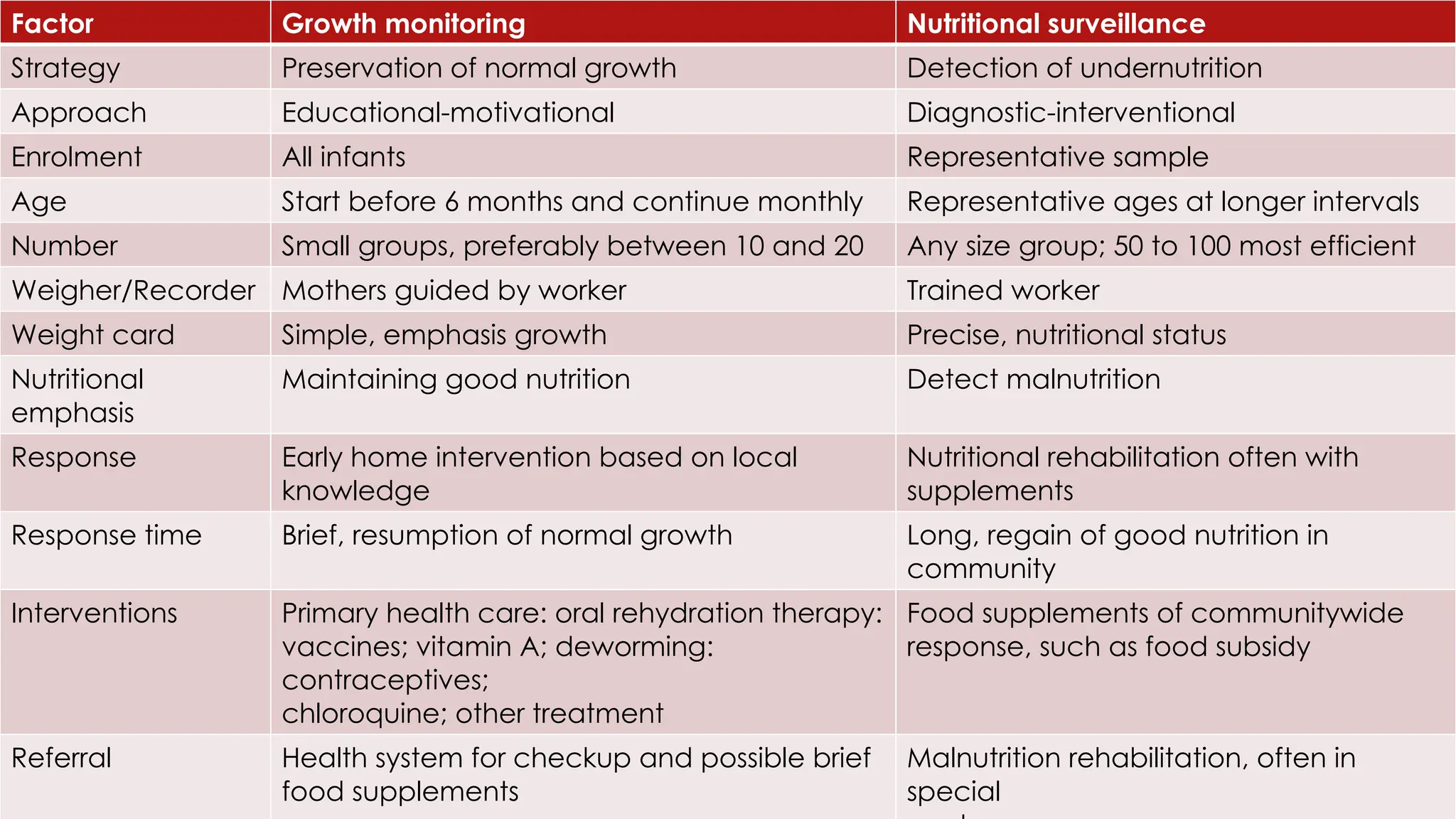
Differences between nutritional surveillance and growth monitoring
Factor Growth monitoring Nutritional surveillance
Strategy Preservation of normal growth Detection of undernutrition
Approach Educational-motivational Diagnostic-interventional
Enrolment All infants Representative sample
Age Start before 6 months and continue monthly Representative ages at longer intervals
Number Small groups, preferably between 10 and 20 Any size group; 50 to 100 most efficient
Weigher/Recorder Mothers guided by worker Trained worker
Weight card Simple, emphasis growth Precise, nutritional status
Nutritional
emphasis
Maintaining good nutrition Detect malnutrition
Response Early home intervention based on local
knowledge
Nutritional rehabilitation often with
supplements
Response time Brief, resumption of normal growth Long, regain of good nutrition in
community
Interventions Primary health care: oral rehydration therapy:
vaccines; vitamin A; deworming:
contraceptives;
chloroquine; other treatment
Food supplements of communitywide
response, such as food subsidy
Referral Health system for checkup and possible brief
food supplements
Malnutrition rehabilitation, often in
special
Nutritional status indicators
 Combating or controlling malnutrition depends primarily on the information regarding the
nutritional status of the population.
 Such information is provided by indicators of nutritional status, which characterize the
nature of the malnutrition problem.
 They are then linked to the characteristics of individuals, times and locations, in order to
obtain an indication of the distribution of the problem in the population and thus an overall
picture of the situation.
 When defining priorities for a nutritional situation, the following questions should be asked.
1. What Type of malnutrition (e.g. undernutrition, overnutrition, micronutrients deficiencies,
severity, etc.)?
2. Who suffers from malnutrition (e.g. age, sex, residency, etc.)?
3. Where are these malnourished individuals (e.g. zones or administrative areas most at risk,
districts, regions, etc.)?
4. When is it occurring (e.g. temporary, seasonal or annual; recurring or not, chronic)?
5. Nature of the problem (e.g. emergency or “normal situation”)?
 First, measurement indices need to be collected at the individual level (e.g.
weight, height, arm circumference, haemoglobin level, etc.).
 This information is then expressed at the level of the population group concerned
in the form of prevalence rates (i.e. as percentages of individuals who are well
nourished or malnourished, with respect to the form of malnutrition under
consideration, and in accordance with chosen cut-off values).
 Examples might be the percentage of children aged under 5 years with a weight
for age index of ≤3 Z-scores or ≤2 Z-scores; or >3 Z-scores or 2% of adults having a
body mass index of <18.5 or <16.0 kg/m².
Characteristics of indicators
a. should be valid, i.e. , they should actually measure what they are supposed to measure;
b. should be reliable and objective, i.e., the answers should be the same if measured by
different people in similar circumstances;
c. should be sensitive, i.e., they should be sensitive to changes in the situation concerned,
d. should be specific, i.e., they should reflect changes only in the situation concerned,
e. should be feasible, i.e., they should have the ability to obtain data needed, and;
f. should be relevant, i.e., they should contribute to the understanding of the phenomenon of
interest.
Nutritional status indicators
 Traditionally, nutritional indicators have been classified as:
a. Biochemical
b. Clinical
c. Anthropometrical
d. Dietary intake.
SOCIAL ASPECTS OF NUTRITION
Problem of malnutrition
 Malnutrition has been defined as "a pathological state resulting from a relative or absolute
deficiency or excess of one or more essential nutrients" .
( 1) Undernutrition :
(2) Overnutrition :
(3) Imbalance : It is the pathological state resulting from a disproportion among essential
nutrients with or without the absolute deficiency of any nutrient.
(4) Specific deficiency :
 On a global scale the five principal nutritional deficiency diseases that are being
accorded the highest priority action
1. Wasting,
2. Stunting,
3. Xerophthalmia,
4. Nutritional anaemias
5. Endemic goitre.
 The effects of malnutrition on the community are both direct and indirect.
 Direct effects - frank and subclinical nutrition deficiency diseases such as kwashiorkor,
marasmus, vitamin and mineral deficiency diseases.
 Indirect effects- are a high morbidity and mortality among young children (nearly 50
per cent of total deaths in the developing countries occur among children under-5
years of age as compared to less than 5 per cent in developed countries), retarded
physical and mental growth and development (which may be permanent), lowered
vitality of the people leading to lowered productivity and reduced life expectancy.
 Malnutrition predisposes to infection and infection to malnutrition; and the morbidity
arising therefrom as a result of complications from such infectious diseases as
tuberculosis and gastro-enteritis is not inconsiderable.
 The high rate of maternal mortality, stillbirth and low birth-weight are all
associated with malnutrition
 The health hazards from overnutrition are a high incidence of obesity, diabetes,
hypertension, cardiovascular and renal diseases, disorders of liver and gall
bladder.
Ecology of malnutrition
 Man-made disease.
 The great advantage of looking at malnutrition as a problem in
human ecology is that it allows for variety of approaches towards
prevention.
 Ecological factors related to malnutrition as follows : conditioning
influences, cultural influences, socioeconomic factors, food
production and health and other services.
(1) CONDITIONING INFLUENCES : Infectious diseases are an important conditioning
factor responsible for malnutrition, particularly in small children .
 Diarrhoea, intestinal parasites, measles, whooping cough, malaria, tuberculosis.
 Vicious circle
(2) CULTURAL INFLUENCES :
 People choose poor diets when good ones are available because of cultural influences
which vary widely from country to country, and from region to region.
 These may be stated as follows :
(a) Food habits, customs, beliefs, traditions and attitudes : They have deep psychological
roots and are associated with love, affection, warmth, self image and social prestige.
 The family plays an important role in shaping the food habits, and these habits are
passed from one generation to another.
 The crux of the problem is that many customs and beliefs apply most often to vulnerable
groups, i.e. infants, toddlers, expectant and lactating women
 Certain foods are "forbidden" as being harmful for the child.
 Then there are certain beliefs about hot and cold foods, light and heavy foods.
(b) Religion : These are known as food taboos which prevent people from consuming
nutritious foods even when these are easily available.
(c) Food fads : The food fads may stand in the way of correcting nutritional deficiencies.
(d) Cooking practices :
(e) Child rearing practices:
(f) Miscellaneous :
(3) SOCIO-ECONOMIC FACTORS : Malnutrition is largely the by-product of poverty,
ignorance, insufficient education, lack of knowledge regarding the nutritive value of foods ,
inadequate sanitary environment, large family size, population explosion, etc.
(4) FOOD PRODUCTION : Increased food production should lead to increased food
consumption.
 The average Indian has 0.6 hectare of land surface compared to 5.8 hectare per head in
the developed countries.
 Yields per hectare are only about one-fourth of those achieved in the industrialized
countries.
 Given the best technology known at present, most developing countries could increase
their food production several fold.
 Scarcity of food, as a factor responsible for malnutrition, may be true at the family level;
but it is not true on a global basis.
 Nor is it true for most of the countries where malnutrition is still a serious problem.
 It is a problem of uneven distribution between the countries and within the countries.
(5) HEALTH AND OTHER SERVICES: The health sector can, if properly organized and given
adequate resources can combat malnutrition. Some of the remedial actions that can be taken
up by the health sector are :
( 1) Nutritional surveillance:
(2) Nutritional rehabilitation :
(3) Nutrition supplementation : The target groups are mothers and children. Supplementary
feeding is normally regarded as a stop-gap measure for the rehabilitation of malnourished
children.
(4) Health education : It is opined that by appropriate educational action, about 50 per cent of
nutritional problems can be solved. Health education programmes in nutrition is often a weak
component. Its reinforcement is a key element in all health services development.
Preventive and social measures
 Since malnutrition is the outcome of several factors, the problem can be solved only by
taking action simultaneously at various levels - family, community, national and
international levels.
 It requires a coordinated approach of many disciplines- nutrition, food technology, health
administration, health education, marketing, etc.
ACTION AT THE FAMILY LEVEL
 The principal target of nutritional improvement in the community is the family, and the
instrument for combating malnutrition at the family level is nutrition education.
 Both the husband and the wife need to be educated on the selection of right kinds of
local foods and in the planning of nutritionally adequate diets within the limits of their
purchasing power.
 Harmful food taboos and dietary prejudices can be identified and corrected.
 The promotion of breast-feeding and improvement in infant and
child feeding practices are the two areas where nutrition education
can have a considerable effect.
 Counter misleading commercial advertising with regard to baby
foods.
 Attention should also be focused on the nutritional needs of
expectant and nursing mothers and children in the family.
 The shortage of protective foods can be met to some extent by planning a kitchen
garden or keeping poultry.
 Adequate nutrition can be obtained in most countries with a combination of locally
available and acceptable foods.
 Other related activities at the family level are the "package" of mother and child
health, family planning and immunization services.
 The community health workers and the multipurpose workers are the kind of people in
key positions to impart nutrition education to the families in their respective areas.
ACTION AT THE COMMUNITY LEVEL
 Action at the community level should commence with the analysis of the nutrition problem
in terms of (a) the extent, distribution and types of nutritional deficiencies; (b) the
population groups at risk, and (c) the dietary and nondietary factors contributing to
malnutrition.
 To obtain this information- diet and nutrition surveys
 Next important step will be to plan realistic and feasible approaches to the control of the
problem based on local resources.
 In many developing countries such as India, it is usual to start with direct
intervention measures such as supplementary feeding programmes, midday
school meals, vitamin A prophylaxis programme, but these will only provide
palliative, partial or temporary solutions.
 The real permanent solution can only come from fundamental measures that will
correct the basic causes of malnutrition.
 This implies, first of all, increasing the availability of foods both in quantity and
quality, but - much more important - making sure that the people suffering or at
risk of malnutrition can obtain these foods.
 Applied Nutrition Programme , The Integrated Child Development Services (!CDS)
Programme
 Significant improvements in the overall living conditions of the people is also
called for at the community level.
 This includes such measures as health education, improvement of water supply,
control of infectious diseases.
ACTION AT THE NATIONAL LEVEL
 The burden of improving the nutritional status of the people, by and
large, is the responsibility of the State.
 Some of the strategies and approaches undertaken at the national
level in India are :
1) Rural development : Even an impressive increase in total food
production will not solve the problem of undernutrition if the
income levels of vast section of the people continue to be so low
that they cannot afford to buy the foods they need.
It is therefore necessary to raise the living standards and purchasing
power of the people. This implies a broad-based programme of rural
development.
(2) Increasing agricultural production : The food production potential is still greatly under-
utilized.
 It must keep pace with population growth.
 This implies application of modern farming practices, the expansion of cultivated areas,
the use of fertilisers , better seeds, and so on.
 Effective food distribution system.
 This implies marketing, land tenure and food price policies.
(3) Stabilization of population: The population policy in India is related to food and nutrition
policy.
(4) Nutrition intervention programmes : Several nutritional problems of developing countries
today can be mitigated, if not entirely solved by short-term programmes.
 The prevention and control of endemic goitre through iodized common salt; the control
of anaemia through distribution of iron and folic acid tablets to pregnant and nursing
mothers, or possibly through fortification of common foods with iron; the control of
nutritional blindness through periodic administration of massive oral doses of vitamin A to
children at risk; supplementary feeding programmes for preschool children are examples
of such measures.
 These programmes have a direct impact on the health and nutritional status of particular
segments of the population.
 These programmes alleviate the situation as a temporary measure.
(5) Nutrition related health activities : Several programmes within the field of health,
seemingly unrelated to nutrition, may have a profound impact on the nutritional status.
 Since malnutrition is closely related to infection, all programmes of immunization and
improvement of environmental sanitation will inevitably have a beneficial effect on
nutrition.
 Programmes of family planning could make a major contribution to the improvement of
nutritional status of mothers and children.
ACTION AT THE INTERNATIONAL LEVEL
 International cooperation can play an important role in mitigating the effects of acute
emergencies caused by floods and droughts.
 World Food Programme - to stimulate and promote economic and social development
as a means of providing enough safe food to those in need and to come to the aid of
victims of emergency is an example of international cooperation.
 Several international agencies such as the FAO, UNICEF, WHO, World Bank, UNDP, and
CARE are working in close collaboration helping the national governments in different
parts of the world in their battle against malnutrition.
Thank you

Methods of Nutritional Surveillance.pptx

  • 1.
  • 2.
    At the endof this session student should be able to 1. Define and differentiate between nutritional surveillance and growth monitoring 2. Discuss methods employed for nutritional surveillance 3. Discuss various nutritional status indicators 4. Discuss social and cultural aspects of nutrition
  • 3.
    Definition  "Keeping watchover nutrition, in order to make decisions that will lead to improvement in nutrition in population".  Regular and systematic collection of data on nutritional outcomes and exposures should provide ongoing information about the nutritional conditions of the population and the factors that influence them.
  • 4.
     Regular andtimely collection, analysis, and reporting of data on nutrition risk factors, nutritional status, and nutrition-related diseases in the population.  The activity is undertaken to provide information useful in supporting, improving, and guiding decisions regarding the need for nutrition interventions and the extent and distribution of nutrition problems in the population.  A food and nutrition surveillance system is a mechanism to transfer food and nutrition data into action through formulation, modification and application of the food and nutrition policy of a country.
  • 5.
    Tuffrey and HallEmerg Themes Epidemiol (2016) 13:4
  • 6.
    Objectives of nutritionsurveillance 1. To monitor the nutrition situation; 2. To identify factors associated with malnutrition; 3. To inform nutrition policies and programmes; 4. To track progress towards achieving nutrition goals; 5. To serve as an early warning of increased nutritional risk; 6. To assess the delivery and coverage of services; 7. To evaluate programmes and interventions; and 8. To detect the impact of changes in policies.
  • 7.
    In emergency settings,the objectives specifically focus on the following:  A warning system- A means of highlighting an evolving crisis.  Identification of appropriate response strategies- Non-food as well as food assistance to address the underlying causes of malnutrition.  Triggering a response- Nutrition surveillance systems provide a trend analysis focusing on the magnitude of change. This may trigger an in-depth assessment, which in turn may lead to a response. • Targeting - Nutrition information can help target areas that are more at risk or in greater need of assistance. • Identification of malnourished children- Some forms of surveillance can identify acutely malnourished children.
  • 9.
    Before  Prior toimplementing a nutrition surveillance system, an initial assessment should be conducted 1. To determine the type, extent and timing of the nutritional problems; 2. To identify and describe groups at risk; 3. To assess the reasons for the presence of malnutrition; and 4. To identify existing data sources that could be useful to the system. This information can be based on data from similar countries, spot surveys, community studies, hospital reports and routinely collected data.
  • 10.
    Uses of nutritionalsurveillance  To provide all the necessary information, periodically at varying intervals in time according to the needs in each particular case.  Enhance the monitoring of both population-specific and Region-specific trends in nutrition-related risk factors and conditions.
  • 11.
    Methods- Types ofData  Primary data- original data that are collected exclusively for surveillance purposes  Secondary data- Data collected for any other reason
  • 12.
     Primary dataincludes- 1. Repeated cross-sectional surveys and 2. Data collection at sentinel sites in communities 3. Data about children attending schools.  Secondary data includes- 1. Use of admissions data from feeding centres 2. Data collected at health facilities 3. Data collected in the community
  • 13.
    Primary data collection:cross sectional surveys ‑ 1a. Large scale nationally representative surveys- Nationally representative data for many low-income countries are provided by two programs of household surveys: the Demographic and Health Surveys (DHS) supported by USAID and the Multiple Indicator Cluster Surveys (MICS) led by UNICEF.  Given the delay between collecting data and producing validated findings, these surveys are unsuitable for tracking the prevalence of wasting near or above emergency thresholds.
  • 14.
     The surveillancesystem should make an inventory of all large national surveys related to health, food and nutrition that could act as a basis by breaking data down at subregional, district and village levels.  In particular, frequent surveys such as the Demographic Health Survey, National Nutrition Survey or National Food Security Surveys should be considered.  Try to include selected nutrition indicators.
  • 15.
    1b. Repeated subnational cross sectional surveys- ‑ ‑ Repeated surveys using probability sampling methods at subnational level for the purposes of nutrition surveillance are undertaken at intervals of 1, 3, 4, 6 or 12 months.  Cluster sampling is used for practical reasons and new clusters may be drawn for each round of data collection, or clusters drawn initially may be used in subsequent rounds.
  • 16.
     They assessthe type, severity and extent of malnutrition and its causes among a representative sample of the population (children and/or adults).  Their purpose is to support policy-makers and managers to design strategies and prioritize geographical areas at risk and specific types of interventions.  Repeated surveys include national surveys, which are periodically conducted at national level, and small-scale surveys, which are carried out at local level to gather nutrition information at a suitable time.
  • 17.
    2. Community basedsentinel sites- ‑ Most often used by NGOs.  Data are collected periodically in communities selected because they are in an area that is highly vulnerable to malnutrition or that is typical of a livelihood zone or area.  Typically 12–50 children are studied per site and data are collected every 1–3 months.  Children are sampled randomly within the sites but the sites themselves can be sampled either purposively or randomly within the district, livelihood zone or ecological zone that has been sampled purposively.  Alternatively, the same children can be studied repeatedly, with replacements when children become older than a threshold age, are lost to follow-up, or die.
  • 18.
    Advantages of thisapproach 1. Quicker 2. Costs less; 3. Fewer sites are included so more detail on causes can be collected; 4. Community members can become involved in the data collection, leading to assessments which are more participatory. Disadvantage: 5. Unknown level of bias which is likely to vary on a case-by-case basis depending on the environmental context and exact methods applied. 6. During the process of surveillance, the nutritional situation in the selected sites may become progressively different from the rest of community that they were chosen to represent. This is due to the inputs of the survey teams who may provide education, advice and counselling; treating illness or referring malnourished children to health facilities.
  • 19.
    3. Data aboutchildren attending schools: There is School census data generally no sampling:  All children at a particular stage or stages of schooling are included.  Nutritional assessment is occasionally undertaken in schools, where first-grade children are measured through censuses every two to three years.  The objective is to identify high-risk children with poor health, malnutrition and low socioeconomic status.  Results can be used to target school feeding programmes and support policy-making in food-based strategies.  The need for monitoring obesity among school-aged children is becoming more important.  School census data, supported by information on specific food consumption patterns, marketing of healthy food and information on physical activity levels, are very important to understand the main causes of obesity.
  • 20.
    Collection of secondarydata for nutrition surveillance  Advantages - costs of undertaking primary data collection are avoided; they are available more quickly than survey data; and they have a greater breadth of coverage.  Disadvantages- Data are rarely complete; Not representative, and data are often of poor quality.  Potential sources of secondary data include routinely collected health statistics, household budget surveys, market research surveys, industry surveys and research studies.
  • 21.
    Secondary data: 1. Admissionsto feeding centres and to community based management of acute ‑ malnutrition (CMAM) 2. Anthropometry data from clinics- growth monitoring of children in clinics from which data are compiled and used for surveillance. Birthweight can also be used for surveillance Such data may aid decisions about targeting interventions by identifying vulnerable geographic areas, and the data may be especially useful in emergencies where there is physical insecurity and it is not possible to carry out surveys.
  • 22.
    3. Secondary data:anthropometry data collected in the community  There are several ways that anthropometry data are collected through health systems in the community including: a. community-based growth monitoring, b. screening children for referral to feeding programmes c. Screening children for malnutrition incorporated into Child Health Days
  • 23.
    Combination of methods Surveys that provide representative data and reliable estimates are expensive, and repeated surveys more so.  Consequently, one approach to surveillance involves undertaking surveys only in areas that have been identified as experiencing deterioration in nutritional status or food security by another method, such as monitoring admissions to feeding programmes or data from community sentinel sites.
  • 27.
    Growth monitoring  Growthmonitoring is a continuous monitoring of growth in children.  Its aim is to identify slowing or faltering of growth at the individual level, and thus help to correct the problem promptly.  However, the WHO new growth curve (weight/height or length) is now recommended.  Growth monitoring can either be conducted by health professionals at maternal and child health clinics (clinic-based growth monitoring) or by trained members of the community in villages (community-based growth monitoring).
  • 29.
    Nutritional surveillance andgrowth monitoring  Growth monitoring is oriented to the individual child, and is a dynamic measure of its health from month to month.  It focuses on normal nutrition and the means to promote continued growth and good health.  It requires enrolment of the infant at an early stage, preferably before 6 months.  Regular monthly participation is crucial to detect early onset of growth faltering.
  • 30.
     Nutritional surveillance, on the other hand, can be carried out on a representative sample of children in the community.  It gives a reliable idea of the overall nutritional condition of village (or area) A - whether it is good or bad, is better or worse than that of village B or C (and so requires supplies and personnel), and whether it is improving or deteriorating with time.  It can help to diagnose malnutrition and assess the impact of occurrence like drought or measures designed to alleviate malnutrition in the community at large.
  • 31.
    Differences between nutritionalsurveillance and growth monitoring Factor Growth monitoring Nutritional surveillance Strategy Preservation of normal growth Detection of undernutrition Approach Educational-motivational Diagnostic-interventional Enrolment All infants Representative sample Age Start before 6 months and continue monthly Representative ages at longer intervals Number Small groups, preferably between 10 and 20 Any size group; 50 to 100 most efficient Weigher/Recorder Mothers guided by worker Trained worker Weight card Simple, emphasis growth Precise, nutritional status Nutritional emphasis Maintaining good nutrition Detect malnutrition Response Early home intervention based on local knowledge Nutritional rehabilitation often with supplements Response time Brief, resumption of normal growth Long, regain of good nutrition in community Interventions Primary health care: oral rehydration therapy: vaccines; vitamin A; deworming: contraceptives; chloroquine; other treatment Food supplements of communitywide response, such as food subsidy Referral Health system for checkup and possible brief food supplements Malnutrition rehabilitation, often in special
  • 32.
    Nutritional status indicators Combating or controlling malnutrition depends primarily on the information regarding the nutritional status of the population.  Such information is provided by indicators of nutritional status, which characterize the nature of the malnutrition problem.  They are then linked to the characteristics of individuals, times and locations, in order to obtain an indication of the distribution of the problem in the population and thus an overall picture of the situation.
  • 33.
     When definingpriorities for a nutritional situation, the following questions should be asked. 1. What Type of malnutrition (e.g. undernutrition, overnutrition, micronutrients deficiencies, severity, etc.)? 2. Who suffers from malnutrition (e.g. age, sex, residency, etc.)? 3. Where are these malnourished individuals (e.g. zones or administrative areas most at risk, districts, regions, etc.)? 4. When is it occurring (e.g. temporary, seasonal or annual; recurring or not, chronic)? 5. Nature of the problem (e.g. emergency or “normal situation”)?
  • 34.
     First, measurementindices need to be collected at the individual level (e.g. weight, height, arm circumference, haemoglobin level, etc.).  This information is then expressed at the level of the population group concerned in the form of prevalence rates (i.e. as percentages of individuals who are well nourished or malnourished, with respect to the form of malnutrition under consideration, and in accordance with chosen cut-off values).  Examples might be the percentage of children aged under 5 years with a weight for age index of ≤3 Z-scores or ≤2 Z-scores; or >3 Z-scores or 2% of adults having a body mass index of <18.5 or <16.0 kg/m².
  • 35.
    Characteristics of indicators a.should be valid, i.e. , they should actually measure what they are supposed to measure; b. should be reliable and objective, i.e., the answers should be the same if measured by different people in similar circumstances; c. should be sensitive, i.e., they should be sensitive to changes in the situation concerned, d. should be specific, i.e., they should reflect changes only in the situation concerned, e. should be feasible, i.e., they should have the ability to obtain data needed, and; f. should be relevant, i.e., they should contribute to the understanding of the phenomenon of interest.
  • 36.
    Nutritional status indicators Traditionally, nutritional indicators have been classified as: a. Biochemical b. Clinical c. Anthropometrical d. Dietary intake.
  • 39.
  • 40.
    Problem of malnutrition Malnutrition has been defined as "a pathological state resulting from a relative or absolute deficiency or excess of one or more essential nutrients" . ( 1) Undernutrition : (2) Overnutrition : (3) Imbalance : It is the pathological state resulting from a disproportion among essential nutrients with or without the absolute deficiency of any nutrient. (4) Specific deficiency :
  • 41.
     On aglobal scale the five principal nutritional deficiency diseases that are being accorded the highest priority action 1. Wasting, 2. Stunting, 3. Xerophthalmia, 4. Nutritional anaemias 5. Endemic goitre.
  • 42.
     The effectsof malnutrition on the community are both direct and indirect.  Direct effects - frank and subclinical nutrition deficiency diseases such as kwashiorkor, marasmus, vitamin and mineral deficiency diseases.  Indirect effects- are a high morbidity and mortality among young children (nearly 50 per cent of total deaths in the developing countries occur among children under-5 years of age as compared to less than 5 per cent in developed countries), retarded physical and mental growth and development (which may be permanent), lowered vitality of the people leading to lowered productivity and reduced life expectancy.  Malnutrition predisposes to infection and infection to malnutrition; and the morbidity arising therefrom as a result of complications from such infectious diseases as tuberculosis and gastro-enteritis is not inconsiderable.
  • 43.
     The highrate of maternal mortality, stillbirth and low birth-weight are all associated with malnutrition  The health hazards from overnutrition are a high incidence of obesity, diabetes, hypertension, cardiovascular and renal diseases, disorders of liver and gall bladder.
  • 44.
    Ecology of malnutrition Man-made disease.  The great advantage of looking at malnutrition as a problem in human ecology is that it allows for variety of approaches towards prevention.  Ecological factors related to malnutrition as follows : conditioning influences, cultural influences, socioeconomic factors, food production and health and other services.
  • 45.
    (1) CONDITIONING INFLUENCES: Infectious diseases are an important conditioning factor responsible for malnutrition, particularly in small children .  Diarrhoea, intestinal parasites, measles, whooping cough, malaria, tuberculosis.  Vicious circle
  • 46.
    (2) CULTURAL INFLUENCES:  People choose poor diets when good ones are available because of cultural influences which vary widely from country to country, and from region to region.  These may be stated as follows : (a) Food habits, customs, beliefs, traditions and attitudes : They have deep psychological roots and are associated with love, affection, warmth, self image and social prestige.  The family plays an important role in shaping the food habits, and these habits are passed from one generation to another.
  • 47.
     The cruxof the problem is that many customs and beliefs apply most often to vulnerable groups, i.e. infants, toddlers, expectant and lactating women  Certain foods are "forbidden" as being harmful for the child.  Then there are certain beliefs about hot and cold foods, light and heavy foods.
  • 48.
    (b) Religion :These are known as food taboos which prevent people from consuming nutritious foods even when these are easily available. (c) Food fads : The food fads may stand in the way of correcting nutritional deficiencies. (d) Cooking practices : (e) Child rearing practices: (f) Miscellaneous :
  • 49.
    (3) SOCIO-ECONOMIC FACTORS: Malnutrition is largely the by-product of poverty, ignorance, insufficient education, lack of knowledge regarding the nutritive value of foods , inadequate sanitary environment, large family size, population explosion, etc.
  • 50.
    (4) FOOD PRODUCTION: Increased food production should lead to increased food consumption.  The average Indian has 0.6 hectare of land surface compared to 5.8 hectare per head in the developed countries.  Yields per hectare are only about one-fourth of those achieved in the industrialized countries.  Given the best technology known at present, most developing countries could increase their food production several fold.  Scarcity of food, as a factor responsible for malnutrition, may be true at the family level; but it is not true on a global basis.  Nor is it true for most of the countries where malnutrition is still a serious problem.  It is a problem of uneven distribution between the countries and within the countries.
  • 51.
    (5) HEALTH ANDOTHER SERVICES: The health sector can, if properly organized and given adequate resources can combat malnutrition. Some of the remedial actions that can be taken up by the health sector are : ( 1) Nutritional surveillance: (2) Nutritional rehabilitation : (3) Nutrition supplementation : The target groups are mothers and children. Supplementary feeding is normally regarded as a stop-gap measure for the rehabilitation of malnourished children. (4) Health education : It is opined that by appropriate educational action, about 50 per cent of nutritional problems can be solved. Health education programmes in nutrition is often a weak component. Its reinforcement is a key element in all health services development.
  • 52.
    Preventive and socialmeasures  Since malnutrition is the outcome of several factors, the problem can be solved only by taking action simultaneously at various levels - family, community, national and international levels.  It requires a coordinated approach of many disciplines- nutrition, food technology, health administration, health education, marketing, etc.
  • 53.
    ACTION AT THEFAMILY LEVEL  The principal target of nutritional improvement in the community is the family, and the instrument for combating malnutrition at the family level is nutrition education.  Both the husband and the wife need to be educated on the selection of right kinds of local foods and in the planning of nutritionally adequate diets within the limits of their purchasing power.  Harmful food taboos and dietary prejudices can be identified and corrected.
  • 54.
     The promotionof breast-feeding and improvement in infant and child feeding practices are the two areas where nutrition education can have a considerable effect.  Counter misleading commercial advertising with regard to baby foods.  Attention should also be focused on the nutritional needs of expectant and nursing mothers and children in the family.
  • 55.
     The shortageof protective foods can be met to some extent by planning a kitchen garden or keeping poultry.  Adequate nutrition can be obtained in most countries with a combination of locally available and acceptable foods.  Other related activities at the family level are the "package" of mother and child health, family planning and immunization services.  The community health workers and the multipurpose workers are the kind of people in key positions to impart nutrition education to the families in their respective areas.
  • 56.
    ACTION AT THECOMMUNITY LEVEL  Action at the community level should commence with the analysis of the nutrition problem in terms of (a) the extent, distribution and types of nutritional deficiencies; (b) the population groups at risk, and (c) the dietary and nondietary factors contributing to malnutrition.  To obtain this information- diet and nutrition surveys  Next important step will be to plan realistic and feasible approaches to the control of the problem based on local resources.
  • 57.
     In manydeveloping countries such as India, it is usual to start with direct intervention measures such as supplementary feeding programmes, midday school meals, vitamin A prophylaxis programme, but these will only provide palliative, partial or temporary solutions.  The real permanent solution can only come from fundamental measures that will correct the basic causes of malnutrition.
  • 58.
     This implies,first of all, increasing the availability of foods both in quantity and quality, but - much more important - making sure that the people suffering or at risk of malnutrition can obtain these foods.  Applied Nutrition Programme , The Integrated Child Development Services (!CDS) Programme  Significant improvements in the overall living conditions of the people is also called for at the community level.  This includes such measures as health education, improvement of water supply, control of infectious diseases.
  • 59.
    ACTION AT THENATIONAL LEVEL  The burden of improving the nutritional status of the people, by and large, is the responsibility of the State.  Some of the strategies and approaches undertaken at the national level in India are : 1) Rural development : Even an impressive increase in total food production will not solve the problem of undernutrition if the income levels of vast section of the people continue to be so low that they cannot afford to buy the foods they need. It is therefore necessary to raise the living standards and purchasing power of the people. This implies a broad-based programme of rural development.
  • 60.
    (2) Increasing agriculturalproduction : The food production potential is still greatly under- utilized.  It must keep pace with population growth.  This implies application of modern farming practices, the expansion of cultivated areas, the use of fertilisers , better seeds, and so on.  Effective food distribution system.  This implies marketing, land tenure and food price policies. (3) Stabilization of population: The population policy in India is related to food and nutrition policy.
  • 61.
    (4) Nutrition interventionprogrammes : Several nutritional problems of developing countries today can be mitigated, if not entirely solved by short-term programmes.  The prevention and control of endemic goitre through iodized common salt; the control of anaemia through distribution of iron and folic acid tablets to pregnant and nursing mothers, or possibly through fortification of common foods with iron; the control of nutritional blindness through periodic administration of massive oral doses of vitamin A to children at risk; supplementary feeding programmes for preschool children are examples of such measures.  These programmes have a direct impact on the health and nutritional status of particular segments of the population.  These programmes alleviate the situation as a temporary measure.
  • 62.
    (5) Nutrition relatedhealth activities : Several programmes within the field of health, seemingly unrelated to nutrition, may have a profound impact on the nutritional status.  Since malnutrition is closely related to infection, all programmes of immunization and improvement of environmental sanitation will inevitably have a beneficial effect on nutrition.  Programmes of family planning could make a major contribution to the improvement of nutritional status of mothers and children.
  • 63.
    ACTION AT THEINTERNATIONAL LEVEL  International cooperation can play an important role in mitigating the effects of acute emergencies caused by floods and droughts.  World Food Programme - to stimulate and promote economic and social development as a means of providing enough safe food to those in need and to come to the aid of victims of emergency is an example of international cooperation.  Several international agencies such as the FAO, UNICEF, WHO, World Bank, UNDP, and CARE are working in close collaboration helping the national governments in different parts of the world in their battle against malnutrition.
  • 65.