Randomized Controlled Trial
Maj Dr Naveen Phuyal
MBBS, MD
Randomized Control Trial
Maj Dr Naveen Phuyal
MBBS, MD
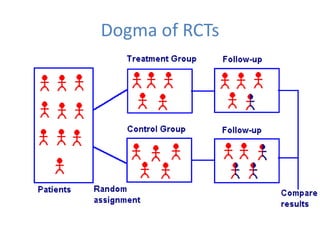
Dogma of RCTs
Consider how you would go about evaluating
the following interventions
– Surgical versus medical termination of pregnancy
– Referral guidelines for radiographic examination
– Paracetamol and/or ibuprofen for treating children with
fever
– Nurse counsellors as an alternative to clinical geneticists
for genetic counselling
– Single dose of chemotherapy versus radiotherapy treating
testicular cancer Cervical cancer vaccine
The need to evaluate health care
• Variations in health care
• Unproven treatments
• Inadequacies in care
• Inaccurate medical models
• Limitation of resources
• New innovations
• …
Crombie (1996)
Simple Definition
• A study in which people are allocated at
random to receive one of several
interventions
(simple but powerful research tool)
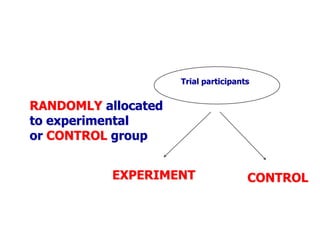
Trial participants
CONTROLEXPERIMENT
RANDOMLY allocated
to experimental
or CONTROL group
• Random allocation to intervention groups
• All participants have equal chance of being
allocated to each intervention group
why RCTs are referred to as randomised
controlled trials
• One intervention is regarded as control
treatment (the group of participants who
receive this are the control group)
• NOTE: Contemporaneous (not historical
controls)
why RCTs are referred to as randomised
controlled trials
Experimental Group
• receive new intervention
• (also called treatment
group or intervention
group interchangeably)
Control Group
• can be
– conventional practice
– no intervention (this
may be conventional
practice)
– placebo
• RCTs are
– Experiments: investigators can influence
number, type, regime of interventions
– Quantitative: measure events rather than try to
interpret them in their natural settings
– Comparative: compare two or more
interventions
Inclusion/exclusion criteria
• Decision rules applied to potential trial
participants to judge eligibility for inclusion in
trial
• See CONSORT statement
www.consort-statement.org
• Important that they are applied identically to
all groups in a trial!
Randomization
• Randomisation is the process of random allocation
• Allocation is not determined by investigators,
clinicians or participants
• Equal chance of being assigned to each intervention
group
• Individual people
– patients
– caregivers (physicians, nurses etc)
• Groups of people, ‘cluster randomisation’
Pseudo-randomization
• Other allocation methods include
– according to date of birth
– the number on hospital records
– date of invitation etc.
• These are NOT regarded as random
• These are called pseudo- or quasi-random
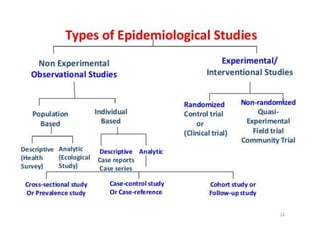
• Controlled clinical trials (CCTs) are not the
same as randomised controlled trials
• Controlled clinical trials include non-
randomised controlled trials and
randomised controlled trials
Why randomization?
• Characteristics similar across groups at baseline
• Can isolate and quantify impact of interventions
with effects from other factors minimised
• Risk of imbalance not abolished completely even
if perfect randomisation
• To combat selection bias
Why do we need a control group?
• Don’t need a control group if completely
predictable results
– Parachutes when jumping from plane
– New drug cures a few rabies cases
• But
– No intervention has 100% efficacy
– Many diseases recover spontaneously
Classification of Randomised Trials
• Parallel Group
– Randomly assigned to 2 groups
– Treatment vs non treatment
• Crossover
– Over time random sequence of intervention
• Split Body
– eg Right vs Left Random treatment vs No Treatment
• Cluster
– Pre-existing Groups eg Villages/Schools
• Factorial
– Combination of interventions / non interventions in Random groups
Classification of Randomised Trials
By outcome of interest (efficacy vs. effectiveness)
• RCTs - "explanatory"
– Test efficacy
– Highly selected participants
– Highly Controlled conditions
• RCTs – “pragmatic.”
– Test effectiveness in every day practice
– Unselected Participants
– Flexible Conditions
– Give informed decisions about practice
Classification of Randomised Trials
By hypothesis (superiority vs. noninferiority vs. equivalence)
• "superiority trials" (most)
– statistically significant
• "noninferiority trials”
– new treatment no worse than existing Rx
• "equivalence trials"
- x2 Rx indistiguishable
Classification of Randomised Trials
• By blinding
• Open trials
• Single blind trials
• Double blind trails
• Triple blind trials
Randomisation - Goals
• Equal Group Sizes for Adequate Statistical Power
(Especially Subgroup Analyses)
• Low selection bias
(investigator cannot predict the next subject's group
assignment by examining which group has been
assigned the fewest subjects up to that point)
• Low probability of confounding
(i.e., a low probability of "accidental bias"),
Methods of carrying out
randomization
• Coin tossing
• Random number table
• Computer based randomization
• Sealed envelopes
• Telephone randomization
• Pharmacy randomization
• Web based randomization
• Attendance sheets
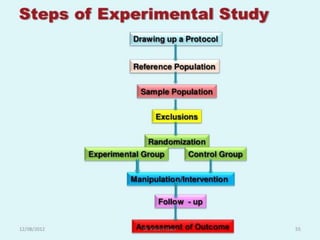
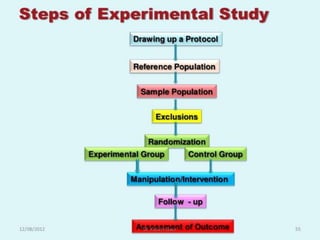
Six essential steps
• Drawing up a protocol
• Selecting reference and experimental
populations
• Randomization
• Manipulation or intervention
• Follow up
• Assessment of outcome
Drawing up a protocol
• Aims and objectives of the study
• Questions to be answered
• Sample size
• Criteria and procedure for selection of both groups
• Procedure for allocation in both groups
• Treatments to be applied
• Responsibilities of parties
• Once a protocol ahs been made its should be strictly
adhered
• Prevents bias and errors
• Pilot studies’
– Feasibility, acceptability, operational efficiency
Selecting reference and experimental
population
Reference (Target)population
• Populations to which the
findings may be applicable
• As broad as mankind or
Limited to geographical area,
age, sex, occupation, social
groups
• Whole city, school children,
industrial workers, obstetric
population
Experimental population
• Derived from reference
population
• Actual population that
participates in study
• Ideally randomly chosen
• Choose a stable population
• 3 criteria's
– Informed consent
– Representative
– Eligible
Randomization
• Definition
• Attempt to eliminate bias and allow
comparability- not matching
• Like can be compared to like
• No selection bias
• Best done using random number tables
Manipulation
• Intervene or manipulate the study
• Delibrate application or withdrawal
• Reduction of a suspected factor
• Independent variable ( drug, vaccine, habit)
and dependent variable ( incidence of disease,
survival time, recovery period)
Follow up
• At definite intervals of time
• In a standard measure
• Equal intensity
• Same given circumstances
• Duration of trial= outcome(start- end)
• Losses to follow up(attrition): death,
migration, loss of interest
Assessment
• Positive results
– Reduced incidence of disease
– Reduced cost to HCS
• Negative results
– Side effects
– Complications
– Death
• Bias may arise at three sources
– Participants : Subject variation
– Observer bias
– Bias in evaluation
– Randomization cannot guard against this bias so a technique called blinding is
used.
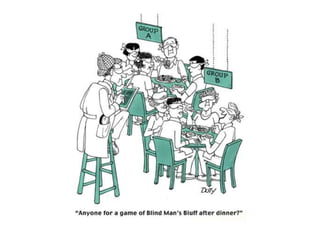
Blinding
• Single blind trial
• Double blind trial
• Triple blind trial
Types of Randomized controlled trials
• Clinical trail
• Preventive trial
• Risk factor trial
• Cessation experiments
• Trial of etiological agents
• Evaluation of health services
Clinical trial
• Evaluation of beta-blockers in decreasing CVD
mortality
• Trails of folate supplementation before
conception to prevent NTD.
• Trials of Aspirin in CVD mortality
• RCT of coronary bypass surgery in MI.
Preventive trials
• Handwashing
• Vaccines
• Whopping cough vaccination trial
Risk factor trials
• Study of risk factors
• Major risk factor for CAD is elevated cholesterol,
smoking, HTN, sedentary lifestyle.
• So reducing cholesterol, quitting smoking, control
of BP and regualr physical exercise prevents CAD.
• The Stanford Three community trial
• North Karelia Project
• MRFIT trial
Cessation experiment
• Termination or cessation of a habit or cause
• Smoking cessation studies
Trial of etiological agents
• Retrolental fibroplagia as a cause of blindness
Evaluation of Health services
• Effectiveness and efficiency of health services
• Domicillary treatement vs sanitoriaum
treatment of TB
Non-randomized trials
• Uncontrolled trials (trials with no comparison groups).
Eg. Pap smear test reduces mortality from Cx CA
• Natural experiments: cigerrete smokig: smokers vs non
smokers
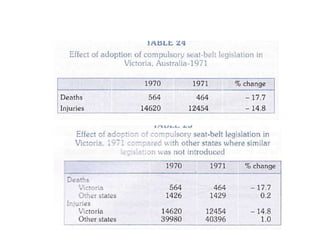
• Before and after comparison studies
• (eg. James Lind and scurvy)
– Using a control group
– Without a control group
Thank You

8. randomized control trials

  • 1.
    Randomized Controlled Trial MajDr Naveen Phuyal MBBS, MD
  • 2.
    Randomized Control Trial MajDr Naveen Phuyal MBBS, MD
  • 4.
  • 5.
    Consider how youwould go about evaluating the following interventions – Surgical versus medical termination of pregnancy – Referral guidelines for radiographic examination – Paracetamol and/or ibuprofen for treating children with fever – Nurse counsellors as an alternative to clinical geneticists for genetic counselling – Single dose of chemotherapy versus radiotherapy treating testicular cancer Cervical cancer vaccine
  • 6.
    The need toevaluate health care • Variations in health care • Unproven treatments • Inadequacies in care • Inaccurate medical models • Limitation of resources • New innovations • … Crombie (1996)
  • 7.
    Simple Definition • Astudy in which people are allocated at random to receive one of several interventions (simple but powerful research tool)
  • 8.
  • 9.
    • Random allocationto intervention groups • All participants have equal chance of being allocated to each intervention group why RCTs are referred to as randomised controlled trials
  • 10.
    • One interventionis regarded as control treatment (the group of participants who receive this are the control group) • NOTE: Contemporaneous (not historical controls) why RCTs are referred to as randomised controlled trials
  • 11.
    Experimental Group • receivenew intervention • (also called treatment group or intervention group interchangeably) Control Group • can be – conventional practice – no intervention (this may be conventional practice) – placebo
  • 12.
    • RCTs are –Experiments: investigators can influence number, type, regime of interventions – Quantitative: measure events rather than try to interpret them in their natural settings – Comparative: compare two or more interventions
  • 13.
    Inclusion/exclusion criteria • Decisionrules applied to potential trial participants to judge eligibility for inclusion in trial • See CONSORT statement www.consort-statement.org • Important that they are applied identically to all groups in a trial!
  • 14.
    Randomization • Randomisation isthe process of random allocation • Allocation is not determined by investigators, clinicians or participants • Equal chance of being assigned to each intervention group • Individual people – patients – caregivers (physicians, nurses etc) • Groups of people, ‘cluster randomisation’
  • 15.
    Pseudo-randomization • Other allocationmethods include – according to date of birth – the number on hospital records – date of invitation etc. • These are NOT regarded as random • These are called pseudo- or quasi-random
  • 16.
    • Controlled clinicaltrials (CCTs) are not the same as randomised controlled trials • Controlled clinical trials include non- randomised controlled trials and randomised controlled trials
  • 17.
    Why randomization? • Characteristicssimilar across groups at baseline • Can isolate and quantify impact of interventions with effects from other factors minimised • Risk of imbalance not abolished completely even if perfect randomisation • To combat selection bias
  • 18.
    Why do weneed a control group? • Don’t need a control group if completely predictable results – Parachutes when jumping from plane – New drug cures a few rabies cases • But – No intervention has 100% efficacy – Many diseases recover spontaneously
  • 19.
    Classification of RandomisedTrials • Parallel Group – Randomly assigned to 2 groups – Treatment vs non treatment • Crossover – Over time random sequence of intervention • Split Body – eg Right vs Left Random treatment vs No Treatment • Cluster – Pre-existing Groups eg Villages/Schools • Factorial – Combination of interventions / non interventions in Random groups
  • 20.
    Classification of RandomisedTrials By outcome of interest (efficacy vs. effectiveness) • RCTs - "explanatory" – Test efficacy – Highly selected participants – Highly Controlled conditions • RCTs – “pragmatic.” – Test effectiveness in every day practice – Unselected Participants – Flexible Conditions – Give informed decisions about practice
  • 21.
    Classification of RandomisedTrials By hypothesis (superiority vs. noninferiority vs. equivalence) • "superiority trials" (most) – statistically significant • "noninferiority trials” – new treatment no worse than existing Rx • "equivalence trials" - x2 Rx indistiguishable
  • 22.
    Classification of RandomisedTrials • By blinding • Open trials • Single blind trials • Double blind trails • Triple blind trials
  • 24.
    Randomisation - Goals •Equal Group Sizes for Adequate Statistical Power (Especially Subgroup Analyses) • Low selection bias (investigator cannot predict the next subject's group assignment by examining which group has been assigned the fewest subjects up to that point) • Low probability of confounding (i.e., a low probability of "accidental bias"),
  • 25.
    Methods of carryingout randomization • Coin tossing • Random number table • Computer based randomization • Sealed envelopes • Telephone randomization • Pharmacy randomization • Web based randomization • Attendance sheets
  • 26.
    Six essential steps •Drawing up a protocol • Selecting reference and experimental populations • Randomization • Manipulation or intervention • Follow up • Assessment of outcome
  • 27.
    Drawing up aprotocol • Aims and objectives of the study • Questions to be answered • Sample size • Criteria and procedure for selection of both groups • Procedure for allocation in both groups • Treatments to be applied • Responsibilities of parties • Once a protocol ahs been made its should be strictly adhered • Prevents bias and errors • Pilot studies’ – Feasibility, acceptability, operational efficiency
  • 28.
    Selecting reference andexperimental population Reference (Target)population • Populations to which the findings may be applicable • As broad as mankind or Limited to geographical area, age, sex, occupation, social groups • Whole city, school children, industrial workers, obstetric population Experimental population • Derived from reference population • Actual population that participates in study • Ideally randomly chosen • Choose a stable population • 3 criteria's – Informed consent – Representative – Eligible
  • 29.
    Randomization • Definition • Attemptto eliminate bias and allow comparability- not matching • Like can be compared to like • No selection bias • Best done using random number tables
  • 30.
    Manipulation • Intervene ormanipulate the study • Delibrate application or withdrawal • Reduction of a suspected factor • Independent variable ( drug, vaccine, habit) and dependent variable ( incidence of disease, survival time, recovery period)
  • 31.
    Follow up • Atdefinite intervals of time • In a standard measure • Equal intensity • Same given circumstances • Duration of trial= outcome(start- end) • Losses to follow up(attrition): death, migration, loss of interest
  • 32.
    Assessment • Positive results –Reduced incidence of disease – Reduced cost to HCS • Negative results – Side effects – Complications – Death • Bias may arise at three sources – Participants : Subject variation – Observer bias – Bias in evaluation – Randomization cannot guard against this bias so a technique called blinding is used.
  • 33.
    Blinding • Single blindtrial • Double blind trial • Triple blind trial
  • 34.
    Types of Randomizedcontrolled trials • Clinical trail • Preventive trial • Risk factor trial • Cessation experiments • Trial of etiological agents • Evaluation of health services
  • 35.
    Clinical trial • Evaluationof beta-blockers in decreasing CVD mortality • Trails of folate supplementation before conception to prevent NTD. • Trials of Aspirin in CVD mortality • RCT of coronary bypass surgery in MI.
  • 36.
    Preventive trials • Handwashing •Vaccines • Whopping cough vaccination trial
  • 37.
    Risk factor trials •Study of risk factors • Major risk factor for CAD is elevated cholesterol, smoking, HTN, sedentary lifestyle. • So reducing cholesterol, quitting smoking, control of BP and regualr physical exercise prevents CAD. • The Stanford Three community trial • North Karelia Project • MRFIT trial
  • 38.
    Cessation experiment • Terminationor cessation of a habit or cause • Smoking cessation studies
  • 39.
    Trial of etiologicalagents • Retrolental fibroplagia as a cause of blindness
  • 40.
    Evaluation of Healthservices • Effectiveness and efficiency of health services • Domicillary treatement vs sanitoriaum treatment of TB
  • 41.
    Non-randomized trials • Uncontrolledtrials (trials with no comparison groups). Eg. Pap smear test reduces mortality from Cx CA • Natural experiments: cigerrete smokig: smokers vs non smokers • Before and after comparison studies • (eg. James Lind and scurvy) – Using a control group – Without a control group
  • 43.

Editor's Notes

  • #30 Randomization is a statistical procedure by which participants are allocated into groups called “study” and “control” groups, to receive or not to receive AN EXPERIMENTAL PREVENTIVE OR THERAPEUTIC PROCEDURE, MANOEVRE, OR INTERN=VENTION.