CARE AFTER DELIVERY:
POSTPARTUM CARE
OBJECTIVES
To learn
• Number and timing of postpartum visits for
mother and baby
• History-taking, examination, management and
counseling during postpartum visits
• Steps for referral and transfer of baby
2
IMPORTANCE OF POSTPARTUM
CARE
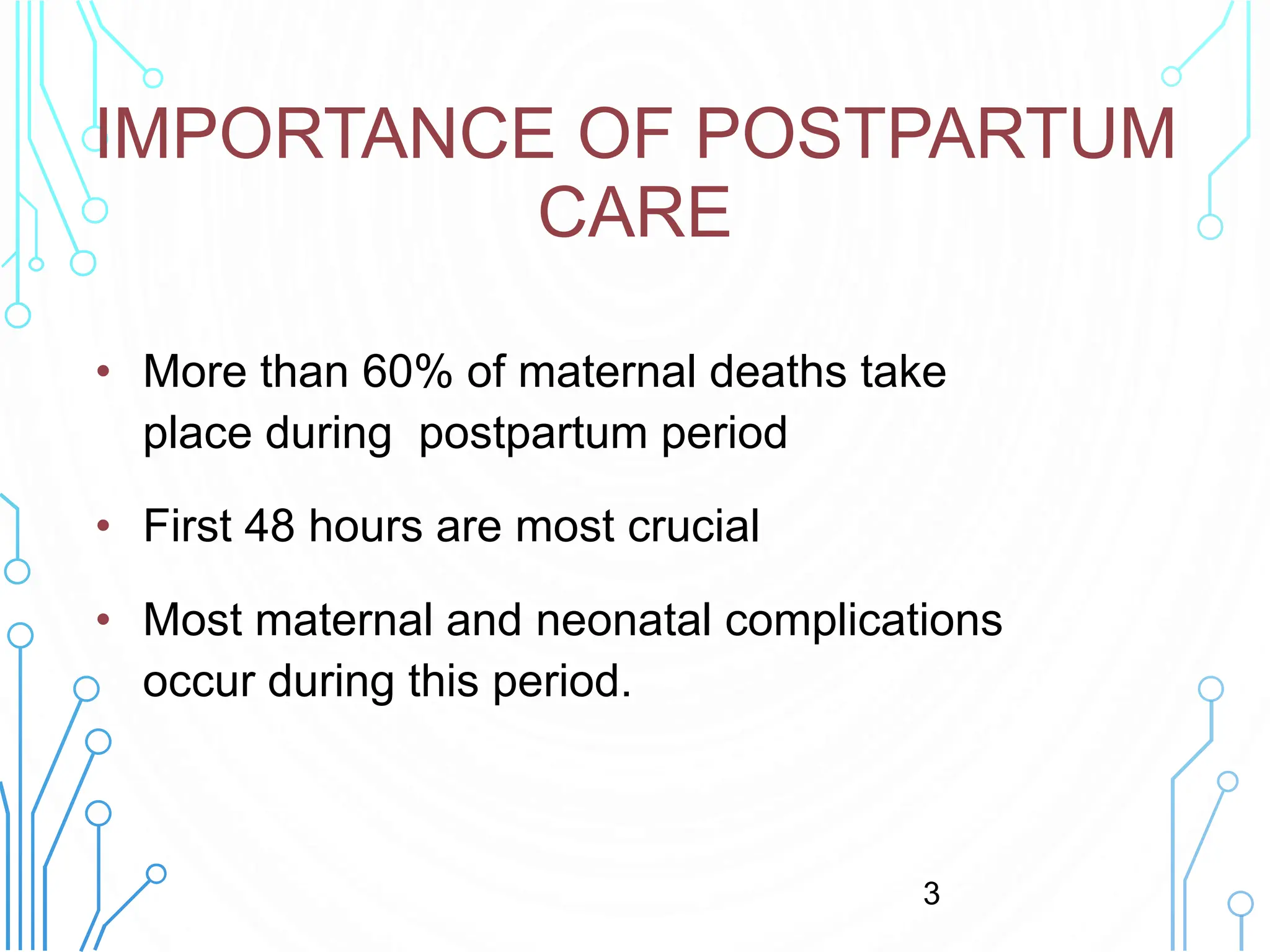
• More than 60% of maternal deaths take
place during postpartum period
• First 48 hours are most crucial
• Most maternal and neonatal complications
occur during this period.
3
4
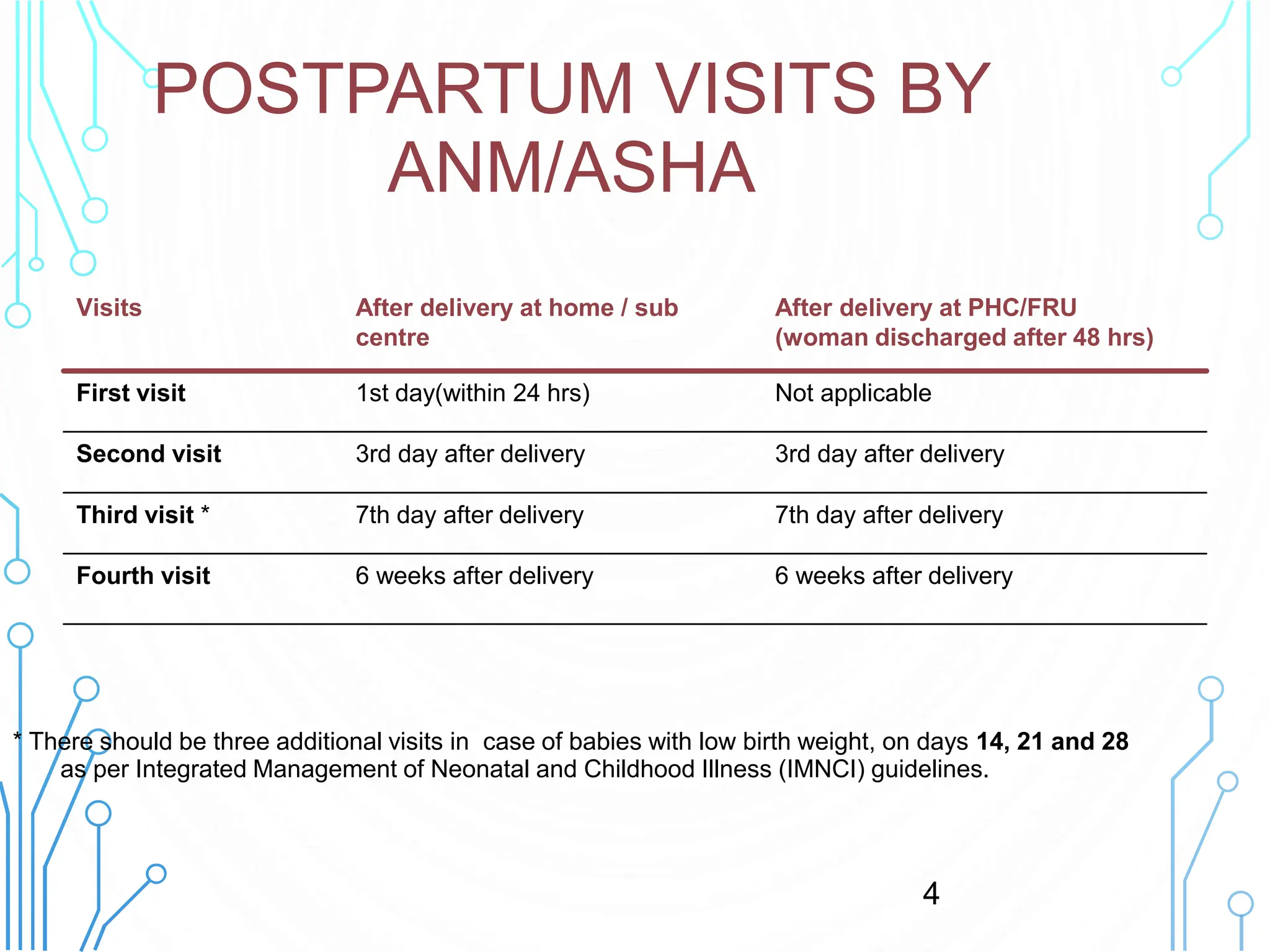
POSTPARTUM VISITS BY
ANM/ASHA
* There should be three additional visits in case of babies with low birth weight, on days 14, 21 and 28
as per Integrated Management of Neonatal and Childhood Illness (IMNCI) guidelines.
6 weeks after delivery
Fourth visit
7th day after delivery
Third visit *
3rd day after delivery
Second visit
Not applicable
1st day(within 24 hrs)
First visit
After delivery at PHC/FRU
(woman discharged after 48 hrs)
After delivery at home / sub
centre
Visits
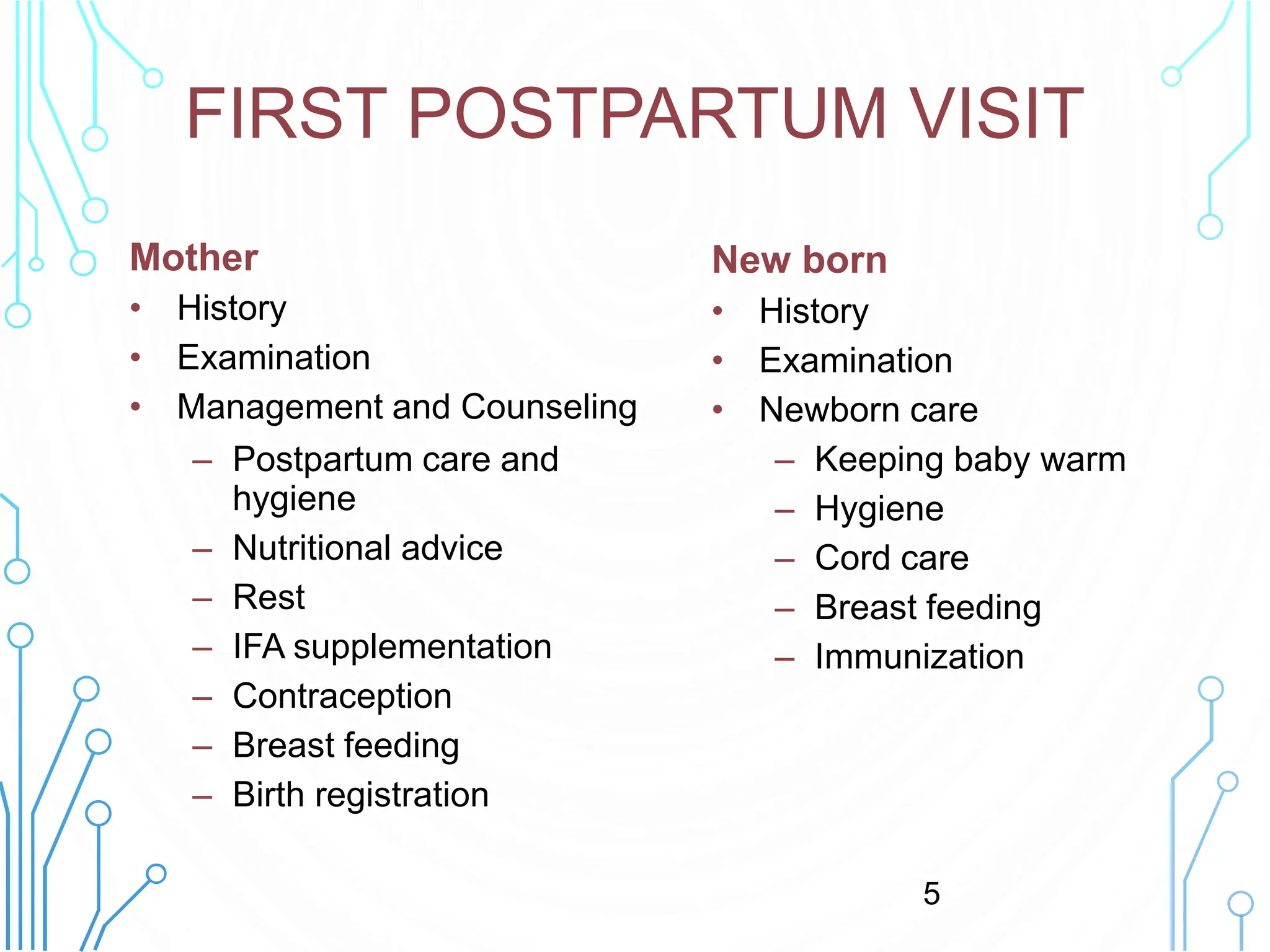
FIRST POSTPARTUM VISIT
Mother
• History
• Examination
• Management and Counseling
– Postpartum care and
hygiene
– Nutritional advice
– Rest
– IFA supplementation
– Contraception
– Breast feeding
– Birth registration
5
New born
• History
• Examination
• Newborn care
– Keeping baby warm
– Hygiene
– Cord care
– Breast feeding
– Immunization
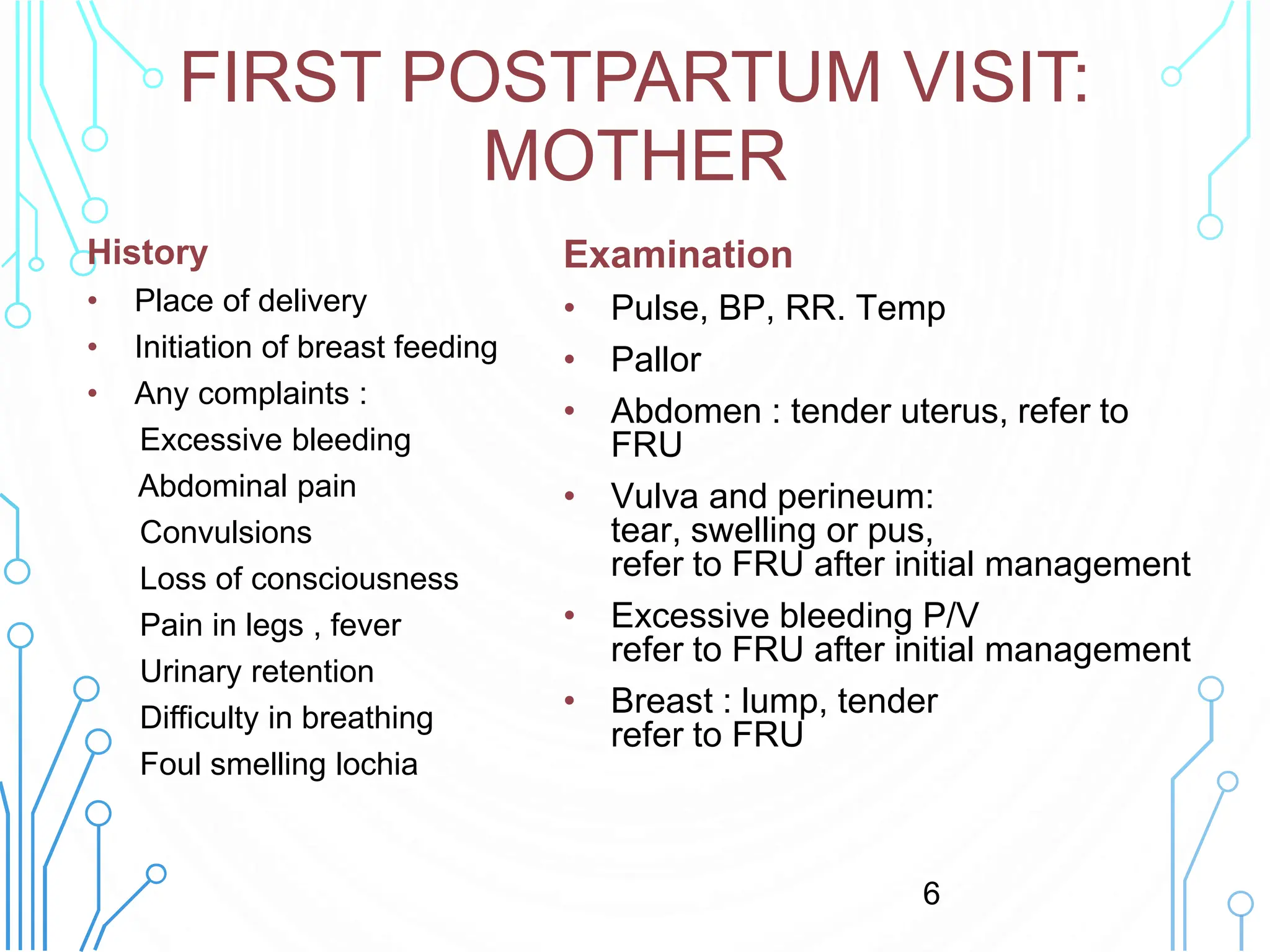
FIRST POSTPARTUM VISIT:
MOTHER
History
• Place of delivery
• Initiation of breast feeding
• Any complaints :
Excessive bleeding
Abdominal pain
Convulsions
Loss of consciousness
Pain in legs , fever
Urinary retention
Difficulty in breathing
Foul smelling lochia
6
Examination
• Pulse, BP, RR. Temp
• Pallor
• Abdomen : tender uterus, refer to
FRU
• Vulva and perineum:
tear, swelling or pus,
refer to FRU after initial management
• Excessive bleeding P/V
refer to FRU after initial management
• Breast : lump, tender
refer to FRU
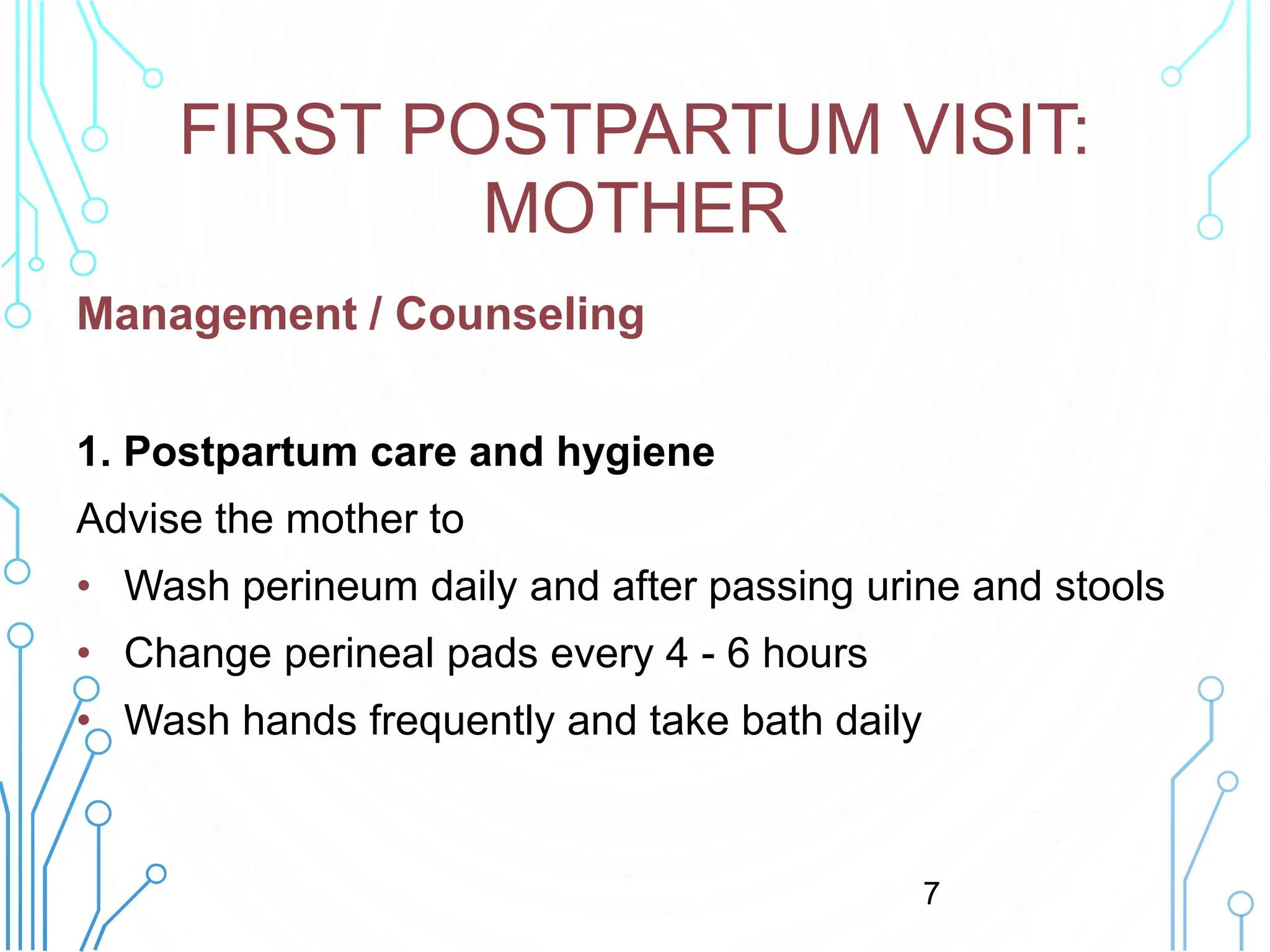
FIRST POSTPARTUM VISIT:
MOTHER
Management / Counseling
1. Postpartum care and hygiene
Advise the mother to
• Wash perineum daily and after passing urine and stools
• Change perineal pads every 4 - 6 hours
• Wash hands frequently and take bath daily
7
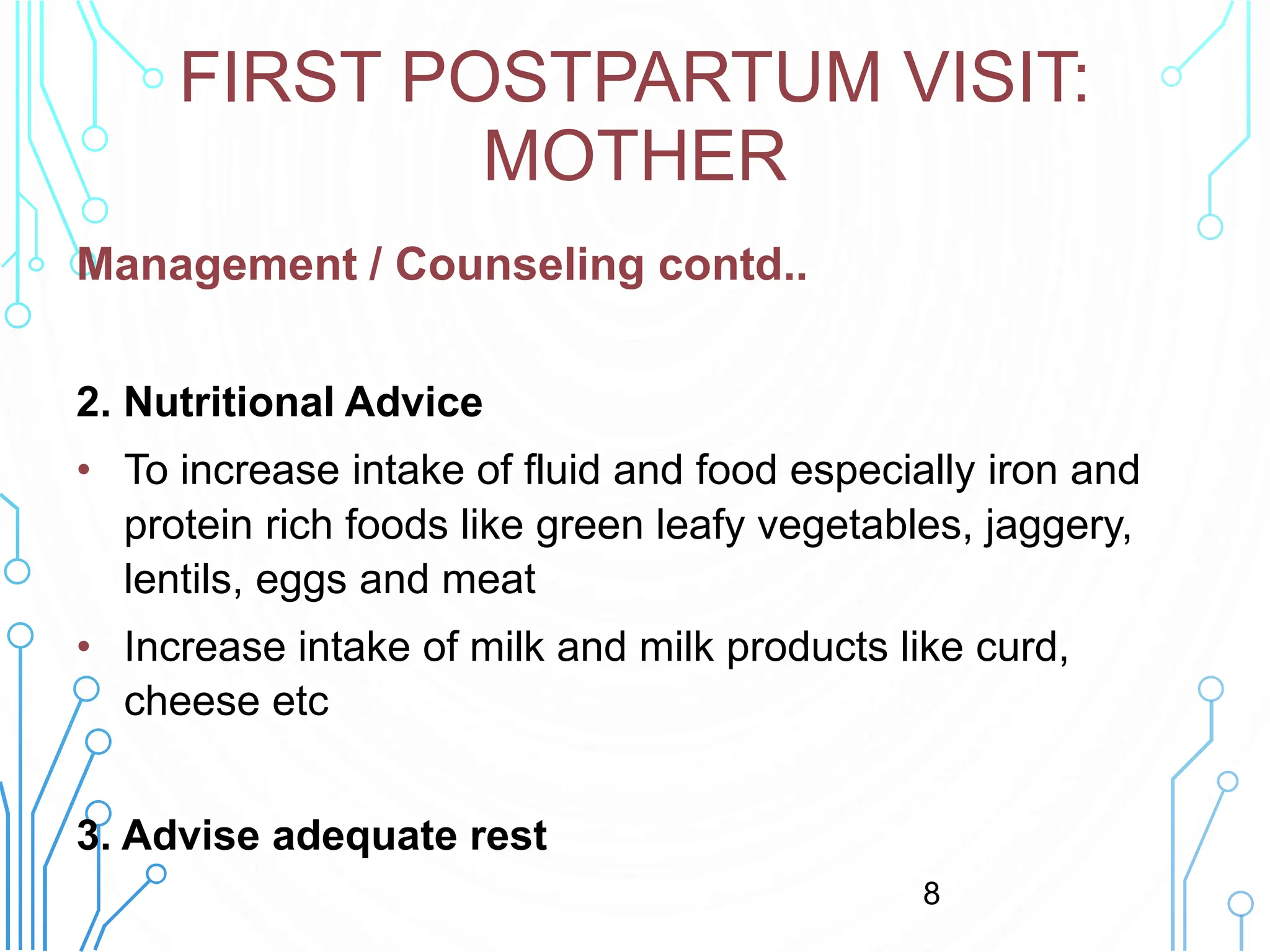
FIRST POSTPARTUM VISIT:
MOTHER
Management / Counseling contd..
2. Nutritional Advice
• To increase intake of fluid and food especially iron and
protein rich foods like green leafy vegetables, jaggery,
lentils, eggs and meat
• Increase intake of milk and milk products like curd,
cheese etc
3. Advise adequate rest
8
FIRST POSTPARTUM VISIT:
MOTHER
Management / Counseling contd..
4. IFA Supplementation
• Women with normal Hb are advised to take 1 IFA tablet
daily for 3 months
• If Hb below 11 gm%, advise her to take 2 IFA tabs daily
and repeat Hb after 1 month
5. Contraception
• Counsel couple regarding contraception
9
FIRST POSTPARTUM VISIT:
MOTHER
Management / Counseling contd..
6. Breastfeeding
Advise the mother-
• For exclusive breast feeding on demand, at least 6 to 8
times during day & 2-3 times during night
AVOID PRE- LACTEAL FEEDS
10
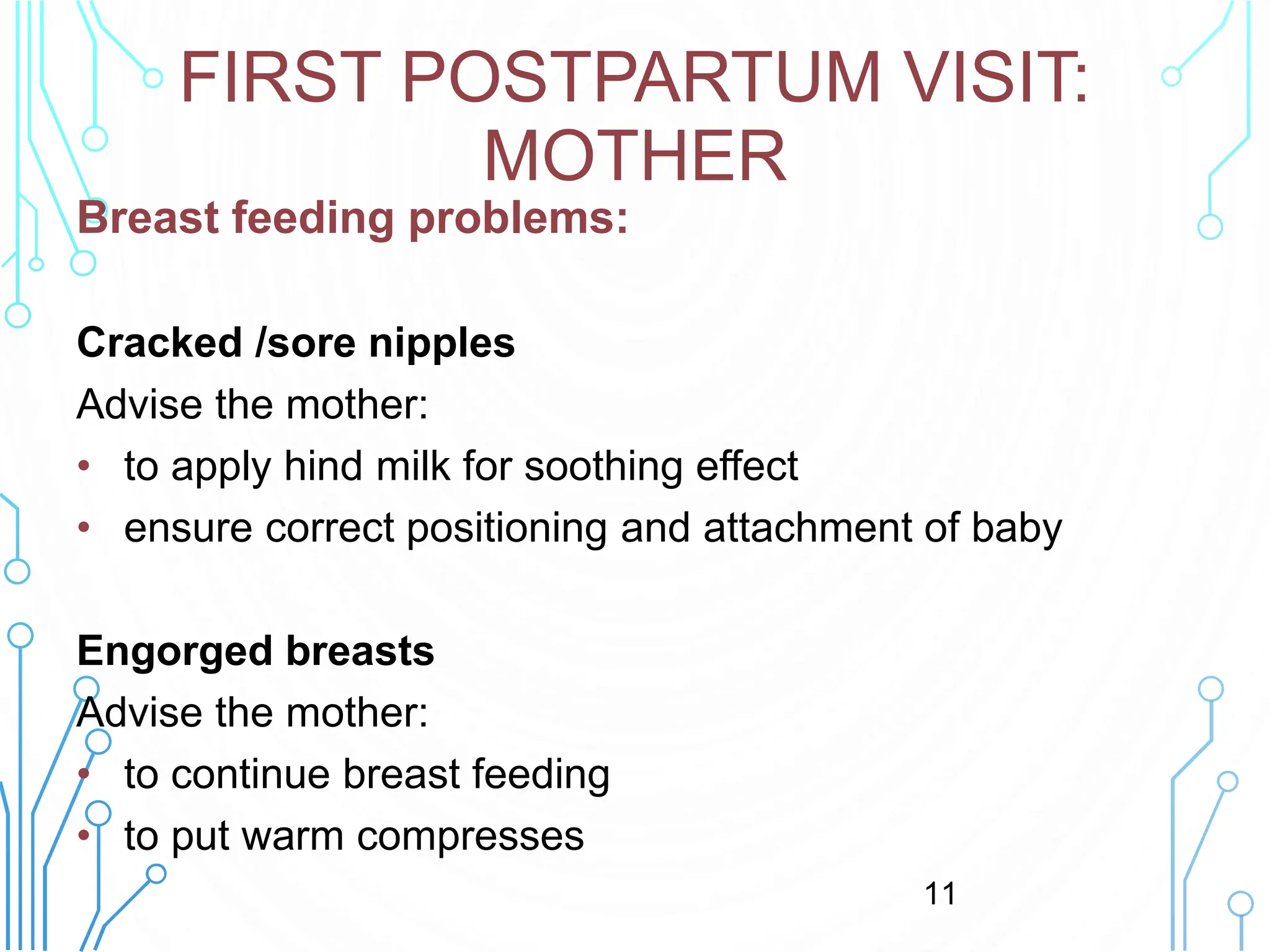
FIRST POSTPARTUM VISIT:
MOTHER
Breast feeding problems:
Cracked /sore nipples
Advise the mother:
• to apply hind milk for soothing effect
• ensure correct positioning and attachment of baby
Engorged breasts
Advise the mother:
• to continue breast feeding
• to put warm compresses
11
FIRST POSTPARTUM VISIT:
MOTHER
Registration of birth
Emphasize the importance of registration of birth
with local panchayat
• It is a legal document
• Required for many purposes
12
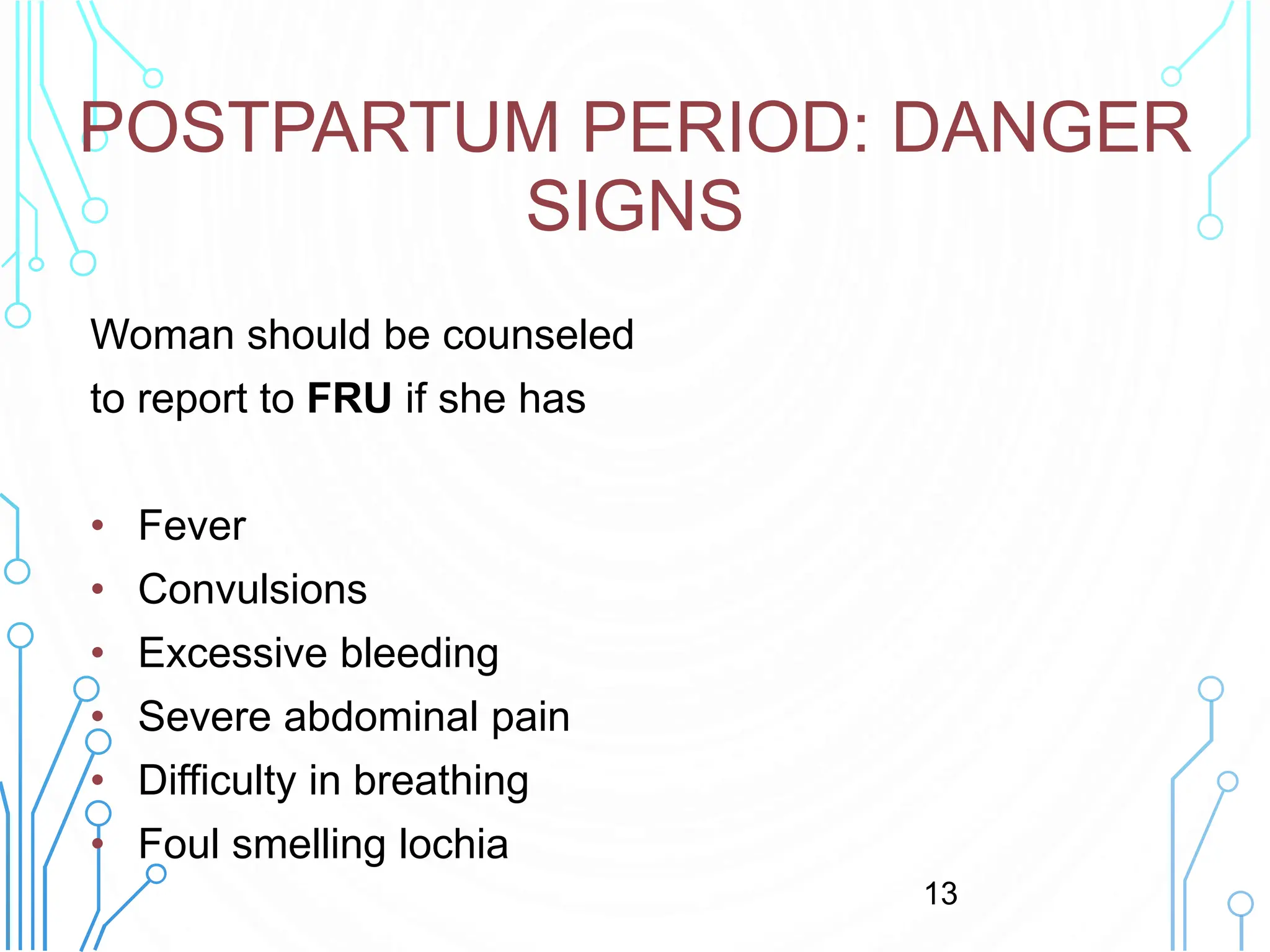
POSTPARTUM PERIOD: DANGER
SIGNS
Woman should be counseled
to report to FRU if she has
• Fever
• Convulsions
• Excessive bleeding
• Severe abdominal pain
• Difficulty in breathing
• Foul smelling lochia
13
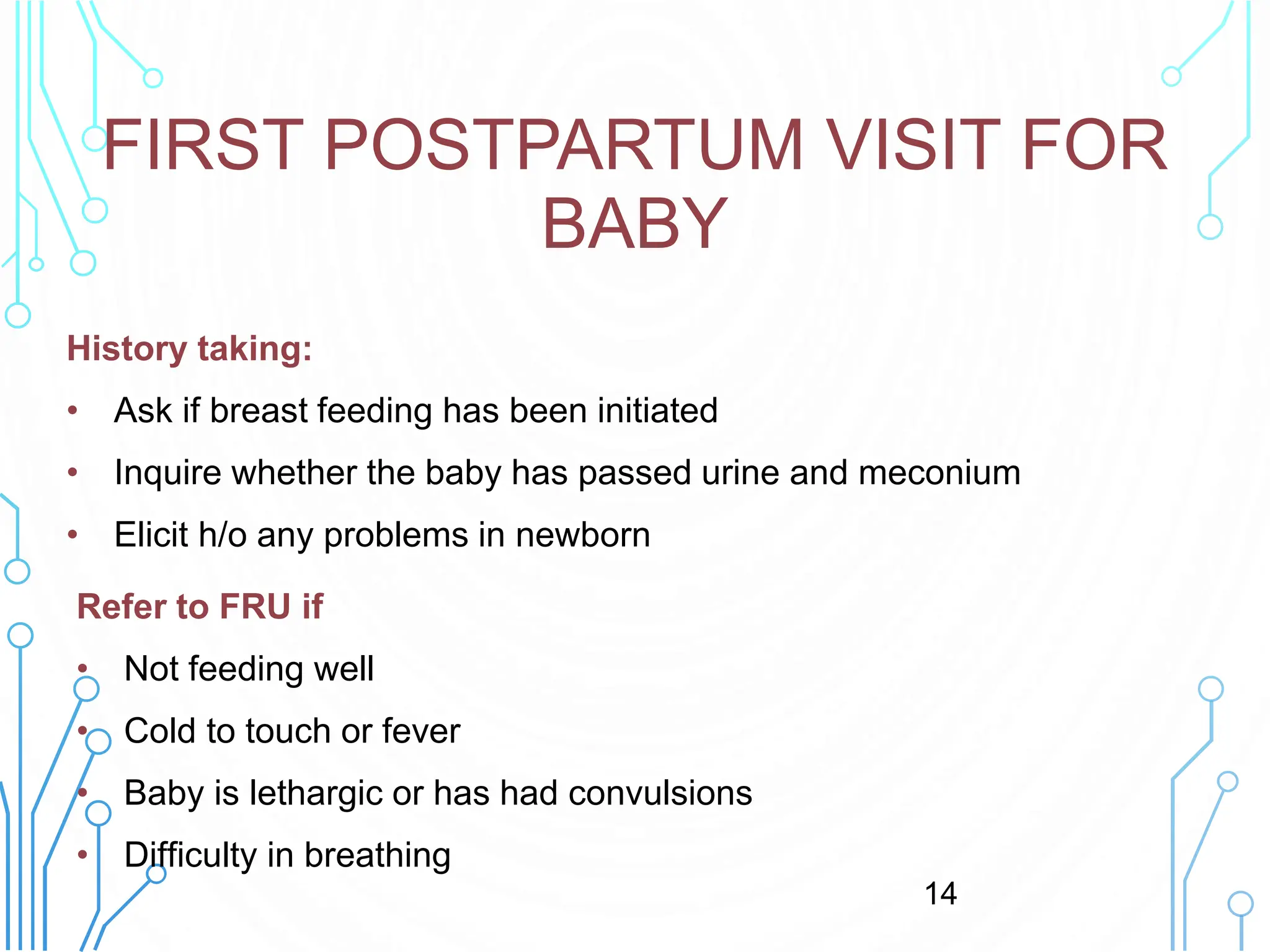
FIRST POSTPARTUM VISIT FOR
BABY
History taking:
• Ask if breast feeding has been initiated
• Inquire whether the baby has passed urine and meconium
• Elicit h/o any problems in newborn
14
Refer to FRU if
• Not feeding well
• Cold to touch or fever
• Baby is lethargic or has had convulsions
• Difficulty in breathing
FIRST POSTPARTUM VISIT FOR
BABY
15
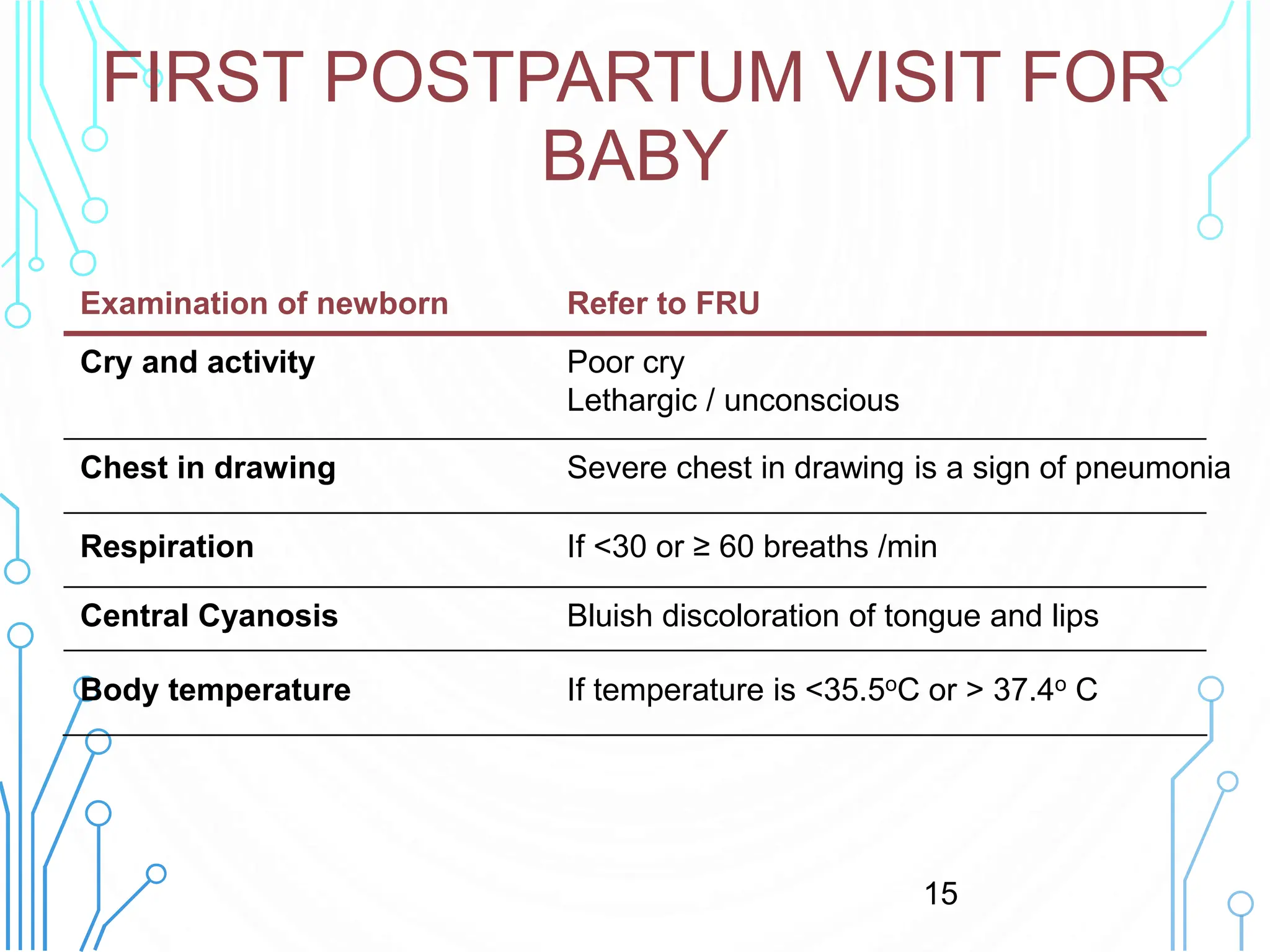
Examination of newborn Refer to FRU
Cry and activity Poor cry
Lethargic / unconscious
Chest in drawing Severe chest in drawing is a sign of pneumonia
Respiration If <30 or ≥ 60 breaths /min
Central Cyanosis Bluish discoloration of tongue and lips
Body temperature If temperature is <35.5oC or > 37.4o C
FIRST POSTPARTUM VISIT FOR
BABY
16
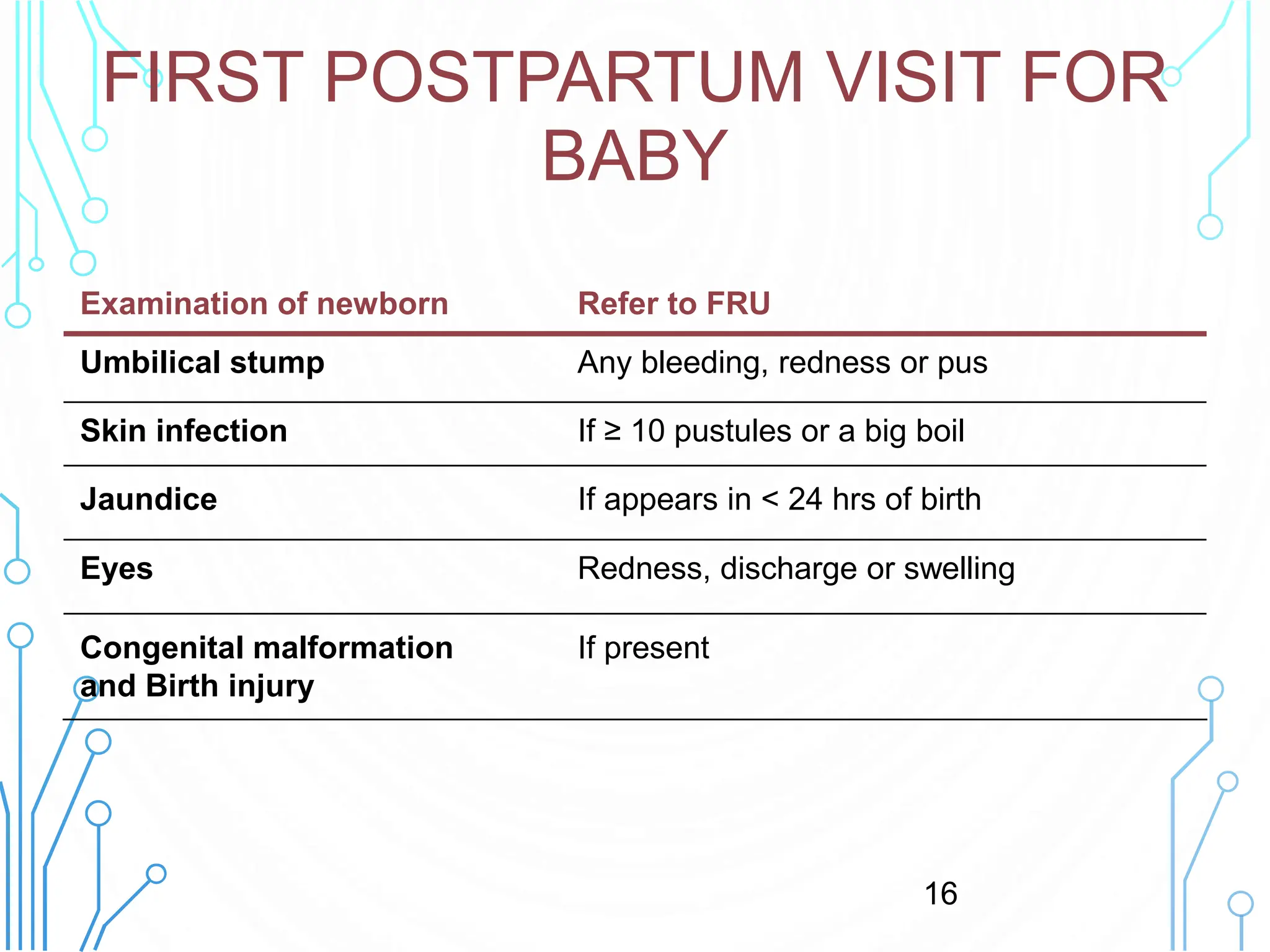
Examination of newborn Refer to FRU
Umbilical stump Any bleeding, redness or pus
Skin infection If ≥ 10 pustules or a big boil
Jaundice If appears in < 24 hrs of birth
Eyes Redness, discharge or swelling
Congenital malformation
and Birth injury
If present
FIRST POSTPARTUM VISIT FOR
BABY
Breast Feeding : Signs of good attachment
• Chin touching breast
• Mouth wide open
• Lower lip turned outward
• More areola visible above than below the mouth
17
A baby poorly attached to the
breast
A baby well attached to the
breast
FIRST POSTPARTUM VISIT FOR
BABY
Breast Feeding: Effects of poor attachment
• Pain and damage to nipples, leading to sore nipples
• Breast is not emptied completely, resulting in
breast engorgement
• Poor milk supply: baby not satisfied
• Poor weight gain of baby.
18
FIRST POSTPARTUM VISIT FOR
BABY
Immunization of Newborn
Counsel mother on where and when
to take baby for immunization
19
2ND AND 3RD VISIT FOR MOTHER
On 3rd and 7th day following delivery
History taking:
As on first visit
In addition ask for history of
• Continued bleeding P/V, foul discharge P/V
• Swelling or tenderness of breast.
• Feeling unhappy or crying easily
Examination: Same as on 1st visit
Management and Counseling: Same as on 1st visit
20
2ND AND 3RD VISIT FOR BABY
History taking and Examination:
Same as in first visit
Management and Counseling:
In addition to counseling in first visit, advise the mother :
To exclusively breast feed for six months.
To wean at six months.
21
FOURTH VISIT FOR MOTHER
At 6 weeks following delivery
History taking:
Ask the mother for following:
• Has vaginal bleeding stopped?
• Has menstrual cycle returned?
• Is there any foul smelling vaginal discharge?
• Any problems regarding breast feeding?
• Any other complaints?
• Give relevant advice & refer to M.O. if needed
22
FOURTH VISIT FOR MOTHER
Examination:
Similar to examination during previous visit
Management and Counseling:
Diet and Rest:
Emphasize importance of nutrition as in second and third visit.
Contraception:
Emphasize importance of using contraceptive methods for
spacing and limiting family size
23
FOURTH VISIT FOR BABY
History taking:
Ask the mother about
• Vaccines received by baby so far
• Is baby taking breast feed well?
• Weight gain of baby
• Any other problem
Examination:
• Check weight of baby.
• General examination of baby
24
FOURTH VISIT FOR BABY
Management and Counseling:
Emphasize on exclusive breast feeding
Refer baby to F.R.U. if
• Not sucking well at breast
• Is lethargic / unconscious
• Has fever or is cold to touch
• Cord - swollen or discharge present
• Diarrhea, blood in stool
• Convulsions
• Difficulty in breathing
25
KEY MESSAGES
Post partum care: Mother
• Make at least 4 postpartum visits for timely recognition
of complications like PPH, puerperal sepsis
• Advise mother on nutrition
• Advise mother on rest, hygiene, breast feeding and
contraception
26
KEY MESSAGES
Post partum care: New born
Screen for danger signs in newborn
Advise the mother to
• Keep baby warm
• Take care of umbilicus, skin & eyes
• Give exclusive breast feeds
• Ensure correct positioning & attachment to breast
• Immunize the baby
27
STEPS FOR TRANSFER AND REFERRAL
OF BABY
Preparation:
• Explain reason for transferring baby to higher facility
• If possible transfer the mother with baby so that she can
feed the baby
• A health care worker should accompany baby
• Ask relative to accompany baby and mother
28
STEPS FOR REFERRAL OF BABY
Communication:
• Fill up a referral form with baby’s essential information
and send it with baby
• If possible contact health care facility in advance
29
STEPS FOR TRANSFER OF
BABY
Care during transfer:
• Keep baby in skin to skin contact with mother, if not
possible keep baby dressed and covered
• Ensure that baby receives feeds
• If baby gasping or respiratory rate <30 breaths /minute,
resuscitate baby using bag and mask
30
THANK YOU
31

Postpartum Care.....................pptx

  • 1.
  • 2.
    OBJECTIVES To learn • Numberand timing of postpartum visits for mother and baby • History-taking, examination, management and counseling during postpartum visits • Steps for referral and transfer of baby 2
  • 3.
    IMPORTANCE OF POSTPARTUM CARE •More than 60% of maternal deaths take place during postpartum period • First 48 hours are most crucial • Most maternal and neonatal complications occur during this period. 3
  • 4.
    4 POSTPARTUM VISITS BY ANM/ASHA *There should be three additional visits in case of babies with low birth weight, on days 14, 21 and 28 as per Integrated Management of Neonatal and Childhood Illness (IMNCI) guidelines. 6 weeks after delivery 6 weeks after delivery Fourth visit 7th day after delivery 7th day after delivery Third visit * 3rd day after delivery 3rd day after delivery Second visit Not applicable 1st day(within 24 hrs) First visit After delivery at PHC/FRU (woman discharged after 48 hrs) After delivery at home / sub centre Visits
  • 5.
    FIRST POSTPARTUM VISIT Mother •History • Examination • Management and Counseling – Postpartum care and hygiene – Nutritional advice – Rest – IFA supplementation – Contraception – Breast feeding – Birth registration 5 New born • History • Examination • Newborn care – Keeping baby warm – Hygiene – Cord care – Breast feeding – Immunization
  • 6.
    FIRST POSTPARTUM VISIT: MOTHER History •Place of delivery • Initiation of breast feeding • Any complaints : Excessive bleeding Abdominal pain Convulsions Loss of consciousness Pain in legs , fever Urinary retention Difficulty in breathing Foul smelling lochia 6 Examination • Pulse, BP, RR. Temp • Pallor • Abdomen : tender uterus, refer to FRU • Vulva and perineum: tear, swelling or pus, refer to FRU after initial management • Excessive bleeding P/V refer to FRU after initial management • Breast : lump, tender refer to FRU
  • 7.
    FIRST POSTPARTUM VISIT: MOTHER Management/ Counseling 1. Postpartum care and hygiene Advise the mother to • Wash perineum daily and after passing urine and stools • Change perineal pads every 4 - 6 hours • Wash hands frequently and take bath daily 7
  • 8.
    FIRST POSTPARTUM VISIT: MOTHER Management/ Counseling contd.. 2. Nutritional Advice • To increase intake of fluid and food especially iron and protein rich foods like green leafy vegetables, jaggery, lentils, eggs and meat • Increase intake of milk and milk products like curd, cheese etc 3. Advise adequate rest 8
  • 9.
    FIRST POSTPARTUM VISIT: MOTHER Management/ Counseling contd.. 4. IFA Supplementation • Women with normal Hb are advised to take 1 IFA tablet daily for 3 months • If Hb below 11 gm%, advise her to take 2 IFA tabs daily and repeat Hb after 1 month 5. Contraception • Counsel couple regarding contraception 9
  • 10.
    FIRST POSTPARTUM VISIT: MOTHER Management/ Counseling contd.. 6. Breastfeeding Advise the mother- • For exclusive breast feeding on demand, at least 6 to 8 times during day & 2-3 times during night AVOID PRE- LACTEAL FEEDS 10
  • 11.
    FIRST POSTPARTUM VISIT: MOTHER Breastfeeding problems: Cracked /sore nipples Advise the mother: • to apply hind milk for soothing effect • ensure correct positioning and attachment of baby Engorged breasts Advise the mother: • to continue breast feeding • to put warm compresses 11
  • 12.
    FIRST POSTPARTUM VISIT: MOTHER Registrationof birth Emphasize the importance of registration of birth with local panchayat • It is a legal document • Required for many purposes 12
  • 13.
    POSTPARTUM PERIOD: DANGER SIGNS Womanshould be counseled to report to FRU if she has • Fever • Convulsions • Excessive bleeding • Severe abdominal pain • Difficulty in breathing • Foul smelling lochia 13
  • 14.
    FIRST POSTPARTUM VISITFOR BABY History taking: • Ask if breast feeding has been initiated • Inquire whether the baby has passed urine and meconium • Elicit h/o any problems in newborn 14 Refer to FRU if • Not feeding well • Cold to touch or fever • Baby is lethargic or has had convulsions • Difficulty in breathing
  • 15.
    FIRST POSTPARTUM VISITFOR BABY 15 Examination of newborn Refer to FRU Cry and activity Poor cry Lethargic / unconscious Chest in drawing Severe chest in drawing is a sign of pneumonia Respiration If <30 or ≥ 60 breaths /min Central Cyanosis Bluish discoloration of tongue and lips Body temperature If temperature is <35.5oC or > 37.4o C
  • 16.
    FIRST POSTPARTUM VISITFOR BABY 16 Examination of newborn Refer to FRU Umbilical stump Any bleeding, redness or pus Skin infection If ≥ 10 pustules or a big boil Jaundice If appears in < 24 hrs of birth Eyes Redness, discharge or swelling Congenital malformation and Birth injury If present
  • 17.
    FIRST POSTPARTUM VISITFOR BABY Breast Feeding : Signs of good attachment • Chin touching breast • Mouth wide open • Lower lip turned outward • More areola visible above than below the mouth 17 A baby poorly attached to the breast A baby well attached to the breast
  • 18.
    FIRST POSTPARTUM VISITFOR BABY Breast Feeding: Effects of poor attachment • Pain and damage to nipples, leading to sore nipples • Breast is not emptied completely, resulting in breast engorgement • Poor milk supply: baby not satisfied • Poor weight gain of baby. 18
  • 19.
    FIRST POSTPARTUM VISITFOR BABY Immunization of Newborn Counsel mother on where and when to take baby for immunization 19
  • 20.
    2ND AND 3RDVISIT FOR MOTHER On 3rd and 7th day following delivery History taking: As on first visit In addition ask for history of • Continued bleeding P/V, foul discharge P/V • Swelling or tenderness of breast. • Feeling unhappy or crying easily Examination: Same as on 1st visit Management and Counseling: Same as on 1st visit 20
  • 21.
    2ND AND 3RDVISIT FOR BABY History taking and Examination: Same as in first visit Management and Counseling: In addition to counseling in first visit, advise the mother : To exclusively breast feed for six months. To wean at six months. 21
  • 22.
    FOURTH VISIT FORMOTHER At 6 weeks following delivery History taking: Ask the mother for following: • Has vaginal bleeding stopped? • Has menstrual cycle returned? • Is there any foul smelling vaginal discharge? • Any problems regarding breast feeding? • Any other complaints? • Give relevant advice & refer to M.O. if needed 22
  • 23.
    FOURTH VISIT FORMOTHER Examination: Similar to examination during previous visit Management and Counseling: Diet and Rest: Emphasize importance of nutrition as in second and third visit. Contraception: Emphasize importance of using contraceptive methods for spacing and limiting family size 23
  • 24.
    FOURTH VISIT FORBABY History taking: Ask the mother about • Vaccines received by baby so far • Is baby taking breast feed well? • Weight gain of baby • Any other problem Examination: • Check weight of baby. • General examination of baby 24
  • 25.
    FOURTH VISIT FORBABY Management and Counseling: Emphasize on exclusive breast feeding Refer baby to F.R.U. if • Not sucking well at breast • Is lethargic / unconscious • Has fever or is cold to touch • Cord - swollen or discharge present • Diarrhea, blood in stool • Convulsions • Difficulty in breathing 25
  • 26.
    KEY MESSAGES Post partumcare: Mother • Make at least 4 postpartum visits for timely recognition of complications like PPH, puerperal sepsis • Advise mother on nutrition • Advise mother on rest, hygiene, breast feeding and contraception 26
  • 27.
    KEY MESSAGES Post partumcare: New born Screen for danger signs in newborn Advise the mother to • Keep baby warm • Take care of umbilicus, skin & eyes • Give exclusive breast feeds • Ensure correct positioning & attachment to breast • Immunize the baby 27
  • 28.
    STEPS FOR TRANSFERAND REFERRAL OF BABY Preparation: • Explain reason for transferring baby to higher facility • If possible transfer the mother with baby so that she can feed the baby • A health care worker should accompany baby • Ask relative to accompany baby and mother 28
  • 29.
    STEPS FOR REFERRALOF BABY Communication: • Fill up a referral form with baby’s essential information and send it with baby • If possible contact health care facility in advance 29
  • 30.
    STEPS FOR TRANSFEROF BABY Care during transfer: • Keep baby in skin to skin contact with mother, if not possible keep baby dressed and covered • Ensure that baby receives feeds • If baby gasping or respiratory rate <30 breaths /minute, resuscitate baby using bag and mask 30
  • 31.