RANDOMIZED
CONTROL TRIALS
Dr Stefi M S,1st
year PG.
Dept of community medicine
Mentor: Dr Surendra
Asst. Professor, Dept of Community Medicine
ESICMC, Hyderabad.
LEARNING OBJECTIVES
 To describe the important elements of RCT.
 To define the purpose of RCT
 To introduce problems related to RCT
 Identify types of RCT
 To identify non randomized control trials
BIBLIOGRAPHY
 Basic epidemiology, 2nd
edition, Bonita R, Beaglehole, Kjellstrom
 Gordis epidemiology, 6th
edition, Celentano, Szklo M.
 Park’s textbook pf preventive and social medicine 26th
ed.
 Textbook of public health and community medicine.3rd
ed, Bhalwar R.
 Jekel’s Epidemiology, Biostatistics, Preventive Medicine, and Public Health.4th
ed
 Houle S. An Introduction to the Fundamentals of Randomized Controlled Trials in
Pharmacy Research
 Hall NS. R. A. Fisher and his advocacy of randomization.
 Bhide A, Shah PS, Acharya G. A simplified guide to randomized controlled trials.
OUTLINE
 Introduction (5-10)
 Steps In RCT (11-31)
 Types Of RCT (32-36)
 Advantages And Disadvantages (37-41)
 Non- Randomized Experimental Studies (43-44)
 Phases Of Clinical Trial and example (50-53)
 Conclusion and take home message (54-55)
 References (56-57)
INTRODUCTION
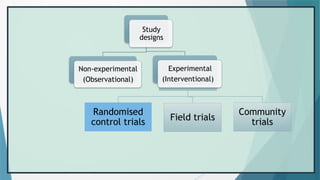
Experimental
studies
Randomised
control trials Field trials
Community
trials
Study
designs
Non-experimental
(Observational)
Experimental
(Interventional)
WHAT IS RANDOMIZED CONTROL TRIAL?
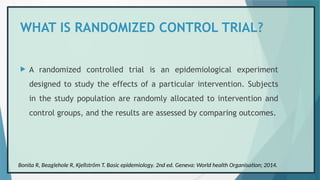
 A randomized controlled trial is an epidemiological experiment
designed to study the effects of a particular intervention. Subjects
in the study population are randomly allocated to intervention and
control groups, and the results are assessed by comparing outcomes.
Bonita R, Beaglehole R, Kjellström T. Basic epidemiology. 2nd ed. Geneva: World health Organisation; 2014.
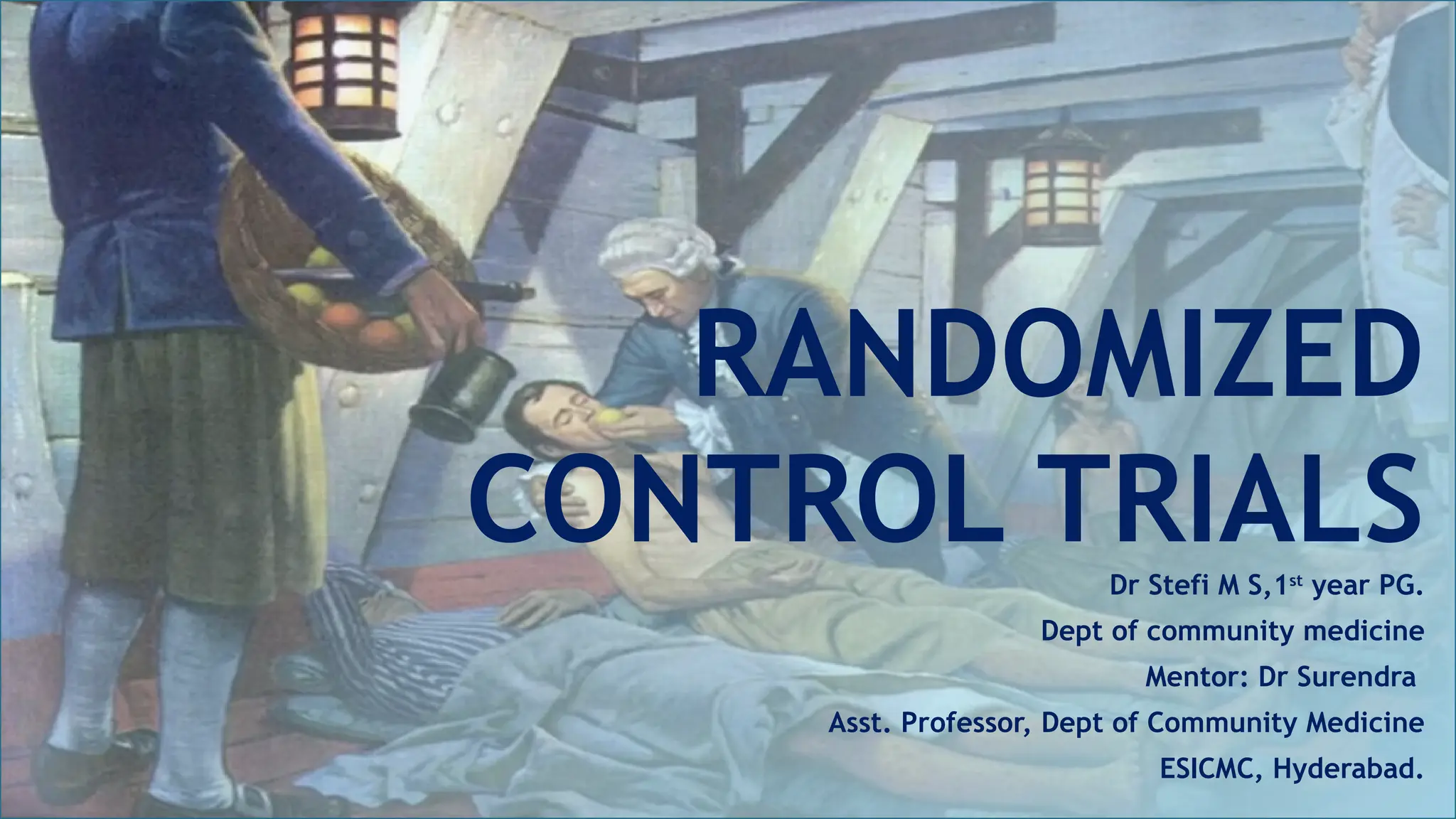
HISTORY
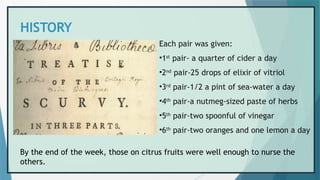
• James Lind (1716-1794)
• In 1747, on board HMS
Salisbury, he carried out one
of the first controlled clinical
trials recorded in medical
science.
• He took 12 men suffering
from similar symptoms of
scurvy, divided them into six
pairs and treated them with
remedies suggested by
previous writers.
James Lind: The man who helped to cure scurvy with lemons. BBC News [Internet]. 2016 Oct 3 [cited 2023 Jan 5];
Available from: https://www.bbc.com/news/uk-england-37320399
HISTORY
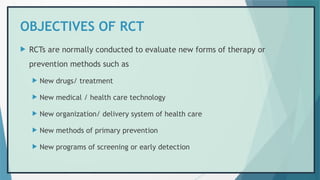
Each pair was given:
•1st
pair- a quarter of cider a day
•2nd
pair-25 drops of elixir of vitriol
•3rd
pair-1/2 a pint of sea-water a day
•4th
pair-a nutmeg-sized paste of herbs
•5th
pair-two spoonful of vinegar
•6th
pair-two oranges and one lemon a day
By the end of the week, those on citrus fruits were well enough to nurse the
others.
OBJECTIVES OF RCT
 RCTs are normally conducted to evaluate new forms of therapy or
prevention methods such as
 New drugs/ treatment
 New medical / health care technology
 New organization/ delivery system of health care
 New methods of primary prevention
 New programs of screening or early detection
STEPS IN RCT
 1. DRAWING UP A PROTOCOL
 2. SELECTION OF SUBJECTS
 3. RANDOMIZATION
 4. MANIPULATION/ INTERVENTION
 5. FOLLOW-UP
 6. ASSESSMENT OF OUTCOME
DRAWING UP A PROTOCOL
 A randomised control trial should be conducted under a strict protocol.
 The protocol specifies :
 The aims and objectives of the study.
 Questions to be answered
 Criteria for selection of study population
 Sample size
 Procedure of randomization
 Treatments to be applied
 Working procedure and schedules.
SCHEMATIC DIAGRAM
Houle S. An Introduction to the Fundamentals of Randomized Controlled Trials in Pharmacy Research. Can J Hosp Pharm
[Internet]. 2015 Feb 26
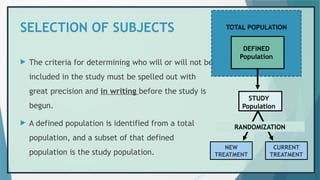
SELECTION OF SUBJECTS TOTAL POPULATION
 The criteria for determining who will or will not be
included in the study must be spelled out with
great precision and in writing before the study is
begun.
 A defined population is identified from a total
population, and a subset of that defined
population is the study population.
DEFINED
Population
STUDY
Population
TOTAL POPULATION
RANDOMIZATION
NEW
TREATMENT
CURRENT
TREATMENT
SELECTION OF SUBJECTS
 The participants must fulfil the following criteria:
a. Give informed consent
b. Should be representative of the population to which they belong.
c. Qualified or eligible for trial
CHALLENGES
 Recruiting a sufficient number participants.
 Willingness to randomization
 Also, participants must be fully informed of the risks.
 Arrangements to cover travel, accommodation or loss of pay.
 Avoid promising the participant, the benefits of the therapy being tested.
 Retaining volunteers for the full duration of the study.
 Loss to follow-up/ attrition bias
RANDOMIZATION
 Randomization is a statistical procedure by which the study participants
are allocated into groups usually called experimental and control
groups, to receive or not to receive an experimental preventive or
therapeutic procedure, maneuver or intervention.
 The requirement of randomization in experimental design was first
stated by R. A. Fisher, statistician and geneticist, in 1925 in his book
Statistical Methods for Research Workers.
Hall NS. R. A. Fisher and his advocacy of randomization. J Hist Biol. 2007;40(2):295–325..
RANDOMIZATION
 Randomization ensures that everyone in the study population has equal
chances to be either in treatment group or control group.
 The critical element of randomization is the unpredictability of the next
assignment.
ALLOCATION CONCEALMENT
 Neither front-line care providers, investigators or participants are aware
of whether the next eligible participant will be receiving treatment or
control intervention.
 This should be masked until the time when participants are ready to
receive intervention.
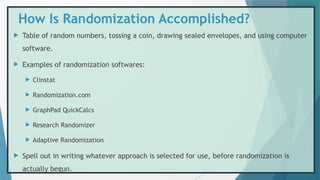
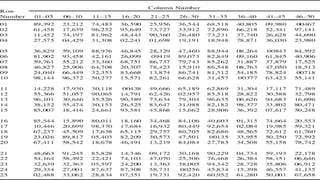
How Is Randomization Accomplished?
 Table of random numbers, tossing a coin, drawing sealed envelopes, and using computer
software.
 Examples of randomization softwares:
 Clinstat
 Randomization.com
 GraphPad QuickCalcs
 Research Randomizer
 Adaptive Randomization
 Spell out in writing whatever approach is selected for use, before randomization is
actually begun.
How Is Randomization Accomplished?
Why Randomization?
 To achieve non predictability of the next assignment.
 To prevent any subjective biases of the investigators while assigning the
treatment groups.
 If the study is large enough, randomization will increase the likelihood
that the groups will be comparable to each other in regard to certain
characteristics that could affect the prognosis.
Why Randomization?
 Known variables can be matched.
 Randomization distributes the both known and unknown variables
between the two groups.
 Also, if we match on a particular characteristic, we cannot analyze its
association with the outcome because the two groups will already be
identical.
CHALLENGES
 Conflict might experienced by many clinicians who enroll their own
patients in randomized trials.
 To prevent this kind of bias, randomization is done by an impartial separate
coordinating and statistical center.
 Allocation concealment
 Blinding
 Randomization is not a guarantee of comparability because chance may
play a role.
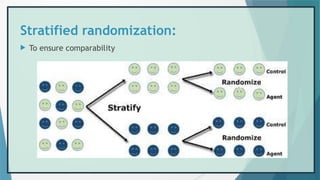
Stratified randomization:
 To ensure comparability
MANIPULATION/ INTERVENTION
 By deliberate application or withdrawal or reduction of a specific factor
as laid down in protocol
 Creates an independent variable whose effect is then determined by
measurement of final outcome, which constitutes the dependent variable
 E.g. new drug- incidence of outcome.
FOLLOW-UP/DATA COLLECTED
 It is essential that the data collected for each of the study groups be of
the same quality.
 TREATMENT
 We must know to which treatment group the patient was assigned. We must
know which therapy the patient actually received.
 OUTCOME:
 Measurements include both improvement (the desired effect) and any side
effects that may appear
CHALLENGES
 OBSERVER BIAS
 Outcomes being measured more carefully in those receiving a new drug
than in those receiving currently available therapy.
 Can be reduced by:
 BLINDING
BLINDING
 SINGLE BLIND TRIAL:
 Participant is not aware whether he belongs to the study group or control
group.
 DOUBLE BLIND TRIAL:
 Neither the investigator nor the participant is aware of the group allocation
and treatment
 TRIPLE BLIND TRIAL:
 Participant, the investigator and the person analyzing the data are all blind.
ANALYSIS
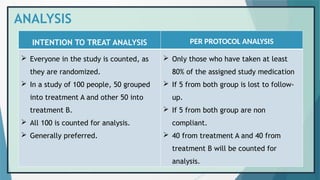
INTENTION TO TREAT ANALYSIS PER PROTOCOL ANALYSIS
 Everyone in the study is counted, as
they are randomized.
 In a study of 100 people, 50 grouped
into treatment A and other 50 into
treatment B.
 All 100 is counted for analysis.
 Generally preferred.
 Only those who have taken at least
80% of the assigned study medication
 If 5 from both group is lost to follow-
up.
 If 5 from both group are non
compliant.
 40 from treatment A and 40 from
treatment B will be counted for
analysis.
ANALYSIS
 Calculate the incidence of outcome in the exposed and non exposed
group(Exposed to new treatment/intervention)
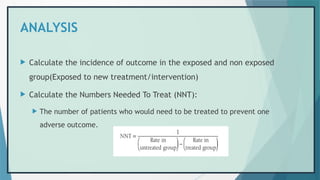
 Calculate the Numbers Needed To Treat (NNT):
 The number of patients who would need to be treated to prevent one
adverse outcome.
TYPES OF RCT
 Crossover Design
 Factorial Design
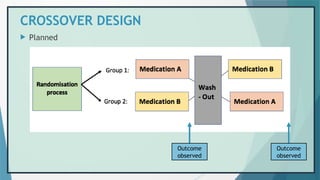
CROSSOVER DESIGN
 Planned
Outcome
observed
Outcome
observed
CROSSOVER DESIGN-CHALLENGES
 CARRY OVER
 The order in which the therapies are given may elicit psychological
responses.
 The planned crossover design is clearly not possible if the new therapy is
surgical or if the new therapy cures the disease.
CROSSOVER DESIGN-UNPLANNED
 Some subjects may later change their mind to under go a certain type of
intervention
 Sometimes, the health condition of some subjects may worsen and
require another intervention than the assigned.
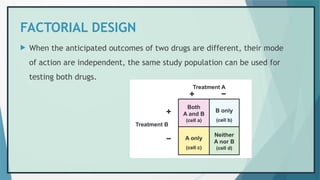
FACTORIAL DESIGN
 When the anticipated outcomes of two drugs are different, their mode
of action are independent, the same study population can be used for
testing both drugs.
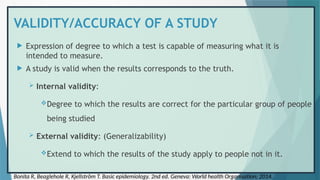
VALIDITY/ACCURACY OF A STUDY
 Expression of degree to which a test is capable of measuring what it is
intended to measure.
 A study is valid when the results corresponds to the truth.
 Internal validity:
Degree to which the results are correct for the particular group of people
being studied
 External validity: (Generalizability)
Extend to which the results of the study apply to people not in it.
Bonita R, Beaglehole R, Kjellström T. Basic epidemiology. 2nd ed. Geneva: World health Organisation; 2014.
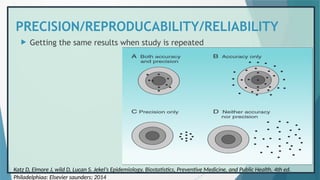
PRECISION/REPRODUCABILITY/RELIABILITY
 Getting the same results when study is repeated
Katz D, Elmore J, wild D, Lucan S. Jekel’s Epidemiology, Biostatistics, Preventive Medicine, and Public Health. 4th ed.
Philadelphiaa: Elsevier saunders; 2014
ADVANTAGES OF RCT
 High internal validity
 Investigator has control over patient’s exposure
 Prospective data collection
 Comparability between groups
 Ability to evaluate causal relationships
 Removes a large number of biases related to selection and measurement.
DISADVANTAGES OF RCT
 Publication bias
 Non compliance
 Higher cost than observational studies
 Limited external validity and generalizability
 Ethical considerations related to assigning patients to particular care
approaches
Noncompliance
 Patients may agree to be randomized, but following randomization they
may not comply with the assigned treatment.
 Dropouts from the study
 Checks on potential noncompliance
 E.g. urine tests for the agent being tested or for one of its metabolites.
Noncompliance
 Drop-ins:
 Patients in one group may inadvertently take the agent assigned to the other
group.
 How to reduce?
 Give a list of preparations containing the specified medicine.
 Urine tests for metabolites of specified medicine.
 The net effect of noncompliance on the study results will be to reduce any
observed differences
Noncompliance- How to Solve?
 To carry out a pilot study in which compliers and noncompliers were
identified.
 Conduct the actual study with the compliers.
 Problem: compromise in generalizability
REPORTING THE RESULTS OF RCT
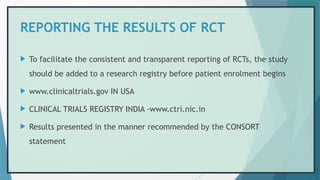
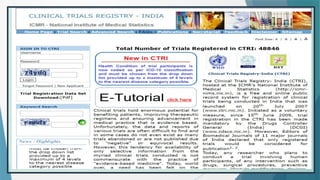
 To facilitate the consistent and transparent reporting of RCTs, the study
should be added to a research registry before patient enrolment begins
 www.clinicaltrials.gov IN USA
 CLINICAL TRIALS REGISTRY INDIA -www.ctri.nic.in
 Results presented in the manner recommended by the CONSORT
statement
NON-RANDOMIZED STUDIES
 In circumstances, when an “intervention” has been given to one group of
subjects and not given to another group, but the procedure of “random
allocation” has not been enforced for various reasons of practicability or
ethics, are called as “Quasi - experimental” studies.
Bhalwar R. Textbook of public health and community medicine. 3rd ed. New Delhi: Wolters Kluwer Pvt Ltd; 2019.
Quasi – experimental studies
 Natural experiments
 Smokers and non smokers
 Religious or social groups
 Atomic bombings
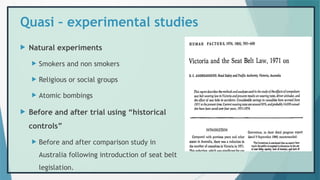
 Before and after trial using “historical
controls”
 Before and after comparison study in
Australia following introduction of seat belt
legislation.
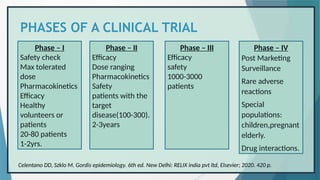
PHASES OF A CLINICAL TRIAL
Phase – I
Safety check
Max tolerated
dose
Pharmacokinetics
Efficacy
Healthy
volunteers or
patients
20-80 patients
1-2yrs.
Phase – II
Efficacy
Dose ranging
Pharmacokinetics
Safety
patients with the
target
disease(100-300).
2-3years
Phase – III
Efficacy
safety
1000-3000
patients
Phase – IV
Post Marketing
Surveillance
Rare adverse
reactions
Special
populations:
children,pregnant
elderly.
Drug interactions.
Celentano DD, Szklo M. Gordis epidemiology. 6th ed. New Delhi: RELIX india pvt ltd, Elsevier; 2020. 420 p.
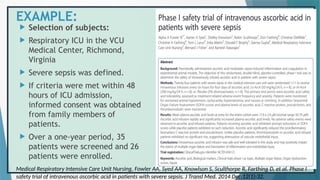
EXAMPLE:
 Selection of subjects:
 Respiratory ICU in the VCU
Medical Center, Richmond,
Virginia
 Severe sepsis was defined.
 If criteria were met within 48
hours of ICU admission,
informed consent was obtained
from family members of
patients.
 Over a one-year period, 35
patients were screened and 26
patients were enrolled.
Medical Respiratory Intensive Care Unit Nursing, Fowler AA, Syed AA, Knowlson S, Sculthorpe R, Farthing D, et al. Phase I
safety trial of intravenous ascorbic acid in patients with severe sepsis. J Transl Med. 2014 Dec;12(1):32.
Phase I safety trial of intravenous ascorbic acid in
patients with severe sepsis
 Randomization:
 Research randomizer
 3 groups after randomization:
1) Placebo:5% dextrose and water
 2) Low dose ascorbic acid
3) High dose ascorbic acid
 Single blind study
Medical Respiratory Intensive Care Unit Nursing, Fowler AA, Syed AA, Knowlson S, Sculthorpe R, Farthing D, et al. Phase I
safety trial of intravenous ascorbic acid in patients with severe sepsis. J Transl Med. 2014 Dec;12(1):32.
Phase I safety trial of intravenous ascorbic acid
in patients with severe sepsis
 Follow-up:
 primary end points as treatment-related adverse-event frequency and severity
 Assessment of organ failure: Sequential Organ Failure Assessment(SOFA)score
 Hypotension
 Tachycardia
 Hypernatremia
 Nausea or vomiting
 CRP
 Plasma ascorbic acid levels
 ANALYSIS:
 Per protocol analysis
 No patients were withdrawn due to study-related adverse events
 Ascorbic acid levels increased in treatment group
 Patients treated with either dose of ascorbic acid exhibited descending
SOFA scores over the 4-day study period
 Patients receiving ascorbic acid exhibited rapid reductions in CRP levels
Phase I safety trial of intravenous ascorbic acid
in patients with severe sepsis
CONCLUSION
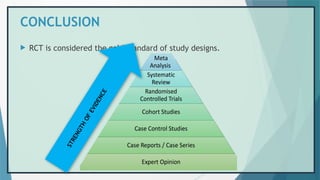
 RCT is considered the gold standard of study designs.
S
T
R
E
N
G
T
H
O
F
E
V
I
D
E
N
C
E
TAKE HOME MESSAGE:
 Randomization is the heart of RCT.
 RCT has all the advantages of a cohort study, no selection bias, no
subjective influence of investigator or analyzer, confounding factors also
taken care of.
 Has higher strength of evidence than observational studies.
REFERENCES
1. Bonita R, Beaglehole R, Kjellström T. Basic epidemiology. 2nd ed. Geneva: World health
Organisation; 2014. 212 p.
2. James Lind: The man who helped to cure scurvy with lemons. BBC News [Internet]. 2016 Oct 3
[cited 2023 Jan 5]; Available from: https://www.bbc.com/news/uk-england-37320399
3. Celentano DD, Szklo M. Gordis epidemiology. 6th ed. New Delhi: RELIX india pvt ltd, Elsevier;
2020. 420 p.
4. Houle S. An Introduction to the Fundamentals of Randomized Controlled Trials in Pharmacy
Research. Can J Hosp Pharm [Internet]. 2015 Feb 26 [cited 2023 Jan 6];68(1). Available from:
https://www.cjhp-online.ca/index.php/cjhp/article/view/1422
5. Park K. Park’s textbook pf preventive and social medicine. 26th ed. Jabalpur: M/s Banarsidas
Bhanot publishers; 2021.
REFERENCES
6. Hall NS. R. A. Fisher and his advocacy of randomization. J Hist Biol. 2007;40(2):295–325.
7. Bhide A, Shah PS, Acharya G. A simplified guide to randomized controlled trials. Acta Obstet
Gynecol Scand. 2018;97(4):380–7.
8. Saghaei M. An Overview of Randomization and Minimization Programs for Randomized Clinical
Trials. J Med Signals Sens. 2011;1(1):55–61.
9. Appendix 7.A Using a Table of Random Numbers - Statistical Inference: A Short Course [Book]
[Internet]. [cited 2023 Jan 8]. Available from: https://www.oreilly.com/library/view/statistical-
inference-a/9781118309803/c07anchor-6.html
10. Katz D, Elmore J, wild D, Lucan S. Jekel’s Epidemiology, Biostatistics, Preventive Medicine, and
Public Health. 4th ed. Philadelphiaa: Elsevier saunders; 2014.
REFERENCES
11. Bhalwar R. Textbook of public health and community medicine. 3rd ed. New Delhi: Wolters
Kluwer Pvt Ltd; 2019.
12. Clinical Trials Registry - India (CTRI) [Internet]. [cited 2023 Jan 8]. Available from:
https://ctri.nic.in/Clinicaltrials/login.php
13. QUASI- | English meaning - Cambridge Dictionary [Internet]. [cited 2023 Jan 9]. Available from:
https://dictionary.cambridge.org/dictionary/english/quasi
14. Medical Respiratory Intensive Care Unit Nursing, Fowler AA, Syed AA, Knowlson S, Sculthorpe R,
Farthing D, et al. Phase I safety trial of intravenous ascorbic acid in patients with severe sepsis. J
Transl Med. 2014 Dec;12(1):32.
15. Fujii T, Luethi N, Young PJ, Frei DR, Eastwood GM, French CJ, et al. Effect of Vitamin C,
Hydrocortisone, and Thiamine vs Hydrocortisone Alone on Time Alive and Free of Vasopressor
Support Among Patients With Septic Shock: The VITAMINS Randomized Clinical Trial. JAMA. 2020
Feb 4;323(5):423–31.
THANKYOU

RANDOMIZED CONTROL TRIALS PowerPoint presentation

  • 1.
    RANDOMIZED CONTROL TRIALS Dr StefiM S,1st year PG. Dept of community medicine Mentor: Dr Surendra Asst. Professor, Dept of Community Medicine ESICMC, Hyderabad.
  • 2.
    LEARNING OBJECTIVES  Todescribe the important elements of RCT.  To define the purpose of RCT  To introduce problems related to RCT  Identify types of RCT  To identify non randomized control trials
  • 3.
    BIBLIOGRAPHY  Basic epidemiology,2nd edition, Bonita R, Beaglehole, Kjellstrom  Gordis epidemiology, 6th edition, Celentano, Szklo M.  Park’s textbook pf preventive and social medicine 26th ed.  Textbook of public health and community medicine.3rd ed, Bhalwar R.  Jekel’s Epidemiology, Biostatistics, Preventive Medicine, and Public Health.4th ed  Houle S. An Introduction to the Fundamentals of Randomized Controlled Trials in Pharmacy Research  Hall NS. R. A. Fisher and his advocacy of randomization.  Bhide A, Shah PS, Acharya G. A simplified guide to randomized controlled trials.
  • 4.
    OUTLINE  Introduction (5-10) Steps In RCT (11-31)  Types Of RCT (32-36)  Advantages And Disadvantages (37-41)  Non- Randomized Experimental Studies (43-44)  Phases Of Clinical Trial and example (50-53)  Conclusion and take home message (54-55)  References (56-57)
  • 5.
  • 6.
    Experimental studies Randomised control trials Fieldtrials Community trials Study designs Non-experimental (Observational) Experimental (Interventional)
  • 7.
    WHAT IS RANDOMIZEDCONTROL TRIAL?  A randomized controlled trial is an epidemiological experiment designed to study the effects of a particular intervention. Subjects in the study population are randomly allocated to intervention and control groups, and the results are assessed by comparing outcomes. Bonita R, Beaglehole R, Kjellström T. Basic epidemiology. 2nd ed. Geneva: World health Organisation; 2014.
  • 8.
    HISTORY • James Lind(1716-1794) • In 1747, on board HMS Salisbury, he carried out one of the first controlled clinical trials recorded in medical science. • He took 12 men suffering from similar symptoms of scurvy, divided them into six pairs and treated them with remedies suggested by previous writers. James Lind: The man who helped to cure scurvy with lemons. BBC News [Internet]. 2016 Oct 3 [cited 2023 Jan 5]; Available from: https://www.bbc.com/news/uk-england-37320399
  • 9.
    HISTORY Each pair wasgiven: •1st pair- a quarter of cider a day •2nd pair-25 drops of elixir of vitriol •3rd pair-1/2 a pint of sea-water a day •4th pair-a nutmeg-sized paste of herbs •5th pair-two spoonful of vinegar •6th pair-two oranges and one lemon a day By the end of the week, those on citrus fruits were well enough to nurse the others.
  • 10.
    OBJECTIVES OF RCT RCTs are normally conducted to evaluate new forms of therapy or prevention methods such as  New drugs/ treatment  New medical / health care technology  New organization/ delivery system of health care  New methods of primary prevention  New programs of screening or early detection
  • 11.
    STEPS IN RCT 1. DRAWING UP A PROTOCOL  2. SELECTION OF SUBJECTS  3. RANDOMIZATION  4. MANIPULATION/ INTERVENTION  5. FOLLOW-UP  6. ASSESSMENT OF OUTCOME
  • 12.
    DRAWING UP APROTOCOL  A randomised control trial should be conducted under a strict protocol.  The protocol specifies :  The aims and objectives of the study.  Questions to be answered  Criteria for selection of study population  Sample size  Procedure of randomization  Treatments to be applied  Working procedure and schedules.
  • 13.
    SCHEMATIC DIAGRAM Houle S.An Introduction to the Fundamentals of Randomized Controlled Trials in Pharmacy Research. Can J Hosp Pharm [Internet]. 2015 Feb 26
  • 14.
    SELECTION OF SUBJECTSTOTAL POPULATION  The criteria for determining who will or will not be included in the study must be spelled out with great precision and in writing before the study is begun.  A defined population is identified from a total population, and a subset of that defined population is the study population. DEFINED Population STUDY Population TOTAL POPULATION RANDOMIZATION NEW TREATMENT CURRENT TREATMENT
  • 15.
    SELECTION OF SUBJECTS The participants must fulfil the following criteria: a. Give informed consent b. Should be representative of the population to which they belong. c. Qualified or eligible for trial
  • 16.
    CHALLENGES  Recruiting asufficient number participants.  Willingness to randomization  Also, participants must be fully informed of the risks.  Arrangements to cover travel, accommodation or loss of pay.  Avoid promising the participant, the benefits of the therapy being tested.  Retaining volunteers for the full duration of the study.  Loss to follow-up/ attrition bias
  • 17.
    RANDOMIZATION  Randomization isa statistical procedure by which the study participants are allocated into groups usually called experimental and control groups, to receive or not to receive an experimental preventive or therapeutic procedure, maneuver or intervention.  The requirement of randomization in experimental design was first stated by R. A. Fisher, statistician and geneticist, in 1925 in his book Statistical Methods for Research Workers. Hall NS. R. A. Fisher and his advocacy of randomization. J Hist Biol. 2007;40(2):295–325..
  • 18.
    RANDOMIZATION  Randomization ensuresthat everyone in the study population has equal chances to be either in treatment group or control group.  The critical element of randomization is the unpredictability of the next assignment.
  • 19.
    ALLOCATION CONCEALMENT  Neitherfront-line care providers, investigators or participants are aware of whether the next eligible participant will be receiving treatment or control intervention.  This should be masked until the time when participants are ready to receive intervention.
  • 20.
    How Is RandomizationAccomplished?  Table of random numbers, tossing a coin, drawing sealed envelopes, and using computer software.  Examples of randomization softwares:  Clinstat  Randomization.com  GraphPad QuickCalcs  Research Randomizer  Adaptive Randomization  Spell out in writing whatever approach is selected for use, before randomization is actually begun.
  • 21.
    How Is RandomizationAccomplished?
  • 22.
    Why Randomization?  Toachieve non predictability of the next assignment.  To prevent any subjective biases of the investigators while assigning the treatment groups.  If the study is large enough, randomization will increase the likelihood that the groups will be comparable to each other in regard to certain characteristics that could affect the prognosis.
  • 23.
    Why Randomization?  Knownvariables can be matched.  Randomization distributes the both known and unknown variables between the two groups.  Also, if we match on a particular characteristic, we cannot analyze its association with the outcome because the two groups will already be identical.
  • 24.
    CHALLENGES  Conflict mightexperienced by many clinicians who enroll their own patients in randomized trials.  To prevent this kind of bias, randomization is done by an impartial separate coordinating and statistical center.  Allocation concealment  Blinding  Randomization is not a guarantee of comparability because chance may play a role.
  • 25.
  • 26.
    MANIPULATION/ INTERVENTION  Bydeliberate application or withdrawal or reduction of a specific factor as laid down in protocol  Creates an independent variable whose effect is then determined by measurement of final outcome, which constitutes the dependent variable  E.g. new drug- incidence of outcome.
  • 27.
    FOLLOW-UP/DATA COLLECTED  Itis essential that the data collected for each of the study groups be of the same quality.  TREATMENT  We must know to which treatment group the patient was assigned. We must know which therapy the patient actually received.  OUTCOME:  Measurements include both improvement (the desired effect) and any side effects that may appear
  • 28.
    CHALLENGES  OBSERVER BIAS Outcomes being measured more carefully in those receiving a new drug than in those receiving currently available therapy.  Can be reduced by:  BLINDING
  • 29.
    BLINDING  SINGLE BLINDTRIAL:  Participant is not aware whether he belongs to the study group or control group.  DOUBLE BLIND TRIAL:  Neither the investigator nor the participant is aware of the group allocation and treatment  TRIPLE BLIND TRIAL:  Participant, the investigator and the person analyzing the data are all blind.
  • 30.
    ANALYSIS INTENTION TO TREATANALYSIS PER PROTOCOL ANALYSIS  Everyone in the study is counted, as they are randomized.  In a study of 100 people, 50 grouped into treatment A and other 50 into treatment B.  All 100 is counted for analysis.  Generally preferred.  Only those who have taken at least 80% of the assigned study medication  If 5 from both group is lost to follow- up.  If 5 from both group are non compliant.  40 from treatment A and 40 from treatment B will be counted for analysis.
  • 31.
    ANALYSIS  Calculate theincidence of outcome in the exposed and non exposed group(Exposed to new treatment/intervention)  Calculate the Numbers Needed To Treat (NNT):  The number of patients who would need to be treated to prevent one adverse outcome.
  • 32.
    TYPES OF RCT Crossover Design  Factorial Design
  • 33.
  • 34.
    CROSSOVER DESIGN-CHALLENGES  CARRYOVER  The order in which the therapies are given may elicit psychological responses.  The planned crossover design is clearly not possible if the new therapy is surgical or if the new therapy cures the disease.
  • 35.
    CROSSOVER DESIGN-UNPLANNED  Somesubjects may later change their mind to under go a certain type of intervention  Sometimes, the health condition of some subjects may worsen and require another intervention than the assigned.
  • 36.
    FACTORIAL DESIGN  Whenthe anticipated outcomes of two drugs are different, their mode of action are independent, the same study population can be used for testing both drugs.
  • 37.
    VALIDITY/ACCURACY OF ASTUDY  Expression of degree to which a test is capable of measuring what it is intended to measure.  A study is valid when the results corresponds to the truth.  Internal validity: Degree to which the results are correct for the particular group of people being studied  External validity: (Generalizability) Extend to which the results of the study apply to people not in it. Bonita R, Beaglehole R, Kjellström T. Basic epidemiology. 2nd ed. Geneva: World health Organisation; 2014.
  • 38.
    PRECISION/REPRODUCABILITY/RELIABILITY  Getting thesame results when study is repeated Katz D, Elmore J, wild D, Lucan S. Jekel’s Epidemiology, Biostatistics, Preventive Medicine, and Public Health. 4th ed. Philadelphiaa: Elsevier saunders; 2014
  • 39.
    ADVANTAGES OF RCT High internal validity  Investigator has control over patient’s exposure  Prospective data collection  Comparability between groups  Ability to evaluate causal relationships  Removes a large number of biases related to selection and measurement.
  • 40.
    DISADVANTAGES OF RCT Publication bias  Non compliance  Higher cost than observational studies  Limited external validity and generalizability  Ethical considerations related to assigning patients to particular care approaches
  • 41.
    Noncompliance  Patients mayagree to be randomized, but following randomization they may not comply with the assigned treatment.  Dropouts from the study  Checks on potential noncompliance  E.g. urine tests for the agent being tested or for one of its metabolites.
  • 42.
    Noncompliance  Drop-ins:  Patientsin one group may inadvertently take the agent assigned to the other group.  How to reduce?  Give a list of preparations containing the specified medicine.  Urine tests for metabolites of specified medicine.  The net effect of noncompliance on the study results will be to reduce any observed differences
  • 43.
    Noncompliance- How toSolve?  To carry out a pilot study in which compliers and noncompliers were identified.  Conduct the actual study with the compliers.  Problem: compromise in generalizability
  • 44.
    REPORTING THE RESULTSOF RCT  To facilitate the consistent and transparent reporting of RCTs, the study should be added to a research registry before patient enrolment begins  www.clinicaltrials.gov IN USA  CLINICAL TRIALS REGISTRY INDIA -www.ctri.nic.in  Results presented in the manner recommended by the CONSORT statement
  • 46.
    NON-RANDOMIZED STUDIES  Incircumstances, when an “intervention” has been given to one group of subjects and not given to another group, but the procedure of “random allocation” has not been enforced for various reasons of practicability or ethics, are called as “Quasi - experimental” studies. Bhalwar R. Textbook of public health and community medicine. 3rd ed. New Delhi: Wolters Kluwer Pvt Ltd; 2019.
  • 47.
    Quasi – experimentalstudies  Natural experiments  Smokers and non smokers  Religious or social groups  Atomic bombings  Before and after trial using “historical controls”  Before and after comparison study in Australia following introduction of seat belt legislation.
  • 48.
    PHASES OF ACLINICAL TRIAL Phase – I Safety check Max tolerated dose Pharmacokinetics Efficacy Healthy volunteers or patients 20-80 patients 1-2yrs. Phase – II Efficacy Dose ranging Pharmacokinetics Safety patients with the target disease(100-300). 2-3years Phase – III Efficacy safety 1000-3000 patients Phase – IV Post Marketing Surveillance Rare adverse reactions Special populations: children,pregnant elderly. Drug interactions. Celentano DD, Szklo M. Gordis epidemiology. 6th ed. New Delhi: RELIX india pvt ltd, Elsevier; 2020. 420 p.
  • 49.
    EXAMPLE:  Selection ofsubjects:  Respiratory ICU in the VCU Medical Center, Richmond, Virginia  Severe sepsis was defined.  If criteria were met within 48 hours of ICU admission, informed consent was obtained from family members of patients.  Over a one-year period, 35 patients were screened and 26 patients were enrolled. Medical Respiratory Intensive Care Unit Nursing, Fowler AA, Syed AA, Knowlson S, Sculthorpe R, Farthing D, et al. Phase I safety trial of intravenous ascorbic acid in patients with severe sepsis. J Transl Med. 2014 Dec;12(1):32.
  • 50.
    Phase I safetytrial of intravenous ascorbic acid in patients with severe sepsis  Randomization:  Research randomizer  3 groups after randomization: 1) Placebo:5% dextrose and water  2) Low dose ascorbic acid 3) High dose ascorbic acid  Single blind study Medical Respiratory Intensive Care Unit Nursing, Fowler AA, Syed AA, Knowlson S, Sculthorpe R, Farthing D, et al. Phase I safety trial of intravenous ascorbic acid in patients with severe sepsis. J Transl Med. 2014 Dec;12(1):32.
  • 51.
    Phase I safetytrial of intravenous ascorbic acid in patients with severe sepsis  Follow-up:  primary end points as treatment-related adverse-event frequency and severity  Assessment of organ failure: Sequential Organ Failure Assessment(SOFA)score  Hypotension  Tachycardia  Hypernatremia  Nausea or vomiting  CRP  Plasma ascorbic acid levels
  • 52.
     ANALYSIS:  Perprotocol analysis  No patients were withdrawn due to study-related adverse events  Ascorbic acid levels increased in treatment group  Patients treated with either dose of ascorbic acid exhibited descending SOFA scores over the 4-day study period  Patients receiving ascorbic acid exhibited rapid reductions in CRP levels Phase I safety trial of intravenous ascorbic acid in patients with severe sepsis
  • 53.
    CONCLUSION  RCT isconsidered the gold standard of study designs. S T R E N G T H O F E V I D E N C E
  • 54.
    TAKE HOME MESSAGE: Randomization is the heart of RCT.  RCT has all the advantages of a cohort study, no selection bias, no subjective influence of investigator or analyzer, confounding factors also taken care of.  Has higher strength of evidence than observational studies.
  • 55.
    REFERENCES 1. Bonita R,Beaglehole R, Kjellström T. Basic epidemiology. 2nd ed. Geneva: World health Organisation; 2014. 212 p. 2. James Lind: The man who helped to cure scurvy with lemons. BBC News [Internet]. 2016 Oct 3 [cited 2023 Jan 5]; Available from: https://www.bbc.com/news/uk-england-37320399 3. Celentano DD, Szklo M. Gordis epidemiology. 6th ed. New Delhi: RELIX india pvt ltd, Elsevier; 2020. 420 p. 4. Houle S. An Introduction to the Fundamentals of Randomized Controlled Trials in Pharmacy Research. Can J Hosp Pharm [Internet]. 2015 Feb 26 [cited 2023 Jan 6];68(1). Available from: https://www.cjhp-online.ca/index.php/cjhp/article/view/1422 5. Park K. Park’s textbook pf preventive and social medicine. 26th ed. Jabalpur: M/s Banarsidas Bhanot publishers; 2021.
  • 56.
    REFERENCES 6. Hall NS.R. A. Fisher and his advocacy of randomization. J Hist Biol. 2007;40(2):295–325. 7. Bhide A, Shah PS, Acharya G. A simplified guide to randomized controlled trials. Acta Obstet Gynecol Scand. 2018;97(4):380–7. 8. Saghaei M. An Overview of Randomization and Minimization Programs for Randomized Clinical Trials. J Med Signals Sens. 2011;1(1):55–61. 9. Appendix 7.A Using a Table of Random Numbers - Statistical Inference: A Short Course [Book] [Internet]. [cited 2023 Jan 8]. Available from: https://www.oreilly.com/library/view/statistical- inference-a/9781118309803/c07anchor-6.html 10. Katz D, Elmore J, wild D, Lucan S. Jekel’s Epidemiology, Biostatistics, Preventive Medicine, and Public Health. 4th ed. Philadelphiaa: Elsevier saunders; 2014.
  • 57.
    REFERENCES 11. Bhalwar R.Textbook of public health and community medicine. 3rd ed. New Delhi: Wolters Kluwer Pvt Ltd; 2019. 12. Clinical Trials Registry - India (CTRI) [Internet]. [cited 2023 Jan 8]. Available from: https://ctri.nic.in/Clinicaltrials/login.php 13. QUASI- | English meaning - Cambridge Dictionary [Internet]. [cited 2023 Jan 9]. Available from: https://dictionary.cambridge.org/dictionary/english/quasi 14. Medical Respiratory Intensive Care Unit Nursing, Fowler AA, Syed AA, Knowlson S, Sculthorpe R, Farthing D, et al. Phase I safety trial of intravenous ascorbic acid in patients with severe sepsis. J Transl Med. 2014 Dec;12(1):32. 15. Fujii T, Luethi N, Young PJ, Frei DR, Eastwood GM, French CJ, et al. Effect of Vitamin C, Hydrocortisone, and Thiamine vs Hydrocortisone Alone on Time Alive and Free of Vasopressor Support Among Patients With Septic Shock: The VITAMINS Randomized Clinical Trial. JAMA. 2020 Feb 4;323(5):423–31.
  • 58.

Editor's Notes

  • #8 James lind was a scotish surgeon and joined the Royal Navy as a surgeon's mate.
  • #9 Dr Lind's "Treatise of the Scurvy", containing a celebrated review of literature on the disease, appeared in 1753, by which time he was a practising physician in Edinburgh.
  • #14 For example, the total population might be all patients with lupus erythematosus, the defined population might be all patients with lupus erythematosus in our community, and the study population could be patients with the disease who receive their medical care from one of several clinics in our community.
  • #15 Consent after having fully informed about the purpose, procedures and possible dangers of the trial. If we are testing a treatment for anemia , people who doe not have anemia will not be eligible for the trial.
  • #16 the justification for conducting a randomized trial is that we do not know which therapy is better. the persons conducting the trial avoid being overly zealous in promising the participants benefits that have not yet been demonstrated to be associated with the therapy being tested. Participants may lose interest in the study , find participation too inconvenient when it takes years of followup
  • #17  Earlier designs involved the judgment of the experimenter; this led to possible bias and inaccurate interpretation of the data
  • #19 PREVENTS unnecessary adjustments as to whether to enroll a participant or not (such as after knowing that the prognosis is not good and the patient is randomized to an experimental treatment, the investigator changes her/his mind and decides not to include the participant in the study) can be avoided. This is very important in situations when blinding of intervention is not possible.
  • #20 To allocate subjects to treatment groups randomly, we can use the Supervising the overall aspects of randomization and keeping records of different allocations, with their labels, is a difficult and error-prone task, which necessitates using advance computer software.
  • #21 e.g., that a decision has been made that odd digits will designate assignment to treatment A and even digits will designate treatment B. The treatment assignment that is designated by the random number is written on a card, and this card is placed inside an opaque envelope. Each envelope is labeled on the outside: Patient 1, Patient 2, Patient 3, and so on, to match the sequence in which the patients are enrolled in the study. The envelopes are then sealedWhen the first patient is enrolled, envelope 1 is opened and the assignment is read;
  • #22 Hypothetical Eg. Studying effects of a new drug on controlling blood sugar in diabetic patients, we didn’t randomize, treatment population came from a geographical area with more affluent people and control group came from non affluent people. Study found that new drug is very good in controlling the blood sugar. But this control of blood sugar may be due the difference in diet also.
  • #23 an individual’s genetic constitution, elements of an individual’s immune status, or other variables of which we may not even be aware) Matching: For example, in previous example if we match the study population and control population with respect to their diet/economy, we cannot measure how the diet is associated with reduction of blood sugar.
  • #24 A clinician might be having assumptions of which treatment is better from his/her experience, so assigning his patients into another treatment group might bring a conflict and the clinician might unknowingly introduce bias. After doing randomization, there is a chance that a particular variable was more concentrated on one side.
  • #25 Where, the study population is first divided into different stratas and sub stratas and then each strata/substrata is randomized into new treatment and current treatment group.
  • #27 Treatment e.g. A patient may agree to be randomized but may later change his or her mind and refuse to comply. a patient who was not assigned to receive treatment A may have taken treatment A on his or her own, without the knowledge of investigators.
  • #33 Thus each patient can serve as his or her own control, removing the variation between individuals in many characteristics that could potentially affect a comparison of the effectiveness of two agents.
  • #34 Carryover: Some effects or residue of treatment A is carried over while in treatment B.to prevent this sufficient wash out period is required.
  • #41 DROPOUTS: refusal to comply or may stop participating in the study without admitting this to the investigator or the study staff.
  • #42 Eg in a trial of the effect of aspirin for prevention of myocardial infarction
  • #43 cannot be generalised to population in any free-living community, which would consist of both compliers and noncompliers.
  • #44 Consolidated Standards of Reporting Trials 
  • #46 often ideal conduct on the basis of RCT may not be possible. at times, one may not be able to “randomly” allocate subjects into two group. The word meaning of ‘quasi’ is almost. s
  • #47 Where experimental studies are not possible in human populations the epidemiologist seeks to identify natural circumstances that mimic an experiment. Deaths and injuries of occupants of cars before and after introduction of seat belt legislation is compared.
  • #48 Clinical trials have four phases which are sequentially studied on human beings. Before phase I is undertaken, the new drug or treatment modality should have passed through the animal and laboratory testing and should have shown to have pharmacological effect, safe and free of malignancies and teratogenic effects. Only thereafter can a drug enter the phase I of clinical trials.
  • #49 Reasons for excluding the 9 patients are as follows: a) 3 patients had terminal cancer and were not expected to survive for 24 hours; b) Informed consent could not be obtained in two homeless septic patients, and c) family members refused consent in 4 patients
  • #51 Four objective indices were monitored during and after ascorbic acid infusion:
  • #52 One patient in the Hi-AscA group was withdrawn by family members and transferred to another institution. One other Hi-AscA patient was withdrawn after Hemophagocytic Syndrome plus sepsis was recognized. These two patients are not included in the analysis.