Randomization in
medical research
MPH Course - Epidemiology Module
Dr. Vignesh L, M.D. (AIIMS, New Delhi)
Senior Resident
Department of Preventive & Social Medicine
JIPMER, Puducherry
Outline
• What is random & randomization?
• Why to randomize?
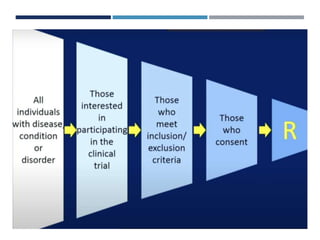
• Whom and what to randomize?
• How to randomize?
• Threats to randomization
• References and further reading
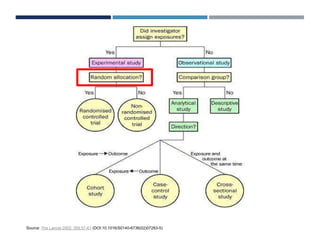
Source: The Lancet 2002; 359:57-61 (DOI:10.1016/S0140-6736(02)07283-5)
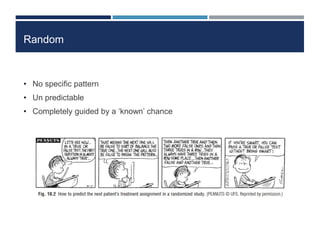
Random
• No specific pattern
• Un predictable
• Completely guided by a ‘known’ chance
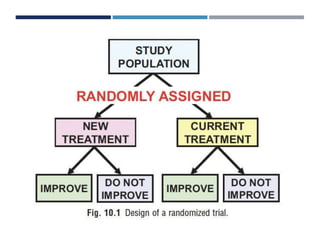
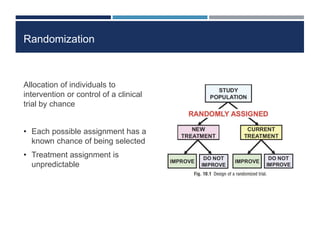
Randomization
Allocation of individuals to
intervention or control of a clinical
trial by chance
• Each possible assignment has a
known chance of being selected
• Treatment assignment is
unpredictable
Why to Randomize?
• Avoids selection bias
• Balances confounding factors between both the groups – Known and
unknown factors
• Allows to perform statistical tests for establishing causality
What to Randomize?
• Participants / Individual – Classical RCT
• Community / locality – Community trial or Cluster randomized trials
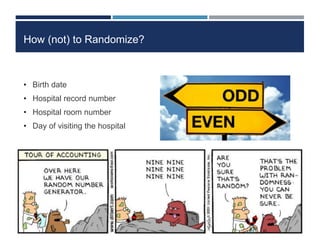
How (not) to Randomize?
• Birth date
• Hospital record number
• Hospital room number
• Day of visiting the hospital
How to Randomize?
• Simple randomization
• Permuted block randomization
• Stratified randomization
• Adaptive randomization
Block randomization
• Every block of X new participants is randomly and equally allocated to
treatment arms A & B
• Block size 4 – 6 possibilities
ABBB AABB AAAB BAAA BBAA BBBA
Advantage
• Equal assignment
Disadvantage
• If block size is known, last participant assignment can be predicted –
random/unknown block size
• Imbalance in critical variables
Stratified randomization
• Important variables that can affect the outcome are stratified and
randomization done separately between these strata
• E.g., Study site in multi-site trial
Advantage
• Balance of critical variables achieved
Disadvantage
• Can’t use too many variables for strata ( < 4 )
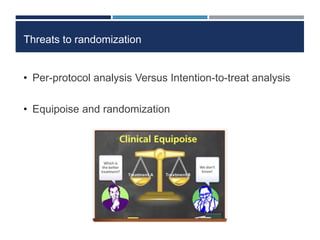
Threats to randomization
• Per-protocol analysis Versus Intention-to-treat analysis
• Equipoise and randomization
References
• Leon Gordis – Epidemiology 6th Edition
• John Last – A Dictionary of Epidemiology
• Introduction to the Principles and Practice of Clinical Research (IPPCR) –
Issues in Randomization: Video in Youtube -
https://www.youtube.com/watch?v=UgFXLk7i46c&ab_channel=NIHVideo
Cast
Topics for further reading:
• Adaptive randomization
Questions!?

Randomization in medical research

  • 1.
    Randomization in medical research MPHCourse - Epidemiology Module Dr. Vignesh L, M.D. (AIIMS, New Delhi) Senior Resident Department of Preventive & Social Medicine JIPMER, Puducherry
  • 2.
    Outline • What israndom & randomization? • Why to randomize? • Whom and what to randomize? • How to randomize? • Threats to randomization • References and further reading
  • 3.
    Source: The Lancet2002; 359:57-61 (DOI:10.1016/S0140-6736(02)07283-5)
  • 7.
    Random • No specificpattern • Un predictable • Completely guided by a ‘known’ chance
  • 8.
    Randomization Allocation of individualsto intervention or control of a clinical trial by chance • Each possible assignment has a known chance of being selected • Treatment assignment is unpredictable
  • 9.
    Why to Randomize? •Avoids selection bias • Balances confounding factors between both the groups – Known and unknown factors • Allows to perform statistical tests for establishing causality
  • 10.
    What to Randomize? •Participants / Individual – Classical RCT • Community / locality – Community trial or Cluster randomized trials
  • 11.
    How (not) toRandomize? • Birth date • Hospital record number • Hospital room number • Day of visiting the hospital
  • 12.
    How to Randomize? •Simple randomization • Permuted block randomization • Stratified randomization • Adaptive randomization
  • 13.
    Block randomization • Everyblock of X new participants is randomly and equally allocated to treatment arms A & B • Block size 4 – 6 possibilities ABBB AABB AAAB BAAA BBAA BBBA Advantage • Equal assignment Disadvantage • If block size is known, last participant assignment can be predicted – random/unknown block size • Imbalance in critical variables
  • 14.
    Stratified randomization • Importantvariables that can affect the outcome are stratified and randomization done separately between these strata • E.g., Study site in multi-site trial Advantage • Balance of critical variables achieved Disadvantage • Can’t use too many variables for strata ( < 4 )
  • 15.
    Threats to randomization •Per-protocol analysis Versus Intention-to-treat analysis • Equipoise and randomization
  • 16.
    References • Leon Gordis– Epidemiology 6th Edition • John Last – A Dictionary of Epidemiology • Introduction to the Principles and Practice of Clinical Research (IPPCR) – Issues in Randomization: Video in Youtube - https://www.youtube.com/watch?v=UgFXLk7i46c&ab_channel=NIHVideo Cast Topics for further reading: • Adaptive randomization
  • 17.