Non-inferiority trials: a
cautionary tale
F. Maignen (PharmD, MSc, MSc,
GradStat)
November 2015
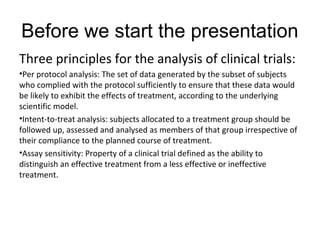
Before we start the presentation
Three principles for the analysis of clinical trials:
•Per protocol analysis: The set of data generated by the subset of subjects
who complied with the protocol sufficiently to ensure that these data would
be likely to exhibit the effects of treatment, according to the underlying
scientific model.
•Intent-to-treat analysis: subjects allocated to a treatment group should be
followed up, assessed and analysed as members of that group irrespective of
their compliance to the planned course of treatment.
•Assay sensitivity: Property of a clinical trial defined as the ability to
distinguish an effective treatment from a less effective or ineffective
treatment.
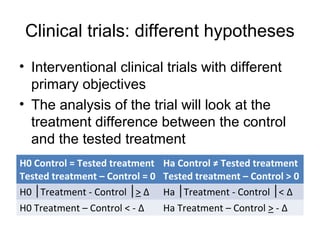
Clinical trials: different hypotheses
• Interventional clinical trials with different
primary objectives
• The analysis of the trial will look at the
treatment difference between the control
and the tested treatment
H0 Control = Tested treatment
Tested treatment – Control = 0
Ha Control ≠ Tested treatment
Tested treatment – Control > 0
H0 Treatment - Control│ │> Δ Ha Treatment - Control <│ │ Δ
H0 Treatment – Control < - Δ Ha Treatment – Control > - Δ
Hypothesis testing
1. Superiority (difference)
2. Equivalence
3. Non-inferiority
H0 Control = Tested treatment
Tested treatment – Control = 0
Ha Control ≠ Tested treatment
Tested treatment – Control > 0
H0 Treatment - Control│ │> Δ Ha Treatment - Control <│ │ Δ
H0 Treatment - Control < - Δ Ha Treatment - Control > - Δ
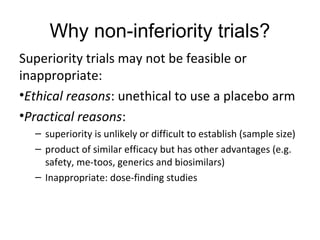
Why non-inferiority trials?
Superiority trials may not be feasible or
inappropriate:
•Ethical reasons: unethical to use a placebo arm
•Practical reasons:
– superiority is unlikely or difficult to establish (sample size)
– product of similar efficacy but has other advantages (e.g.
safety, me-toos, generics and biosimilars)
– Inappropriate: dose-finding studies
Underlying idea of non-inferiority
trials
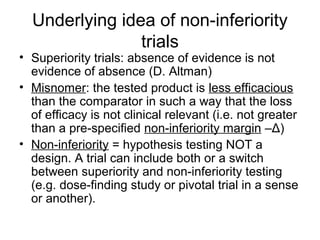
• Superiority trials: absence of evidence is not
evidence of absence (D. Altman)
• Misnomer: the tested product is less efficacious
than the comparator in such a way that the loss
of efficacy is not clinical relevant (i.e. not greater
than a pre-specified non-inferiority margin –Δ)
• Non-inferiority = hypothesis testing NOT a
design. A trial can include both or a switch
between superiority and non-inferiority testing
(e.g. dose-finding study or pivotal trial in a sense
or another).
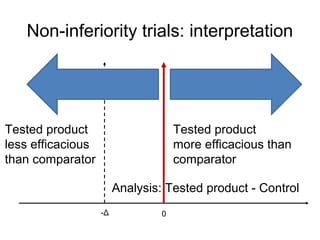
Non-inferiority trials: interpretation
0-Δ
Analysis: Tested product - Control
Tested product
more efficacious than
comparator
Tested product
less efficacious
than comparator
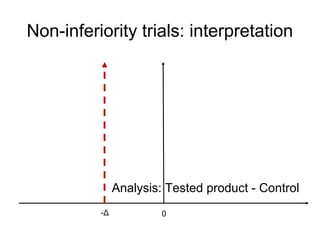
Non-inferiority trials: interpretation
Analysis: Tested product - Control
0-Δ
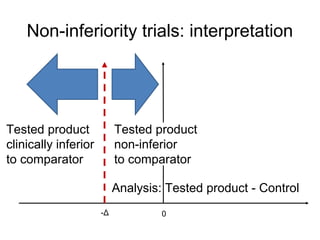
Non-inferiority trials: interpretation
Tested product
clinically inferior
to comparator
Analysis: Tested product - Control
0-Δ
Tested product
non-inferior
to comparator
Non-inferiority trials: interpretation
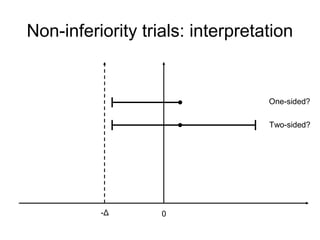
0-Δ
One-sided?
Two-sided?
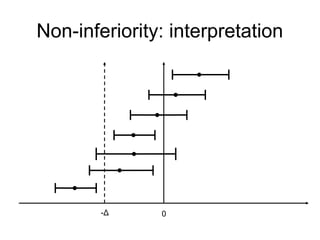
Non-inferiority: interpretation
0-Δ
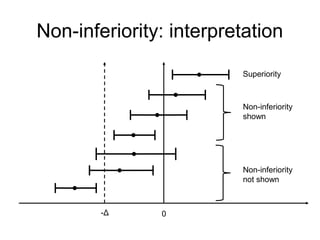
Non-inferiority: interpretation
0-Δ
Non-inferiority
not shown
Non-inferiority
shown
Superiority
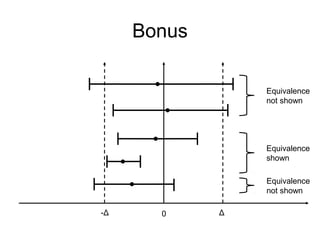
Bonus
0-Δ Δ
Equivalence
shown
Equivalence
not shown
Equivalence
not shown
What are the pitfalls when
conducting non-inferiority trials?
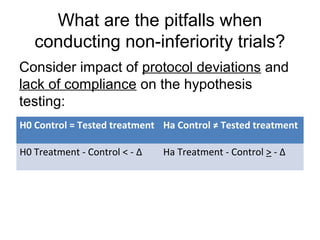
Consider impact of protocol deviations and
lack of compliance on the hypothesis
testing:
H0 Control = Tested treatment Ha Control ≠ Tested treatment
H0 Treatment - Control < - Δ Ha Treatment - Control > - Δ
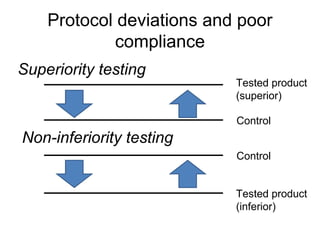
Protocol deviations and poor
compliance
Tested product
(superior)
Control
Control
Tested product
(inferior)
Superiority testing
Non-inferiority testing
What are the pitfalls when
conducting non-inferiority trials?
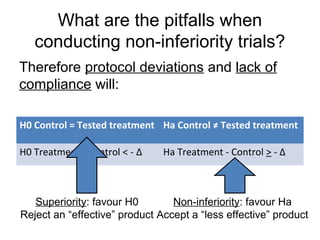
Therefore protocol deviations and lack of
compliance will:
H0 Control = Tested treatment Ha Control ≠ Tested treatment
H0 Treatment - Control < - Δ Ha Treatment - Control > - Δ
Superiority: favour H0
Reject an “effective” product
Non-inferiority: favour Ha
Accept a “less effective” product
Assay sensitivity
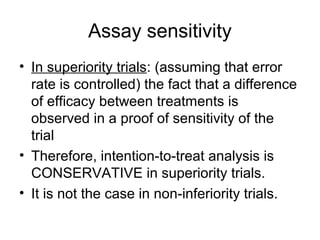
• In superiority trials: (assuming that error
rate is controlled) the fact that a difference
of efficacy between treatments is
observed in a proof of sensitivity of the
trial
• Therefore, intention-to-treat analysis is
CONSERVATIVE in superiority trials.
• It is not the case in non-inferiority trials.
Golden rules of non-inferiority trials
• The trial must be appropriately conducted
and protocol deviations must be avoided
i.e. the intention-to-treat and the per
protocol analyses must give identical
results
• Treatment compliance must be (measured
and) ensured.
Methodological aspects
• The non-inferiority margin must be pre-
specified (numerous rules and guidelines
exist) IN ALL CASES (even when switching
hypotheses).
• Assay sensitivity should be checked
– Direct or indirect evidence that the control is
showing usual efficacy
– Comparing the trial with earlier trials which
demonstrated the efficacy of the control
– Compliance, ITT, PP.
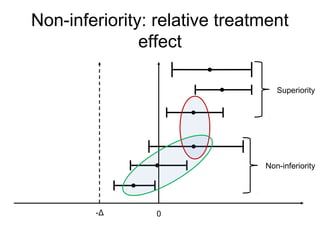
Non-inferiority: relative treatment
effect
0-Δ
Non-inferiority
Superiority
Reading
Switching between superiority and non-inferiority.
British Journal Clinical Pharmacology, 52, 219-228.
ICH E10 (www.ich.org)
BMJ Endgames (P. Sedgwick) on non-inferiority.
-BMJ 2011;342:d3253 doi: 10.1136/bmj.d3253
-BMJ 2013;347:f6853 doi: 10.1136/bmj.f6853
Analysis by intention to treat BMJ 2011;342:d2212 doi:
10.1136/bmj.d2212
Analysis by per protocol BMJ 2011;342:d2330 doi:
10.1136/bmj.d2330

Non inferiority clinical trials

  • 1.
    Non-inferiority trials: a cautionarytale F. Maignen (PharmD, MSc, MSc, GradStat) November 2015
  • 3.
    Before we startthe presentation Three principles for the analysis of clinical trials: •Per protocol analysis: The set of data generated by the subset of subjects who complied with the protocol sufficiently to ensure that these data would be likely to exhibit the effects of treatment, according to the underlying scientific model. •Intent-to-treat analysis: subjects allocated to a treatment group should be followed up, assessed and analysed as members of that group irrespective of their compliance to the planned course of treatment. •Assay sensitivity: Property of a clinical trial defined as the ability to distinguish an effective treatment from a less effective or ineffective treatment.
  • 4.
    Clinical trials: differenthypotheses • Interventional clinical trials with different primary objectives • The analysis of the trial will look at the treatment difference between the control and the tested treatment H0 Control = Tested treatment Tested treatment – Control = 0 Ha Control ≠ Tested treatment Tested treatment – Control > 0 H0 Treatment - Control│ │> Δ Ha Treatment - Control <│ │ Δ H0 Treatment – Control < - Δ Ha Treatment – Control > - Δ
  • 5.
    Hypothesis testing 1. Superiority(difference) 2. Equivalence 3. Non-inferiority H0 Control = Tested treatment Tested treatment – Control = 0 Ha Control ≠ Tested treatment Tested treatment – Control > 0 H0 Treatment - Control│ │> Δ Ha Treatment - Control <│ │ Δ H0 Treatment - Control < - Δ Ha Treatment - Control > - Δ
  • 6.
    Why non-inferiority trials? Superioritytrials may not be feasible or inappropriate: •Ethical reasons: unethical to use a placebo arm •Practical reasons: – superiority is unlikely or difficult to establish (sample size) – product of similar efficacy but has other advantages (e.g. safety, me-toos, generics and biosimilars) – Inappropriate: dose-finding studies
  • 7.
    Underlying idea ofnon-inferiority trials • Superiority trials: absence of evidence is not evidence of absence (D. Altman) • Misnomer: the tested product is less efficacious than the comparator in such a way that the loss of efficacy is not clinical relevant (i.e. not greater than a pre-specified non-inferiority margin –Δ) • Non-inferiority = hypothesis testing NOT a design. A trial can include both or a switch between superiority and non-inferiority testing (e.g. dose-finding study or pivotal trial in a sense or another).
  • 8.
    Non-inferiority trials: interpretation 0-Δ Analysis:Tested product - Control Tested product more efficacious than comparator Tested product less efficacious than comparator
  • 9.
  • 10.
    Non-inferiority trials: interpretation Testedproduct clinically inferior to comparator Analysis: Tested product - Control 0-Δ Tested product non-inferior to comparator
  • 11.
  • 12.
  • 13.
  • 14.
  • 15.
    What are thepitfalls when conducting non-inferiority trials? Consider impact of protocol deviations and lack of compliance on the hypothesis testing: H0 Control = Tested treatment Ha Control ≠ Tested treatment H0 Treatment - Control < - Δ Ha Treatment - Control > - Δ
  • 16.
    Protocol deviations andpoor compliance Tested product (superior) Control Control Tested product (inferior) Superiority testing Non-inferiority testing
  • 17.
    What are thepitfalls when conducting non-inferiority trials? Therefore protocol deviations and lack of compliance will: H0 Control = Tested treatment Ha Control ≠ Tested treatment H0 Treatment - Control < - Δ Ha Treatment - Control > - Δ Superiority: favour H0 Reject an “effective” product Non-inferiority: favour Ha Accept a “less effective” product
  • 18.
    Assay sensitivity • Insuperiority trials: (assuming that error rate is controlled) the fact that a difference of efficacy between treatments is observed in a proof of sensitivity of the trial • Therefore, intention-to-treat analysis is CONSERVATIVE in superiority trials. • It is not the case in non-inferiority trials.
  • 19.
    Golden rules ofnon-inferiority trials • The trial must be appropriately conducted and protocol deviations must be avoided i.e. the intention-to-treat and the per protocol analyses must give identical results • Treatment compliance must be (measured and) ensured.
  • 20.
    Methodological aspects • Thenon-inferiority margin must be pre- specified (numerous rules and guidelines exist) IN ALL CASES (even when switching hypotheses). • Assay sensitivity should be checked – Direct or indirect evidence that the control is showing usual efficacy – Comparing the trial with earlier trials which demonstrated the efficacy of the control – Compliance, ITT, PP.
  • 21.
  • 22.
    Reading Switching between superiorityand non-inferiority. British Journal Clinical Pharmacology, 52, 219-228. ICH E10 (www.ich.org) BMJ Endgames (P. Sedgwick) on non-inferiority. -BMJ 2011;342:d3253 doi: 10.1136/bmj.d3253 -BMJ 2013;347:f6853 doi: 10.1136/bmj.f6853 Analysis by intention to treat BMJ 2011;342:d2212 doi: 10.1136/bmj.d2212 Analysis by per protocol BMJ 2011;342:d2330 doi: 10.1136/bmj.d2330