Prepared By – Undhad Tushar C.
Masters Of Pharmacy Sem – 2
(Pharmacology) R.K. University
Under The Guidance Of
Dr. Pravin R. Tirgar
Ph D, M. Pharm - Pharmacology,
Professor, School Of Pharmacy,
RK University
1
 1. Introduction of observational study
 2. Advantages
 3. Disadvantages
 4. Application
 5. Types of observational study
1) Cohort study
2) Case control study
3) Cross sectional study
TUSHAR UNDHAD Observational studies 2
INTRODUCT
ION
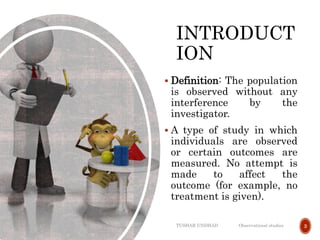
 Definition: The population
is observed without any
interference by the
investigator.
 A type of study in which
individuals are observed
or certain outcomes are
measured. No attempt is
made to affect the
outcome (for example, no
treatment is given).
TUSHAR UNDHAD Observational studies 3
WHY
OBSERVATIO
NAL STUDIES
 Cheaper
 Can examine long
term effect
 Hypothesis generation
 Sometime,
experimental study are
not ethical
TUSHAR UNDHAD Observational studies 4
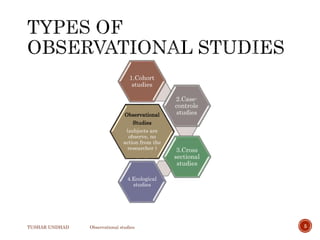
Observational
Studies
(subjects are
observe, no
action from the
researcher )
1.Cohort
studies
3.Cross
sectional
studies
4.Ecological
studies
2.Case-
controle
studies
TUSHAR UNDHAD Observational studies 5
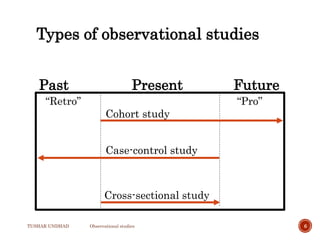
Past Future
Present
“Pro”
“Retro”
Case-control study
Cohort study
Cross-sectional study
TUSHAR UNDHAD Observational studies 6
Types of observational studies
1. COHORT
STUDIES
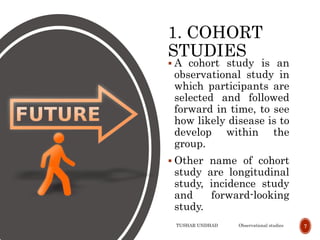
 A cohort study is an
observational study in
which participants are
selected and followed
forward in time, to see
how likely disease is to
develop within the
group.
 Other name of cohort
study are longitudinal
study, incidence study
and forward-looking
study.
TUSHAR UNDHAD Observational studies 7
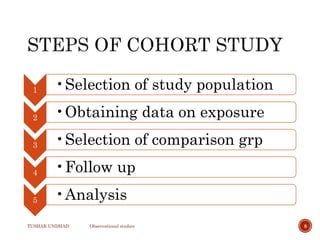
1 •Selection of study population
2 •Obtaining data on exposure
3 •Selection of comparison grp
4 •Follow up
5 •Analysis
TUSHAR UNDHAD Observational studies 8
TUSHAR UNDHAD Observational studies 9
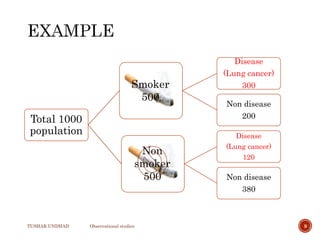
Total 1000
population
Disease
(Lung cancer)
300
Non disease
200
Disease
(Lung cancer)
120
Non disease
380
Smoker
500
Non
smoker
500
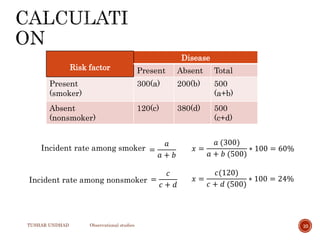
Risk factor
Disease
Present Absent Total
Present
(smoker)
300(a) 200(b) 500
(a+b)
Absent
(nonsmoker)
120(c) 380(d) 500
(c+d)
TUSHAR UNDHAD Observational studies 10
Incident rate among smoker =
𝑎
𝑎 + 𝑏
𝑥 =
𝑎 (300)
𝑎 + 𝑏 (500)
∗ 100 = 60%
Incident rate among nonsmoker =
𝑐
𝑐 + 𝑑
𝑥 =
𝑐(120)
𝑐 + 𝑑 (500)
∗ 100 = 24%
TUSHAR UNDHAD Observational studies 11
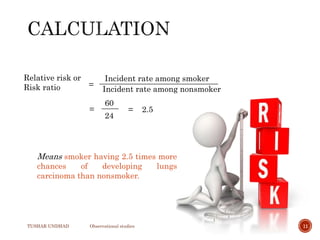
Relative risk or
Risk ratio =
Incident rate among smoker
Incident rate among nonsmoker
=
60
24
= 2.5
Means smoker having 2.5 times more
chances of developing lungs
carcinoma than nonsmoker.
ADVANTAGE
S
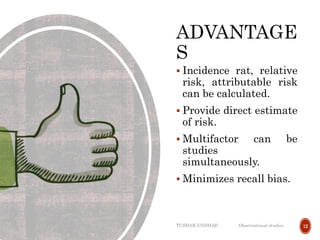
 Incidence rat, relative
risk, attributable risk
can be calculated.
 Provide direct estimate
of risk.
 Multifactor can be
studies
simultaneously.
 Minimizes recall bias.
TUSHAR UNDHAD Observational studies 12
DISADVANT
AGES
 Large population is
needed.
 Not suitable for rare
disease.
 It is time consuming
 Expensive.
 Certain administrative
problem like loss of
staff, loss of funding.
 Ethical problem.
TUSHAR UNDHAD Observational studies 13
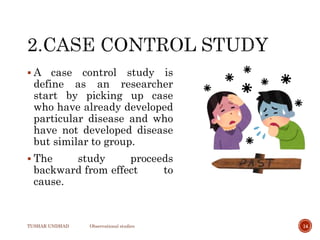
 A case control study is
define as an researcher
start by picking up case
who have already developed
particular disease and who
have not developed disease
but similar to group.
 The study proceeds
backward from effect to
cause.
TUSHAR UNDHAD Observational studies 14
 A case control study involves two population case
and control.
 Case: A person in the population or study group
identified having the particular disease, health
disorder or condition under investigator.
 Control: It use a control or comparison group to
support inference.
 Control must be ideally matching with the cases by
age, sex and other characteristics except the control
must not be suffering from disease.
TUSHAR UNDHAD Observational studies 15
 1. Selection of case
 2. Selection of controls
 3. Information on exposure
 4. Analysis
TUSHAR UNDHAD Observational studies 16
1. Selection of cases
 Preferably new cases or incidence case.
 Random selection, Convenient selection.
2.Selection of control
 Control must be ideally matching with the cases by
age, sex and other characteristics except the control
must not be suffering from disease.
 Hospital control, Random selection, Friend and
relative.
 Control from general population.
TUSHAR UNDHAD Observational studies 17
3. Information on exposure
 Observation
 Interviews
 Examination of records
4. Analysis
 Exposure rates among the disease(case)
 Exposure rates among the non disease
 Odd s ratio
TUSHAR UNDHAD Observational studies 18
TUSHAR UNDHAD Observational studies 19
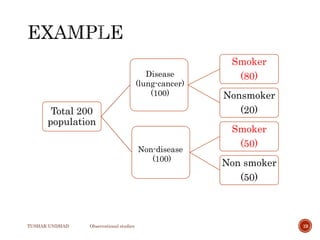
Total 200
population
Smoker
(80)
Nonsmoker
(20)
Smoker
(50)
Non smoker
(50)
Disease
(lung-cancer)
(100)
Non-disease
(100)
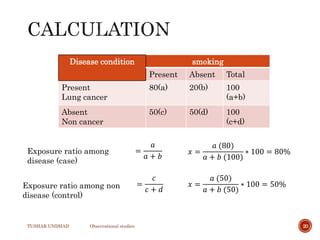
Disease condition smoking
Present Absent Total
Present
Lung cancer
80(a) 20(b) 100
(a+b)
Absent
Non cancer
50(c) 50(d) 100
(c+d)
TUSHAR UNDHAD Observational studies 20
Exposure ratio among
disease (case)
=
𝑎
𝑎 + 𝑏
𝑥 =
𝑎 (80)
𝑎 + 𝑏 (100)
∗ 100 = 80%
𝑥 =
𝑎 (50)
𝑎 + 𝑏 (50)
∗ 100 = 50%
=
𝑐
𝑐 + 𝑑
Exposure ratio among non
disease (control)
TUSHAR UNDHAD Observational studies 21
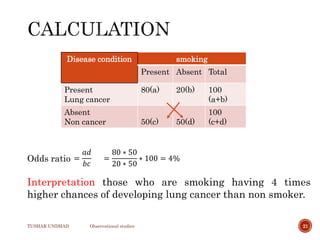
Odds ratio =
𝑎𝑑
𝑏𝑐
=
80 ∗ 50
20 ∗ 50
∗ 100 = 4%
Disease condition smoking
Present Absent Total
Present
Lung cancer
80(a) 20(b) 100
(a+b)
Absent
Non cancer 50(c) 50(d)
100
(c+d)
Interpretation those who are smoking having 4 times
higher chances of developing lung cancer than non smoker.
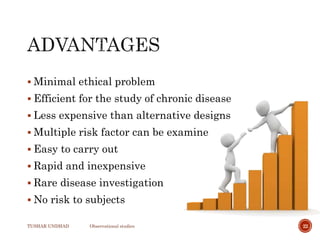
 Minimal ethical problem
 Efficient for the study of chronic disease
 Less expensive than alternative designs
 Multiple risk factor can be examine
 Easy to carry out
 Rapid and inexpensive
 Rare disease investigation
 No risk to subjects
TUSHAR UNDHAD Observational studies 22
 Selection of an appropriate comparison group may
be difficult.
 Control selection is difficult.
 Susceptible to recall bias.
TUSHAR UNDHAD Observational studies 23
 Evaluating vaccine effectiveness
 Evaluation of treatment and program
 Evaluation of screening
 Outbreak investigation
 Occupation health research
TUSHAR UNDHAD Observational studies 24
 Introduction:
 In cross sectional study both exposure and disease
outcome are determine simultaneously for each
subject.
 Cross sectional study is a study in which all the
measurement are taken particular point in time.
 We identify prevalent cases of disease.
 When study only measure health outcome it is
known as descriptive cross sectional study.
TUSHAR UNDHAD Observational studies 25
 When a study measure both exposure and health
outcome at same time it is known as analytical cross
sectional study.
 Snapshot studies
 Observational at a single hypothetical point in time.
TUSHAR UNDHAD Observational studies 26
TUSHAR UNDHAD Observational studies 27
Community
Worksite
School
Hospital
TUSHAR UNDHAD Observational studies 28
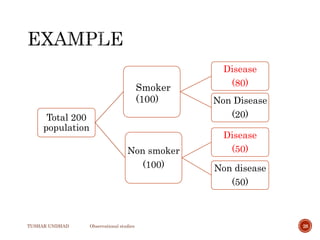
Total 200
population
Disease
(80)
Non Disease
(20)
Non smoker
(100)
Disease
(50)
Non disease
(50)
Smoker
(100)
TUSHAR UNDHAD Observational studies 29
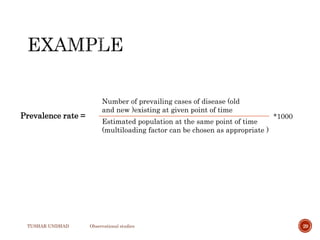
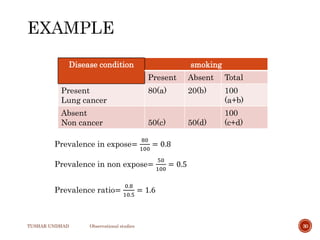
Prevalence rate =
Number of prevailing cases of disease (old
and new )existing at given point of time
*1000
Estimated population at the same point of time
(multiloading factor can be chosen as appropriate )
TUSHAR UNDHAD Observational studies 30
Disease condition smoking
Present Absent Total
Present
Lung cancer
80(a) 20(b) 100
(a+b)
Absent
Non cancer 50(c) 50(d)
100
(c+d)
Prevalence in non expose=
50
100
= 0.5
Prevalence in expose=
80
100
= 0.8
Prevalence ratio=
0.8
10.5
= 1.6
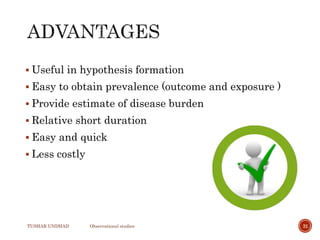
 Useful in hypothesis formation
 Easy to obtain prevalence (outcome and exposure )
 Provide estimate of disease burden
 Relative short duration
 Easy and quick
 Less costly
TUSHAR UNDHAD Observational studies 31
 With no comparison group, no formal assessment of
relationship between exposure and outcome
 Not suitable for rare disease
 Recall bias
TUSHAR UNDHAD Observational studies 32
 https://www.slideshare.net/herunyu/cross-sectional-study-overview
 https://www.slideshare.net/MmedscHahm/cross-sectional-studydrwah
 https://www.slideshare.net/DrLipilekhaPatnaik/cross-sectional-study-
131584520?qid=2070f513-67dd-4b35-a64a-
7f731511964f&v=&b=&from_search=8
 https://www.slideshare.net/PreethiSelvaraj2/cross-sectional-
study?qid=2070f513-67dd-4b35-a64a-7f731511964f&v=&b=&from_search=5
 https://www.pngegg.com/en/search?q=past
 https://www.slideshare.net/mohdnajmulaqibkhan/journal-club-reasons-for-
failure-of-immunization-a-crosssectional-studyamong-1223monthold-children-
of-lucknow-india?qid=2070f513-67dd-4b35-a64a-
7f731511964f&v=&b=&from_search=4.
 https://www.slideshare.net/mohdnajmulaqibkhan/journal-club-reasons-for-
failure-of-immunization-a-crosssectional-studyamong-1223monthold-children-
of-lucknow-india?qid=2070f513-67dd-4b35-a64a-
7f731511964f&v=&b=&from_search=4
TUSHAR UNDHAD Observational studies 33
34

observational study.pptx

  • 1.
    Prepared By –Undhad Tushar C. Masters Of Pharmacy Sem – 2 (Pharmacology) R.K. University Under The Guidance Of Dr. Pravin R. Tirgar Ph D, M. Pharm - Pharmacology, Professor, School Of Pharmacy, RK University 1
  • 2.
     1. Introductionof observational study  2. Advantages  3. Disadvantages  4. Application  5. Types of observational study 1) Cohort study 2) Case control study 3) Cross sectional study TUSHAR UNDHAD Observational studies 2
  • 3.
    INTRODUCT ION  Definition: Thepopulation is observed without any interference by the investigator.  A type of study in which individuals are observed or certain outcomes are measured. No attempt is made to affect the outcome (for example, no treatment is given). TUSHAR UNDHAD Observational studies 3
  • 4.
    WHY OBSERVATIO NAL STUDIES  Cheaper Can examine long term effect  Hypothesis generation  Sometime, experimental study are not ethical TUSHAR UNDHAD Observational studies 4
  • 5.
    Observational Studies (subjects are observe, no actionfrom the researcher ) 1.Cohort studies 3.Cross sectional studies 4.Ecological studies 2.Case- controle studies TUSHAR UNDHAD Observational studies 5
  • 6.
    Past Future Present “Pro” “Retro” Case-control study Cohortstudy Cross-sectional study TUSHAR UNDHAD Observational studies 6 Types of observational studies
  • 7.
    1. COHORT STUDIES  Acohort study is an observational study in which participants are selected and followed forward in time, to see how likely disease is to develop within the group.  Other name of cohort study are longitudinal study, incidence study and forward-looking study. TUSHAR UNDHAD Observational studies 7
  • 8.
    1 •Selection ofstudy population 2 •Obtaining data on exposure 3 •Selection of comparison grp 4 •Follow up 5 •Analysis TUSHAR UNDHAD Observational studies 8
  • 9.
    TUSHAR UNDHAD Observationalstudies 9 Total 1000 population Disease (Lung cancer) 300 Non disease 200 Disease (Lung cancer) 120 Non disease 380 Smoker 500 Non smoker 500
  • 10.
    Risk factor Disease Present AbsentTotal Present (smoker) 300(a) 200(b) 500 (a+b) Absent (nonsmoker) 120(c) 380(d) 500 (c+d) TUSHAR UNDHAD Observational studies 10 Incident rate among smoker = 𝑎 𝑎 + 𝑏 𝑥 = 𝑎 (300) 𝑎 + 𝑏 (500) ∗ 100 = 60% Incident rate among nonsmoker = 𝑐 𝑐 + 𝑑 𝑥 = 𝑐(120) 𝑐 + 𝑑 (500) ∗ 100 = 24%
  • 11.
    TUSHAR UNDHAD Observationalstudies 11 Relative risk or Risk ratio = Incident rate among smoker Incident rate among nonsmoker = 60 24 = 2.5 Means smoker having 2.5 times more chances of developing lungs carcinoma than nonsmoker.
  • 12.
    ADVANTAGE S  Incidence rat,relative risk, attributable risk can be calculated.  Provide direct estimate of risk.  Multifactor can be studies simultaneously.  Minimizes recall bias. TUSHAR UNDHAD Observational studies 12
  • 13.
    DISADVANT AGES  Large populationis needed.  Not suitable for rare disease.  It is time consuming  Expensive.  Certain administrative problem like loss of staff, loss of funding.  Ethical problem. TUSHAR UNDHAD Observational studies 13
  • 14.
     A casecontrol study is define as an researcher start by picking up case who have already developed particular disease and who have not developed disease but similar to group.  The study proceeds backward from effect to cause. TUSHAR UNDHAD Observational studies 14
  • 15.
     A casecontrol study involves two population case and control.  Case: A person in the population or study group identified having the particular disease, health disorder or condition under investigator.  Control: It use a control or comparison group to support inference.  Control must be ideally matching with the cases by age, sex and other characteristics except the control must not be suffering from disease. TUSHAR UNDHAD Observational studies 15
  • 16.
     1. Selectionof case  2. Selection of controls  3. Information on exposure  4. Analysis TUSHAR UNDHAD Observational studies 16
  • 17.
    1. Selection ofcases  Preferably new cases or incidence case.  Random selection, Convenient selection. 2.Selection of control  Control must be ideally matching with the cases by age, sex and other characteristics except the control must not be suffering from disease.  Hospital control, Random selection, Friend and relative.  Control from general population. TUSHAR UNDHAD Observational studies 17
  • 18.
    3. Information onexposure  Observation  Interviews  Examination of records 4. Analysis  Exposure rates among the disease(case)  Exposure rates among the non disease  Odd s ratio TUSHAR UNDHAD Observational studies 18
  • 19.
    TUSHAR UNDHAD Observationalstudies 19 Total 200 population Smoker (80) Nonsmoker (20) Smoker (50) Non smoker (50) Disease (lung-cancer) (100) Non-disease (100)
  • 20.
    Disease condition smoking PresentAbsent Total Present Lung cancer 80(a) 20(b) 100 (a+b) Absent Non cancer 50(c) 50(d) 100 (c+d) TUSHAR UNDHAD Observational studies 20 Exposure ratio among disease (case) = 𝑎 𝑎 + 𝑏 𝑥 = 𝑎 (80) 𝑎 + 𝑏 (100) ∗ 100 = 80% 𝑥 = 𝑎 (50) 𝑎 + 𝑏 (50) ∗ 100 = 50% = 𝑐 𝑐 + 𝑑 Exposure ratio among non disease (control)
  • 21.
    TUSHAR UNDHAD Observationalstudies 21 Odds ratio = 𝑎𝑑 𝑏𝑐 = 80 ∗ 50 20 ∗ 50 ∗ 100 = 4% Disease condition smoking Present Absent Total Present Lung cancer 80(a) 20(b) 100 (a+b) Absent Non cancer 50(c) 50(d) 100 (c+d) Interpretation those who are smoking having 4 times higher chances of developing lung cancer than non smoker.
  • 22.
     Minimal ethicalproblem  Efficient for the study of chronic disease  Less expensive than alternative designs  Multiple risk factor can be examine  Easy to carry out  Rapid and inexpensive  Rare disease investigation  No risk to subjects TUSHAR UNDHAD Observational studies 22
  • 23.
     Selection ofan appropriate comparison group may be difficult.  Control selection is difficult.  Susceptible to recall bias. TUSHAR UNDHAD Observational studies 23
  • 24.
     Evaluating vaccineeffectiveness  Evaluation of treatment and program  Evaluation of screening  Outbreak investigation  Occupation health research TUSHAR UNDHAD Observational studies 24
  • 25.
     Introduction:  Incross sectional study both exposure and disease outcome are determine simultaneously for each subject.  Cross sectional study is a study in which all the measurement are taken particular point in time.  We identify prevalent cases of disease.  When study only measure health outcome it is known as descriptive cross sectional study. TUSHAR UNDHAD Observational studies 25
  • 26.
     When astudy measure both exposure and health outcome at same time it is known as analytical cross sectional study.  Snapshot studies  Observational at a single hypothetical point in time. TUSHAR UNDHAD Observational studies 26
  • 27.
    TUSHAR UNDHAD Observationalstudies 27 Community Worksite School Hospital
  • 28.
    TUSHAR UNDHAD Observationalstudies 28 Total 200 population Disease (80) Non Disease (20) Non smoker (100) Disease (50) Non disease (50) Smoker (100)
  • 29.
    TUSHAR UNDHAD Observationalstudies 29 Prevalence rate = Number of prevailing cases of disease (old and new )existing at given point of time *1000 Estimated population at the same point of time (multiloading factor can be chosen as appropriate )
  • 30.
    TUSHAR UNDHAD Observationalstudies 30 Disease condition smoking Present Absent Total Present Lung cancer 80(a) 20(b) 100 (a+b) Absent Non cancer 50(c) 50(d) 100 (c+d) Prevalence in non expose= 50 100 = 0.5 Prevalence in expose= 80 100 = 0.8 Prevalence ratio= 0.8 10.5 = 1.6
  • 31.
     Useful inhypothesis formation  Easy to obtain prevalence (outcome and exposure )  Provide estimate of disease burden  Relative short duration  Easy and quick  Less costly TUSHAR UNDHAD Observational studies 31
  • 32.
     With nocomparison group, no formal assessment of relationship between exposure and outcome  Not suitable for rare disease  Recall bias TUSHAR UNDHAD Observational studies 32
  • 33.
     https://www.slideshare.net/herunyu/cross-sectional-study-overview  https://www.slideshare.net/MmedscHahm/cross-sectional-studydrwah https://www.slideshare.net/DrLipilekhaPatnaik/cross-sectional-study- 131584520?qid=2070f513-67dd-4b35-a64a- 7f731511964f&v=&b=&from_search=8  https://www.slideshare.net/PreethiSelvaraj2/cross-sectional- study?qid=2070f513-67dd-4b35-a64a-7f731511964f&v=&b=&from_search=5  https://www.pngegg.com/en/search?q=past  https://www.slideshare.net/mohdnajmulaqibkhan/journal-club-reasons-for- failure-of-immunization-a-crosssectional-studyamong-1223monthold-children- of-lucknow-india?qid=2070f513-67dd-4b35-a64a- 7f731511964f&v=&b=&from_search=4.  https://www.slideshare.net/mohdnajmulaqibkhan/journal-club-reasons-for- failure-of-immunization-a-crosssectional-studyamong-1223monthold-children- of-lucknow-india?qid=2070f513-67dd-4b35-a64a- 7f731511964f&v=&b=&from_search=4 TUSHAR UNDHAD Observational studies 33
  • 34.