WORLD ANAESTHESIA DAY
#MEDSAFE #WAD2022
BY
DR. RAVIKIRAN H M
MBBS, DNB ANAESTHESIOLOGY
ADMO, CENTRAL HOSPITAL, MALIGAON
DEPARTMENT OF ANAESTHESIA AND CRITICAL CARE
INDEX
• History
• Introduction
• WAD2022: Theme
• Definition
• Categories of error
• Source of error
• Reducing the risk of error
• Recommendations
• Conclusion
• References
HISTORY
Amphitheater-Ether dome,
Massachusetts Hospital,
Boston. On 16th October
1846, Dentist-William T G
Morton, first successful
public demonstration of
ether anesthesia, John
Collins Warren was the
surgeon, removed a tumor
from neck of patient
named Edward Gilbert
Abbott.
INTRODUCTION
• Unsafe medication practices and medication errors are the leading
causes of avoidable harm in health care across the world.
• It is projected that 5% of all patients who are admitted to a hospital
experience a medication error, and that an average hospital will have
one medication error every 23 hours or every 20 admissions.
• Medication errors result in severe patient harm, disability and even
death.
• Globally, the cost associated with medication errors has been
estimated at $42 billion USD annually.
INTRODUCTION cont…
• As recognized leaders in patient
safety, anesthesia professionals
are at the forefront of
medication safety.
• All anesthesia professionals on
a daily basis employ personal
and team-based practices and
techniques to ensure that their
patients receive the correct
medication, at the right
concentration, at the right time
and in the right place.
BIG TOPIC IN ANAESTHESIA
SPECIFICALLY?
1. Medications we use can be lethal
2. Narrow therapeutic window
3. Ampoules are nearly identical
4. Need of administration of multiple drug at a time
5. Critical events
6. Very less time
7. Sole individual that prescribes, dispenses, prepares,
administers and documents
8. Distracting environment: Hurrying surgeon
9. Team work
THEME
• WAD 2022 is about the global anesthesia community celebrating and
sharing personal and professional expertise.
• Sharing on their social media feeds the techniques that they employ
every day to ensure patient safety.
• Highlight their leadership and expertise in medication safety.
• Improving medication safety practices and reducing medication
errors.
Medication safety = Patient Safety
#MEDSAFE #WAD2022
TIPS/EXAMPLES ON SOCIAL PLATFORMS
• I am #MedSafe because I pre-prepare my syringes when I can.
• I am #MedSafe because I always keep my syringes colour-
coded.
• I am #MedSafe because I prioritise my wellbeing, so I’m not
overly fatigued in the operating theatre.
DEFINITION
• Medication errors are ‘a failure in
the treatment process that lead to, or
have the potential to lead to, harm to
the patient’.
• An ‘error’ is a failure to carry out
the plan as intended – or it’s a
deficient plan to begin with.
CATEGORISATION OF MEDICATION
ERRORS
Stage in the
process
Medication selection; purchase; storage; dispensing or
manipulation; distribution; prescribing; administration;
documentation; or clinical monitoring
Causative factor Supply failure; lack of clinician’s knowledge; communication
failures; or distracting work environment
Mechanism of
error
Surge in demand for a drug with low stock levels or
misselection of a syringe from a tray of drugs
Based on
psychological
theory
Errors when planning actions, errors in the execution of well-
planned actions, or deliberate violations
Clinical impact
(actual or
potential)
From no harm to life-threatening complications
Note: Commonest cause of medication related adverse events is drug misidentification resulting
in the wrong medication being in the syringe.
SOURCES OF ERROR
• Similar looking
ampoules/packaging or ‘look
alike’
• Similar sounding names or ‘sound
alike’ Ex: Adrenaline, Atropine
• Falsely anticipated or confounded
storage location
• Concentration of the preparation.
Ex: Midazolam, Heparin
• Intended route of administration of
the preparation
HUMAN FACTORS IN MEDICINES SAFETY
REDUCING THE RISK OF ERROR
• In 2017 the WHO identified its third
‘Global Patient Safety Challenge’ as
improving medication safety by
strengthening the systems for reducing
MEs and avoidable medication-related
harm.
• The three key priorities for safety
improvements are high-risk medication,
polypharmacy, and transition of care.
• Target of 50% reduction in number of
incidents of medication harm.
REDUCING THE RISK OF ERROR cont..
• Studies show that there are methods of improving medication
safety.
• For example, engagement with checklists and technology has
been shown to enhance performance, as well as pre-preparing
syringes when possible.
• It’s also important to encourage a ‘just’safety culture through
the routine reporting of medical errors, creating a fair
environment where systemic issues can be distinguished and
resolved.
REDUCING THE RISK OF ERROR cont..
1. Medicines management systems
2. Product design
3. Supply & storage
4. Drug loading
5. Cross checking
6. Working environment
7. Drug effect monitor
8. STAR second approach
9. Bucket of drug approach
10. Safety culture of incident reporting
11. Recommendations & Checklist
MEDICINES MANAGEMENT SYSTEMS
• It is the clinical, cost-effective & safe use of medicines to ensure
patients get the maximum benefit from the medicines they need, while
at the same time minimizing potential harm.
• Looks at systems surrounding selection, purchase, storage, dispensing,
prescribing and administration.
• Recommendation: the Royal College of Anaesthetists’ Guidelines for
the Provision of Anaesthetic Services (GPAS) that ‘reliable medicine-
management systems should be in place, and appropriate safety
measures should be taken to minimize errors.
• Include ensuring appropriate training for all staff, access to
appropriate & up-to-date resources, following legislation for
medications, SOP & access to a clinical pharmacy service for advice.
PRODUCT DESIGN
From left to right: Luer-lock syringe for intravenous use, ENFit standard
syringe for enteral use, and NRFit standard syringe for central neuraxial
and regional anaesthesia.
PRODUCT DESIGN cont..
• Pharmaceutical companies and procurement authority should
comply with national guidelines of packing & labeling.
• The number of syringes that are prepared in the operating
theatres is minimised to increase safety, especially of high-risk
medications Ex. Heparin, Morphine..
• Prefilled syringes are made in a system designed to ensure the
quality of the product and with enhanced labeling
SUPPLY AND STORAGE OF MEDICATIONS
• Facilities for medication storage that allow
– Timely access,
– Maintaining integrity of the medicines and
– Aiding organizations to comply with safe
and secure storage requirements
• Reliable medicines management, stock review,
supply, expiry checks, and access to
appropriately trained pharmacy staff to manage
any drug shortages
• In-date supply maintained for emergency drugs
• Buffer stock
DRUG LOADING
• Only handle one medication at a time.
• Quarantine medication preparation activities:
Whenever possible do not allow distraction or
answering of questions while preparing medications.
• Read carefully before the drug is drawn up or
injected.
• Ideally drugs should be drawn up and labelled by the
anaesthetist who administers them
• Storage: clear and distinct location. Ex: Rainbow
tray
All syringes containing drugs are clearly labeled, and it is recommended that the label
includes a colour as defined by international norm ISO 26825
Three separate trays that allow the anaesthetist to clearly
separate routine, local and emergency drugs.
Allow all syringes to sit comfortably within the sections
together with the ampoules and are less likely to be relocated
or swapped.
RAINBOW TRAY
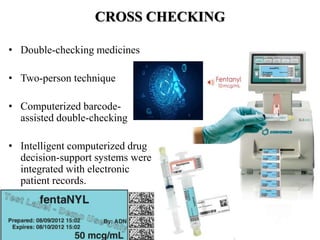
CROSS CHECKING
• Double-checking medicines
• Two-person technique
• Computerized barcode-
assisted double-checking
• Intelligent computerized drug
decision-support systems were
integrated with electronic
patient records.
WORKING ENVIRONMENT
• Adequate rest, active supervision,
avoiding distractions, and engagement
with checklists and technology.
• Last minute changes in operating list
order to be avoided
• Senior>>Junior anesthetist will reduce
error
• Anaesthesia is provided on a
nonelective basis and outside of
normal working hours is more error
prone
DRUG EFFECT MONITOR
• BIS is recommended during use of TIVA: CLADS
STAR second
• As soon as I pick it up, I
 Stop
 Think
 Act
 Reflect: whether it
achieved the goal I
wanted.
BUCKET OF DRUGS APPROACH
• Drug misidentification is most common type of error.
• Strategy for addressing this is to make the packaging of different
medications as distinct as possible from one another.
• A less intuitive but often touted alternative approach is to do the exact
opposite: make the packaging of all drugs so similar that great effort
must be expended to ensure the correct medication is being given.
• Logic: providing distinctive packaging encourages clinicians to
become reliant on these cues to identify medications, rather than
concentrating on reading the label – and that this complacency may
actually promote misidentifications
BUCKET OF DRUGS APPROACH cont..
• Rationale: making all medication packaging as close as possible to
identical, the clinician is instead compelled to perform the task
required of them: vigilant checking of the medication label.
• Remove cues related to position in the storage drawer : placing all of
these identical medications into a single receptacle – a ‘bucket of
drugs’, which could only be distinguished by reading the details on
the label.
• Impractical: lack of time, various expiry date, similar drug
appearance preparation not possible
PROMOTING SAFETY CULTURE
• Routine reporting of MEs, ADRs, and near misses should be easy to
perform and actively encouraged.
• Root cause investigations should be fair and transparent, with
compassionate support and feedback afforded to those involved.
• Investigations should focus on the various latent factors arising from
the working environment in conjunction with the final ‘action error’.
• Analysis of individual reports and regular audit of collective reports
enables the development of quality improvement interventions.
PROMOTING SAFETY CULTURE cont…
• Important policy changes should
be implemented in a timely fashion
and be well publicised to the
relevant staff, and subsequently re-
evaluated.
• A ‘just culture’ model of shared
accountability between
management and staff has been
advocated.
• Although a nonpunitive approach
is appropriate for most errors,
individuals are accountable if they
deliberately or repeatedly
compromise patient safety.
JUST
CULTURE
REPORTING
CULTURE
LEARNING
CULTURE
RECOMMENDATIONS
RECOMMENDATION: PREOPERATIVE
• Confirm the drug history, allergy status, and patient weight with the
patient, clinical records and relatives/ carer’s, when relevant.
• Include relevant patient information such as allergy status in the
preoperative time-out.
• Single location for recording medications across surgery (pre, intra,
PACU)
• Automated alerts within anaesthesia information system for: Dose,
Allergy, Drug-drug interactions
• Establish weight-based dose limits: Infusion device has prompts re
limits, Computer prompted ,Paper sheet to consult
RECOMMENDATION: PREPARATION/CART
INVENTORY
• Minimise the risk of infection
– Effective hand hygiene.
– Limit each ampoule or vial to single patient use.
– Swab vial tops and injection ports with 70% alcohol wipes.
– Cap syringes and store them in clean trays for each patient.
• Environment for drug preparation
– Adequate lighting
– Uncluttered workspace
– Minimal distractions
• Read drug labeling carefully to check the name, concentration and
expiry date.
RECOMMENDATION: PREPARATION cont..
• Draw up drugs using one syringe and one ampoule at a time.
• Apply colour-coded syringe labels except when an uninterrupted
process is used for the preparation and bolus administration of single
drugs, with any remaining drug discarded immediately.
• Use a consistent process for labeling either before or after drawing up
a drug.
• If drug preparation is disrupted then discard the syringe.
• Prepared syringes should be logically ordered in an appropriate
container.
RECOMMENDATION: PREPARATION cont..
• Prefilled or pharmacy prepared syringes may improve safety
for high risk, compounded or diluted drugs. Otherwise
carefully double-check these types of medication during
preparation.
• Locate drugs prepared for emergency use or different routes
of administration separately in the workspace.
• Safely store all used drug ampoules and syringes until the end
of each case to facilitate investigation of suspicious adverse
events.
RECOMMENDATION: PREPARATION cont..
• Drug trays in anaesthesia carts:
– Standardized across all locations
– Tray divisions labeled clearly
– Drugs placed to minimize confusion
– Modular system
– Pharmacy manages drug trays
• Eliminate unusual drugs from usual locations
– Unique location or tray
– Remove at end of case
• Single use vials preferable;
• If multi-dose vial required, discard at end of case
RECOMMENDATION: PREPARATION cont..
• Management of high risk/dangerous drugs
– No concentrated drugs
– Only one standard concentration on cart
– Pharmacy provides diluted, high risk drugs (insulin, heparin)
– Alert label on concentrated or high risk drugs
– No large volume epinephrine
• Separate regional cart for regional drugs
• Only preservative free local anaesthetics
• SQ or topical local anaesthetics clearly labeled
• Pharmacy prepares all compounded drugs
• Regional anaesthetic solutions clearly segregated from i.v. meds
RECOMMENDATION: DRUG INFO
• Cognitive aids, checklists, rescue protocols; Infusion rate charts
• Specialized carts have protocols (malignant hyperthermia, cardiac
arrest)
• Verify high risk med and weight based doses with 2 people
• Read and verify every vial, ampoule, syringe label before
administration:
– Barcode system in use with audible and visual cues
– Use a 2 person check
– Single person check
RECOMMENDATION: DRUG INFO cont..
• Every medication labeled with name, date, concentration
– 3 if Barcode system used
– 2 if Preprinted, colour coded per ISO standards
• Avoid abbreviations and zero issues
• Unlabeled syringe immediately discarded
• Minimize provider prepared syringes
– Prefilled whenever possible
– Compounded and diluted drugs prepared by pharmacy
– Provider prepares dilutions of high risk meds, 2 person check
or careful double check
RECOMMENDATION: ADMINISTRATION
• Minimise the time between drawing-up a drug and administering it.
• For infusions use smart pumps that have guardrails and alerts, labels
at the patient end, Luer-lock connections, and one-way valves.
• During TIVA ensure that, where possible, the intravenous cannula
used for drug delivery is visible and patent at all times.
• Differentiate non-intravenous lines with coloured labels (epidural:
yellow; arterial: red) and use route specific administration sets.
RECOMMENDATION: ADMINISTRATION cont..
• Anyone administering medication must firstly positively identify the
patient and be aware of the relevant drug and patient information.
• Verbal prescriptions should be spoken back for verification and
announced when given.
• Use smart pumps
• Flush the catheter dead space after drug administration.
RECOMMENDATION: AFTER ADMINISTRATION
• Legibly document the drug name, dose, route and time for
every drug administration.
• Discard unused drugs at the end of each case.
• Unused controlled drugs should be disposed of into controlled
drug waste containers.
• Review medication at handovers.
RECOMMENDATION: CULTURE
• Non-punitive QA system for incident reporting, analysis, and
intervention
• Written policies for medication safety; adequate teaching of
new staff on policies
• Establish a culture of respect and collaboration that endorses
patient safety and establishes compliance (just
culture/compliance)
• Adequate supervision, teaching and in-service training
RECOMMENDATION: PHARMACY
• Formulary designed to avoid purchase of lookalike meds; when
unable to avoid, do not store in proximity; add alert labels to
lookalike medications
• Pharmacist assigned to support OR;
• Pharmacists available 24/7 for questions;
• Pharmacists participate in educational;
• OR pharmacists receive specialized education re OR
• Pharmacy responsible for medication flow (ordering to discard)
RECOMMENDATION: PHARMACY cont..
• Pharmacy stocks, tracks, delivers drug trays;
• Pharmacy prepares all compounded or diluted high risk drugs
• Pharmacy prepares infusions
• Policy for return of unused or unusual drugs - clean sweep
• Changes in drugs supplied (new labels, new concentrations) require
alerts to staff and possibly alert labels on new drugs
• Unique i.v. solutions (glucose, heparin, hypertonic, sterile water,
epidural solutions) stored separate from regular i.v. solutions
CONCLUSION
• Failures of medicine safety in clinical practice remain a prevalent
source of avoidable iatrogenic harm.
• In order to improve medicine safety, there is a need for effective
medicine management systems
• Embrace the principles of medicines safety culture.
• Redesign and early education of junior trainees about these processes.
• Medication handling become an explicit, core competence of early
clinical training.
REFERENCES
1. WFSA: World Anaesthesia Day 2022-Medication Safety
#MedSafe
2. E. Mackay J. Jennings and S. Webber. Medicines safety in
anaesthetic practice. BJA, 2019(5):151-7.
3. S. D. Marshall and N. Chrimes. Medication handling: towards
a practical, human-centred approach. Anaesthesia 2019, 74,
280–4.
4. J. A. Wahr, J. H. Abernathy III, E. H. Lazarra, J. R. Keebler,
M. H. Wall, I. Lynch, R. Wolfe and R. L. Cooper. Medication
safety in the operating room: literature and expert-based
recommendations. BJA, 2017, 118 (1): 32–43.
5. Google & social media images
THANK YOU

Medication safety.pptx

  • 1.
    WORLD ANAESTHESIA DAY #MEDSAFE#WAD2022 BY DR. RAVIKIRAN H M MBBS, DNB ANAESTHESIOLOGY ADMO, CENTRAL HOSPITAL, MALIGAON DEPARTMENT OF ANAESTHESIA AND CRITICAL CARE
  • 2.
    INDEX • History • Introduction •WAD2022: Theme • Definition • Categories of error • Source of error • Reducing the risk of error • Recommendations • Conclusion • References
  • 3.
    HISTORY Amphitheater-Ether dome, Massachusetts Hospital, Boston.On 16th October 1846, Dentist-William T G Morton, first successful public demonstration of ether anesthesia, John Collins Warren was the surgeon, removed a tumor from neck of patient named Edward Gilbert Abbott.
  • 5.
    INTRODUCTION • Unsafe medicationpractices and medication errors are the leading causes of avoidable harm in health care across the world. • It is projected that 5% of all patients who are admitted to a hospital experience a medication error, and that an average hospital will have one medication error every 23 hours or every 20 admissions. • Medication errors result in severe patient harm, disability and even death. • Globally, the cost associated with medication errors has been estimated at $42 billion USD annually.
  • 6.
    INTRODUCTION cont… • Asrecognized leaders in patient safety, anesthesia professionals are at the forefront of medication safety. • All anesthesia professionals on a daily basis employ personal and team-based practices and techniques to ensure that their patients receive the correct medication, at the right concentration, at the right time and in the right place.
  • 7.
    BIG TOPIC INANAESTHESIA SPECIFICALLY? 1. Medications we use can be lethal 2. Narrow therapeutic window 3. Ampoules are nearly identical 4. Need of administration of multiple drug at a time 5. Critical events 6. Very less time 7. Sole individual that prescribes, dispenses, prepares, administers and documents 8. Distracting environment: Hurrying surgeon 9. Team work
  • 8.
    THEME • WAD 2022is about the global anesthesia community celebrating and sharing personal and professional expertise. • Sharing on their social media feeds the techniques that they employ every day to ensure patient safety. • Highlight their leadership and expertise in medication safety. • Improving medication safety practices and reducing medication errors. Medication safety = Patient Safety #MEDSAFE #WAD2022
  • 9.
    TIPS/EXAMPLES ON SOCIALPLATFORMS • I am #MedSafe because I pre-prepare my syringes when I can. • I am #MedSafe because I always keep my syringes colour- coded. • I am #MedSafe because I prioritise my wellbeing, so I’m not overly fatigued in the operating theatre.
  • 10.
    DEFINITION • Medication errorsare ‘a failure in the treatment process that lead to, or have the potential to lead to, harm to the patient’. • An ‘error’ is a failure to carry out the plan as intended – or it’s a deficient plan to begin with.
  • 11.
    CATEGORISATION OF MEDICATION ERRORS Stagein the process Medication selection; purchase; storage; dispensing or manipulation; distribution; prescribing; administration; documentation; or clinical monitoring Causative factor Supply failure; lack of clinician’s knowledge; communication failures; or distracting work environment Mechanism of error Surge in demand for a drug with low stock levels or misselection of a syringe from a tray of drugs Based on psychological theory Errors when planning actions, errors in the execution of well- planned actions, or deliberate violations Clinical impact (actual or potential) From no harm to life-threatening complications Note: Commonest cause of medication related adverse events is drug misidentification resulting in the wrong medication being in the syringe.
  • 12.
    SOURCES OF ERROR •Similar looking ampoules/packaging or ‘look alike’ • Similar sounding names or ‘sound alike’ Ex: Adrenaline, Atropine • Falsely anticipated or confounded storage location • Concentration of the preparation. Ex: Midazolam, Heparin • Intended route of administration of the preparation
  • 13.
    HUMAN FACTORS INMEDICINES SAFETY
  • 14.
    REDUCING THE RISKOF ERROR • In 2017 the WHO identified its third ‘Global Patient Safety Challenge’ as improving medication safety by strengthening the systems for reducing MEs and avoidable medication-related harm. • The three key priorities for safety improvements are high-risk medication, polypharmacy, and transition of care. • Target of 50% reduction in number of incidents of medication harm.
  • 15.
    REDUCING THE RISKOF ERROR cont.. • Studies show that there are methods of improving medication safety. • For example, engagement with checklists and technology has been shown to enhance performance, as well as pre-preparing syringes when possible. • It’s also important to encourage a ‘just’safety culture through the routine reporting of medical errors, creating a fair environment where systemic issues can be distinguished and resolved.
  • 16.
    REDUCING THE RISKOF ERROR cont.. 1. Medicines management systems 2. Product design 3. Supply & storage 4. Drug loading 5. Cross checking 6. Working environment 7. Drug effect monitor 8. STAR second approach 9. Bucket of drug approach 10. Safety culture of incident reporting 11. Recommendations & Checklist
  • 17.
    MEDICINES MANAGEMENT SYSTEMS •It is the clinical, cost-effective & safe use of medicines to ensure patients get the maximum benefit from the medicines they need, while at the same time minimizing potential harm. • Looks at systems surrounding selection, purchase, storage, dispensing, prescribing and administration. • Recommendation: the Royal College of Anaesthetists’ Guidelines for the Provision of Anaesthetic Services (GPAS) that ‘reliable medicine- management systems should be in place, and appropriate safety measures should be taken to minimize errors. • Include ensuring appropriate training for all staff, access to appropriate & up-to-date resources, following legislation for medications, SOP & access to a clinical pharmacy service for advice.
  • 18.
    PRODUCT DESIGN From leftto right: Luer-lock syringe for intravenous use, ENFit standard syringe for enteral use, and NRFit standard syringe for central neuraxial and regional anaesthesia.
  • 19.
    PRODUCT DESIGN cont.. •Pharmaceutical companies and procurement authority should comply with national guidelines of packing & labeling. • The number of syringes that are prepared in the operating theatres is minimised to increase safety, especially of high-risk medications Ex. Heparin, Morphine.. • Prefilled syringes are made in a system designed to ensure the quality of the product and with enhanced labeling
  • 20.
    SUPPLY AND STORAGEOF MEDICATIONS • Facilities for medication storage that allow – Timely access, – Maintaining integrity of the medicines and – Aiding organizations to comply with safe and secure storage requirements • Reliable medicines management, stock review, supply, expiry checks, and access to appropriately trained pharmacy staff to manage any drug shortages • In-date supply maintained for emergency drugs • Buffer stock
  • 21.
    DRUG LOADING • Onlyhandle one medication at a time. • Quarantine medication preparation activities: Whenever possible do not allow distraction or answering of questions while preparing medications. • Read carefully before the drug is drawn up or injected. • Ideally drugs should be drawn up and labelled by the anaesthetist who administers them • Storage: clear and distinct location. Ex: Rainbow tray
  • 22.
    All syringes containingdrugs are clearly labeled, and it is recommended that the label includes a colour as defined by international norm ISO 26825
  • 23.
    Three separate traysthat allow the anaesthetist to clearly separate routine, local and emergency drugs. Allow all syringes to sit comfortably within the sections together with the ampoules and are less likely to be relocated or swapped. RAINBOW TRAY
  • 24.
    CROSS CHECKING • Double-checkingmedicines • Two-person technique • Computerized barcode- assisted double-checking • Intelligent computerized drug decision-support systems were integrated with electronic patient records.
  • 25.
    WORKING ENVIRONMENT • Adequaterest, active supervision, avoiding distractions, and engagement with checklists and technology. • Last minute changes in operating list order to be avoided • Senior>>Junior anesthetist will reduce error • Anaesthesia is provided on a nonelective basis and outside of normal working hours is more error prone
  • 26.
    DRUG EFFECT MONITOR •BIS is recommended during use of TIVA: CLADS
  • 27.
    STAR second • Assoon as I pick it up, I  Stop  Think  Act  Reflect: whether it achieved the goal I wanted.
  • 28.
    BUCKET OF DRUGSAPPROACH • Drug misidentification is most common type of error. • Strategy for addressing this is to make the packaging of different medications as distinct as possible from one another. • A less intuitive but often touted alternative approach is to do the exact opposite: make the packaging of all drugs so similar that great effort must be expended to ensure the correct medication is being given. • Logic: providing distinctive packaging encourages clinicians to become reliant on these cues to identify medications, rather than concentrating on reading the label – and that this complacency may actually promote misidentifications
  • 29.
    BUCKET OF DRUGSAPPROACH cont.. • Rationale: making all medication packaging as close as possible to identical, the clinician is instead compelled to perform the task required of them: vigilant checking of the medication label. • Remove cues related to position in the storage drawer : placing all of these identical medications into a single receptacle – a ‘bucket of drugs’, which could only be distinguished by reading the details on the label. • Impractical: lack of time, various expiry date, similar drug appearance preparation not possible
  • 30.
    PROMOTING SAFETY CULTURE •Routine reporting of MEs, ADRs, and near misses should be easy to perform and actively encouraged. • Root cause investigations should be fair and transparent, with compassionate support and feedback afforded to those involved. • Investigations should focus on the various latent factors arising from the working environment in conjunction with the final ‘action error’. • Analysis of individual reports and regular audit of collective reports enables the development of quality improvement interventions.
  • 31.
    PROMOTING SAFETY CULTUREcont… • Important policy changes should be implemented in a timely fashion and be well publicised to the relevant staff, and subsequently re- evaluated. • A ‘just culture’ model of shared accountability between management and staff has been advocated. • Although a nonpunitive approach is appropriate for most errors, individuals are accountable if they deliberately or repeatedly compromise patient safety. JUST CULTURE REPORTING CULTURE LEARNING CULTURE
  • 32.
  • 33.
    RECOMMENDATION: PREOPERATIVE • Confirmthe drug history, allergy status, and patient weight with the patient, clinical records and relatives/ carer’s, when relevant. • Include relevant patient information such as allergy status in the preoperative time-out. • Single location for recording medications across surgery (pre, intra, PACU) • Automated alerts within anaesthesia information system for: Dose, Allergy, Drug-drug interactions • Establish weight-based dose limits: Infusion device has prompts re limits, Computer prompted ,Paper sheet to consult
  • 34.
    RECOMMENDATION: PREPARATION/CART INVENTORY • Minimisethe risk of infection – Effective hand hygiene. – Limit each ampoule or vial to single patient use. – Swab vial tops and injection ports with 70% alcohol wipes. – Cap syringes and store them in clean trays for each patient. • Environment for drug preparation – Adequate lighting – Uncluttered workspace – Minimal distractions • Read drug labeling carefully to check the name, concentration and expiry date.
  • 35.
    RECOMMENDATION: PREPARATION cont.. •Draw up drugs using one syringe and one ampoule at a time. • Apply colour-coded syringe labels except when an uninterrupted process is used for the preparation and bolus administration of single drugs, with any remaining drug discarded immediately. • Use a consistent process for labeling either before or after drawing up a drug. • If drug preparation is disrupted then discard the syringe. • Prepared syringes should be logically ordered in an appropriate container.
  • 36.
    RECOMMENDATION: PREPARATION cont.. •Prefilled or pharmacy prepared syringes may improve safety for high risk, compounded or diluted drugs. Otherwise carefully double-check these types of medication during preparation. • Locate drugs prepared for emergency use or different routes of administration separately in the workspace. • Safely store all used drug ampoules and syringes until the end of each case to facilitate investigation of suspicious adverse events.
  • 37.
    RECOMMENDATION: PREPARATION cont.. •Drug trays in anaesthesia carts: – Standardized across all locations – Tray divisions labeled clearly – Drugs placed to minimize confusion – Modular system – Pharmacy manages drug trays • Eliminate unusual drugs from usual locations – Unique location or tray – Remove at end of case • Single use vials preferable; • If multi-dose vial required, discard at end of case
  • 38.
    RECOMMENDATION: PREPARATION cont.. •Management of high risk/dangerous drugs – No concentrated drugs – Only one standard concentration on cart – Pharmacy provides diluted, high risk drugs (insulin, heparin) – Alert label on concentrated or high risk drugs – No large volume epinephrine • Separate regional cart for regional drugs • Only preservative free local anaesthetics • SQ or topical local anaesthetics clearly labeled • Pharmacy prepares all compounded drugs • Regional anaesthetic solutions clearly segregated from i.v. meds
  • 39.
    RECOMMENDATION: DRUG INFO •Cognitive aids, checklists, rescue protocols; Infusion rate charts • Specialized carts have protocols (malignant hyperthermia, cardiac arrest) • Verify high risk med and weight based doses with 2 people • Read and verify every vial, ampoule, syringe label before administration: – Barcode system in use with audible and visual cues – Use a 2 person check – Single person check
  • 40.
    RECOMMENDATION: DRUG INFOcont.. • Every medication labeled with name, date, concentration – 3 if Barcode system used – 2 if Preprinted, colour coded per ISO standards • Avoid abbreviations and zero issues • Unlabeled syringe immediately discarded • Minimize provider prepared syringes – Prefilled whenever possible – Compounded and diluted drugs prepared by pharmacy – Provider prepares dilutions of high risk meds, 2 person check or careful double check
  • 41.
    RECOMMENDATION: ADMINISTRATION • Minimisethe time between drawing-up a drug and administering it. • For infusions use smart pumps that have guardrails and alerts, labels at the patient end, Luer-lock connections, and one-way valves. • During TIVA ensure that, where possible, the intravenous cannula used for drug delivery is visible and patent at all times. • Differentiate non-intravenous lines with coloured labels (epidural: yellow; arterial: red) and use route specific administration sets.
  • 42.
    RECOMMENDATION: ADMINISTRATION cont.. •Anyone administering medication must firstly positively identify the patient and be aware of the relevant drug and patient information. • Verbal prescriptions should be spoken back for verification and announced when given. • Use smart pumps • Flush the catheter dead space after drug administration.
  • 43.
    RECOMMENDATION: AFTER ADMINISTRATION •Legibly document the drug name, dose, route and time for every drug administration. • Discard unused drugs at the end of each case. • Unused controlled drugs should be disposed of into controlled drug waste containers. • Review medication at handovers.
  • 44.
    RECOMMENDATION: CULTURE • Non-punitiveQA system for incident reporting, analysis, and intervention • Written policies for medication safety; adequate teaching of new staff on policies • Establish a culture of respect and collaboration that endorses patient safety and establishes compliance (just culture/compliance) • Adequate supervision, teaching and in-service training
  • 45.
    RECOMMENDATION: PHARMACY • Formularydesigned to avoid purchase of lookalike meds; when unable to avoid, do not store in proximity; add alert labels to lookalike medications • Pharmacist assigned to support OR; • Pharmacists available 24/7 for questions; • Pharmacists participate in educational; • OR pharmacists receive specialized education re OR • Pharmacy responsible for medication flow (ordering to discard)
  • 46.
    RECOMMENDATION: PHARMACY cont.. •Pharmacy stocks, tracks, delivers drug trays; • Pharmacy prepares all compounded or diluted high risk drugs • Pharmacy prepares infusions • Policy for return of unused or unusual drugs - clean sweep • Changes in drugs supplied (new labels, new concentrations) require alerts to staff and possibly alert labels on new drugs • Unique i.v. solutions (glucose, heparin, hypertonic, sterile water, epidural solutions) stored separate from regular i.v. solutions
  • 47.
    CONCLUSION • Failures ofmedicine safety in clinical practice remain a prevalent source of avoidable iatrogenic harm. • In order to improve medicine safety, there is a need for effective medicine management systems • Embrace the principles of medicines safety culture. • Redesign and early education of junior trainees about these processes. • Medication handling become an explicit, core competence of early clinical training.
  • 48.
    REFERENCES 1. WFSA: WorldAnaesthesia Day 2022-Medication Safety #MedSafe 2. E. Mackay J. Jennings and S. Webber. Medicines safety in anaesthetic practice. BJA, 2019(5):151-7. 3. S. D. Marshall and N. Chrimes. Medication handling: towards a practical, human-centred approach. Anaesthesia 2019, 74, 280–4. 4. J. A. Wahr, J. H. Abernathy III, E. H. Lazarra, J. R. Keebler, M. H. Wall, I. Lynch, R. Wolfe and R. L. Cooper. Medication safety in the operating room: literature and expert-based recommendations. BJA, 2017, 118 (1): 32–43. 5. Google & social media images
  • 49.