ADULT
ACLS –AHA HIGHLIGHTS
BY
DR. RAVIKIRAN H M
MBBS, DNB ANAESTHESIOLOGY
ADMO, CENTRAL HOSPITAL, MALIGAON
Advanced cardiovascular life support-ACLS", refers to a set of clinical guidelines for
the urgent and emergent treatment of life-threatening cardiovascular conditions that
will cause or have caused cardiac arrest, using advanced medical procedures,
medications, and techniques.
INTRODUCTION
 This has been re-emphasized. Risk of harm to the patient is
low if the patient is not in cardiac arrest.
 Less than 40% of adults receive layperson-initiated CPR, and
fewer than 12% have an AED applied before EMS arrival.
 Within 10sec of cardiac arrest patient loose consciousness
 Brain survival time: 4min
 Every 1minute delay in defibrillation reduce chance of
survival by 10%
 Bystander CPR doubles the rate of survival
EARLY INITIATION OF CPR BY LAY RESCUERS: GOLDEN
MINUTES
BLS ACLS
CAN BE PERFORMED BY ANYONE TRAINED MEDICAL PARAMEDICAL
STAFF
RHYTHM IDENTIFICATION BY AED RHYTHM IDENTIFICATION BY
RESUSICATOR
AED FOR DEFIBRILLATION MANUAL DEFIBRILLATOR
NO IV LINE DRUG USE IV LINE AND DRUG MANAGEMENT
NO ADVANCED AIRWAY ADVANCED AIRWAY USE
NO OXYGEN SUPPORT OXYGEN SUPPORT
Comprises of Doctors, trained paramedical staff, Nurses.
MEMBERS: Minimum 6 and maximum 10
1. 1 TEAM LEADER
2. 1 COMPRESSOR & 1 VENTILATOR ( CHANGE
ROLES EVERY 2 MINS)
3. 1 DEFIBRILLATOR
4. 1 INTRAVENOUS DRUG DELIVERY
5. 1 TIME KEEPER
Note: CPR coach to help team leader. CPR coach ensures
high quality BLS, while team leader focuses on other
aspects like ACLS
TEAM OF TRAINED PROFESSIONALS
The Compressor
AED/Monitor/
Defibrillator
The Airway
Manager
Resuscitation
Triangle Roles
around
patient
The Leadership Roles are:
1.Team Leader
2.IV/IO/Medication Administrator
3.Timekeeper/Recorder
CHAINS OF SURVIVAL
RECOGNITION OF CARDIAC ARREST
NONVASOPRESSOR MEDICATIONS
DURING CARDIAC ARREST
OPENING AIRWAY
ADVANCED AIRWAY DEVICE
CPR FEEDBACK DEVICES
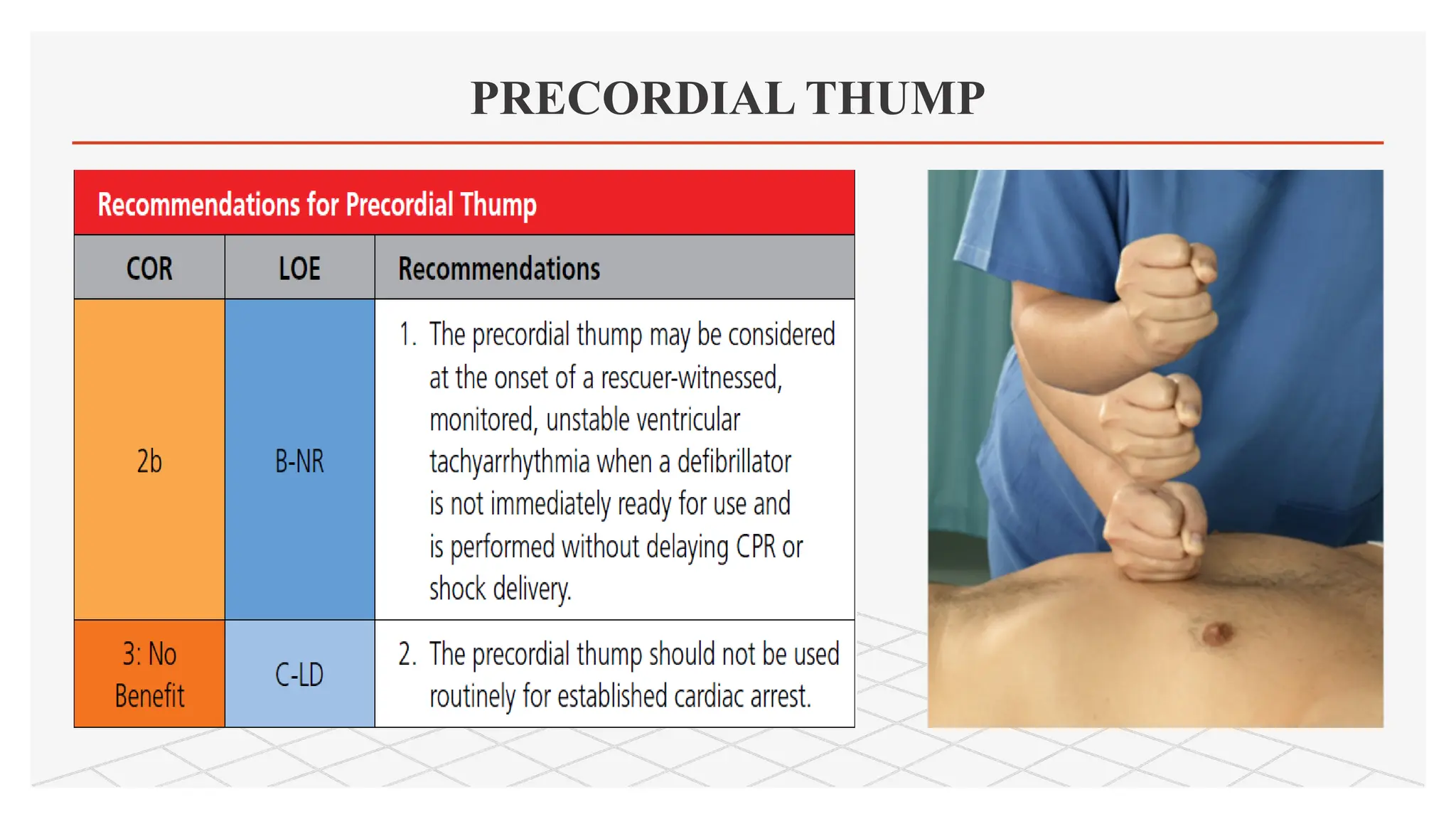
PRECORDIAL THUMP
COUGH CPR
ELECTRIC PACING
IV vs IO DURING CPR
• Can be kept up-to 48hrs
• If trained well <10sec procedure
• Also useful for burr hole
MECHANICAL CPR DEVICES
IMPEDENCE TRESHOLD DEVICES
(a) Impedance threshold device (ITD) and ResQCPR:
ResQPod+ResQPump. (b) Phased thoracic-abdominal compression-
decompression CPR
INTERPOSED ABDOMINAL COMPRESSION CPR
ECPR
Use of extracorporeal cardiopulmonary resuscitation for patients with cardiac arrest
refractory to standard advanced cardiovascular life support is reasonable in select patients
when provided within an appropriately trained and equipped system of care.
 With respect to timing, for cardiac arrest with a nonshockable rhythm, it is reasonable to
administer epinephrine as soon as feasible.
 With respect to timing, for cardiac arrest with a shockable rhythm, it may be reasonable to
administer epinephrine after initial defibrillation attempts have failed.
 Reasonable to use audiovisual feedback devices during CPR for real-time optimization of
CPR performance
 Reasonable to use physiologic parameters such as arterial blood pressure or ETCO2 when
feasible to monitor and optimize CPR quality
ADULT ACLS HIGHLIGHTS
 The usefulness of double sequential defibrillation for refractory shockable rhythm has not
been established.
 Changing the direction of defibrillation current by repositioning the pads may be as
effective as double sequential defibrillation while avoiding the risks of harm from
increased energy and damage to defibrillators
 Reasonable for providers to first attempt establishing IV access for drug administration in
cardiac arrest
 IO access may be considered if attempts at IV access are unsuccessful or not feasible.
ADULT ACLS HIGHLIGHTS cont…
AMERICAN CLINICAL NEUROPHYSIOLOGY SOCIETY
CRITERIA
OPIOID-ASSOCIATED EMERGENCY FOR HEALTHCARE
PROVIDERS ALGORITHM
Adult Bradycardia
Algorithm
Adult Tachycardia With a Pulse Algorithm
IV Medications Commonly Used for Acute Rate Control in Atrial
Fibrillation and Atrial Flutter
Cardiac Arrest in Pregnancy In-Hospital ACLS Algorithm
 Cardiac arrest survivors have multimodal rehabilitation assessment and treatment for
physical, neurologic, cardiopulmonary, and cognitive impairments before discharge from
the hospital.
 Cardiac arrest survivors and their caregivers receive comprehensive, multidisciplinary
discharge planning, to include medical and rehabilitative treatment recommendations and
return to activity/work expectations.
 Structured assessment for anxiety, depression, posttraumatic stress, and fatigue for cardiac
arrest survivors and their caregivers.
Care and Support During Recovery
 Debriefings and referral for follow up for emotional support for lay rescuers, EMS
providers, and hospital-based healthcare workers after a cardiac arrest event may be
beneficial.
Debriefings for Rescuers
 Incorporating repetition with feedback.
 Booster training (ie, brief retraining sessions) should be added to massed learning (ie,
traditional course based) to assist with retention of CPR skills. Provided that individual
students can attend all sessions, separating training into multiple sessions (ie, spaced
learning) is preferable to massed learning.
 In situ training (ie, resuscitation education in actual clinical spaces) can be used to
enhance learning outcomes and improve resuscitation performance.
 Virtual reality, which is the use of a computer interface to create an immersive
environment, and gamified learning, which is play and competition with other students,
can be incorporated into resuscitation training for laypersons and healthcare providers
 All healthcare providers should complete an adult ACLS course or its equivalent
RESUSCITATION EDUCATION SCIENCE
 Survival after cardiac arrest requires an integrated system of people, training, equipment,
and organizations .
 Team feedback matters. Structured debriefing protocols improve the performance of
resuscitation teams in subsequent resuscitation.
 System-wide feedback matters. Implementing structured data collection and review
improves resuscitation processes and survival both inside and outside the hospital.
 Novel methods to use mobile phone technology to alert trained lay rescuers of events that
require CPR are promising and deserve more study.
 It is reasonable for organizations that treat cardiac arrest patients to collect processes-of-
care data and outcomes.
SYSTEMS OF CARE
SPECIAL CIRCUMSTANCES OF
RESUSCITATION
Amiodarone and lidocaine are now considered equivalent as antiarrhythmic in cardiac arrest scenarios.
For adult symptomatic bradycardia, atropine dose changed to 1 mg from 0.5 mg. Dopamine dose for this changed from 2-20 mcg/kg/minute to 5-20
mcg/kg/minute.
Emphasis on prevention of hyperoxia, hypoxemia and hypotension
Initial stabilization split in to manage airway, manage respiratory parameters and manage hemodynamic parameters.
For adult tachycardia IV access and ECG moved earlier in the algorithm.
Updated ACS algorithm contact to balloon inflation goal less than or equal to 90 minutes
Target SpO2 >94% for stroke and general care; 92-98% for post cardiac arrest care
During CPR, 15 seconds before pausing compressions, high performance team should check for pulse, precharge defibrillator, and prepare to deliver shock in 10
seconds or less to increase CCF>80% as 10% rise in CCF leads to 11% rise in survival
Feedback devices or metronomes(can be downloaded on mobiles too)
IV preferred over IO
New diagram to guide neuroprognostication
SUMMARY
1. Highlights of the 2020 American Heart Association's Guidelines for CPR and ECC
2. 2023 American Heart Association Focused Update on Adult Advanced Cardiovascular
Life Support: An Update to the American Heart Association Guidelines for
Cardiopulmonary Resuscitation and Emergency Cardiovascular Care
REFERENCE
THANK YOU

ACLS Highlights Advanced cardiac Life Support.pptx

  • 1.
    ADULT ACLS –AHA HIGHLIGHTS BY DR.RAVIKIRAN H M MBBS, DNB ANAESTHESIOLOGY ADMO, CENTRAL HOSPITAL, MALIGAON
  • 2.
    Advanced cardiovascular lifesupport-ACLS", refers to a set of clinical guidelines for the urgent and emergent treatment of life-threatening cardiovascular conditions that will cause or have caused cardiac arrest, using advanced medical procedures, medications, and techniques. INTRODUCTION
  • 3.
     This hasbeen re-emphasized. Risk of harm to the patient is low if the patient is not in cardiac arrest.  Less than 40% of adults receive layperson-initiated CPR, and fewer than 12% have an AED applied before EMS arrival.  Within 10sec of cardiac arrest patient loose consciousness  Brain survival time: 4min  Every 1minute delay in defibrillation reduce chance of survival by 10%  Bystander CPR doubles the rate of survival EARLY INITIATION OF CPR BY LAY RESCUERS: GOLDEN MINUTES
  • 4.
    BLS ACLS CAN BEPERFORMED BY ANYONE TRAINED MEDICAL PARAMEDICAL STAFF RHYTHM IDENTIFICATION BY AED RHYTHM IDENTIFICATION BY RESUSICATOR AED FOR DEFIBRILLATION MANUAL DEFIBRILLATOR NO IV LINE DRUG USE IV LINE AND DRUG MANAGEMENT NO ADVANCED AIRWAY ADVANCED AIRWAY USE NO OXYGEN SUPPORT OXYGEN SUPPORT
  • 5.
    Comprises of Doctors,trained paramedical staff, Nurses. MEMBERS: Minimum 6 and maximum 10 1. 1 TEAM LEADER 2. 1 COMPRESSOR & 1 VENTILATOR ( CHANGE ROLES EVERY 2 MINS) 3. 1 DEFIBRILLATOR 4. 1 INTRAVENOUS DRUG DELIVERY 5. 1 TIME KEEPER Note: CPR coach to help team leader. CPR coach ensures high quality BLS, while team leader focuses on other aspects like ACLS TEAM OF TRAINED PROFESSIONALS The Compressor AED/Monitor/ Defibrillator The Airway Manager Resuscitation Triangle Roles around patient The Leadership Roles are: 1.Team Leader 2.IV/IO/Medication Administrator 3.Timekeeper/Recorder
  • 7.
  • 8.
  • 18.
  • 22.
  • 26.
  • 31.
  • 38.
  • 39.
  • 40.
  • 41.
    IV vs IODURING CPR • Can be kept up-to 48hrs • If trained well <10sec procedure • Also useful for burr hole
  • 43.
  • 44.
    IMPEDENCE TRESHOLD DEVICES (a)Impedance threshold device (ITD) and ResQCPR: ResQPod+ResQPump. (b) Phased thoracic-abdominal compression- decompression CPR
  • 45.
  • 46.
    ECPR Use of extracorporealcardiopulmonary resuscitation for patients with cardiac arrest refractory to standard advanced cardiovascular life support is reasonable in select patients when provided within an appropriately trained and equipped system of care.
  • 47.
     With respectto timing, for cardiac arrest with a nonshockable rhythm, it is reasonable to administer epinephrine as soon as feasible.  With respect to timing, for cardiac arrest with a shockable rhythm, it may be reasonable to administer epinephrine after initial defibrillation attempts have failed.  Reasonable to use audiovisual feedback devices during CPR for real-time optimization of CPR performance  Reasonable to use physiologic parameters such as arterial blood pressure or ETCO2 when feasible to monitor and optimize CPR quality ADULT ACLS HIGHLIGHTS
  • 48.
     The usefulnessof double sequential defibrillation for refractory shockable rhythm has not been established.  Changing the direction of defibrillation current by repositioning the pads may be as effective as double sequential defibrillation while avoiding the risks of harm from increased energy and damage to defibrillators  Reasonable for providers to first attempt establishing IV access for drug administration in cardiac arrest  IO access may be considered if attempts at IV access are unsuccessful or not feasible. ADULT ACLS HIGHLIGHTS cont…
  • 65.
  • 68.
    OPIOID-ASSOCIATED EMERGENCY FORHEALTHCARE PROVIDERS ALGORITHM
  • 69.
  • 71.
    Adult Tachycardia Witha Pulse Algorithm
  • 79.
    IV Medications CommonlyUsed for Acute Rate Control in Atrial Fibrillation and Atrial Flutter
  • 80.
    Cardiac Arrest inPregnancy In-Hospital ACLS Algorithm
  • 84.
     Cardiac arrestsurvivors have multimodal rehabilitation assessment and treatment for physical, neurologic, cardiopulmonary, and cognitive impairments before discharge from the hospital.  Cardiac arrest survivors and their caregivers receive comprehensive, multidisciplinary discharge planning, to include medical and rehabilitative treatment recommendations and return to activity/work expectations.  Structured assessment for anxiety, depression, posttraumatic stress, and fatigue for cardiac arrest survivors and their caregivers. Care and Support During Recovery
  • 87.
     Debriefings andreferral for follow up for emotional support for lay rescuers, EMS providers, and hospital-based healthcare workers after a cardiac arrest event may be beneficial. Debriefings for Rescuers
  • 88.
     Incorporating repetitionwith feedback.  Booster training (ie, brief retraining sessions) should be added to massed learning (ie, traditional course based) to assist with retention of CPR skills. Provided that individual students can attend all sessions, separating training into multiple sessions (ie, spaced learning) is preferable to massed learning.  In situ training (ie, resuscitation education in actual clinical spaces) can be used to enhance learning outcomes and improve resuscitation performance.  Virtual reality, which is the use of a computer interface to create an immersive environment, and gamified learning, which is play and competition with other students, can be incorporated into resuscitation training for laypersons and healthcare providers  All healthcare providers should complete an adult ACLS course or its equivalent RESUSCITATION EDUCATION SCIENCE
  • 89.
     Survival aftercardiac arrest requires an integrated system of people, training, equipment, and organizations .  Team feedback matters. Structured debriefing protocols improve the performance of resuscitation teams in subsequent resuscitation.  System-wide feedback matters. Implementing structured data collection and review improves resuscitation processes and survival both inside and outside the hospital.  Novel methods to use mobile phone technology to alert trained lay rescuers of events that require CPR are promising and deserve more study.  It is reasonable for organizations that treat cardiac arrest patients to collect processes-of- care data and outcomes. SYSTEMS OF CARE
  • 90.
  • 102.
    Amiodarone and lidocaineare now considered equivalent as antiarrhythmic in cardiac arrest scenarios. For adult symptomatic bradycardia, atropine dose changed to 1 mg from 0.5 mg. Dopamine dose for this changed from 2-20 mcg/kg/minute to 5-20 mcg/kg/minute. Emphasis on prevention of hyperoxia, hypoxemia and hypotension Initial stabilization split in to manage airway, manage respiratory parameters and manage hemodynamic parameters. For adult tachycardia IV access and ECG moved earlier in the algorithm. Updated ACS algorithm contact to balloon inflation goal less than or equal to 90 minutes Target SpO2 >94% for stroke and general care; 92-98% for post cardiac arrest care During CPR, 15 seconds before pausing compressions, high performance team should check for pulse, precharge defibrillator, and prepare to deliver shock in 10 seconds or less to increase CCF>80% as 10% rise in CCF leads to 11% rise in survival Feedback devices or metronomes(can be downloaded on mobiles too) IV preferred over IO New diagram to guide neuroprognostication SUMMARY
  • 103.
    1. Highlights ofthe 2020 American Heart Association's Guidelines for CPR and ECC 2. 2023 American Heart Association Focused Update on Adult Advanced Cardiovascular Life Support: An Update to the American Heart Association Guidelines for Cardiopulmonary Resuscitation and Emergency Cardiovascular Care REFERENCE
  • 104.