METHODS OF
RANDOMIZATION
BY
DR NEHA GURBANI
MPH 1ST YEAR
LEARNING OBJECTIVES
The learner will be able to –
- Describe the methods of randomization with
examples.
- Explain the purpose of randomization in clinical
trials.
- Elaborate the process of randomization in
clinical trials.

CONTENTS
- Overview of randomization
- Purpose of randomization
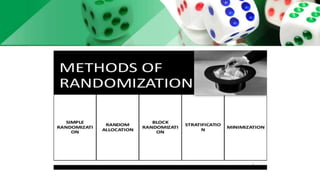
- Methods of randomization
-Simple randomization
-Random allocation
-Block randomization
-Stratification
-Minimization
- Sample size
- Documentation
- Monitoring management
OVERVIEW OF RANDOMIZATION
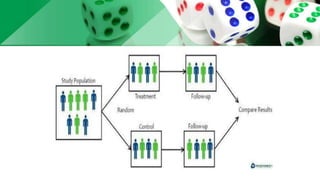
● The process by which each subject has the same
chance of being assigned to either intervention or
control.
● Neither the subject nor the investigator should know
the treatment assignment before the subject′s decision
to enter the study.
→ this removes investigator bias.
Purpose of randomization
• Primary purpose- to prevent bias in allocating
subjects to treatment groups.
• Secondary purpose- to achieve comparability
between the groups.
SIMPLE RANDOMIZATION
• If there are 50 (N) number of subjects, the
treatment plan is divided equally that is 25
(n1) and 25 (n2).such that n1+ n2 = N.
• The envelopes with the treatment nplans
are labelled and shuffled.
• The order of the envelopes give the order of
treatment of subjects.
RANDOM ALLOCATION
• Random allocation is a procedure in which
identified sample participants are randomly
assigned to a treatment and each participant has
the same probability of being assigned to any
particular treatment.
• If the design is based on N participants and n1 are
to be assigned to treatment 1 then all possible
samples of size n1 have the same probability of
being assigned to treatment 1.
BLOCK RANDOMIZATION
• Block randomization is commonly used in the two treatment situation
where sample sizes for the two treatments are to be equal or approximately
equal.
• The process involves recruiting participants in short blocks and ensuring that
half of the participants within each block are allocated to treatment “A” and
other half to “B”.
• There are six different ways that four
patients can be split evenly between two
treatments.
1. AABB 4. BAAB
2. ABAB 5. BABA
3. ABBA 6. BBAA
• The next step is to select randomly amongst these six
different blocks for each group of four participants that are
recruited.
• The random selection can be done using a list of random
numbers generated using statistical software e.g SPSS,
EXCEL, MINITAB,STATA,SAS. EG
9795270571964604603256331708242973….
• Since there are only six different blocks-
525164647632563312423…..
• Blocks are selected according to the above sequence.
5. BABA 2. ABAB
1. AABB 6. BBAA 4. BAAB
5. BABA
4. STRATIFICATION
• A stratification factor is a categorical covariate which
divides the patient population according to its levels e.g
• - sex, 2 levels: male, female
• - age, 3 levels: <40, 40-59, ≥60 years
• -recruitment centres
• - menopausal status
• -any other known prognostic factors.
5. MINIMIZATION
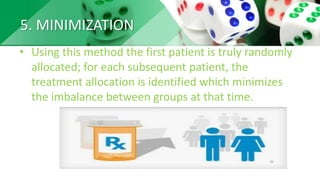
• Using this method the first patient is truly randomly
allocated; for each subsequent patient, the
treatment allocation is identified which minimizes
the imbalance between groups at that time.
Sample size
• The number of subjects in a critical trial should always be large
enough to provide a reliable answer to the questions
addressed. this number is usually determined by the primary
objective of the trial. If the sample size is determined on some
other basis, then this should be clear and justified.
• The sample size of an equivalence trial should be based on the
objective of obtaining a confidence interval for the treatment
difference that shows that the treatment differs at most by a
clinically acceptable difference.
• The exact sample size in a group
sequential trial cannot be fixed in
advance because it depends upon the
play of chance in combination with the
chosen stopping guideline and the true
treatment difference.
DOCUMENTATION
• The collection of data and transfer of data from the investigator to the sponsor can take
place through a variety of media, including paper case record forms, remote sites
monitoring systems, medical computer systems and electronic transfers.
• Whatever data capture instrument is used, the form and content of information collected
should be in full accordance with the protocol and should be established in advance of
the conduct of the clinical trial.
• The process of data capture, through to database finalization, should be carried out in
accordance with good clinical practice (GCP). Documentation for all subjects for whom trial
procedures (eg run-in period) were initiated may be useful.
• The computer software used for data management and statistical analysis should be
reliable and documentation of appropriate software testing procedures should be
available.
MONITORING MANAGEMENT
• Careful conduct of a clinical trial according to the protocol has a major impact on
the credibility of the results. Careful monitoring can ensure that the difficulties
are noticed early and their occurrence or recurrence minimized.
• There are two distinct types of monitoring that generally characterize
confirmatory clinical trials sponsored by the pharmaceutical industry. One type
of monitoring concerns the oversight of the quality of the trial, while the other
type involves breaking the blind to make treatment comparisons. Both types of
trial monitoring, in addition to entailing different staff responsibilities, involve
access to different types of trial data and information and thus different
principles apply for the control of potential, statistical and operational bias.
REFERENCES
• RC GOYAL- Research methodology for health professionals
(study design options in medical and health research )
• AMEENA MEHABOOB- Methods of randomization of clinical
trials.
• Randomization of clinical trials, university of the west of
England.
• KP SURESH – an overview of randomization techniques: an
unbiased assessment of outcome in clinical research.
thank you

methods of randomization.pptx

  • 1.
  • 2.
    LEARNING OBJECTIVES The learnerwill be able to – - Describe the methods of randomization with examples. - Explain the purpose of randomization in clinical trials. - Elaborate the process of randomization in clinical trials.

  • 3.
    CONTENTS - Overview ofrandomization - Purpose of randomization - Methods of randomization -Simple randomization -Random allocation -Block randomization -Stratification -Minimization - Sample size - Documentation - Monitoring management
  • 4.
    OVERVIEW OF RANDOMIZATION ●The process by which each subject has the same chance of being assigned to either intervention or control. ● Neither the subject nor the investigator should know the treatment assignment before the subject′s decision to enter the study. → this removes investigator bias.
  • 6.
    Purpose of randomization •Primary purpose- to prevent bias in allocating subjects to treatment groups. • Secondary purpose- to achieve comparability between the groups.
  • 8.
  • 10.
    • If thereare 50 (N) number of subjects, the treatment plan is divided equally that is 25 (n1) and 25 (n2).such that n1+ n2 = N. • The envelopes with the treatment nplans are labelled and shuffled. • The order of the envelopes give the order of treatment of subjects.
  • 11.
    RANDOM ALLOCATION • Randomallocation is a procedure in which identified sample participants are randomly assigned to a treatment and each participant has the same probability of being assigned to any particular treatment. • If the design is based on N participants and n1 are to be assigned to treatment 1 then all possible samples of size n1 have the same probability of being assigned to treatment 1.
  • 12.
    BLOCK RANDOMIZATION • Blockrandomization is commonly used in the two treatment situation where sample sizes for the two treatments are to be equal or approximately equal. • The process involves recruiting participants in short blocks and ensuring that half of the participants within each block are allocated to treatment “A” and other half to “B”.
  • 13.
    • There aresix different ways that four patients can be split evenly between two treatments. 1. AABB 4. BAAB 2. ABAB 5. BABA 3. ABBA 6. BBAA
  • 14.
    • The nextstep is to select randomly amongst these six different blocks for each group of four participants that are recruited. • The random selection can be done using a list of random numbers generated using statistical software e.g SPSS, EXCEL, MINITAB,STATA,SAS. EG 9795270571964604603256331708242973…. • Since there are only six different blocks- 525164647632563312423….. • Blocks are selected according to the above sequence.
  • 15.
    5. BABA 2.ABAB 1. AABB 6. BBAA 4. BAAB 5. BABA
  • 16.
    4. STRATIFICATION • Astratification factor is a categorical covariate which divides the patient population according to its levels e.g • - sex, 2 levels: male, female • - age, 3 levels: <40, 40-59, ≥60 years • -recruitment centres • - menopausal status • -any other known prognostic factors.
  • 18.
    5. MINIMIZATION • Usingthis method the first patient is truly randomly allocated; for each subsequent patient, the treatment allocation is identified which minimizes the imbalance between groups at that time.
  • 19.
    Sample size • Thenumber of subjects in a critical trial should always be large enough to provide a reliable answer to the questions addressed. this number is usually determined by the primary objective of the trial. If the sample size is determined on some other basis, then this should be clear and justified. • The sample size of an equivalence trial should be based on the objective of obtaining a confidence interval for the treatment difference that shows that the treatment differs at most by a clinically acceptable difference.
  • 20.
    • The exactsample size in a group sequential trial cannot be fixed in advance because it depends upon the play of chance in combination with the chosen stopping guideline and the true treatment difference.
  • 21.
    DOCUMENTATION • The collectionof data and transfer of data from the investigator to the sponsor can take place through a variety of media, including paper case record forms, remote sites monitoring systems, medical computer systems and electronic transfers. • Whatever data capture instrument is used, the form and content of information collected should be in full accordance with the protocol and should be established in advance of the conduct of the clinical trial.
  • 22.
    • The processof data capture, through to database finalization, should be carried out in accordance with good clinical practice (GCP). Documentation for all subjects for whom trial procedures (eg run-in period) were initiated may be useful. • The computer software used for data management and statistical analysis should be reliable and documentation of appropriate software testing procedures should be available.
  • 23.
    MONITORING MANAGEMENT • Carefulconduct of a clinical trial according to the protocol has a major impact on the credibility of the results. Careful monitoring can ensure that the difficulties are noticed early and their occurrence or recurrence minimized. • There are two distinct types of monitoring that generally characterize confirmatory clinical trials sponsored by the pharmaceutical industry. One type of monitoring concerns the oversight of the quality of the trial, while the other type involves breaking the blind to make treatment comparisons. Both types of trial monitoring, in addition to entailing different staff responsibilities, involve access to different types of trial data and information and thus different principles apply for the control of potential, statistical and operational bias.
  • 24.
    REFERENCES • RC GOYAL-Research methodology for health professionals (study design options in medical and health research ) • AMEENA MEHABOOB- Methods of randomization of clinical trials. • Randomization of clinical trials, university of the west of England. • KP SURESH – an overview of randomization techniques: an unbiased assessment of outcome in clinical research.

  • 25.