LESSON 1
Random Variable and
Probability
Distribution
Learning Objectives
illustrates a random variable (discrete and continuous)
distinguished between a discrete and a continuous random
variable
finds the possible values of a random variable
illustrates a probability distribution for a discrete random
variable and its properties
computes probabilities corresponding to a given random
variable
Experiments
are any movement or
activity which can be
done repeatedly under
similar or comparative
condition.
Outcomes
are the result of a given
experiment
Sample Space
is the set of all possible
outcomes of an
experiment
Example
rolling a die (dice) is an
example of experiment
Example
Upon rolling the die, it is expected that
it will show a dot on the top which are
either 1, 2, 3, 4, 5 or 6, these are what
we call the sample space of the given
experiment. If you are only interested
on a given value of dots, let say, three
dots, then “3” is what we call the
outcome or the sample.
is a characteristic or
attribute that can assume
different values
(ex. in algebra, variables like
x can be any number)
use capital letter (X, Y, Z, and others)
to denote or represent a variable.
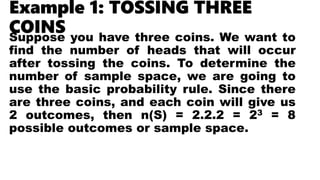
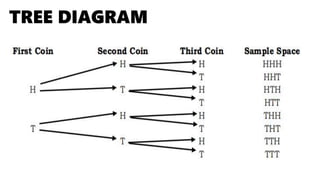
Example 1: TOSSING THREE
COINS
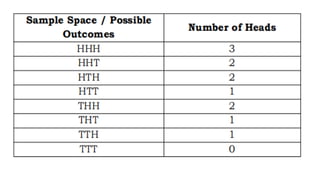
Suppose you have three coins. We want to
find the number of heads that will occur
after tossing the coins. To determine the
number of sample space, we are going to
use the basic probability rule. Since there
are three coins, and each coin will give us
2 outcomes, then n(S) = 2.2.2 = 23 = 8
possible outcomes or sample space.
TREE DIAGRAM
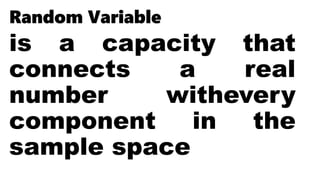
Random Variable
is a capacity that
connects a real
number withevery
component in the
sample space
Random Variable
It is a variable whose
qualities are controlled
by chance.
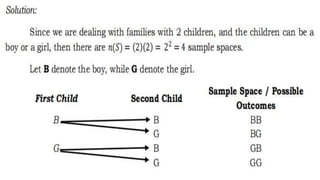
Example 2: BOYS or GIRLS?
An experiment consists of
studying the number of boys in
families with exactly 2 children.
The random variable X may be
used to represent the number of
boys.
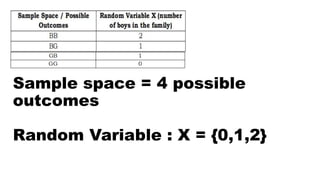
Sample space = 4 possible
outcomes
Random Variable : X = {0,1,2}
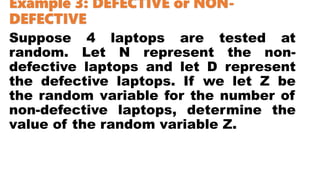
Example 3: DEFECTIVE or NON-
DEFECTIVE
Suppose 4 laptops are tested at
random. Let N represent the non-
defective laptops and let D represent
the defective laptops. If we let Z be
the random variable for the number of
non-defective laptops, determine the
value of the random variable Z.
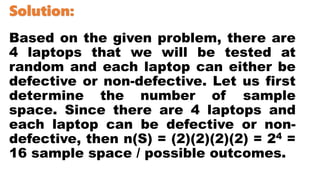
Solution:
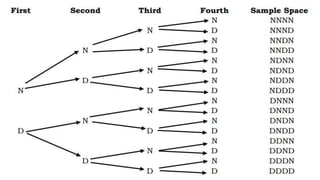
Based on the given problem, there are
4 laptops that we will be tested at
random and each laptop can either be
defective or non-defective. Let us first
determine the number of sample
space. Since there are 4 laptops and
each laptop can be defective or non-
defective, then n(S) = (2)(2)(2)(2) = 24 =
16 sample space / possible outcomes.
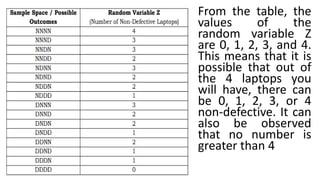
From the table, the
values of the
random variable Z
are 0, 1, 2, 3, and 4.
This means that it is
possible that out of
the 4 laptops you
will have, there can
be 0, 1, 2, 3, or 4
non-defective. It can
also be observed
that no number is
greater than 4
TYPES OF RANDOM VARIABLE
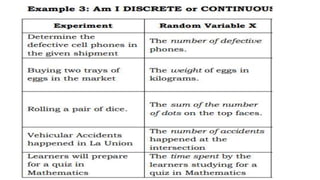
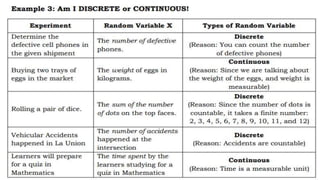
Discrete Random Variables
are variables that can take on a finite
number of distinct values. In easier
definition, discrete random variable is
a set of possible outcomes that is
countable.
TYPES OF RANDOM VARIABLE
Discrete Random Variables
Examples
number of heads acquired while
flipping a coin three times
the number of defective chairs,
the number of boys in the family,
the number of students present in
the online class
TYPES OF RANDOM VARIABLE
Continuous Random Variables
are random variables that take an
infinitely uncountable number of
potential values, regularly measurable
amounts.
TYPES OF RANDOM VARIABLE
Continuous Random Variables
Examples
represent measured data, such as
height,
weights,
temperature.
Random Variable and Probability Distribution.pptx

Random Variable and Probability Distribution.pptx

  • 1.
    LESSON 1 Random Variableand Probability Distribution
  • 2.
    Learning Objectives illustrates arandom variable (discrete and continuous) distinguished between a discrete and a continuous random variable finds the possible values of a random variable illustrates a probability distribution for a discrete random variable and its properties computes probabilities corresponding to a given random variable
  • 4.
    Experiments are any movementor activity which can be done repeatedly under similar or comparative condition.
  • 5.
    Outcomes are the resultof a given experiment
  • 6.
    Sample Space is theset of all possible outcomes of an experiment
  • 7.
    Example rolling a die(dice) is an example of experiment
  • 8.
    Example Upon rolling thedie, it is expected that it will show a dot on the top which are either 1, 2, 3, 4, 5 or 6, these are what we call the sample space of the given experiment. If you are only interested on a given value of dots, let say, three dots, then “3” is what we call the outcome or the sample.
  • 9.
    is a characteristicor attribute that can assume different values (ex. in algebra, variables like x can be any number) use capital letter (X, Y, Z, and others) to denote or represent a variable.
  • 10.
    Example 1: TOSSINGTHREE COINS Suppose you have three coins. We want to find the number of heads that will occur after tossing the coins. To determine the number of sample space, we are going to use the basic probability rule. Since there are three coins, and each coin will give us 2 outcomes, then n(S) = 2.2.2 = 23 = 8 possible outcomes or sample space.
  • 11.
  • 13.
    Random Variable is acapacity that connects a real number withevery component in the sample space
  • 14.
    Random Variable It isa variable whose qualities are controlled by chance.
  • 15.
    Example 2: BOYSor GIRLS? An experiment consists of studying the number of boys in families with exactly 2 children. The random variable X may be used to represent the number of boys.
  • 17.
    Sample space =4 possible outcomes Random Variable : X = {0,1,2}
  • 18.
    Example 3: DEFECTIVEor NON- DEFECTIVE Suppose 4 laptops are tested at random. Let N represent the non- defective laptops and let D represent the defective laptops. If we let Z be the random variable for the number of non-defective laptops, determine the value of the random variable Z.
  • 19.
    Solution: Based on thegiven problem, there are 4 laptops that we will be tested at random and each laptop can either be defective or non-defective. Let us first determine the number of sample space. Since there are 4 laptops and each laptop can be defective or non- defective, then n(S) = (2)(2)(2)(2) = 24 = 16 sample space / possible outcomes.
  • 21.
    From the table,the values of the random variable Z are 0, 1, 2, 3, and 4. This means that it is possible that out of the 4 laptops you will have, there can be 0, 1, 2, 3, or 4 non-defective. It can also be observed that no number is greater than 4
  • 22.
    TYPES OF RANDOMVARIABLE Discrete Random Variables are variables that can take on a finite number of distinct values. In easier definition, discrete random variable is a set of possible outcomes that is countable.
  • 23.
    TYPES OF RANDOMVARIABLE Discrete Random Variables Examples number of heads acquired while flipping a coin three times the number of defective chairs, the number of boys in the family, the number of students present in the online class
  • 24.
    TYPES OF RANDOMVARIABLE Continuous Random Variables are random variables that take an infinitely uncountable number of potential values, regularly measurable amounts.
  • 25.
    TYPES OF RANDOMVARIABLE Continuous Random Variables Examples represent measured data, such as height, weights, temperature.