LESSON 1:
THE CONCEPT
OF RANDOM
VARIABLE
Mrs. Mariepet C.
Agustines
RANDOM
- means that the experiment may result
in one of several possible values of
the variable.
2
VARIABLE
- is a quantity which during a calculation
is assumed to vary or be capable of
varying in value.
RANDOM VARIABLE
- is a variable whose value is a
numerical outcome of a random
phenomenon.
- is a variable whose value is
unknown or a function that
assigns values to each of an
experiment's outcomes.
- often designated by letters
- classified as discrete or
continuous
3
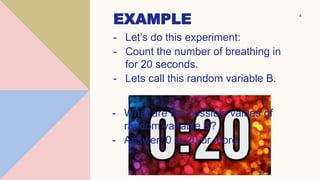
EXAMPLE
- Let’s do this experiment:
- Count the number of breathing in
for 20 seconds.
- Lets call this random variable B.
4
- What are the possible values of
random variable B?
- Answer: 0 to 20 or more
VARIABLE
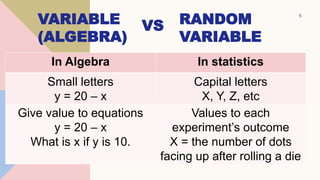
(ALGEBRA)
In Algebra In statistics
Small letters
y = 20 – x
Capital letters
X, Y, Z, etc
Give value to equations
y = 20 – x
What is x if y is 10.
Values to each
experiment’s outcome
X = the number of dots
facing up after rolling a die
5
VS RANDOM
VARIABLE
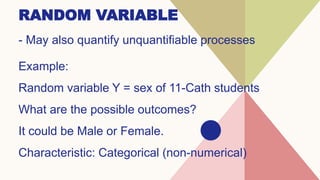
RANDOM VARIABLE
- May also quantify unquantifiable processes
Example:
Random variable Y = sex of 11-Cath students
What are the possible outcomes?
It could be Male or Female.
Characteristic: Categorical (non-numerical)
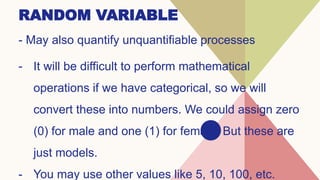
RANDOM VARIABLE
- May also quantify unquantifiable processes
- It will be difficult to perform mathematical
operations if we have categorical, so we will
convert these into numbers. We could assign zero
(0) for male and one (1) for female. But these are
just models.
- You may use other values like 5, 10, 100, etc.
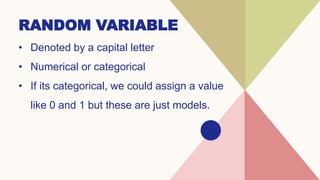
RANDOM VARIABLE
• Denoted by a capital letter
• Numerical or categorical
• If its categorical, we could assign a value
like 0 and 1 but these are just models.
RANDOM VARIABLE
OTHER EXAMPLES
• Number of messages/chats sent in a day
• Number of tiles needed to cover the floor area
• Amount of time needed to walk from home to school
• Gender of Grade 11 students taking up HUMSS
• Height of applicants for the Miss Toledo
TYPES OF DATA
1. Categorical
- describes categories or groups
Examples:
• Sex – Male or Female
• Eye Color – Brown, Black, Blue
• Grade Level – Grade 7, Grade 8, Grade 9, 10, 11, 12
• Answers to “Yes and No questions”
• Are you currently enrolled in LurayIINHS? Yes and No
TYPES OF DATA
2. Numerical
- represents numbers
Examples:
• Score in Diagnostic Exam : 0 – 48
• Weight – 45 kg, 46.8 kg, 52.5 kg
• Age – 18 yo, 22 yo, 17 yo
• Grades – 75, 83, 91
TWO SUBTYPE
a. Discrete Variable
 a random variable is called discrete if it has either a finite
or a countable number of possible values.
 the value could be 2, 24, 34, or 135 students, but it cannot
be 233/2 or 12.23 students.
 are considered countable values, since you could count a
whole number of them.
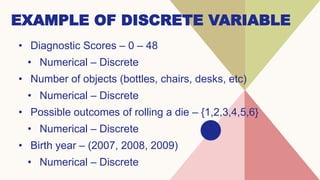
EXAMPLE OF DISCRETE VARIABLE
• Diagnostic Scores – 0 – 48
• Numerical – Discrete
• Number of objects (bottles, chairs, desks, etc)
• Numerical – Discrete
• Possible outcomes of rolling a die – {1,2,3,4,5,6}
• Numerical – Discrete
• Birth year – (2007, 2008, 2009)
• Numerical – Discrete
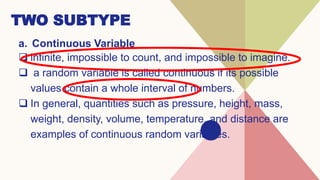
TWO SUBTYPE
a. Continuous Variable
 infinite, impossible to count, and impossible to imagine.
 a random variable is called continuous if its possible
values contain a whole interval of numbers.
 In general, quantities such as pressure, height, mass,
weight, density, volume, temperature, and distance are
examples of continuous random variables.
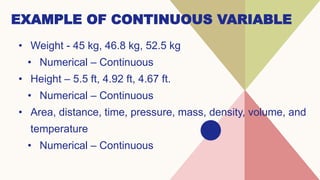
EXAMPLE OF CONTINUOUS VARIABLE
• Weight - 45 kg, 46.8 kg, 52.5 kg
• Numerical – Continuous
• Height – 5.5 ft, 4.92 ft, 4.67 ft.
• Numerical – Continuous
• Area, distance, time, pressure, mass, density, volume, and
temperature
• Numerical – Continuous
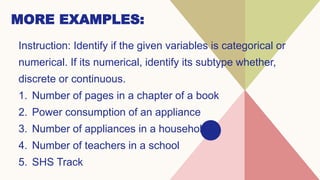
MORE EXAMPLES:
Instruction: Identify if the given variables is categorical or
numerical. If its numerical, identify its subtype whether,
discrete or continuous.
1. Number of pages in a chapter of a book
2. Power consumption of an appliance
3. Number of appliances in a household
4. Number of teachers in a school
5. SHS Track
MORE EXAMPLES:
6. Length of a tree
7. Hair color
8. Teacher positions
9. Number of students in a class
10.Music Genre
POSSIBLE VALUES OF
A RANDOM VARIABLE
TERMS
• Sample space – all possible outcomes of a random
experiment (Let’s say S)
• Sample Point – each outcome. It is also called an element
or a member of the sample space.
• Event – a subset of the sample space. (Let’s say A)
WE TOSS A COIN THREE TIMES
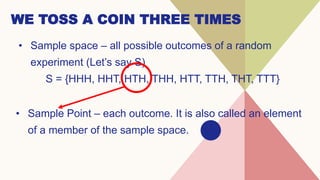
• Sample space – all possible outcomes of a random
experiment (Let’s say S)
S = {HHH, HHT, HTH, THH, HTT, TTH, THT, TTT}
• Sample Point – each outcome. It is also called an element
of a member of the sample space.
EVENT – NO HEADS OCCUR
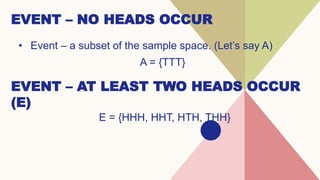
• Event – a subset of the sample space. (Let’s say A)
A = {TTT}
EVENT – AT LEAST TWO HEADS OCCUR
(E)
E = {HHH, HHT, HTH, THH}
HOW DO WE GET THE
POSSIBLE VALUES OF
A RANDOM VARIABLE?
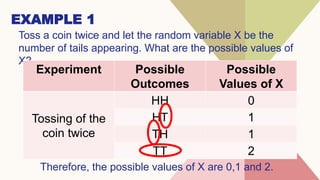
EXAMPLE 1
Toss a coin twice and let the random variable X be the
number of tails appearing. What are the possible values of
X?
Experiment Possible
Outcomes
Possible
Values of X
Tossing of the
coin twice
HH 0
HT 1
TH 1
TT 2
Therefore, the possible values of X are 0,1 and 2.
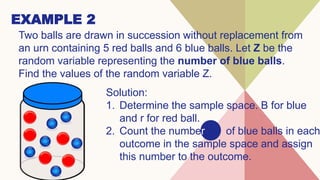
EXAMPLE 2
Two balls are drawn in succession without replacement from
an urn containing 5 red balls and 6 blue balls. Let Z be the
random variable representing the number of blue balls.
Find the values of the random variable Z.
Solution:
1. Determine the sample space. B for blue
and r for red ball.
2. Count the number of blue balls in each
outcome in the sample space and assign
this number to the outcome.
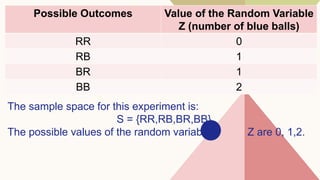
Possible Outcomes Value of the Random Variable
Z (number of blue balls)
RR 0
RB 1
BR 1
BB 2
The sample space for this experiment is:
S = {RR,RB,BR,BB}
The possible values of the random variable Z are 0, 1,2.
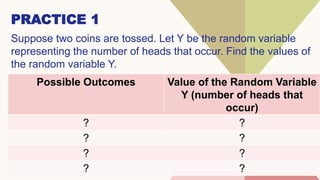
Possible Outcomes Value of the Random Variable
Y (number of heads that
occur)
? ?
? ?
? ?
? ?
Suppose two coins are tossed. Let Y be the random variable
representing the number of heads that occur. Find the values of
the random variable Y.
PRACTICE 1
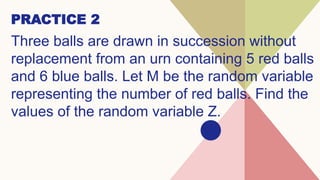
Three balls are drawn in succession without
replacement from an urn containing 5 red balls
and 6 blue balls. Let M be the random variable
representing the number of red balls. Find the
values of the random variable Z.
PRACTICE 2
PRACTICE 2
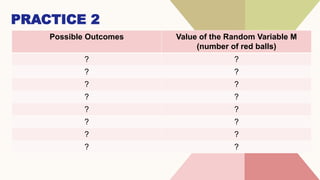
Possible Outcomes Value of the Random Variable M
(number of red balls)
? ?
? ?
? ?
? ?
? ?
? ?
? ?
? ?

Random Variable

  • 1.
    LESSON 1: THE CONCEPT OFRANDOM VARIABLE Mrs. Mariepet C. Agustines
  • 2.
    RANDOM - means thatthe experiment may result in one of several possible values of the variable. 2 VARIABLE - is a quantity which during a calculation is assumed to vary or be capable of varying in value.
  • 3.
    RANDOM VARIABLE - isa variable whose value is a numerical outcome of a random phenomenon. - is a variable whose value is unknown or a function that assigns values to each of an experiment's outcomes. - often designated by letters - classified as discrete or continuous 3
  • 4.
    EXAMPLE - Let’s dothis experiment: - Count the number of breathing in for 20 seconds. - Lets call this random variable B. 4 - What are the possible values of random variable B? - Answer: 0 to 20 or more
  • 5.
    VARIABLE (ALGEBRA) In Algebra Instatistics Small letters y = 20 – x Capital letters X, Y, Z, etc Give value to equations y = 20 – x What is x if y is 10. Values to each experiment’s outcome X = the number of dots facing up after rolling a die 5 VS RANDOM VARIABLE
  • 6.
    RANDOM VARIABLE - Mayalso quantify unquantifiable processes Example: Random variable Y = sex of 11-Cath students What are the possible outcomes? It could be Male or Female. Characteristic: Categorical (non-numerical)
  • 7.
    RANDOM VARIABLE - Mayalso quantify unquantifiable processes - It will be difficult to perform mathematical operations if we have categorical, so we will convert these into numbers. We could assign zero (0) for male and one (1) for female. But these are just models. - You may use other values like 5, 10, 100, etc.
  • 8.
    RANDOM VARIABLE • Denotedby a capital letter • Numerical or categorical • If its categorical, we could assign a value like 0 and 1 but these are just models.
  • 9.
    RANDOM VARIABLE OTHER EXAMPLES •Number of messages/chats sent in a day • Number of tiles needed to cover the floor area • Amount of time needed to walk from home to school • Gender of Grade 11 students taking up HUMSS • Height of applicants for the Miss Toledo
  • 10.
    TYPES OF DATA 1.Categorical - describes categories or groups Examples: • Sex – Male or Female • Eye Color – Brown, Black, Blue • Grade Level – Grade 7, Grade 8, Grade 9, 10, 11, 12 • Answers to “Yes and No questions” • Are you currently enrolled in LurayIINHS? Yes and No
  • 11.
    TYPES OF DATA 2.Numerical - represents numbers Examples: • Score in Diagnostic Exam : 0 – 48 • Weight – 45 kg, 46.8 kg, 52.5 kg • Age – 18 yo, 22 yo, 17 yo • Grades – 75, 83, 91
  • 12.
    TWO SUBTYPE a. DiscreteVariable  a random variable is called discrete if it has either a finite or a countable number of possible values.  the value could be 2, 24, 34, or 135 students, but it cannot be 233/2 or 12.23 students.  are considered countable values, since you could count a whole number of them.
  • 13.
    EXAMPLE OF DISCRETEVARIABLE • Diagnostic Scores – 0 – 48 • Numerical – Discrete • Number of objects (bottles, chairs, desks, etc) • Numerical – Discrete • Possible outcomes of rolling a die – {1,2,3,4,5,6} • Numerical – Discrete • Birth year – (2007, 2008, 2009) • Numerical – Discrete
  • 14.
    TWO SUBTYPE a. ContinuousVariable  infinite, impossible to count, and impossible to imagine.  a random variable is called continuous if its possible values contain a whole interval of numbers.  In general, quantities such as pressure, height, mass, weight, density, volume, temperature, and distance are examples of continuous random variables.
  • 15.
    EXAMPLE OF CONTINUOUSVARIABLE • Weight - 45 kg, 46.8 kg, 52.5 kg • Numerical – Continuous • Height – 5.5 ft, 4.92 ft, 4.67 ft. • Numerical – Continuous • Area, distance, time, pressure, mass, density, volume, and temperature • Numerical – Continuous
  • 16.
    MORE EXAMPLES: Instruction: Identifyif the given variables is categorical or numerical. If its numerical, identify its subtype whether, discrete or continuous. 1. Number of pages in a chapter of a book 2. Power consumption of an appliance 3. Number of appliances in a household 4. Number of teachers in a school 5. SHS Track
  • 17.
    MORE EXAMPLES: 6. Lengthof a tree 7. Hair color 8. Teacher positions 9. Number of students in a class 10.Music Genre
  • 18.
    POSSIBLE VALUES OF ARANDOM VARIABLE
  • 19.
    TERMS • Sample space– all possible outcomes of a random experiment (Let’s say S) • Sample Point – each outcome. It is also called an element or a member of the sample space. • Event – a subset of the sample space. (Let’s say A)
  • 20.
    WE TOSS ACOIN THREE TIMES • Sample space – all possible outcomes of a random experiment (Let’s say S) S = {HHH, HHT, HTH, THH, HTT, TTH, THT, TTT} • Sample Point – each outcome. It is also called an element of a member of the sample space.
  • 21.
    EVENT – NOHEADS OCCUR • Event – a subset of the sample space. (Let’s say A) A = {TTT} EVENT – AT LEAST TWO HEADS OCCUR (E) E = {HHH, HHT, HTH, THH}
  • 22.
    HOW DO WEGET THE POSSIBLE VALUES OF A RANDOM VARIABLE?
  • 23.
    EXAMPLE 1 Toss acoin twice and let the random variable X be the number of tails appearing. What are the possible values of X? Experiment Possible Outcomes Possible Values of X Tossing of the coin twice HH 0 HT 1 TH 1 TT 2 Therefore, the possible values of X are 0,1 and 2.
  • 24.
    EXAMPLE 2 Two ballsare drawn in succession without replacement from an urn containing 5 red balls and 6 blue balls. Let Z be the random variable representing the number of blue balls. Find the values of the random variable Z. Solution: 1. Determine the sample space. B for blue and r for red ball. 2. Count the number of blue balls in each outcome in the sample space and assign this number to the outcome.
  • 25.
    Possible Outcomes Valueof the Random Variable Z (number of blue balls) RR 0 RB 1 BR 1 BB 2 The sample space for this experiment is: S = {RR,RB,BR,BB} The possible values of the random variable Z are 0, 1,2.
  • 26.
    Possible Outcomes Valueof the Random Variable Y (number of heads that occur) ? ? ? ? ? ? ? ? Suppose two coins are tossed. Let Y be the random variable representing the number of heads that occur. Find the values of the random variable Y. PRACTICE 1
  • 27.
    Three balls aredrawn in succession without replacement from an urn containing 5 red balls and 6 blue balls. Let M be the random variable representing the number of red balls. Find the values of the random variable Z. PRACTICE 2
  • 28.
    PRACTICE 2 Possible OutcomesValue of the Random Variable M (number of red balls) ? ? ? ? ? ? ? ? ? ? ? ? ? ? ? ?