Dianne Reichel T. Ronio
Teacher III
New Normal
Classroom Rules
Checking of
Attendance
After going through this lesson, you
are able to:
1. define a normal random variable;
2. illustrate a normal random
variable and its characteristics;
After going through this lesson, you
are able to:
3. listen attentively during class
discussion;
4. participate actively in activities;
and
After going through this lesson, you
are able to:
5. appreciate the importance of the
lesson being discussed.
Review!!!
Read the following
statements carefully and
determine whether it is
TRUE or FALSE.
Probability is the value
greater than or equal to
zero but less
than or equal to one.
Discrete variables are
the infinite numerical
values like heights,
weights, distance and
length
34% is also
equal 0.34.
Mean, mode and
standard deviation
are the measures
of central
tendency.
Mean is equal to the
summation of scores
divided by the
number of cases.
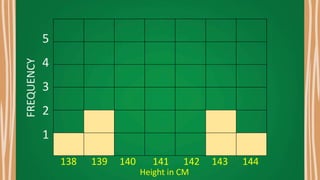
The distribution of the
height (X) in centimeter
(cm) of the 16 teachers of
Naic Integrated NHS-
SHS was presented on the
table. Construct a
histogram for the random
variable (X).
5
4
3
2
1
138 139 140 141 142 143 144
FREQUENCY
Height in CM
5
4
3
2
1
138 139 140 141 142 143 144
FREQUENCY
Height in CM
5
4
3
2
1
138 139 140 141 142 143 144
FREQUENCY
Height in CM
5
4
3
2
1
138 139 140 141 142 143 144
FREQUENCY
Height in CM
5
4
3
2
1
138 139 140 141 142 143 144
FREQUENCY
Height in CM
5
4
3
2
1
138 139 140 141 142 143 144
FREQUENCY
Height in CM
5
4
3
2
1
138 139 140 141 142 143 144
FREQUENCY
Height in CM
Normal Probability
Distribution
• is a probability distribution of
continuous random variables.
Normal Probability
Distribution
• It is used to describe the
characteristics of populations and
help us visualize the inferences we
make about the population.
Normal Probability
Distribution
• It also used to determine the
probabilities and percentile of
the continuous random
variables in the distribution.
Properties of Normal Curve
1. The normal curve is bell-
shaped.
2. The curve is
symmetrical about its
center.
Properties of Normal Curve
3. The mean, median, and mode
coincide at the center.
4. The width of the curve is
determined by the standard
deviation of the distribution.
Properties of Normal Curve
5. The tails of the curve are plotted
in both directions and flatten out
indefinitely along the horizontal axis.
The tails are thus asymptotic to the
baseline
6. The total area under a normal
curve is 1
Below is the graph of the normal curve
A normally distributed random variable with a mean μ =
0 and standard deviation ơ = 1 is called a standard
normal variable
The shape of a normal curve is based on the
two given parameters, the mean and the
standard deviation of the distribution.
When comparing two distributions each
described by the normal curve, the following
are the three situations based on the said
parameters
When the means are not equal, but the standard
deviations are equal. (μ1 ≠ μ2 ; ơ1 =ơ2 ), the
curves have a similar shape but centered at
different points
When the means are equal, but the standard deviations
are not equal. (μ1 = μ2 ; ơ1 ≠ ơ2 ), the curves are
centered at the same point but they have different
height and spreads
When the means are different and the standard
deviations are also different (μ1≠ μ2 ; ơ1 ≠ ơ2 ), the
curves are centered at different points and vary in
shapes
Analyze the following figures and
describe each by identifying
whether they have the same or
different mean and standard
deviation.
Check each figure and
answer the questions that
follows.
After going through this lesson, you
are able to:
1. Calculate the mean and the
variance of a discrete random
variable;
Recall the formula for:
1.Expected Value or Mean Value
2.Variance
3.Standard Deviation
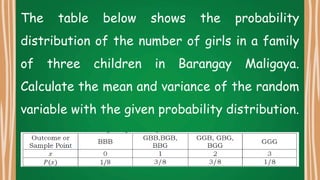
The table below shows the probability
distribution of the number of girls in a family
of three children in Barangay Maligaya.
Calculate the mean and variance of the random
variable with the given probability distribution.
Game of Chance
Game of Chance
Questions:
1. If you are Cardo, would you buy a raffle ticket?
Why?
2. If Cardo decided to buy five tickets, what is the
probability that he would win the prize if 1000 tickets
were sold?
What is the probability that Cardo will lose the bet?
3. How much money will Cardo gain if he wins the
prize?
Questions:
4. How much money will be wasted if he will not
win the prize and he buy one ticket?
5. What if 1000 tickets were purchased by
different individuals, what is the expected value
of buying one ticket?
6. How would you describe Romulo as a friend?
Seatwork 13:Raffle Tickets Problem
Seatwork 14: Raffle for a Cause
Seatwork 15: Roulette Wheel
Seatwork 16: Insurance Investment
The negative value (in expected value)
means that one loses money on the
average.
Having this knowledge, you can now
make a wise decision.
But remember, important things should be
prioritized. If you can afford to buy tickets
without sacrificing your essential needs. It is
okay to take a chance sometimes. You should also
consider saving money for future use, because
not every day you have enough funds, having
extra money would be a great help in times of
need.
Assessment
Direction: Choose the letter of the best
answer.
Week 3 Statistics and Probability.pptx

Week 3 Statistics and Probability.pptx

  • 1.
    Dianne Reichel T.Ronio Teacher III
  • 4.
  • 6.
  • 7.
    After going throughthis lesson, you are able to: 1. define a normal random variable; 2. illustrate a normal random variable and its characteristics;
  • 8.
    After going throughthis lesson, you are able to: 3. listen attentively during class discussion; 4. participate actively in activities; and
  • 9.
    After going throughthis lesson, you are able to: 5. appreciate the importance of the lesson being discussed.
  • 10.
  • 11.
    Read the following statementscarefully and determine whether it is TRUE or FALSE.
  • 12.
    Probability is thevalue greater than or equal to zero but less than or equal to one.
  • 13.
    Discrete variables are theinfinite numerical values like heights, weights, distance and length
  • 14.
  • 15.
    Mean, mode and standarddeviation are the measures of central tendency.
  • 16.
    Mean is equalto the summation of scores divided by the number of cases.
  • 18.
    The distribution ofthe height (X) in centimeter (cm) of the 16 teachers of Naic Integrated NHS- SHS was presented on the table. Construct a histogram for the random variable (X).
  • 19.
    5 4 3 2 1 138 139 140141 142 143 144 FREQUENCY Height in CM
  • 20.
    5 4 3 2 1 138 139 140141 142 143 144 FREQUENCY Height in CM
  • 21.
    5 4 3 2 1 138 139 140141 142 143 144 FREQUENCY Height in CM
  • 22.
    5 4 3 2 1 138 139 140141 142 143 144 FREQUENCY Height in CM
  • 23.
    5 4 3 2 1 138 139 140141 142 143 144 FREQUENCY Height in CM
  • 24.
    5 4 3 2 1 138 139 140141 142 143 144 FREQUENCY Height in CM
  • 25.
    5 4 3 2 1 138 139 140141 142 143 144 FREQUENCY Height in CM
  • 26.
    Normal Probability Distribution • isa probability distribution of continuous random variables.
  • 27.
    Normal Probability Distribution • Itis used to describe the characteristics of populations and help us visualize the inferences we make about the population.
  • 28.
    Normal Probability Distribution • Italso used to determine the probabilities and percentile of the continuous random variables in the distribution.
  • 29.
    Properties of NormalCurve 1. The normal curve is bell- shaped. 2. The curve is symmetrical about its center.
  • 30.
    Properties of NormalCurve 3. The mean, median, and mode coincide at the center. 4. The width of the curve is determined by the standard deviation of the distribution.
  • 31.
    Properties of NormalCurve 5. The tails of the curve are plotted in both directions and flatten out indefinitely along the horizontal axis. The tails are thus asymptotic to the baseline 6. The total area under a normal curve is 1
  • 32.
    Below is thegraph of the normal curve
  • 33.
    A normally distributedrandom variable with a mean μ = 0 and standard deviation ơ = 1 is called a standard normal variable
  • 34.
    The shape ofa normal curve is based on the two given parameters, the mean and the standard deviation of the distribution. When comparing two distributions each described by the normal curve, the following are the three situations based on the said parameters
  • 35.
    When the meansare not equal, but the standard deviations are equal. (μ1 ≠ μ2 ; ơ1 =ơ2 ), the curves have a similar shape but centered at different points
  • 36.
    When the meansare equal, but the standard deviations are not equal. (μ1 = μ2 ; ơ1 ≠ ơ2 ), the curves are centered at the same point but they have different height and spreads
  • 37.
    When the meansare different and the standard deviations are also different (μ1≠ μ2 ; ơ1 ≠ ơ2 ), the curves are centered at different points and vary in shapes
  • 38.
    Analyze the followingfigures and describe each by identifying whether they have the same or different mean and standard deviation.
  • 39.
    Check each figureand answer the questions that follows.
  • 40.
    After going throughthis lesson, you are able to: 1. Calculate the mean and the variance of a discrete random variable;
  • 41.
    Recall the formulafor: 1.Expected Value or Mean Value 2.Variance 3.Standard Deviation
  • 42.
    The table belowshows the probability distribution of the number of girls in a family of three children in Barangay Maligaya. Calculate the mean and variance of the random variable with the given probability distribution.
  • 43.
  • 44.
  • 45.
    Questions: 1. If youare Cardo, would you buy a raffle ticket? Why? 2. If Cardo decided to buy five tickets, what is the probability that he would win the prize if 1000 tickets were sold? What is the probability that Cardo will lose the bet? 3. How much money will Cardo gain if he wins the prize?
  • 46.
    Questions: 4. How muchmoney will be wasted if he will not win the prize and he buy one ticket? 5. What if 1000 tickets were purchased by different individuals, what is the expected value of buying one ticket? 6. How would you describe Romulo as a friend?
  • 47.
  • 48.
  • 49.
  • 50.
  • 51.
  • 52.
    The negative value(in expected value) means that one loses money on the average. Having this knowledge, you can now make a wise decision.
  • 53.
    But remember, importantthings should be prioritized. If you can afford to buy tickets without sacrificing your essential needs. It is okay to take a chance sometimes. You should also consider saving money for future use, because not every day you have enough funds, having extra money would be a great help in times of need.
  • 54.
    Assessment Direction: Choose theletter of the best answer.