Random Forest in
Machine Learning
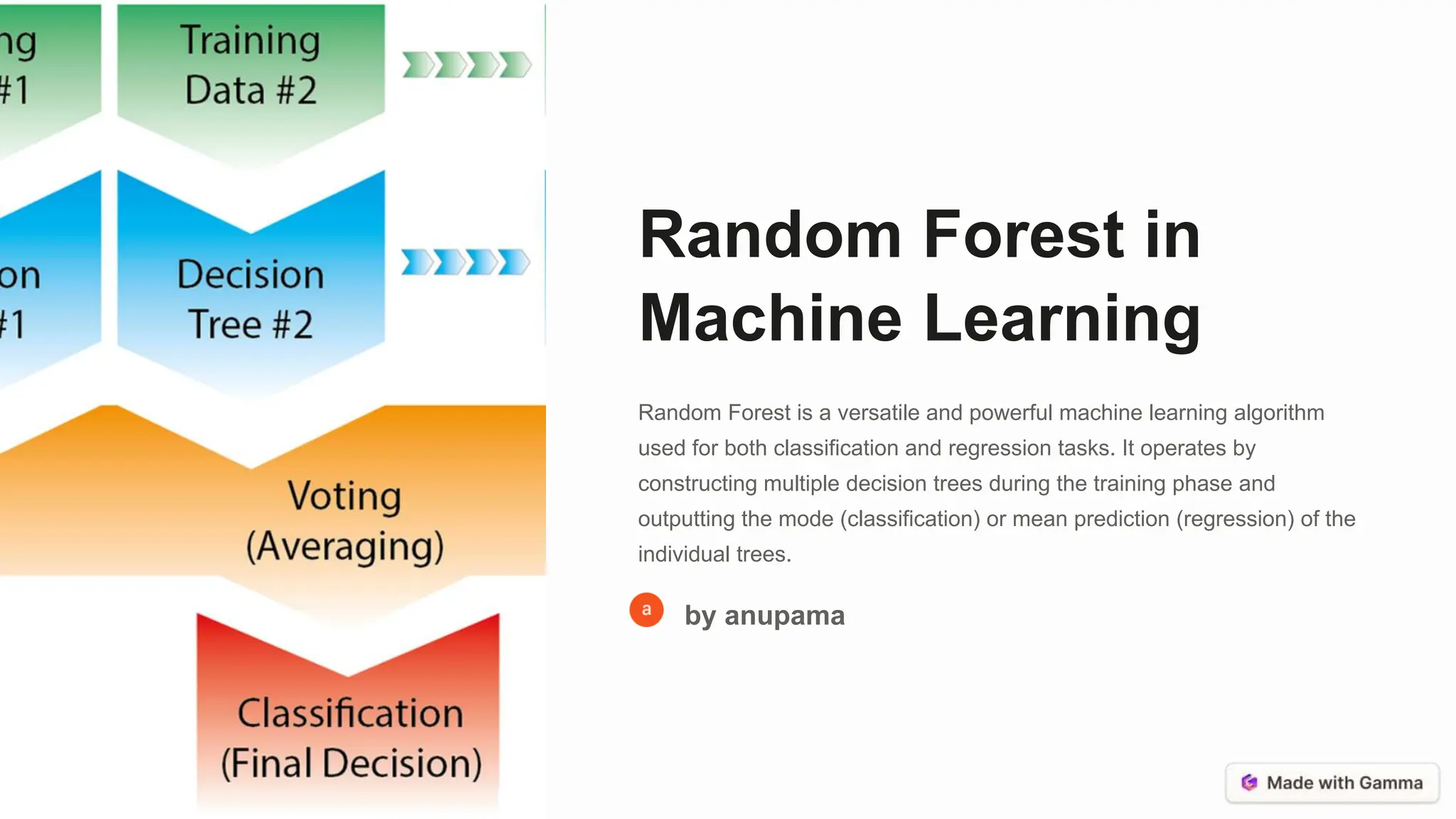
Random Forest is a versatile and powerful machine learning algorithm
used for both classification and regression tasks. It operates by
constructing multiple decision trees during the training phase and
outputting the mode (classification) or mean prediction (regression) of the
individual trees.
by anupama
Introduction to Random Forest
Versatile Algorithm
Random Forest is a versatile and powerful machine learning algorithm used for both classification and
regression tasks. It operates by constructing multiple decision trees during the training phase and
outputting the mode (classification) or mean prediction (regression) of the individual trees.
Process of Random Forest
1 Random Sampling
Randomly select a subset of data from the training set with replacement (bootstrap
sampling).
2 Feature Selection
A random subset of features is considered for splitting at each node of the decision tree.
3 Building Decision Trees
Construct multiple decision trees based on the selected data and features.
4 Combining Predictions
For classification, the mode of the predictions of all trees is taken; for regression, the
mean of the predictions is calculated.
Applications of Random Forest
1 Classification
Spam detection, sentiment analysis,
disease diagnosis.
2 Regression
Stock price prediction, real estate price
prediction, demand forecasting.
3 Anomaly Detection
Fraud detection, network intrusion
detection.
4 Feature Importance
Identifying important features in complex
datasets.
Types of Data Suitable for Random
Forest
Categorical Data
Random Forest can handle categorical
features well, making it suitable for datasets
with mixed data types.
High Dimensionality
It performs well with datasets having a large
number of features.
Noisy Data
Random Forest is robust to noisy data and
outliers, making it suitable for real-world
datasets.
Imbalanced Data
It can handle class imbalance effectively by
balancing class weights during training.
Conclusion
1 Versatile & Robust
Algorithm
Random Forest is a versatile and
robust machine learning algorithm
with numerous applications across
various domains.
2 Popularity Among
Practitioners
Its ability to handle different types of
data, robustness to noise, and ease
of use make it a popular choice
among data scientists and
practitioners.

what is Random-Forest-Machine-Learning.pptx

  • 1.
    Random Forest in MachineLearning Random Forest is a versatile and powerful machine learning algorithm used for both classification and regression tasks. It operates by constructing multiple decision trees during the training phase and outputting the mode (classification) or mean prediction (regression) of the individual trees. by anupama
  • 2.
    Introduction to RandomForest Versatile Algorithm Random Forest is a versatile and powerful machine learning algorithm used for both classification and regression tasks. It operates by constructing multiple decision trees during the training phase and outputting the mode (classification) or mean prediction (regression) of the individual trees.
  • 3.
    Process of RandomForest 1 Random Sampling Randomly select a subset of data from the training set with replacement (bootstrap sampling). 2 Feature Selection A random subset of features is considered for splitting at each node of the decision tree. 3 Building Decision Trees Construct multiple decision trees based on the selected data and features. 4 Combining Predictions For classification, the mode of the predictions of all trees is taken; for regression, the mean of the predictions is calculated.
  • 4.
    Applications of RandomForest 1 Classification Spam detection, sentiment analysis, disease diagnosis. 2 Regression Stock price prediction, real estate price prediction, demand forecasting. 3 Anomaly Detection Fraud detection, network intrusion detection. 4 Feature Importance Identifying important features in complex datasets.
  • 5.
    Types of DataSuitable for Random Forest Categorical Data Random Forest can handle categorical features well, making it suitable for datasets with mixed data types. High Dimensionality It performs well with datasets having a large number of features. Noisy Data Random Forest is robust to noisy data and outliers, making it suitable for real-world datasets. Imbalanced Data It can handle class imbalance effectively by balancing class weights during training.
  • 6.
    Conclusion 1 Versatile &Robust Algorithm Random Forest is a versatile and robust machine learning algorithm with numerous applications across various domains. 2 Popularity Among Practitioners Its ability to handle different types of data, robustness to noise, and ease of use make it a popular choice among data scientists and practitioners.