Recommendation Systems
Dept. of Comp. Engg.
What is a Recommmendation System?
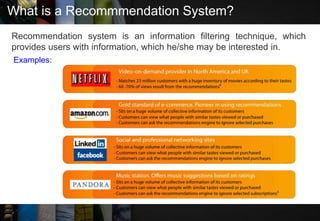
Recommendation system is an information filtering technique, which
provides users with information, which he/she may be interested in.
Examples:
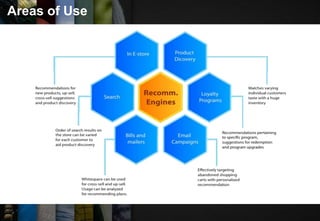
Areas of Use
Why there is a need?
“Getting Information off the internet is like taking a drink from a fire
hydrant” - Mitchell Kapor
- Information Overload
- User Experience
- Revenues
Recommender systems help in addressing the information overload
problem by retrieving the information desired by the user based on his or
similar users' preferences and interests.
Types of Recommendation System
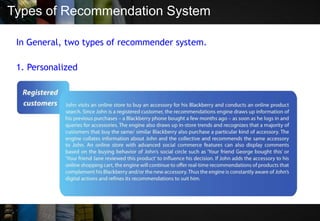
In General, two types of recommender system.
1. Personalized
Types... Cont'd
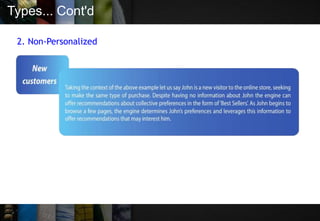
2. Non-Personalized
Types... cont'd
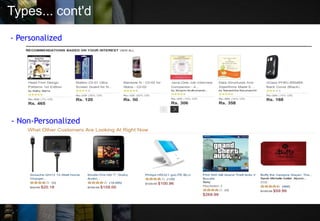
- Personalized
- Non-Personalized
Techniques : Data Acquisition
1. Explicit Data
- Customer Ratings
- Feedback
- Demographics
- Physiographics
- Ephemeral Needs
2. Implicit Data
- Purchase History
- Click or Browse History
3. Product Information
- Product Taxonomy
- Product Attributes
- Product Descriptions
Techniques : Recommendation Generation
1. Collaborative Filtering method finds a subset of users who have
similar tastes and preferences to the target user and use this subset for
offering recommendations.
Basic Assumptions :
- Users with similar interests have common preferences.
- Sufficiently large number of user preferences are available.
Main Approaches :
- User Based
- Item Based
Techniques : Recommendation Generation
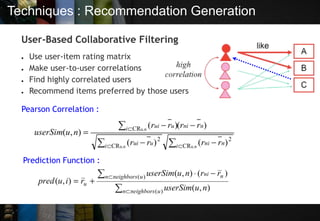
User-Based Collaborative Filtering
● Use user-item rating matrix
● Make user-to-user correlations
● Find highly correlated users
● Recommend items preferred by those users
Pearson Correlation :
Prediction Function :
Techniques : Recommendation Generation
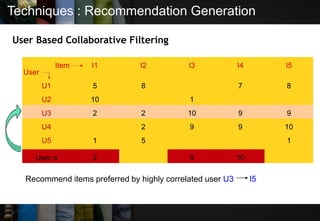
User Based Collaborative Filtering
Item
User
I1 I2 I3 I4 I5
U1 5 8 7 8
U2 10 1
U3 2 2 10 9 9
U4 2 9 9 10
U5 1 5 1
User a 2 9 10
Recommend items preferred by highly correlated user U3 I5
Techniques : Recommendation Generation
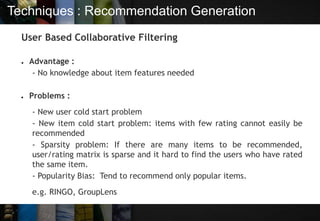
User Based Collaborative Filtering
● Advantage :
- No knowledge about item features needed
● Problems :
- New user cold start problem
- New item cold start problem: items with few rating cannot easily be
recommended
- Sparsity problem: If there are many items to be recommended,
user/rating matrix is sparse and it hard to find the users who have rated
the same item.
- Popularity Bias: Tend to recommend only popular items.
e.g. RINGO, GroupLens
Techniques : Recommendation Generation
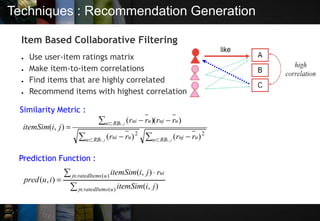
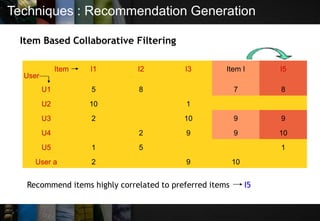
Item Based Collaborative Filtering
● Use user-item ratings matrix
● Make item-to-item correlations
● Find items that are highly correlated
● Recommend items with highest correlation
Similarity Metric :
Prediction Function :
Techniques : Recommendation Generation
Item Based Collaborative Filtering
Item
User
I1 I2 I3 Item I I5
U1 5 8 7 8
U2 10 1
U3 2 10 9 9
U4 2 9 9 10
U5 1 5 1
User a 2 9 10
Recommend items highly correlated to preferred items I5
Techniques : Recommendation Generation
Item Based Collaborative Filtering
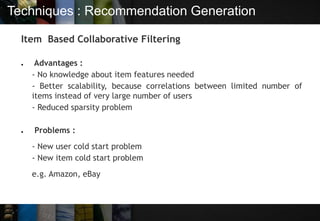
● Advantages :
- No knowledge about item features needed
- Better scalability, because correlations between limited number of
items instead of very large number of users
- Reduced sparsity problem
● Problems :
- New user cold start problem
- New item cold start problem
e.g. Amazon, eBay
Techniques : Recommendation Generation
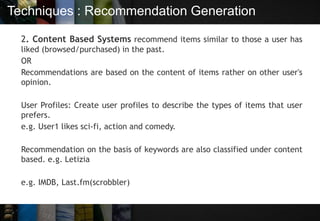
2. Content Based Systems recommend items similar to those a user has
liked (browsed/purchased) in the past.
OR
Recommendations are based on the content of items rather on other user's
opinion.
User Profiles: Create user profiles to describe the types of items that user
prefers.
e.g. User1 likes sci-fi, action and comedy.
Recommendation on the basis of keywords are also classified under content
based. e.g. Letizia
e.g. IMDB, Last.fm(scrobbler)
Techniques : Recommendation Generation
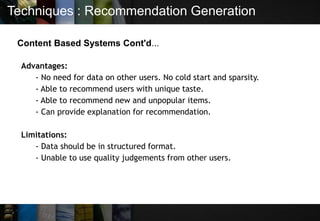
Content Based Systems Cont'd...
Advantages:
- No need for data on other users. No cold start and sparsity.
- Able to recommend users with unique taste.
- Able to recommend new and unpopular items.
- Can provide explanation for recommendation.
Limitations:
- Data should be in structured format.
- Unable to use quality judgements from other users.
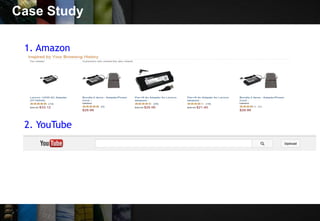
Case Study
1. Amazon
2. YouTube
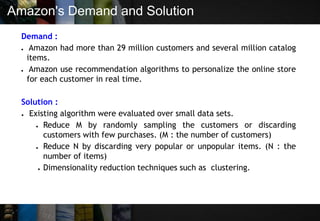
Amazon's Demand and Solution
Demand :
● Amazon had more than 29 million customers and several million catalog
items.
● Amazon use recommendation algorithms to personalize the online store
for each customer in real time.
Solution :
● Existing algorithm were evaluated over small data sets.
● Reduce M by randomly sampling the customers or discarding
customers with few purchases. (M : the number of customers)
● Reduce N by discarding very popular or unpopular items. (N : the
number of items)
● Dimensionality reduction techniques such as clustering.
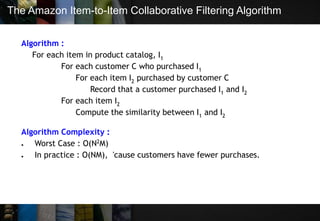
The Amazon Item-to-Item Collaborative Filtering Algorithm
Algorithm :
For each item in product catalog, I1
For each customer C who purchased I1
For each item I2 purchased by customer C
Record that a customer purchased I1 and I2
For each item I2
Compute the similarity between I1 and I2
Algorithm Complexity :
● Worst Case : O(N2M)
● In practice : O(NM), 'cause customers have fewer purchases.
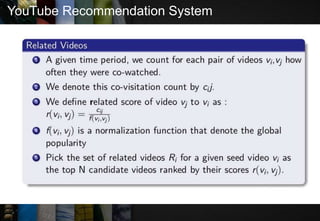
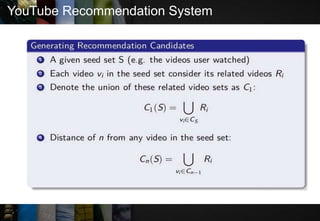
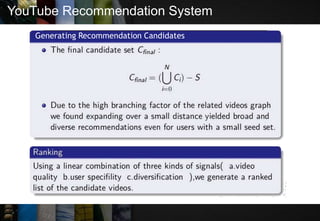
YouTube Recommendation System
Generating Recommendation Candidates
recommendation system a topic in marketing analytics

recommendation system a topic in marketing analytics

  • 1.
  • 2.
    What is aRecommmendation System? Recommendation system is an information filtering technique, which provides users with information, which he/she may be interested in. Examples:
  • 3.
  • 4.
    Why there isa need? “Getting Information off the internet is like taking a drink from a fire hydrant” - Mitchell Kapor - Information Overload - User Experience - Revenues Recommender systems help in addressing the information overload problem by retrieving the information desired by the user based on his or similar users' preferences and interests.
  • 5.
    Types of RecommendationSystem In General, two types of recommender system. 1. Personalized
  • 6.
  • 7.
  • 8.
    Techniques : DataAcquisition 1. Explicit Data - Customer Ratings - Feedback - Demographics - Physiographics - Ephemeral Needs 2. Implicit Data - Purchase History - Click or Browse History 3. Product Information - Product Taxonomy - Product Attributes - Product Descriptions
  • 9.
    Techniques : RecommendationGeneration 1. Collaborative Filtering method finds a subset of users who have similar tastes and preferences to the target user and use this subset for offering recommendations. Basic Assumptions : - Users with similar interests have common preferences. - Sufficiently large number of user preferences are available. Main Approaches : - User Based - Item Based
  • 10.
    Techniques : RecommendationGeneration User-Based Collaborative Filtering ● Use user-item rating matrix ● Make user-to-user correlations ● Find highly correlated users ● Recommend items preferred by those users Pearson Correlation : Prediction Function :
  • 11.
    Techniques : RecommendationGeneration User Based Collaborative Filtering Item User I1 I2 I3 I4 I5 U1 5 8 7 8 U2 10 1 U3 2 2 10 9 9 U4 2 9 9 10 U5 1 5 1 User a 2 9 10 Recommend items preferred by highly correlated user U3 I5
  • 12.
    Techniques : RecommendationGeneration User Based Collaborative Filtering ● Advantage : - No knowledge about item features needed ● Problems : - New user cold start problem - New item cold start problem: items with few rating cannot easily be recommended - Sparsity problem: If there are many items to be recommended, user/rating matrix is sparse and it hard to find the users who have rated the same item. - Popularity Bias: Tend to recommend only popular items. e.g. RINGO, GroupLens
  • 13.
    Techniques : RecommendationGeneration Item Based Collaborative Filtering ● Use user-item ratings matrix ● Make item-to-item correlations ● Find items that are highly correlated ● Recommend items with highest correlation Similarity Metric : Prediction Function :
  • 14.
    Techniques : RecommendationGeneration Item Based Collaborative Filtering Item User I1 I2 I3 Item I I5 U1 5 8 7 8 U2 10 1 U3 2 10 9 9 U4 2 9 9 10 U5 1 5 1 User a 2 9 10 Recommend items highly correlated to preferred items I5
  • 15.
    Techniques : RecommendationGeneration Item Based Collaborative Filtering ● Advantages : - No knowledge about item features needed - Better scalability, because correlations between limited number of items instead of very large number of users - Reduced sparsity problem ● Problems : - New user cold start problem - New item cold start problem e.g. Amazon, eBay
  • 16.
    Techniques : RecommendationGeneration 2. Content Based Systems recommend items similar to those a user has liked (browsed/purchased) in the past. OR Recommendations are based on the content of items rather on other user's opinion. User Profiles: Create user profiles to describe the types of items that user prefers. e.g. User1 likes sci-fi, action and comedy. Recommendation on the basis of keywords are also classified under content based. e.g. Letizia e.g. IMDB, Last.fm(scrobbler)
  • 17.
    Techniques : RecommendationGeneration Content Based Systems Cont'd... Advantages: - No need for data on other users. No cold start and sparsity. - Able to recommend users with unique taste. - Able to recommend new and unpopular items. - Can provide explanation for recommendation. Limitations: - Data should be in structured format. - Unable to use quality judgements from other users.
  • 18.
  • 19.
    Amazon's Demand andSolution Demand : ● Amazon had more than 29 million customers and several million catalog items. ● Amazon use recommendation algorithms to personalize the online store for each customer in real time. Solution : ● Existing algorithm were evaluated over small data sets. ● Reduce M by randomly sampling the customers or discarding customers with few purchases. (M : the number of customers) ● Reduce N by discarding very popular or unpopular items. (N : the number of items) ● Dimensionality reduction techniques such as clustering.
  • 20.
    The Amazon Item-to-ItemCollaborative Filtering Algorithm Algorithm : For each item in product catalog, I1 For each customer C who purchased I1 For each item I2 purchased by customer C Record that a customer purchased I1 and I2 For each item I2 Compute the similarity between I1 and I2 Algorithm Complexity : ● Worst Case : O(N2M) ● In practice : O(NM), 'cause customers have fewer purchases.
  • 21.
  • 22.
  • 23.