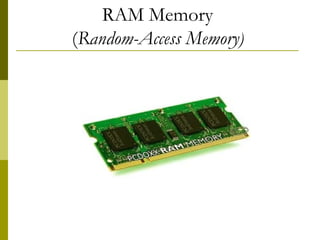
RAM Memory  ( Random-Access Memory )
Registered RAM  Module is a type often used in servers and equipment. They have integrated circuits  that are responsible to repeat the address  and control signals. The clock signals are  reconstructed using the PLL, which is  located on the module itself. The data  signals pass directly from the memory bus  to the RAM IC.
RAM Memory Usage  It is used as working memory for the operating system, programs and most of the software. This is where you load all the instructions that run the processor and other units of computation.
Relationship with the rest of the system  Within the hierarchy of the RAM memory is at a level after the processor registers and caches. It is a relatively fast memory and an average capacity: about 2010, it was easy to find memories at speeds over 1 GHz, and capacities up to 8 GB per module, coming to see memories passing the 3 Ghz barrier for this same date.
Memory Technologies  The current memory technology uses a sync signal for the read-write so that is always synchronized with a clock of the memory bus, unlike the older FPM and EDO memory that were asynchronous. More than a decade ago the industry opted for synchronous technologies, allowing to build integrated operating at a frequency above 66 MHz
What is RAM memory formed?  RAM modules are printed circuit boards with  silicon semiconductor soldiers, in the case of  SIMM type on, copper is used for the area  where the plug (your pin). As printed circuit  boards (such as motherboards or graphics  cards, etc), the RAM modules can be made  of fiberglass and other composites.

Ram memory

  • 1.
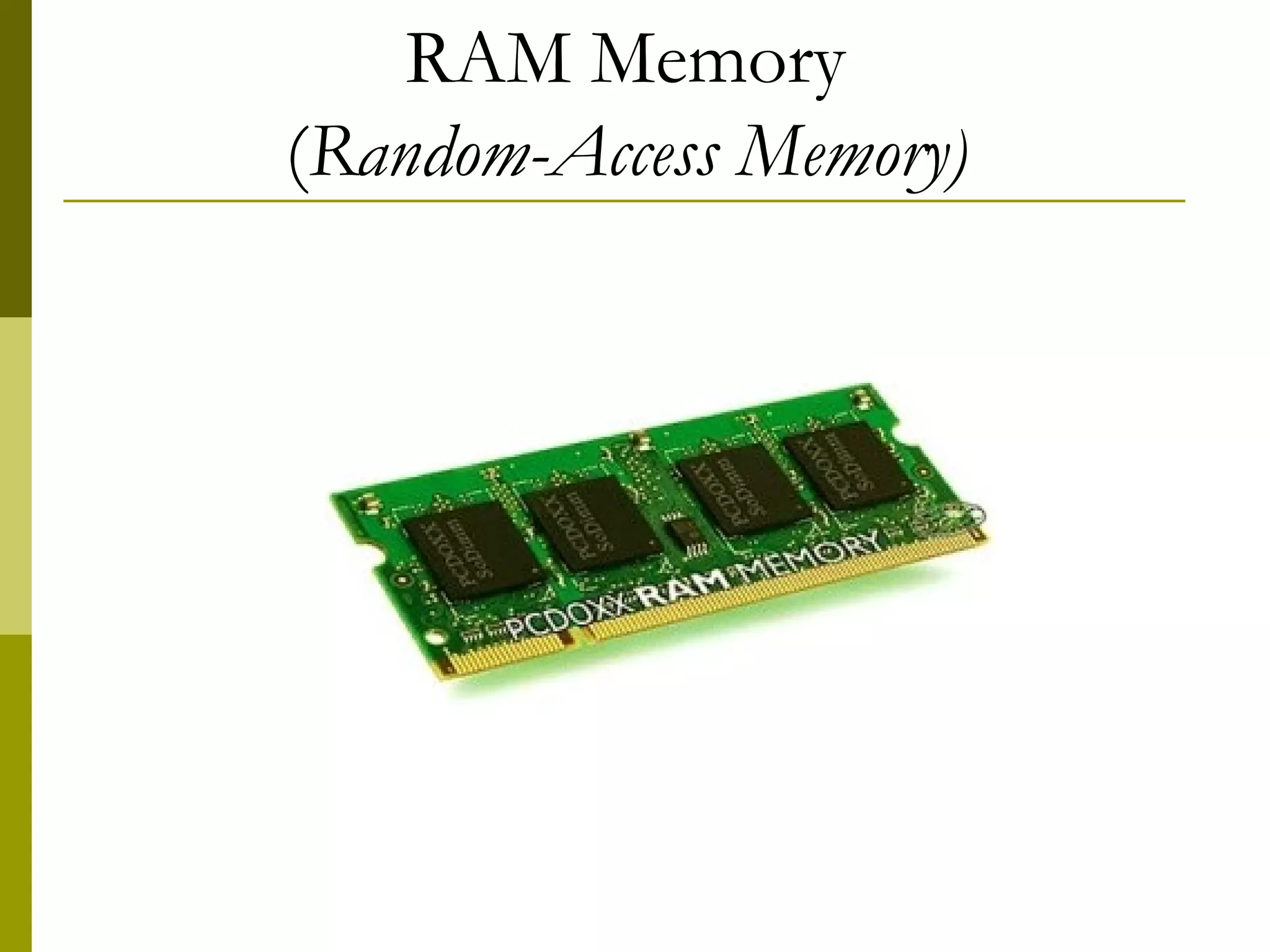
    RAM Memory  (Random-Access Memory )
  • 2.
    Registered RAM Module is a type often used in servers and equipment. They have integrated circuits that are responsible to repeat the address and control signals. The clock signals are reconstructed using the PLL, which is located on the module itself. The data signals pass directly from the memory bus to the RAM IC.
  • 3.
    RAM Memory Usage It is used as working memory for the operating system, programs and most of the software. This is where you load all the instructions that run the processor and other units of computation.
  • 4.
    Relationship with therest of the system Within the hierarchy of the RAM memory is at a level after the processor registers and caches. It is a relatively fast memory and an average capacity: about 2010, it was easy to find memories at speeds over 1 GHz, and capacities up to 8 GB per module, coming to see memories passing the 3 Ghz barrier for this same date.
  • 5.
    Memory Technologies The current memory technology uses a sync signal for the read-write so that is always synchronized with a clock of the memory bus, unlike the older FPM and EDO memory that were asynchronous. More than a decade ago the industry opted for synchronous technologies, allowing to build integrated operating at a frequency above 66 MHz
  • 6.
    What is RAMmemory formed? RAM modules are printed circuit boards with silicon semiconductor soldiers, in the case of SIMM type on, copper is used for the area where the plug (your pin). As printed circuit boards (such as motherboards or graphics cards, etc), the RAM modules can be made of fiberglass and other composites.