Yogita Saini
M.P.Ed
A3014915012
ASPESS
Amity University
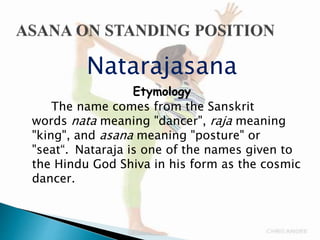
Natarajasana
Etymology
The name comes from the Sanskrit
words nata meaning "dancer", raja meaning
"king", and asana meaning "posture" or
"seat“. Nataraja is one of the names given to
the Hindu God Shiva in his form as the cosmic
dancer.
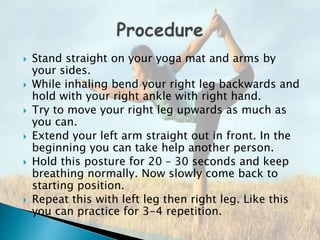
 Stand straight on your yoga mat and arms by
your sides.
 While inhaling bend your right leg backwards and
hold with your right ankle with right hand.
 Try to move your right leg upwards as much as
you can.
 Extend your left arm straight out in front. In the
beginning you can take help another person.
 Hold this posture for 20 – 30 seconds and keep
breathing normally. Now slowly come back to
starting position.
 Repeat this with left leg then right leg. Like this
you can practice for 3-4 repetition.
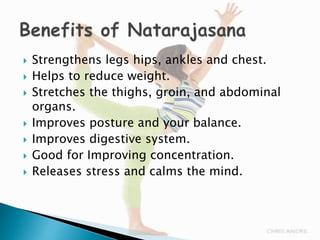
 Strengthens legs hips, ankles and chest.
 Helps to reduce weight.
 Stretches the thighs, groin, and abdominal
organs.
 Improves posture and your balance.
 Improves digestive system.
 Good for Improving concentration.
 Releases stress and calms the mind.
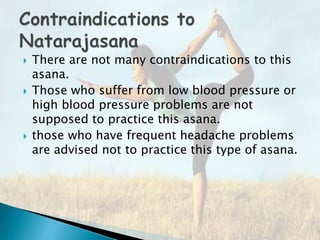
 There are not many contraindications to this
asana.
 Those who suffer from low blood pressure or
high blood pressure problems are not
supposed to practice this asana.
 those who have frequent headache problems
are advised not to practice this type of asana.
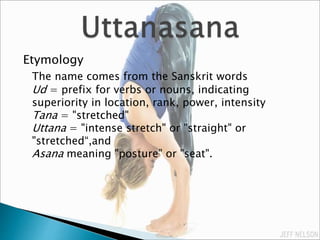
Etymology
The name comes from the Sanskrit words
Ud = prefix for verbs or nouns, indicating
superiority in location, rank, power, intensity
Tana = "stretched"
Uttana = "intense stretch" or "straight" or
"stretched“,and
Asana meaning "posture" or "seat".
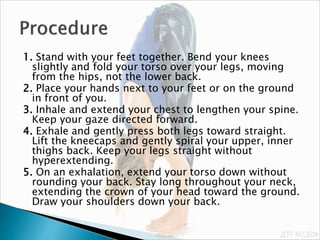
1. Stand with your feet together. Bend your knees
slightly and fold your torso over your legs, moving
from the hips, not the lower back.
2. Place your hands next to your feet or on the ground
in front of you.
3. Inhale and extend your chest to lengthen your spine.
Keep your gaze directed forward.
4. Exhale and gently press both legs toward straight.
Lift the kneecaps and gently spiral your upper, inner
thighs back. Keep your legs straight without
hyperextending.
5. On an exhalation, extend your torso down without
rounding your back. Stay long throughout your neck,
extending the crown of your head toward the ground.
Draw your shoulders down your back.
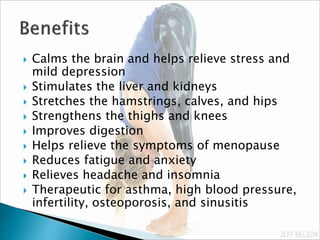
 Calms the brain and helps relieve stress and
mild depression
 Stimulates the liver and kidneys
 Stretches the hamstrings, calves, and hips
 Strengthens the thighs and knees
 Improves digestion
 Helps relieve the symptoms of menopause
 Reduces fatigue and anxiety
 Relieves headache and insomnia
 Therapeutic for asthma, high blood pressure,
infertility, osteoporosis, and sinusitis
This asana has been criticized by
some practitioners of kinesiology,
physical therapy, and others, who
recommend a seated rather than
standing forward bend.
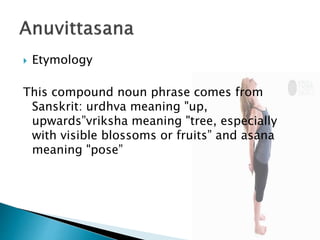
 Etymology
This compound noun phrase comes from
Sanskrit: urdhva meaning "up,
upwards”vriksha meaning "tree, especially
with visible blossoms or fruits” and asana
meaning "pose”
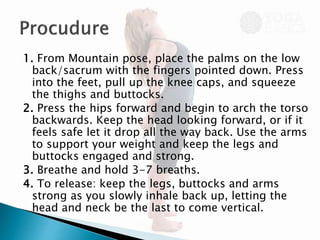
1. From Mountain pose, place the palms on the low
back/sacrum with the fingers pointed down. Press
into the feet, pull up the knee caps, and squeeze
the thighs and buttocks.
2. Press the hips forward and begin to arch the torso
backwards. Keep the head looking forward, or if it
feels safe let it drop all the way back. Use the arms
to support your weight and keep the legs and
buttocks engaged and strong.
3. Breathe and hold 3-7 breaths.
4. To release: keep the legs, buttocks and arms
strong as you slowly inhale back up, letting the
head and neck be the last to come vertical.
Benefits:-
Standing Backbend opens the front of the body, and
strengthens the respiratory, cardiovascular and
endocrine systems.
Contraindications:
Recent or chronic injury to the hips, back or neck.
Yoga standing posture Asana .. Ppt

Yoga standing posture Asana .. Ppt

  • 1.
  • 2.
    Natarajasana Etymology The name comesfrom the Sanskrit words nata meaning "dancer", raja meaning "king", and asana meaning "posture" or "seat“. Nataraja is one of the names given to the Hindu God Shiva in his form as the cosmic dancer.
  • 3.
     Stand straighton your yoga mat and arms by your sides.  While inhaling bend your right leg backwards and hold with your right ankle with right hand.  Try to move your right leg upwards as much as you can.  Extend your left arm straight out in front. In the beginning you can take help another person.  Hold this posture for 20 – 30 seconds and keep breathing normally. Now slowly come back to starting position.  Repeat this with left leg then right leg. Like this you can practice for 3-4 repetition.
  • 4.
     Strengthens legships, ankles and chest.  Helps to reduce weight.  Stretches the thighs, groin, and abdominal organs.  Improves posture and your balance.  Improves digestive system.  Good for Improving concentration.  Releases stress and calms the mind.
  • 5.
     There arenot many contraindications to this asana.  Those who suffer from low blood pressure or high blood pressure problems are not supposed to practice this asana.  those who have frequent headache problems are advised not to practice this type of asana.
  • 6.
    Etymology The name comesfrom the Sanskrit words Ud = prefix for verbs or nouns, indicating superiority in location, rank, power, intensity Tana = "stretched" Uttana = "intense stretch" or "straight" or "stretched“,and Asana meaning "posture" or "seat".
  • 7.
    1. Stand withyour feet together. Bend your knees slightly and fold your torso over your legs, moving from the hips, not the lower back. 2. Place your hands next to your feet or on the ground in front of you. 3. Inhale and extend your chest to lengthen your spine. Keep your gaze directed forward. 4. Exhale and gently press both legs toward straight. Lift the kneecaps and gently spiral your upper, inner thighs back. Keep your legs straight without hyperextending. 5. On an exhalation, extend your torso down without rounding your back. Stay long throughout your neck, extending the crown of your head toward the ground. Draw your shoulders down your back.
  • 8.
     Calms thebrain and helps relieve stress and mild depression  Stimulates the liver and kidneys  Stretches the hamstrings, calves, and hips  Strengthens the thighs and knees  Improves digestion  Helps relieve the symptoms of menopause  Reduces fatigue and anxiety  Relieves headache and insomnia  Therapeutic for asthma, high blood pressure, infertility, osteoporosis, and sinusitis
  • 9.
    This asana hasbeen criticized by some practitioners of kinesiology, physical therapy, and others, who recommend a seated rather than standing forward bend.
  • 10.
     Etymology This compoundnoun phrase comes from Sanskrit: urdhva meaning "up, upwards”vriksha meaning "tree, especially with visible blossoms or fruits” and asana meaning "pose”
  • 11.
    1. From Mountainpose, place the palms on the low back/sacrum with the fingers pointed down. Press into the feet, pull up the knee caps, and squeeze the thighs and buttocks. 2. Press the hips forward and begin to arch the torso backwards. Keep the head looking forward, or if it feels safe let it drop all the way back. Use the arms to support your weight and keep the legs and buttocks engaged and strong. 3. Breathe and hold 3-7 breaths. 4. To release: keep the legs, buttocks and arms strong as you slowly inhale back up, letting the head and neck be the last to come vertical.
  • 12.
    Benefits:- Standing Backbend opensthe front of the body, and strengthens the respiratory, cardiovascular and endocrine systems. Contraindications: Recent or chronic injury to the hips, back or neck.