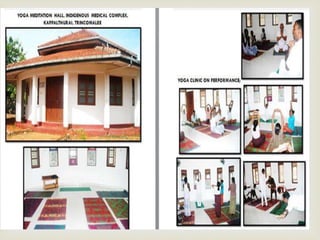
Yoga Meditation Centre,
Kappalthurai,
Trincomalee,
Sri Lanka.

Dr. (Mrs). S. Thusitha (MD-S),
MA (Yoga)
Dr. S. R. Pholtan Rajeev
(BSMS) (Hon.), Spe. Trained in
Yoga

YOGA is a Sanskrit word meaning UNION.
Yoga involves;
 body posture –Asanas
 controlled breathing
 meditation
 repeated recital - mantras
What is YOGA

 PHYSICAL HATHA YOGA
 MENTAL RAJA YOGA
 EMOTIONAL BHAKTI YOGA
 INTELLECTUAL JNANA YOGA
 SPIRITUAL BASIS KARMA YOGA
Types of YOGA

TRAINING IN YOGA FOR
@ PERSONALITY GROWTH
@ PREVENTION OF DISEASES
@ PRODUCTIVE EFFICIENCY
Purpose of YOGA

Treatment
Long term rehabilitation
Promotion of positive health
by
IAYT -Integration of Ayurveda
& Yoga Therapy
HEALTH - PREVENTION

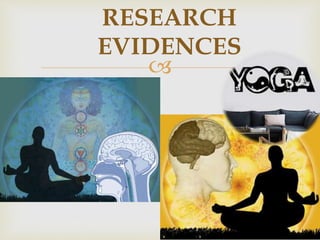
RESEARCH
EVIDENCES

 Evaluation of effect of some Hatha yogic Exercises on primary and
secondary Hypertension with special reference to Body Immunity
 Coronary Atherosclerosis Reversal Potential of Yoga Lifestyle Intervention
 Integrated Approach of Yoga Therapy for Stress Related Ailments
 Understanding the Neuro-dynamical Complexities of meditative process
from the EEG signal
 Integrated Approach of Yoga Therapy in the Management of Cancer 42
 Uni-Nostril Yoga breathing and Obesity: A study of Efficacy and
Mechanisms
 To study the Efficacy of Yoga and Naturopathy in the Management of
Withdrawal Symptoms of Drug Dependents, etc..
(Deptt. of AYUSH, Ministry of Health & F.W., Government of India)
61-65, Institutional Area, Janakpuri, New Delhi - 110 058
E-mail: ccryn@vsnl.net Website: www.ccryn.org
Research Publication No. 2
CLINICAL RESEARCH PROFILE
CENTRAL COUNCIL FOR RESEARCH IN YOGA &
NATUROPATHY

THE HEALTH BENEFITS
OF YOGA
It begins by working with the body on a
structural level.
Yogic practices stimulate & balance all the
systems of the body.
A few month practice of yoga triggers
neurohormonal mechanisms that bring health
benefits.

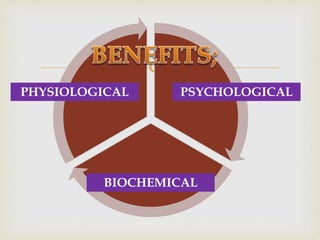
PHYSIOLOGICAL PSYCHOLOGICAL
BIOCHEMICAL

Effects on the Nervous System
Effects on the CVS
Effects on Respiratory System
Effects on Metabolic Rate
Effects on Skeleto-muscular System
Effects on Digestive System
PHYSIOLOGICAL
Benefits

Bring stable automomic nervous system equilibrium
with a tendency toward parasympathetic nervous
system dominance.
This result in;
Decrease in normal range of Heart Rate, BP, RR
Improvement in GIT & excretory functions, sexual
activity,
favours storage of absorbed nutrients
Electric Dermal Response (EDR)
Effects on the Nervous
System

EEG Predominance of alpha waves; theta,
delta & beta waves also increases. This
indicates a more relaxed state of mind &
result in:
 Sensory attenuation
 i.e minimal sensory input (less distraction, better
concentration & pain decreases)
 Motor attenuation
 i.e minimal motor input (comfortable posture)

Higher function of the nervous system
 Improvement of higher intellectual activities –
emotional affects, motivation, behavior, learning
efficiency, personality, memory, moral& social
sense etc.
 Improvement in cerebral blood flow with
synchronized neuronal activity
 Depth perception & critical fusion frequency
improves, indicating reduced fatigue & stress
level.

Heart rate & systemic BP decreases
Cardiovascular efficiency increases
 A given level of exercise is associated with a
smaller increase in above parameters. This may be
attributed to increase baro-reflex sensitivity.
Effects on the CVS
Respiratory Rate decreases
Tidal volume increases
Vital capacity increases
Breath holding time increases
Maximum breathing capacity (MBC) increases
Respiratory efficiency increases & respiration
become more smooth
 Mechanism: parasympathetic nervous system
dominance with decrease in sympathetic activity.
Effects on Respiratory
System

It slow down metabolism by decreasing the
oxygen consumption.
 The fall in the metabolic rate is much greater &
more steep than during sleep. There is no fall in
the internal body temperature.
Higher maximum oxygen consumption can
be achieved due to increase in cardio-
respiratory efficiency.
Effects on Metabolic
Rate

 Musculo-Skeletal flexibility & joint range of
movement increases
 Strength & resiliency increases
 Endurance increases
 Energy level increases
Effects on Skeleto-
muscular System

 Yoga helps digestion by;
 Increase blood flow to GIT
 Stimulate peristalsis
 Relax digestive system & leads to more effective
elimination
Effects on Digestive
System

Somatic & kinesthetis awareness increases
Mood improves & subjective well being
increases
Social adjustment increases
Anxiety & depression decreases
Hostility decreases
Psychomotor functions improves.
PSYCHOLOGICAL
Benefits

Psychomotor functions improves such
as;
Grip strength increases
Fine skill movements improves
Endurance increases
Integrated functions of body parts
improves

 This profile improves indicating an anti-stress &
antioxidant effect important in the prevention of
degeneration diseases.
 Heamatocrit, Hb and lymphocyte count increses
 Total serum protein & vitamin C increases
 Glucose & sodium levels decreases.
 Lipid profile;
 Total Cholesterol, Triglycerides, LDL & VLDL are
decreses, HDL increases.
BIOCHEMICAL Benefits

YOGA IN HEALTH &
DISEASES

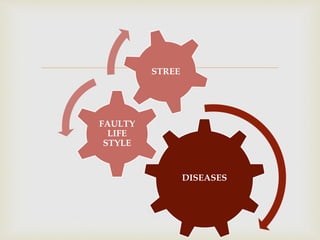
DISEASES
FAULTY
LIFE
STYLE
STREE

Yoga is helpful in the management of obesity
Mechanism;
 By simple excess calorie expenditure
 Life style modification
 Improvement in dietary habits
 Positive body-mind equilibrium
OBESITY & Body Weight

 A short period (03months) of regular yogic practice for
01hr / day is effective in controlling blood pressure.
Mechanism;
 restoration of baroreflex sensitivity with autonomic
readjustments.
 Progressive reduction of sympatho-adrenal &
rennin-angiotension activity.
HYPERTENSION

 Reduced heart rate variability & baroreflex
sensitivity are powerful predictors of CAD / IHD
Mechanism;
 slow breathing yogic exercises with mantras
increases HR variability & baroreflex sensitivity
by re-synchroning inherent cardiovascular
rhythms. This also decreases RR interval in
ECG, reduces both systolic & diastolic BP.
 improve serum lipid profile in IHD pt.
Coronary Artery Disease (CAD) /
Ischaemic Heart Disease (IHD)

 Yoga help in the reduction of sympathetic
activity with reduction in heart rate, Oxygen
consumption & increase tidal volume. >>>
protection IHD & Myocardial Infarction.
 Yoga exercise increases regression & retards
progression of atherosclerosis in CAD.
 Lipid lowering & plaque-stabilizing effects of
yoga exercise seems to be similar to that of
statin drugs.
 Yoga is also shown to have the ability to
control the sympathetic overdrive thus
mimicking beta blockade.

YOGA exercise tone & shape the body,
improve posture & circulation & contribute
to feeling of well-being.
Mechanism;
 Neurohormonal modulation involving
insulin & glucagon activity.
DIABETES MELLITUS

Asanas strengthen back muscles & relieve
backache.
They also help reliving muscular spasm by
increasing flexibility, decrease in body
weight & stress, & producing relaxation of
the body as a whole.
SKELETO-MUSCULAR
disorders

What type of cancer you have, and your
physical abilities; yogic practice will be
specific help to move in a positive direction.
Yoga helps an adjunct to medical treatment by;
 Ease the symptoms
 Give more energy
 Calm the mind
 Give tools for accepting, loving & motivation.
CANCER Recovery

Yoga practice has been long used for stress
reduction as well as for prevention &
treatment of psychological disturbances.
Yogic exercises & relaxation improve
insomnia, tension headache & irritable bowel
or bladder.
Psychiatric disturbances
YOGA
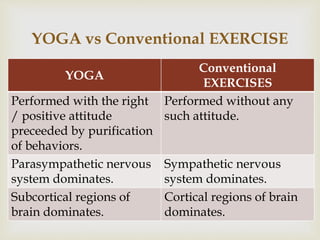
Conventional
EXERCISES
Performed with the right
/ positive attitude
preceeded by purification
of behaviors.
Performed without any
such attitude.
Parasympathetic nervous
system dominates.
Sympathetic nervous
system dominates.
Subcortical regions of
brain dominates.
Cortical regions of brain
dominates.
YOGA vs Conventional EXERCISE

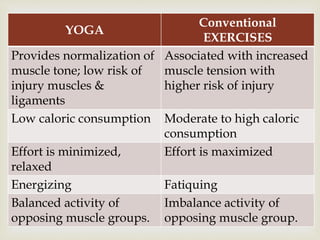
YOGA
Conventional
EXERCISES
Provides normalization of
muscle tone; low risk of
injury muscles &
ligaments
Associated with increased
muscle tension with
higher risk of injury
Low caloric consumption Moderate to high caloric
consumption
Effort is minimized,
relaxed
Effort is maximized
Energizing Fatiquing
Balanced activity of
opposing muscle groups.
Imbalance activity of
opposing muscle group.

YOGA
Conventional
EXERCISES
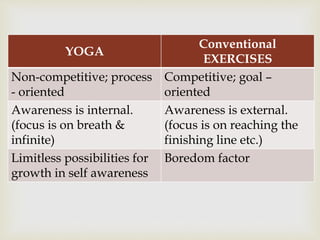
Non-competitive; process
- oriented
Competitive; goal –
oriented
Awareness is internal.
(focus is on breath &
infinite)
Awareness is external.
(focus is on reaching the
finishing line etc.)
Limitless possibilities for
growth in self awareness
Boredom factor

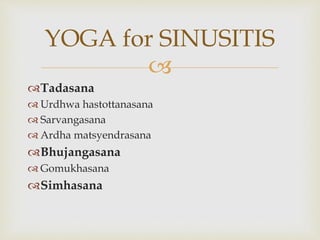
Tadasana
 Urdhwa hastottanasana
 Sarvangasana
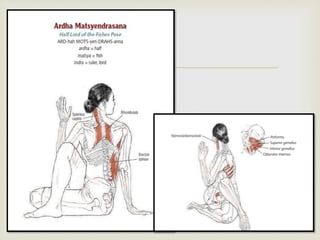
 Ardha matsyendrasana
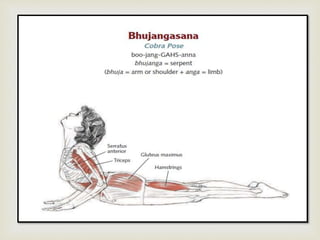
Bhujangasana
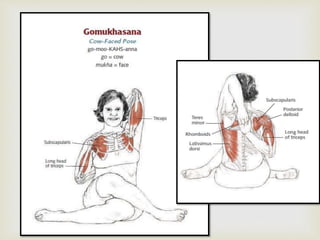
 Gomukhasana
Simhasana
YOGA for SINUSITIS

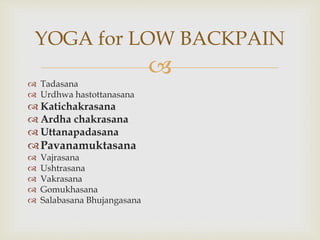
 Tadasana
 Urdhwa hastottanasana
 Katichakrasana
 Ardha chakrasana
 Uttanapadasana
Pavanamuktasana
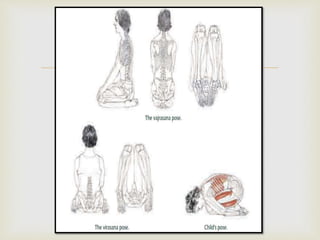
 Vajrasana
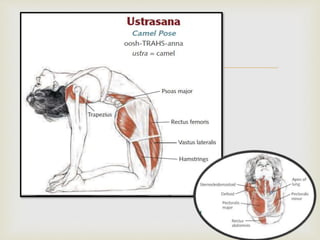
 Ushtrasana
 Vakrasana
 Gomukhasana
 Salabasana Bhujangasana
YOGA for LOW BACKPAIN

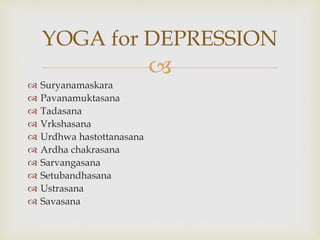
 Suryanamaskara
 Pavanamuktasana
 Tadasana
 Vrkshasana
 Urdhwa hastottanasana
 Ardha chakrasana
 Sarvangasana
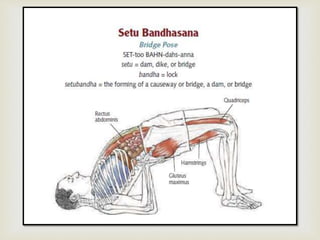
 Setubandhasana
 Ustrasana
 Savasana
YOGA for DEPRESSION

 Tadasana
 Katichakrasana
 Uttanapadasana
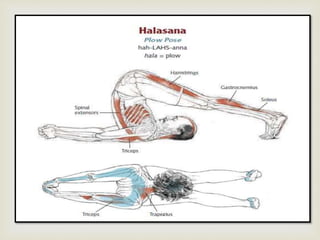
Ardhahalasana
 Pavanamuktasana
 Ustrasana
 Gomukhasana
Vakrasana
 Bhujangasana
 Makarasana
Shavasana
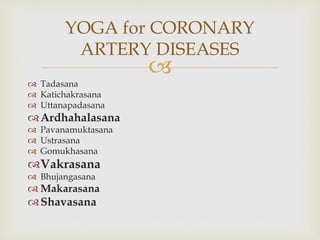
YOGA for CORONARY
ARTERY DISEASES

 Tadasana
 Vrkshasana
 Uttanapadasana
Pavanamuktasana
Sarvangasana
 Vajrasana
 Vakrasana
 Ustrasana
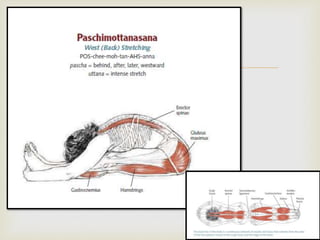
 Pascimottasana
 Ardhamatsyendrasana
 Bhujangasana
 Makarasana
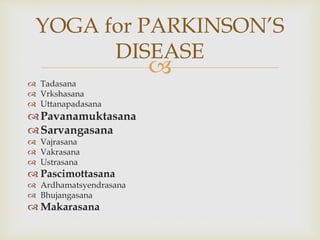
YOGA for PARKINSON’S
DISEASE
Tadasana
 Urdhwahastottanasana
 Katichakrasana
 Uttanapadasana
 Pavanamuktasana
Vajrasana
 Gomukhashana
 Ustrasana
 Vakrasana
 Ardhamatsyendrasana
 Bhujangasana
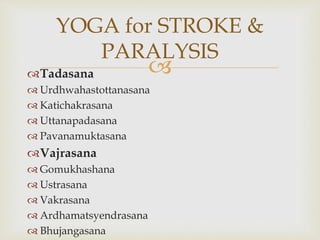
YOGA for STROKE &
PARALYSIS

 Tadasana
Uttanapadasana
Pavanamuktasana
Sarvangasana
Ardha matsendrasana
Ushtrasana
 Vakrasana
 Gomukhasana
 Salabasana Bhujangasana
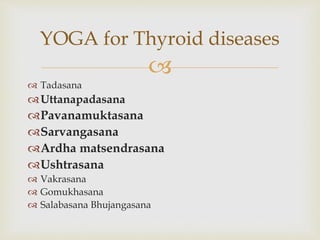
YOGA for Thyroid diseases

Uttanapadasana b
Pavanamuktasana b
Purvaddasana f
Sedhubanthasana f
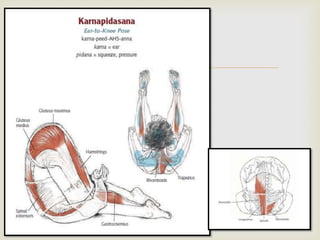
Karnapedasana / Lingasana m
 Vajrasana
 Ushtrasana
 Vakrasana
Salabasana b
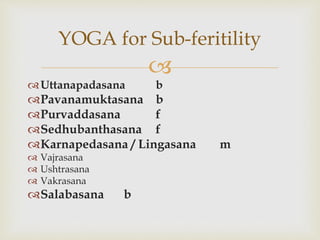
YOGA for Sub-feritility

 Tadasana
 Urdhwa hastottanasana
Ardha chakrasana
Uttanapadasana
Pavanamuktasana
 Vajrasana
 Gomukhasana
Bhujangasana
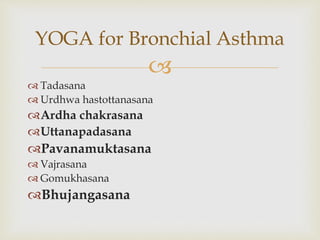
YOGA for Bronchial Asthma


Effective
management
on Clinical
Problems by
Hatha Yoga

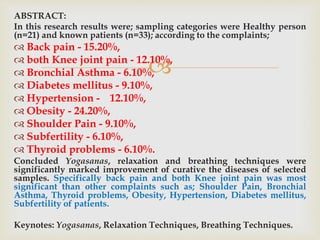
ABSTRACT:
In this research results were; sampling categories were Healthy person
(n=21) and known patients (n=33); according to the complaints;
 Back pain - 15.20%,
 both Knee joint pain - 12.10%,
 Bronchial Asthma - 6.10%,
 Diabetes mellitus - 9.10%,
 Hypertension - 12.10%,
 Obesity - 24.20%,
 Shoulder Pain - 9.10%,
 Subfertility - 6.10%,
 Thyroid problems - 6.10%.
Concluded Yogasanas, relaxation and breathing techniques were
significantly marked improvement of curative the diseases of selected
samples. Specifically back pain and both Knee joint pain was most
significant than other complaints such as; Shoulder Pain, Bronchial
Asthma, Thyroid problems, Obesity, Hypertension, Diabetes mellitus,
Subfertility of patients.
Keynotes: Yogasanas, Relaxation Techniques, Breathing Techniques.

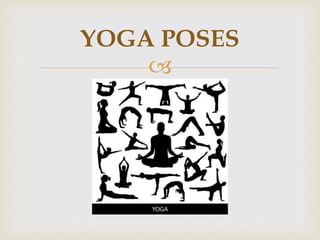
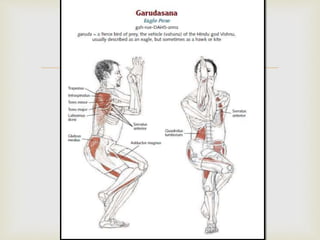
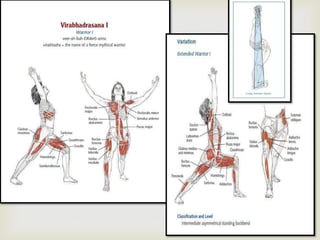
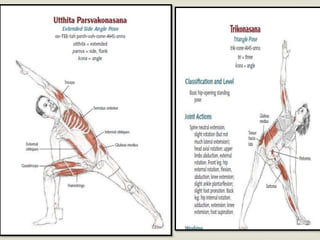
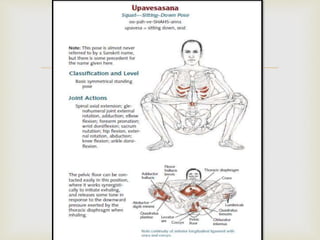
YOGA POSES

STANDING POSES
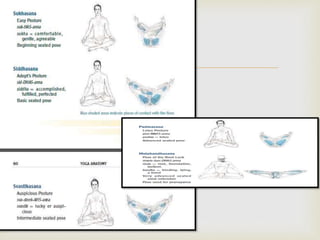
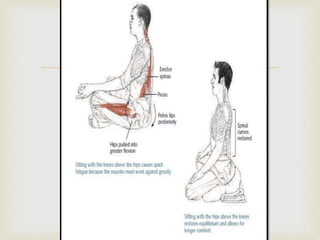
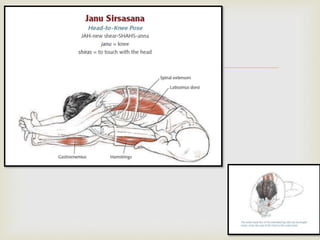
SITTING POSES
SUPINE POSES
PRONE POSES

STANDING POSES

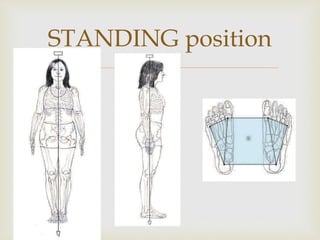
STANDING position







SITTING POSES















SUPINE POSES











PRONE POSES






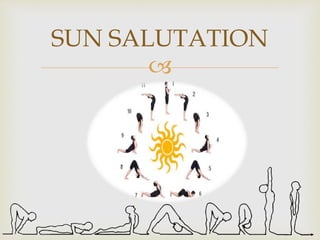
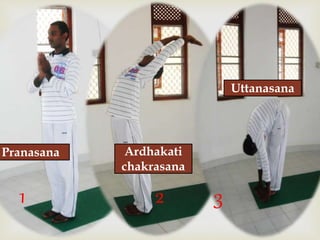
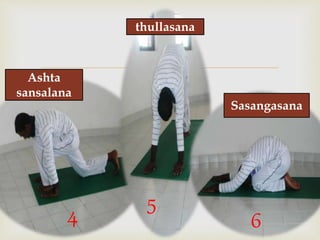
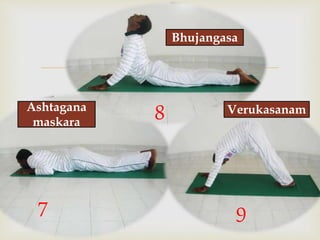
SUN SALUTATION

1 2 3
Pranasana Ardhakati
chakrasana
Uttanasana

4 5
6
Sasangasana
Ashta
sansalana
thullasana

7
8
9
Verukasanam
Bhujangasa
Ashtagana
maskara

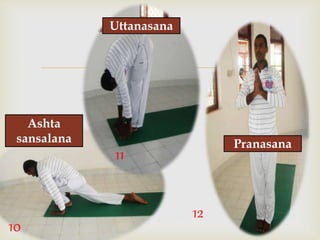
10
11
12
Pranasana
Uttanasana
Ashta
sansalana

 PRANAYAMA is the science of proper breathing.
 Breath is the main source of nourishment for all the
cells of the body.
 The main purpose of pranayama is to gain control
over the Autonomous Nervous System & through it
to influence the mental functions.
 It involves;
 slow deep inspiration
 Holding breath
 Near complete expiration.
PRANAYAMA

Suryabhedena
Ujjayi
Sheetkari
Sheetali
Bhramari
Bhastrika
Moorcha
Plavani
Types of pranayama;

Regular practice of pranayama can
modulate the sensitivity of chemo-
receptors & also makes mind calm &
quiet.
Benefit of pranayama;

Main; nadishodhana / nadisuthi
Benefits;
 calm mind, improve focus & concentration.
 Balances left & right hemispheres.
 Strengthens the immune system.
 Provide sufficient oxygen for the
functioning of every cell in our body.


Thank
YOGA
today!

Yoga present

  • 1.
  • 2.
     Dr. (Mrs). S.Thusitha (MD-S), MA (Yoga) Dr. S. R. Pholtan Rajeev (BSMS) (Hon.), Spe. Trained in Yoga
  • 3.
     YOGA is aSanskrit word meaning UNION. Yoga involves;  body posture –Asanas  controlled breathing  meditation  repeated recital - mantras What is YOGA
  • 4.
      PHYSICAL HATHAYOGA  MENTAL RAJA YOGA  EMOTIONAL BHAKTI YOGA  INTELLECTUAL JNANA YOGA  SPIRITUAL BASIS KARMA YOGA Types of YOGA
  • 5.
     TRAINING IN YOGAFOR @ PERSONALITY GROWTH @ PREVENTION OF DISEASES @ PRODUCTIVE EFFICIENCY Purpose of YOGA
  • 6.
     Treatment Long term rehabilitation Promotionof positive health by IAYT -Integration of Ayurveda & Yoga Therapy HEALTH - PREVENTION
  • 7.
  • 8.
  • 9.
     Evaluation ofeffect of some Hatha yogic Exercises on primary and secondary Hypertension with special reference to Body Immunity  Coronary Atherosclerosis Reversal Potential of Yoga Lifestyle Intervention  Integrated Approach of Yoga Therapy for Stress Related Ailments  Understanding the Neuro-dynamical Complexities of meditative process from the EEG signal  Integrated Approach of Yoga Therapy in the Management of Cancer 42  Uni-Nostril Yoga breathing and Obesity: A study of Efficacy and Mechanisms  To study the Efficacy of Yoga and Naturopathy in the Management of Withdrawal Symptoms of Drug Dependents, etc.. (Deptt. of AYUSH, Ministry of Health & F.W., Government of India) 61-65, Institutional Area, Janakpuri, New Delhi - 110 058 E-mail: ccryn@vsnl.net Website: www.ccryn.org Research Publication No. 2 CLINICAL RESEARCH PROFILE CENTRAL COUNCIL FOR RESEARCH IN YOGA & NATUROPATHY
  • 10.
     THE HEALTH BENEFITS OFYOGA It begins by working with the body on a structural level. Yogic practices stimulate & balance all the systems of the body. A few month practice of yoga triggers neurohormonal mechanisms that bring health benefits.
  • 11.
  • 12.
     Effects on theNervous System Effects on the CVS Effects on Respiratory System Effects on Metabolic Rate Effects on Skeleto-muscular System Effects on Digestive System PHYSIOLOGICAL Benefits
  • 13.
     Bring stable automomicnervous system equilibrium with a tendency toward parasympathetic nervous system dominance. This result in; Decrease in normal range of Heart Rate, BP, RR Improvement in GIT & excretory functions, sexual activity, favours storage of absorbed nutrients Electric Dermal Response (EDR) Effects on the Nervous System
  • 14.
     EEG Predominance ofalpha waves; theta, delta & beta waves also increases. This indicates a more relaxed state of mind & result in:  Sensory attenuation  i.e minimal sensory input (less distraction, better concentration & pain decreases)  Motor attenuation  i.e minimal motor input (comfortable posture)
  • 15.
     Higher function ofthe nervous system  Improvement of higher intellectual activities – emotional affects, motivation, behavior, learning efficiency, personality, memory, moral& social sense etc.  Improvement in cerebral blood flow with synchronized neuronal activity  Depth perception & critical fusion frequency improves, indicating reduced fatigue & stress level.
  • 16.
     Heart rate &systemic BP decreases Cardiovascular efficiency increases  A given level of exercise is associated with a smaller increase in above parameters. This may be attributed to increase baro-reflex sensitivity. Effects on the CVS
  • 17.
    Respiratory Rate decreases Tidalvolume increases Vital capacity increases Breath holding time increases Maximum breathing capacity (MBC) increases Respiratory efficiency increases & respiration become more smooth  Mechanism: parasympathetic nervous system dominance with decrease in sympathetic activity. Effects on Respiratory System
  • 18.
     It slow downmetabolism by decreasing the oxygen consumption.  The fall in the metabolic rate is much greater & more steep than during sleep. There is no fall in the internal body temperature. Higher maximum oxygen consumption can be achieved due to increase in cardio- respiratory efficiency. Effects on Metabolic Rate
  • 19.
      Musculo-Skeletal flexibility& joint range of movement increases  Strength & resiliency increases  Endurance increases  Energy level increases Effects on Skeleto- muscular System
  • 20.
      Yoga helpsdigestion by;  Increase blood flow to GIT  Stimulate peristalsis  Relax digestive system & leads to more effective elimination Effects on Digestive System
  • 21.
     Somatic & kinesthetisawareness increases Mood improves & subjective well being increases Social adjustment increases Anxiety & depression decreases Hostility decreases Psychomotor functions improves. PSYCHOLOGICAL Benefits
  • 22.
     Psychomotor functions improvessuch as; Grip strength increases Fine skill movements improves Endurance increases Integrated functions of body parts improves
  • 23.
      This profileimproves indicating an anti-stress & antioxidant effect important in the prevention of degeneration diseases.  Heamatocrit, Hb and lymphocyte count increses  Total serum protein & vitamin C increases  Glucose & sodium levels decreases.  Lipid profile;  Total Cholesterol, Triglycerides, LDL & VLDL are decreses, HDL increases. BIOCHEMICAL Benefits
  • 24.
  • 25.
  • 26.
     Yoga is helpfulin the management of obesity Mechanism;  By simple excess calorie expenditure  Life style modification  Improvement in dietary habits  Positive body-mind equilibrium OBESITY & Body Weight
  • 27.
      A shortperiod (03months) of regular yogic practice for 01hr / day is effective in controlling blood pressure. Mechanism;  restoration of baroreflex sensitivity with autonomic readjustments.  Progressive reduction of sympatho-adrenal & rennin-angiotension activity. HYPERTENSION
  • 28.
      Reduced heartrate variability & baroreflex sensitivity are powerful predictors of CAD / IHD Mechanism;  slow breathing yogic exercises with mantras increases HR variability & baroreflex sensitivity by re-synchroning inherent cardiovascular rhythms. This also decreases RR interval in ECG, reduces both systolic & diastolic BP.  improve serum lipid profile in IHD pt. Coronary Artery Disease (CAD) / Ischaemic Heart Disease (IHD)
  • 29.
      Yoga helpin the reduction of sympathetic activity with reduction in heart rate, Oxygen consumption & increase tidal volume. >>> protection IHD & Myocardial Infarction.  Yoga exercise increases regression & retards progression of atherosclerosis in CAD.  Lipid lowering & plaque-stabilizing effects of yoga exercise seems to be similar to that of statin drugs.  Yoga is also shown to have the ability to control the sympathetic overdrive thus mimicking beta blockade.
  • 30.
     YOGA exercise tone& shape the body, improve posture & circulation & contribute to feeling of well-being. Mechanism;  Neurohormonal modulation involving insulin & glucagon activity. DIABETES MELLITUS
  • 31.
     Asanas strengthen backmuscles & relieve backache. They also help reliving muscular spasm by increasing flexibility, decrease in body weight & stress, & producing relaxation of the body as a whole. SKELETO-MUSCULAR disorders
  • 32.
     What type ofcancer you have, and your physical abilities; yogic practice will be specific help to move in a positive direction. Yoga helps an adjunct to medical treatment by;  Ease the symptoms  Give more energy  Calm the mind  Give tools for accepting, loving & motivation. CANCER Recovery
  • 33.
     Yoga practice hasbeen long used for stress reduction as well as for prevention & treatment of psychological disturbances. Yogic exercises & relaxation improve insomnia, tension headache & irritable bowel or bladder. Psychiatric disturbances
  • 34.
    YOGA Conventional EXERCISES Performed with theright / positive attitude preceeded by purification of behaviors. Performed without any such attitude. Parasympathetic nervous system dominates. Sympathetic nervous system dominates. Subcortical regions of brain dominates. Cortical regions of brain dominates. YOGA vs Conventional EXERCISE
  • 35.
     YOGA Conventional EXERCISES Provides normalization of muscletone; low risk of injury muscles & ligaments Associated with increased muscle tension with higher risk of injury Low caloric consumption Moderate to high caloric consumption Effort is minimized, relaxed Effort is maximized Energizing Fatiquing Balanced activity of opposing muscle groups. Imbalance activity of opposing muscle group.
  • 36.
     YOGA Conventional EXERCISES Non-competitive; process - oriented Competitive;goal – oriented Awareness is internal. (focus is on breath & infinite) Awareness is external. (focus is on reaching the finishing line etc.) Limitless possibilities for growth in self awareness Boredom factor
  • 37.
     Tadasana  Urdhwa hastottanasana Sarvangasana  Ardha matsyendrasana Bhujangasana  Gomukhasana Simhasana YOGA for SINUSITIS
  • 38.
      Tadasana  Urdhwahastottanasana  Katichakrasana  Ardha chakrasana  Uttanapadasana Pavanamuktasana  Vajrasana  Ushtrasana  Vakrasana  Gomukhasana  Salabasana Bhujangasana YOGA for LOW BACKPAIN
  • 39.
      Suryanamaskara  Pavanamuktasana Tadasana  Vrkshasana  Urdhwa hastottanasana  Ardha chakrasana  Sarvangasana  Setubandhasana  Ustrasana  Savasana YOGA for DEPRESSION
  • 40.
      Tadasana  Katichakrasana Uttanapadasana Ardhahalasana  Pavanamuktasana  Ustrasana  Gomukhasana Vakrasana  Bhujangasana  Makarasana Shavasana YOGA for CORONARY ARTERY DISEASES
  • 41.
      Tadasana  Vrkshasana Uttanapadasana Pavanamuktasana Sarvangasana  Vajrasana  Vakrasana  Ustrasana  Pascimottasana  Ardhamatsyendrasana  Bhujangasana  Makarasana YOGA for PARKINSON’S DISEASE
  • 42.
    Tadasana  Urdhwahastottanasana  Katichakrasana Uttanapadasana  Pavanamuktasana Vajrasana  Gomukhashana  Ustrasana  Vakrasana  Ardhamatsyendrasana  Bhujangasana YOGA for STROKE & PARALYSIS
  • 43.
      Tadasana Uttanapadasana Pavanamuktasana Sarvangasana Ardha matsendrasana Ushtrasana Vakrasana  Gomukhasana  Salabasana Bhujangasana YOGA for Thyroid diseases
  • 44.
     Uttanapadasana b Pavanamuktasana b Purvaddasanaf Sedhubanthasana f Karnapedasana / Lingasana m  Vajrasana  Ushtrasana  Vakrasana Salabasana b YOGA for Sub-feritility
  • 45.
      Tadasana  Urdhwahastottanasana Ardha chakrasana Uttanapadasana Pavanamuktasana  Vajrasana  Gomukhasana Bhujangasana YOGA for Bronchial Asthma
  • 46.
  • 47.
  • 48.
     ABSTRACT: In this researchresults were; sampling categories were Healthy person (n=21) and known patients (n=33); according to the complaints;  Back pain - 15.20%,  both Knee joint pain - 12.10%,  Bronchial Asthma - 6.10%,  Diabetes mellitus - 9.10%,  Hypertension - 12.10%,  Obesity - 24.20%,  Shoulder Pain - 9.10%,  Subfertility - 6.10%,  Thyroid problems - 6.10%. Concluded Yogasanas, relaxation and breathing techniques were significantly marked improvement of curative the diseases of selected samples. Specifically back pain and both Knee joint pain was most significant than other complaints such as; Shoulder Pain, Bronchial Asthma, Thyroid problems, Obesity, Hypertension, Diabetes mellitus, Subfertility of patients. Keynotes: Yogasanas, Relaxation Techniques, Breathing Techniques.
  • 49.
  • 50.
  • 51.
  • 52.
  • 53.
  • 54.
  • 55.
  • 56.
  • 57.
  • 58.
  • 59.
  • 60.
  • 61.
  • 62.
  • 63.
  • 64.
  • 65.
  • 66.
  • 67.
  • 68.
  • 69.
  • 70.
  • 71.
  • 72.
  • 73.
  • 74.
  • 75.
  • 76.
  • 77.
  • 78.
  • 79.
  • 80.
  • 81.
  • 82.
  • 83.
  • 84.
  • 85.
  • 86.
  • 87.
  • 88.
  • 89.
  • 90.
  • 91.
  • 92.
     1 2 3 PranasanaArdhakati chakrasana Uttanasana
  • 93.
  • 94.
  • 95.
  • 96.
      PRANAYAMA isthe science of proper breathing.  Breath is the main source of nourishment for all the cells of the body.  The main purpose of pranayama is to gain control over the Autonomous Nervous System & through it to influence the mental functions.  It involves;  slow deep inspiration  Holding breath  Near complete expiration. PRANAYAMA
  • 97.
  • 98.
     Regular practice ofpranayama can modulate the sensitivity of chemo- receptors & also makes mind calm & quiet. Benefit of pranayama;
  • 99.
     Main; nadishodhana /nadisuthi Benefits;  calm mind, improve focus & concentration.  Balances left & right hemispheres.  Strengthens the immune system.  Provide sufficient oxygen for the functioning of every cell in our body.
  • 100.
  • 101.