YOGA an  overview
Yoga: IntroductionOrigin:		 Yoga is originated from Veda, oldest scripture of India (4000 B.C.) and systematically presented by Sage Patanjali  in Yogasutra in around 150 B.C.Founder: 		Hiranyagarbha is the founder of yoga. Sage Patanjali: 		Patanjali, an Indian sage is the compiler of Yoga Science. He wrote ‘Yogasutra’ containing 195 verses divided in four chapters. It is believed that he was an incarnation of Adishesha, a mythological God. Scholars such as S. N. Dasgupta, claims this is the same Patanjali who authored the Mahabhasya, a treatise on Sanskrit grammar.
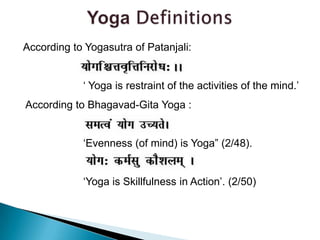
Yoga DefinitionsAccording to Yogasutra of Patanjali:  			‘ Yoga is restraint of the activities of the mind.’ According to Bhagavad-Gita Yoga :			‘Evenness (of mind) is Yoga” (2/48).  			‘Yoga is Skillfulness in Action’. (2/50)
	There are basically four paths which all lead to the same goal, the attainment of the ultimate Reality. These paths are:Karma-Yoga	-	The Yoga of Action
Bhakti-Yoga	-	The Yoga of Devotion
Gyana-Yoga	-	The Yoga of Knowledge
Raja-Yoga	-	The Royal yoga PathHatha-Yoga	-	The Physical YogaKinds of Yoga
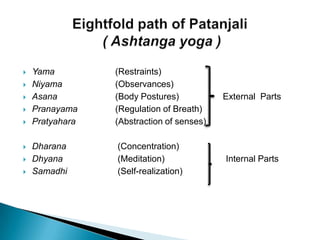
Yama		(Restraints)Niyama		(Observances)Asana		(Body Postures)                  External  PartsPranayama  		(Regulation of Breath)Pratyahara		(Abstraction of senses)Dharana 		 (Concentration)Dhyana		 (Meditation)	         	      Internal PartsSamadhi	 	 (Self-realization)Eightfold path of Patanjali ( Ashtanga yoga )
Yama and NiyamaRestraints (Yama): Rules of social disciplineAhimsa 		 Non-harming
Satya 			 Truthfulness
Asteya  		 Non-stealing
Brahmacharya		 Continence
Aparigraha		 Non-possessiveness Observances (Niyama):Rules of individual discipline. Shauch			 Cleanliness
Santosh		 Contentment
Tapa			 Austerity
Svadhyaya		 Inner exploration
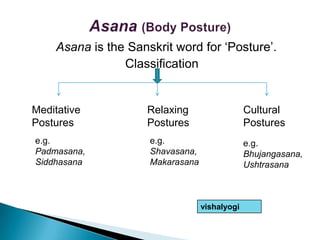
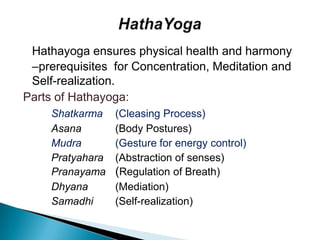
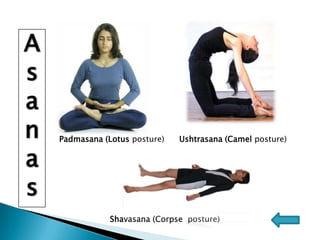
Ishvar-pranidhan	Surrender to the GodAsana(Body Posture)Asana is the Sanskrit word for ‘Posture’.Classification   Meditative 	  	Relaxing 		Cultural   Postures			Postures		Posturese.g.Shavasana, Makarasanae.g.Padmasana,   Siddhasanae.g. Bhujangasana,Ushtrasanavishalyogi
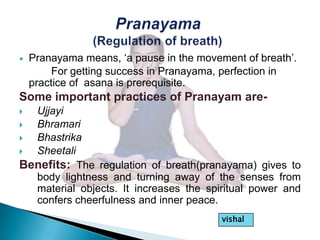
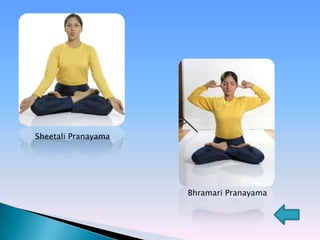
Pranayama (Regulation of breath)Pranayama means, ‘a pause in the movement of breath’.		For getting success in Pranayama, perfection in practice of  asana is prerequisite.Some important practices of Pranayam are-Ujjayi 	BhramariBhastrikaSheetaliBenefits: The regulation of breath(pranayama) gives to body lightness and turning away of the senses from material objects. It increases the spiritual power and confers cheerfulness and inner peace.vishal
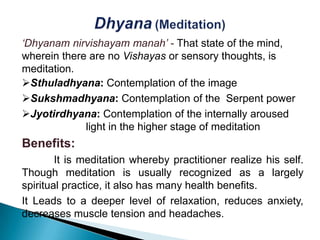
Dhyana(Meditation)‘Dhyanam nirvishayam manah’ - That state of the mind,   wherein there are no Vishayas or sensory thoughts, is meditation. Sthuladhyana: Contemplation of the image
Sukshmadhyana: Contemplation of the  Serpent power

Yoga Presentation