According to Vedic philosophy, the individual
self is alienated from its transcendent self, and
this isolation is the root cause of human
suffering.
@Healer & feelings
संयोगो योग इत्युक्तो
जीवात्मपरमात्मनोः॥
Union of the self
(jivātma) with the
Divine (paramātma) is
said to be yoga.
—Yoga Yajnavalkya
@Healer & feelings
“Yoga is like a river that has been flowing
for so many years Our ancient people did a
lot of research within themselves… One of
the greatest gifts that yoga gives is
observation; observation of the self and of
others… Nothing is constant. Even science
believes things will change”T. K. V. Desikachar
@Healer & feelings
The yogic concept of fitness involves
balancing and integrating all aspects of
ourselves, and of our lives, which leads
us towards inhabiting our bodies and
becoming comfortable with ourselves.
This is a continual, developing process,
a journey from agony to ecstasy. (The
Greek “ekstasis” means to “stand
outside” the ordinary self.)
@Healer & feelings
The Veda, the earliest sacred
literature of India, contain the
first references to yoga. Written
in Sanskrit, the mother of many
Indo-european languages, in
1500 BCE, from these taproots
grew the Upanishads, about 800
years later, which give teachings
on meditation.
@Healer & feelings
Yoga is far more than a system of
preventative or restorative healthcare.
Yoga looks at health from a broad,
holistic perspective that integrative
medicine is only now rediscovering. This
perspective appreciates the enormous
influence of the mind your
psychological attitudes on physical
health.
@Healer & feelings
The word Yoga comes from the ancient
Sanskrit language, Yoga means “union” or
“integration” and also “discipline.” The
system of Yoga, then, is a unitive or
integrating discipline. Yoga seeks unity at
various levels. it seeks to unite body and
mind, Yoga also seeks to unite the rational
mind and the emotions.
@Healer & feelings
In Hindu philosophy, yoga is
the name of one of the
six orthodox (which accept
the testimony of Vedas)
philosophical schools. The
yoga school was founded
by PATANJALI
@Healer & feelings
The process of systematization of
yoga which began in the middle and
Yoga Upanishads culminated with
the Yoga Sutras of
Patanjali. Scholars also note the
influence of Buddhist and Samkhyan
ideas on the Yoga Sutras
@Healer & feelings
Bhakti (bhuk-tee) Yoga
The Yoga of devotion: Bhakti Yoga
practitioners believe that a supreme
being transcends their lives, and they
feel moved to connect or even
completely merge with that supreme
being through acts of devotion.
Bhakti Yoga includes such practices as
making flower offerings, singing
hymns of praise, and thinking about
the Divine.
@Healer & feelings
Hatha (haht-ha) Yoga
The Yoga of physical discipline: All branches of Yoga
seek to achieve the same final goal, enlightenment),
but Hatha Yoga approaches this goal through the
body instead of through the mind or the emotions.
Hatha Yoga practitioners believe that unless they
properly purify and prepare their bodies, the higher
stages of meditation and beyond are virtually
impossible to achieve Hatha Yoga is much more than
posture practice
@Healer & feelings
Jnana (gyah-nah) Yoga
The Yoga of wisdom: Jnana Yoga teaches the ideal of
nondualism — that reality is singular and your
perception of countless distinct phenomena is a basic
misconception. All these things are real at your
present level of consciousness, but they aren’t
ultimately real as separate or distinct things. Upon
enlightenment, everything melts into one, and you
become one with the immortal spirit.
@Healer & feelings
Mantra (mahn-trah) Yoga
The Yoga of potent sound: Mantra Yoga makes
use of sound to harmonize the body and focus
the mind. It works with mantras, which can be a
syllable, word, or phrase. Traditionally,
practitioners receive a mantra from their
teacher in the context of a formal initiation.
@Healer & feelings
Raja (rah- jah) Yoga
The Royal Yoga: Raja Yoga means literally “Royal
Yoga” and is also known as classical Yoga. refer to
the eight- fold path laid down in the Yoga Sutra
of Patanjali, the standard work of Raja Yoga.
Another name for this yogic tradition is Ashtanga
Yoga (ahsh-tahng-gah), the “eight-limbed
Yoga” from ashta (eight) and anga (limb)
@Healer & feelings
Tantra (tahn-trah) Yoga
(including Laya Yoga and Kundalini Yoga), the Yoga of continuity:
Tantra Yoga is the most complex and most widely misunderstood
branch of Yoga, Tantra Yoga is actually a strict spiritual discipline
involving fairly complex rituals and detailed visualizations of
deities. These deities are either visions of the divine and are
invoked to aid the yogic process of contemplation.
Another common name for Tantra Yoga is Kundalini Yoga (koon-
dah-lee-nee). The latter name, which means “she who is coiled,”
hints at the secret “serpent power” that Tantra Yoga seeks to
activate: the latent spiritual energy stored in the human body
@Healer & feelings
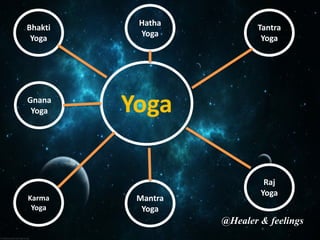
Hatha
Yoga
Gnana
Yoga
Karma
Yoga
Mantra
Yoga
Raj
Yoga
Tantra
Yoga
Bhakti
Yoga
Yoga
@Healer & feelings
@Healer & feelings
In its voyage to modernity, Yoga has undergone
many transformations. One of them was Hatha
Yoga, which emerged around 1100 AD. The most
significant adaptations, however, occurred
during the past several decades, particularly to
serve the needs or wants of modern society.
Many styles of hybrid Yoga are available today.
@Healer & feelings
Iyengar Yoga
founded in 1974 and dedicated to his late wife,
Ramamani, is located in Pune, India. It is the most
widely recognized approach to Hatha Yoga.
Characteristics of this style include precision
performance and the aid of numerous props.
B.K.S. Iyengar, the brother in-law of the famous
T.S. Krishnamacharya (1888–1989) and uncle of
T.K.V. Desikachar, developed this approach.
@Healer & feelings
Viniyoga (vee-nee yoh-gah)
Focuses on the breath and emphasizes practicing Yoga according
to your individual needs and capacities. Shri Krishnamacharya
first developed this approach, and his son T.K.V. Desikachar
continued it. In the United States, Viniyoga is now associated
with Gary Kraftsow and the American Viniyoga Institute (AVI),
Desikachar has expanded his approach in conjunction with his
son Kausthub under the new umbrella of The Krishnamacharya
Healing and Yoga Foundation (KHYF) and Sannidhi of
Krishnamacharya Yoga (SKY), headquartered in Chennai), India.
@Healer & feelings
Ashtanga Yoga(modified)
Is by far the most athletic of the Yoga. This version
combines postures with breathing. Ashtanga Yoga differs
from Patanjali’s eightfold path (also called Ashtanga Yoga),
although it’s theoretically grounded in it. This approach
originated with Shri Krishnamacharya but grew in
popularity thanks to K. Pattabhi Jois. Jois was born
in 1915 but had such a modern outlook that he
draw eager Western students to his Ashtanga
Yoga Institute in Mysore, India, until his death in 2009.
@Healer & feelings
POWER YOGA
K. Pattabhi Jois was a principal disciple of T.S.
Krishnamacharya, who apparently instructed him to
teach the sequences known as Ashtanga Yoga or Power
Yoga. is a generic term for any style that closely follows
Ashtanga Yoga but doesn’t have a set series of postures.
It emphasizes flexibility and strength and was mainly
responsible for introducing Yoga postures into gyms.
Beryl Bender Birch, Bryan Kest, Baron Baptiste, and Sherri
Baptiste Freeman are all closely associated with Power
Yoga.
@Healer & feelings
Vinyasa Yoga and Flow Yoga,
developed by Ganga White
and Tracey Rich, are variations
of Ashtanga Yoga
@Healer & feelings
Kripalu Yoga
Is a three-stage Yoga approach tailored to the needs of
Western students. The first stage emphasizes postural
alignment and coordination of breath and movement;
you hold the postures for a short time only. The second
stage adds meditation and prolongs the postures. In the
final stage, practicing the postures becomes a
spontaneous meditation in motion. Swami Kripalvananda
(1913–1981) created Kripalu Yoga, and his disciple Yogi
Amrit Desai further developed it.
@Healer & feelings
Integral Yoga
Integral Yoga aims to integrate the various
aspects of the body-mind using a combination of
postures, breathing techniques, deep relaxation,
and meditation. Swami Satchidananda (1914–
2002), a student of the famous Swami Sivananda
of Rishikesh, India, introduced this type of Yoga at
the Woodstock festival in 1969, where he taught
the baby boomers to chant om. Over the years,
Integral Yoga has attracted thousands of
students.
@Healer & feelings
Ananda Yoga
Ananda Yoga is a gentle style that prepares
students for meditation. Its distinguishing
features are the silent affirmations associated
with holding the postures. Ananda Yoga is
anchored in the teachings of Paramahansa
Yogananda (1893–1952) and Swami
Kriyananda, one of his disciples. This Yoga style
includes Yogananda’s unique energization
exercises, first developed in 1917, which
involve consciously directing the body’s energy
(life force) to different organs and limbs.
@Healer & feelings
Kundalini Yoga
Kundalini Yoga isn’t only an independent
approach of Yoga; it’s also the name of a style of
Hatha Yoga. Its purpose is to awaken the serpent
power (kundalini) by means of postures, breath
control, chanting, and meditation. Sikh master
Yogi Bhajan (1929–2004), who came to the
United States in 1969, developed the approach;
he is the founder and spiritual head of the
Healthy, Happy, Holy Organization (3HO),
@Healer & feelings
Somatic Yoga
Somatic Yoga is an integrated approach to the
harmonious development of body and mind,
based on both traditional yogic principles and
modern psychophysiological research. It’s the
creation of Eleanor Criswell, EdD, emeritus
professor of psychology at Sonoma State
University in California, and emeritus professor of
The International Association of Yoga therapists.
She has taught Yoga since the early 1960s. This
gentle approach emphasizes visualization, very
slow movement into and out of postures,
conscious breathing, mindfulness, and frequent
relaxation between postures. @Healer & feelings
Bikram Yoga
Bikram Yoga has a set routine of 26 postures.
This very vigorous style requires a certain fitness
level for participation, especially because it calls
for a high room temperature. Founder Bikram
Choudhury, who achieved fame as the teacher
of Hollywood stars, teaches at the Yoga College
of India in Bombay and other locations around
the world, including San Francisco and Tokyo.
@Healer & feelings
Moksha Yoga
Moksha Yoga champions a green philosophy. It
uses traditional postures n a heated room and
includes relaxation periods. This approach is
based on the style of Bikram Yoga (listed next)
and is popular in Canada.
@Healer & feelings
Other Yoga styles
Tri Yoga (developed by Kali Ray), White Lotus
Yoga (developed by Ganga White and Tracey
Rich), Jivamukti (developed by Sharon
Gannon and David Life), Ishta Yoga (an
acronym for the Integrated Science of Hatha,
Tantra, and Ayurveda, developed by Mani
Finger), Forrest Yoga (a mixture of Hatha Yoga
and Native American ideas created by Ana
Forrest), and Yin Yoga (developed by Paul
Grilley).
@Healer & feelings
Yoga has undergone various
adaptations. Broadly, we can look at
yoga in four overlapping approaches.
As a method for physical fitness
and health maintenance
As a body-oriented therapy
As a comprehensive lifestyle
As a spiritual discipline
@Healer & feelings
Yoga as fitness training:
Yoga as fitness training, is the most
popular way Westerners practice Yoga. It’s
also the most radical revamping of
Traditional Yoga. More precisely, it’s a
modification of traditional Hatha Yoga.
Yoga as fitness train-ing is concerned
primarily with the physical body’s
flexibility, resilience, and strength
@Healer & feelings
Yoga as therapy
Yoga as therapy, applies yogic techniques to
restore health or full physical and mental
function. While the idea behind as a therapy is
quite old, it’s growing into a whole new
professional discipline. Yoga therapists have
specialized training to apply the tools of Yoga
to promote and support healing. Commonly,
Yoga therapy, addresses the special needs and
enables people who cannot participate in a
typical group setting to enjoy Yoga’s many
fruits
@Healer & feelings
Yoga as a lifestyle
You unlock the real potency of Yoga when you
adopt it as a lifestyle living Yoga and practicing it
every day through physical exercises or
meditation. Above all, when you adopt Yoga as
a lifestyle, you apply the wisdom of Yoga to your
everyday life and live with awareness. Yoga has
much sage advice about everyday living,
including diet and sleep habits, how you relate
to others, and where you focus your attention
and energy. It offers a total system of conscious
and skillful living.
@Healer & feelings
Yoga as a spiritual discipline
Lifestyle Yoga (see the preceding section) is
concerned with healthy, whole-some,
functional, and benevolent living. Yoga as a
spiritual discipline, the fourth approach, is
concerned with all that plus the traditional
ideal of enlightenment that is, discovering your
spiritual nature.
@Healer & feelings
Balancing Your Life with Yoga
The Hindu tradition explains Yoga as the discipline of
balance, another way of expressing the ideal of unity
through Yoga. Everything in you must harmonize to
function optimally. A disharmonious mind is disturbing in
itself, but sooner or later, it also causes physical
problems. An imbalanced body can easily warp your
emotions and thought processes. If you have strained
relationships with others, you cause distress not only for
them, but also for yourself. And when your relationship
with your physical environment is dis-harmonious you
trigger serious repercussions for everyone.
@Healer & feelings
References:
Barbara Stoler Miller, "Yoga: Discipline of Freedom: the Yoga Sutra Attributed to Patanjali; a
Translation of the Text, with Commentary, Introduction, and Glossary of Keywords."
University of California Press, 1996
James Mallinson, "Sāktism and Hathayoga," 6 March 2012.
Mike Burley (2012), Classical Samkhya and Yoga - An Indian Metaphysics of Experience,
Routledge
Aranya, Swami Hariharananda (2000). Yoga Philosophy of Patanjali with Bhasvati. Calcutta,
India: University of Calcutta.
Burley, Mikel (2000). Hatha Yoga: Its Context, Theory and Practice. Delhi: Motilal Banarsidass.
@Healer & feelings
Created by:
Healer & feelings
14.ashutosh@gmail.com

Modern yoga

  • 1.
    According to Vedicphilosophy, the individual self is alienated from its transcendent self, and this isolation is the root cause of human suffering. @Healer & feelings
  • 2.
    संयोगो योग इत्युक्तो जीवात्मपरमात्मनोः॥ Unionof the self (jivātma) with the Divine (paramātma) is said to be yoga. —Yoga Yajnavalkya @Healer & feelings
  • 3.
    “Yoga is likea river that has been flowing for so many years Our ancient people did a lot of research within themselves… One of the greatest gifts that yoga gives is observation; observation of the self and of others… Nothing is constant. Even science believes things will change”T. K. V. Desikachar @Healer & feelings
  • 4.
    The yogic conceptof fitness involves balancing and integrating all aspects of ourselves, and of our lives, which leads us towards inhabiting our bodies and becoming comfortable with ourselves. This is a continual, developing process, a journey from agony to ecstasy. (The Greek “ekstasis” means to “stand outside” the ordinary self.) @Healer & feelings
  • 5.
    The Veda, theearliest sacred literature of India, contain the first references to yoga. Written in Sanskrit, the mother of many Indo-european languages, in 1500 BCE, from these taproots grew the Upanishads, about 800 years later, which give teachings on meditation. @Healer & feelings
  • 6.
    Yoga is farmore than a system of preventative or restorative healthcare. Yoga looks at health from a broad, holistic perspective that integrative medicine is only now rediscovering. This perspective appreciates the enormous influence of the mind your psychological attitudes on physical health. @Healer & feelings
  • 7.
    The word Yogacomes from the ancient Sanskrit language, Yoga means “union” or “integration” and also “discipline.” The system of Yoga, then, is a unitive or integrating discipline. Yoga seeks unity at various levels. it seeks to unite body and mind, Yoga also seeks to unite the rational mind and the emotions. @Healer & feelings
  • 8.
    In Hindu philosophy,yoga is the name of one of the six orthodox (which accept the testimony of Vedas) philosophical schools. The yoga school was founded by PATANJALI @Healer & feelings
  • 9.
    The process ofsystematization of yoga which began in the middle and Yoga Upanishads culminated with the Yoga Sutras of Patanjali. Scholars also note the influence of Buddhist and Samkhyan ideas on the Yoga Sutras @Healer & feelings
  • 10.
    Bhakti (bhuk-tee) Yoga TheYoga of devotion: Bhakti Yoga practitioners believe that a supreme being transcends their lives, and they feel moved to connect or even completely merge with that supreme being through acts of devotion. Bhakti Yoga includes such practices as making flower offerings, singing hymns of praise, and thinking about the Divine. @Healer & feelings
  • 11.
    Hatha (haht-ha) Yoga TheYoga of physical discipline: All branches of Yoga seek to achieve the same final goal, enlightenment), but Hatha Yoga approaches this goal through the body instead of through the mind or the emotions. Hatha Yoga practitioners believe that unless they properly purify and prepare their bodies, the higher stages of meditation and beyond are virtually impossible to achieve Hatha Yoga is much more than posture practice @Healer & feelings
  • 12.
    Jnana (gyah-nah) Yoga TheYoga of wisdom: Jnana Yoga teaches the ideal of nondualism — that reality is singular and your perception of countless distinct phenomena is a basic misconception. All these things are real at your present level of consciousness, but they aren’t ultimately real as separate or distinct things. Upon enlightenment, everything melts into one, and you become one with the immortal spirit. @Healer & feelings
  • 13.
    Mantra (mahn-trah) Yoga TheYoga of potent sound: Mantra Yoga makes use of sound to harmonize the body and focus the mind. It works with mantras, which can be a syllable, word, or phrase. Traditionally, practitioners receive a mantra from their teacher in the context of a formal initiation. @Healer & feelings
  • 14.
    Raja (rah- jah)Yoga The Royal Yoga: Raja Yoga means literally “Royal Yoga” and is also known as classical Yoga. refer to the eight- fold path laid down in the Yoga Sutra of Patanjali, the standard work of Raja Yoga. Another name for this yogic tradition is Ashtanga Yoga (ahsh-tahng-gah), the “eight-limbed Yoga” from ashta (eight) and anga (limb) @Healer & feelings
  • 15.
    Tantra (tahn-trah) Yoga (includingLaya Yoga and Kundalini Yoga), the Yoga of continuity: Tantra Yoga is the most complex and most widely misunderstood branch of Yoga, Tantra Yoga is actually a strict spiritual discipline involving fairly complex rituals and detailed visualizations of deities. These deities are either visions of the divine and are invoked to aid the yogic process of contemplation. Another common name for Tantra Yoga is Kundalini Yoga (koon- dah-lee-nee). The latter name, which means “she who is coiled,” hints at the secret “serpent power” that Tantra Yoga seeks to activate: the latent spiritual energy stored in the human body @Healer & feelings
  • 16.
  • 17.
  • 18.
    In its voyageto modernity, Yoga has undergone many transformations. One of them was Hatha Yoga, which emerged around 1100 AD. The most significant adaptations, however, occurred during the past several decades, particularly to serve the needs or wants of modern society. Many styles of hybrid Yoga are available today. @Healer & feelings
  • 19.
    Iyengar Yoga founded in1974 and dedicated to his late wife, Ramamani, is located in Pune, India. It is the most widely recognized approach to Hatha Yoga. Characteristics of this style include precision performance and the aid of numerous props. B.K.S. Iyengar, the brother in-law of the famous T.S. Krishnamacharya (1888–1989) and uncle of T.K.V. Desikachar, developed this approach. @Healer & feelings
  • 20.
    Viniyoga (vee-nee yoh-gah) Focuseson the breath and emphasizes practicing Yoga according to your individual needs and capacities. Shri Krishnamacharya first developed this approach, and his son T.K.V. Desikachar continued it. In the United States, Viniyoga is now associated with Gary Kraftsow and the American Viniyoga Institute (AVI), Desikachar has expanded his approach in conjunction with his son Kausthub under the new umbrella of The Krishnamacharya Healing and Yoga Foundation (KHYF) and Sannidhi of Krishnamacharya Yoga (SKY), headquartered in Chennai), India. @Healer & feelings
  • 21.
    Ashtanga Yoga(modified) Is byfar the most athletic of the Yoga. This version combines postures with breathing. Ashtanga Yoga differs from Patanjali’s eightfold path (also called Ashtanga Yoga), although it’s theoretically grounded in it. This approach originated with Shri Krishnamacharya but grew in popularity thanks to K. Pattabhi Jois. Jois was born in 1915 but had such a modern outlook that he draw eager Western students to his Ashtanga Yoga Institute in Mysore, India, until his death in 2009. @Healer & feelings
  • 22.
    POWER YOGA K. PattabhiJois was a principal disciple of T.S. Krishnamacharya, who apparently instructed him to teach the sequences known as Ashtanga Yoga or Power Yoga. is a generic term for any style that closely follows Ashtanga Yoga but doesn’t have a set series of postures. It emphasizes flexibility and strength and was mainly responsible for introducing Yoga postures into gyms. Beryl Bender Birch, Bryan Kest, Baron Baptiste, and Sherri Baptiste Freeman are all closely associated with Power Yoga. @Healer & feelings
  • 23.
    Vinyasa Yoga andFlow Yoga, developed by Ganga White and Tracey Rich, are variations of Ashtanga Yoga @Healer & feelings
  • 24.
    Kripalu Yoga Is athree-stage Yoga approach tailored to the needs of Western students. The first stage emphasizes postural alignment and coordination of breath and movement; you hold the postures for a short time only. The second stage adds meditation and prolongs the postures. In the final stage, practicing the postures becomes a spontaneous meditation in motion. Swami Kripalvananda (1913–1981) created Kripalu Yoga, and his disciple Yogi Amrit Desai further developed it. @Healer & feelings
  • 25.
    Integral Yoga Integral Yogaaims to integrate the various aspects of the body-mind using a combination of postures, breathing techniques, deep relaxation, and meditation. Swami Satchidananda (1914– 2002), a student of the famous Swami Sivananda of Rishikesh, India, introduced this type of Yoga at the Woodstock festival in 1969, where he taught the baby boomers to chant om. Over the years, Integral Yoga has attracted thousands of students. @Healer & feelings
  • 26.
    Ananda Yoga Ananda Yogais a gentle style that prepares students for meditation. Its distinguishing features are the silent affirmations associated with holding the postures. Ananda Yoga is anchored in the teachings of Paramahansa Yogananda (1893–1952) and Swami Kriyananda, one of his disciples. This Yoga style includes Yogananda’s unique energization exercises, first developed in 1917, which involve consciously directing the body’s energy (life force) to different organs and limbs. @Healer & feelings
  • 27.
    Kundalini Yoga Kundalini Yogaisn’t only an independent approach of Yoga; it’s also the name of a style of Hatha Yoga. Its purpose is to awaken the serpent power (kundalini) by means of postures, breath control, chanting, and meditation. Sikh master Yogi Bhajan (1929–2004), who came to the United States in 1969, developed the approach; he is the founder and spiritual head of the Healthy, Happy, Holy Organization (3HO), @Healer & feelings
  • 28.
    Somatic Yoga Somatic Yogais an integrated approach to the harmonious development of body and mind, based on both traditional yogic principles and modern psychophysiological research. It’s the creation of Eleanor Criswell, EdD, emeritus professor of psychology at Sonoma State University in California, and emeritus professor of The International Association of Yoga therapists. She has taught Yoga since the early 1960s. This gentle approach emphasizes visualization, very slow movement into and out of postures, conscious breathing, mindfulness, and frequent relaxation between postures. @Healer & feelings
  • 29.
    Bikram Yoga Bikram Yogahas a set routine of 26 postures. This very vigorous style requires a certain fitness level for participation, especially because it calls for a high room temperature. Founder Bikram Choudhury, who achieved fame as the teacher of Hollywood stars, teaches at the Yoga College of India in Bombay and other locations around the world, including San Francisco and Tokyo. @Healer & feelings
  • 30.
    Moksha Yoga Moksha Yogachampions a green philosophy. It uses traditional postures n a heated room and includes relaxation periods. This approach is based on the style of Bikram Yoga (listed next) and is popular in Canada. @Healer & feelings
  • 31.
    Other Yoga styles TriYoga (developed by Kali Ray), White Lotus Yoga (developed by Ganga White and Tracey Rich), Jivamukti (developed by Sharon Gannon and David Life), Ishta Yoga (an acronym for the Integrated Science of Hatha, Tantra, and Ayurveda, developed by Mani Finger), Forrest Yoga (a mixture of Hatha Yoga and Native American ideas created by Ana Forrest), and Yin Yoga (developed by Paul Grilley). @Healer & feelings
  • 32.
    Yoga has undergonevarious adaptations. Broadly, we can look at yoga in four overlapping approaches. As a method for physical fitness and health maintenance As a body-oriented therapy As a comprehensive lifestyle As a spiritual discipline @Healer & feelings
  • 33.
    Yoga as fitnesstraining: Yoga as fitness training, is the most popular way Westerners practice Yoga. It’s also the most radical revamping of Traditional Yoga. More precisely, it’s a modification of traditional Hatha Yoga. Yoga as fitness train-ing is concerned primarily with the physical body’s flexibility, resilience, and strength @Healer & feelings
  • 34.
    Yoga as therapy Yogaas therapy, applies yogic techniques to restore health or full physical and mental function. While the idea behind as a therapy is quite old, it’s growing into a whole new professional discipline. Yoga therapists have specialized training to apply the tools of Yoga to promote and support healing. Commonly, Yoga therapy, addresses the special needs and enables people who cannot participate in a typical group setting to enjoy Yoga’s many fruits @Healer & feelings
  • 35.
    Yoga as alifestyle You unlock the real potency of Yoga when you adopt it as a lifestyle living Yoga and practicing it every day through physical exercises or meditation. Above all, when you adopt Yoga as a lifestyle, you apply the wisdom of Yoga to your everyday life and live with awareness. Yoga has much sage advice about everyday living, including diet and sleep habits, how you relate to others, and where you focus your attention and energy. It offers a total system of conscious and skillful living. @Healer & feelings
  • 36.
    Yoga as aspiritual discipline Lifestyle Yoga (see the preceding section) is concerned with healthy, whole-some, functional, and benevolent living. Yoga as a spiritual discipline, the fourth approach, is concerned with all that plus the traditional ideal of enlightenment that is, discovering your spiritual nature. @Healer & feelings
  • 37.
    Balancing Your Lifewith Yoga The Hindu tradition explains Yoga as the discipline of balance, another way of expressing the ideal of unity through Yoga. Everything in you must harmonize to function optimally. A disharmonious mind is disturbing in itself, but sooner or later, it also causes physical problems. An imbalanced body can easily warp your emotions and thought processes. If you have strained relationships with others, you cause distress not only for them, but also for yourself. And when your relationship with your physical environment is dis-harmonious you trigger serious repercussions for everyone. @Healer & feelings
  • 38.
    References: Barbara Stoler Miller,"Yoga: Discipline of Freedom: the Yoga Sutra Attributed to Patanjali; a Translation of the Text, with Commentary, Introduction, and Glossary of Keywords." University of California Press, 1996 James Mallinson, "Sāktism and Hathayoga," 6 March 2012. Mike Burley (2012), Classical Samkhya and Yoga - An Indian Metaphysics of Experience, Routledge Aranya, Swami Hariharananda (2000). Yoga Philosophy of Patanjali with Bhasvati. Calcutta, India: University of Calcutta. Burley, Mikel (2000). Hatha Yoga: Its Context, Theory and Practice. Delhi: Motilal Banarsidass. @Healer & feelings Created by: Healer & feelings 14.ashutosh@gmail.com