Rain gauge


  Done by:-
   Chintan
  Dharmin
   Manav
Intro. on rain gauge
• A rain gauge is a type of instrument used
  by meteorologists and hydrologists to gather
  and measure the amount of
  liquid precipitation over a set period of time.
History of rain gauge
• The first known rainfall records were kept by
  the Ancient Greeks, about 500 B.C. This was
  followed 100 years later by people in India using
  bowls to record the rainfall.
• While some sources state that the much
  later cheugugi of Korea was the world's first
  gauge, other sources say that Jang Yeong-
  sil developed or refined an existing gauge. In
  1662, Christopher Wren created the first tipping-
  bucket rain gauge in Britain.
Principles of it
• Most rain gauges generally measure the precipitation
  in millimeters. The level of rainfall is sometimes reported
  as inches or centimeters.
• Rain gauge amounts are read either manually or by automatic
  weather station (AWS). The frequency of readings will depend
  on the requirements of the collection agency.
• In most cases the precipitation is not retained, however some
  stations do submit rainfall (and snowfall) for testing, which is
  done to obtain levels of pollutants.
• Another problem encountered is when the temperature is
  close to or below freezing. Rain may fall on the funnel and ice
  or snow may collect in the gauge and not permit any
  subsequent rain to pass through.
Types of rain-gauges
•   Standard rain gauge
•   Weighing precipitation gauge
•   Tipping bucket rain gauge
•   Optical rain gauge
•   Acoustic rain gauge
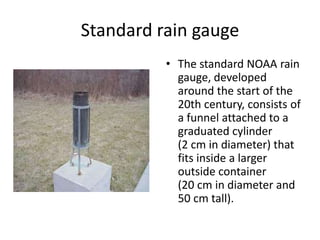
Standard rain gauge
          • The standard NOAA rain
            gauge, developed
            around the start of the
            20th century, consists of
            a funnel attached to a
            graduated cylinder
            (2 cm in diameter) that
            fits inside a larger
            outside container
            (20 cm in diameter and
            50 cm tall).
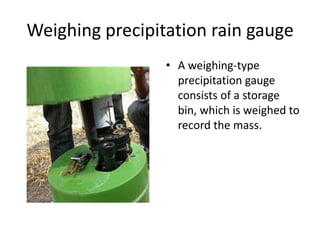
Weighing precipitation rain gauge
                 • A weighing-type
                   precipitation gauge
                   consists of a storage
                   bin, which is weighed to
                   record the mass.
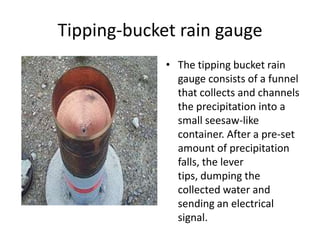
Tipping-bucket rain gauge
             • The tipping bucket rain
               gauge consists of a funnel
               that collects and channels
               the precipitation into a
               small seesaw-like
               container. After a pre-set
               amount of precipitation
               falls, the lever
               tips, dumping the
               collected water and
               sending an electrical
               signal.
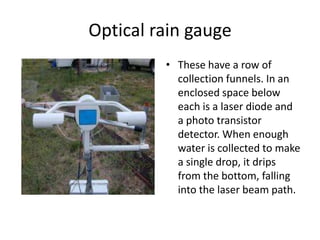
Optical rain gauge
         • These have a row of
           collection funnels. In an
           enclosed space below
           each is a laser diode and
           a photo transistor
           detector. When enough
           water is collected to make
           a single drop, it drips
           from the bottom, falling
           into the laser beam path.
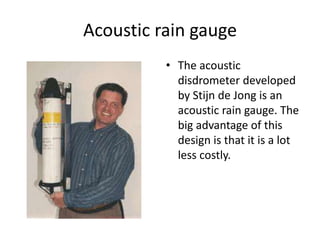
Acoustic rain gauge
          • The acoustic
            disdrometer developed
            by Stijn de Jong is an
            acoustic rain gauge. The
            big advantage of this
            design is that it is a lot
            less costly.
Rain gauge

Rain gauge

  • 1.
    Rain gauge Done by:- Chintan Dharmin Manav
  • 2.
    Intro. on raingauge • A rain gauge is a type of instrument used by meteorologists and hydrologists to gather and measure the amount of liquid precipitation over a set period of time.
  • 3.
    History of raingauge • The first known rainfall records were kept by the Ancient Greeks, about 500 B.C. This was followed 100 years later by people in India using bowls to record the rainfall. • While some sources state that the much later cheugugi of Korea was the world's first gauge, other sources say that Jang Yeong- sil developed or refined an existing gauge. In 1662, Christopher Wren created the first tipping- bucket rain gauge in Britain.
  • 4.
    Principles of it •Most rain gauges generally measure the precipitation in millimeters. The level of rainfall is sometimes reported as inches or centimeters. • Rain gauge amounts are read either manually or by automatic weather station (AWS). The frequency of readings will depend on the requirements of the collection agency. • In most cases the precipitation is not retained, however some stations do submit rainfall (and snowfall) for testing, which is done to obtain levels of pollutants. • Another problem encountered is when the temperature is close to or below freezing. Rain may fall on the funnel and ice or snow may collect in the gauge and not permit any subsequent rain to pass through.
  • 5.
    Types of rain-gauges • Standard rain gauge • Weighing precipitation gauge • Tipping bucket rain gauge • Optical rain gauge • Acoustic rain gauge
  • 6.
    Standard rain gauge • The standard NOAA rain gauge, developed around the start of the 20th century, consists of a funnel attached to a graduated cylinder (2 cm in diameter) that fits inside a larger outside container (20 cm in diameter and 50 cm tall).
  • 7.
    Weighing precipitation raingauge • A weighing-type precipitation gauge consists of a storage bin, which is weighed to record the mass.
  • 8.
    Tipping-bucket rain gauge • The tipping bucket rain gauge consists of a funnel that collects and channels the precipitation into a small seesaw-like container. After a pre-set amount of precipitation falls, the lever tips, dumping the collected water and sending an electrical signal.
  • 9.
    Optical rain gauge • These have a row of collection funnels. In an enclosed space below each is a laser diode and a photo transistor detector. When enough water is collected to make a single drop, it drips from the bottom, falling into the laser beam path.
  • 10.
    Acoustic rain gauge • The acoustic disdrometer developed by Stijn de Jong is an acoustic rain gauge. The big advantage of this design is that it is a lot less costly.