Policy for Attendance

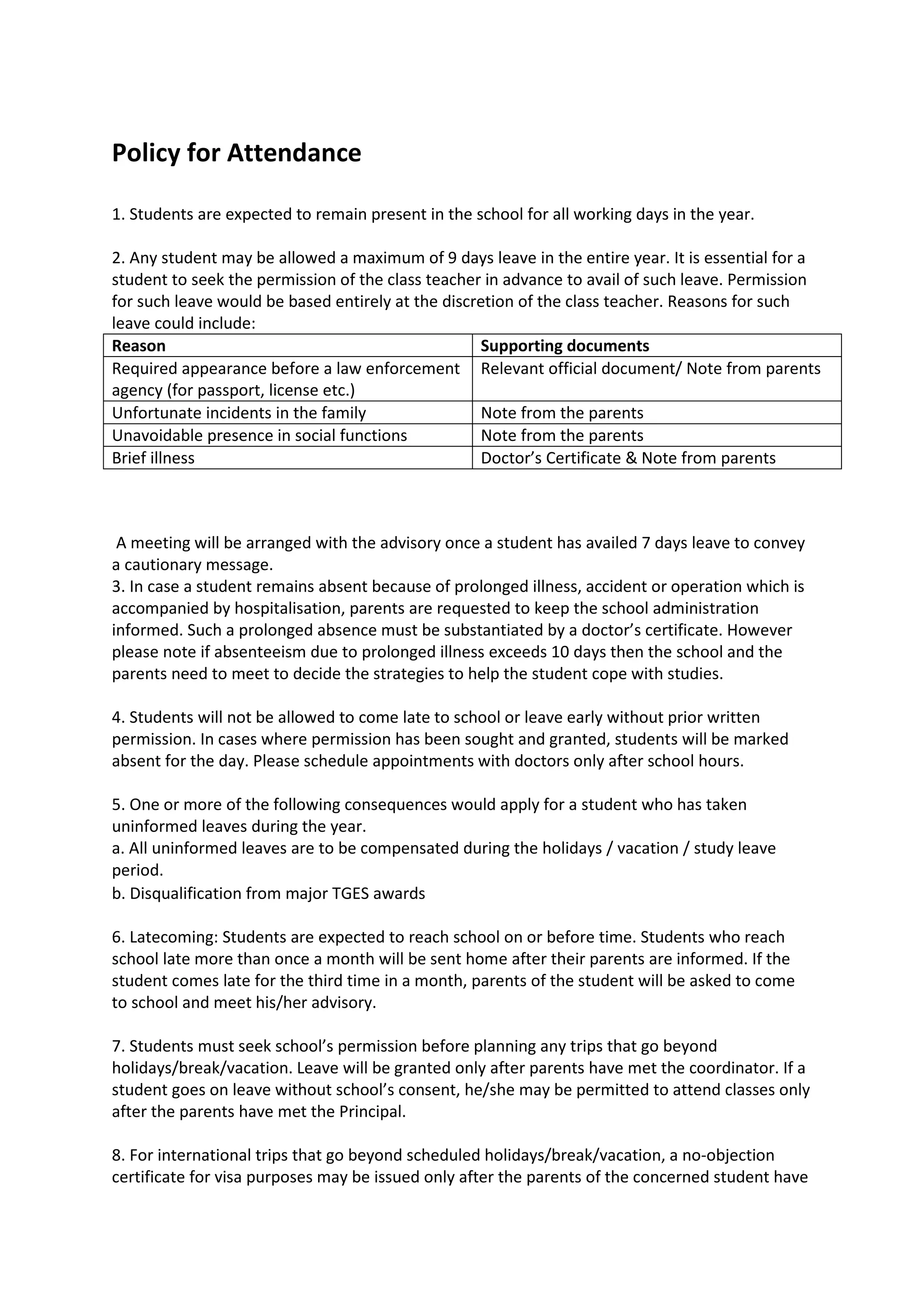
1. Students are expected to remain present in the school for all working days in the year.

2. Any student may be allowed a maximum of 9 days leave in the entire year. It is essential for a
student to seek the permission of the class teacher in advance to avail of such leave. Permission
for such leave would be based entirely at the discretion of the class teacher. Reasons for such
leave could include:
Reason                                              Supporting documents
Required appearance before a law enforcement Relevant official document/ Note from parents
agency (for passport, license etc.)
Unfortunate incidents in the family                 Note from the parents
Unavoidable presence in social functions            Note from the parents
Brief illness                                       Doctor’s Certificate & Note from parents


 A meeting will be arranged with the advisory once a student has availed 7 days leave to convey
a cautionary message.
3. In case a student remains absent because of prolonged illness, accident or operation which is
accompanied by hospitalisation, parents are requested to keep the school administration
informed. Such a prolonged absence must be substantiated by a doctor’s certificate. However
please note if absenteeism due to prolonged illness exceeds 10 days then the school and the
parents need to meet to decide the strategies to help the student cope with studies.

4. Students will not be allowed to come late to school or leave early without prior written
permission. In cases where permission has been sought and granted, students will be marked
absent for the day. Please schedule appointments with doctors only after school hours.

5. One or more of the following consequences would apply for a student who has taken
uninformed leaves during the year.
a. All uninformed leaves are to be compensated during the holidays / vacation / study leave
period.
b. Disqualification from major TGES awards

6. Latecoming: Students are expected to reach school on or before time. Students who reach
school late more than once a month will be sent home after their parents are informed. If the
student comes late for the third time in a month, parents of the student will be asked to come
to school and meet his/her advisory.

7. Students must seek school’s permission before planning any trips that go beyond
holidays/break/vacation. Leave will be granted only after parents have met the coordinator. If a
student goes on leave without school’s consent, he/she may be permitted to attend classes only
after the parents have met the Principal.

8. For international trips that go beyond scheduled holidays/break/vacation, a no-objection
certificate for visa purposes may be issued only after the parents of the concerned student have
met the coordinator. No-objection certificate will be issued after reviewing the student’s
attendance, behavior and performance records.

9. Please note that attendance is mandatory for all students during school functions like prize-
giving ceremonies, cultural assembliies etc. Failure to do so may invite attendant consequences.
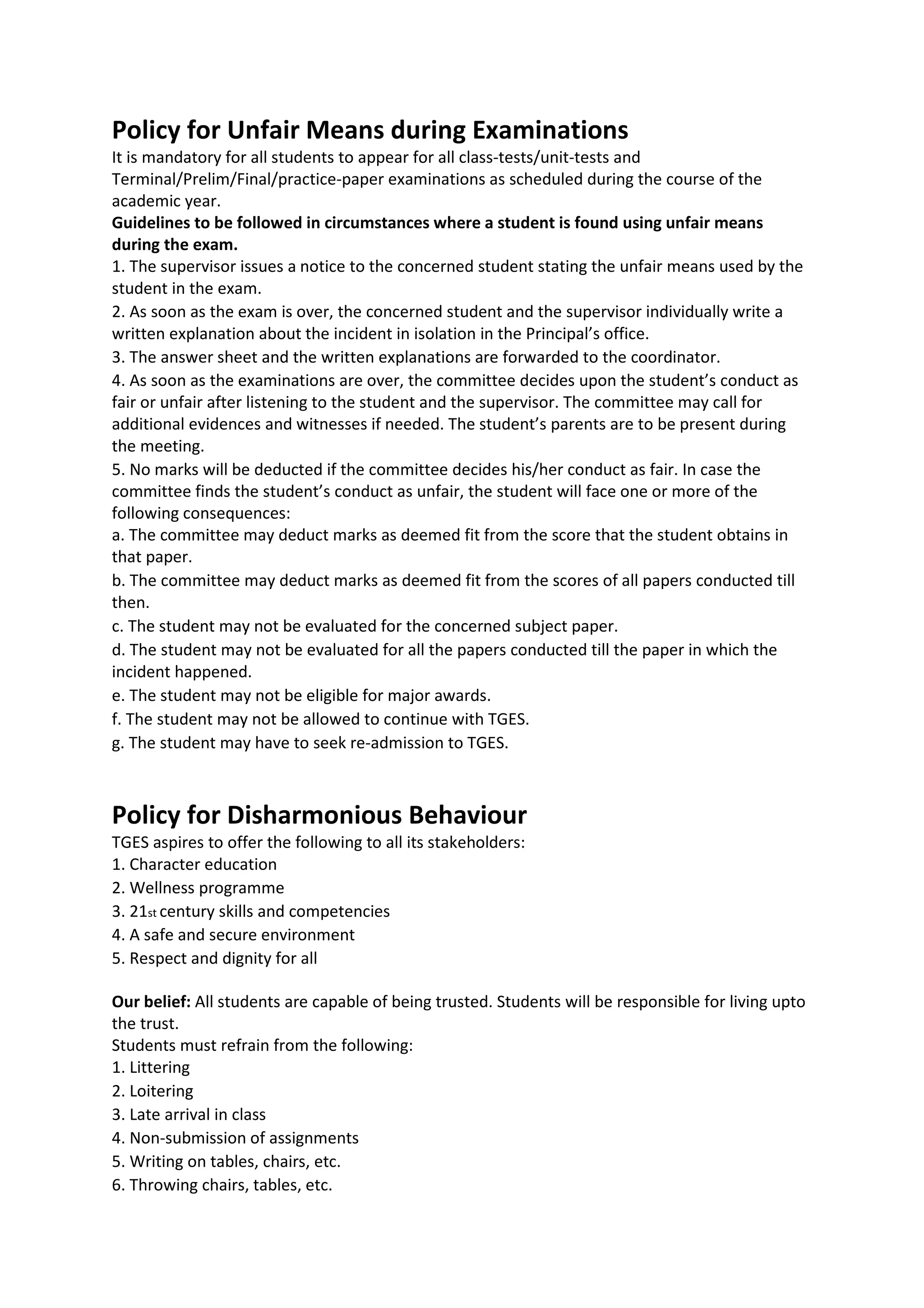
Policy for Unfair Means during Examinations
It is mandatory for all students to appear for all class-tests/unit-tests and
Terminal/Prelim/Final/practice-paper examinations as scheduled during the course of the
academic year.
Guidelines to be followed in circumstances where a student is found using unfair means
during the exam.
1. The supervisor issues a notice to the concerned student stating the unfair means used by the
student in the exam.
2. As soon as the exam is over, the concerned student and the supervisor individually write a
written explanation about the incident in isolation in the Principal’s office.
3. The answer sheet and the written explanations are forwarded to the coordinator.
4. As soon as the examinations are over, the committee decides upon the student’s conduct as
fair or unfair after listening to the student and the supervisor. The committee may call for
additional evidences and witnesses if needed. The student’s parents are to be present during
the meeting.
5. No marks will be deducted if the committee decides his/her conduct as fair. In case the
committee finds the student’s conduct as unfair, the student will face one or more of the
following consequences:
a. The committee may deduct marks as deemed fit from the score that the student obtains in
that paper.
b. The committee may deduct marks as deemed fit from the scores of all papers conducted till
then.
c. The student may not be evaluated for the concerned subject paper.
d. The student may not be evaluated for all the papers conducted till the paper in which the
incident happened.
e. The student may not be eligible for major awards.
f. The student may not be allowed to continue with TGES.
g. The student may have to seek re-admission to TGES.


Policy for Disharmonious Behaviour
TGES aspires to offer the following to all its stakeholders:
1. Character education
2. Wellness programme
3. 21st century skills and competencies
4. A safe and secure environment
5. Respect and dignity for all

Our belief: All students are capable of being trusted. Students will be responsible for living upto
the trust.
Students must refrain from the following:
1. Littering
2. Loitering
3. Late arrival in class
4. Non-submission of assignments
5. Writing on tables, chairs, etc.
6. Throwing chairs, tables, etc.
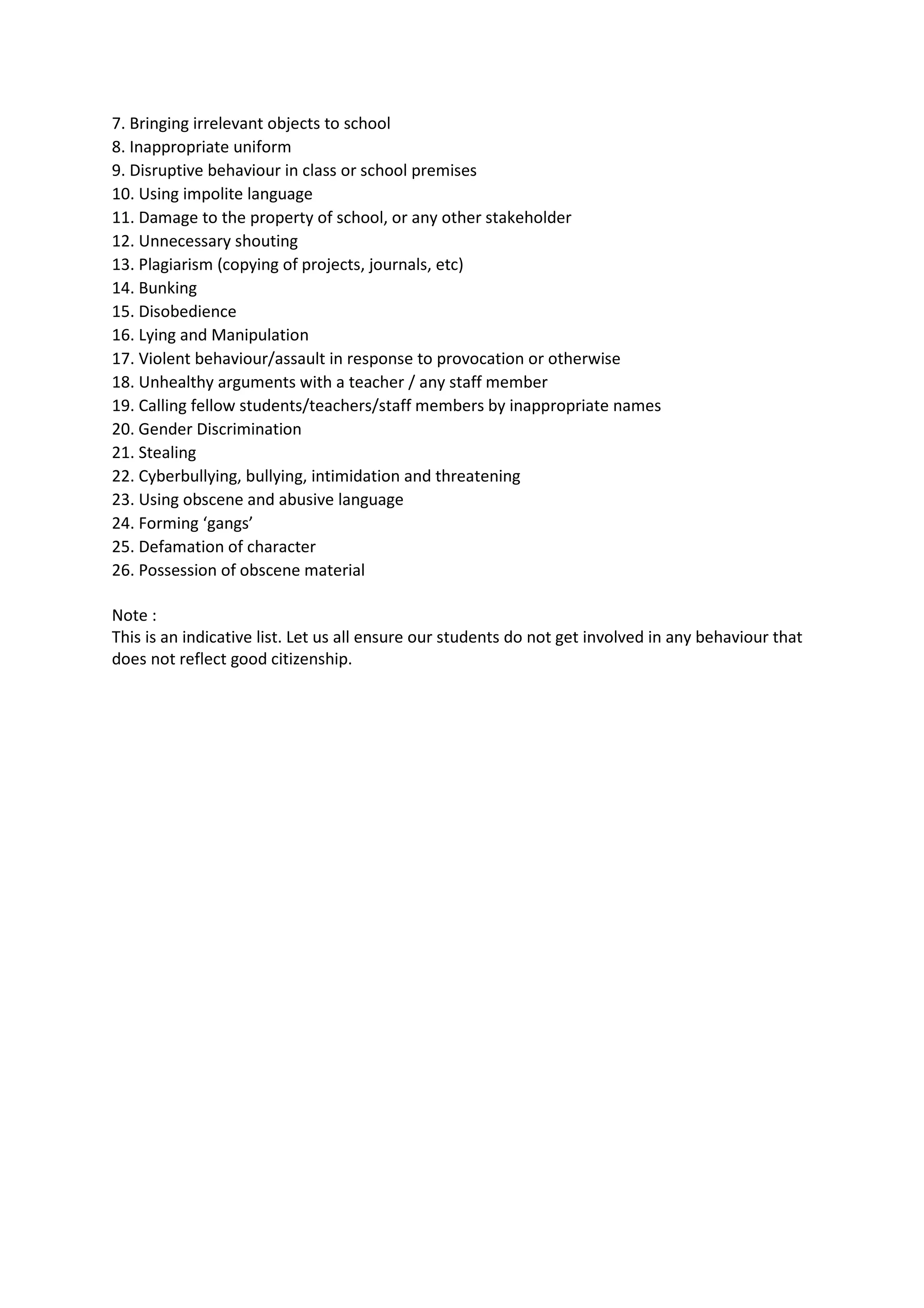
7. Bringing irrelevant objects to school
8. Inappropriate uniform
9. Disruptive behaviour in class or school premises
10. Using impolite language
11. Damage to the property of school, or any other stakeholder
12. Unnecessary shouting
13. Plagiarism (copying of projects, journals, etc)
14. Bunking
15. Disobedience
16. Lying and Manipulation
17. Violent behaviour/assault in response to provocation or otherwise
18. Unhealthy arguments with a teacher / any staff member
19. Calling fellow students/teachers/staff members by inappropriate names
20. Gender Discrimination
21. Stealing
22. Cyberbullying, bullying, intimidation and threatening
23. Using obscene and abusive language
24. Forming ‘gangs’
25. Defamation of character
26. Possession of obscene material

Note :
This is an indicative list. Let us all ensure our students do not get involved in any behaviour that
does not reflect good citizenship.
Dealing with disciplinary infractions
The following consequences have been laid out for students in order to foster a sense of
citizenship in the school:
1st instance
1. Teacher counsels the student and documents the same.

(Counselling may be done a number of times depending upon the nature of infraction)
2. Parents will be called.
3. Warning letter for school suspension will be issued.

2nd instance
1. Parents will be called. Student to be isolated within the class till the parents come.
2. Teacher counsels the student in parents’ presence and documents the same.
3. Warning for in-school suspension will be issued.

3rd instance
1. Parents will be called. Student to be isolated within the class till the parents come.
2. Student faces in-school suspension for 1-3 days depending upon the nature of infraction.
3. Warning for suspension at home will be issued.
4. In school suspension and student will be issued a warning letter for expulsion
5. Student suspended from attending one CCE per subject


4th instance
1. Parents will be called. Student to be isolated within the class till the parents come.
2. Students will be expelled

Please note: The gravity of the infraction will decide the consequences.
Recommendation letters/Character Certificate
(as applicable)
Recommendation letters and the character certificate play a crucial role in students’ admission
process. Students must earn their right to receive these letters at the end of each class. This
goodwill-earning process is a constant endeavor. Possible ways to do this is to display good
behaviour and citizenship consistently.
Policy for Responsible Device Usage

We understand technology plays a vital role in the students’ learning process. With this view,
students may be permitted to bring their devices to school. A device is a powerful tool and with
responsible use it can effectively contribute to students’ learning. This also puts additional
responsibility on the students.
Important Note: The devices permitted in school are laptops, netbooks, tablets and e-book
readers.
This Responsible Device Use policy clearly states what use of the device is acceptable and what
is not.
Expectations from students (at all times within the school campus):
 We expect all students to be responsible for their own behaviour while using the device.
 The device should be used for educational purposes only.
 If students are found playing games, watching movies, surfing internet or using the device
without an educational purpose, the privilege to bring the device to school will be withdrawn.
 It is mandatory for the device to have an 8-10 hour battery life. Power-cords and chargers
are not to be brought to school.
 Students may be given access to school internet. A separate account to access the internet will
be provided to students and their activities on the internet will be supervised.
 Students must not carry any device (eg. Dongle, SIM card) used to access internet directly on
their device. Any such internet device shall be confiscated for 28 working days and the privilege
to bring the laptop/tablet/netbook to school will be withdrawn.
 Using pirated copies of software and operating system is illegal and hence not permitted.
Parents will be responsible for their children using pirated versions of software and operating
system. The school cannot be held responsible for the same.
 ICT security system must be respected it is a criminal offence to use a computer for a purpose
not permitted by the system owner. Strict consequences will follow if the school’s ICT security
system is violated.
 Students must take responsibility for their devices. It is recommended that students don’t give
their devices to anyone.
 The school may not be held responsible for damage, loss or theft of devices.
Policy for Uniforms

Students are expected to be in the school uniform at ALL times, including additional classes,
project work, SEP etc.
Guidelines for school uniform are:
 The new school uniform must be worn according to the designated days.
 It is mandatory to wear sports shoes on all days.
 Hair should be properly trimmed and neatly combed.
 Boys are expected to be clean shaven at all times.

Students must avoid the following at all times:
 Slippers, sandals, floaters etc.
 Fancy hair-styles
 ewellery
 Make up (nail-polish, eye liner and mehendi)
 Bands of any kind
 Tattoos
 Coloured contact lenses
 Coloured or streaked hair
Policy for Damage to School Property

 Parents are required to pay for any damage that may have been caused by the student
intentionally to the school property including lab equipment, glass panes, library books, glass
boards, smart-boards, laptops, computers, projectors and other furniture.
 Intentional damage caused by a student may be a reason for expulsion from school.
 Expenses for any damage will be recovered from the student’s imprest deposit.

Policies 2012

  • 1.
    Policy for Attendance 1.Students are expected to remain present in the school for all working days in the year. 2. Any student may be allowed a maximum of 9 days leave in the entire year. It is essential for a student to seek the permission of the class teacher in advance to avail of such leave. Permission for such leave would be based entirely at the discretion of the class teacher. Reasons for such leave could include: Reason Supporting documents Required appearance before a law enforcement Relevant official document/ Note from parents agency (for passport, license etc.) Unfortunate incidents in the family Note from the parents Unavoidable presence in social functions Note from the parents Brief illness Doctor’s Certificate & Note from parents A meeting will be arranged with the advisory once a student has availed 7 days leave to convey a cautionary message. 3. In case a student remains absent because of prolonged illness, accident or operation which is accompanied by hospitalisation, parents are requested to keep the school administration informed. Such a prolonged absence must be substantiated by a doctor’s certificate. However please note if absenteeism due to prolonged illness exceeds 10 days then the school and the parents need to meet to decide the strategies to help the student cope with studies. 4. Students will not be allowed to come late to school or leave early without prior written permission. In cases where permission has been sought and granted, students will be marked absent for the day. Please schedule appointments with doctors only after school hours. 5. One or more of the following consequences would apply for a student who has taken uninformed leaves during the year. a. All uninformed leaves are to be compensated during the holidays / vacation / study leave period. b. Disqualification from major TGES awards 6. Latecoming: Students are expected to reach school on or before time. Students who reach school late more than once a month will be sent home after their parents are informed. If the student comes late for the third time in a month, parents of the student will be asked to come to school and meet his/her advisory. 7. Students must seek school’s permission before planning any trips that go beyond holidays/break/vacation. Leave will be granted only after parents have met the coordinator. If a student goes on leave without school’s consent, he/she may be permitted to attend classes only after the parents have met the Principal. 8. For international trips that go beyond scheduled holidays/break/vacation, a no-objection certificate for visa purposes may be issued only after the parents of the concerned student have
  • 2.
    met the coordinator.No-objection certificate will be issued after reviewing the student’s attendance, behavior and performance records. 9. Please note that attendance is mandatory for all students during school functions like prize- giving ceremonies, cultural assembliies etc. Failure to do so may invite attendant consequences.
  • 3.
    Policy for UnfairMeans during Examinations It is mandatory for all students to appear for all class-tests/unit-tests and Terminal/Prelim/Final/practice-paper examinations as scheduled during the course of the academic year. Guidelines to be followed in circumstances where a student is found using unfair means during the exam. 1. The supervisor issues a notice to the concerned student stating the unfair means used by the student in the exam. 2. As soon as the exam is over, the concerned student and the supervisor individually write a written explanation about the incident in isolation in the Principal’s office. 3. The answer sheet and the written explanations are forwarded to the coordinator. 4. As soon as the examinations are over, the committee decides upon the student’s conduct as fair or unfair after listening to the student and the supervisor. The committee may call for additional evidences and witnesses if needed. The student’s parents are to be present during the meeting. 5. No marks will be deducted if the committee decides his/her conduct as fair. In case the committee finds the student’s conduct as unfair, the student will face one or more of the following consequences: a. The committee may deduct marks as deemed fit from the score that the student obtains in that paper. b. The committee may deduct marks as deemed fit from the scores of all papers conducted till then. c. The student may not be evaluated for the concerned subject paper. d. The student may not be evaluated for all the papers conducted till the paper in which the incident happened. e. The student may not be eligible for major awards. f. The student may not be allowed to continue with TGES. g. The student may have to seek re-admission to TGES. Policy for Disharmonious Behaviour TGES aspires to offer the following to all its stakeholders: 1. Character education 2. Wellness programme 3. 21st century skills and competencies 4. A safe and secure environment 5. Respect and dignity for all Our belief: All students are capable of being trusted. Students will be responsible for living upto the trust. Students must refrain from the following: 1. Littering 2. Loitering 3. Late arrival in class 4. Non-submission of assignments 5. Writing on tables, chairs, etc. 6. Throwing chairs, tables, etc.
  • 4.
    7. Bringing irrelevantobjects to school 8. Inappropriate uniform 9. Disruptive behaviour in class or school premises 10. Using impolite language 11. Damage to the property of school, or any other stakeholder 12. Unnecessary shouting 13. Plagiarism (copying of projects, journals, etc) 14. Bunking 15. Disobedience 16. Lying and Manipulation 17. Violent behaviour/assault in response to provocation or otherwise 18. Unhealthy arguments with a teacher / any staff member 19. Calling fellow students/teachers/staff members by inappropriate names 20. Gender Discrimination 21. Stealing 22. Cyberbullying, bullying, intimidation and threatening 23. Using obscene and abusive language 24. Forming ‘gangs’ 25. Defamation of character 26. Possession of obscene material Note : This is an indicative list. Let us all ensure our students do not get involved in any behaviour that does not reflect good citizenship.
  • 5.
    Dealing with disciplinaryinfractions The following consequences have been laid out for students in order to foster a sense of citizenship in the school: 1st instance 1. Teacher counsels the student and documents the same. (Counselling may be done a number of times depending upon the nature of infraction) 2. Parents will be called. 3. Warning letter for school suspension will be issued. 2nd instance 1. Parents will be called. Student to be isolated within the class till the parents come. 2. Teacher counsels the student in parents’ presence and documents the same. 3. Warning for in-school suspension will be issued. 3rd instance 1. Parents will be called. Student to be isolated within the class till the parents come. 2. Student faces in-school suspension for 1-3 days depending upon the nature of infraction. 3. Warning for suspension at home will be issued. 4. In school suspension and student will be issued a warning letter for expulsion 5. Student suspended from attending one CCE per subject 4th instance 1. Parents will be called. Student to be isolated within the class till the parents come. 2. Students will be expelled Please note: The gravity of the infraction will decide the consequences. Recommendation letters/Character Certificate (as applicable) Recommendation letters and the character certificate play a crucial role in students’ admission process. Students must earn their right to receive these letters at the end of each class. This goodwill-earning process is a constant endeavor. Possible ways to do this is to display good behaviour and citizenship consistently.
  • 6.
    Policy for ResponsibleDevice Usage We understand technology plays a vital role in the students’ learning process. With this view, students may be permitted to bring their devices to school. A device is a powerful tool and with responsible use it can effectively contribute to students’ learning. This also puts additional responsibility on the students. Important Note: The devices permitted in school are laptops, netbooks, tablets and e-book readers. This Responsible Device Use policy clearly states what use of the device is acceptable and what is not. Expectations from students (at all times within the school campus):  We expect all students to be responsible for their own behaviour while using the device.  The device should be used for educational purposes only.  If students are found playing games, watching movies, surfing internet or using the device without an educational purpose, the privilege to bring the device to school will be withdrawn.  It is mandatory for the device to have an 8-10 hour battery life. Power-cords and chargers are not to be brought to school.  Students may be given access to school internet. A separate account to access the internet will be provided to students and their activities on the internet will be supervised.  Students must not carry any device (eg. Dongle, SIM card) used to access internet directly on their device. Any such internet device shall be confiscated for 28 working days and the privilege to bring the laptop/tablet/netbook to school will be withdrawn.  Using pirated copies of software and operating system is illegal and hence not permitted. Parents will be responsible for their children using pirated versions of software and operating system. The school cannot be held responsible for the same.  ICT security system must be respected it is a criminal offence to use a computer for a purpose not permitted by the system owner. Strict consequences will follow if the school’s ICT security system is violated.  Students must take responsibility for their devices. It is recommended that students don’t give their devices to anyone.  The school may not be held responsible for damage, loss or theft of devices.
  • 7.
    Policy for Uniforms Studentsare expected to be in the school uniform at ALL times, including additional classes, project work, SEP etc. Guidelines for school uniform are:  The new school uniform must be worn according to the designated days.  It is mandatory to wear sports shoes on all days.  Hair should be properly trimmed and neatly combed.  Boys are expected to be clean shaven at all times. Students must avoid the following at all times:  Slippers, sandals, floaters etc.  Fancy hair-styles  ewellery  Make up (nail-polish, eye liner and mehendi)  Bands of any kind  Tattoos  Coloured contact lenses  Coloured or streaked hair
  • 8.
    Policy for Damageto School Property  Parents are required to pay for any damage that may have been caused by the student intentionally to the school property including lab equipment, glass panes, library books, glass boards, smart-boards, laptops, computers, projectors and other furniture.  Intentional damage caused by a student may be a reason for expulsion from school.  Expenses for any damage will be recovered from the student’s imprest deposit.