The Human
Part I:


Lobes, the Cerebral Cortex, and Cortical Regions
                  of the Brain
Cerebrum -The largest division of the brain.     It is
 divided into two hemispheres, each of which is
 divided into four lobes.


                                                  Cerebrum
Cerebrum


                                                  Cerebellum
Cerebral Cortex - The outermost layer of gray
matter making up the superficial aspect of the
cerebrum.


                                          Cerebral Cortex


            Cerebral   Cortex
Cerebral Features:
• Gyri – Elevated ridges “winding” around the brain.

• Sulci – Small grooves dividing the gyri
   – Central Sulcus – Divides the Frontal Lobe from the Parietal
   Lobe

• Fissures – Deep grooves, generally dividing large
regions/lobes of the brain
    – Longitudinal Fissure – Divides the two Cerebral Hemispheres

    – Transverse Fissure – Separates the Cerebrum from the
    Cerebellum

    – Sylvian/Lateral Fissure – Divides the Temporal Lobe from the
    Frontal and Parietal Lobes
Gyri (ridge)


                    Sulci
                  (groove)


Fissure
(deep groove)
Specific Sulci/Fissures:

             Central Sulcus

                               Longitudinal Fissure


 Sylvian/Lateral
 Fissure

                              Transverse Fissure
Lobes of the Brain (4)


•   Frontal
•   Parietal
•   Occipital
•   Temporal
Lobes of the Brain - Frontal
• The Frontal Lobe of the brain is located deep to the Frontal Bone
  of the skull.
• It plays an integral role in the following functions/actions:

       - Memory Formation

       - Emotions
       - Decision
       Making/Reasoning
       - Personality

      Investigation (Phineas Gage)
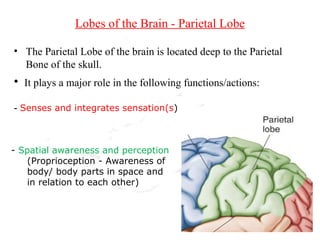
Lobes of the Brain - Parietal Lobe

• The Parietal Lobe of the brain is located deep to the Parietal
  Bone of the skull.
• It plays a major role in the following functions/actions:

- Senses and integrates sensation(s)


- Spatial awareness and perception
   (Proprioception - Awareness of
   body/ body parts in space and
   in relation to each other)
Lobes of the Brain – Occipital Lobe


• The Occipital Lobe of the Brain is
  located deep to the Occipital Bone
  of the Skull.


• Its primary function is the
processing, integration, interpretation,
etc. of VISION and visual stimuli.
Lobes of the Brain – Temporal Lobe
• The Temporal Lobes are located on the sides of the brain, deep
  to the Temporal Bones of the skull.


• They play an integral role in the
following functions:


   - Hearing
   -Organization/Comprehension of
   language

   - Information Retrieval
Lobes and Structures of the
 B.            Brain                       G.
          A.

                                                F.


C.

                                                E.
     D.
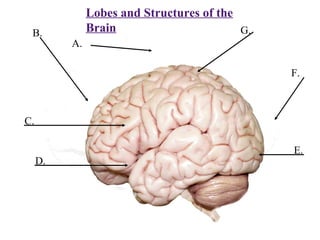
Lobes and Structures of the Brain

A. Central Sulcus

B. Frontal Lobe

C. Sylvian/Lateral Fissure
                                     A. (groove)   G.
D. Temporal Lobe              B.
E. Transverse Fissure                                   F.

F. Occipital Lobe

G. Parietal Lobe              C. (groove)
                             D.                         E.
                                                    (groove)
A.        K.
                                   J.
Cortical Regions

     B.                                 I.


                                         H.

                                              G.


C.


          D.
                   E.    F.
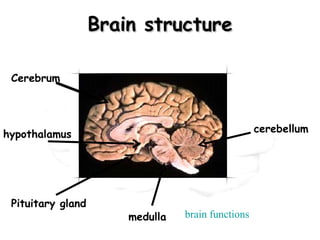
Brain structure

 Cerebrum


                                                   cerebellum
hypothalamus


 Pituitary gland
                       medulla   brain functions
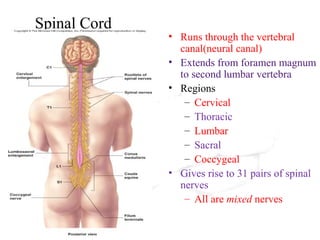
Spinal Cord
              • Runs through the vertebral
                canal(neural canal)
              • Extends from foramen magnum
                to second lumbar vertebra
              • Regions
                 – Cervical
                 – Thoracic
                 – Lumbar
                 – Sacral
                 – Coccygeal
              • Gives rise to 31 pairs of spinal
                nerves
                 – All are mixed nerves
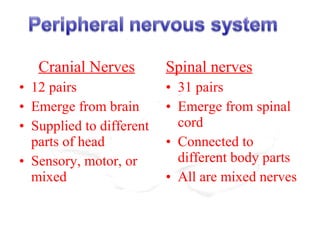
Cranial Nerves         Spinal nerves
• 12 pairs                • 31 pairs
• Emerge from brain       • Emerge from spinal
• Supplied to different     cord
  parts of head           • Connected to
• Sensory, motor, or        different body parts
  mixed                   • All are mixed nerves
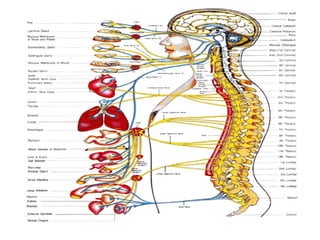
• The organs (the "viscera") of our body,
  such as the heart, stomach and intestines,
  are regulated by a part of the nervous
  system called the autonomic nervous
  system (ANS).
• The ANS is part of the peripheral nervous
  system and it controls many organs and
  muscles within the body.
The ANS is most important in two situations:
• In emergencies that cause stress and require us
  to "fight" or take "flight" (run away)


• In non emergencies that allow us to "rest"
  and "digest."
• Eye, ear, nose, skin and tongue
• Enable the body to detect the various changes
  in the surroundings
• Important link between external and internal
  environment
• Makes body irritable and sensitive
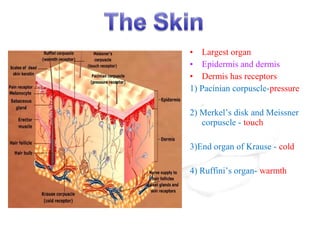
• Largest organ
• Epidermis and dermis
• Dermis has receptors
1) Pacinian corpuscle-pressure

2) Merkel’s disk and Meissner
   corpuscle - touch

3)End organ of Krause - cold

4) Ruffini’s organ- warmth
• Two parts- external nose
  and nasal cavity
• Nasal cavity has mucous
  membrane on top side
• Molecules dissolve in the
  mucous and stimulate
  olfactory receptor cells
• Olfactory nerve carries
  impulses to the brain
• Organ of taste
• Has gustatory receptors or
  taste buds
• chemicals in the food
  dissolve in saliva and
  stimulate these receptors.
• Four regions,
a) Back – bitter
b) Tip – sweet
c) Sides – salt and sour

Human brain

  • 1.
  • 2.
    Part I: Lobes, theCerebral Cortex, and Cortical Regions of the Brain
  • 3.
    Cerebrum -The largestdivision of the brain. It is divided into two hemispheres, each of which is divided into four lobes. Cerebrum Cerebrum Cerebellum
  • 4.
    Cerebral Cortex -The outermost layer of gray matter making up the superficial aspect of the cerebrum. Cerebral Cortex Cerebral Cortex
  • 5.
    Cerebral Features: • Gyri– Elevated ridges “winding” around the brain. • Sulci – Small grooves dividing the gyri – Central Sulcus – Divides the Frontal Lobe from the Parietal Lobe • Fissures – Deep grooves, generally dividing large regions/lobes of the brain – Longitudinal Fissure – Divides the two Cerebral Hemispheres – Transverse Fissure – Separates the Cerebrum from the Cerebellum – Sylvian/Lateral Fissure – Divides the Temporal Lobe from the Frontal and Parietal Lobes
  • 6.
    Gyri (ridge) Sulci (groove) Fissure (deep groove)
  • 7.
    Specific Sulci/Fissures: Central Sulcus Longitudinal Fissure Sylvian/Lateral Fissure Transverse Fissure
  • 8.
    Lobes of theBrain (4) • Frontal • Parietal • Occipital • Temporal
  • 9.
    Lobes of theBrain - Frontal • The Frontal Lobe of the brain is located deep to the Frontal Bone of the skull. • It plays an integral role in the following functions/actions: - Memory Formation - Emotions - Decision Making/Reasoning - Personality Investigation (Phineas Gage)
  • 10.
    Lobes of theBrain - Parietal Lobe • The Parietal Lobe of the brain is located deep to the Parietal Bone of the skull. • It plays a major role in the following functions/actions: - Senses and integrates sensation(s) - Spatial awareness and perception (Proprioception - Awareness of body/ body parts in space and in relation to each other)
  • 11.
    Lobes of theBrain – Occipital Lobe • The Occipital Lobe of the Brain is located deep to the Occipital Bone of the Skull. • Its primary function is the processing, integration, interpretation, etc. of VISION and visual stimuli.
  • 12.
    Lobes of theBrain – Temporal Lobe • The Temporal Lobes are located on the sides of the brain, deep to the Temporal Bones of the skull. • They play an integral role in the following functions: - Hearing -Organization/Comprehension of language - Information Retrieval
  • 13.
    Lobes and Structuresof the B. Brain G. A. F. C. E. D.
  • 14.
    Lobes and Structuresof the Brain A. Central Sulcus B. Frontal Lobe C. Sylvian/Lateral Fissure A. (groove) G. D. Temporal Lobe B. E. Transverse Fissure F. F. Occipital Lobe G. Parietal Lobe C. (groove) D. E. (groove)
  • 15.
    A. K. J. Cortical Regions B. I. H. G. C. D. E. F.
  • 16.
    Brain structure Cerebrum cerebellum hypothalamus Pituitary gland medulla brain functions
  • 17.
    Spinal Cord • Runs through the vertebral canal(neural canal) • Extends from foramen magnum to second lumbar vertebra • Regions – Cervical – Thoracic – Lumbar – Sacral – Coccygeal • Gives rise to 31 pairs of spinal nerves – All are mixed nerves
  • 21.
    Cranial Nerves Spinal nerves • 12 pairs • 31 pairs • Emerge from brain • Emerge from spinal • Supplied to different cord parts of head • Connected to • Sensory, motor, or different body parts mixed • All are mixed nerves
  • 23.
    • The organs(the "viscera") of our body, such as the heart, stomach and intestines, are regulated by a part of the nervous system called the autonomic nervous system (ANS). • The ANS is part of the peripheral nervous system and it controls many organs and muscles within the body.
  • 24.
    The ANS ismost important in two situations: • In emergencies that cause stress and require us to "fight" or take "flight" (run away) • In non emergencies that allow us to "rest" and "digest."
  • 26.
    • Eye, ear,nose, skin and tongue • Enable the body to detect the various changes in the surroundings • Important link between external and internal environment • Makes body irritable and sensitive
  • 27.
    • Largest organ •Epidermis and dermis • Dermis has receptors 1) Pacinian corpuscle-pressure 2) Merkel’s disk and Meissner corpuscle - touch 3)End organ of Krause - cold 4) Ruffini’s organ- warmth
  • 28.
    • Two parts-external nose and nasal cavity • Nasal cavity has mucous membrane on top side • Molecules dissolve in the mucous and stimulate olfactory receptor cells • Olfactory nerve carries impulses to the brain
  • 29.
    • Organ oftaste • Has gustatory receptors or taste buds • chemicals in the food dissolve in saliva and stimulate these receptors. • Four regions, a) Back – bitter b) Tip – sweet c) Sides – salt and sour