Signaling: Objects, Engineering
principles and Types of Signals.
Wednesday, 09 August 2017 GEORGE ZACHARIA 1
SIGNALLING
Signalling consists of systems, devices and means by which trains are
operated efficiently and tracks are used to maximum extent,
maintaining safety of passengers, staff and the rolling stock.
It includes the use and working of signals, points, block instruments
and other equipment.
Wednesday, 09 August 2017 GEORGE ZACHARIA 2
Objectives of Signalling
1. To provide facilities for the efficient movement of trains.
2. To ensure safety between two (or) more trains which cross (or)
approach each other’s path.
3. To provide facilities for the maximum utility of tracks.
4. To provide facilities for safe and efficient shunting operations.
5. To guide train movement during maintenance and repairs of the
track.
6. To safe guard the trains at converging junctions and give directional
indications at diverging junctions.
Wednesday, 09 August 2017 GEORGE ZACHARIA 3
Engineering Principles of Signalling
Following Engineering Principles should be followed in design and provision
of signals and signalling systems:
1. In the design of circuits and systems, factors like reliability, simplicity and
financial aspects are to be considered.
2. The aspects of fixed signals should be distinctive and unambiguous.
i.e. one should not be mistaken by the other.
3. A given signal must convey the same indication to the driver at all
times, all places , all circumstances.
4. Action required by a signal should be definite and capable of easy
implementation.
Wednesday, 09 August 2017 GEORGE ZACHARIA 4
5. Each and every signal should afford the maximum possible sighting
distance.
6. Number of fixed signals for each route should be kept minimum.
Wednesday, 09 August 2017 GEORGE ZACHARIA 5
CLASSISIFCATION OF SIGNALS
• Various types of signals are Classified by following characteristics:
1. Operational characteristics
2. Functional characteristics
3. Locational characteristics
4. Special characteristics
Wednesday, 09 August 2017 GEORGE ZACHARIA 6
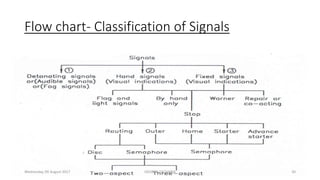
1. Operating Characteristics
• Based on the way of operation signals are again classified into :
1. Detonating Signals ( Fog signals) ( Audible signals)
2. Hand Signals
3. Fixed Signals
Wednesday, 09 August 2017 GEORGE ZACHARIA 7
Detonating Signals
• During foggy and cloudy weather when hand signals are not visible,
detonators are placed on rails which will explode with a loud sound ,
when train passes over them.
• This sound draws the attention of the driver. From safety point of
view, detonators are placed on rails at least 400 to 500 metres ahead
of signal which will enable the driver to stop the train (or) to obey the
signal.
Wednesday, 09 August 2017 GEORGE ZACHARIA 8
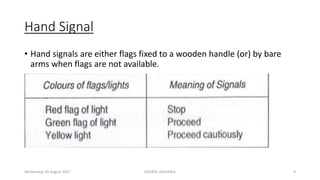
Hand Signal
• Hand signals are either flags fixed to a wooden handle (or) by bare
arms when flags are not available.
Wednesday, 09 August 2017 GEORGE ZACHARIA 9
2.Functional Characteristics
• Signals can be classified on the basis of functions as below:
1. Stop signals (or) Semaphore type signals
2. Warner Signals
3. Shunting signals
4. Coloured –Light signals
Wednesday, 09 August 2017 GEORGE ZACHARIA 10
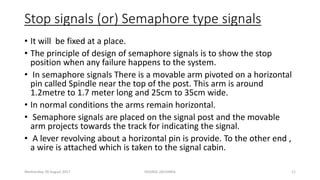
Stop signals (or) Semaphore type signals
• It will be fixed at a place.
• The principle of design of semaphore signals is to show the stop
position when any failure happens to the system.
• In semaphore signals There is a movable arm pivoted on a horizontal
pin called Spindle near the top of the post. This arm is around
1.2metre to 1.7 meter long and 25cm to 35cm wide.
• In normal conditions the arms remain horizontal.
• Semaphore signals are placed on the signal post and the movable
arm projects towards the track for indicating the signal.
• A lever revolving about a horizontal pin is provide. To the other end ,
a wire is attached which is taken to the signal cabin.
Wednesday, 09 August 2017 GEORGE ZACHARIA 11
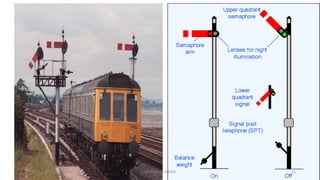
• Semaphore signal in “ON” position gives the “Stop” indication, when
Semaphore signal in “OFF” position gives the “Proceed” indication
during day time.
Wednesday, 09 August 2017 GEORGE ZACHARIA 12
Wednesday, 09 August 2017 GEORGE ZACHARIA 13
Wednesday, 09 August 2017 GEORGE ZACHARIA 14
Warner Signals
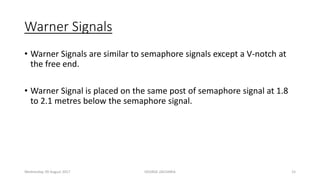
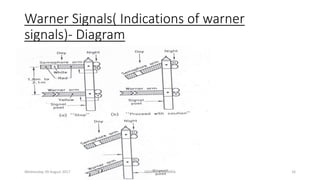
• Warner Signals are similar to semaphore signals except a V-notch at
the free end.
• Warner Signal is placed on the same post of semaphore signal at 1.8
to 2.1 metres below the semaphore signal.
Wednesday, 09 August 2017 GEORGE ZACHARIA 15
Warner Signals( Indications of warner
signals)- Diagram
Wednesday, 09 August 2017 GEORGE ZACHARIA 16
Shunting Signals
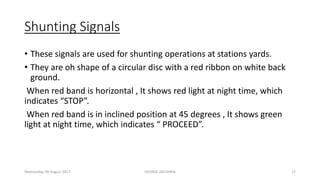
• These signals are used for shunting operations at stations yards.
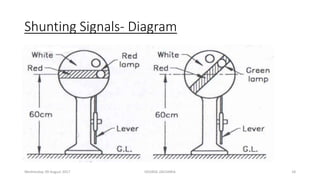
• They are oh shape of a circular disc with a red ribbon on white back
ground.
When red band is horizontal , It shows red light at night time, which
indicates “STOP”.
When red band is in inclined position at 45 degrees , It shows green
light at night time, which indicates “ PROCEED”.
Wednesday, 09 August 2017 GEORGE ZACHARIA 17
Shunting Signals- Diagram
Wednesday, 09 August 2017 GEORGE ZACHARIA 18
3. Locational characteristics
• In view of where signals are located, they can be dived into :
1. Reception Signals:
i) Outer signal ii) Home signal
2. Departure Signals:
i) Starter signal ii) Advance starter signal
Wednesday, 09 August 2017 GEORGE ZACHARIA 19
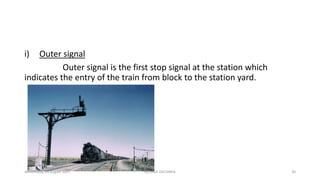
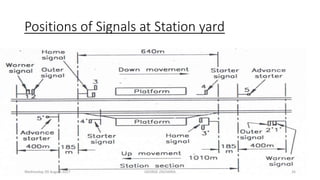
i) Outer signal
Outer signal is the first stop signal at the station which
indicates the entry of the train from block to the station yard.
Wednesday, 09 August 2017 GEORGE ZACHARIA 20
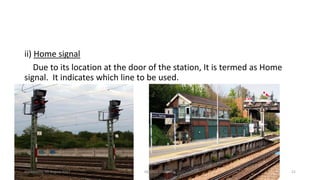
ii) Home signal
Due to its location at the door of the station, It is termed as Home
signal. It indicates which line to be used.
Wednesday, 09 August 2017 GEORGE ZACHARIA 21
• Departure Signals:
This signals controls the despatch of trains from the stations.
These are of two types:
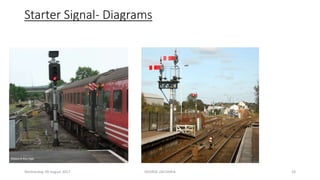
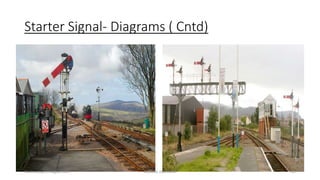
i) Starter Signal
Starter Signal marks the limit upto which trains stopping at a
station come to halt (or) stand. It is the last stop signal at a station.
No train can leave the station unless the starter signal shows a
“ PROCEED” Signal
Wednesday, 09 August 2017 GEORGE ZACHARIA 22
ii) Advance Starter Signal
Besides the starter signal for each station lines from which trains
starts, an advance starter may also be provided ( usually around 180
metres more than Starter Signal).
It is the LAST STOP SIGNAL at a station.
Advance starter signal gives the indication that train has left the
station, and is no more the responsibility of the station master.
Wednesday, 09 August 2017 GEORGE ZACHARIA 23
Starter Signal- Diagrams
Wednesday, 09 August 2017 GEORGE ZACHARIA 24
Starter Signal- Diagrams ( Cntd)
Wednesday, 09 August 2017 GEORGE ZACHARIA 25
Positions of Signals at Station yard
Wednesday, 09 August 2017 GEORGE ZACHARIA 26
4. Special Signals
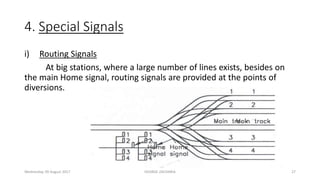
i) Routing Signals
At big stations, where a large number of lines exists, besides on
the main Home signal, routing signals are provided at the points of
diversions.
Wednesday, 09 August 2017 GEORGE ZACHARIA 27
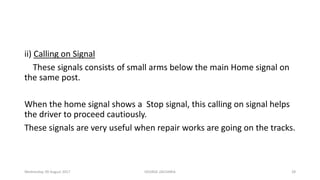
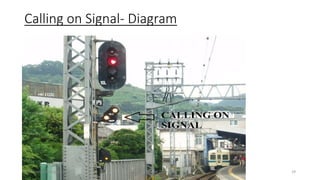
ii) Calling on Signal
These signals consists of small arms below the main Home signal on
the same post.
When the home signal shows a Stop signal, this calling on signal helps
the driver to proceed cautiously.
These signals are very useful when repair works are going on the tracks.
Wednesday, 09 August 2017 GEORGE ZACHARIA 28
Calling on Signal- Diagram
Wednesday, 09 August 2017 GEORGE ZACHARIA 29
Flow chart- Classification of Signals
Wednesday, 09 August 2017 GEORGE ZACHARIA 30

Signals

  • 1.
    Signaling: Objects, Engineering principlesand Types of Signals. Wednesday, 09 August 2017 GEORGE ZACHARIA 1
  • 2.
    SIGNALLING Signalling consists ofsystems, devices and means by which trains are operated efficiently and tracks are used to maximum extent, maintaining safety of passengers, staff and the rolling stock. It includes the use and working of signals, points, block instruments and other equipment. Wednesday, 09 August 2017 GEORGE ZACHARIA 2
  • 3.
    Objectives of Signalling 1.To provide facilities for the efficient movement of trains. 2. To ensure safety between two (or) more trains which cross (or) approach each other’s path. 3. To provide facilities for the maximum utility of tracks. 4. To provide facilities for safe and efficient shunting operations. 5. To guide train movement during maintenance and repairs of the track. 6. To safe guard the trains at converging junctions and give directional indications at diverging junctions. Wednesday, 09 August 2017 GEORGE ZACHARIA 3
  • 4.
    Engineering Principles ofSignalling Following Engineering Principles should be followed in design and provision of signals and signalling systems: 1. In the design of circuits and systems, factors like reliability, simplicity and financial aspects are to be considered. 2. The aspects of fixed signals should be distinctive and unambiguous. i.e. one should not be mistaken by the other. 3. A given signal must convey the same indication to the driver at all times, all places , all circumstances. 4. Action required by a signal should be definite and capable of easy implementation. Wednesday, 09 August 2017 GEORGE ZACHARIA 4
  • 5.
    5. Each andevery signal should afford the maximum possible sighting distance. 6. Number of fixed signals for each route should be kept minimum. Wednesday, 09 August 2017 GEORGE ZACHARIA 5
  • 6.
    CLASSISIFCATION OF SIGNALS •Various types of signals are Classified by following characteristics: 1. Operational characteristics 2. Functional characteristics 3. Locational characteristics 4. Special characteristics Wednesday, 09 August 2017 GEORGE ZACHARIA 6
  • 7.
    1. Operating Characteristics •Based on the way of operation signals are again classified into : 1. Detonating Signals ( Fog signals) ( Audible signals) 2. Hand Signals 3. Fixed Signals Wednesday, 09 August 2017 GEORGE ZACHARIA 7
  • 8.
    Detonating Signals • Duringfoggy and cloudy weather when hand signals are not visible, detonators are placed on rails which will explode with a loud sound , when train passes over them. • This sound draws the attention of the driver. From safety point of view, detonators are placed on rails at least 400 to 500 metres ahead of signal which will enable the driver to stop the train (or) to obey the signal. Wednesday, 09 August 2017 GEORGE ZACHARIA 8
  • 9.
    Hand Signal • Handsignals are either flags fixed to a wooden handle (or) by bare arms when flags are not available. Wednesday, 09 August 2017 GEORGE ZACHARIA 9
  • 10.
    2.Functional Characteristics • Signalscan be classified on the basis of functions as below: 1. Stop signals (or) Semaphore type signals 2. Warner Signals 3. Shunting signals 4. Coloured –Light signals Wednesday, 09 August 2017 GEORGE ZACHARIA 10
  • 11.
    Stop signals (or)Semaphore type signals • It will be fixed at a place. • The principle of design of semaphore signals is to show the stop position when any failure happens to the system. • In semaphore signals There is a movable arm pivoted on a horizontal pin called Spindle near the top of the post. This arm is around 1.2metre to 1.7 meter long and 25cm to 35cm wide. • In normal conditions the arms remain horizontal. • Semaphore signals are placed on the signal post and the movable arm projects towards the track for indicating the signal. • A lever revolving about a horizontal pin is provide. To the other end , a wire is attached which is taken to the signal cabin. Wednesday, 09 August 2017 GEORGE ZACHARIA 11
  • 12.
    • Semaphore signalin “ON” position gives the “Stop” indication, when Semaphore signal in “OFF” position gives the “Proceed” indication during day time. Wednesday, 09 August 2017 GEORGE ZACHARIA 12
  • 13.
    Wednesday, 09 August2017 GEORGE ZACHARIA 13
  • 14.
    Wednesday, 09 August2017 GEORGE ZACHARIA 14
  • 15.
    Warner Signals • WarnerSignals are similar to semaphore signals except a V-notch at the free end. • Warner Signal is placed on the same post of semaphore signal at 1.8 to 2.1 metres below the semaphore signal. Wednesday, 09 August 2017 GEORGE ZACHARIA 15
  • 16.
    Warner Signals( Indicationsof warner signals)- Diagram Wednesday, 09 August 2017 GEORGE ZACHARIA 16
  • 17.
    Shunting Signals • Thesesignals are used for shunting operations at stations yards. • They are oh shape of a circular disc with a red ribbon on white back ground. When red band is horizontal , It shows red light at night time, which indicates “STOP”. When red band is in inclined position at 45 degrees , It shows green light at night time, which indicates “ PROCEED”. Wednesday, 09 August 2017 GEORGE ZACHARIA 17
  • 18.
    Shunting Signals- Diagram Wednesday,09 August 2017 GEORGE ZACHARIA 18
  • 19.
    3. Locational characteristics •In view of where signals are located, they can be dived into : 1. Reception Signals: i) Outer signal ii) Home signal 2. Departure Signals: i) Starter signal ii) Advance starter signal Wednesday, 09 August 2017 GEORGE ZACHARIA 19
  • 20.
    i) Outer signal Outersignal is the first stop signal at the station which indicates the entry of the train from block to the station yard. Wednesday, 09 August 2017 GEORGE ZACHARIA 20
  • 21.
    ii) Home signal Dueto its location at the door of the station, It is termed as Home signal. It indicates which line to be used. Wednesday, 09 August 2017 GEORGE ZACHARIA 21
  • 22.
    • Departure Signals: Thissignals controls the despatch of trains from the stations. These are of two types: i) Starter Signal Starter Signal marks the limit upto which trains stopping at a station come to halt (or) stand. It is the last stop signal at a station. No train can leave the station unless the starter signal shows a “ PROCEED” Signal Wednesday, 09 August 2017 GEORGE ZACHARIA 22
  • 23.
    ii) Advance StarterSignal Besides the starter signal for each station lines from which trains starts, an advance starter may also be provided ( usually around 180 metres more than Starter Signal). It is the LAST STOP SIGNAL at a station. Advance starter signal gives the indication that train has left the station, and is no more the responsibility of the station master. Wednesday, 09 August 2017 GEORGE ZACHARIA 23
  • 24.
    Starter Signal- Diagrams Wednesday,09 August 2017 GEORGE ZACHARIA 24
  • 25.
    Starter Signal- Diagrams( Cntd) Wednesday, 09 August 2017 GEORGE ZACHARIA 25
  • 26.
    Positions of Signalsat Station yard Wednesday, 09 August 2017 GEORGE ZACHARIA 26
  • 27.
    4. Special Signals i)Routing Signals At big stations, where a large number of lines exists, besides on the main Home signal, routing signals are provided at the points of diversions. Wednesday, 09 August 2017 GEORGE ZACHARIA 27
  • 28.
    ii) Calling onSignal These signals consists of small arms below the main Home signal on the same post. When the home signal shows a Stop signal, this calling on signal helps the driver to proceed cautiously. These signals are very useful when repair works are going on the tracks. Wednesday, 09 August 2017 GEORGE ZACHARIA 28
  • 29.
    Calling on Signal-Diagram Wednesday, 09 August 2017 GEORGE ZACHARIA 29
  • 30.
    Flow chart- Classificationof Signals Wednesday, 09 August 2017 GEORGE ZACHARIA 30