It consists of the systems, devices and
means by which trains are operated
efficiently and tracks are used to maximum
extent, maintaining the safety of the
passengers, the staff and the rolling stock.
To provide facilities for the efficient
movement of trains
To ensure safety between two or more
trains which cross or approach each
other’s path
To provide facilities for the maximum utility
of the track
To guide the trains movement during
maintenance and the repair of the track
Classification based on Operation
Characteristics
Classification based on Function
Classification based on Location
Special Signals
1. Detonating Signals( Fog or Audible )
2. Hand Signals (Visual Indication)
3. Fixed Signals (Visual Indication)
1. Stop or Semaphore type Signals
2. Warner Signals
3. Shunting Signals
4. Colored Light Signals (Disc or Ground)
Reception Signals
a) outer Signal b) Home Signal
Departure Signals
a) Starter b) Advanced Starter
1. Repeater or Co-acting Signals
2. Routing Signals
3. Calling on Signals
Detonating signals otherwise known as
detonators or fog signals are appliances
which are fixed on the rails, and when an
Engine (or vehicle) passes over them, they
explode with a loud report so as to attract
the attention of the Driver.
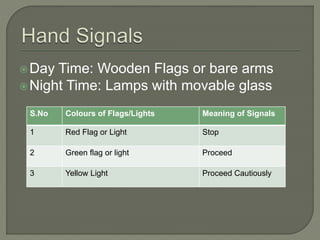
Day Time: Wooden Flags or bare arms
Night Time: Lamps with movable glass
S.No Colours of Flags/Lights Meaning of Signals
1 Red Flag or Light Stop
2 Green flag or light Proceed
3 Yellow Light Proceed Cautiously
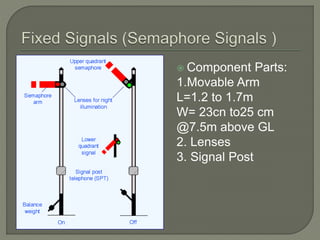
 Component Parts:
1.Movable Arm
L=1.2 to 1.7m
W= 23cn to25 cm
@7.5m above GL
2. Lenses
3. Signal Post
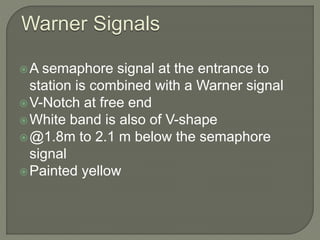
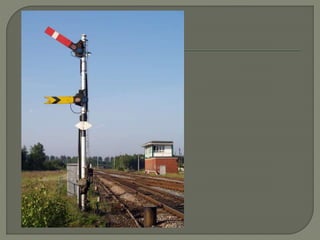
Warner Signals
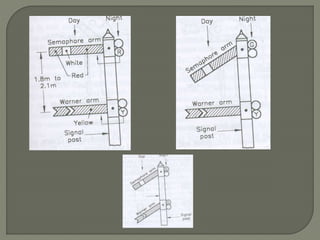
A semaphore signal at the entrance to
station is combined with a Warner signal
V-Notch at free end
White band is also of V-shape
@1.8m to 2.1 m below the semaphore
signal
Painted yellow
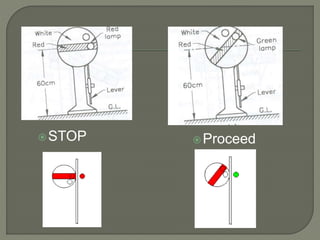
For shunting operations @yards
Circular Disc with red band on a white
background .
Disc can revolve in vertical plane by pulling
the lever by hand
Two holes( Red, Green) for lamps
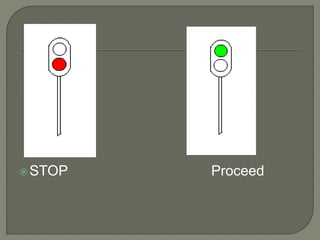
STOP Proceed
Replacement of semaphore signals
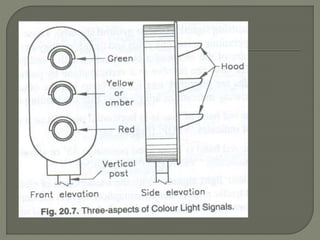
High intensity beam color light signals(day
or night)
Types:
1. Two Aspect( Green and Red)
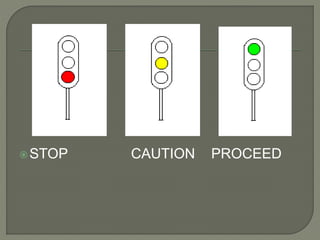
2. Three Aspect( Green, Yellow and Red)
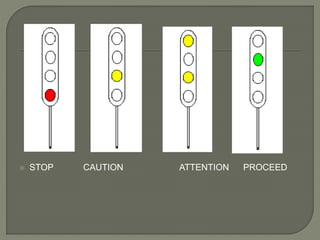
3. Four Aspect (Green, Yellow, Red and
Yellow)
STOP Proceed
STOP CAUTION PROCEED
 STOP CAUTION ATTENTION PROCEED
Signals controlling the reception of trains
into a station
Types:
Outer Signal
Home Signal
First stop signal at a Station
@0.54km in advance for BG
In STOP position -90 m distance prior to
Outer signal driver has to stop
In PROCEED position- move with normal
speed assuming the home signal is also
proceed position
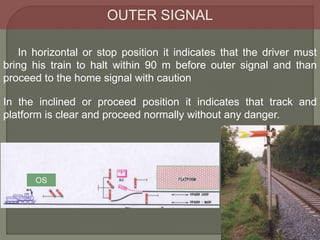
OUTER SIGNAL
This is Warner signal for the driver which gives the indication of
the position ahead whether the platform is clear or not.
A certain distance is required to bring a moving train to halt.
This distance depends upon the speed of the train, its weight,
brake power of the locomotive etc.
Thus the first signal is provided at this distance beyond the
station limit, that is why it is know as outer signal
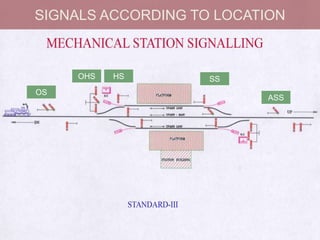
ASS
SS
HS
OS
OHS
SIGNALS ACCORDING TO LOCATION
In the inclined or proceed position it indicates that track and
platform is clear and proceed normally without any danger.
In horizontal or stop position it indicates that the driver must
bring his train to halt within 90 m before outer signal and than
proceed to the home signal with caution
OUTER SIGNAL
OS
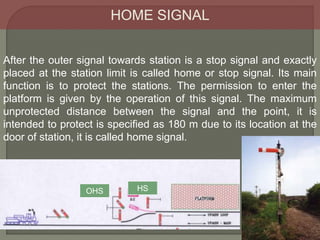
HOME SIGNAL
After the outer signal towards station is a stop signal and exactly
placed at the station limit is called home or stop signal. Its main
function is to protect the stations. The permission to enter the
platform is given by the operation of this signal. The maximum
unprotected distance between the signal and the point, it is
intended to protect is specified as 180 m due to its location at the
door of station, it is called home signal.
HS
OHS
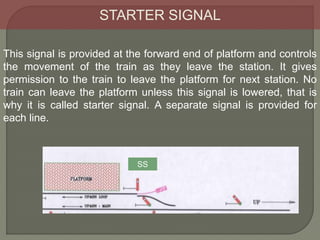
STARTER SIGNAL
This signal is provided at the forward end of platform and controls
the movement of the train as they leave the station. It gives
permission to the train to leave the platform for next station. No
train can leave the platform unless this signal is lowered, that is
why it is called starter signal. A separate signal is provided for
each line.
SS
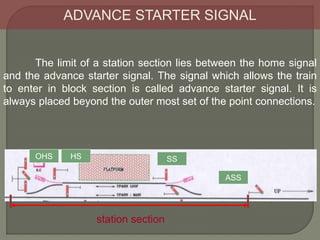
ADVANCE STARTER SIGNAL
The limit of a station section lies between the home signal
and the advance starter signal. The signal which allows the train
to enter in block section is called advance starter signal. It is
always placed beyond the outer most set of the point connections.
ASS
SS
HS
OHS
station section
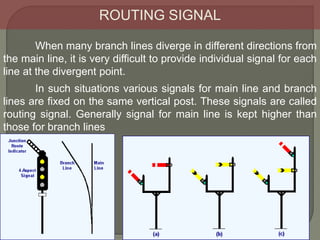
ROUTING SIGNAL
When many branch lines diverge in different directions from
the main line, it is very difficult to provide individual signal for each
line at the divergent point.
In such situations various signals for main line and branch
lines are fixed on the same vertical post. These signals are called
routing signal. Generally signal for main line is kept higher than
those for branch lines
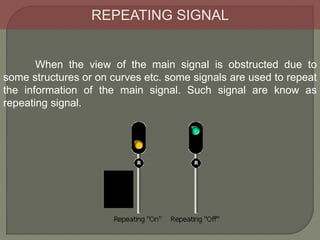
REPEATING SIGNAL
When the view of the main signal is obstructed due to
some structures or on curves etc. some signals are used to repeat
the information of the main signal. Such signal are know as
repeating signal.
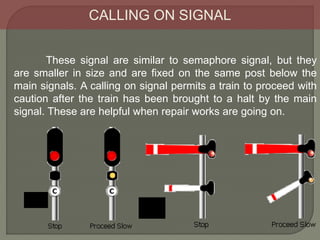
CALLING ON SIGNAL
These signal are similar to semaphore signal, but they
are smaller in size and are fixed on the same post below the
main signals. A calling on signal permits a train to proceed with
caution after the train has been brought to a halt by the main
signal. These are helpful when repair works are going on.

Signals.pptx

  • 1.
    It consists ofthe systems, devices and means by which trains are operated efficiently and tracks are used to maximum extent, maintaining the safety of the passengers, the staff and the rolling stock.
  • 2.
    To provide facilitiesfor the efficient movement of trains To ensure safety between two or more trains which cross or approach each other’s path To provide facilities for the maximum utility of the track To guide the trains movement during maintenance and the repair of the track
  • 3.
    Classification based onOperation Characteristics Classification based on Function Classification based on Location Special Signals
  • 4.
    1. Detonating Signals(Fog or Audible ) 2. Hand Signals (Visual Indication) 3. Fixed Signals (Visual Indication)
  • 5.
    1. Stop orSemaphore type Signals 2. Warner Signals 3. Shunting Signals 4. Colored Light Signals (Disc or Ground)
  • 6.
    Reception Signals a) outerSignal b) Home Signal Departure Signals a) Starter b) Advanced Starter
  • 7.
    1. Repeater orCo-acting Signals 2. Routing Signals 3. Calling on Signals
  • 8.
    Detonating signals otherwiseknown as detonators or fog signals are appliances which are fixed on the rails, and when an Engine (or vehicle) passes over them, they explode with a loud report so as to attract the attention of the Driver.
  • 9.
    Day Time: WoodenFlags or bare arms Night Time: Lamps with movable glass S.No Colours of Flags/Lights Meaning of Signals 1 Red Flag or Light Stop 2 Green flag or light Proceed 3 Yellow Light Proceed Cautiously
  • 10.
     Component Parts: 1.MovableArm L=1.2 to 1.7m W= 23cn to25 cm @7.5m above GL 2. Lenses 3. Signal Post
  • 11.
    Warner Signals A semaphoresignal at the entrance to station is combined with a Warner signal V-Notch at free end White band is also of V-shape @1.8m to 2.1 m below the semaphore signal Painted yellow
  • 14.
    For shunting operations@yards Circular Disc with red band on a white background . Disc can revolve in vertical plane by pulling the lever by hand Two holes( Red, Green) for lamps
  • 15.
  • 16.
    Replacement of semaphoresignals High intensity beam color light signals(day or night) Types: 1. Two Aspect( Green and Red) 2. Three Aspect( Green, Yellow and Red) 3. Four Aspect (Green, Yellow, Red and Yellow)
  • 17.
  • 19.
  • 20.
     STOP CAUTIONATTENTION PROCEED
  • 21.
    Signals controlling thereception of trains into a station Types: Outer Signal Home Signal
  • 22.
    First stop signalat a Station @0.54km in advance for BG In STOP position -90 m distance prior to Outer signal driver has to stop In PROCEED position- move with normal speed assuming the home signal is also proceed position
  • 23.
    OUTER SIGNAL This isWarner signal for the driver which gives the indication of the position ahead whether the platform is clear or not. A certain distance is required to bring a moving train to halt. This distance depends upon the speed of the train, its weight, brake power of the locomotive etc. Thus the first signal is provided at this distance beyond the station limit, that is why it is know as outer signal
  • 24.
  • 25.
    In the inclinedor proceed position it indicates that track and platform is clear and proceed normally without any danger. In horizontal or stop position it indicates that the driver must bring his train to halt within 90 m before outer signal and than proceed to the home signal with caution OUTER SIGNAL OS
  • 26.
    HOME SIGNAL After theouter signal towards station is a stop signal and exactly placed at the station limit is called home or stop signal. Its main function is to protect the stations. The permission to enter the platform is given by the operation of this signal. The maximum unprotected distance between the signal and the point, it is intended to protect is specified as 180 m due to its location at the door of station, it is called home signal. HS OHS
  • 27.
    STARTER SIGNAL This signalis provided at the forward end of platform and controls the movement of the train as they leave the station. It gives permission to the train to leave the platform for next station. No train can leave the platform unless this signal is lowered, that is why it is called starter signal. A separate signal is provided for each line. SS
  • 28.
    ADVANCE STARTER SIGNAL Thelimit of a station section lies between the home signal and the advance starter signal. The signal which allows the train to enter in block section is called advance starter signal. It is always placed beyond the outer most set of the point connections. ASS SS HS OHS station section
  • 29.
    ROUTING SIGNAL When manybranch lines diverge in different directions from the main line, it is very difficult to provide individual signal for each line at the divergent point. In such situations various signals for main line and branch lines are fixed on the same vertical post. These signals are called routing signal. Generally signal for main line is kept higher than those for branch lines
  • 30.
    REPEATING SIGNAL When theview of the main signal is obstructed due to some structures or on curves etc. some signals are used to repeat the information of the main signal. Such signal are know as repeating signal.
  • 31.
    CALLING ON SIGNAL Thesesignal are similar to semaphore signal, but they are smaller in size and are fixed on the same post below the main signals. A calling on signal permits a train to proceed with caution after the train has been brought to a halt by the main signal. These are helpful when repair works are going on.